Monthly Archives: October 2022

Who Is Yeshua?

Yeshua is everything to us:  our salvation, our hope, our future, to name a few. It is important to get to know Him as well as possible.  We can do this by interacting with Him and also by reading the Bible.  It is the word of Yehovah and Yeshua is the living Word of Yehovah.  This series, entitled “Who Is Yeshua?” will consist of twenty-one articles. Each article will explore a different section of the Bible to discover different titles and roles of Yeshua and our response to each role. In the sixth article in the series, Yeshua is our Provider.

The book of Numbers provides many examples of Yeshua as Yehovah Yireh or Yehovah, our Provider.  In Numbers 9, the Israelites are instructed to observe the second Passover. The lamb they sacrificed represented the true Lamb of Yehovah.  Most likely they wouldn’t have realized this, but were they able to make the connection between the blood of their sacrificed lamb and the lamb that was offered in place of Isaac in Genesis 22? Abraham answered, “God himself will provide the lamb for the burnt offering, my son.” (Gen 22:8)  Do we recognize and appreciate the wonderful gift that Yeshua has provided for us? 

In Numbers 11, the Israelites complain about lack of meat.  In Exodus 16 that Yehovah had already provided manna from Heaven and quail to sustain them in the wilderness. The problem wasn’t that they desired meat again.  The problem was their attitude and approach.  They simply could have asked Moshe to pray for them, or better still, they could have asked Yehovah to provide meat for them.  Would you rather have someone ask you politely for something or complain that you are a lousy provider?  Were they ever grateful for all that Yehovah provided?  Are we grateful for all that He provides for us?

Yeshua is our Bread from Heaven. I am the living bread that came down from heaven. Whoever eats this bread will live forever. This bread is my flesh, which I will give for the life of the world.” (John 6:51) Do we gratefully partake of what Yeshua has lovingly offered or are we searching for something in the world to satisfy us?

Yehovah offers the Israelites the land He promised to give them.  He had made this promise to Abraham, Isaac and Jacob and again to the Israelites.  The Lord now said to Moses, “Send out men to explore the land of Canaan, the land I am giving to the Israelites (Numbers13:1-2).  In the following chapter, we see that the Israelites were afraid and refused to go into the land.  That night all the members of the community raised their voices and wept aloud. All the Israelites grumbled against Moses and Aaron, and the whole assembly said to them, “If only we had died in Egypt! Or in this wilderness! Why is the Lord bringing us to this land only to let us fall by the sword? Our wives and children will be taken as plunder. Wouldn’t it be better for us to go back to Egypt?”And they said to each other, “We should choose a leader and go back to Egypt (Num 14:1-4).

Yeshua offers us the Kingdom of Heaven.  And in the days of those kings the God of heaven will set up a kingdom that shall never be destroyed, nor shall the kingdom be left to another people. It shall break in pieces all these kingdoms and bring them to an end, and it shall stand forever. (Daniel 2:44).  Do we seek His kingdom above all else or will we refuse His offer just as the Israelites did?

In Numbers 19, a perfect red heifer was to be slaughtered and completely burned outside the camp.  The priest was to throw some cedar wood, hyssop and scarlet wool onto the heifer as it was burning.  The ashes would then be mixed with water to purify those who had become unclean through contact or proximity to a dead body.  This is a picture of Yeshua’s death on the cross (represented by the cedar wood).  Our Perfect Lamb was covered by our scarlet sins (Isaiah 1:18) and would also be covered in His own blood.  His sacrifice would be as hyssop, cleansing us from the death of sin. 

In Numbers 20 the Israelites were again complaining about lack of water.  Their complaining upset Moses so much that did not speak to the rock as commanded, but rather struck it instead.  Even so, water gushed out of the rock.  Yeshua was struck on our behalf and out of Him flows living water.  On the last and greatest day of the feast, Jesus stood up and called out in a loud voice, “If anyone is thirsty, let him come to Me and drink. Whoever believes in Me, as the Scripture has said: ‘Streams of living water will flow from within him.’ ”… (John 7:37-38).

In Numbers 21, we encounter another picture of Yeshua providing for us.  [The Israelites] traveled from Mount Hor along the route to the Red Sea to go around Edom. But the people grew impatient on the way;they spoke against God and against Moses, and said, “Why have you brought us up out of Egypt to die in the wilderness? There is no bread! There is no water! And we detest this miserable food!”

Then the Lord sent venomous snakes among them; they bit the people and many Israelites died.The people came to Moses and said, “We sinned when we spoke against the Lord and against you. Pray that the Lord will take the snakes away from us.” So, Moses prayed for the people.

The Lord said to Moses, “Make a snake and put it up on a pole; anyone who is bitten can look at it and live.” So Moses made a bronze snake and put it up on a pole. Then when anyone was bitten by a snake and looked at the bronze snake, they lived (Numbers 21:4-9)   The bronze snake on the pole is a shadow picture of Yeshua on the cross.  As Moses lifted up the serpent in the wilderness, even so must the Son of Man be lifted up; so that whoever believes will in Him have eternal life (John 3:14-15). Those who forsake their sins and believe in Him will never die the second death, but will live forever.

Later in chapter 21, we see a picture of Yehovah providing protection against enemies. Then [the Israelites] turned and went up along the road toward Bashan, and Og king of Bashan and his whole army marched out to meet them in battle at Edrei. The Lord said to Moses, “Do not be afraid of him, for I have delivered him into your hands, along with his whole army and his land. Do to him what you did to Sihon king of the Amorites, who reigned in Heshbon.” So, they struck him down, together with his sons and his whole army, leaving them no survivors. And they took possession of his land (Num 21:33-35).

Yeshua will return as our conquering King and will destroy our enemies. I looked up and saw a white horse standing there. Its rider carried a bow, and a crown was placed on his head. He rode out to win many battles and gain the victory (Rev 6:2). In the midst of ever-increasing darkness, in the midst of our own troubles and trials, do we feel alone and isolated, or do we eagerly wait for our conquering King?

This is an excellent time to ask forgiveness for your sins and invite Yeshua (Jesus) to be Lord of your life.  When we commit sin, we incur a debt that none of us can ever pay on our own.  It cannot be paid with earthly currency or even with great sacrifice on our part.  This debt can only be paid for by the blood of Yeshua which has already been shed for us. This is the greatest gift to ever be offered.  Don’t miss out.  After you have accepted Yeshua as your Lord and Savior, ask for baptism in the Holy Spirit.  The Holy Spirit will be your constant companion and Counselor and will equip you for Kingdom living. 

Who Is Yeshua?

Yeshua is everything to us:  our salvation, our hope, our future, to name a few. It is important to get to know Him as well as possible.  We can do this by interacting with Him and also by reading the Bible.  It is the word of Yehovah and Yeshua is the living Word of Yehovah.  This series, entitled “Who Is Yeshua?” will consist of twenty-one articles. Each article will explore a different section of the Bible to discover different titles and roles of Yeshua and our response to each role. In the fifth article in the series, Yeshua is the Faithful One.

To better understand Yeshua, we must correctly understand Job.  There has been much speculation over what Job did wrong to deserve to lose everything.  After all, he must have done something wrong or Yehovah would not have allowed such losses and horrors in his life.  It reminds me of the gospel story of the man born blind.  The story is recorded in Matthew 9, Mark 8 and John 9.  Jesus saw a man who had been blind since birth. His disciples asked him, “Rabbi, who sinned, this man or his parents, that he was born blind?” Jesus replied: Neither this man nor his parents sinned … but this happened so that the works of God might be displayed in him (John 9:1-5) 

Let us look closely at the story of Job.  There once was a man named Job who lived in the land of Uz. He was blameless—a man of complete integrity. He feared God and stayed away from evil (Job 1:1).  There is nothing in this passage that would indicate that Job had sinned; in fact, it is quite the opposite.

One day the members of the heavenly court came to present themselves before the Lord, and the Accuser, Satan came with them. “Where have you come from?” the Lord asked Satan. Satan answered the Lord, “I have been patrolling the earth, watching everything that’s going on.” Then the Lord asked Satan, “Have you noticed my servant Job? He is the finest man in all the earth. He is blameless—a man of complete integrity. He fears God and stays away from evil.” (Job 1:6-8) Yehovah’s own words confirm that Job had not committed any serious sin; in fact, Yehovah describes him as “blameless”. 

If Job did not sin, then why did Yehovah allow these atrocities to happen to him? Let us read further in chapter one of Job’s story.  Satan replied to the Lord, “Yes, but Job has good reason to fear God. You have always put a wall of protection around him and his home and his property. You have made him prosper in everything he does. Look how rich he is!  But reach out and take away everything he has, and he will surely curse you to your face!”  (Job 1:9-11)

The Accuser claimed that Job was only faithful to Yehovah because Yehovah made him prosper in everything.  Yehovah then responds by allowing the Accuser to test him by taking away all his possessions and even his children.  What was Job’s response to learning that he had lost everything?  He said, “I came naked from my mother’s womb, and I will be naked when I leave.  The Lord gave me what I had, and the Lord has taken it away. Praise the name of the Lord!” In all of this, Job did not sin by blaming God (Job 1:1-22).

Later, Job was struck with boils from head to toe because the Accuser claimed that loss of health would cause Job to curse Yehovah.  At this point, even Job’s wife urged him to curse Yehovah (Job 2:9), but Job refused. 

So, what’s the purpose of the story of Job?  It’s the same purpose as the story of the man born blind:  to glorify Yehovah.  Why did Yeshua suffer loss, humiliation, cursing and death?  So that His Father would be glorified.  When Jesus had spoken these things, He lifted up His eyes to heaven and said, “Father, the hour has come. Glorify Your Son, that Your Son may glorify You. For You granted Him authority over all people, so that He may give eternal life to all those You have given Him.…” (John 17:1-2). Yeshua was smitten so that Yehovah would be glorified and His plan to establish His kingdom on earth would be fulfilled. 

In the end, Yehovah restored and even doubled all that Job had lost.  Through Yeshua’s suffering and resurrection, Yehovah is not only glorified but has restored all that we lost through sin.  Not only have we regained what we lost, but Yehovah now offers us much more in His kingdom.  He makes us His sons and daughters. 

Job was severely tested and remained faithful to YehovahYeshua was severely tested and remained faithful to His Father.  Many of our brothers and sisters in Yeshua are suffering loss of family, home, income, health, freedom and even life.  They are being tested and I pray that they will all have the strength and trust to remain faithful.  Our time will come, too, or for some of us, it may already have arrived.  Will we remain faithful to Yehovah no matter what the cost to us?  And everyone who has given up houses or brothers or sisters or father or mother or children or property, for my sake, will receive a hundred times as much in return and will inherit eternal life (Matt 19:29).

This is an excellent time to ask forgiveness for your sins and invite Yeshua (Jesus) to be Lord of your life.  When we commit sin, we incur a debt that none of us can ever pay on our own.  It cannot be paid with earthly currency or even with great sacrifice on our part.  This debt can only be paid for by the blood of Yeshua which has already been shed for us. This is the greatest gift to ever be offered.  Don’t miss out.  After you have accepted Yeshua as your Lord and Savior, ask for baptism in the Holy Spirit.  The Holy Spirit will be your constant companion and Counselor and will equip you for Kingdom living. 
Who Is Yeshua?

Yeshua is everything to us:  our salvation, our hope, our future, to name a few. It is important to get to know Him as well as possible.  We can do this by interacting with Him and also by reading the Bible.  It is the word of Yehovah and Yeshua is the living Word of Yehovah.  This series, entitled “Who Is Yeshua?” will consist of twenty-one articles. Each article will explore a different section of the Bible to discover different titles and roles of Yeshua and our response to each role. In the fourth article in the series, Yeshua is our Kinsman Redeemer.

In the Gospels, Yeshua identified Himself often as “Son of Man”.  In Hebrew, if you want to refer to a human being you refer to the person as “son of man”, or actually “son of Adam” (ben adam).  Yeshua was pointing out that He was a human being just like the rest of us.  One reason that He became human was so that He would be eligible to redeem us.  Thus, He could identify Himself as our Kinsman.

‘Now if the means of a stranger or of a sojourner with you becomes sufficient, and a countryman of yours becomes so poor with regard to him as to sell himself to a stranger who is sojourning with you, or to the descendants of a stranger’s family, then he shall have redemption right after he has been sold. One of his brothers may redeem him, or his uncle, or his uncle’s son, may redeem him, or one of his blood relatives from his family may redeem him; or if he prospers, he may redeem himself… (Lev 25:47-55)

While it is possible for a person to acquire enough wealth to redeem himself from bondage in the physical realm, in the spiritual realm it is impossible for any of us or all of us collectively to redeem ourselves from bondage to spiritual enemies.  Therefore, we need a kinsman who is qualified to redeem us.  Since none of us qualifies, Yeshua became one of us so that we would have the necessary kinsman to rescue us.

If a fellow countryman of yours becomes so poor he has to sell part of his property, then his nearest kinsman is to come and buy back what his relative has sold (Lev 25:25).

Yeshua not only redeemed us, but He also restores what we have lost.  Yeshua was wounded so that we could be healed.  But He was pierced for our transgressions, He was crushed for our iniquities; the punishment that brought us peace was upon Him, and by His stripes we are healed (Is 53:3). 

Adam and Eve were driven from the Garden of Eden, a paradise free from useless toil, pestilence, death, disease, and so on.  Consequently, as their descendants we have lived with poverty, disease, violence, death, injury and sorrow.  Paradise was lost to us but, through our faith in Yeshua, we are welcome in Yehovahs heavenly paradise.  And He said to him [the thief on the cross], “Truly I say to you, today you will be with Me in Paradise (Luke 23:43).

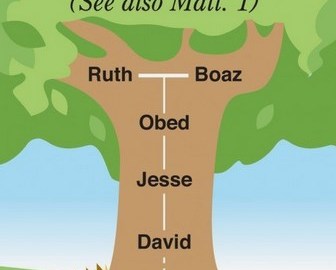
In the book of Ruth, Boaz accepts responsibility as Ruth and Naomi’s kinsman redeemer.  Then Boaz said to the elders and to the crowd standing around, “You are witnesses that today I have bought from Naomi all the property of Elimelech, Kilion, and Mahlon.  And with the land I have acquired Ruth, the Moabite widow of Mahlon, to be my wife. This way she can have a son to carry on the family name of her dead husband and to inherit the family property here in his hometown. You are all witnesses today.” (Ruth 4:9-10)

Just as Boaz married Ruth, our Kinsman Redeemer will marry us.  For I am jealous for you with God’s kind of jealousy; since I promised to present you as a pure virgin in marriage to your one husband, the Messiah; (2 Cor 11:2).  Why would Yeshua want to do this?  Why not just redeem us and be done with it? Yeshua desires an intimate relationship with us corporately and also individually. I stand at the door and knock. If anyone hears my voice and opens the door, I will come in and eat with him, and he with me (Rev 3:20).  Yeshua wants to be involved in our daily lives.  He is aware of all our thoughts, actions, attitudes, dreams and fears.  “Come to me, all you who are weary and burdened, and I will give you rest. Take my yoke upon you and learn from me, for I am gentle and humble in heart, and you will find rest for your souls.  For my yoke is easy and my burden is light” (Matt 11:28-30). He desires to restore what has been lost to us.  Instead of your shame there shall be a double portion; instead of dishonor they shall rejoice in their lot; therefore, in their land they shall possess a double portion; they shall have everlasting joy (Is 61:7). Yeshua wants to protect us and provide for us.  He promises to be with us always.  He does not leave us to the mercy of our enemies.  “And lo, I am with you always, even unto the end of the world” (Matt 28:20)   Just as a husband and wife are meant to share their daily lives, dreams, hopes, frustrations and challenges, we are welcomed and encouraged by Yeshua to share every detail of our daily lives with Him.  We are never alone for He is our constant Companion.  He is our Kinsman Redeemer.

This is an excellent time to ask forgiveness for your sins and invite Yeshua (Jesus) to be Lord of your life.  When we commit sin, we incur a debt that none of us can ever pay on our own.  It cannot be paid with earthly currency or even with great sacrifice on our part.  This debt can only be paid for by the blood of Yeshua which has already been shed for us. This is the greatest gift to ever be offered.  Don’t miss out.  After you have accepted Yeshua as your Lord and Savior, ask for baptism in the Holy Spirit.  The Holy Spirit will be your constant companion and Counselor and will equip you for Kingdom living. 

Who Is Yeshua?

Yeshua is everything to us:  our salvation, our hope, our future, to name a few. It is important to get to know Him as well as possible.  We can do this by interacting with Him and also by reading the Bible.  It is the word of Yehovah and Yeshua is the living Word of Yehovah.  This series, entitled “Who Is Yeshua?” will consist of twenty-one articles. Each article will explore a different section of the Bible to discover different titles and roles of Yeshua and our response to each role. In the third article in the series, Yeshua is our Atonement.

In Leviticus 16, we discover the foreshadowing of Yeshua as our Atoning Sacrifice, our High Priest, our Scapegoat and our Covenant.  Yeshua, the perfect Lamb, was sacrificed in our place, to make atonement for our sins.  Then Aaron will come out to purify the altar that stands before the Lord. He will do this by taking some of the blood from the bull and the goat and putting it on each of the horns of the altar.Then he must sprinkle the blood with his finger seven times over the altar. In this way, he will cleanse it from Israel’s defilement and make it holy (Lev 16:18-19). This offering was to be made once each year on the 10th day of the appointed month early in autumn, the day known as Yom Kippur (day of covering) or, more accurately, Yom haKippurim (day of the coverings).  Unlike a bull and goat that had to be sacrificed each year, Yeshua was sacrificed one time to make perpetual atonement for our sins, transgressions and iniquities.

Yeshua is also our High Priest, for He offered Himself as our atoning sacrifice. No one can take my life from me. I sacrifice it voluntarily. For I have the authority to lay it down when I want to and also to take it up again. For this is what my Father has commanded.” (John 10 :18)

Yeshua is our Scapegoat.  When Aaron has finished purifying the Most Holy Place and the Tabernacle and the altar, he must present the live goat. He will lay both of his hands on the goat’s head and confess over it all the wickedness, rebellion, and sins of the people of Israel. In this way, he will transfer the people’s sins to the head of the goat. Then a man specially chosen for the task will drive the goat into the wilderness.  As the goat goes into the wilderness, it will carry all the people’s sins upon itself into a desolate land (Lev 16:20-22). Yeshua carries our sin far away so that it no longer has the power to defile. 

Yeshua’s sacrifice reconciles us to His Father.  In order to properly relate to Yehovah, we must understand the idea of covenant, because Yehovah desires a covenant relationship with us.  There are many instances of covenants in the Old Testament: in Genesis, Yehovah’s covenants with Noah (Gen 8-9), with Abraham (Gen 9-17), with Moses (Deut 28 and Ex 31) and with David (2 Sam 7).  Each of these covenants was a step toward progressing Yehovah’s plan for establishing His Kingdom on earth as it is in Heaven.  Our covenant with our Father has the same goal.

Covenants were common in ancient times and were taken very seriously.  Generally, when a covenant was made, the parties would each pledge their promises.  Then one or more animals were cut in two and placed across from each other to make a path.  Those entering into covenant would walk that path as a pledge that they would not break the covenant or they too would be cut in half. Covenants involved blood and the curse of death for the one breaking the covenant.

In ancient times, covenants were used to define social and political relationships.  Often, the covenant was between a greater king and a lesser king.  The greater king offered care and protection from enemies while the lesser king offered loyalty and obedience. The greater king then “adopted” the lesser king and his household into the greater king’s family.  Covenants involved ongoing relationship and partnering with the other party to achieve a desired common goal.  In our case, Yehovah promises to care and provide for us and protect us from our enemies.  We promise our loyalty and obedience to Him.  We partner together to establish His Kingdom on earth.  When we repent of our sins and turn our lives over to Yeshua, it means that we are to trust and obey Him.  We remain loyal and obedient to Yehovah.

An important part of covenant-making included eating a meal together featuring the sacrificed animal or animals.  In our case, we partake of what we call communion or kiddush to commemorate our covenant relationship with Yehovah. As they were eating, Jesus took some bread and blessed it. Then he broke it in pieces and gave it to the disciples, saying, “Take this and eat it, for this is my body.” And he took a cup of wine and gave thanks to God for it. He gave it to them and said, “Each of you drink from it, for this is my blood, which confirms the covenant between God and his people. It is poured out as a sacrifice to forgive the sins of many (Matt 26:26-28)  

This is an excellent time to ask forgiveness for your sins and invite Yeshua (Jesus) to be Lord of your life.  When we commit sin, we incur a debt that none of us can ever pay on our own.  It cannot be paid with earthly currency or even with great sacrifice on our part.  This debt can only be paid for by the blood of Yeshua which has already been shed for us. This is the greatest gift to ever be offered.  Don’t miss out.  After you have accepted Yeshua as your Lord and Savior, ask for baptism in the Holy Spirit.  The Holy Spirit will be your constant companion and Counselor and will equip you for Kingdom living.