All posts by nancyryall

Who Is Yeshua?

Yeshua is everything to us:  our salvation, our hope, our future, to name a few. It is important to get to know Him as well as possible.  We can do this by interacting with Him and also by reading the Bible.  It is the word of Yehovah and Yeshua is the living Word of Yehovah.  This series, entitled “Who Is Yeshua?” will consist of twenty-one articles. Each article will explore a different section of the Bible to discover different titles and roles of Yeshua and our response to each role. In the third article in the series, Yeshua is our Atonement.

In Leviticus 16, we discover the foreshadowing of Yeshua as our Atoning Sacrifice, our High Priest, our Scapegoat and our Covenant.  Yeshua, the perfect Lamb, was sacrificed in our place, to make atonement for our sins.  Then Aaron will come out to purify the altar that stands before the Lord. He will do this by taking some of the blood from the bull and the goat and putting it on each of the horns of the altar.Then he must sprinkle the blood with his finger seven times over the altar. In this way, he will cleanse it from Israel’s defilement and make it holy (Lev 16:18-19). This offering was to be made once each year on the 10th day of the appointed month early in autumn, the day known as Yom Kippur (day of covering) or, more accurately, Yom haKippurim (day of the coverings).  Unlike a bull and goat that had to be sacrificed each year, Yeshua was sacrificed one time to make perpetual atonement for our sins, transgressions and iniquities.

Yeshua is also our High Priest, for He offered Himself as our atoning sacrifice. No one can take my life from me. I sacrifice it voluntarily. For I have the authority to lay it down when I want to and also to take it up again. For this is what my Father has commanded.” (John 10 :18)

Yeshua is our Scapegoat.  When Aaron has finished purifying the Most Holy Place and the Tabernacle and the altar, he must present the live goat. He will lay both of his hands on the goat’s head and confess over it all the wickedness, rebellion, and sins of the people of Israel. In this way, he will transfer the people’s sins to the head of the goat. Then a man specially chosen for the task will drive the goat into the wilderness.  As the goat goes into the wilderness, it will carry all the people’s sins upon itself into a desolate land (Lev 16:20-22). Yeshua carries our sin far away so that it no longer has the power to defile. 

Yeshua’s sacrifice reconciles us to His Father.  In order to properly relate to Yehovah, we must understand the idea of covenant, because Yehovah desires a covenant relationship with us.  There are many instances of covenants in the Old Testament: in Genesis, Yehovah’s covenants with Noah (Gen 8-9), with Abraham (Gen 9-17), with Moses (Deut 28 and Ex 31) and with David (2 Sam 7).  Each of these covenants was a step toward progressing Yehovah’s plan for establishing His Kingdom on earth as it is in Heaven.  Our covenant with our Father has the same goal.

Covenants were common in ancient times and were taken very seriously.  Generally, when a covenant was made, the parties would each pledge their promises.  Then one or more animals were cut in two and placed across from each other to make a path.  Those entering into covenant would walk that path as a pledge that they would not break the covenant or they too would be cut in half. Covenants involved blood and the curse of death for the one breaking the covenant.

In ancient times, covenants were used to define social and political relationships.  Often, the covenant was between a greater king and a lesser king.  The greater king offered care and protection from enemies while the lesser king offered loyalty and obedience. The greater king then “adopted” the lesser king and his household into the greater king’s family.  Covenants involved ongoing relationship and partnering with the other party to achieve a desired common goal.  In our case, Yehovah promises to care and provide for us and protect us from our enemies.  We promise our loyalty and obedience to Him.  We partner together to establish His Kingdom on earth.  When we repent of our sins and turn our lives over to Yeshua, it means that we are to trust and obey Him.  We remain loyal and obedient to Yehovah.

An important part of covenant-making included eating a meal together featuring the sacrificed animal or animals.  In our case, we partake of what we call communion or kiddush to commemorate our covenant relationship with Yehovah. As they were eating, Jesus took some bread and blessed it. Then he broke it in pieces and gave it to the disciples, saying, “Take this and eat it, for this is my body.” And he took a cup of wine and gave thanks to God for it. He gave it to them and said, “Each of you drink from it, for this is my blood, which confirms the covenant between God and his people. It is poured out as a sacrifice to forgive the sins of many (Matt 26:26-28)  

This is an excellent time to ask forgiveness for your sins and invite Yeshua (Jesus) to be Lord of your life.  When we commit sin, we incur a debt that none of us can ever pay on our own.  It cannot be paid with earthly currency or even with great sacrifice on our part.  This debt can only be paid for by the blood of Yeshua which has already been shed for us. This is the greatest gift to ever be offered.  Don’t miss out.  After you have accepted Yeshua as your Lord and Savior, ask for baptism in the Holy Spirit.  The Holy Spirit will be your constant companion and Counselor and will equip you for Kingdom living. 

Who Is Yeshua?

Yeshua is everything to us:  our salvation, our hope, our future, to name a few. It is important to get to know Him as well as possible.  We can do this by interacting with Him and also by reading the Bible.  It is the word of Yehovah and Yeshua is the living Word of Yehovah.  This series, entitled “Who Is Yeshua?” will consist of twenty-one articles. Each article will explore a different section of the Bible to discover different titles and roles of Yeshua and our response to each role. In the second article in the series, Yeshua is the perfect Lamb.

 In Exodus, we learn about the Passover Lamb. 

Now the Lord said to Moses and Aaron in the land of Egypt,“This month shall be the beginning of months for you; it is to be the first month of the year for you. Speak to all the congregation of Israel, saying, ‘On the tenth of this month they are, each one, to take a lamb for themselves, according to the fathers’ households, a lamb for each household. Now if the household is too small for a lamb, then he and his neighbor nearest to his house are to take one according to the number of persons in them; in proportion to what each one should eat, you are to divide the lamb.Your lamb shall be an unblemished male a year old; you may take it from the sheep or from the goats.  You shall keep it until the fourteenth day of the same month, then the whole assembly of the congregation of Israel is to slaughter it at twilight. Moreover, they shall take some of the blood and put it on the two doorposts and on the lintel of the houses in which they eat it. They shall eat the flesh that same night, roasted with fire, and they shall eat it with unleavened bread and bitter herbs. Do not eat any of it raw or boiled at all with water, but rather roasted with fire, both its head and its legs along with its entrails. And you shall not leave any of it over until morning, but whatever is left of it until morning, you shall completely burn with fire (Ex 12:1-10).

Many of us, at one time or another in our lives, think that we can improve ourselves if we try hard enough.  That may be true to some extent, but the kind of improvement that is most essential to us is not attainable by our efforts.  No matter how well we clean up our act, we still owe an enormous debt, one that we cannot repay on our own.  If all humanity could come into agreement and try to pay the debt collectively for all of us, it would still be impossible.  The kind of debt we owe cannot be paid back with money or good deeds. Indeed, under the law almost everything is purified with blood, and without the shedding of blood there is no forgiveness of sins (Heb 9:22).  It takes the blood of an innocent person willing to sacrifice himself for us.  None of us fits the bill of “innocent person” no matter how good we think we are.  “…for all have sinned and fall short of the glory of God” (Rom 3:23).

It is the blood of the lamb that saved the first born in Egypt from death.  It is the blood of our Passover Lamb that saves us from the second death.  The life is in the blood. For the life of the flesh is in the blood, and I have given it for you on the altar to make atonement for your souls, for it is the blood that makes atonement by the life (Lev 17:11).

How do we know for sure that the Passover Lamb in Exodus is a representative of Yeshua?  There are many other Scriptures that explain this to us.  For example, in 1 Corinthians 5:7, we read, “Get rid of the old hametz [leaven], so that you can be a new batch of dough, because in reality you are unleavened. For our Pesach [Passover] lamb, the Messiah, has been sacrificed.

In John 1:29, John the Baptist identifies Yeshua as the Lamb of God.  The next day, Yochanan saw Yeshua coming toward him and said, “Look! God’s lamb! The one who is taking away the sin of the world!  There are many other passages that identify Yeshua as the ultimate Passover Lamb, such as Isaiah 53:7; 1 Pet 1:19, Matt 26:2, and Matt. 26:26.

According to the instructions given in Exodus, the lamb was to be selected from the flock on the 10th day of the first month, Aviv.  The lamb was to be taken into the household much as a family pet becomes part of the household today.  The lamb was being inspected to make sure there were no flaws or imperfections, but the lamb was now a dear part of the family.  This is a foreshadowing of Yeshua being born among and living with His chosen people.  Many embraced Him and loved Him, especially during His ministry. 

When He took upon Himself the sins of the world, He opened Himself up to the rejection and condemnation of His people. They put Him to death as one reviled. He was despised and rejected by men; a man of sorrows, and acquainted with grief; and as one from whom men hide their faces he was despised, and we esteemed him not (Is 53:3). They did not realize that He was dying in their place, just as the Passover lamb died in their place each year, so that they would be covered. Only this time, they would be more than covered for a year; their sin debt would be permanently removed. Surely, he took up our pain and bore our suffering, yet we considered him punished by God, stricken by him, and afflicted. But he was pierced for our transgressions, he was crushed for our iniquities; the punishment that brought us peace was on him (Is 53:4-5) and by his wounds we are healed.

Furthermore, the yearly Passover lamb was put to death and remained dead.  Our true Passover Lamb, Yeshua, was raised from the dead after three days and three nights in the grave!  The Author of life took on a new life, a new body, so that we could do the same! Jesus said to her, “I am the resurrection and the life. Whoever believes in me, though he die, yet shall he live (John 11:25). Not only are our sins forgiven, but our debt is paid and we are given new life, eternal life.  We no longer have to fear when our mortal bodies die, for we will have new bodies that will live forever and have no defects, no blemishes.  Yeshua not only pays a debt we could never pay and removes our condemnation, but He gives us immortality and glory!  A new life forever with Him!  We can now take on immortality because we wear His robe of righteousness. If the Spirit of him who raised Jesus from the dead dwells in you, he who raised Christ Jesus from the dead will also give life to your mortal bodies through his Spirit who dwells in you.  (Rom 8:11)

This is an excellent time to ask forgiveness for your sins and invite Yeshua (Jesus) to be Lord of your life.  When we commit sin, we incur a debt that none of us can ever pay on our own.  It cannot be paid with earthly currency or even with great sacrifice on our part.  This debt can only be paid for by the blood of Yeshua which has already been shed for us. This is the greatest gift to ever be offered.  Don’t miss out.  After you have accepted Yeshua as your Lord and Savior, ask for baptism in the Holy Spirit.  The Holy Spirit will be your constant companion and Counselor and will equip you for Kingdom living. 

Who Is Yeshua?

Yeshua is everything to us:  our salvation, our hope, our future, to name a few. It is important to get to know Him as well as possible.  We can do this by interacting with Him and also by reading the Bible.  It is the word of Yehovah and Yeshua is the living Word of Yehovah.  This series, entitled “Who Is Yeshua?” will consist of twenty-one articles. Each article will explore a different section of the Bible to discover different titles and roles of Yeshua and our response to each role. In the first article in the series, Yeshua is the Seed.

In Genesis, we learn that Yeshua is the Seed of the Woman. And I will put enmity between you and the woman, and between your seed and her Seed; He shall bruise your head, and you shall bruise His heel” (Gen 3:15). (See also 1 John 3:8 and Gal 4:4) Why is this important?  It is because we are humans and we have sinned.  It is humankind that owes a tremendous debt, a debt that we cannot pay collectively, let alone individually. Only a human who is totally righteous, takes on the sin and weakness of everyone and who willingly gives up His life can pay the price.  Among all of humankind, there is no one else besides Yeshua who fits the requirements. “Although you wash yourself with lye and use much soap, the stain of your iniquity is before Me,” declares the Lord God (Jer 2:22).

What would it take to pay this enormous debt and reconcile with Yehovah?  It would take the sacrifice of a human who is totally free from blemish, from any hint of sin.  In fact, the law requires that nearly everything be cleansed with blood, and without the shedding of blood there is no forgiveness (Heb 9:22).  The animals who were sacrificed in the place of the guilty humans were innocent and were supposed to be without blemish.  Do not present an animal with defects, because the LORD will not accept it on your behalf (Lev 22:20).

A woman was the first to sin, but Yehovah in His infinite mercy and provision, had already provided a way for the woman and all her descendants to be saved.  It would be through the seed of a woman, that Yeshua (salvation) would come and sacrifice Himself so that we could be reunited to Yehovah and so that we could share in all that had been planned for us from the beginning.  What was planned for us?  Each one of us is designed to be an integral part of His kingdom.  For I know the plans I have for you,” declares the Lord, “plans to prosper you and not to harm you, plans to give you hope and a future (Jer 29:11).  We are part of something much greater than any of us individually, yet as individuals each one of us is loved and valued. 

Yeshua came to establish the Kingdom of Yehovah on earth.  [Yeshua] was going throughout all Galilee, teaching in their synagogues and proclaiming the gospel of the kingdom, and healing every kind of disease and every kind of sickness among the people (Matt 4:23).

How do each of us participate in the Kingdom?  Then Jesus came to them and said, “All authority in heaven and on earth has been given to me. Therefore, go and make disciples of all nations, baptizing them in the name of the Father and of the Son and of the Holy Spirit, and teaching them to obey everything I have commanded you. And truly I am with you always, to the very end of the age.” (Matt 28:18-20)   We are called to spread the word of His glorious plan.  When we share this message with others, we are scattering seed, the seed that comes from the SeedI tell you the truth, unless a kernel of wheat is planted in the soil and dies, it remains alone. But its death will produce many new kernels—a plentiful harvest of new lives (John 12:24)

In the parable of the sower (Matt 13:1-9), Yeshua tells us that when we spread the word (sow the seed) that some of the seed will fall onto poor soil or wither under challenging conditions.  This is not necessarily failure on our part.  After all, Yeshua died for all of us, yet not all of us will accept His precious gift of salvation.  When a farmer sows seeds, only some of the seeds will germinate.  Of the seed that germinates, only some will produce a good crop.  Plants can get too much rain, not enough rain, not enough sun, or pests can come and weaken or kill the plant.  And yet, the farmer continues to sow seed year after year.  It is the same with us.  We must continue to sow seed (the word of Yehovah) even though we cannot control the outcome of each seed.  It will require sacrifice on our part, perhaps even our very lives, to carry out our assignment.

“Listen! A farmer went out to plant some seeds. As he scattered them across his field, some seeds fell on a footpath, and the birds came and ate them. Other seeds fell on shallow soil with underlying rock. The seeds sprouted quickly because the soil was shallow. But the plants soon wilted under the hot sun, and since they didn’t have deep roots, they died. Other seeds fell among thorns that grew up and choked out the tender plants. Still other seeds fell on fertile soil, and they produced a crop that was thirty, sixty, and even a hundred times as much as had been planted! Anyone with ears to hear should listen and understand.”  (Matt 13:3-9)

 “Now listen to the explanation of the parable about the farmer planting seeds.  The seed that fell on the footpath represents those who hear the message about the Kingdom and don’t understand it. Then the evil one comes and snatches away the seed that was planted in their hearts.  The seed on the rocky soil represents those who hear the message and immediately receive it with joy.  But since they don’t have deep roots, they don’t last long. They fall away as soon as they have problems or are persecuted for believing God’s word. The seed that fell among the thorns represents those who hear God’s word, but all too quickly the message is crowded out by the worries of this life and the lure of wealth, so no fruit is produced. The seed that fell on good soil represents those who truly hear and understand God’s word and produce a harvest of thirty, sixty, or even a hundred times as much as had been planted!” (Matt 13:18-23) Yeshua is the original Seed as explained in Genesis.  When Yeshua is put to death, new life springs from Him and many seeds are now available.  Very truly I tell you, unless a kernel of wheat falls to the ground and dies, it remains only a single seed. But if it dies, it produces many seeds. Anyone who loves their life will lose it, while anyone who hates their life in this world will keep it for eternal life (John 12:24). The seeds produced by Yeshua’s death were first planted in His followers.  They then produced fruit that bore more seeds which they then sowed in others.  It is that seed which was planted in each of us who are led to accept Him as our Lord and Redeemer.  We are then to bear fruit which produces seed (the good news of the Kingdom) and it is that seed that we are to sow in others in order to increase the Kingdom.

This is an excellent time to ask forgiveness for your sins and invite Yeshua (Jesus) to be Lord of your life.  When we commit sin, we incur a debt that none of us can ever pay on our own.  It cannot be paid with earthly currency or even with great sacrifice on our part.  This debt can only be paid for by the blood of Yeshua which has already been shed for us. This is the greatest gift to ever be offered.  Don’t miss out.  After you have accepted Yeshua as your Lord and Savior, ask for baptism in the Holy Spirit.  The Holy Spirit will be your constant companion and Counselor and will equip you for Kingdom living. 

Kingdom Unity

In the previous article, we discovered the importance of Kingdom focus rather than earthly focus.  While it is true that we live in the world, it is also true that we are first and foremost citizens of the Kingdom of Heaven.  Our assignment is to bring the Kingdom of Heaven to earth.  How do we do that? 

Yeshua told us that if we believe in Him and the One who sent Him, then the Kingdom of Heaven already resides in us. Some of the Pharisees asked Jesus, “When will the kingdom of God come?” Jesus answered, “God’s kingdom is coming, but not in a way that you will be able to see with your eyes. People will not say, ‘Look, here it is!’ or, ‘There it is!’ because God’s kingdom is withinyou.” (Luke 17:20-21 NCV) The kingdom of God is within us!  As we grow in His ways, the kingdom of Heaven will radiate through us into the world.  The Spirit works through us to change the atmosphere around us.

Yeshua told us that the Kingdom of Heaven is like a bit of yeast in a batch of dough. [Yeshua] also used this illustration: “The Kingdom of Heaven is like the yeast a woman used in making bread. Even though she put only a little yeast in three measures of flour, it permeated every part of the dough.” (Matt 13:33 NLT) As we interact with the world, the “yeast” of the Kingdom within us will begin to permeate every part of the earth. 

The Kingdom of Heaven grows within us as we interact daily with Yehovah and sit at His feet, eager to learn His ways.  We meditate on His word so that we gain more of His wisdom and knowledge.  As we grow more like Him, our influence (yeast) will be more effective and on a larger scale.  We should live in unity and love with our fellow believers.

So, what happened? The Body of Messiah has multiple fractures due to division and even malice among its members.  Yeshua warned us that a house divided against itself cannot stand (Mark 3:25).  The Body of Messiah is fractured because we, individually and collectively, have failed to yield to the Holy Spirit. If each of us dies to himself or herself and yields to the Holy Spirit, we will have unity, for the Holy Spirit does not disagree with Himself or with the Father or Yeshua.  Paul writes in Galatians 2:20, “I have been crucified with Christ. It is no longer I who live, but Christ who lives in me. And the life I now live in the flesh I live by faith in the Son of God, who loved me and gave himself for me.”  Where we fail to die to ourselves, we introduce death into the Body of Messiah.

The fractured Body of Messiah is the reason why evil has prevailed in this world.  It is only in unity that we have the strength to address the evil that is covering the world in darkness.  Some leaders and other individuals in the Body of Messiah have already recognized this and have begun to work together and pray together. In order to do this effectively, they have to die to themselves. The rest of Yeshua’s followers must follow their example.  How will we stand before the Judge one day and explain that we were too busy fighting among ourselves to carry out our assignments from Him?  Rather than fight the adversary and his followers, we aided and abetted them with our disagreements and divisions.  How will the Judge respond? 

As we ponder these questions, perhaps we should consider 1 John 4:20 (ESV), If anyone says, “I love God,” and hates his brother, he is a liar; for he who does not love his brother whom he has seen cannot love God whom he has not seen. Another Scripture verse to meditate on are Yeshua’s words in John 13:35, “Your love for one another will prove to the world that you are my disciples.” 

When the Holy Spirit reigns in our hearts all the petty disagreements which people have clung to for decades, even centuries, will fall away like so much chaff, and divisions in the Body of Messiah will be healed.  The unity and love that is in us is the yeast that is supposed to permeate throughout the world, just as a little yeast permeates the entire dough as Yeshua explained in Matthew 13:33.  If we want to share the Kingdom with others, we will have to live it as well as preach and teach about it. We can only do this successfully by yielding to the Holy Spirit. 

Your kingdom come, Your will be done on earth as it is in Heaven (Matt 6:10).

Kingdom Focus

We are presently facing numerous challenges on many fronts and fear, unrest, and division are now more prevalent among us.  These reactions are not in keeping with Yehovah’s will for us, for the Holy Spirit brings love, shalom and unity.  How do we handle these challenges without falling into ungodly traps?  We know from Scripture that Yeshua does only what He sees His Father doing (John 5:19).  Therefore, as followers of Yeshua, we must do what we see Yeshua doing, for then we will also be doing what our Father is doing.

Since our challenges are very evident in the physical realm, there is strong temptation to address these issues in the physical realm and to rely on earthly leaders and experts for guidance.  Sadly, many of us are discovering that this is not an effective solution. So, what is a better strategy? 

In response to my cries for help to Abba, the Holy Spirit guided me to pursue the following Bible study: Get a sheet of paper and put a vertical dividing line down the middle. 
Title the left column “Kingdom of Heaven” and the right column “Earthly Governments”.  Now peruse the four Gospels, and record any words or actions of Yeshua that belong to either category.  Below, is a partial listing (the first two gospels) of the results of my own study.  All references were taken from the New Living Translation (NLT) unless otherwise noted. Before we begin, however, let us review some of the governments of Yeshua‘s time.  The Jewish government was headed by corrupt leaders who had created their own religion.  The Romans, known for extreme cruelty, had conquered and occupied Israel.  Anyone traveling the main roads was forced to see victims of crucifixion dying slow, tortured deaths.  The victims might even be family members or close friends.  In view of very real threats and horrors, what was Yeshua’s main focus?

Sorry! This product is not available for purchase at this time.
Kingdom of Heaven/Kingdom of God Earthly Governments
Kingdom of Heaven/Kingdom of God  
“Repent of your sins and turn to God, for the Kingdom of Heaven is near.”  (Matt 4:17).  
Matthew 5-7: Yeshua talks about living as citizens of the Kingdom of Heaven.  
When Yeshua had finished saying these things, the crowds were amazed at His teaching, for he taught with real authority— quite unlike their teachers or religious law (Matt 7 28).  
“And I tell you this, that many Gentiles will come from all over the world—from east and west—and sit down with Abraham, Isaac, and Jacob at the feast in the Kingdom of Heaven (Matt 8:11).  
“Go and announce to them that the Kingdom of Heaven is near” (Matt 10:7).
“And from the time John the Baptist began preaching until now, the Kingdom of Heaven has been forcefully advancing and violent people are attacking it” (Matt 11:12).  
“But if I am casting out demons by the Spirit of God, then the Kingdom of God has arrived among you” (Matt 12:28).  
“You are permitted to understand the secrets of the Kingdom of Heaven, but others are not” (Matt 13:11).  
Matthew 13 contains several other parables concerning the Kingdom of Heaven.  “I tell you the truth, unless you turn from your sins and become like little children, you will never get into the Kingdom of Heaven….” (Matt 18:3-11)  
“Some are born as eunuchs, some have been made eunuchs by others, and some choose not to marry for the sake of the Kingdom of Heaven…  (Matt 19 12)  
Matt 20:1-16 is the Parable of the Vineyard Workers  
“I tell you the truth, corrupt tax collectors and prostitutes will get into the Kingdom of God before you do” (Matt 21:31).  
Matthew 33-44 is the Parable of the Evil Farmers   Matthew 22:14 is the Parable of the Great Feast  
Matthew 25 is two parables about the Kingdom of Heaven and teaching on the final judgment when the King returns to reign on the earth.  
“The Kingdom of God is near!  Repent of your sins and believe the Good News (Mark 1:15)  
In Mark 4, Yeshua speaks in various parables concerning the Kingdom of God.  
“I tell you the truth, some standing here  right now will not die before they see the Kingdom of God arrive in power!” (Mark 9:1)  
“If your hand causes you to sin, cut it off. It’s better to enter eternal life with only one hand than to go into the unquenchable fires of hell with two hands….and if your eye causes you to sin, gouge it out.  It’s better to enter the Kingdom of God with only one eye than to have two eyes and be thrown into hell, where the maggots never die and the fire never goes out.” (Mark 9:43-48)  
“Let the children come to me.  Don’t stop them!  For the Kingdom of God belongs to those who are like these children.  I tell you the truth anyone who doesn’t receive the Kingdom of God like a child will never enter it.”   (Mark 10:14-15)  
“How hard it is for the rich to enter the Kingdom of God!” Dear children, it is very hard to enter the Kingdom of God.  In fact, it is easier for a camel to go through the eye of a needle than for a rich person to enter the Kingdom of God!” (Mark 10:23-25)  
Parable of the Evil Farmers (Mark 12:1-12)  
Realizing how much the man understood, [Yeshua] said to him, “You are not far from the Kingdom of God.”  (Mark 12:34)  
And [Yeshua] said to them, “This is my blood, which confirms the covenant between God and his people.  It is poured out as a sacrifice for many.  I tell you the truth, I will not drink wine again until the day I drink it new in the Kingdom of God.” (Mark 14:24-25)                      
“Beware of false prophets…” (Matt 7:15-16)  

“You hypocrites!  Isaiah was and right when he prophesied about you, for he wrote… (Mark 7:6-23)  

Watch out!  Beware of the yeast of the Pharisees and of Herod.” (Mark 8:15)  

Jesus turned around and looked at His disciples, then reprimanded Peter, “Get away from me, Satan!” he said.  You are seeing things merely from a human point of view, not from God’s.” (Mark 8:33)  
Later the leaders sent some Pharisees and supporters of Herod to trap [Yeshua] into saying something for which he could be arrested…. “Should we pay taxes to Caesar or not?  Should we pay them or shouldn’t we?”  [Yeshua] saw through their hypocrisy and said, “Why are you trying to trap me?  Show me a Roman coin, and I’ll tell you.” When the handed it to him, he asked, “Whose picture and title are stamped on it?’ “Caesar’s,” they replied. “Well then,” [Yeshua] said, “give to Caesar what belongs to Caesar, and give to God what belongs to God.”  (Mark 12:13-17)  
[Yeshua] also taught: “Beware of these teachers of religious law!  For they like to parade around in flowing robes and receive respectful greetings as they walk in the marketplaces.   And how they love the seats of honor in the synagogues and the head table at banquets.  Yet, they shamelessly cheat widows out of their property and then pretend to be pious by making long prayers in public.  Because of this, they will be more severely punished.” (Mark 12:38-40)    
Kingdom of Heaven vs. Earthly Governments

As we can clearly see, Yeshua’s main focus was on the Kingdom of Heaven.  Did He make a difference in the physical realm?  Of course!  He healed the sick, raised the dead, fed the hungry and taught the crowds.  However, He did not try to change the current governments nor did He get caught up in political arguments.  His focus was on the Kingdom of Heaven.  He did and spoke only what He saw His Father doing and saying.  He submitted Himself to the guidance and power of the Holy Spirit.  Jesus gave them this answer: “Very truly I tell you, the Son can do nothing by himself; he can do only what he sees his Father doing, because whatever the Father does the Son also does. (John 5:19 NIV). Jesus, full of the Holy Spirit, left the Jordan and was led by the Spirit into the wilderness. (Luke 4:1 NIV).   “But if it is by the Spirit of God that I drive out demons, then the kingdom of God has come upon you.” (Matt 12:28 NIV):

Yeshua did not get caught up local politics with one exception (Matt. 25-15-22; Mark 12:13-17; Luke 20:20-26).  He frequently admonished and confronted the Jewish leaders because they were disqualifying themselves from the Kingdom of Heaven and they were leading many others to follow suit.  Still, His focus was on building the Kingdom of Heaven.  Many of His followers turned away from Him because they wanted Him to address the issue of Roman subjection.  Actually, He did address the issues of bondage, oppression, cruelty and many other things in His work on the cross and in His resurrection.  But He was going to the source of the problem and the source had its roots in the spiritual realm.  Although He did something physical when He suffered beatings, mocking, and crucifixion, He was addressing a spiritual matter.  Many followers had left Him because He would not take a stand against the Romans.

Instead, He was taking a stand against the evil behind the Romans’ sinfulness and the sinfulness of the whole world.

Our first response to any threat in the physical realm should be seeking the guidance of the Holy Spirit.  He will show you the spiritual root and help you address the problem at that level.  When we get to the source of the problem, we can truly see everlasting results.  When we address only the physical realm, we apply a bandage to a wound that continues to fester.

The bandage will hide the wound, but the wound will still be around, just under the surface.  When we focus on problems, they are magnified.  When we focus on Yehovah, He is magnified. If we keep our focus on Yehovah and seek His kingdom and His ways, then we have His shalom that passes all understanding. “Seek the Kingdom of God above all else, and live righteously, and he will give you everything you need” (Matthew 6:33).  If we focus on Yehovah and His Kingdom of Heaven, we learn to address the fear, unrest and division that is so prevalent in the physical realm by confronting the source of this ungodliness in the spiritual realm.  We will become peacemakers.  “Blessed are the peacemakers, for they will be called children of God” (Matt 5:9 NIV).

Which Law?

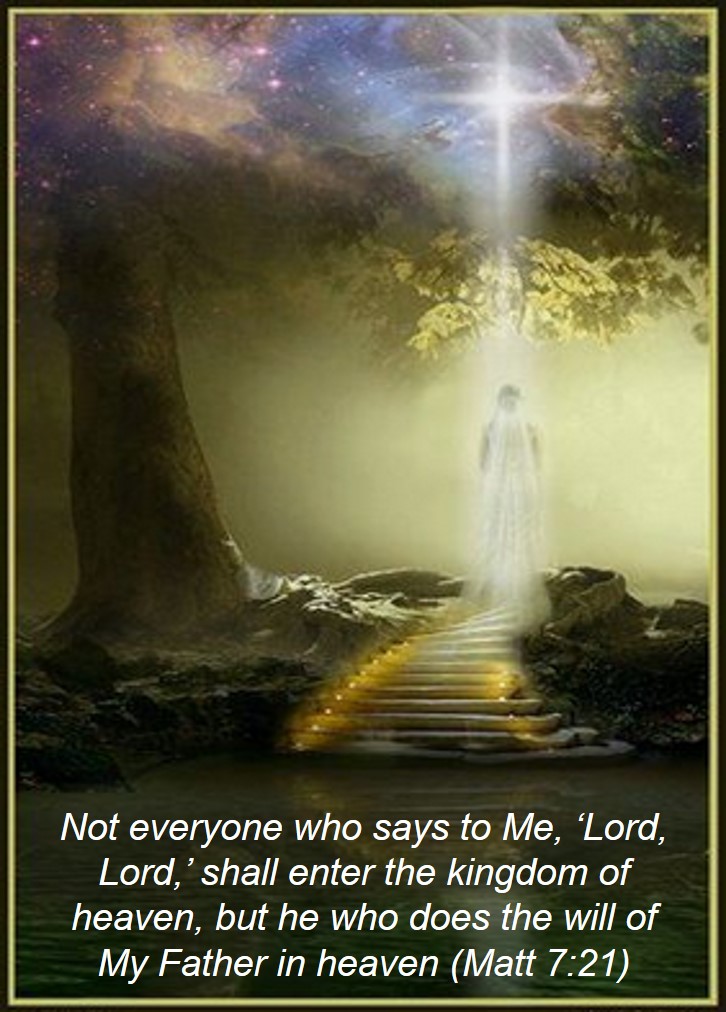
Not everyone who says to meThis article is the final of three articles in a series entitled “Living Kingdom”.  We will examine the importance of choosing to abide by YHVH’s commands as we consider the choices of individuals in Scripture.  The Good News (Gospel) is about YHVH’s kingdom.  Salvation is necessary for Kingdom Living, but it is a part of the process, not the goal.  We face the same challenges as the Israelites:  recognizing and obeying our King. 
Yeshua said, “If you love Me, obey My commandments” (John 14:15).  Misinformation abounds among present-day followers of Yeshua concerning what Yeshua meant by “commandments”.  It is time to clear away the cobwebs of lies and confusion that impede us from all that YHVH intends for us.

Sha’ul (Paul) discusses more than one type of law even though many Bible translations speak of all types as just “law”.  Sha’ul is talking mainly to Gentiles who were involved in pagan worship and were heavily influenced by the law of hasatan (Satan).  Sha’ul pointed out that they had been released from the law of sin and death and were now free to pursue the law of YHVH which leads to freedom and life.  It is helpful for us to use a translation that clearly distinguishes the different types of law, so all Scripture quoted in this article will be taken from New Living Translation (NLT).

In Deuteronomy 30:19-20, YHVH clearly points out that we have two choices.  “Today I have given you the choice between life and death, between blessings and curses. Now I call on heaven and earth to witness the choice you make. Oh, that you would choose life, so that you and your descendants might live!   You can make this choice by loving [YHVH] your God, obeying him, and committing yourself firmly to him. This is the key to your life.…”  The Israelites had lived in a pagan culture (Egypt) for over 400 years.  The choices given here were between YHVH’s law or hasatan’s law.  We all live in a world that has been influenced by the values of hasatan’s law which are sometimes called “worldly ways” or “living in the flesh”.

In the first chapter of Romans (1:18-32), we find mention of the two types of law.  First there is the law and order of YHVH expressed through His creation: They know the truth about God because he has made it obvious to them.  For ever since the world was created, people have seen the earth and sky. Through everything God made, they can clearly see his invisible qualities—his eternal power and divine nature. So they have no excuse for not knowing God (v 18-20).  YHVH’s ways are evident throughout creation, but He has also given us His law in written form (Scripture) and has written it on our hearts.  The opposite of YHVH’s law, satanic law, is graphically described in verses 28-32:  Since they thought it foolish to acknowledge God, he abandoned them to their foolish thinking and let them do things that should never be done. Their lives became full of every kind of wickedness, sin, greed, hate, envy, murder, quarreling, deception, malicious behavior, and gossip.…  They know God’s justice requires that those who do these things deserve to die, yet they do them anyway. Worse yet, they encourage others to do them, too.  If hasatan had his way, this is the only law any of us would know.  Therefore, he has worked throughout history to obscure and misconstrue YHVH’s law.

There has been confusion about the law since the time of the apostles.  First, some Jewish leaders were adding pre-requisites before receiving salvation.  We are rescued (salvation) from the dominion of hasatan through faith and even that faith is a gift from YHVH (Eph. 2:8).   Second, Constantine, in an effort to unite his empire, combined the sacred with the pagan and forbade keeping Torah under pain of death, thus distorting the Sabbaths and replacing the appointed times of YHVH.  Later, in the time of Martin Luther, grace was misconstrued as being the opposite of keeping law.

One dangerous heresy that has resulted today is the widespread belief that Yeshua’s followers are no longer under any type of law.  Grace reconciles us to YHVH and keeps us in relationship with YHVH when we transgress while unlearning hasatan’s ways and learning YHVH’s ways.  Grace is not a replacement for obedience to YHVH’s laws but rather the application of the atonement and covering of Yeshua when we repent of our sin.

Another myth today is that the laws of YHVH are too difficult to keep and therefore YHVH has done away with them.  There are 613 laws in the Torah and no one person is accountable for all of them.  Some are for priests only, others just for men, some for women only, and so on.  There are actually 1,050 commands in the New Testament!

Adam and Eve were influenced by hasatan and sinned against YHVH, subjecting themselves to hasatan.  Until hasatan distracted and confused them, they were capable of keeping YHVH’s law.  Now, we who are born under the dominion and influence of hasatan, struggle to keep YHVH’s law on our own.  Therefore, through Yeshua’s covering and the empowerment of the Holy Spirit we can maintain our relationship with YHVH while we are being perfected.  For God is working in you, giving you the desire and the power to do what pleases him (Phil 2:13).

Yeshua rebuked the Scribes and Pharisees for their false teachings and actions.  Under the guise of keeping Torah, the Pharisees were more often keeping their own man-made laws (Matt 23:15-30).  hhhahasMan-made law is the distortion of YHVH’s law thanks to humans who have disobeyed by adding to or subtracting from YHVH’s law (Deut 4:2).  Man-made law is actually satanic law in another guise.

Salvation is not a one-time event, but a process.  Dear friends, you always followed my instructions when I was with you. And now that I am away, it is even more important. Work hard to show the results of your salvation, obeying God with deep reverence and fear (Phil 2:12).  YHVH has not changed, neither has His law nor His expectations of us.

Strongholds: Avoiding the Pitfalls


This  is the second of three articles in a series entitled “Living Kingdom”.  We will examine the importance of choosing to abide by YHVH’s commands as we consider the choices of individuals in Scripture.  The Good News (Gospel) is about YHVH’s kingdom.  Salvation is necessary for Kingdom Living, but it is a part of the process, not the goal.  We face the same challenges as the Israelites:  recognizing and obeying our King.     

In the first article (Law-Abiding­ Citizens?), we examined the importance of following YHVH’s commands.  Obedience provides rewards and disobedience incurs punishment.  We who claim to belong to YHVH must recognize that we serve a King.  The words of YHVH in 1 Samuel 8:7 ring just as true today as they did then.  “Do everything they say to you,” the LORD replied, “for it is me they are rejecting, not you. They don’t want me to be their king any longer.”

We sometimes stray from following YHVH without realizing it.  We, like many Israelites, are more easily influenced by physical and worldly rather than spiritual and heavenly.  We forget that we are on a battlefield and the battle is spiritual, a war being waged between YHVH and hasatan.   When we are threatened or suffer injury, we are tempted to build strongholds rather than turn to YHVH.   This article provides some examples from Scripture to help us recognize common false strongholds and their pitfalls.  First of all, what is a stronghold?

Merriam-Webster defines the word “stronghold” as follows:  1: a fortified place; 2: a place of security or survival; a place dominated by a particular group or marked by a particular characteristic  These can be geographical places or places we build within our souls.  Strongholds in our souls invite demons to move in so they can more easily torment and manipulate us.  Our first example demonstrates this clearly.

YHVH chose Saul to be his human representative because the people had difficulty following a King who is spirit.  However, Saul relied on his own judgment and didn’t fully heed YHVH’s instructions, nor was he truly repentant when Samuel pointed out his sin. (1 Sam 15).  YHVH removed the Holy Spirit  from Saul and placed His Spirit on David instead.  When the Holy Spirit departed, a demon of fear entered Saul, followed later by a tormenting spirit.  We cannot rely on ourselves; it is YHVH who equips us and supplies all our need.  When we deny YHVH access in any area of our lives, we open the door for evil spirits.  I am YHVH, there is no other, besides Me there is no God; I equip you, though you do not know me (Is 45:5).”

Although YHVH selected David to be Saul’s replacement, it was years before David ascended to the throne.  During that time, YHVH tested and strengthened David to be a more faithful representative than Saul.  David was tempted to build false strongholds, especially reliance on other people and strategic hideouts, but none of these protected him.  David learned that it was reliance on YHVH that kept him safe.  We are tempted to rely on human leaders or experts to provide solutions to problems with spiritual roots.  These are jobs that only YHVH can handle and we must turn to Him and encourage others to do likewise.  O give us help against the adversary, for deliverance by man is in vain (Ps 60:11).  Thus says the LORD, “Cursed is the man who trusts in mankind and makes flesh his strength, and whose heart turns away from YHVH (Jer 17:5).

Solomon turned to wealth, power and prestige and strayed from YHVH.  He allowed his wives to persuade him to engage in pagan worship. And the Lord was angry with Solomon because his heart had turned away from the Lord, the God of Israel, who had appeared to him twice and had commanded him concerning this thing, that he should not go after other gods. But he did not keep what the Lord commanded (1 Kings 11:10).  Many of us are racing to acquire bigger, better and more to impress others, but is YHVH impressed by our selfishness?  In the end, it doesn’t matter what anyone besides YHVH thinks of us.  YHVH is our Judge.  How can we impress Him?  “Do not neglect to do good and to share what you have, for such sacrifices are pleasing to God” (Heb 13:16).  How different might the United States be if the inalienable rights listed in the Declaration of Independence read “that among these are Life, Liberty, and the pursuit of YHVH” rather than “the pursuit of Happiness”?

Throughout history humans have built castles, forts, and other strongholds to keep out the enemy.  The people of Jericho relied on their massive walls and sturdy gates to keep them safe from harm.   However, the very walls intended to protect them actually destroyed them (Joshua 6).  We can build walls to keep others out, but is that our commission from Yeshua?  He said we would be known by our love.  “By this everyone will know that you are my disciples, if you love one another (John 13:35).” For I was hungry, and you fed me. I was thirsty, and you gave me a drink. I was a stranger, and you invited me into your home (Matt 25:35).”

Simon Peter used a sword to cut off a soldier’s ear during Yeshua’s arrest.  Yeshua warned him that physical violence was not the right choice (Matt 26:52).  We can amass armies and weapons of mass destruction, but how will this help us spread the Good News of the Kingdom of YHVH?  Yeshua has promised us that we would suffer persecution for following Him and it is YHVH who will avenge us.  “ And will not God bring about justice for his chosen ones, who cry out to him day and night? Will he keep putting them off?  I tell you, he will see that they get justice, and quickly. However, when the Son of Man comes, will he find faith on the earth (Luke 18:7-8)?”

The  scribes and Pharisees thought genealogy and man-made traditions were sure guarantees, but they were wrong (Matt 3:9; Matt 15:1-20).  It is not who we are biologically but who we worship and how we worship.  YHVH tests our spirits and our hearts (Prov 16:2, 21:2).  The Jewish leaders had constructed their own religion, adding to and subtracting from YHVH’s commands (Matt 23).  Sadly, we have inherited man-made traditions and pagan worship passed down for many centuries (Jer 16:19).   Now that we know that Sunday worship, Christmas and Easter are not from YHVH but are perversions of His appointed times, how do we respond?  Will our love of traditions, pressure from our families or society prevail over what we now know to be the truth?  “Not everyone who says to me, ‘Lord, Lord,’ will enter the kingdom of heaven, but only the one who does the will of my Father who is in heaven.  Many will say to me on that day, ‘Lord, Lord, did we not prophesy in your name and in your name drive out demons and in your name perform many miracles?’  Then I will tell them plainly, ‘I never knew you. Away from me, you evildoers (Matt 7:21-23)!  ’These are not easy choices, but Yeshua warned us about that.   But small is the gate and narrow the road that leads to life, and only a few find it (Matt 7:14).

It is time to ask Yeshua to shine His glory light on any strongholds within us.  It is time to let go of that which is not of Him.  Yeshua relinquished all for us.  Now He expects the same of us.  False strongholds are the means of withholding ourselves from YHVH and are open invitations for the enemy to move in.  YHVH is our one and only true Stronghold (Ps 18:2).

Law-Abiding Citizens?

Not everyone who says to meSince the time of Martin Luther, much emphasis has been put on salvation through Yeshua as a gift of YHVH’s grace and not something we merit.  This is true, but it is only a part of the truth.  Yeshua taught about salvation and stressed that reunification with YHVH was possible only through Yeshua Himself.  However, the majority of Yeshua’s teaching focused on how to live in the Kingdom of YHVH (Matt 5-7; 16:19, 18:3, 29-30, 19:23).  Salvation supplies us citizenship in YHVH’s kingdom, but as citizens we must abide by the rules and regulations of our King.  Citizens and visitors in all countries on earth are required to obey the rules of the country where they reside or visit.  What are the consequences of ignoring YHVH’s teaching and commandments?  What are the rewards?  Two books of Scripture (Judges and Ruth) present vivid pictures of the two choices and their consequences.  As we review the stories in these two books, let us look for insights into kingdom living and see how the Body of Messiah measures up.

The Book of Judges provides examples of those who made it to the Promised Land but who failed to follow YHVH’s explicit commands (Judges 2:10).  Let us begin with the story of Micah (chapter 17).  Micah stole 1100 silver pieces from his mother (violating Ex 20: 12, 15).  He overheard his mother putting a curse on the thief.  Micah confessed his sin and returned the money.  His mother used part of the money to “honor” YHVH by creating some idols.  Mixing pagan with sacred and is strictly forbidden by YHVH (Ex 20:3-5).   Micah hired a Levite to serve as a priest in his home.  Levites were to serve YHVH in the Tabernacle, not in individual homes (Num 18:1-2).  How do these choices compare to the development of the Body of Messiah? The church early on mixed pagan with sacred (Christmas and Easter replacing the seven feasts of YHVH), misappropriated funds (selling indulgences and relics), provided idols (statues), and created roles for “priests” that YHVH never authorized.  These practices continue today.  Corruption spreads quickly but is not easily eradicated.  Over time, the Israelites’ disobedience led to their expulsion from the land.  What will be the consequence of our continued disobedience in the kingdom of YHVH?

Next,  the tribe of Dan discovered Micah’s evil setup (Judges 18).  They not only failed to root out the evil, but they stole the idols and the Levite “priest” from Micah thus spreading evil throughout an entire tribe.   Even though YHVH raised up various judges to lead the people, their influence was short-lived.  Strong godly leaders have arisen throughout the history of Christianity.  Revivals have come and gone. Leaders can inspire, exhort and teach, but we make our own choices.  Each person is responsible for establishing and maintaining a relationship with YHVH by loving Him and obeying Him.  We are also responsible for exhorting each other in the Body of Messiah (Col 3:12-17) and rooting out evil from our midst.  Each of us will appear before the Judge (Matt 7:21-23).

Finally, there is the tragic tale of the Levite and his concubine (Judges 19).  The Levite not only failed to protect his concubine, but he used her as a human shield to protect himself.  At that time travel in the Promised Land was no safer than in foreign lands (Judges 19:12).  Israel finally addressed the situation by almost eliminating an entire tribe, not to mention the loss of life in the other tribes.  The first two days Israel fought with the tribe of Benjamin (where the rape and murder had taken place), the other tribes suffered heavy losses.  Was this perhaps punishment for not purging evil from their midst earlier?  On the third day, the tribe of Benjamin was defeated and almost totally destroyed.   A lot of people were killed, but was the evil eradicated?  Being a member of a particular congregation or denomination in the Body of Messiah does not guarantee that we will be righteous before the Judge.  The many incidences of corruption, immorality, etc. within the Body of Messiah today bear witness to our failure to purge evil from our midst.  How many people have sought to know Yeshua and His Father within the Body of Messiah only to be discouraged or even destroyed?  What are we doing to purge evil from our midst?

The book of Ruth provides strong examples of Kingdom of heaven living. Ruth, Naomi and Boaz lived during the same time period as the book of Judges, but their choices brought blessings to themselves and others.  They represent the remnant, those in each generation who truly follow YHVH’s ways, the few chosen from among the many who are called (Matt 22:14).  The climax of the story takes place in the springtime during the barley harvest, the time of Pesach.  Boaz not only followed Torah (Lev 23:22) by allowing Ruth, a poor foreigner, to glean from his fields, but he provided protection and advice for her, unlike the Levite did for his concubine.  We are to welcome the “foreigners” to our faith who seek to know, love and serve YHVH.  We are called to make disciples of them, providing advice, mentoring and protection, not bias and judgment.  Ruth wholeheartedly sought to serve YHVH and her new family.  She was willing to follow the advice of both Naomi and Boaz.  We have much to learn from each other.  Are we proud and obstinate or humble and yielding?  Boaz followed the commandments of YHVH in offering to the kinsman redeemer first in line the opportunity to do his duty.  When the first kinsman redeemer refused, Boaz assumed his assigned duty.  Ruth and Boaz were harvesting barley; we are to harvest souls.  (John 4:35-36).  While bloodlines are important and respected by YHVH, they are no guarantee for eternity.  Neither is the fact that we claim to accept Yeshua as our Savior.  The litmus test for all of us is faithfulness to YHVH and His Torah.

The prevailing excuse given in Judges is that Israel had no king.  Actually, they did have a King who is Spirit, but they failed to recognize Him.  He later came to earth as a human and many still failed to recognize Him.  Our King, who is both YHVH and human resides in heaven, but also in our hearts.  Do we recognize Him as King?  Do we follow His commands?

Picturing Messiah

Snapshots of Messiah

The Old Testament contains numerous snapshots of Messiah in His many roles and aspects.  The more snapshots we examine, the more comprehensive our understanding of Messiah.  As we explore some details of Messiah, we discover implications for ourselves for it is not only our job to learn about Messiah, but to reflect His glory.  

In this article, we will focus on chapters 15 and 17 of Deuteronomy. The first three verses of chapter 15 command us to forgive debts owed to us.  Our Savior paid our debt in full and does not demand reimbursement.  In our case, the debt each of us owes is far beyond our means to repay.  Our Savior repaid all debts owed to YHVH once for all (Heb 10:12; Rom 8:9-10).  Therefore, we are not to expect payment from our debtors, but are called to forgive them even as we are forgiven and to reconcile just as we have been reconciled to YHVH.  (1 John 1:9; Matt 18:21-35).

Chapter 15, verses 4-11 illustrate the generosity that characterizes Messiah.  Our Savior not only released us from impossible debt, but liberally shares His own treasures with us (Is 55:1-2; Matt 8:16-17; Eph 1:1-18).  We are to do likewise (Matt 10:8) with those who have wronged us.  How generous are we toward our enemies, or even toward those who have not offended us but are needy?  Do we judge the poor, ignore them, or reach out to them?

Messiah rescues us from slavery to hasatan and restores us to the kingdom of YHVH.  As citizens of the kingdom of YHVH, we are to use our freedom to serve YHVH and others just as Messiah has served us (1 Pet 2:16; Gal 5:13).  We cannot reflect the glory of YHVH by serving ourselves, but only by serving others.

The sacrifices described in Deuteronomy 15:23 and 17:1 were to be without any sickness, deformity, or blemish, thus illustrating Messiah.  It is through the most perfect Sacrifice that we who are diseased, deformed and stained with sin, are made whole and perfect by the One who absorbed all our imperfections in Himself and put them to death.  The Israelites were to eat the flesh of the sacrifices for nourishment, but were forbidden to consume any of the blood, which contains life.  We gain little from consuming the life of creatures inferior to us, but we gain everything from partaking of the flesh and blood of the One who gives life to all (John 6:53).

The Israelites were ordered to keep evil from their midst.  This was so serious a matter, that a person found guilty of introducing evil was to be stoned to death.  Messiah warned people to turn from their sins (Matt 4:17; Luke 5:32).  He expelled demons from multitudes of people (Matt 8:16; Mark 1:34; Luke 4:41).  When He returns, Messiah Yeshua will eradicate all evil from the earth (Is 25:8; Rev 21:3-4).  We too are empowered and expected to purge all evil from our midst (Jude 1:14-15).

Priests and judges were appointed by YHVH (Deut 17:8-13).  The verdict of a priest or judge was final and orders were to be carried out exactly.  Yeshua did not come as judge the first time (John 3:17).  However, Messiah will return as Judge (Matt 25:31-46; James 5:9; 2 Cor 5:10).  Messiah’s judgement will be final and His orders will be carried out precisely (Is 2:2-4; Micah 4:1-3; Is 9:6-7).  Just as Yeshua came the first time to serve, not to judge, so we must focus on serving others, not judging them.  Our time for judging comes later (1 Cor 6:1-6).  We also are priests (1 Pet 2:9) and Messiah Yeshua is our High Priest (Heb 4:14-16).  Our main job as priests is to worship YHVH and show others His goodness (1 Pet 2:5, 9).

Deuteronomy 17:14-20 describes the selection and appointment of a human king and the guidelines for human kings.  A vivid picture of Messiah as our king emerges from these verses:

  • The king was selected by YHVH Himself (Ps 110: 1-2; Rev 19:11-16). If we have accepted Messiah Yeshua as Lord of our lives, then we are already citizens in His kingdom and are subject to Him first and foremost.
  • The king was a fellow Israelite. Messiah Yeshua is a fellow Israelite (2 Sam 7:12-13; Matt 1:1-17; Luke 3:21-38).  The Israelites were taught some basics of kingdom living and when Yeshua came to the earth He taught and demonstrated Kingdom living.
  • The king should not build up a large stable of horses. In Scripture horses were used for war and could become a false stronghold.  The king should not depend not on horses, but rather on His fear of YHVH (Ps 147:10-11).  Even though Messiah will return on a horse, He does not depend on the horse.  Rather, the horse depends on its Creator, Messiah Yeshua (John 1:1-3).  We must rely solely on YHVH for our strength and protection and avoid false strongholds.
  • The king was not to return or send his people to Egypt (symbolizing slavery and bondage). Messiah came free us from bondage to hasatan (Heb 2:14; Col 2:15).  When Messiah returns, He will place hasatan in bondage (Rev 20:1-3) and imprison him for the rest of eternity (Rev 20:10).
  • The king is not to have many wives, lest he turn away from YHVH. Yeshua has the Bride.  Although many individuals make up that Bride, they are all united by His Holy Spirit and operate as one (echad) (1 Cor 12:12, 27 NLT; Eph 4:3-5; 2 Cor 11:2).
  • The king is to read Torah daily to remain humble and obedient to YHVH. When hasatan tempted Yeshua in the wilderness, Yeshua responded by quoting from Deuteronomy each time.  Yeshua is the Living Torah, the Word of YHVH (John 1:1-5).  We, too, should keep Scripture within our hearts to remain humble and faithful to YHVH (Deut 6:5-6; 2 Tim 3:16).

These snapshots of Messiah give us much to ponder.  Yeshua is our perfect example of how to live and serve in YHVH’s kingdom.  How well do we reflect His glory?

The Cost of Fear

He will not leave you

To our beloved readers:  I write this article as one who has struggled for years with fear.  Bit by bit I have overcome some of my “illegal” fears, but my struggle continues.  I write this article to myself as well as to all of you.  Let us keep our focus on the prize before us.

Fear is one of the emotions that YHVH gave to us for a specific purpose.  We are to fear only YHVH knowing that He is much greater than us and more powerful.   However, many of us fear much more than the awesome might of YHVH.  We humans have many different types of fear.    Yet Scripture tells us repeatedly not to be afraid.

In Exodus 1:19-45 and Numbers  13-14, we read that the Israelites refused to go into the Promised Land because of their fear of the giant people living there.  As they focused on the problem it seemed to magnify, distracting them so that they forgot the signs and wonders that YHVH had already performed to release them from slavery in Egypt.  As a result of yielding to their fear, the Israelites paid a heavy price.  They wandered in the wilderness for 40 years until that generation of adults died out.  They not only forfeited a much easier life in a land of abundance, but they failed to assume their divine assignment from YHVH.  Instead of carrying out their mission, they spent the rest of their lives wandering around aimlessly.  YHVH simply waited until a new generation was raised up to replace those who had yielded to fear.

What can we learn from the Israelites? In Exodus 19 and 20, we see that YHVH wants to meet with the people.  The manifestations of His presence (fire, smoke, lightening and thunder and so on) made the people afraid.  We are to have great awe and respect for the Ancient of Days, but we are not to be afraid to speak to Him and hear His voice.  Now, we do not hear YHVH’s voice thundering, but instead we listen for a still small voice inside of us.  YHVH has made it more comfortable for us to hear Him.  In the Exodus account, barriers were erected around the mountain in order to separate YHVH from the fallen, sinful humans, but Yeshua has removed those barriers for us.  The veil in the Temple has been torn and we are free to have a close personal relationship with our Father and His Son.  Do we fear having an intimate relationship with our Father or with Yeshua?  If so, what price are we paying for our fear?  What are we losing?

Our Father spoke His commandments to the Israelites, but they were too afraid to continue hearing from Him.  So He wrote out His commands on tablets of stone.  After Yeshua returned to His Father, He sent the Holy Spirit to write His law on our hearts.  The Holy Spirit not only has put the law on our hearts but works through us so that we can carry out YHVH’s commands.  Do we fear having the Holy Spirit operate in us and through us?

Just as YHVH delivered the Israelites from bondage, He desires to set us free from our bondage to sin and to demons.  Many of us deny that we can be in bondage to demons when we are already born again.  Others of us are afraid of the spiritual realm and the idea of demons, so we stay in denial and try to ignore them.  Just as termites in your house will not go away if you simply ignore them, neither will demons depart from you because you deny their existence or their presence.  Do we fear seeking deliverance from  demons who hold us in bondage and torment us?  Do we fear the spiritual realm?   As the Israelites were commanded to purge leaven from their midst during Unleavened Bread, we are expected to permanently purge sin and demonic influence from our midst.  How does our bondage hinder us from completing our mission on earth and enjoying life in abundance (John 10:10)?

When the Israelites began to fear the giants in Canaan, they abandoned the only fear they were supposed to have, fear of YHVH.  Their fear of the giants became so great that they disobeyed the only One who is to be feared.  Is it the same with us?  Do we fear that which challenges us to the point that we forget to fear YHVH and thus fail in our divine assignments? Will we fail in our mission because our fear is misplaced?  What blessings and joys are we forfeiting because we give in to forbidden fears?