All posts by nancyryall

Who Is in Control?

who is in controlIn my last blog we looked at the story of Jacob, Leah, and Rachel to examine how people rely on themselves and their own devices instead of trusting YHVH. The Bible is packed with such illustrations for good reason. There is one true stronghold (YHVH) and one false stronghold (self) and for each person there is a lifelong battle between the two.

Since the fall of Adam and Eve, evil has infested our planet and now many people agree that we are in or near the end times when evil increases (2 Tim 3:1-17). Although Yeshua clearly stated that no one knows the hour of His return except the Father, predictions and rumors (often conflicting) are more rampant than ever. Many of us feel the need to be informed and prepared, and so we should. However, we should not be concerned with the predictions and the rumors, but rather with Scripture. YHVH admonishes us to be ever vigilant (1 Peter 5:8). This verse applies to us and all the generations after Peter regardless of when the end comes. Our focus should be on the spiritual realm, not the physical realm. If we are obeying YHVH’s commands, keeping ourselves focused on Him, and doing the work that Abba has assigned us in the harvest, then we need not live in fear even if the end comes in our lifetime (Luke 12:36-48)

Many of us are racing around to prepare for any type of disaster that may befall us. We are buying up silver and gold, hoarding food and water and other necessities, and watching every move and speech in the political scenario. Why? There is no biblical mandate to do these things. In fact, the Bible clearly tells us that hoarding is wrong (Prov 11:24, Eccl 5:13, Luke 12:34, 1 Tim 6:7). We may justify our actions by saying that when things get bad, we will share with others. Right now, things are really bad for some people, so why not give to them now? Our Father has promised to take care of us and has put it in writing (Matt 6:25-34). Do we really believe what Yeshua tells us? Our actions very clearly reflect what we believe.

It is true that the Israelites left Egypt well-stocked with silver and gold and clothing. This may have been compensation for all the hard work they had done for the Egyptians. It may have been a necessity for buying what they needed from other countries as they passed through. At any rate, the gold became a god for them. If you feel that the Ruach is prompting you to collect silver or gold or to store food, just be very careful that it is the Ruach’s voice you are hearing and not some other voice. And be very careful that your hoard does not become your god.

What about the political scenario? What about human leaders? What does Scripture say about that? Insofar as we are able to without violating YHVH’s laws, we are to obey whoever YIHVH has put in charge (1 Pet 2:130-14, Mark 12:17, Col 3:22-25). When human laws would force us to violate YHVH’s laws and commands, then we must follow YHVH (Acts 5:29).

Over the years, most of us have gotten used to taking charge of ourselves and our situations. In the United States, we live in a culture that values such attitudes. We vote for our leaders and we express our opinions freely. We do what we think is best to provide for ourselves and our loved ones. These are the values of our culture, but are they the actions our Father wants us to learn? The story of the Israelites in Exodus answers our questions graphically. YHVH was teaching the Israelites how to live according to His ways. They were in a wilderness where conditions were tough and sometimes life-threatening. The Israelites had two choices. Either they could go to YHVH with their requests and rely on Him or they could grumble and complain and take matters into their own hands. Read through Exodus carefully and note when YHVH blessed the Israelites for their choices and when He punished them. We, too, are living in a wilderness of some sort especially as evil increases, and we have the same choices.

YHVH is teaching us, as He taught the Israelites, that He is in control. Can we influence His decisions at times? Moses did, but then Moses was close to YHVH because Moses was obedient to YHVH and willing to follow orders, no matter how tough the situation. We may not be leaders of people, but we can be obedient and trusting toward YHVH. We can take our concerns to YHVH and try to persuade Him through our prayers. However, we are not to take matters into our own hands and determine our outcome. This will lead to a disastrous outcome for us as it did for those who worshiped the golden calf.

What is our best course of action in these times? The same course of action that YHVH gave to the Israelites in Deuteronomy 6:4-9. When we meditate and pray through His words, we begin to understand His perspective. If we do not stay focused on His word, we can easily slip into a worldly perspective. The Israelites were sojourners and foreigners in other lands, just as we must be sojourners and foreigners on the earth until Yeshua’s return. We are citizens of the kingdom of YHVH and our King must be our first priority, not the happenings in this foreign land. We are answerable to Him and what a blessing that is, for He is ultimately in control and He is the only one we can truly trust.

Strongholds

Strongholds2What do you do when faced with a crisis or a difficult situation? Do you try different strategies, talk it over with friends, search online, or seek the advice of experts? Do you take it to YHVH in prayer? Going to YHVH in prayer should be our first reaction, but often it isn’t. If we aren’t turning to YHVH first, we need to ask ourselves if we have developed a false stronghold. In truth, YHVH is our only true stronghold. [YHVH] is my rock and my fortress and my deliverer, my God, my rock, in whom I take refuge, my shield, and the horn of my salvation, my stronghold (Ps. 18:2 NLT).

The story of Jacob, Leah, and Rachel provides some important lessons on the importance of turning to YHVH first. Let us closely examine Genesis 29:16-30:24. Jacob desires Rachel from the start. When Laban offers him wages for his work, Jacob strikes a bargain to work seven years for Rachel’s hand in marriage.   There is no mention at any time that Jacob sought YHVH’s guidance as to his marriage partner. Rachel was attractive and that was enough for Jacob.

Leah is pawned off onto Jacob through Laban’s dishonesty. Jacob confronts Laban, but does not take the matter to YHVH. Leah, on the other hand, is in a most awkward and painful position. She is married to a man who is disgusted with her and with being tricked into marrying her. A week later, Jacob gets his beloved Rachel as his wife and Leah is pushed into the background.

YHVH sees Leah’s distress and comforts her with four sons. Each time she is grateful to YHVH and names her sons to reflect her gratitude and praise. Leah wants to be loved by Jacob, as is evidenced by her comments on each successive son’s birth.

Rachel sees that Leah is bearing and she is not. Rachel does not go to YHVH, but confronts Jacob. Jacob tells her that he is not God. He does not offer to pray for her. Rachel ignores the possibility of going to YHVH and seeking help. She comes up with her own solution. She will give her maid to Jacob and have sons through her maid. The firstborn, Dan, will father a tribe of Israel, but in the end this tribe will no longer be recognized as part of Israel (Rev 7). The tribe of Dan was the first of the twelve tribes to fall into idolatry (Judges 18:1-31).

When Dan is born, Rachel says that YHVH has judged her case and heard her voice. It is unclear whether she sought YHVH or she came to that conclusion on her own. When Naphtali is born through her maid, Rachel is concerned about competition with her sister and that she is gaining on Leah.

Leah now sinks to Rachel’s competitive level. She gives her maid to Jacob and has two sons through her maid. She does not mention YHVH when Gad is born, but instead says that “fortune has come”. When Asher is born, Lean talks of her happiness, but once again does not credit YHVH. Had Leah stopped bearing because she had fallen away from YHVH?

There is no mention of Jacob ever praying to YHVH for his wives, that the sisters might be reconciled or that either or both of them would bear children. Ignoring a problem or living in denial is a powerful stronghold. What would have happened if Jacob had sought YHVH concerning his wives?

Later, the two sisters bargain over some mandrakes (another false stronghold) that Reuben has gathered for his mother. Leah apparently was eager to bear more children. Rachel bargains for the mandrakes and says Leah can sleep with Jacob that night. Leah gets pregnant again and credits YHVH with rewarding her for sharing her maid. I believe that YHVH is clearly demonstrating that this is a matter He controls, and mandrakes have no power. If Rachel used the mandrakes and slept with Jacob, it did not avail, for she did not become pregnant.

We see that after Leah has borne six sons and a daughter, Rachel finally decides to cry out to YHVH (Then God remembered Rachel, and God listened to her and opened her womb. (Gen 30:22 NKJV). Rachel names her son Joseph, hoping that YHVH will add to the number of sons she bears. She correctly prophesies that she will bear another son (Benjamin).

It is clear from this story, that when we cry out to YHVH and trust in Him, He hears and responds with love because we have opened ourselves to receive His blessing. When we turn to others means (false gods or false strongholds), YHVH does help us because we have closed the door to Him. How is YHVH teaching you to look to Him alone and trust Him? If we are looking to anything or anyone else, we are building a false stronghold. YHVH is our only true and ever faithful stronghold.

Esau’s Blessing

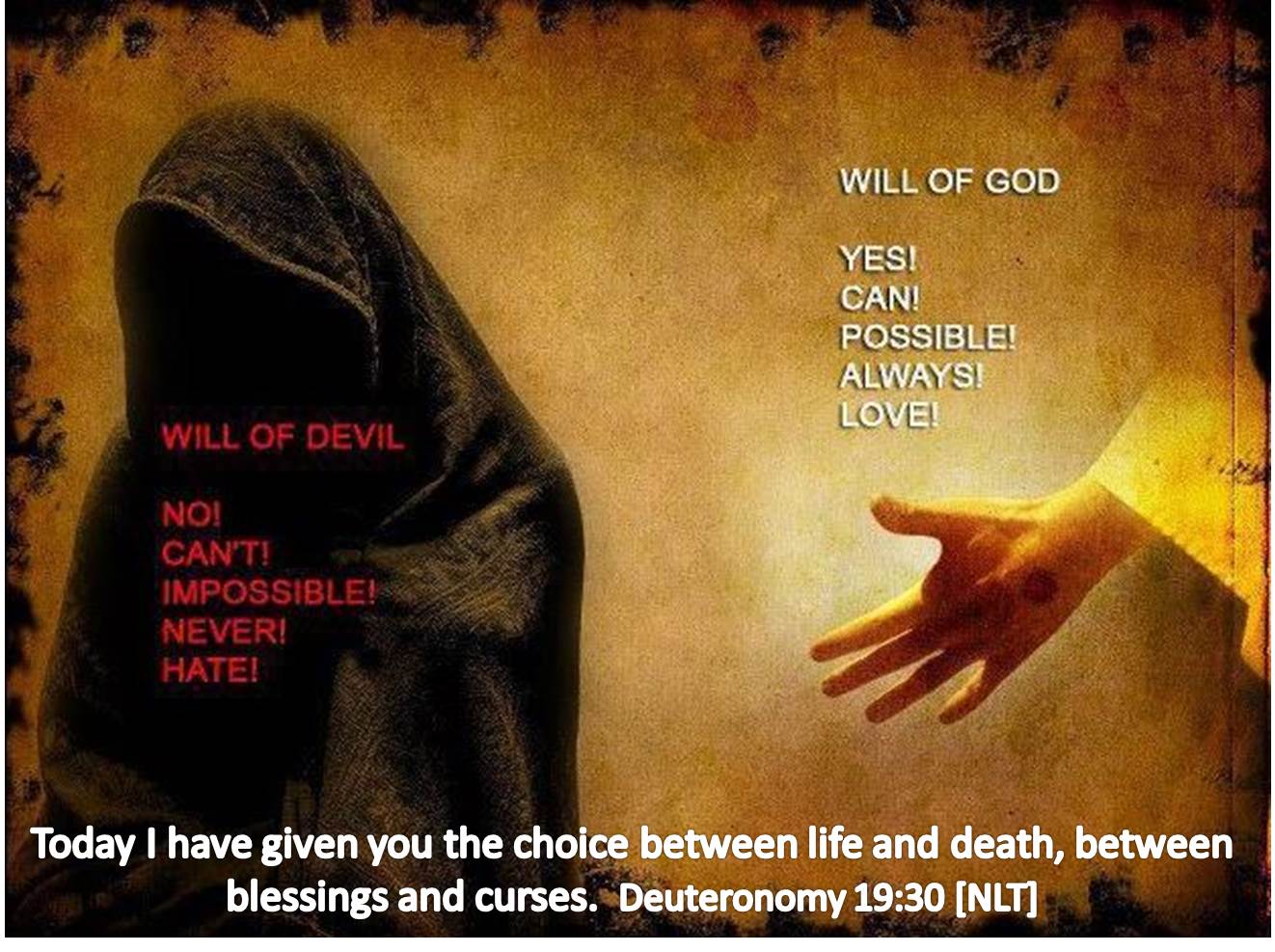
choice between life and deathMost of us are familiar with the narrative of Jacob and Esau who were twins. Esau was the firstborn, but as he emerged from the womb, Jacob was holding onto his heel. Esau was very casual about his birthright (traded for a bowl of lentils) and rebellious when it came to following YHVH’s commands (marrying a pagan woman). We recall how Jacob tricked his father into giving him Esau’s blessing as the firstborn son. These stories can be found in Genesis 25-27.

When we read the story of Jacob and Esau, we tend to dwell on the rivalry between the brothers, Jacob’s deception, and family dysfunctions with Isaac favoring Esau and Rebecca favoring Jacob. We focus our attention on Jacob and shove Esau into the background. Do we realize that Esau’s story is our story? Do we comprehend what YHVH (through Isaac) was saying to Esau (and to us)? Let us examine Esau’s blessing closely, for in it lays a gem of hope, the greatest hope for us all.

The blessing consists of three sentences and is translated incorrectly in many English versions. The English Standard Version (ESV) and the New Living Translation (NLT) have a more correct translation. The first sentence, “You will live away from the richness of the earth, and away from the dew of the heaven above.” So far this doesn’t sound like much of a blessing and indeed it isn’t. Esau will not enjoy the abundance and blessings that YHVH provides for us in the earth. Even what he has, he will not enjoy. This is not something new for Esau, because he never really enjoyed or appreciated what he had. He could not see the true value in his blessings.

Although Esau was the firstborn and was entitled to receive a double inheritance, he traded it for instant gratification in a bowl of lentils. His carnal nature, his flesh, dominated his decision making. So it is with us when we are still in sin and in the kingdom of darkness. Even what we have on this earth, we cannot fully enjoy and appreciate while we are blinded by the enemy.

The next sentence of the blessing states, “You will live by your sword, and you will serve your brother.” Esau would serve Jacob, his younger brother. What does this mean for us? We live in a world of violence and deception. We end up serving those who are crafty enough to foil us. Our concern is to gain what we can, often by any means, and protect it at all costs.

So where is the hope in all this? It is contained in the last sentence, “But when you decide to break free, you will shake his yoke from your neck.” How was Esau to break free? How are we to break free? We must make the same decision that YHVH presented to Esau. We must choose to stop serving hasatan and the humans who follow the ways of the kingdom of darkness.

When we decide to break free, we can be restored to our birthright which is relationship with YHVH . We have this option because of the love and sacrifice of Yeshua, our Messiah. We throw off the yoke of Satan and accept the yoke of Yeshua. It is an easy yoke. We serve others, not because we are forced to, but out of love and gratitude to YHVH. Our older Brother serves us and we serve Him. Our brothers and sisters serve us just as we serve them. We no longer haggle over the abundance of the earth, but share and enjoy all that YHVH provides, which is far more than enough for us all.

Scripture tells us that “all have sinned and fall short of the glory of God.” If you aren’t Yeshua, you fit into this category with all other humans. Whether we know it or not, we are serving Satan when we don’t serve YHVH. Just before I prayed for salvation for myself, I distinctly recall inwardly chafing at the idea of turning my life over to Yeshua and serving Him. The idea of being a servant seemed foreign to me. I thought I was my own person, making my own decisions. Only sometime later would it become crystal clear to me just how much I had been in bondage to Satan all my life. My greatest joy is to serve Yeshua now that I realize all that I have gained by serving Him.

If you have not yet made the decision to break free from the yoke of Satan, do not wait any longer. Perhaps you don’t feel that you are in any type of bondage. You are your own person and you live your life the way you see fit. This was precisely what Esau did when he married a pagan woman. He did not consider YHVH’s commands or his parents’ teachings. This was precisely what I did and my life was a mess before I threw off Satan’s yoke.

Tell Yeshua that you no longer want to work for Satan, but you want to work for YHVH. Tell Him that you are ready to trade your cumbersome yoke of bondage for the easy yoke of Yeshua. Embrace Yeshua’s precious gift of salvation and let Him embrace you with His overwhelming love.

Oil vs. Oil

precious oilFor when the foolish took their lamps, they took no oil with them,…(Matt 25:3)

If you have been wise enough to heed James Corbett’s documentary (How Big Oil Conquered the World) relating the history of how the oil industry has taken over medicine, finance, education, and agriculture, then you know that Satan once again has his counterfeit of YHVH’s genuine provision.

Satan’s workers have manipulated events, industries, and perceptions in order to attain wealth for themselves at severe and often devastating cost to others. Yeshua warned us to be wise to the enemy’s ways, to understand how the enemy works. “Behold, I am sending you out as sheep in the midst of wolves, so be wise as serpents and innocent as doves.…” (Matt 10:16)

Yeshua also warned us about the values of the kingdom of darkness. “What is highly valued among men is detestable in God’s sight” (Luke 16:15) Those who desire to attain this world’s wealth have made crude oil their god and it will lead to destruction. Those of us who follow Yeshua must pursue another type of oil. This Oil is our God, better known as the Holy Spirit. Yeshua set aside His power to show us the power and glory of His Oil. Philippians 2:1-11 shows us how to use this Oil properly. Yeshua did not grasp the power that was rightfully His, but emptied Himself to show us how to thrive in YHVH’s kingdom.

The Spirit of the Lord is upon Me, because He has anointed Me to preach the gospel to the poor. He has sent Me to heal the brokenhearted, to preach deliverance to the captives and recovery of sight to the blind, to set at liberty those who are oppressed. . . . (Luke 4:18)

The world’s oil is pursued by a few to enrich themselves, thus resulting in impoverishing many.  YHVH’s Oil is intended for all who pursue Him and is designed to enrich all.

When one day we stand before the Judge, crude oil and all that it can buy will be as dung. If we have selfishly pursued building our own kingdom instead of pursuing YHVH’s kingdom, we will stand condemned even if we were revered by the world.

Those of us who have pursued YHVH’s kingdom and His Holy Spirit with reckless abandon will be rewarded with treasures far superior to any treasures the kingdom of darkness can offer. Kingdom of darkness treasures will wear out, but Kingdom of light treasures will never be destroyed.

 “Do not store up for yourselves treasures on earth, where moths and vermin destroy, and where thieves break in and steal. But store up for yourselves treasures in heaven, where moths and vermin do not destroy, and where thieves do not break in and steal.  For where your treasure is, there your heart will be also.” (Matt 6:19-21)

How is it that the masses have been so gullible and allowed themselves to be manipulated and deceived? Is it possible that the majority of those who profess to follow Yeshua have not pursued His Oil with a fraction of the vigor and zeal that Satan’s servants have demonstrated in pursuing the world’s oil? How active have we been in increasing YHVH’s kingdom on earth and teaching His values? Yeshua has restored dominion of the earth to His followers, but how zealous have we been to restore the earth to Yeshua? If we have dominion over the earth, then through Yeshua’s power and authority, we can change the very atmosphere of our environment.   Our Oil enables us to blaze forth to vanquish the darkness that currently prevails.

 Of course, there is great risk in promoting values that oppose the world’s current culture. Yeshua Himself suffered the consequences for doing so and warned us to expect the same treatment. Remember what I told you: ‘A servant is not greater than his master.’ If they persecuted me, they will persecute you also. If they obeyed my teaching, they will obey yours also (John 15:20).

These are harsh words to ingest, especially for those of us who have been nestled in our comfort zones for so long. Our comfort zones provide nothing more than a delusion that we are secure. We must renew our minds and realize that our only security lies in risking all for YHVH’s kingdom. We will only be able to carry out our assignments if we have the Oil that YHVH provides.

 “But when they arrest you, do not worry about what to say or how to say it. At that time you will be given what to say, for it will not be you speaking, but the Spirit of your Father speaking through you.” (Matt 10:19-20)

There has long prevailed a distorted teaching that the Holy Spirit and all that He brings are “not for today, but was provided only to get the church established.” Actually it is YHVH’s kingdom that needs to be established and when we call it “church” we seem to lose sight of the true goal.  If we are not guided by the Holy Spirit, we will be guided by earthly values and our efforts will merely contribute to Satan’s kingdom.   Yeshua’s words in Matthew 25 refer to the Holy Spirit as the Oil that will prepare us for the Bridegroom’s return. Since the Bridegroom has not yet returned, we should be diligently pursuing the Oil of the Holy Spirit, lest we are caught unawares and be shut out forever. May the Bridegroom find each one of our lamps brimming with Oil when He returns.

Who Is YHVH?

Jesus is GodIn last week’s blog, Peter pointed out that Yeshua is YHVH. Why is it so important to make this point? Does it change your perspective of Yeshua? There is a tendency in many of us to rank God the Father as superior to Yeshua. It has even been taught in some circles that we are only to address the Father in prayer, and that it is wrong to pray to Yeshua. When Yeshua taught His disciples how to pray, He addressed the Father rather than Himself. And yet, Yeshua also tells us “Whatever you ask in My name, that will I do, so that the Father may be glorified in the Son. “If you ask Me anything in My name, I will do it (John 14:13-14). Yeshua glorifies the Father, and the Father glorifies His Son, Yeshua (John 8:54, 17:1; John 17:5).

Over the past two centuries, there have been various creeds and teachings denying that Yeshua is God. This type of heresy continues today. In fact, in some circles Yeshua is considered to be merely a thought or spiritual representation of YHVH.  Yeshua is clearly identified as YHVH’s Son in Scripture (1 Cor 15:28; Ps 2:7; Heb 1:5; Matt 3:17; John 1:14; 1 John 4:10; John 5:26; 1 John 5:9). Even we mortals produce children and they are certainly more than just a thought or a representation of us. If the name of YHVH had been known and if Scripture in its entirety had been correctly understood, then these debates would not have surfaced or, if they had, could have been quickly dismissed.

In order to get a more complete picture, it is best to start at the beginning and work from there. John 1:1-2 helps us to get started.  In the beginning was the Word, and the Word was with God, and the Word was God. He was with God in the beginning. Through him all things were made; without him nothing was made that has been made.” . This verse takes us back to the first chapter of Genesis. The Word spoke creation into being. Later the Word would speak to Abraham in front of his tent (Gen 18) and to Moses in the burning bush (Ex 3). We learn in John 1:14 that the Word became flesh and dwelt among us.

The Word not only became flesh, but put Himself in the same position as the rest of us. For a time He set aside His power and entered the world in total dependence on the Father. Who, being in very nature God, did not consider equality with God something to be grasped, but made himself nothing, taking the very nature of a servant, being made in human likeness (Phil 2:5). He showed us what we could do when empowered by the Holy Spirit as He was. “Very truly I tell you, whoever believes in me will do the works I have been doing, and they will do even greater things than these, because I am going to the Father.” (John 14:12-14)

The Jewish leaders understood that to be the Son of YHVH meant equality with YHVH.    For this reason they tried all the more to kill him; not only was he breaking the Sabbath, but he was even calling God his own Father, making himself equal with God (John 5:18).  Yeshua told them that he saw the Father at work and did the same work as His Father.  Yeshua went on to clarify the relationship between His Father and Himself (John 5:19-23).

YHVH tells us that His thoughts are above our thoughts, and His ways above our ways (Is 55:8-9). It is difficult to understand how three separate persons can be so united and act as one. Yet, YHVH has provided an example for us. The three persons of YHVH are echad, just as a husband and wife are echad.  The husband and wife can become one flesh, but they can also think and act in unity. Even so, they remain two distinct people.  In Hebrew, echad can not only mean “one” as in the number one, but it can mean thinking and acting together as one. The example we have of husband and wife is not perfect, and sometimes far from it.  But we can see how the ideal would be when a husband and wife are aligned in their thinking and acting.

The third Person (Holy Spirit) of the Godhead has been sent to us to help us understand YHVH’s thoughts and ways.  Yeshua tells us in John 16:12-14:

“I have many more things to say to you, but you cannot bear them now. “But when He, the Spirit of truth, comes, He will guide you into all the truth; for He will not speak on His own initiative, but whatever He hears, He will speak; and He will disclose to you what is to come. “He will glorify Me, for He will take of Mine and will disclose it to you.…”. 

We see clearly that the Holy Spirit is also a Person, for Yeshua refers to the Spirit repeatedly as He, not it.  Yeshua states that the Holy Spirit will not speak on His own initiative.  If Father, Son and Holy Spirit were all the same Person, there would be no need to make such a statement.  The three persons of YHVH are perfectly aligned at all times and, therefore, may seem to be only one.   Each person of the Godhead, YHVH, is wholly divine and wholly deserving of our worship, awe, and devotion.

The Mighty Power of YHVH

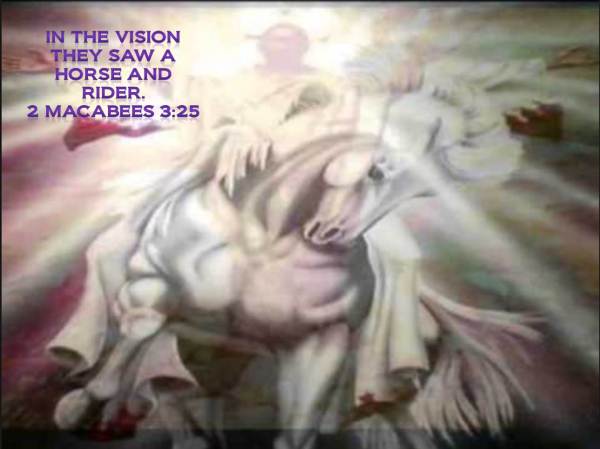
horse and riderTo celebrate Chanukah, we decided to read a portion of the story of the Maccabees each night.   The second book of Maccabees, chapter three has enlightened our understanding of the events leading up to the celebration of Chanukah. It has also provided us with insight and direction in dealing with issues that are currently challenging us.

Here is a brief summary of the chapter. There was a high priest named Onias who strictly obeyed the laws of YHVH. While Onias was high priest, Jerusalem enjoyed peace and prosperity, and received respect and generous gifts from the kings of many nations.

A man named Simon lost an argument with Onias and sought revenge by lying to Apollonius, governor of Greater Syria, and offering to him the money from the Temple treasury. Apollonius passed this misinformation on to the king, who sent a man named Heliodorus to confiscate the money. A portion of this money had been designated for the widows and orphans and a portion of it belonged to a wealthy man. To take the money would be to break YHVH’s laws concerning money deposited in the Temple treasury and would betray the trust of those who depended on the integrity of the ones in charge of the treasury. Heliodorus decided to confiscate the money anyway.

The priests and the people joined together in begging YHVH to protect the treasury money, praying on their faces before His altar. YHVH responded in a dramatic way. Heliodorus returned to the king without the money, but with a strong testimony concerning the power and faithfulness of YHVH.

This story speaks volumes to us as we seek funds to build a refuge for some widows in India. Just as the people of Jerusalem were on their faces before YHVH, the widows in our sister congregations spend much of each day on their faces, praying for the salvation of others. And yet, these women are considered curses in their society and are much oppressed.

We are in the process of raising funds for the construction of the widows’ home. As we began this process, the Holy Spirit led us to create a faith covenant with YHVH. Each day we remind YHVH of His promises towards the widows, orphans and the oppressed by reading aloud pertinent Scripture verses. Several weeks after we began our faith covenant, YHVH gave us His response to our covenant, which is Proverbs 15:25: “YHVH will tear down the house of the proud, but will establish the boundary of the widow.”

As developments unfold, we comprehend at new levels the depth of YHVH’s promise in this verse. Persecution against non-Hindus is on the rise in India. It is becoming more difficult to get the funds safely delivered to the congregational leaders. Local authorities who have been bent on persecuting our sister congregations are gaining more power. Our sister congregations, especially the leaders, are watched very carefully. We would be tempted to think that this cause is hopeless, but the Holy Spirit reminds us that this home for the widows is YHVH’s response to the cries of the congregants after the widows were thrown out of a temporary shelter and had their lives threatened.

Therefore, we believe that 2 Maccabees, chapter 3 illustrates for us our next step.   We are asking that those who support us in this effort storm heaven and remind YHVH of His promise in Proverbs 15:25. We believe He will hear our cries and respond in a powerful way if we stand on faith in this matter.

We have provided a copy of chapter 3 below for you to read and prayerfully consider. Note how many times YHVH miraculously intervenes to answer the cries of those who seek diligently to keep His laws.

II Maccabbees 3

When Onias[a] was High Priest in Jerusalem, the holy city enjoyed peace and prosperity, and its laws were strictly obeyed, because he was devout and hated evil. The kings of Syria and Egypt honored the Temple and presented it with expensive gifts, and King Seleucus, ruler of all Asia, even paid the costs of the Temple sacrifices from the revenues he collected.

But a man by the name of Simon, of the tribe of Bilgah, the chief administrative official of the Temple, lost an argument he had with Onias over the regulations governing the city market. At this time Apollonius son of Thraseus was the governor of Greater Syria. Simon went to him and said that there was so much money in the Temple treasury that it could not be counted, and since the money was not needed for sacrifices, it might as well be placed under the king’s control.

When Apollonius met with the king, he told him about the money, and the king ordered Heliodorus, his chief minister, to get it for him. Heliodorus set out at once on his mission, but he claimed that he was only making a tour of inspection of the cities of Greater Syria. After he had arrived in Jerusalem and had been warmly received by the High Priest, he explained the real reason for his visit and asked if what he had been told was true. 10-11 The High Priest then stated that Simon, that devil of a man, had not been elling the truth. There was indeed some money in the Temple treasury, but part of it was set aside for widows and orphans and part of it belonged to Hyrcanus son of Tobias, a very important man. He also pointed out that the total amount was only 30,000 pounds of silver and 15,000 pounds of gold. 12 He added that it was absolutely impossible that anyone should be permitted to take the money of those people who had placed their trust in the sanctity and safety of this world-famous Temple.

13 But Heliodorus insisted that the money should be taken for the royal treasury, as the king had ordered. 14 So he set a day and went into the Temple to supervise the counting of the money. This caused an uproar throughout the entire city. 15 Priests, wearing their priestly robes, threw themselves face downward before the altar and begged God to keep the money safe, since he had given the laws designed to protect the money that people deposited in the Temple. 16 It was heartbreaking to see the High Priest. His face turned pale, revealing the agony of his soul, 17 and his body was trembling with fear, reflecting the pain in his heart. 18 People ran from their houses to join together in prayer that the Temple might not be defiled. 19 Women, wearing nothing but skirts of sackcloth, crowded the streets. Young girls whose parents had never allowed them to be seen in public ran to the gates or to the walls of the city, or just stared out of their windows. 20 But wherever they went, they lifted their hands to God in prayer. 21 What a pitiful sight it was to see the High Priest in such great agony and frustration and to see everyone in the city confused and lying face down on the ground.

22 While everyone was begging the Lord Almighty to protect the money that had been entrusted to his care, 23 Heliodorus went on with his plan. 24 But at the very moment that he and his bodyguards arrived at the treasury, the Lord of all supernatural powers caused such a vision to appear that everyone who had dared to enter with Heliodorus was panic-stricken and weak with fear at this display of the Lord’s power. 25 In the vision they saw a horse and a rider. The horse had a richly decorated bridle, and its rider, dressed in gold armor, was frightening. Suddenly the horse rushed at Heliodorus, then reared up and struck at him with its hoofs. 26 Heliodorus also saw two unusually strong and handsome young men, wearing very fine clothes. They stood on either side of him and beat him unmercifully. 27 He immediately fell to the ground unconscious, and his men put him on a stretcher 28 and carried him out. Only a moment earlier this man had entered the treasury with a large group of men, including all his bodyguards, but now he was being carried away helpless. So they all openly acknowledged the mighty power of God.

29Heliodorus lay there unable to speak and without hope of recovery from this demonstration of God’s power. 30But the Jews praised Almighty God because he had miraculously protected his Temple and had brought great happiness where only minutes before there had been fear and confusion. 31 Some of Heliodorus’ friends quickly asked Onias the High Priest to pray that the Most High would spare the life of this man who was at the point of death. 32 So the High Priest offered a sacrifice in the hope that God would save Heliodorus, for he did not want the king to think that the Jews had done this to the man he had sent. 33 While Onias was offering the sacrifice, the two young men, wearing the same clothes as before, again appeared to Heliodorus and said,

Be grateful to the High Priest; the Lord has spared your life because of him. 34 Remember that it was the Lord of heaven who punished you. Now go and tell everyone of his great power.  When they had said this, they disappeared.

35 So Heliodorus offered a sacrifice to the Lord and made many promises, because the Lord had spared his life. Then he said good-bye to Onias and returned with his army to the king. 36 There he told everyone what the Lord, the most powerful of all gods, had done.

37 When the king asked Heliodorus who would be the best man to send on the next mission to Jerusalem, Heliodorus replied, 38If you have an enemy or know of someone plotting against your government, send him. He will come back badly beaten, if he comes back at all, for some strange power from God is at work there. 39The God of heaven watches over the Temple; he strikes down and destroys anyone who comes to harm it.

40 That is the story of how the Temple treasury was protected from Heliodorus.

Call to Action

not everyoneOur role as followers of Yeshua is to be an active role. Even the Hebrew language is an active language with the emphasis on verbs rather than nouns.  Yeshua modeled the type of action He expects to see from each of us.  He taught, healed, encouraged, fed the hungry, and admonished wayward leaders, even at the cost of His life.

Many disciples of Yeshua in our culture have devoted themselves almost exclusively to improving themselves and studying Scripture. These things are undoubtedly important, but there must be a healthy balance between improving self and helping others. We are required to meditate on and study Scripture, but it is useless if we do not also live it (James 1:22).

In His Sermon on the Mount, Yeshua describes those who will be welcomed into His Kingdom.

“Then the King will say to those on His right, ‘Come, you who are blessed of My Father, inherit the kingdom prepared for you from the foundation of the world. For I was hungry, and you gave Me something to eat; I was thirsty, and you gave Me something to drink; I was a stranger, and you invited Me in; naked, and you clothed Me; I was sick, and you visited Me; I was in prison, and you came to Me.’…   (Matt 25:34-36)

No mention is made in this passage concerning how well we know the Bible, although in other passages Scripture makes it clear that this is important ( Josh 1:8; 2 Tim 2:15, 3:16-17). In the past, I have been complacent with acquiring and storing knowledge of Scripture, but did not always put it into practice. It was only after I heard a missionary point out that Americans are great at acquiring knowledge, but we are deficient in actively building up the kingdom of YHVH, that I woke up. As I heard of new converts to Yeshua, with barely the rudiments of the Gospel, preaching, teaching and working miracles with the power of the Holy Spirit, I was truly convicted. They were doing so much with so little.

Secular news reports rarely discuss persecution and oppression of Yeshua’s followers, so pro-active research on our part is needed. Some of the things I have discovered: many of our brothers and sisters all over the globe are being persecuted for their faith, yet preach the gospel despite daily risk of imprisonment or death.  Political and/or religious leaders in numerous countries, seek to control all religious thought and activity and to eradicate any group that does not conform. North Korea is just one example.   In Iraq, Islamic extremists are beheading Christians. One tactic is to invade each home and demand that the children renounce Yeshua and embrace Allah. The children thus far have refused to give up Yeshua and were consequently beheaded in front of their parents. Leaders in India are routinely and consistently adding restrictions to hinder the spread of Christianity. Radical groups’ violence goes unchecked and police often “fail” to find sufficient evidence against the perpetrators. Christian refugees from Syria are being attacked by Muslims in some of the countries where they have sought refuge. The men are beaten and their wives and children are being raped and sodomized.   We must do more than shake our heads. Love is an action, not a feeling.

Martin Luther King, Jr. correctly stated that “It may well be that we will have to repent in this generation. Not merely for the vitriolic words and the violent actions of the bad people, but for the appalling silence and indifference of the good people who sit around and say, “Wait on time.” (Martin Luther King Jr., A Testament of Hope: The Essential Writings and Speeches)

Rather than randomly search out a worthy cause and plunge in, ask YHVH to direct you to the job He has appointed for you. There is much work to be done and windows of opportunity are closing rapidly. YHVH is still in control and is orchestrating His plan, so the best use of our time and effort is to yield ourselves to His assignment for us. Let us not be the generation who has to repent for keeping silent and doing nothing. Let us be the generation that accomplishes His will and is rewarded. Let us be the generation that is known by our love for one another, whatever the cost

Why do you call me, ‘Lord, Lord,’ and do not do what I say?
I will show you what he is like who comes to me and hears my words and puts them into practice.  He is like a man building a house, who dug down deep and laid the foundation on rock. When a flood came, the torrent struck that house but could not shake it, because it was well built.  But the one who hears my words and does not put them into practice is like a man who built a house on the ground without a foundation. The moment the torrent struck that house, it collapsed and its destruction was complete.” (Luke 6:46-69)

A Pleasing Fragrance

aroma pleasing to GodIn Exodus 30:34-38, YHVH instructs Moses concerning the incense that is to be made for YHVH’s altar. This incense was to be used solely for YHVH and not for anyone else. Each of the ingredients has much significance for us, both spiritually and physically.

The first ingredient mentioned is stacte, which is a product of myrrh. Modern authorities believe that the stacte was taken from other sources, but ancient authorities equate stacte with myrrh.  It seems more likely that the stacte YHVH intended was from myrrh because of its spiritual significance in Scripture. The wise men offered myrrh to Yeshua as a child (Matt 2:11) and Nicodemus supplied a mixture of myrrh and aloes for Yeshua’s burial (John 19:39). When Yeshua returns, Psalm 45:8 tells us that His robes will be scented with myrrh, aloes, and cassia (cinnamon).

The Hebrew word for stacte is nataph. Both words mean drop or tear. The resin is naturally produced, but sometimes the plant is bruised In order to release more resin. To obtain stacte, the bark of the tree must be cut. The resin is placed in a container and hot water is poured over it. Lumps of myrrh resin and oil sink to the bottom and the water is drained off. Stacte is the liquid taken from within the lumps of myrrh. The lumps must be broken in order to obtain the stacte.

Since ancient times, myrrh has been used in salves for cuts and sores, in rejuvenating facial creams, and in perfumes. Today, myrrh can be found in toothpastes, creams and cosmetics, and is recommended for healing a variety of illnesses including digestive disorders, arthritic pain, and regeneration of healthy cells, to name a few.

The second ingredient is onycha, a Greek word meaning fingernail or claw. The Hebrew word is shecheleth, which means “to roar as a lion”. The root of the Hebrew word means to exude a fragrance. Once again, there are various opinions as to the source of onycha, but the most likely seems to be a type of rock rose. The flower petals resemble a human fingernail that has been painted red.   The twigs and roots of the rock rose are still used for medicinal purposes.

The third ingredient is galbanum, a gum resin with a musky odor. The resin comes in either lumps or tears and has a bitter taste. Both Hippocrates and Pliny extolled its medicinal qualities. Pliny asserted that “the very touch of it mixed with oil of spondylium is sufficient to kill a serpent.”

The final ingredient for the incense is pure frankincense, another aromatic resin. It is produced by slashing the bark in a process called “striping”. The hardened resins are called tears. The Boswellia sacra trees that produce frankincense are able to live in harsh, unforgiving environments and can even grow out of solid rock. The Hebrew word for frankincense is lebonah, which means “white”. YHVH commanded that frankincense be included in the grain offerings (Lev. 2:1) and meat offerings (Lev 2:15). A very pure type of frankincense known as lebonah zakkah in Hebrew, was to be presented with the showbread (Lev 24:7).

Just as Yeshua shed His blood for our healing and restoration, the sap in the tree or shrub produces the resins that are so healing for us.  The sap is the “lifeblood” of the tree or shrub.  Yeshua only is pure enough to be our perfect sacrifice, even more pure than the purest frankincense.  Sap or resin leaks out only when a tree is damaged or cut, just as Yeshua’s blood was released during His suffering and crucifixion.  We can readily see how each ingredient in the incense points to Yeshua’s most precious sacrifice on our behalf. The incense was to be used only for YHVH just as Yeshua alone was worthy to be our sacrifice. Yeshua’s sacrifice is the most pleasing odor to YHVH, the most perfect expression of love.

What does this mean for us? We see that the ingredients of this most sacred incense glorify Yeshua and point to His precious work of redemption. We are restored to YHVH and healed in body and soul. In Yeshua’s righteousness, we can offer ourselves as living sacrifices to YHVH (Rom 12:1).   We too can be pleasing fragrances to YHVH.

Reflections

beholding as in a mirror

Evil is increasing and many are falling away from YHVH’s commands.  Corruption, violence and immorality are becoming more the norm than the exception.  The time for judgment is fast approaching for this world.   What is our attitude towards the evil and the sinful people around us? What should our response be as we await YHVH’s impending judgment?

In Genesis 19:16:33, YHVH reveals to Abraham His concerns about two particularly sinful cities.  Abraham’s response was not to become self-righteous because he did not live in either of those cities, nor did he point an accusing finger and judge the residents of Sodom and Gomorrah.  He does not ask YHVH to change His commandments.  Abraham instead pleads for mercy on behalf of those who are righteous in the midst of so much evil.  YHVH agrees that if ten men can be found who are righteous, then He will reconsider His course of action towards Sodom and Gomorrah.

What is our attitude toward those who engage in corruption, violence or immorality today?  Do we recall that from YHVH’s perspective all sin is an abomination?  Does that include us?  “…for all have sinned and fall short of the glory of God.”  We should never condone or excuse sin.  However, our first priority is to check ourselves for sin (Matt 7:5).  We may not be engaged in violent acts or dishonest dealings with others, but do we fail to forgive others?  Do we reach out to others to warn them in love to turn back to YHVH or do we shun those who might be saved?  Do we reach out to the poor and needy around us or do we shut ourselves away from their misery?

Yeshua came to the earth the first time to pay the debt for our sinfulness and restore us to relationship to YHVH.  He has given us His Holy Spirit and the means to be freed from bondage to Satan.  He is restoring us to the dignity that humans once had before Adam and Eve sinned.  Adam and Eve were given dominion over the earth and were to be subject only to YHVH. Humans were created in YHVH’s image and are intended to reflect His glory.   If we are now free from the bonds of Satan and are restored to our former position as managers over the earth, then are we not to some degree accountable for its present condition?  It is true that other people have just as much right as we do to make their own decisions.  Nevertheless, it is our duty to reach out to others in love just as Yeshua reached out to us in our sinfulness.  In Matthew 28:18-19, Yeshua states, “All authority has been given to Me in heaven and on earth. Go therefore and make disciples of all the nations, baptizing them in the name of the Father and the Son and the Holy Spirit…”  These are the marching orders and first priority of those who have been accepted into YHVH’s kingdom.”  Where does this command fall in our personal list of priorities?

Some of us sin by making excuses about being a lowly sinner.  Many of us grew up or are currently in congregations that fostered this attitude of helplessness.  We are worms or larvae who never develop into butterflies, but are doomed to remain worms while we are on this earth.  We never seem to throw off our own sinfulness and allow ourselves to be transformed by the work of the Holy Spirit just as a butterfly is formed in its chrysalis.  How can we expect to help others to throw off their mantles of sin and corruption if we won’t even help ourselves?

In Ezekiel 3:17-18, YHVH appoints Ezekiel as watchman over Israel.  If Ezekiel failed to warn others of their sins and the impending consequences, then he would be just as liable for their sins as they are.  Likewise, we are appointed to the same task today.

But you, dear friends, by building yourselves up in your most holy faith and praying in the Holy Spirit, keep yourselves in God’s love as you wait for the mercy of our Lord Jesus Christ to bring you to eternal life.  Be merciful to those who doubt; save others by snatching them from the fire; to others show mercy, mixed with fear—hating even the clothing stained by corrupted flesh (Jude 1:20-23).

On Judgment Day, will we be rewarded or punished for our attitude and behavior towards others?  Are we living up to Yeshua’s standards and expectations?  Are we a true reflection of YHVH’s glory?

Heart to Heart

that they may be one

There are many reasons why YHVH established Shabbat and the Feasts.  These are His set-apart times for teaching us, preparing us, celebrating with us, and bringing order to His Kingdom.  The end result is that YHVH desires is to be intimate with us individually and corporately.  One of my favorite verses in Scripture is from Deuteronomy 30:19 and the first part of verse 20, in the Complete Jewish Bible translation..

I call on heaven and earth to witness against you today that I have presented you with life and death, the blessing and the curse. Therefore, choose life, so that you will live, you and your descendants, loving [YHVH] your God, paying attention to what he says and clinging to him – for that is the purpose of your life!

Shabbats are very important to YHVH and, whether or not we know it, they are important to us.  The 23rd chapter of Leviticus designates clearly all the days that are Shabbats, whether weekly or during the Feasts.  Later in Leviticus, YHVH points out the consequences for working during a Shabbat.

For six days work is to be done, but the seventh day is a day of sabbath rest, holy to the LORD. Whoever does any work on the Sabbath day is to be put to death (Lev. 31:15).

The consequences for disobedience are harsh and hardly seem an invitation for intimacy, but it is most likely a necessary starting place. In the Exodus account of the Israelites in Egypt, we see a people that are unruly and often wayward. They had been immersed in idolatry and enslaved to cruel taskmasters.   To win their trust, YHVH demonstrated through signs and wonders that He is to be both feared and respected and also that He is able to protect and provide for His people. YHVH was formidable to their enemies, while protecting and providing for the Israelites..

When they were in the wilderness, YHVH gave them new commands and imposed strict consequences for disobedience, so that He would be taken seriously. Despite all the signs and wonders people still complained that He wouldn’t provide for them and tried to return to their idols. There was at least one person who ignored YHVH’s commands concerning Shabbat. YHVH had to follow through with the consequences He had established and the man was put to death (Num 15:30-36).  Were such harsh consequences necessary?

As a former teacher, I quickly learned that at the beginning of a new school year, teachers must be stricter than normal. The more unruly the students the more critical it becomes to establish authority and order. Once the students are settled, a proper atmosphere is established where students can learn and a healthy relationship with the teacher can be fostered.  If teachers are extra strict at the start, the focus can more quickly shift from the rules to learning.

Once each of us comprehends that YHVH is sovereign and is to be obeyed, then we are in a position to learn what He has to teach us. As we progress with our learning and interact more with YHVH, we grow closer to our sovereign King. Over time, we set aside our old ways and take on His ways. We experience His concern for our hearts. Eventually, we are ready to hear what is on His heart.

We make the transition from obeying the “no work” command simply because it is a command to refraining from work because we are eager to spend time with our Teacher.  We value what is important to YHVH.  Sometimes it is necessary to do His work even on ShabbatYeshua demonstrated this when He healed on Shabbat.  He was showing us that the purpose of Shabbat is to be in tune with our Father’s heart. It is not to become fascinated with rules and regulations.

Even as we grow closer to YHVH, we must be mindful that we are dealing with our Creator and our Sovereign. We are not to take His words lightly or take Him for granted. We must maintain a balance between healthy respect and intimacy with YHVH. Otherwise, we will find ourselves slipping from following His heart on Shabbat to following our own concerns. If that happens, our relationship with YHVH will quickly deteriorate as we move away from Him.

Yeshua spent time on Shabbat teaching, being taught, and healing. He was closely aligned with Abba’s heart and could easily transition to whatever His Father desired for Him to do at any given moment. Such intimacy is our Father’s desire for us and the reason He created us.

If we keep in mind the real purpose for our existence, we will remain focused on our Father’s heart and not fall into legalistic traps.  We will reap all the rewards that YHVH intends for us.