All posts by nancyryall

Offensive Judgment

for with what judgmentIf you have ever spent time in a congregation, then you most likely have encountered at least one instance of a Christian or Messianic believer judging another. Perhaps you were even the one being judged. Perhaps you were the one who did the judging.

Over several decades, I have been a member of various congregations. I have noticed many instances of Christians or Messianic believers judging a fellow member or a newcomer who showed up at their door, I have experienced many of the examples mentioned below, either as the one who was judged or as the one who judged (or should I say misjudged?).

The effects of our misjudging, whether subtle or blatant, are powerful and can be devastating to others. Actions or reactions such as a certain “knowing” glance, turning away, keeping someone at arm’s length, gossiping, excluding another, and so on, may seem insignificant in a world full of violence and horror. And yet, if we are engaging in any of these actions, we are not following Yeshua’s command to love one another. That means we are sinning and sin is never insignificant (Matt. 5:21-22).

The sheep in wolf’s clothing: Often we judge others by their appearance. The less similar they are to us, the more we tend to suspect them. Does the person wear our kind of clothes, have a similar hairstyle, and so on? If not, then they are automatically suspect. Consider Isaiah 11:3, NLT

Assumptions and generalizations: If you are divorced, then it is your fault and you are considered sinful and loose with your morals. If you are married, then you are automatically moral and upright. The list goes on, but you get the idea. Consider John 8:7 and Rom 2:1.

Talents and gifts or lack thereof: Some gifts may be prized over others, and those with the valued gifts are welcomed more warmly. Those people whose gifts are not easily recognized or deemed less essential may be ignored or otherwise devalued. Consider 1 Cor 12:4.

 Political choices: There are no perfect people or political leaders (except Yeshua). There is no holy and perfect political party. Consider Psalms 146:3 and 118:8 and Jer 17:5.

 Racial prejudice: Belonging to a different race or associating with those of a different race means that you are less moral or upright. Alas, prejudice is still alive and kicking even among those who appear to be strong believers. Consider 1 John 2:9, 1 Cor 12:13 and Gal 3:28.

 Financial status: If you are rich, then you are greedy and selfish or else you are inevitably upright and moral. If you are poor, then you are lazy and worthless or you are good, but unjustly oppressed. In his book, The Blood of Lambs, Kamal Saleem, former terrorist-turned-Christian makes a poignant point. He used to recruit people in the United States for Islam and jihad by taking food to the poor, often in neighborhoods where there were Christian churches. None of the Christians had ever bothered to reach out to those he visited, thus making his task easier. Consider Matt 25:34-36 and Isaiah 58:6-7.

The wolf in sheep’s clothing: We seek to be broadminded sometimes even when we are steeped in ignorance. We implicitly trust people because they claim to be Christian or because they look like us or they seem to be like us in other ways. They appear to be our kind of people, so they must be alright. Many a person has trusted in such a way and lived to regret it. Consider Matt 7:8, 10:16 and 1 John 4:1.

We cannot accurately judge because we don’t see others’ motives, emotions, or past experiences (Prov 16:2; 21:2 NIV). So how do we know when a person is sincere? How do we know if someone really wants to change or is truly seeking YHVH’s help? How do we know if someone is pulling the wool over our eyes?

While it is not our duty to judge others, it is our duty to distinguish to the best of our ability. We are expected to make wise decisions concerning our friends and associates. We must have some order and regulation in our congregations. Leaders especially have a duty to protect their congregations. We obviously cannot rely on our own wisdom, so we must seek YHVH’s wisdom instead. We ask YHVH for the discernment which is provided to us by His Holy Spirit. We must proceed with a judicious mix of caution and love.

When we judge another, we risk offending that person and YHVH.  Above all, we are called to do everything in love. Yeshua commanded us to love one another, not to judge one another (John 13:34). If we perceive someone as an enemy, we are still called to love that person, even if that person has misjudged or mistreated us (Matt 5:44). These Scripture passages are very familiar to us, but how well do we live up to Yeshua’s expectations? This is a question that I must ask myself every day. What about you?

Who Is to Judge?

Who are you to judgeThe topic of judging others leads us into sensitive territory. Discussing this subject tends to unveil misunderstanding, hurt feelings, defensiveness, and a host of other negative reactions in us. It seems that most people harbor strong ideas of what they mean by judging, how and when to “judge,” who is to be judged, and so on.

 Bible verses are quoted to bolster each viewpoint. In order to settle arguments and arrive at some practical solutions, it is wise to consider the original Greek word that was used and translated into the English word “judge”.  I consulted Strong’s Exhaustive Concordance to examine the Greek word used by the authors and translated into English as “judge”. Most New Testament passages using the verb “judge” are translated from the Greek (Strong’s number 2919. krino), and include, but are not limited to, the following passages:

Matt 7:1   “Judge not lest ye be judged…”

Luke 6:37 “Judge not and ye shall not be judged…”

John 7:24 Do not judge by appearance, but judge with right judgment.”

According to Strong’s, the Greek word krino means “to distinguish”. Implied meanings include: to try, condemn, punish. It can also mean avenge, conclude, condemn, damn, decree, determine, esteem, judge, go to (sue at the) law, ordain, call in question, sentence to, think.

When krino is used in the New Testament, it is generally used in passages that discourage believers from judging. Although Ephesians 4:25 reminds us to “speak truth to our neighbor,” there is no mention of judging our neighbor. Galatians 6:1 tells us to restore transgressors in a spirit of gentleness. We are also admonished to “keep watch on yourself, lest you too be tempted.” We are living in the kingdom of darkness and are still vulnerable to sin to some degree or another.  We are in no position to judge each other, but we are encouraged to assist each other in living according to YHVH’s ways.  If we judge others who sin, then we will be judged in the same way, because we too have our moments of weakness. We may concoct our own “levels” of sin, and conclude that our sins aren’t as bad as those of our neighbor, but beware.  All sin is an abomination to YHVH.

Some may argue that in 1 Cor 5:12, Paul is telling us that we are to judge believers.  Let us look at the context.  There was a person in the congregation at Corinth who was openly engaging in sinful behavior.  Paul was advising that the person be removed from the congregation so that he would not lead other believers to follow his corrupt behavior.  If the person was removed from the congregation, it was in the hopes that he would come to his senses and realize the danger of his poor choices.  There was no need for the others to place him into Satan’s hands; the sinner was already doing that.  Whenever any of us turn from YHVH, we automatically open the door to Satan.

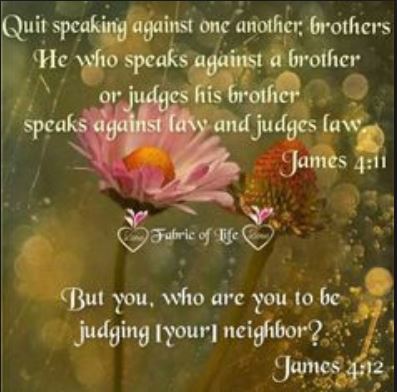
James 4:11-12 explains why we are not to judge.

“Speak not evil one of another, brethren. He that speaketh evil of his brother, and judgeth his brother, speaketh evil of the law, and judgeth the law, but if thou judge the law, thou are not a doer of the law, but a judge. There is one lawgiver, who is able to save and to destroy: who art thou that judgest another?”

The “lawgiver” is YHVH and the “law” or “Word” is Yeshua.  Yet, not even Yeshua judged others when He came to earth the first time, so it is not our place to judge others either (John 12:46-48). When Yeshua returns, He will judge others (2 Tim 4:1). Those who return with Yeshua to reign with Him will also judge the world (2 Cor. 6:2). While we are still in our imperfect state, we are not to judge, for we, too, are still weak enough to succumb to temptation. Therefore, we are to love and encourage each other and to gently admonish one another when necessary, but it is not our job to judge each other.

Letting Go

your right hand upholds me

As newborns, we automatically close our little fists around objects near to us. When someone holds us, we cling to their clothing or to an offered finger or sometimes to a strand of hair. It seems that most of my life I have been clinging to treasured objects, precious dreams, or beloved people. It is difficult and painful to let go. Sometimes it seems impossible, certainly unthinkable.

We were born for love and fellowship, yet we must learn to let go of loved ones. We were created for enjoyment and pleasure, yet often we must let go of that which delights us. Why this paradox? I’m not sure I have the answers, but I will share the thoughts I have gleaned from decades of clinging, then letting go.

The more we value someone or something, the greater the pain when we must let go. The pain lasts for a long time, sometimes for the rest of our lives. At times we cling to the pain as a way of trying to hang on to what we lost. In the end, it becomes necessary to let go of even the pain if we are to move forward.

Why does YHVH allow loss and pain? He is the source of love, beauty, fellowship, joy, shalom. Why does He allow so much suffering and anguish? Doesn’t He realize how horrible it is to let go, especially to let go of someone you love and cherish?

Yes, He does know. He relinquished His only begotten Son to a fallen, cruel world to share in our sorrows and sufferings. He then allowed this precious Son to take on all the sin and pain and suffering and endure excruciating pain and misery in order to save us from an eternity of wretchedness and hopelessness. For a time, He put us ahead of even His most beloved Son.

We are on this earth to learn to let go (Matt 6:19-21; Luke 9:62)). That doesn’t mean that we are not supposed to love others, to enjoy or to cherish hopes, dreams, even objects. It means that we must be willing to release each treasure when the time comes until there is only One Whom our fists and our hearts embrace. We must put Him first.

We are on this earth to cling to the Source of all that we love and value. When we let go and cling solely to Him, we learn a valuable truth. YHVH released Yeshua and watched Him endure untold suffering and death. However, that is not the end of the story. Yeshua has been reunited with YHVH forever and sits at His right hand. All that we have relinquished will one day be restored to us if we cling to YHVH and put Him first. In the end, we can have it all.

The Overlooked Sin

no one comes to the Father

The Jews had an opportunity to accept their Messiah or reject Him at His first coming. While many Jews accepted Yeshua as their kinsmen Redeemer and King, the majority did not. Over the centuries, many peoples have hated and persecuted the Jews, citing the rejection and crucifixion of Yeshua as “justification.” Many people smugly criticize the Jews and yet are guilty of the same sin.

The same challenge is presented to each of us. Do we accept Yeshua as our Redeemer and King? Have we asked for forgiveness of our sins and invited Yeshua to be King over us?

Jewish leaders resented Yeshua’s criticism of their man-made traditions and their hypocrisy. They wanted to do things their own way (Luke 6:1-12; Luke 7:29-30). They refused the help they so desperately needed.   Some people today say that belief in God is for weak people, not recognizing that they, too, are weak people who very much need a Savior. They believe that they are capable of running their own lives and sometimes the lives of others without Yeshua’s help.

Jewish people were looking for a leader who would save them from physical oppression (John 6:14-15). They didn’t realize that the spiritual oppression Yeshua overcame is far more serious and is also the root cause of the physical oppression. Many people today are focused solely on the physical realm, unaware or misunderstanding the spiritual realm. We can choose to renounce our subjection to Satan and embrace the salvation offered by Yeshua, but it is a choice that each of us must make in order to enter the Kingdom of YHVH.

Jewish people believed that being born Jewish was sufficient or that following the traditions and rituals established by men would secure them a place with YHVH.

Many people today believe that it is enough to be a “basically good person” or to belong to a particular denomination or congregation. Many people do not recognize their own sins, especially the most glaring one, the sin of rejecting Yeshua as their Redeemer (Luke 5:32).

Yeshua died a gruesome, violent death to pay the penalty for our sins and to ransom us from the grip of the evil one. Do we honestly believe that we can ignore Yeshua’s redemptive work and make our own way into the Kingdom of YHVH? If this were true, then Yeshua’s work would have been a waste of time and effort. Do you honestly assume that YHVH made the agonizing decision to send His precious Son to be slaughtered on our behalf, but is now willing to overlook our rejection of His beloved Son and His hard-earned gift of salvation?

Do not be deceived. No matter how “good” you are and no matter how exemplary your life has been, you have absolutely nothing to offer that can save you from eternal damnation. You are like a drowning person who has been thrown a precious Lifeline. However, it is necessary to seize and cling to this Lifeline in order to be acceptable to YHVH.

When Will Yeshua Return?

blessed is He who comesAmid endless speculation and discussion concerning end times events, and especially the timing of Messiah Yeshua’s return, one important factor is often overlooked. Both the Old and New Testaments agree that one thing must happen before Yeshua will return (Matt 23:39). The Jews as a group must invite Yeshua to return.

At Yeshua’s first coming, He announced that He was the long-awaited Messiah and performed signs and wonders that only Messiah would be able to perform. However, many of the Jewish leaders were threatened by Messiah’s coming. Yeshua criticized their practices and leadership. They did not humble themselves and submit to Messiah’s kingship, but rejected Yeshua and many Jews followed the guidance of their leaders and rejected Him as well.

 Yeshua warned them that He would not return to them until they proclaimed, “Blessed is He that comes in the name of YHVH.” In 70 AD the Temple was destroyed as and the Jews were killed or driven from Israel. Although, there has always been a small remnant of Jews who remained in the land, the Jewish people would not again reside in the land as a nation until 1948.

 It is now over 70 years since Israel was declared a nation once again. So, why hasn’t the nation of Israel made the statement necessary to usher in Messiah Yeshua’s return? What are the obstacles to Israel welcoming Yeshua as Messiah? The list below provides some insight:

  • Persecution of Jews at the hand of Christians in the name of Jesus for 2000 years
  • Reading the New Testament is forbidden or discouraged for many Jews since it is viewed not only as heresy, but is perceived as a hate document due to the aforementioned persecution
  • Key passages of Old Testament Scripture pointing to Yeshua are forbidden reading or are not included in the Parasha series in most Jewish congregations.
  • False teaching and tradition regarding Yeshua from both Jewish and Christian leaders
  • Fear of the loss of identity as Jews due to false Christian teaching (having to relinquish worship, feasts, Sabbaths, etc. and adopting practices that are not only foreign, but are even expressly forbidden by YHVH
  • Speaking the name of YHVH. Current common practice is that the name of YHVH is too sacred to be written or pronounced aloud, rendering it impossible to welcome the One Who comes in the name of YHVH.
  • Misunderstanding of the tri-une God and thus rejection of Yeshua as the Son of YHVH or as equal to YHVH because YHVH is one (echad). Actually, echad not only designates the number one in Hebrew, but can also designate unity, such as a husband and wife who are one (echad).

 Both Jewish and non-Jewish believers in Messiah Yeshua who yearn for Yeshua’s return can play a vital and active role in addressing and removing these obstacles. How can we make a difference?

 First, pray for the salvation of Israel and for the Jewish people still scattered throughout the world (Gen 12:2-3).

 Second, educate yourself and seek the truth concerning the history and development of Christianity, the various forms of persecution of the Jews by Christians over the past two thousand years, the reasons for avoiding the name of YHVH, and so on. Seek to understand the misconceptions of the Jewish people as well as your own misconceptions. Some suggested resources are listed at the end of this article (Hosea 4:6).

Third, reach out to the Jewish people with love and understanding. Seek forgiveness and reconciliation where needed (Ps. 133:1).

 YHVH has always known that the enemy would go all out to bring about the rejection of Messiah Yeshua and to try to prevent Yeshua’s return in glory. YHVH is well aware that the enemy would succeed in deceiving humans into cooperating with him. However, YHVH has graciously provided opportunities to each of us to shake off the lies, embrace the truth and reverse the present course

 YHVH carries out His plan through us even when our own efforts are misguided. This is clearly demonstrated in the gospel accounts of Yeshua’s entry into Jerusalem on a donkey just days before His crucifixion. The people were lined up with palm branches silently awaiting the arrival of the high priest’s spotless Passover lamb. His followers recognized the true spotless Lamb (Yeshua) and began to hail Him. The others, thinking that the high priest’s lamb had been spotted, joined in the chorus, not realizing that they were “accidentally” hailing the ultimate High Priest and Lamb.

 YHVH will see to it that the Jewish people recognize their Messiah. Yeshua will return to Jerusalem to begin His reign on earth. We can have the privilege of helping in YHVH’s plan by doing our part to bring about this glorious event.

Suggested Resources

Our Hands Are Stained with Blood by Michael L. Brown

Answering Jewish Objections to Jesus by Michael L. Brown (3 volumes)

Introducing Your Jewish Friend to Yeshua by Daniel Nessim and Mark Surey

The Messianic Church Arising!:Restoring the Church to Our Covenant Roots by Robert D. Heidler and Chuck D. Pierce

Restoring The Jewishness of the Gospel:  A Message for Christians Condensed from Messianic Judaism by David H. Stern

Messiah in the Feasts of Israel by Sam Nadler

Invisible Treasure

keep pursuing the goalAs discussed in previous article, Yeshua paid a heavy price for His treasure. We are His pearls of great value. Yeshua is our Pearl of great value, a value far beyond what we can comprehend. Yeshua was once on this earth, but we can no longer see Him. However, He is real and still very much alive, even though to us He is invisible right now.

Let us examine Scripture to learn some of the aspects of Yeshua’s value. The following list is but a fragment of all that describes Messiah Yeshua, but it is plenty for us to contemplate. Yeshua is fully human, but He is also fully God (Matt 16:16; 1 Tim 3:16)). Our treasure is God Himself! Our Father refers to Yeshua as “My Beloved Son. (Matt 17:5).” In western thinking, we tend to view Yeshua as somewhat inferior to Father, but in Hebrew thinking the firstborn son is equal to his father. Colossians 1:15 refers to Yeshua as the first-born of every creature. Yeshua came to restore all creation.

 Our Redeemer is the Creator and Upholder of all things. (Col. 1:16; Heb.1:3). Yeshua refers to Himself as the Alef and the Tav (in Greek, the Alpha and Omega) (Rev. 1:8, 22:3). In ancient Hebrew, each letter was a picture. The alef is the first letter of the Hebrew alphabet and was a picture of a strong bull designating both a leader and a protector. The tav, which is the last letter of the alphabet, was a picture of a cross being carried. Yeshua, Who is first and strongest, made Himself to be last and weakest for our sake (John 1:29).

 Yeshua is eternal life (1 John 1:2; John 11:25). We all face death in our mortal bodies, but we have hope of eternal life in and through Yeshua. In our present life, we may have many trials and tribulations, but we can look forward with hope to a joyous and triumphant life in Messiah Yeshua for eternity.

 Everything we will ever need or desire is in Yeshua. He is our Shepherd (John 10:16). He is the true Vine and we, the branches, receive power and abundant life through Him (John 10:10; John 15:5). It is only with His lifeblood flowing through us that we are able to be fruitful in the Kingdom of God.

 Yeshua is our Provider (John 6:35) and with Him we will want for nothing. We need never fear for Yeshua is also our Rock (Ps. 19:14; 1 Cor 10:4); and our Refuge in all the storms that threaten us (Isa 25:4). Yeshua is our wisdom, righteousness, holiness and redemption (1 Cor 1:30).

 Many people mistakenly believe that there are many ways to God. Yeshua has revealed to us that no one comes to the Father except through Him (John 14:6). Even if it were possible to find another way to the Father, why would we desire anyone or anything else? Yeshua is everything to us (Col 3:11). Therefore, it is our joy and privilege to die to ourselves, so that we may have life in Him. If we are willing to give up all that we have, we will be abundantly compensated (Mark 10:29-30). Our Pearl is priceless indeed!

Buried Treasure

Finding 1 pearl of great value

Again, the kingdom of heaven is like a merchant seeking fine pearls, and upon finding one pearl of great value, he went and sold all that he had and bought it (Matt 13:45-46 NIV)

 Have you ever thought of yourself as valuable? Have you ever considered your true worth? Do you realize how precious you are?

 After Adam and Eve sinned, they lost their glory. They were stained, no longer perfect. They saw their nakedness and were embarrassed and ashamed (Gen 3:7 NLT). They tried to cover up their loss of glory by using fig leaves sewn together. It was not enough. They were still “damaged goods.”

 Even though YHVH was angry with them for their disobedience and lack of trust, He took pity on them. He slew animals and made temporary coverings for Adam and Eve. The Author of life now had to take back the life that He had given to some innocent animals, so that Adam and Eve could be covered, not just physically, but spiritually.

 Animals continued to be sacrificed to cover the sins of Adam and Eve’s offspring. All of nature suffered right along with humans. The blemishes and stains multiplied, while the glory of creation diminished.

 The enemy must have thought he had accomplished his goal. Surely the perfect Creator would discard the earth and its inhabitants. How could YHVH, Who is pure and holy, accept something so tarnished especially those who had been created in His image and likeness? They were a lost cause, or so the enemy thought.

 However, the all-knowing and all-seeing YHVH was already prepared with a plan to rescue and restore what had been damaged or lost. In due time, YHVH would beget a Son and send this most precious Son to be the ultimate sacrifice for us.  The spotless and blameless Yeshua would be sacrificed for the sinful and guilty.

 Yeshua embraced this role, and willingly sacrificed all that He had, even His own body, to pay our debt and our ransom to get us back. Through Yeshua’s shed blood we are once again restored to glory. Yeshua looked through all the ugliness of our sin and saw something precious, so valuable buried within us that He gave everything that He had to purchase us.  What unseen glory awaits us now that we belong to Him again?

And we all, who with unveiled faces contemplate the Lord’s glory, are being transformed into his image with ever-increasing glory, which comes from the Lord, who is the Spirit (2 Cor 3:18 NIV)

Restoring the Bride of Messiah

marriage of the Lamb

In my previous article, we had a glimpse at how the Bride of Messiah has become fragmented over the past 2000 years and how it is now being restored. YHVH is calling many of Yeshua’s followers to explore their Hebrew roots, to learn His name and use it with reverence and awe, to function in the gifts of the Holy Spirit for strengthening the Bride, and to continue to preach the good news of the Kingdom of YHVH throughout all the ends of the earth. YHVH is uniting the fragments to restore the Bride of Messiah. If indeed YHVH is restoring the Bride and we are part of the Bride of Messiah, then each of us has an assignment, a part to play in this restoration.

 How do we find out our personal assignment and ensure that the Bride is prepared to meet her Husband? YHVH must not only unite the various groups and segments of the Bride, but each individual must understand and operate in all the truth. What do we do? Where do we start?

 The best place to start is to come before YHVH and seek His heart. This is best done through praise and worship. As we worship YHVH, He reveals His heart to us. He lets us know how to intercede for our brothers and sisters in Yeshua. YHVH also communicates to us the direction we are to take or the assignment He has designated for us. Sometimes His revelations will catch us off guard, so we must be open and ready for change, even in ourselves.

 In order to be receptive to what YHVH wants to reveal, we must search our own hearts and minds and ensure that we are actively seeking truth, whatever the personal cost. Seeking the truth means letting go of false strongholds, false beliefs, false perceptions. When we seek truth, we must be ready and willing to relinquish our “comfort zones.”

 Our assignments from YHVH will often begin, not with changing others or with some type of outreach, but rather with submitting ourselves to the Potter to be remolded. Many of us have inherited lies from our ancestors.

 [YHVH], my strength, my fortress,
my refuge in time of trouble,
the nations will come to you
from the ends of the earth, saying,
“Our ancestors inherited nothing but lies,
futile idols, completely useless.” (Jer 16:19 CJB)

 When we come to YHVH, we want to come armed with the truth, not the inherited lies. We certainly do not want to come with idols, for these are an abomination to YHVH. Anything we cling to and cannot relinquish to YHVH is an idol. It may not be a carved statue, but it is still a false god. We must be willing to lay ourselves on the altar and ask YHVH to remove the chaff in our lives and leave us with only the finest wheat. Then, we will be ready for our next assignment in restoring the Bride of Messiah. Let us be about our Father’s business (Luke 2:49 CJB).

The Fragmented Bride

Bride of MessiahIn our own spiritual journey, the Holy Spirit has led Peter and me to various congregations and ministries. Each new experience taught us something about living and functioning as members of the kingdom of YHVH. Although we fellowship with various groups and congregations, we continue our search for the one congregation where we are encouraged to put all the newly-acquired pieces together.

 A brief summary of our journey may help to paint this picture more clearly. At one congregation, we learned to love each other unconditionally. However, the Spirit moved us on to another congregation to learn our Hebrew roots so that we might gain a more accurate knowledge of the history of our faith and acquire a better lens through which to understand both Old and New Testaments. Once again the Spirit moved us on to various ministries and congregations in order to understand better how we should be functioning in the gifts of the Holy Spirit. A separate ministry supplied us with a more mature understanding of our spiritual enemies and how to be delivered from bondage to the enemy. Interaction with various other ministries confirmed the message I had received from Father that we were to call Him by His name. While we are grateful for these congregations and ministries, we wonder why each group seems to have part of the truth, but not all of the truth.  After meditating on Acts chapters 2 through 8, I began to realize just how fragmented the Bride of Messiah has become over the centuries.

 The first eight chapters of the Book of Acts paints a very different picture of the living functioning Bride of Messiah. Yeshua’s followers lived together in close proximity to one another sharing all their belongings. As a unit they prayed, praised and worshipped, studied, healed, preached, taught, learned, and shared all their possessions (Acts 2:42-47). Today, we and many others must search from place to place to acquire what we need to be mature contributers to Yeshua’s Bride.

 When did the fragmenting start? Right away, since the majority of Jewish leaders and many of their followers rejected Yeshua as their Messiah. Yeshua’s followers went to the Temple as YHVH commanded in the Torah, but they had to go outside the Temple parameters in order to learn about Yeshua. Although not perfect, the first generation of Yeshua’s followers provided a more complete picture of what the Bride should be. As time went on the Bride became further fragmented as the good news spread and Yeshua’s followers were scattered over several nations. Distance, persecution, poverty and other trials helped to foster misunderstanding, suspicion, and outright abuse or neglect of each other, especially dividing Jews from non-Jews. Constantine’s efforts to unite his massive empire mingled in pagan practices and beliefs, and at the same time sought to eliminate all ties to Jewish or Hebrew roots. Over time empty manmade rites and rituals increasingly replaced true relationship with YHVH.

 At this time, YHVH seems to be restoring the Bride, perfecting her in anticipation of Yeshua’s return. Several congregations that we have met with locally are seeking to restore the missing pieces in their groups. Three Messianic congregations in India have demonstrated for us the most complete example thus far of how the Bride should function. These congregations function according to their Hebrew roots, actively preach and teach the good news of the Kingdom of YHVH, operate daily in the gifts of the Holy Spirit, and call the Father by name. They do so in the midst of daily trials and persecution. What about each of us? How are we participating in YHVH”s work to restore the fragmented Bride?

What Is Wrong with Church?

Bride of Messiah

Scripture has much to say about fellowship among followers of Yeshua. Many people have construed passages such as Heb 10:24-25 and 1 Pet 2:5 to urge us to join a congregation. For centuries people have sought fellowship in church, seeking community, accountability, support and encouragement. However, currently there are multitudes of believers fleeing the established church setting. Why?

 Scripture exhorts us to meet together, to support and encourage one another, to call one another to account and to be accountable to others, to bear one another’s burdens, and so on. While it is true that we need to do these things, it is not necessarily true that a church setting is the best environment to foster such activities. In fact, traditional church practices often hinder or discourage people from following Scripture’s mandates. Here are some examples of how we can lose focus in a church setting:

 Focus shifts to a human agenda rather than the Holy Spirit’s agenda. We can get caught up in our programs and projects and lose sight of our true mission (John 3:6-8; Acts 8:39; 1 John 5:6; John 14:26). We fail to seek guidance daily from the Holy Spirit and draw away from our Father’s plan.

  • Focus centers on the needs of the church entity while neglecting individual needs. Many times people come to service week after week heavily burdened with trials or sin and leave carrying the same burdens. Even if the congregation has an established order of service, does it also provide opportunities through small groups, prayer ministers, or some other means to assist individuals? Is there effective prayer for healing? Are demons expelled? (Matthew 10:7-14)
  • Focus settles on certain truths to the exclusion of the rest of the truth. Is the emphasis on adhering to established doctrines or on learning more about YHVH and His will for us? (John 16:13)
  • Focus turns inward with little or no outreach from the congregation. Do we reach out to those around us who do not yet know the joy of salvation in Yeshua?   Do we help others in need or do we judge them? Do we have an exclusive “club” where we feel comfortable and outsiders remain outsiders? (Matt 25: 35-40; Mark 16:25; Rom. 10:14; Acts 1:8)
  • There is strong temptation to settle into a comfort zone and stagnate. Spiritual growth becomes a threat. Change becomes an unwelcome challenge. (Eph 3:17-19; 2 Pet 3:18)
  • The agenda of an established hierarchy replaces the agenda of the Holy Spirit. (Matt 15:3; Mark 7:3-9)

Recently, we have attended services where the congregations are working hard to address these shortcomings. Even within a worship service, there is room for the Holy Spirit to take over the meeting. Active outreach to the community is passionately pursued by the congregation. There are opportunities for people to seek individual prayer and support so that they do not carry burdens alone.

 We need to broaden our definition of fellowship. There are numerous opportunities to have “church” daily. Tim Mather explains in his book, Escaping Church, that any time we share the good news with another, encourage or advise or pray for another, or have discussions about our faith with others, we are “doing church.”

There are other ways for congregations to restore what is missing that I will discuss in my next article. It is time to repair Messiah’s broken body. It is time for the bride to prepare herself to meet her Husband. It is time for us to have true fellowship with one another.