Category Archives: Nancy’s blogs

A House United

that they all may be oneA 2009 Barna Group article entitled “Most American Christians Do Not Believe that Satan or the Holy Spirit Exist”* sheds light on some basic reasons for the divisions and disagreements among members of the Body of Messiah. The nationwide survey on adult spiritual beliefs indicates that there is much disparity and confusion among American adults on the subject of their faith. Here are some interesting points to consider:

  • Roughly one-fourth of those surveyed aren’t sure who God is.
  • Sixty percent think that Satan is or could be just a symbol of evil, not a living being, yet about 47% of those people believe they are influenced by demons
  • Approximately 48% of those surveyed believe that Jesus sinned or might have sinned while He was on the earth
  • Approximately 58% believe that the Holy Spirit is not a living force, but a symbol of God’s power, although half of that group believes that the Bible is totally accurate in all the principles it teaches.
  • Well over one-half believe that the Bible is accurate in all the principles it teaches, yet approximately one-third of that group also believes that the Bible, the Koran, and the Book of Mormon all express the same spiritual truths.

Several truths glared out at me after studying this survey. First, we need a personal relationship with the Father, Yeshua, and the Holy Spirit in order to understand clearly who God is. Those whose statements on their faith could categorize them as “born again” were more consistent and clear about the Bible’s accuracy, the influence of demons, the true identity of the Holy Spirit, the nature of God (omniscient, omnipresent, e.g.). They were also more adamant that a person must choose between God and Satan and that there is no middle ground. We are called to represent Yeshua on the earth. How can we do that if we don’t truly know Him? We must not only be born again, but we must actively pursue a relationship with YHVH.

Second, it is essential to know the Holy Spirit, for Yeshua promised to send us the Holy Spirit to dwell within us (John 14:16-17). If you are born again, you are born of the Spirit (John 3:6-8). In order to truly follow Yeshua, it is necessary to abandon the sinful nature and live according to the desires of the Holy Spirit (Rom 8:5-6). It is essential to eagerly seek all that the Holy Spirit has to offer to us. The Holy Spirit leads us into all truth (John 16:13. 14:26; 1 John 5:6). Baptism in the Holy Spirit is vital for each member of the Body of Messiah (Matt 3:11, Acts 1:5).

Third, all believers need deliverance. We were born into the kingdom of darkness and in bondage. The divisions, accusations, moral scandals and confusion within the Body of Messiah are all evidence that many believers are still in bondage to Satan.  If deliverance were offered to and accepted by all followers of Yeshua, Satan would lose a lot of his current influence and the credibility of those representing Yeshua would rise considerably. Once we have been delivered from demon oppression, the “blinders” are removed and we see more clearly how our enemy operates. We can then engage in spiritual warfare effectively (Rom 12:21; 1 John 4:1)

Fourth, those who believe in the accuracy of the Bible and at the same time believe that the Koran and the Book of Mormon teach basically the same principles, clearly need a better understanding of the Bible as well as the teachings of the other two books. It is essential to accurately understand our Hebrew roots in order to truly comprehend the Bible. Many Christians who are well-versed in Scripture are still lacking this basic paradigm for understanding what the Bible says.  In other words, they are well versed in what they think the Bible is saying, but they still lack a great deal of understanding that our Jewish brothers and sisters in Yeshua can teach us.  My people perish from a lack of knowledge (Hos 4:6 KJV).

What would happen if the Body of Messiah had a deep, personal relationship with YHVH, were free from demonic manipulation, were taught and guided exclusively by the Holy Spirit, and had a firm grasp of the Bible? The Body of Messiah would become more unified, more certain of the truth, and more effective in the Kingdom of YHVH.  We would be powerful citizens of YHVH’s kingdom and more effective workers in His harvest.

We, as followers of Yeshua, are called to be united. If some of us deny the existence of Holy Spirit, Who guides us into all truth, or of hasatan who guides us into all lies, then confusion and division are inevitable. We are on the battlefield in the middle of a war. If all of us don’t recognize our Commander and listen only to His voice, how can we hope to be united in Him? If we can’t identify the enemy and his wiles, we will not be able to defend ourselves against his attacks. Our enemy knows that his time is growing short, so he is increasing his efforts to bring us all down. It is more important than ever to stand united.

How I beseech you, brethren, by the name of our Lord Jesus Christ, that ye all speak the same thing, and [that] there be no divisions among you; but [that] ye be perfectly joined together in the same mind and in the same judgment. (1 Cor 1:10-12).

 Make every effort to keep the unity of the Spirit through the bond of peace.  There is one body and one Spirit, just as you were called to one hope when you were called;  one Lord, one faith, one baptism;  one God and Father of all, who is over all and through all and in all (Eph 4:3-5)

I have given them the glory that you gave me, that they may be one as we are one— I in them and you in me—so that they may be brought to complete unity (John 17:22-23 NIV).

* “Most American Christians Do Not Believe that Satan or the Holy Spirit Exist. Barna Group, 2009, https://www.barna.org/barna-update/faith-spirituality/260-most-american-christians-do-not-believe-that-satan-or-the-holy-spirit-exis#.VbuKg_mpeSo

Restoring the House

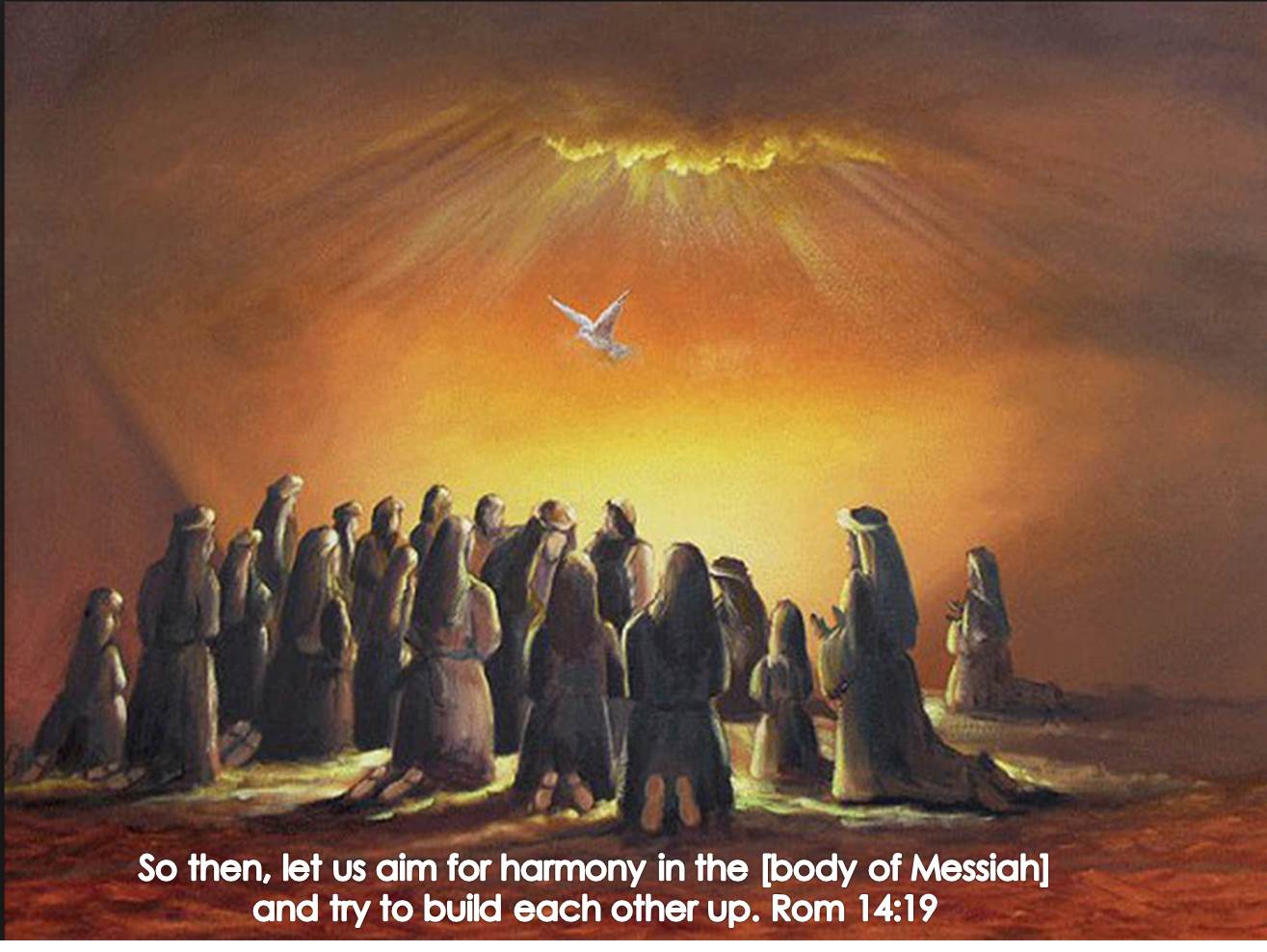
harmony in the body

In last week’s article, we examined the importance of embracing all the truth that YHVH has revealed. Our failure to receive the truth and employ the gifts Elohim provides has caused division and dissension within the Body of Messiah. Our assignment from YHVH is to build up His Body (Matt. 28:16-20) and prepare ourselves to live in His kingdom (Eph 4:13-15). It is time that we re-consider the gifts and tools that are missing in our lives.

For example, some followers of Yeshua say that speaking in tongues is from the devil. Are they saying that YHVH used a sign from the devil to demonstrate that His Holy Spirit had fallen on the followers of Yeshua? (Acts 2:4, 1 Cor 14:2) Speaking in tongues serves as evidence that we have received the Holy Spirit (Acts 10:44-47, 1 Cor 14:22). Actually, praying in tongues is a very powerful tool to strengthen the user (Jude 20). We can pray in tongues when we aren’t sure how to pray in our native language (Rom 8:26). We can us tongues to intercede powerfully on behalf of our brothers and sisters (Eph 6:18).

From the very beginning, there has been misunderstanding and misuse of the gift of speaking in tongues. Hasatan wasted no time in working through people’s pride and immaturity to discredit this gift. When we refuse the gift of speaking in tongues or abandon its use, we lose many opportunities to strengthen ourselves and to assist our brothers and sisters in Yeshua.

Healing the sick is suspect among many believers in Yeshua. Yeshua clearly stated that His followers would lay hands on people and they would get well (Luke 10:9). Sometimes we pray for the sick and they don’t recover, so we give up. Does that mean that healing is not for today? Consider Yeshua’s followers who were unable to expel a demon. Yeshua rebuked them for their lack of faith and then proceeded to expel the demon Himself (Matt 17:14-20). The laying on of hands for healing others is part of our commission from Yeshua (Luke 10:9).

The gift of prophecy is also misunderstood by many. Some people believe that because the Bible is now complete and nothing new is being added, that prophecy has ceased. However, the prophets spoke their messages to the intended audience. At some point, they also recorded the message in writing, but first it was spoken and sometimes demonstrated to enhance understanding (Jer 1:17, 2:2; Hos 1:2) Fortunetelling is hasatan’s counterfeit for prophecy. Prophecy is relaying a message from YHVH at His command to individuals or groups of people, sometimes to a whole nation.  We are expected to prophecy as the Holy Spirit leads (1 Cor 14:39).

For everything that comes from YHVH, hasatan has created a counterfeit to try to discredit YHVH and to cause confusion among humans. We must be discerning at all times and we cannot do this without direct assistance from the Holy Spirit. Therefore, we need infilling or baptism of the Holy Spirit and we need to be open to His direction at all times. Whatever we truly hear from the Holy Spirit will always line up directly with Scripture. YHVH does not contradict Himself.

Perhaps the most misunderstood and least used gift is deliverance. Hasatan has done an excellent job at persuading us to avoid deliverance because it has such a negative impact on his work. Thus, many people in our culture do not even acknowledge that there are demons. Others believe that demons can only affect non-believers. In addition, there has been and still is unnecessary drama in deliverance sessions. If we ask the Holy Spirit to take charge and follow His guidance, deliverance can be accomplished in a calm and orderly manner.

Most people react with outrage when confronted with the possibility that they may be in bondage to demons, saying something like “I’m a nice person.” That is probably true, but can you picture demons reporting back to their leader with the excuse that “we just couldn’t do it because he is such a nice person? In the physical realm, we can be assaulted or kidnapped by others despite the nature of our character.

Hasatan is well aware of his final outcome since it has already been recorded by YHVH in Scripture (John 12:31, Rev 12:9). The best he can hope for is to take down as many humans as he can while he has the opportunity (2 Cor 4:4).   He is delighted when humans, who were created in YHVH’s image, do anything to mar that image. Hasatan has no pity or compassion, but is the father of lies (John 8:44) who seeks to steal, kill and destroy (John 10:10). So you are a nice person? Fine, hasatan will take care of that. In fact, he has been seeking opportunities to snag you from the time you arrive on earth.

Can believers be in bondage to demons? Yes! Right after YHVH revealed the Messiah to Peter, hasatan worked through Peter to try to dissuade Yeshua from His mission (Matt 16). Even though Peter spoke the words, Yeshua confronted hasatan.  Consider also the Corinthians, who were born again, baptized in the Holy Spirit, and operating in the gifts of the Holy Spirit, yet were still heavily influenced by demons and subject to sin (1 Cor 3, 5). Over the centuries, many denominations and congregations have suffered from the scandalous behavior of their members, sometimes even their leaders.

Lack of trust in YHVH is our biggest barrier to accepting the gifts of the Holy Spirit. Lack of trust stems from our two worst enemies: fear and doubt. Trust is built as we get to know YHVH personally and interact with Him. As we learn to trust Him in small things, we can move on to bigger things.

Hasatan knows the power of YHVH’s weapons and tools. He knows one sure way to thwart YHVH’s plan is to persuade us to relinquish our weapons. If hasatan can convince us that the gifts of the Holy Spirit are not from YHVH, but from hasatan, then we will avoid them and think we are doing a very good thing. If he can persuade us to fear or mistrust the most powerful weapons, we won’t be able to use them against him. We will not be effective in building up YHVH’s kingdom. Instead, we will be assisting hasatan in building up his kingdom.

We tend to conform to and become like the god we serve (Ps 115:8). Division, chaos, dissension, mistrust, accusations, self-righteousness are from hasatan. Unity, order, harmony, trust, acceptance and true righteousness are from YHVH. So a Body of Messiah that is riddled with division, confusion, and self-righteous accusations is serving whom? Let us serve YHVH and restore the house that YHVH built by using the gifts and tools He gave to us.

A House Divided

House divided

One dark, stormy day a family decided to put together a jigsaw puzzle. They believed that this activity would bring them closer as a family. As they sat down to work together on this common project, something strange happened. Each person became enamored with one or more pieces of the puzzle and insisted that his or her small collection comprised the entire puzzle and refused to even consider any of the other pieces. The family members started arguing and soon the argument became more hostile. They stopped speaking to one another and each stormed off into a different room of the house with a fragmented portion of the puzzle. The family is still torn apart and the picture is never completed.

This may sound like a ridiculous scenario, yet the followers of Yeshua/Jesus have done just that. Currently, there are about 34,000 different Christian denominations that follow Yeshua/Jesus. Each clings to its own pieces of the truth, believing those pieces make up the entire truth. The result is distrust, bitterness, envy, self-righteousness and a host of other sins. In contrast, the Father, Son and Holy Spirit are in complete harmony and unity at all times. Disharmony and division are not from YHVH, but rather from His enemy, hasatan.

Our enemy, hasatan, knows how powerful the Body of Messiah would be if all its members accepted Yeshua’s gifts and functioned in unity according to YHVH’s plan. Our enemy has done an excellent job of dividing us and weakening the Body of Messiah (2 Cor 11:13). How can the enemy be so successful among followers of Yeshua? He can only do so with our cooperation.

We have lost sight of the fact that when we asked Yeshua to be Lord of our lives and became born again, we relinquished our citizenship in the kingdom of darkness. We are now citizens of the kingdom of YHVH and are subject to Him. We may have thought we were running our own show before we agreed to submit to YHVH, but in truth we were submitting ourselves to hasatan. We are to look to YHVH for truth, wisdom and direction. Instead, we have relied on our own feelings, biases, and fears rather than trusting YHVH at His word. We do not realize that we are still serving hasatan.

At His first coming, Yeshua provided a perfect example of what we are to be and how we are to function. If Yeshua cast out demons by the power of the Holy Spirit, then so must we (Luke 10:17). If Yeshua healed the sick and raised the dead through the power of the Holy Spirit, then so must we (Luke 10:9). If the Holy Spirit uttered prophecy through Yeshua, then we must expect the Holy Spirit to do the same through us as He sees fit (2 Cor 14:1). If Yeshua celebrated YHVH’s feasts and Shabbats, then so must we (Mark 2:28; Mark 14:16; Luke 7:1-10).

When we refuse parts of the truth, we commit sin and grieve the Holy Spirit. If we deny the reality of the gifts of the Spirit, spiritual warfare, our Biblical roots, or any other part of the truth, we are declaring that we believe YHVH’s ways to be faulty or incorrect.   When we refuse part of YHVH’s truth, we take a stand for darkness rather than light and we play into the enemy’s plan for us. We remain divided.

Stand Firm in Love (Part 2)

Let all you do be done with love

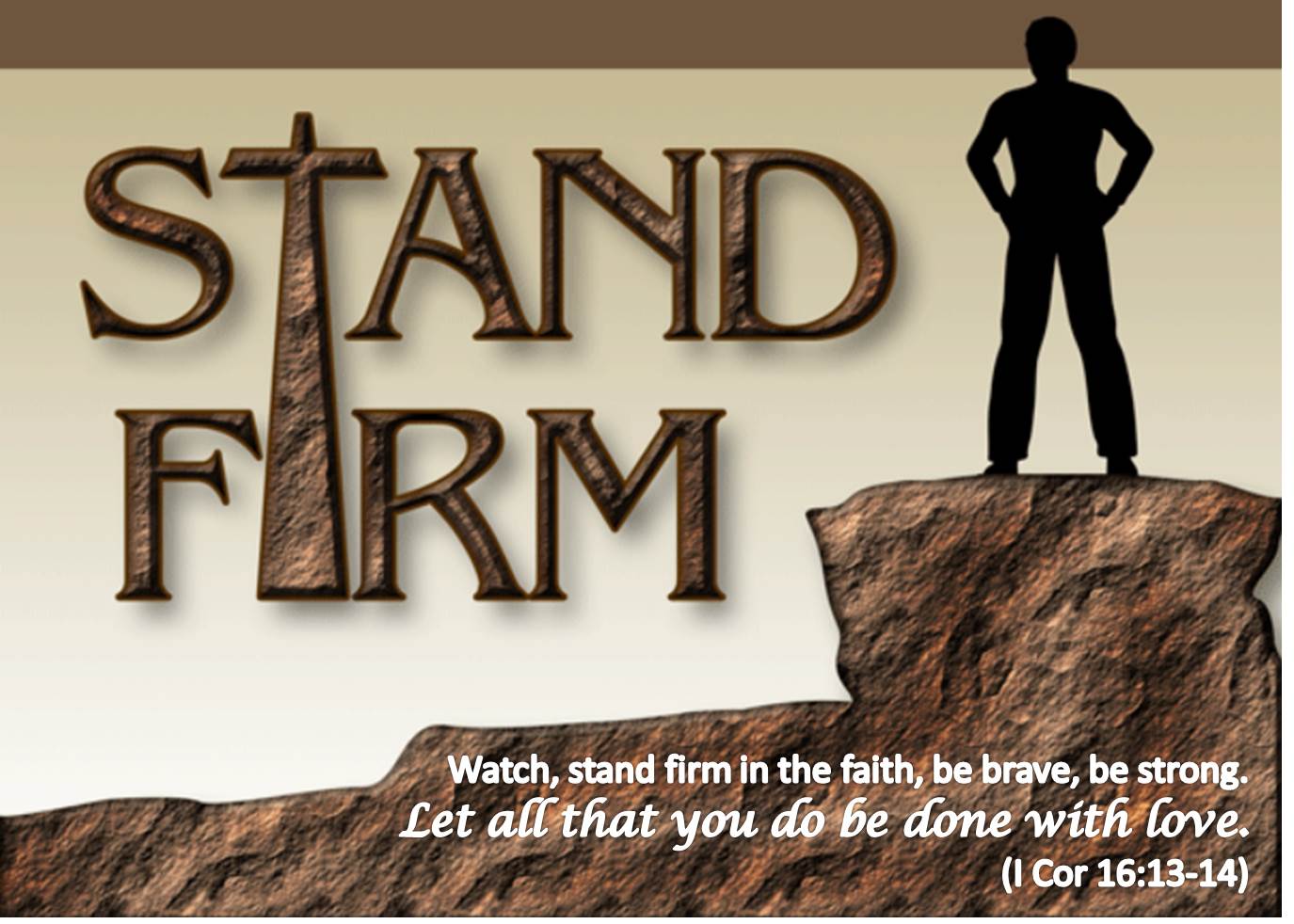
“Watch, stand fast in the faith, be brave, be strong. Let all that you do be done with love.” I Corinthians 16:13-14

Last week, I focused on Verse 13 above as I spoke about holding fast to our convictions when we know they are clear instructions from YHVH’s word. In Part 2 this week I will focus on the second part of this passage above, which says that everything we do should be done in love. From I Corinthians 13 Verse 2 we know that even if we are working miracles through Holy Spirit gifts and have greater faith than the Apostles, “so that we could remove mountains, but have not love, we are nothing”.

The same adage goes for mentoring and discipling other believers – if we are not “speaking the truth in love” (Eph 4:15), then we are better off not speaking at all. Whenever the Holy Spirit puts on our heart that we are to speak with someone, our words need to be spoken “with grace, seasoned with salt, that we may know how we ought to answer each one” (Col 4:6).

When we put this together with Verse 13 above, it means that we are to stand firm in our convictions and not be swayed by the world’s compromise with YHVH’s word, but when we do speak out we need to be sensitive to the beliefs and feelings of others. Does this sensitivity to their beliefs mean that we are to be silent and avoid delicate topics like homosexuality? No, most certainly not! If we were silent, then we would no longer be watchman for YHVH’s Word to others in the world.

So how do we keep the delicate balance between offending people (even friends and family) and speaking the truth in love? Actually, we cannot avoid offending people when we speak God’s truth.  Didn’t Yeshua say:”And blessed is the one who is not offended because of Me” (Matt 11:6), and then: “…you will be hated by all for My name’s sake” (Luke 21:17). Many people were offended by Yeshua’s words, and He told His disciples (including us) that we would be hated when we speak His words and His name.

I believe we need to state the Godly convictions we stand on and why we are so passionate about them. This way, the person will not think we are judging them, and we will not so easily repel them with our strong words. We need to come from the perspective that we love God and want to follow His instructions because He first loved us, and because He made the most incredible sacrifice of all time for us. He hung on a tree for us when we were still sinners and didn’t deserve His love or His sacrifice.

It is only God’s amazing love that will draw people to Him. Until people understand the depth of Yehovah’s love and concern for them as individuals, and that He wants to have a personal relationship with them, there is no hope that they will listen to more serious matters. Once they reach this understanding in their heart, then you can gently start speaking to them about obedience and being pleasing to God in the way they live their lives.

Unless we speak to people out of love, we are like clanging symbols: “If I speak in the tongues of men and of angels, but have not love, I am a noisy gong or a clanging cymbal. And if I have prophetic powers, and understand all mysteries and all knowledge, and if I have all faith, so as to remove mountains, but have not love, I am nothing.” (I Cor 13:1-2) When we share the truth with others, we must season our words with grace so that we allow Abba Father to draw them to Yeshua and the Holy Spirit to convict them in their sinful lifestyle. Then the door is open for us to disciple them and pray with them so that they want change their lifestyle so that they can be pleasing to Yehovah.

We need to look at our heart motives behind our words. When we approach people about their lifestyle or behavior, do we come to them with an air of superiority or self-righteousness, or do we come to them with humility, speaking the truth to them out of love?

Stand Fast to Your Convictions (Part 1)

stand firm“And they overcame him by the blood of the Lamb and by the word of their testimony, for they loved not their lives even unto death.” Revelation 12:11

Last week, Nancy and I were deeply convicted by a powerful teaching we heard at a local congregation. The pastor was focused on getting ourselves fit for the fire that is to come in the End Times (spoken of by Yeshua in Matthew 24).  Believers could interpret this fire that is coming in different ways, but in this context I am seeing it as persecution against the Body of Messiah. Sha’ul told us that we as the Body of Messiah are to “stand fast in one spirit, with one mind striving together for the faith of the gospel” (Phil 1:27).  We are also told to stand fast as individuals in our faith (I Cor 16:13).  This means that we are to hold to our convictions that there is one true God, Yehovah, and one clear standard of morality, which is the set of instructions YHVH has given us in His Torah.

The pastor went on to speak about the need to stand up for what we know is YHVH’s standard of morality in His Kingdom.  He said that as the moral fiber of our nation continues to crumble we will have plenty of opportunities to speak out about God’s stand on moral issues.  In our society today, we have an historic opportunity to stand fast in the face of the growing fires of immorality, and to speak out to others (both believers and non-believers) about God’s standard of morality.  The Supreme Court decision to require all states to conduct same-sex marriages has given us a golden opportunity to test the strength of our commitment to uphold YHVH’s standards in the face of cultural persecution. YHVH spoke often about the abomination of Homosexuality, and He judged it as harshly as any other sin (see Judges 19-20 and Gen 19 for examples). He saw this as a violation of the sin of idolatry, that people exchanged the glory YHVH gave them for a lie, and worshiped the creation instead of the Creator (Rom 1:25).

In our home worship time with Abba, the Ruach keeps bringing Nancy and I back to the passages in Ezekiel (3:16-21 and 33:1-9) where YHVH speaks to Ezekiel about being a watchman to warn God’s people about the upcoming judgment for their sins. I think YHVH is speaking to all of us when He says: “When I say to the wicked, ‘You wicked person, you will surely die,’ and you do not speak out to dissuade them from their ways, that wicked person will die for their sin, and I will hold you accountable for their blood” (Eze 33:8). As God’s people, we are not only accountable for our own sins, but we are accountable for speaking YHVH’s truth to others and warning them about God’s righteous standard. As compassionate believers seeking to be like Yeshua, though, we must speak and act out of love and humility, seasoning our words with grace. We must not condemn or judge others out of our own self-righteousness, remembering that all have sinned and fallen short of the glory of YHVH (including ourselves). See Part 2 of this Blog as we dig deeper into how we should we should act and speak graciously when we encounter unGodly attitudes, words or actions.

YHVH is a merciful Elohim who loves us with an unconditional love. However, YHVH is also a just and righteous God who cannot tolerate sin in His presence. Some see this as an irreconcilable contradiction, but in YHVH’s never-ending mercy, He chose to save His people from their sins by sending His Son to die in place of the death we deserve. This is the amazing miracle of the Good News, but we must do our part as well. In order to benefit from God’s plan of reconciliation with us, we must repent, turn from our sinful ways, and start walking on YHVH’s righteous path. We must not think that our own sin is somehow less offensive to God than the sins of others.

Yeshua told us that He would send fire on the earth. He said that He did not come to earth to bring peace, but division, and that even family members would be divided against each other in the same household (Luke 12:49-53). We know from experience that our families are the most difficult settings to speak out God’s truth, and sometimes are the places of greatest persecution. But we also know as believers that we are to “overcome by the blood of the lamb and the word of our testimony” (Rev 12:11). And what does the rest of that passage say, that we are to “love not our lives even unto death”.

In the face of persecution from our families, friends and fellow believers, we need to stand fast to God’s standard, even when we are criticized, ridiculed, shunned by others, or face possibly even more severe consequences in future times. It is good to meditate on YHVH’s truth, knowing that nothing can separate us from His love, and that He will bless us with boundless spiritual fruit when we boldly share His truth with others.

Inside Out

fruit of the Spirit 2

The account of the fig tree that Yeshua cursed (Matt 21:18-22, Mark 11:12-14) provides many lessons such as the power we have through Yeshua over our environment or the power of faith and trust. It also shows that we must bear good fruit. Since humans are sometimes referred to as trees in Scripture (Ps 1:3 52:8; Is 44:4) this fig tree may very well represent what can happen to us.

We usually do not think of a fig tree as having free will, yet because this fig tree did not perform in compliance with the way it was created, Yeshua cursed it. The fig tree withered and died. Whatever was wrong with the fig tree seems to have been happening “behind the scenes”. The tree was able to produce leaves to provide for its own sustenance, but it did not produce fruit for the sustenance of others. The fig tree had been provided with all that it needed in its creation to produce the expected fruit. It failed in its assigned task.

What lessons does this story hold for us? Yeshua has equipped us mightily so that we might bear good fruit. He has provided a way for us to reconcile with our Creator (Rom 5:10) so that we might learn wisdom (1 Cor 1: 28-31) from Him and have His protection (2 Thess 3:3). Yeshua Himself became our perfect example of how to produce excellent fruit (Luke 6:40). Before He returned to His Father, Yeshua further equipped us with the Holy Spirit so that we might bear the fruit of His Spirit (John 14:26). The Holy Spirit guides and equips us with spiritual gifts for the purpose of making us fruitful.

In addition to being our Comforter and personal Guide, the Holy Spirit works within our hearts and minds, refashioning us so that we might produce optimum fruit. It is our responsibility to yield ourselves to the work of the Spirit and to cooperate with Him. It is easy to let things slide and to drift along thinking everything is alright. On the outside, we may appear to be doing fine, but inside we may be in trouble.

The failure of trees to produce fruit may stem from one or more pests such as borers or fungi or a variety of diseases. The more one knows how a healthy tree is supposed to function and how to identify the culprit(s), the better the chances for correctly addressing the problem. It Is important to determine exactly what is causing the problem, so that the correct remedy may be applied.

The same is true for us. It is our responsibility to understand how we are expected to function and how to identify the culprit(s) that are eating away at our growth and effectiveness. It is also important for us to be on the lookout for any evil or weakness that may be hindering us.

In order to cooperate with the Holy Spirit, we must understand the spiritual realm. We are not as familiar with this realm as with the physical realm, so it takes more effort (Gal 3:1-3) to operate in the spirit realm. This is perhaps one of our biggest battles.

If we are not paying attention, spiritual diseases and pests may begin to eat away at us from the inside. We may not notice it until it is too late, until we are withering up and dying. We must make sure that it is the Holy Spirit who works in us and not the enemy. Let us be vigilant, so that when our Master approaches us expecting good fruit, He may delight in our yield.

Kings or Servants?

if we endure

As children of YHVH, are we servants or kings? Actually, we are both.

We are servants of YHVH (Acts 16:17; 1 Cor. 4:1). Before we were born again, we were servants to the enemy (2 Cor. 11:13-15). Sometimes we still are, when we stray from YHVH’s way (Rom 6:16). YHVH cares for us and serves us, even though He is our Father and King. Therefore, because we are His servants, we serve others, as He guides us (1 John 5:3).

As children of YHVH, we are also kings (Rev 3:21, 5:10). We have been given authority over our environment (Gen 1:26; Ps 8:6). Our homes, possessions and the atmosphere around us are subject to our authority. Our authority comes from Yeshua, Who has been given all authority in heaven and on earth. Sometimes, we forget that our authority does not originate with us. Do we use our authority solely for our own pleasure or do we use our authority to advance the kingdom of YHVH?

Yeshua provides the perfect example for us. He is the King of kings and Lord of lords, yet He came to earth the first time as a servant. He did not forget His identity as King, but He also did not let that identity sidetrack Him from His mission, even when He was tempted by the enemy. While He was on earth, He followed only the will of His Father, not His own will (John 6;38). He served others, even when it wasn’t convenient (Matt. 14:13-14). He made it clear that He was a king and explained how His kingdom operates (Matt 5-7).

Why didn’t Yeshua assume the throne here on earth the first time? Right now, there is another king on the throne over this earth who has many followers and servants (John 18:36). Yeshua was not given all authority in heaven and on earth until He completed His first earthly mission (Matt 28:18). As His followers and subjects, we will not come fully into our glory until we have completed our earthly missions.

For now we are mostly servants, but there must be a balance, just as there was with Yeshua. He came to serve others, but He remained aware of His kingly identity. He understood and used His authority, yet remained always subject to His Father’s commands. It is the same for us.

Some believers are excellent servants, but have lost or confused their identity as children of YHVH. We seem unaware of our value and worth and we often assume false modesty. Sometimes we use our false modesty as an excuse to avoid taking on accountability or responsibility. We cannot do the great work that YHVH assigns us because we mistakenly believe we are too unworthy or inadequate. On our own, this may be true, but we are not on our own. We operate under and with the authority of Yeshua. With Yeshua’s authority, we are quite powerful and can be very effective in YHVH’s kingdom.

On the other hand, some of us live like kings, but with self-serving demands. We live for ourselves and our own pleasure, paying mere lip service at best to our Father’s directions and commands. We are not interested in participating in His harvest or kingdom work.

If we do lower ourselves to servant mode, it is to serve those whom we approve or accept. Yeshua served many disagreeable characters while He was on the earth. If Yeshua reached out to sinful, undesirable people, then we who are also sinful have no valid reason to turn up our noses. Our righteousness, dignity and worth come from Yeshua’s redemptive work on our behalf. We must forsake self interest. If we are well-balanced servants, willing to work effectively in building His kingdom, then we will be prepared to reign with King Yeshua when He returns in glory.

ALL or nothing

how long o you peopleHow committed are we in our relationship with YHVH? What is it worth to us?  How much are we willing to risk? In theory, most of us would say that we would be willing to sacrifice everything. We know what the answer should be. However, in practice what do we risk? Are we willing to tithe our income or share with others when money is tight? Are we willing to endure rejection and criticism from our family and friends because of our relationship with YHVH?  How bad would it have to get before we crumble?

A few years ago, I thought I was strong in my relationship.  However, after only two weeks in harsh conditions with demonic forces all around, I was beginning to lose it. It was an eye-opener for me. It is one thing to sit in comfort and ease at home and imagine how you would handle hardship, persecution, and danger. It is quite another matter to actually live it.

For YHVH and His Son, our relationship is worth the deepest sacrifice.  YHVH sacrificed His only child, His beloved Son. To lose a child is a parent’s worst nightmare, especially to watch an innocent child die an excruciatingly painful death at the hands of one’s worst enemies.  If YHVH wanted a perfect human, He already had one.  It wasn’t enough. He risked what was most precious to Him for the hope of relationship with all of us.

Yeshua is YHVH’s only begotten Son. He was entitled to all the praise and adoration that creation could muster. Yet, He was asked to sacrifice all in order to gain those who had been created for His pleasure, but who were now His enemies. By the time He was arrested, He had been deserted even by his closest friends. He could offer salvation, but would anyone accept it? Yeshua focused solely on YHVH’s promises instead of all the abuse and agony heaped upon Him. Even His closest friends did not comprehend what He was doing for them. If He relied solely on what His five senses told Him, the prospects were bleak.

Yeshua sacrificed all that He had and, as a result, He gained those who believe in Him.  If He had not been willing to risk His comfort, His dignity, the clothes on His back and even His life, He would have gained nothing and we would be lost forever. Only Yeshua and His Father could see the potential in us.

He relinquished everything He had to reclaim those who had lost everything.

We are called to give all of ourselves to Yeshua, for in Him we have all that He has earned for us: relationship with YHVH, eternal life, and restoration of all we have lost. If we do not give our all to Yeshua, then we have nothing.

In approximately one-third of the world today, our brothers and sisters are giving their all to Yeshua. They suffer oppression, trials, and persecution, even torture and death for the sake of their relationship with Yeshua. The rest of us, who live in relative ease and freedom may one day be called to do the same. In the meantime, we can support our brothers and sisters by speaking out on their behalf, by interceding for them and by sending funds to sustain them.

Maybe through our prayers and actions on their behalf, we will be strengthened so that we will endure if we are required to give our all.

Offensive Judgment

for with what judgmentIf you have ever spent time in a congregation, then you most likely have encountered at least one instance of a Christian or Messianic believer judging another. Perhaps you were even the one being judged. Perhaps you were the one who did the judging.

Over several decades, I have been a member of various congregations. I have noticed many instances of Christians or Messianic believers judging a fellow member or a newcomer who showed up at their door, I have experienced many of the examples mentioned below, either as the one who was judged or as the one who judged (or should I say misjudged?).

The effects of our misjudging, whether subtle or blatant, are powerful and can be devastating to others. Actions or reactions such as a certain “knowing” glance, turning away, keeping someone at arm’s length, gossiping, excluding another, and so on, may seem insignificant in a world full of violence and horror. And yet, if we are engaging in any of these actions, we are not following Yeshua’s command to love one another. That means we are sinning and sin is never insignificant (Matt. 5:21-22).

The sheep in wolf’s clothing: Often we judge others by their appearance. The less similar they are to us, the more we tend to suspect them. Does the person wear our kind of clothes, have a similar hairstyle, and so on? If not, then they are automatically suspect. Consider Isaiah 11:3, NLT

Assumptions and generalizations: If you are divorced, then it is your fault and you are considered sinful and loose with your morals. If you are married, then you are automatically moral and upright. The list goes on, but you get the idea. Consider John 8:7 and Rom 2:1.

Talents and gifts or lack thereof: Some gifts may be prized over others, and those with the valued gifts are welcomed more warmly. Those people whose gifts are not easily recognized or deemed less essential may be ignored or otherwise devalued. Consider 1 Cor 12:4.

 Political choices: There are no perfect people or political leaders (except Yeshua). There is no holy and perfect political party. Consider Psalms 146:3 and 118:8 and Jer 17:5.

 Racial prejudice: Belonging to a different race or associating with those of a different race means that you are less moral or upright. Alas, prejudice is still alive and kicking even among those who appear to be strong believers. Consider 1 John 2:9, 1 Cor 12:13 and Gal 3:28.

 Financial status: If you are rich, then you are greedy and selfish or else you are inevitably upright and moral. If you are poor, then you are lazy and worthless or you are good, but unjustly oppressed. In his book, The Blood of Lambs, Kamal Saleem, former terrorist-turned-Christian makes a poignant point. He used to recruit people in the United States for Islam and jihad by taking food to the poor, often in neighborhoods where there were Christian churches. None of the Christians had ever bothered to reach out to those he visited, thus making his task easier. Consider Matt 25:34-36 and Isaiah 58:6-7.

The wolf in sheep’s clothing: We seek to be broadminded sometimes even when we are steeped in ignorance. We implicitly trust people because they claim to be Christian or because they look like us or they seem to be like us in other ways. They appear to be our kind of people, so they must be alright. Many a person has trusted in such a way and lived to regret it. Consider Matt 7:8, 10:16 and 1 John 4:1.

We cannot accurately judge because we don’t see others’ motives, emotions, or past experiences (Prov 16:2; 21:2 NIV). So how do we know when a person is sincere? How do we know if someone really wants to change or is truly seeking YHVH’s help? How do we know if someone is pulling the wool over our eyes?

While it is not our duty to judge others, it is our duty to distinguish to the best of our ability. We are expected to make wise decisions concerning our friends and associates. We must have some order and regulation in our congregations. Leaders especially have a duty to protect their congregations. We obviously cannot rely on our own wisdom, so we must seek YHVH’s wisdom instead. We ask YHVH for the discernment which is provided to us by His Holy Spirit. We must proceed with a judicious mix of caution and love.

When we judge another, we risk offending that person and YHVH.  Above all, we are called to do everything in love. Yeshua commanded us to love one another, not to judge one another (John 13:34). If we perceive someone as an enemy, we are still called to love that person, even if that person has misjudged or mistreated us (Matt 5:44). These Scripture passages are very familiar to us, but how well do we live up to Yeshua’s expectations? This is a question that I must ask myself every day. What about you?

Who Is to Judge?

Who are you to judgeThe topic of judging others leads us into sensitive territory. Discussing this subject tends to unveil misunderstanding, hurt feelings, defensiveness, and a host of other negative reactions in us. It seems that most people harbor strong ideas of what they mean by judging, how and when to “judge,” who is to be judged, and so on.

 Bible verses are quoted to bolster each viewpoint. In order to settle arguments and arrive at some practical solutions, it is wise to consider the original Greek word that was used and translated into the English word “judge”.  I consulted Strong’s Exhaustive Concordance to examine the Greek word used by the authors and translated into English as “judge”. Most New Testament passages using the verb “judge” are translated from the Greek (Strong’s number 2919. krino), and include, but are not limited to, the following passages:

Matt 7:1   “Judge not lest ye be judged…”

Luke 6:37 “Judge not and ye shall not be judged…”

John 7:24 Do not judge by appearance, but judge with right judgment.”

According to Strong’s, the Greek word krino means “to distinguish”. Implied meanings include: to try, condemn, punish. It can also mean avenge, conclude, condemn, damn, decree, determine, esteem, judge, go to (sue at the) law, ordain, call in question, sentence to, think.

When krino is used in the New Testament, it is generally used in passages that discourage believers from judging. Although Ephesians 4:25 reminds us to “speak truth to our neighbor,” there is no mention of judging our neighbor. Galatians 6:1 tells us to restore transgressors in a spirit of gentleness. We are also admonished to “keep watch on yourself, lest you too be tempted.” We are living in the kingdom of darkness and are still vulnerable to sin to some degree or another.  We are in no position to judge each other, but we are encouraged to assist each other in living according to YHVH’s ways.  If we judge others who sin, then we will be judged in the same way, because we too have our moments of weakness. We may concoct our own “levels” of sin, and conclude that our sins aren’t as bad as those of our neighbor, but beware.  All sin is an abomination to YHVH.

Some may argue that in 1 Cor 5:12, Paul is telling us that we are to judge believers.  Let us look at the context.  There was a person in the congregation at Corinth who was openly engaging in sinful behavior.  Paul was advising that the person be removed from the congregation so that he would not lead other believers to follow his corrupt behavior.  If the person was removed from the congregation, it was in the hopes that he would come to his senses and realize the danger of his poor choices.  There was no need for the others to place him into Satan’s hands; the sinner was already doing that.  Whenever any of us turn from YHVH, we automatically open the door to Satan.

James 4:11-12 explains why we are not to judge.

“Speak not evil one of another, brethren. He that speaketh evil of his brother, and judgeth his brother, speaketh evil of the law, and judgeth the law, but if thou judge the law, thou are not a doer of the law, but a judge. There is one lawgiver, who is able to save and to destroy: who art thou that judgest another?”

The “lawgiver” is YHVH and the “law” or “Word” is Yeshua.  Yet, not even Yeshua judged others when He came to earth the first time, so it is not our place to judge others either (John 12:46-48). When Yeshua returns, He will judge others (2 Tim 4:1). Those who return with Yeshua to reign with Him will also judge the world (2 Cor. 6:2). While we are still in our imperfect state, we are not to judge, for we, too, are still weak enough to succumb to temptation. Therefore, we are to love and encourage each other and to gently admonish one another when necessary, but it is not our job to judge each other.