Category Archives: Peter and Nancy’s Blogs

Fragrant Reflections

This is the third article of our Living Tabernacles series, where we study the Tabernacle in depth. It is exciting to see how each element symbolizes some characteristic of Yeshua.  It is also more challenging when we examine what each element means for us, since each of us is now a living tabernacle of YHVH.  We are posting two articles each month as part of this series.

In the first article in this series, Nancy studied the significance of the metals used in the Tabernacle.  In the second article she examined the items YHVH specified in Exodus 25:4-5 as materials to construct and cover the Tabernacle.  In this article we will cover the oil and spices to be used for the anointing oil and the incense in the Tabernacle.

In Exodus 25:6, Abba tells Moshe that they are to gather from the people…”olive oil for the lamps; spices for the anointing oil and the fragrant incense”.  Later on, in Exodus 27:20, YHVH tells Moshe: “Command the people of Israel to bring you pure oil of pressed (beaten or pounded) olives for the light, to keep it burning continually”.  Yeshua is continuously our pure Light.  When we think of Yeshua as the Light of the world, and His command to us to shine that light throughout the world, then we can see how important it is to keep that light shining through us 24/7.

In Exodus 30:23-24 YHVH provides details of the ingredients and preparation for the anointing oil listed in Exodus 25, and how it is to be prepared – He says to Moshe: “Collect choice spices—12 1⁄2 pounds of pure myrrh, 6 1⁄4 pounds of fragrant cinnamon, 6 1⁄4 pounds of fragrant calamus, and 12 1⁄2 pounds of cassia—as measured by the weight of the sanctuary shekel. Also get one gallon of olive oil”. In Verse 25, He then explains how these ingredients are to be mixed together: “Like a skilled incense maker, blend these ingredients to make a holy anointing oil”.  Note that YHVH has added yet another qualification to the anointing oil – as I highlighted in the last verse, it is referred to as a “holy anointing oil”.  This tells us that it is to be set apart and made in a very special way compared to all other oils, such as the oil for the lamps.  Yeshua baptizes us with the anointing oil of the Holy Spirit.

Let us look at the spices to be used in the anointing oil in more detail:

  • Myrrh is a pale yellow gummy substance extracted from a small thorny shrub, typically used in spices and ointments. It is very costly and is known to be purifying to the body, and has a pleasant fragrance.
  • Fragrant cinnamon oil is distilled from the bark of a special type of cinnamon tree. It is very tasty and is often used to flavor food because of its pleasant aroma.
  • Fragrant (or sweet) calamus is a tall wetland plant with scented leaves – it is a fragrant cane whose root is highly prized as a spice. When it is crushed, it exudes a sweet fragrance. The more it is broken and crushed, the more of the fragrance that is exuded. In its spiritual application, the calamus speaks to us of brokenness, and reminds us that Yeshua was crushed and broken for us.  There are times in our lives when we must be crushed or broken in order to be purified.
  • Cassia comes from the aromatic bark of a Middle Eastern tree, and represents the true humility of anointed worship. It is sometimes used as a natural medicine. Cassia is derived from the Hebrew root “quadad”, meaning to bend or bow. This can be seen to represent us as God’s people, who are to bow down in humility before the strong hand of God (1 Pet. 5:6).
  • The main ingredient by volume in the Holy Anointing Oil is olive oil, which has both secular and sacred purposes. The olive tree is very important in secular life for cooking, cosmetics and soaps, and as a fuel for oil lamps. The olive tree has been a symbol of peace and prosperity since the time the dove returned to Noah’s Ark with an olive branch.

Let us now take a look at the spices YHVH specified to be used in the Tabernacle:

  • When Frankincense is burned it emits a fragrant odor, and hence the incense became a symbol of the Divine name (Malachi 1:11) and an emblem of prayer (Psalm 141:2; Luke 1:10; Revelation 5:8; 8:3).
  • Stacte is generally understood to be the purest kind of myrrh; and as the Hebrew name implies a drop, it would seem to refer to this type of myrrh as dropping from the tree of its own accord, without any cutting. This makes me think of Yeshua’s precious teardrops of blood in Gethsemane.
  • Onycha: Hebrew shechelet is thought to be the resin from a Mediterranean shrub that has been used for medicines and sweet perfumes for hundreds of years.
  • Galbanum: this rather foul-odored spice, when mixed with all the other spices, produces a perfect mixture for the incense. An ancient story tells of a perfumer who experimented with the biblical incense recipe and discovered that when the galbanum was left out of the mixture, the other ingredients still produced a pleasant fragrance. However, when the galbanum was added, something quite wonderful happened chemically: “the full mixture of the spices, including the foul galbanum, smelled infinitely more delicious than the mixture without galbanum”. The experiment showed that the galbanum transformed the sweet spices to produce the most beautiful incense possible. In the same way, as saved believers, we are transformed through the cleansing of our “foul” sins into beautiful children of God.

It is wonderful that YHVH explained to His people the precious spices they were to gather and use in the holy anointing oil and the incense, but we need to always remember that our obedience to Him is the sweetest aroma we can sacrifice to Him (1 Sam 15:22).  Our prayers are the most powerful incense we can offer up to YHVH (Rev 5:8).

The holy anointing oil that was to be used in the tabernacle can also be related to the oil of the Holy Spirit, flowing through our own tabernacles, purifying us and making us holy to stand before YHVH in His heavenly Tabernacle.  Let us welcome the oil of the Holy Spirit to keep our bodies and souls pure and set apart from the lusts of the world, such as power, greed, arrogance, hostility and envy.  We are called to be set apart to be with YHVH for all of our days, both here on Earth and forever in Heaven.

Material Reflections

living-tabenacles

This is the second article of a new series (Living Tabernacles)  where we study the Tabernacle in depth. It is exciting to see how each element symbolizes some characteristic of Yeshua.  However, it is more challenging when we examine what each element means for us, for each of us is now a tabernacle of YHVH.  There will be two posts each month for this series.

In the first article in this series, we studied the significance of the metals used in the Tabernacle:  gold, silver and bronze.  In this article we continue examining the list YHVH gave to Moshe itemizing the components He desired to build His Tabernacle.  We will cover the items listed in verses 4 and 5 of Exodus 25: colored threads, fine linen, goat hair, ram skins, fine goatskin leather and acacia wood.

Thread is interwoven throughout the material just as the spiritual significance of these threads should be interwoven throughout our lives.  The scarlet thread symbolizes cleansing, purification, sin, riches, a marker, and/or clothing of a valiant man.  We know what “valiant Man” has died for our sins, cleansing and purifying us.  He still wears those markers on His hands and feet.  He has gained for us untold wealth.  In Him, we must root out the sin that is interwoven in us, so that His cleansing and purifying may permeate every part of us.  We are abundantly wealthy in Yeshua and we wear His mark on us (Rev. 7:2-3).

The blue thread symbolizes holy covering, heavenly, holy service, chastening and water (Spirit).  We are no longer naked in our sin (Gen 2:25, Is 47:3), but are covered with Yeshua’s righteousness.  Yeshua came down from Heaven for the express purpose of establishing (or perhaps re-establishing) YHVH’s kingdom on earth as it is in heaven.  Yeshua baptizes us with the Holy Spirit.  The Holy Spirit fills us, chastening, strengthening and preparing us for holy service to YHVH.

The purple thread symbolizes royalty and riches. The Roman soldiers placed a purple robe on Yeshua during his trial in order to mock Him.  Little did they realize that Yeshua, above any other human, is entitled to wear the color of royalty.  Yeshua is our King and High Priest.  We are a royal priesthood and adopted children of YHVH.  Our wealth is in Messiah Yeshua, for without Him we have nothing and with Him we have an abundance of treasures.

The fine linen spoken of in Exodus 25 is the Hebrew word bad.  The word is from a root which means “separation”.  The Hebrew word for holy is kadosh which means to be set apart.  The fine linen worn by priests indicated that they were set apart to YHVH. YHVH is set apart and we are called to separate ourselves from the world and be dedicated solely to YHVH.  Our clothing must be the fine linen of Yeshua’s righteousness (Rev. 3:18), for without it we will not be welcome at the wedding of the Bridegroom (Matt 22:12).

Goat’s hair is used in Bedouin camps today for tents, tent ropes and rugs.  Goats’ hair cloth is able to stand the hard usage of a frequently shifting encampment.  We must be resilient enough to follow our Leader wherever He takes us.  Goatskin leather was used as a covering for the Tabernacle.  Yeshua is our spiritual covering.  With Yeshua’s covering, we are able to withstand many trials and persecutions.

On Yom Kippur, two goats were selected and lots were cast for them.  One goat would be sacrificed for the sins of the people and the second goat would bear the sins of the people and be sent out of the camp and into the wilderness, signifying how YHVH has removed our sins far from us (Lev 16).  Yeshua is both the sacrifice that atones for our sin (Heb 9:26) and the One who carries our sins as far as the east is from the west (Ps 103:12).

Tanned lambskins were also used to cover the Tabernacle.  Some versions translate this word as badger skins, but this is unlikely since badgers are considered to be unclean animals.  The skins of lambs have significant spiritual relevancy since Yeshua is the “Lamb of God who takes away the sins of the world” (John 1:29) and Yeshua is a covering for us.  Some versions translate the tanned lambskins as lambskins died red.  The blood of Yeshua, the Lamb of YHVH, covered His skin as He hung on the cross.  His blood now covers us.

When Adam and Eve had sinned, they realized that they were naked.  YHVH made the first animal sacrifice on their behalf and clothed them with the skins of the animals signifying a much greater and more effective covering to come (Gen 3:21).

The acacia tree mentioned is likely the gum-arabic tree.  It is a gnarled and thorny tree.  Acacia trees are plentiful in the wilderness where the Israelites traveled.  Acacia wood is not desirable to insects and is virtually indestructible.  Was the cross made from acacia wood?  Possibly, but we have no proof of the type of wood used by the Romans in Jerusalem for crucifixion.  We do know, however, that Yeshua, even though He died, is indestructible.  Was the crown of thorns woven from acacia thorns?  We do not know for sure. The tree is formed much like an umbrella, just as Yeshua’s sacrifice provides us protection from the sentence of eternal death.

What is the significance of all the wood being overlaid with gold?  The acacia wood is gnarled and crooked signifying the twistedness of sin and evil.  The long thorns are menacing.  Yeshua willingly allowed Himself to be beaten beyond recognition.  He wore a crown of thorns and was humiliated and despised.  However, the reward He has reaped for Himself and for us is eternal glory and untold riches.  What appeared to be a disgrace and defeat, has turned into triumph and victory beyond measure (Rom 6:4).  Yeshua now wears a crown of unsurpassable glory.  On our own we are defeated, but in Yeshua we are victorious!

As we reflect on these materials, let us, living temples of the Holy Spirit,  be transformed into the image and likeness of YHVH, reflecting His glory.

Joy through Obedience

well-watered-gardenIn a previous blog, I talked about God wanting to bless us with happiness, as He says in Psalm 37:4 “Delight yourself in YHVH, and He will give you the desires of your heart”.  What brings us the greatest joy on this Earth, though?  We know it is not “seeking after our own pleasure on His holy day” that YHVH speaks against in Psalm 58.  YHVH is speaking about His Shabbat, and He goes on to say in a positive way: “if you call the Sabbath a delight, the holy day of the Lord honorable, and shall honor Him, not doing your own ways, nor finding your own pleasure, nor speaking your own words, then you shall delight yourself in the Lord; and I will cause you to ride on the high hills of the earth, and feed you with the heritage of Jacob your father. The mouth of the Lord has spoken”.

This is one of my favorite passages from all of Scripture, and one of the most amazing promises YHVH makes, to bless us to the highest degree possible!  Can we be truly blessed by YHVH if we are not following His instructions in the Torah?  Consider the example of the remnant of Israel who returned from Babylon: they were back in Israel for almost 100 years before they re-discovered the Torah scrolls and the people asked for them to be read.

In Nehemiah 8, when the people came together as one in the city center, they appealed to Ezra the scribe to read the Torah Scriptures to them.  When they heard the words of the Torah, they were convicted of their sins and they bowed their faces to the ground and began to mourn and weep.  It is obvious from their reactions that they did not just come to listen to the scrolls for entertainment or casual curiosity, but rather they wanted to know the truth of the Torah commands they had broken before the captivity.  They came to hear, listen and then obey what they heard.  This is the meaning of Sh’ma in connection with the greatest of the Torah commandments: “Hear oh Israel, the LORD our God, the LORD is One” Deut 6:4.  We are to hear YHVH’s word, take it deep down into our hearts, and then act on it by obeying what He says.

Going back to the promise from Isaiah 58, YHVH says that if we obey and honor Him, He will cause us to ride on the high hills of the earth.  When YHVH first brought His children out of Egypt, He also said He would make them ride in the heights of the Earth (Deut 32:13).  We know from the other passages that He meant He would give them prosperity, fruitfulness, and blessings in the land.

In Habakkuk 3:18-19, the prophet says: “Yet I will rejoice in the LORD, I will joy in the God of my salvation. The LORD God is my strength; He will make my feet like deer’s feet, and He will make me walk on His high hills”.  God describes Himself as one “Who treads the high places of the earth” (Amos 4:13).   YHVH created us in His image, and He wants us to keep growing closer to Him so that we can walk on His high hills and experience those same high places where He roams in both His earthly and heavenly realms.

YHVH’s thoughts and ways are higher than ours, but He has given us the ability to draw closer to Him through keeping His Torah and His appointed times (Sabbaths and feasts), coming into His presence more and more so that we can enjoy intimate fellowship with Him.  When we walk in our own paths and fail to follow YHVH’s guidance, we are like dry plants in a desert.  I would much rather be a “follower of the way”, keeping YHVH’s commands and enjoying His blessings to be “like a well-watered garden, like a spring whose waters never fail” (Isa 58:11).  Give it a try – walk with YHVH and follow his instructions and the blessings of joy will flow through your life like a never-ending spring.

Does God care about Genes or Jeans (Part 2)?

least of these

In Part 1 of this blog last week, I talked about who are YHVH’s children and those who should keep His Torah, and concluded that it is not Abraham’s biological descendants, but rather those who are His spiritual descendants.  The true children of YHVH’s covenant are those are following His will and trusting Him, keeping His Torah and striving to be pleasing to Him in every part of their lives.  That covered the “genes” part of this 2-part series.  This week I want to focus on what God sees when He looks at us: we know from Scripture that He looks on the inside of us and does not focus on our outer appearance or the level of recognition we merit from the world.  In other words, He doesn’t care whether we wear threadbare jeans vs. classy suits, or how many degrees we have achieved or awards we have won.

What is YHVH truly looking for when He looks deep down inside of our souls?  From Hebrews 4:12, we know that He “discerns the thoughts and intents of our heart”.  But what are His criteria in evaluating our hearts – does He look to see how perfectly we are following His Torah, or how diligently we are working to serve our congregation?  Psalm 58 gives us a beautiful window into YHVH’s heart, and we know that our hearts should line up with His heart as we seek to renew ourselves more into His image every day.

God is conveying a very strong message through Isaiah when He tells Him to shout it out with a shofar blast. (Isa 58:1)  He chastises His people for their false piety – they are trying to impress God by putting on sackcloth and ashes, and afflicting themselves severely when they fast.  The only ones they are impressing are people around them though, not YHVH.  He desires them to fast from their hearts when He says:

“..this is the kind of fasting I want: free those who are wrongly imprisoned; lighten the burden of those who work for you. Let the oppressed go free, and remove the chains that bind people. Share your food with the hungry, and give shelter to the homeless. Give clothes to those who need them, and do not hide from relatives who need your help”. (Isa 58:6-7)

If these concepts sound familiar to New Testament readers, that’s because they are.  Listen to what Yeshua said when He was speaking to the goats on His left and the sheep on His right:

“Then the King will say to those on His right, ‘Come, you who are blessed by My Father, inherit the Kingdom prepared for you from the creation of the world. For I was hungry, and you fed Me. I was thirsty, and you gave Me a drink. I was a stranger, and you invited Me into your home.  I was naked, and you gave Me clothing. I was sick, and you cared for Me. I was in prison, and you visited Me.’  “Then these righteous ones will reply, ‘Lord, when did we ever see You hungry and feed You? Or thirsty and give You something to drink? Or a stranger and show You hospitality? Or naked and give You clothing? When did we ever see You sick or in prison and visit You?’  “And the King will say, ‘I tell you the truth, when you did it to one of the least of these My brothers and sisters,[f] you were doing it to Me!’

“Then the King will turn to those on the left and say, ‘Away with you, you cursed ones, into the eternal fire prepared for the devil and his demons. For I was hungry, and you didn’t feed Me. I was thirsty, and you didn’t give Me a drink. I was a stranger, and you didn’t invite Me into your home. I was naked, and you didn’t give Me clothing. I was sick and in prison, and you didn’t visit Me.’  “Then they will reply, ‘Lord, when did we ever see You hungry or thirsty or a stranger or naked or sick or in prison, and not help You?’  “And He will answer, ‘I tell you the truth, when you refused to help the least of these My brothers and sisters, you were refusing to help Me.’  “And they will go away into eternal punishment, but the righteous will go into eternal life.”

What, then, is truly important to Abba Father when He looks into our souls?  From Yeshua’s words in Matthew 5:7, we know that He desires for us to be pure in heart, not obeying Him out of obligation but because we sincerely want to please Him from the depths of our heart.  And what does He say about those who are pure in heart?  ‘They shall see God’.

This takes us right back to the essence of our relationship with Yehovah – if we want to know Him intimately, we need to align our hearts with His, which means we will automatically do the things that please Him: feed the poor, take care of orphans and widows, shelter the homeless, etc.  In your life, try not to focus on the outward things, but look deep inside your heart.  In the ‘intents and desires of your heart’, after stripping away everything superficial, do you see what YHVH is looking for?

Does God care about Genes or Jeans?

Foreigner keeping TorahIn our recent blog series, Nancy and I made a strong case from the Scriptures that Torah (instruction) has not been done away, but is still just as valid in today’s world as it was in the Temple sacrifice period before Yeshua’s first coming.  In this week’s blog, I would like to focus on to whom YHVH’s Torah applies, and explain why Torah is intended for every person on this Earth, Jew and non-Jew.

In Romans 9, Sha’ul explains to his mostly non-Jewish audience why some of the Israelites are not being saved and brought into God’s Kingdom, while many people who are not Israelites by birth are being redeemed and brought into the body of Messiah by faith.  “Well then, has God failed to fulfill his promise to Israel? No, for not all who are born into the nation of Israel are truly members of God’s people! Being descendants of Abraham doesn’t make them truly Abraham’s children. For the Scriptures say, ‘Isaac is the son through whom your descendants will be counted, though Abraham had other children, too’.  This means that Abraham’s physical descendants are not necessarily children of God. Only the children of the promise are considered to be Abraham’s children”. (Rom 9:6-8)

In the rest of this passage, Sha’ul goes on in Verse 23 to say that God shows mercy to those to whom He desires to show mercy (i.e. He draws them to the truth of Yeshua as the Messiah) and hardens the hearts of others so that they will not listen to the truth.  He then quotes from Hosea, speaking of how the Gentiles (non-Jews from the nations) were “not a people” but now YHVH loves them and calls them His children.  In Verse 24, Sha’ul says that the ones God selects as His children are taken from both the original descendants of Abraham, Isaac and Jacob, as well as those who are “gentiles” (not descended biologically from the fathers of Israel).  He also quotes Isaiah 10:22-23 in saying that only a remnant of Israel will be saved: “Though the people of Israel are as numerous as the sand of the seashore, only a remnant will be saved”.

Since we have established in our previous blogs that the Torah is for all of Abba Father’s children to observe, then the agreement between Old and New Testament Scriptures becomes crystal clear.  Sha’ul quotes Isaiah once again in Romans 10:20 in making his point that the Gentiles will be drawn to YHVH, the true God of Creation, and become part of the “Commonwealth of Israel”: I was found by those who did not seek Me; I was made manifest to those who did not ask for Me” (Isa 65:1).   And again in Romans 10:21 he repeats that many of Israel’s genetic descendants will turn away from YHVH and reject His Messiah: “All day long I have stretched out My hands to a disobedient and contrary people” (Isa 65:2).

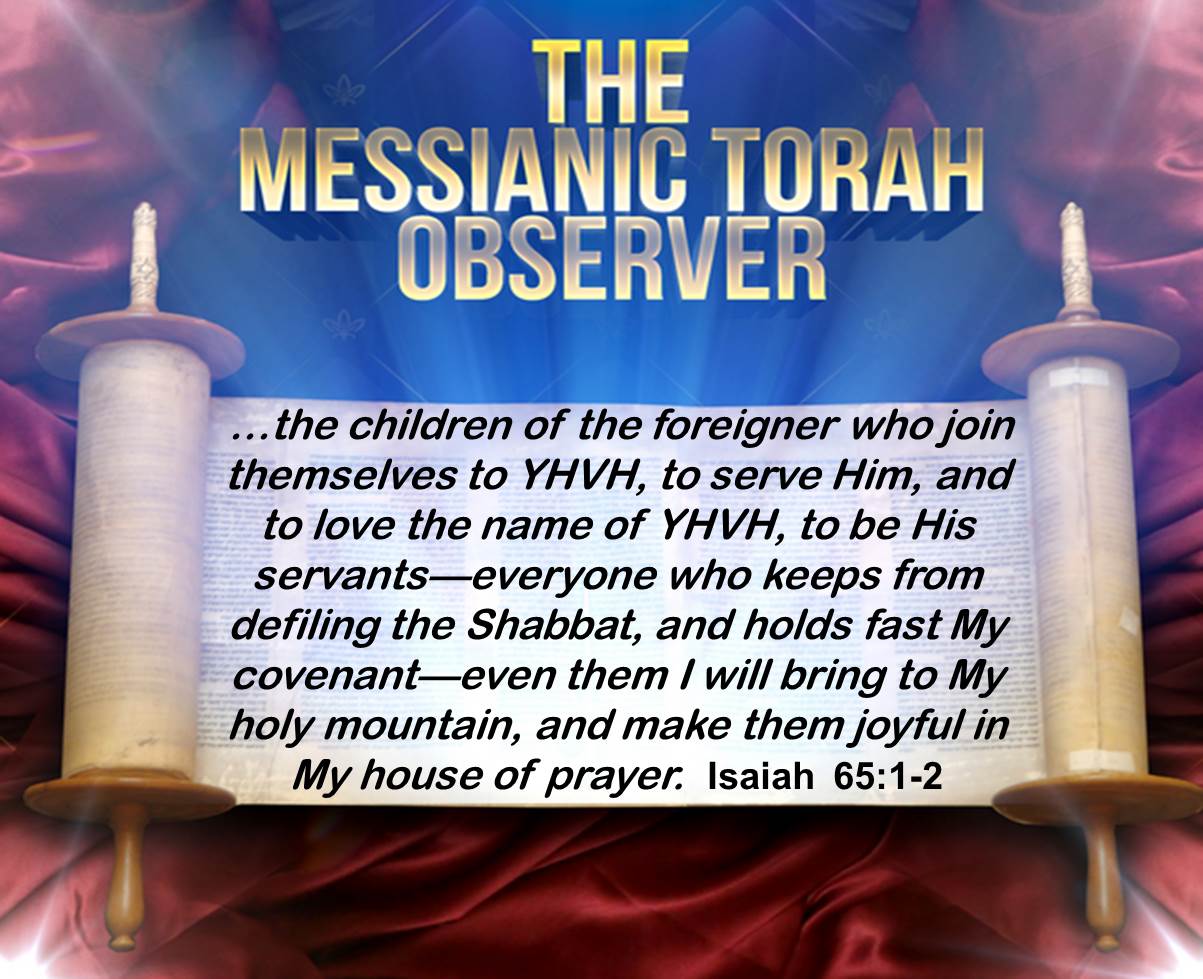
The real clincher for me in terms of making the case that YHVH wants to draw all people into His covenant is in Isaiah 56:6-7: “Also the sons of the foreigner who join themselves to the Lord, to serve Him, and to love the name of the Lord, to be His servants—everyone who keeps from defiling the Sabbath, and holds fast My covenant—even them I will bring to My holy mountain, and make them joyful in My house of prayer. Their burnt offerings and their sacrifices will be accepted on My altar; for My house shall be called a house of prayer for all nations”.  YHVH is clearly speaking of the non-Israelite (Gentile) people of the nations whom He will accept as part of His family, no less His children than the native Israelites.  In the preceding verse (Isa 56:5), YHVH also says: ”Even to them I will give in My house and within My walls a place and a name better than that of sons and daughters; I will give them an everlasting name that shall not be cut off“.

In summary, it is clear that YHVH accepts all of His created humans as His children, whether they are genetic descendants of Israel or foreigners from pagan nations, as long as they keep His Sabbaths and are faithful to His covenant.  This is essentially a restatement of the Torah, as these are YHVH’s key instructions to His people: to keep His Sabbaths (which include His feasts) and live by his Kingdom laws.  It all boils down to Yeshua’s words from Matthew 6:33, to seek first the Kingdom of God and His righteousness – this is the essence of His Torah, where He teaches us how to do this – how can we do any less if we truly love Yehovah our Creator, Lord and Redeemer?  In the nest installment of this 2-part series, I will cover the “Jeans” part of the “Genes or Jeans” equation.

How can We Love?

if you love Me keep me commandmentsIn the first blog of this series, Nancy explained why Torah is still valid in YHVH’s Kingdom on Earth today.  Last week’s blog talked about becoming all that YHVH intends for us to be in this life, including following the loving instructions He gave in His Torah.  This week, I would like to show you why faulty Scripture translation and unclear terminology can confuse us and distort our perception of the truth.

Many Christian churches and denominations use Ephesians 2:8 as their banner verse and state at the core of their doctrines that we are “saved by grace and not by works, lest anyone should boast”.  In many cases, they have taken these words out of context and to such an extreme that they no longer believe we should follow the law (Torah) as that would mean that we are trying to earn our salvation by our works.

However, when we remember that Torah is better translated as instruction than law, we realize that Torah was something God created to help guide us through life in a more joyful, fulfilling way, not something He designed as a set of laws to burden or frustrate us.  Using a more accurate translation of Ephesians 2 (CJB), and moving down from Verse 8 to Verse 10, we see that YHVH has a purpose for our lives that goes far beyond salvation.  Verse 10 says: “For we are His workmanship, as we have been created in Messiah Yeshua for good works, which God prepared beforehand, so that we would walk in them, the good works”.

From this verse and many others in the Scriptures, we know that these good works relate to following God’s will and keeping His commandments (Torah).  Remember what Yeshua said: “If you love Me, you will keep My commandments” (John 14:15).  And what are Yeshua’s commandments?  They are the same as Abba Father’s commandments (the Torah), as Yeshua said He only does what the Father does.  We also know that Yeshua did not do away with the Torah, which Nancy explained well in the first blog of this series – she paraphrased Matthew 5:18 “…until heaven and earth pass away, not one jot or tittle of the Torah will pass away”.

She did a great job of explaining why the Torah is still in effect, but she asked me to go a little deeper into the history of the Scripture translations and interpretations.  To point out one of the many areas of the New Testament where there are glaring differences among different translations, let’s look at Romans 10:4, which is often cited as justification for the law being done away with.  In the original King James Version, this verse reads “For Christ (Messiah) is the end of the law for righteousness to everyone that believeth”.  This indeed could be (and has been) interpreted to mean that when Messiah Yeshua came on the scene, he replaced the law so that it is now obsolete.  However, let’s look at a Messianic translation (the Complete Jewish Bible) which has re-translated the ancient scrolls from a Jewish cultural and religious perspective.  Here is the CJB translation of Romans 10:4: “For the goal at which the Torah aims is the Messiah, who offers righteousness to everyone who trusts”.  This sheds a very different light on this passage.

Earlier in Romans Chapter 10, Sha’ul was talking about how Israel had set up their own system of righteousness, based on what they referred to as the “Oral Law”, but which was actually created by Rabbis who interpreted the Torah based on their own point-of-view and biases.  What Sha’ul is saying in Verses 1-4 of Romans 10 is that the Jewish people (directed by the leaders) had made up their own form of righteousness, whereas Yeshua came to show them the true righteousness they could have by following Him.

Now we can see the vast differences in doctrine from one translation to another; but the burning question is: why are they so different in their spiritual concepts and principles?  I certainly do not profess to be an authoritative expert on Bible translations or exegesis, so I have consulted true scholars in this area.  In  “The Jewish Gospel of John”, author Eli Lizorkin-Eyzenberg helps us dig deeper into the meaning of John 1:17, which in the ESV says: “For the law was given through Moses; grace and truth came through Jesus Christ”.  From his studies, Eli gives us new insights into the dichotomy of law and grace as we know it today from mainstream Christian doctrines.  He says that up until the time of the Reformation, Christian leaders debated among themselves the importance of keeping the Torah (law).  However, when the Protestant Christian movement started, they wanted to emphasize the truth that salvation comes to the believer by faith alone, and not by their works.

The reason for this at the time was because they wanted to contrast this new doctrine with the Catholic dogma that burdened members with so many requirements that it seemed almost impossible to be truly forgiven from their sins.  This was very similar to the religious leaders at the time of Yeshua, who weighed the people down with so many of their man-made laws that they could never hope to be truly righteous before YHVH.  Mr. Lizorkin-Eyzenberg says that the Protestants were so insistent about their new doctrines that many Scriptures (both in the Gospels and in Sha’ul’s letters) were actually re-translated into very different interpretations than were originally intended.  About the passage in John 1:17, Eli says that it would be more accurate to translate it as: “For the Torah was given through Moses and grace and truth came through Jesus Christ”.  The obvious difference is the addition of “and” between the two phrases, now giving the meaning that Torah came through Moses, and Yeshua has now given us grace to keep the Torah, because He has taken away the penalty of the Torah by forgiving our sins and sending them off into the desert to be forever forgotten.

If we were to summarize what Yeshua added to our ability to keep the Torah in one word, it would be “love”. In teachings such as the “Sermon on the Mount”, he clarified and explained the Torah so it would be easier to understand and follow.  And then with His incredible sacrifice on the Cross, He saved us from all our sins and set us free from bondage to hasatan.  As it says in Scripture, He first loved us, so let us love Him by keeping His commandments (John 14:15).

How Can We Live?

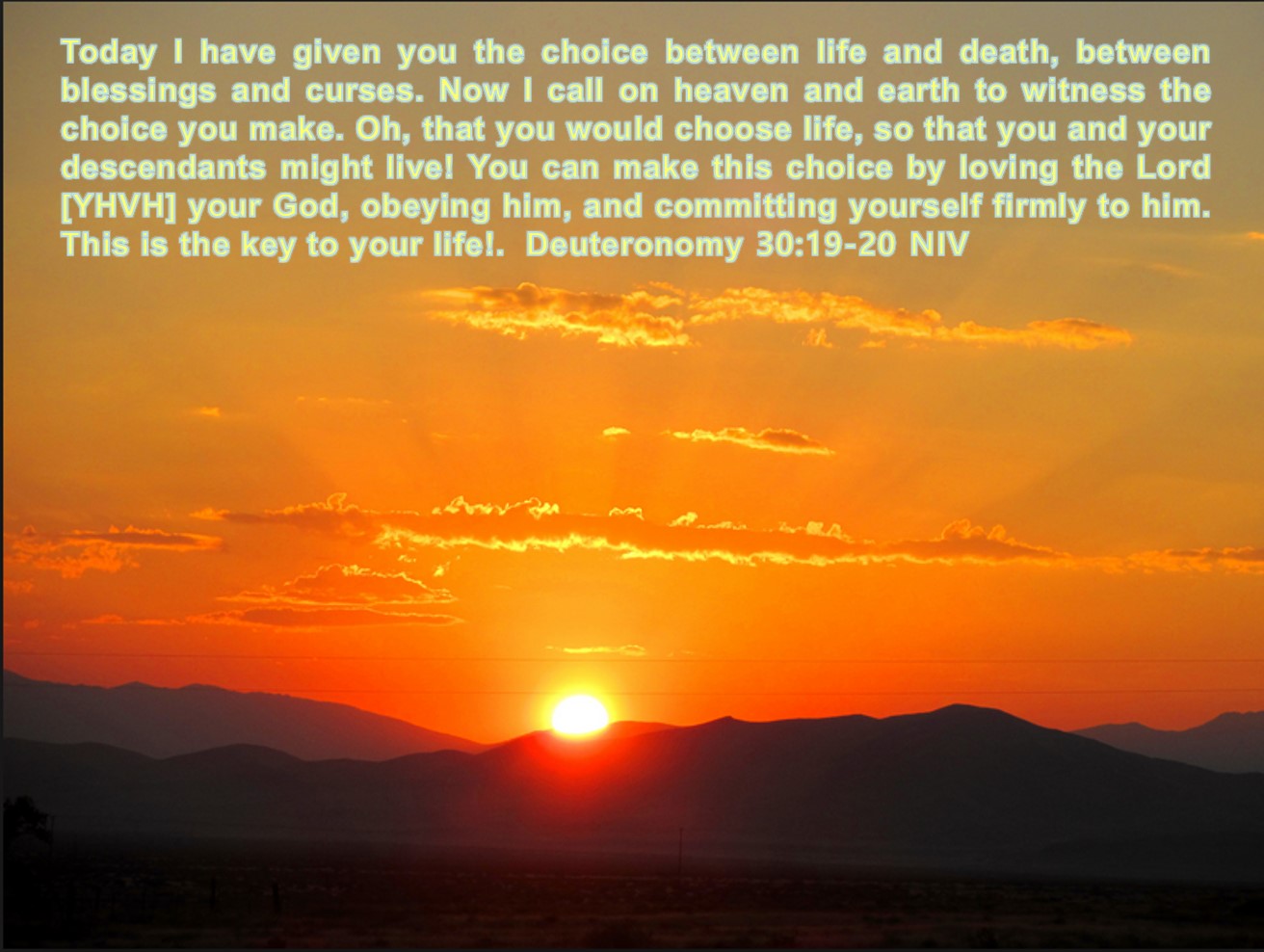
The key to your lifeIn last week’s blog we examined why Torah is still valid.  This week, I would like to add some additional thoughts and clarification on this subject.  Understanding what YHVH expects of us is important.  Some may argue that YHVH loves us no matter what.  That is true, but just as parents love their children, they still have household rules and expectations.  It is more than just obeying YHVH; it is about becoming all that He intends for us.

Peter and I became aware of our Hebrew roots and Torah about twelve years ago.  At the time, we were in our late forties and our children were all grown.  We attended church regularly, were involved in Bible study, and participated in various outreach programs.  We considered ourselves to be mature Christians.  When we began seriously looking into our Hebrew roots and Torah, we realized that we were finally at the grownups’ table.  It was an epiphany for us.  We were finally off the milk and into the meat (1 Cor 3:21).

Faulty translation and unclear terminology can confuse us and distort our perception of the truth.  Peter will expound more fully on these topics in next week’s blog.  For now, however, it is important that we know that YHVH’s purpose in establishing His kingdom on earth is to have relationship with us.  Torah is more than just law; it is instruction and guidelines as well.  YHVH’s desire is to have relationship with us and His Torah shows us how to draw ever closer to Him.  Those who think there is no need for law, ignore it and drift away from YHVH.  Those who try to keep the law “perfectly” do not understand that the Torah is meant to “perfect” us; that is, to make us whole and complete.  They focus on the letter of the law and also drift from YHVH.   The word “perfect” in Hebrew is shalom shalomShalom means wholeness and completeness, reaching full potential.

YHVH calls us to be holy, just as He is holy (Lev 20:26).  To be holy means to be set apart from those who do not follow YHVH.  Ultimately, we are to be set apart from demons and anyone else who is adamant about operating in the kingdom of darkness.  The Israelites were called to be set apart.  They were to follow Torah and be a light to the nations.  For the past 2,000 years, people from other nations have been called to follow Yeshua (the living Torah) and have been grafted in to the olive tree known as Israel.  They, too, are to be set apart and learn how to live in YHVH’s kingdom.

Romans 11:17 can be a touchy subject for Jews and non-Jews alike. We are all called to follow and obey YHVH, regardless of our ethnicity (Gal 3, Col 3 CJB).  YHVH keeps His promises.  If He has made promises that are specifically for physical members of the twelve tribes of Israel, He will keep them.  If He has made promises to anyone else, He will keep those promises also.  It is helpful to remember that we are spirit-beings who reside in a physical body (James 2:26, 1 Thess 5:23).  Galatians 3:26-29 CJB points out that our trust and obedience are what matters; not our ethnicity, gender, or socioeconomic status.

It is crucial that we always keep in mind the big picture.  YHVH is working through the process of salvation and kingdom building on earth that began either before or at creation (Rev. 13:8).  Everything in Scripture is about that process.  YHVH reveals only what is necessary at each phase of the process since YHVH’s enemy, hasatan, is ever vigilant about destroying or interrupting YHVH’s work (John 10:10, 1 Pet 5:8).  YHVH’s kingdom is already established in heaven and hasatan was exiled from YHVH’s heavenly kingdom for trying to take it over.  Now hasatan is trying to do the same with YHVH’s kingdom on earth.

YHVH created the earth and its inhabitants to be a reflection of His heavenly kingdom.   It has always been about establishing His kingdom on earth as it is in heaven.  Humans are created in YHVH’s image and likeness (Gen 1:26).  However, we are fallen since the sin of Adam and Eve.  Therefore, YHVH often has to work through and around our ignorance and stubbornness.  We, in our limitedness, tend to lose sight of the big picture and focus only on the latest phase of YHVH’s plan.  As more of His plan and process are revealed, we tend to think that anything that came before is automatically obsolete.  If we are capable of taking one verse of Scripture out of context, then we are certainly capable of taking one action of YHVH’s out of context.  YHVH is not doing away with former phases; rather, He is building on to former phases.

In summary, our focus is to be on loving and obeying YHVH, so that we can become all that YHVH intends for us to be in His kingdom.  YHVH is in control and will keep all His promises.  As always with YHVH, He will exceed even our wildest expectations.  Dayenu!  Now that is truly living!

Become an Overcomer

soar high on eagle's wingsThe one who overcomes, I will grant to them to sit down with Me on My throne, as I also overcame and sat down with My Father on His throne (Rev 3:21).

Several passages in Scripture stress the importance of being overcomers, but exactly what does that mean?   At first glance, it seems a fairly simple thing to be an overcomer. For example, we read in 1 John 5:4,5:  For everyone who has been born of God overcomes the world. And this is the victory that has overcome the world—our faith. Who is it that overcomes the world except the one who believes that Jesus [Yeshua] is the Son of God?

It might seem that all we need is faith that Yeshua is the Son of God. Ephesians 2:8 tells us that we have been delivered by grace through faith and that even our faith is a gift. This is all true (for Scripture does not lie). However, it is not the complete picture. Faith is more than a sentiment or a creed. Our faith must lead to action. Faith is a gift, but it matters greatly what we do with that gift.

Consider Yeshua’s words in Matthew 25:14-30. We believe that one of the “talents” we have been given is faith. We have also been given other gifts or “talents” corresponding with the purpose YHVH has for each of us in building His kingdom. It is not acceptable for us to bury our gift of faith or let it lay sleeping on a pew. Our faith must spur us into action.

Our faith begins inside, but it should at some point manifest outside as well. Are we becoming more like Yeshua in our attitudes and actions?  2 Corinthians 5:10 shows us that we are accountable: “For we must all appear before the judgment seat of Christ [Messiah], so that each one may be recompensed for their deeds in the body, according to what they have done, whether good or bad.”

So how do we become more like Yeshua? One clear statement is in Romans 12:1-2: “Therefore I urge you, brethren, by the mercies of God, to present your bodies a living and holy sacrifice, acceptable to God, which is your spiritual service of worship. And do not be conformed to this world, but be transformed by the renewing of your mind [soul]…”.  The concept of renewing our minds seems abstract and difficult to accomplish.  Several Scriptures help clarify this process: Ezra 10:11 – Honor the LORD [YHVH]…and do His will. Separate yourselves from the [worldly] people around you…; Ephesians 5:17 – Therefore do not be foolish, but understand what the Lord’s will is; I Peter 1:14 – As obedient children, do not conform to the evil desires you had when you lived in ignorance;  and          I John 2:15 – Do not love the world or anything in the world…

Psalm 103:5 tells us that: [YHVH] contents you with good as long as you live, so that your youth is renewed like an eagle’s.

What does it mean that our youth will be renewed like an eagle’s? An eagle can live up to 70 years, but only if at age 40 the eagle makes a very difficult decision. The eagle has to subject itself to a painful transformation. By age 40, the eagles talons are overgrown and inflexible, the feathers weigh down its wings, and its beak is too bent to be useful. So, over a period of 150 days, the eagle must pluck out beak, talons, and feathers and wait for replacement parts to grow in. He cannot eat and he is completely defenseless. If at any time, the eagle decides that this process is too troublesome, it can give up, but it will die. However, if the eagle persists and “overcomes,” it can regain its youth and live for another 30 years.

What about us? We also must make tough decisions and endure sometimes painful transformations. We must turn our backs on much that might seem desirable in this world and focus on our future with Yeshua. We may be asked to give up everything, even our lives. “And they overcame him because of the blood of the Lamb and because of the word of their testimony, and they did not love their life even when faced with death” (Rev 12:11). However, if we overcome, we will have more than just an extra 30 years of life. We will have eternal life with YHVH. However, we will have much more than that, more than we can imagine.

He who overcomes will thus be clothed in white garments; and I will not erase his name from the book of life, and I will confess his name before My Father and before His angels (Rev 3:5).

He who overcomes, and he who keeps My deeds until the end, TO HIM I WILL GIVE AUTHORITY OVER THE NATIONS; (Rev 2:26)

Follow the World or YHVH?

do not worship their godsIn this second blog of our series on Chanukah and the Maccabbees, we show the distinction between the people of Israel who were staying faithful to YHVH’s appointed times and commandments, and those who were following the pagan ways of the Greeks and Romans. In our previous blog (The Mighty Power of YHVH), we saw that Onias, the high priest of the Jews, stayed faithful to YHVH’s Laws, even when Simon, an Israelite from the tribe of Benjamin plotted with the king to confiscate money from the Temple treasury that was designated for widows and orphans. When the Israelites prayed fervently, YHVH showed great signs and thwarted the intentions of the pagan government to keep the Temple from being defiled.

In II Maccabees 4, Onias’ brother Jason betrayed Onias by telling lies about him and even claiming that he had plotted against the government. He then became the High Priest deceitfully by offering large sums of silver and gold to the king.  He even offered additional silver to build a gymnasium beneath the Temple, and convinced the people to use this pagan facility for nude games in the style of the Greeks. He encouraged the people to follow Greek customs that were contrary to the Law [Torah] and even the priests lost interest in Temple services and sacrifices and would rush off to participate in the games that were forbidden by the Law (II Maccabees 4:14). The people stopped keeping the Feasts and Sabbaths and kept Greek celebrations instead.

Jason was so corrupt that he sent men to the “games” in Tyre with a large amount of silver for a sacrifice to the pagan god Hercules (II Maccabees 4:18-19). Once the Jews moved into actively participating in the ways of the world instead of YHVH’s ways, things went downhill for them very quickly. As recounted in Maccabees 6, There was dissension and jealously among the priests and Jewish leaders, and they killed and bore false testimony to the king about each other, until finally the king decided to become more vindictive about having the Jews abandon their Feasts and Sabbaths, and he defiled the Temple by dedicating it to their chief god, Zeus.

Jason had started the downward spiral of the Jews into the abominations that were committed in the following months. The verse in II Maccabees 4:17 gives the reason for the serious judgments against the Jews that followed their disobedience: “It is a serious thing to disregard God’s Law”. Persecution increased greatly from this time forward, and the Greeks defiled the Temple by holding drinking parties and conducting their immoral sexual rituals with prostitutes there. The altar was filed with unclean animal sacrifices. King Antiochus then prohibited the Jews from keeping their Sabbaths and Feasts, and forced them to eat unclean meats that were sacrificed to the false gods. “Then, during the festival in honor of the wine god Dionysus, they were required to wear ivy wreaths on their heads and march in procession” (II Maccabees 6:7). From this time on, as described in II Maccabees 6:9, the Greek leaders “were told to put to death every Jew who refused to adopt the Greek way of life”.

When Onias was high priest, the people kept the Torah. However, our suspicion is that they were more into following the leaders than they were truly seeking YHVH and His ways. When Jason unjustly replaced Onias, many of the Jews were all too ready to follow him into every type of evil and apostasy. When we look at our modern times, we see that most people (Christian, Messianic or otherwise) tend to follow the ways and customs of the world’s culture, rather than seeking to follow God’s ways and keep His appointed times.

Many today do not realize that they are fighting a battle. Even those who do often fail to recognize that the battle is spiritual. Many followers of Yeshua do not understand the spiritual realm and do not operate in the spirit. However, there is no excuse for ignorance since we have ready access to many versions of Scripture and study tools. We also have the Holy Spirit to guide us.   We must not blindly follow human leaders, but must realize that we as individuals are accountable to YHVH for our choices.

The most glaring examples of this relate to the holidays of Christmas and Easter. Our ancestors celebrated these holidays and many continue to follow suit. When we look at the ancient pagan celebrations, the birth of their chief gods was always celebrated on December 25th. These gods include Zeus/Jupiter, Dionysus/Bacchus, Hercules, Tammuz, Apollo, Mithras, Sol Invictus and others. Birthday celebrations for these pagan gods date back to the time of Nimrod, who was alleged to be Tammuz’ father. Note that Zeus, Dionysus, and Hercules were all being worshiped by the Greeks, and then were adopted by the Jews as part of their apostasy. YHVH established seven feasts to point to the work of His Son. We sin against YHVH when we seek to “honor” Him by celebrating holidays that have always been an abomination to Him. Many try to justify celebrating Yeshua during these pagan holidays, but to mix the pagan and the sacred is an even worse abomination to YHVH. We must not yield to the predominating culture any more than the Jews should have yielded to the predominating Greek culture of their day.

We know that HaSatan attracts followers by counterfeiting the true God. From pagan beliefs, we see a counterfeit parallel between the Greek god Dionysus (Roman god Bacchus) and Yeshua. Dionysus was purported to have been born of a virgin (Ishtar/Isis), son of the heavenly father (Zeus), performed miracles such as turning water into wine (he is the god of wine), died and was raised again on the 3rd day (on March 25th), was identified with the lamb, and given titles such as: “only begotten son“, “king of kings”, “god of gods”, “sin bearer”, “redeemer“,  “anointed one” and “the alpha and omega“.

We do not have space for full discussion here, but many of the other rituals and symbols of Christmas and Easter (whose name comes from Ishtar) originated from pagan rituals and symbols. The wreath comes from the wreath worn at pagan sports celebrations, the tree comes from a pagan ceremony at the time of Nimrod, which claimed that the resurrected Nimrod returned each year to leave gifts under a decorated tree. Read Jeremiah 10 if you want to find out what YHVH says about cutting down and decorating trees for pagan celebrations, and Jeremiah 44:17-19 to read God’s admonition against worshiping the Queen of Heaven (Ishtar in pagan lore).

Armed with this knowledge, how does this affect your view of the main Christian holidays, and more importantly, what does it say to your heart about keeping YHVH’s Feasts and Sabbaths and not the festival celebrations of the world? As we read the story of the Maccabees, it is easy to condemn the Jews who strayed from Yehovah’s commands. Are we guilty of the same thing?

”You shall not worship the LORD your God in that way, for every abominable thing that the LORD [YHVH] hates they have done for their gods…” (Deut 12:31).

The Mighty Power of YHVH

horse and riderTo celebrate Chanukah, we decided to read a portion of the story of the Maccabees each night.   The second book of Maccabees, chapter three has enlightened our understanding of the events leading up to the celebration of Chanukah. It has also provided us with insight and direction in dealing with issues that are currently challenging us.

Here is a brief summary of the chapter. There was a high priest named Onias who strictly obeyed the laws of YHVH. While Onias was high priest, Jerusalem enjoyed peace and prosperity, and received respect and generous gifts from the kings of many nations.

A man named Simon lost an argument with Onias and sought revenge by lying to Apollonius, governor of Greater Syria, and offering to him the money from the Temple treasury. Apollonius passed this misinformation on to the king, who sent a man named Heliodorus to confiscate the money. A portion of this money had been designated for the widows and orphans and a portion of it belonged to a wealthy man. To take the money would be to break YHVH’s laws concerning money deposited in the Temple treasury and would betray the trust of those who depended on the integrity of the ones in charge of the treasury. Heliodorus decided to confiscate the money anyway.

The priests and the people joined together in begging YHVH to protect the treasury money, praying on their faces before His altar. YHVH responded in a dramatic way. Heliodorus returned to the king without the money, but with a strong testimony concerning the power and faithfulness of YHVH.

This story speaks volumes to us as we seek funds to build a refuge for some widows in India. Just as the people of Jerusalem were on their faces before YHVH, the widows in our sister congregations spend much of each day on their faces, praying for the salvation of others. And yet, these women are considered curses in their society and are much oppressed.

We are in the process of raising funds for the construction of the widows’ home. As we began this process, the Holy Spirit led us to create a faith covenant with YHVH. Each day we remind YHVH of His promises towards the widows, orphans and the oppressed by reading aloud pertinent Scripture verses. Several weeks after we began our faith covenant, YHVH gave us His response to our covenant, which is Proverbs 15:25: “YHVH will tear down the house of the proud, but will establish the boundary of the widow.”

As developments unfold, we comprehend at new levels the depth of YHVH’s promise in this verse. Persecution against non-Hindus is on the rise in India. It is becoming more difficult to get the funds safely delivered to the congregational leaders. Local authorities who have been bent on persecuting our sister congregations are gaining more power. Our sister congregations, especially the leaders, are watched very carefully. We would be tempted to think that this cause is hopeless, but the Holy Spirit reminds us that this home for the widows is YHVH’s response to the cries of the congregants after the widows were thrown out of a temporary shelter and had their lives threatened.

Therefore, we believe that 2 Maccabees, chapter 3 illustrates for us our next step.   We are asking that those who support us in this effort storm heaven and remind YHVH of His promise in Proverbs 15:25. We believe He will hear our cries and respond in a powerful way if we stand on faith in this matter.

We have provided a copy of chapter 3 below for you to read and prayerfully consider. Note how many times YHVH miraculously intervenes to answer the cries of those who seek diligently to keep His laws.

II Maccabbees 3

When Onias[a] was High Priest in Jerusalem, the holy city enjoyed peace and prosperity, and its laws were strictly obeyed, because he was devout and hated evil. The kings of Syria and Egypt honored the Temple and presented it with expensive gifts, and King Seleucus, ruler of all Asia, even paid the costs of the Temple sacrifices from the revenues he collected.

But a man by the name of Simon, of the tribe of Bilgah, the chief administrative official of the Temple, lost an argument he had with Onias over the regulations governing the city market. At this time Apollonius son of Thraseus was the governor of Greater Syria. Simon went to him and said that there was so much money in the Temple treasury that it could not be counted, and since the money was not needed for sacrifices, it might as well be placed under the king’s control.

When Apollonius met with the king, he told him about the money, and the king ordered Heliodorus, his chief minister, to get it for him. Heliodorus set out at once on his mission, but he claimed that he was only making a tour of inspection of the cities of Greater Syria. After he had arrived in Jerusalem and had been warmly received by the High Priest, he explained the real reason for his visit and asked if what he had been told was true. 10-11 The High Priest then stated that Simon, that devil of a man, had not been elling the truth. There was indeed some money in the Temple treasury, but part of it was set aside for widows and orphans and part of it belonged to Hyrcanus son of Tobias, a very important man. He also pointed out that the total amount was only 30,000 pounds of silver and 15,000 pounds of gold. 12 He added that it was absolutely impossible that anyone should be permitted to take the money of those people who had placed their trust in the sanctity and safety of this world-famous Temple.

13 But Heliodorus insisted that the money should be taken for the royal treasury, as the king had ordered. 14 So he set a day and went into the Temple to supervise the counting of the money. This caused an uproar throughout the entire city. 15 Priests, wearing their priestly robes, threw themselves face downward before the altar and begged God to keep the money safe, since he had given the laws designed to protect the money that people deposited in the Temple. 16 It was heartbreaking to see the High Priest. His face turned pale, revealing the agony of his soul, 17 and his body was trembling with fear, reflecting the pain in his heart. 18 People ran from their houses to join together in prayer that the Temple might not be defiled. 19 Women, wearing nothing but skirts of sackcloth, crowded the streets. Young girls whose parents had never allowed them to be seen in public ran to the gates or to the walls of the city, or just stared out of their windows. 20 But wherever they went, they lifted their hands to God in prayer. 21 What a pitiful sight it was to see the High Priest in such great agony and frustration and to see everyone in the city confused and lying face down on the ground.

22 While everyone was begging the Lord Almighty to protect the money that had been entrusted to his care, 23 Heliodorus went on with his plan. 24 But at the very moment that he and his bodyguards arrived at the treasury, the Lord of all supernatural powers caused such a vision to appear that everyone who had dared to enter with Heliodorus was panic-stricken and weak with fear at this display of the Lord’s power. 25 In the vision they saw a horse and a rider. The horse had a richly decorated bridle, and its rider, dressed in gold armor, was frightening. Suddenly the horse rushed at Heliodorus, then reared up and struck at him with its hoofs. 26 Heliodorus also saw two unusually strong and handsome young men, wearing very fine clothes. They stood on either side of him and beat him unmercifully. 27 He immediately fell to the ground unconscious, and his men put him on a stretcher 28 and carried him out. Only a moment earlier this man had entered the treasury with a large group of men, including all his bodyguards, but now he was being carried away helpless. So they all openly acknowledged the mighty power of God.

29Heliodorus lay there unable to speak and without hope of recovery from this demonstration of God’s power. 30But the Jews praised Almighty God because he had miraculously protected his Temple and had brought great happiness where only minutes before there had been fear and confusion. 31 Some of Heliodorus’ friends quickly asked Onias the High Priest to pray that the Most High would spare the life of this man who was at the point of death. 32 So the High Priest offered a sacrifice in the hope that God would save Heliodorus, for he did not want the king to think that the Jews had done this to the man he had sent. 33 While Onias was offering the sacrifice, the two young men, wearing the same clothes as before, again appeared to Heliodorus and said,

Be grateful to the High Priest; the Lord has spared your life because of him. 34 Remember that it was the Lord of heaven who punished you. Now go and tell everyone of his great power.  When they had said this, they disappeared.

35 So Heliodorus offered a sacrifice to the Lord and made many promises, because the Lord had spared his life. Then he said good-bye to Onias and returned with his army to the king. 36 There he told everyone what the Lord, the most powerful of all gods, had done.

37 When the king asked Heliodorus who would be the best man to send on the next mission to Jerusalem, Heliodorus replied, 38If you have an enemy or know of someone plotting against your government, send him. He will come back badly beaten, if he comes back at all, for some strange power from God is at work there. 39The God of heaven watches over the Temple; he strikes down and destroys anyone who comes to harm it.

40 That is the story of how the Temple treasury was protected from Heliodorus.