Category Archives: Peter’s blogs

What would you do if you were God (Part 5)

LORD is good“Throughout the earth the story is the same— only a remnant is left, like the stray olives left on the tree or the few grapes left on the vine after harvest.” Isaiah 24:13 [NLT]

In the previous installments of this series on God’s ways, I discussed why YHVH does things the way He does and why His plan seems so odd to us sometimes but is actually the perfect plan for our lives.  In this final blog of the series I want to look into the future and see why He has prophesied and planned out such a seemingly bizarre sequence of events for the end of this age.

From our limited human perspective, it may seem odd that the Creator of this universe would aim to judge His creation by destroying a large portion of it through catastrophic events.  Let us look in more detail at a sampling of His end-time prophecies which are spread across many of the minor and major prophets in addition to the book of Revelation.  When researching a news story, we try to answer the four “w” questions: who, what, when, why.  The “How” question is not so important to us when it comes to Abba‘s future plan, as we do not really need to know how He will perform His will, but rather how we fit into it and what we should do to prepare ourselves.

The “When” question is also not critical to us, as we have no control over it anyway, and we need to be spiritually prepared, whether the events start to play out over the next few years, further into the future, or beyond our earthly lifetime.  Yeshua said that no person would know the day or hour of the end time, not even the angels in Heaven, so we should not waste time speculating about the timing of these events (Matt 24:36).  The explanation of “What” is going to happen in the final days is somewhat more important to us, but mainly from the perspective of discerning the signs of the end times, as Yeshua outlined in Matthew 24-25.  If we get too concerned with answering the “When” and “What” questions (such as being drawn into the pre-Trib Rapture belief), then we can easily miss the more crucial truths of Yeshua’s message.

In Luke 18:8, He asks “when the Son of man returns, will He find faith in the Earth?”  Why is our Creator and Savior questioning the faith of His saints?  In Matthew 24:12, He goes on to say that “iniquity will abound and the love of many will grow cold”.  This agrees with statements in 2 Thessalonians and Daniel that speak of the Tribulation period and the 3 ½ year reign of the anti-messiah, when there will be a great falling away and the “antichrist” [anti-messiah] will be revealed.  Daniel says in his end-times prophecies that the anti-messiah will “wear out the saints of the Most High” (Dan 7:25) and “scatter the power of the holy people” (Dan 12:7).  In 2 Thessalonians 2:3, Sha’ul says “that day will not come until there is a great rebellion against God and the man of lawlessness is revealed”.

So how can we as Abba’s children keep our faith and not grow weary from the enemy?  I believe Revelation 12:11 provides us a good answer, as this passage explains how the saints persevered to the end during the Tribulation: “And they overcame him [HaSatan] by the blood of the Lamb and by the word of their testimony, and they did not love their lives to the death”.  YHVH wants our love and devotion to Him more than anything else – we need to walk with Him constantly and keep trusting Him every step of the way in our lives.

Many of the prophets (Isaiah, Jeremiah, Ezekiel, Zechariah, Malachi, etc.) speak of the believing remnant that will be preserved by YHVH in the latter days to dwell with Him in the Millennial Kingdom.  One of the key underlying themes of Isaiah (e.g. Isa 10:20-22, 11:11-16, 24:13, 27:32, 66:20) is that of the judgment of Israel overall as a nation and people, but the protection and restoration of a small remnant of YHVH’s faithful children (both Jew and non-Jew) to dwell with Him in His eternal Kingdom.  A particularly meaningful passage is located in Malachi:16-18.

Then those who feared the Lord spoke with each other, and the Lord listened to what they said. In His presence, a scroll of remembrance was written to record the names of those who feared Him and honored His name. They will be My people, says the Lord of Heaven’s Armies. On the day when I act in judgment, they will be My own special treasure. I will spare them as a father spares an obedient child. Then you will again see the difference between the righteous and the wicked, between those who serve God and those who do not.”

This passage provides us a window into YHVH’s own heart, which is what we desire as His people in relationship with Him.  It shows us that He loves us all, but He especially desires to keep track of the names of those who truly love Him with all their hearts (fear Him & honor His Name).  He wants to draw them near to Him as His special treasure, and preserve them for the last days, when He will reign on the Earth in the person of Yeshua HaMashiach.  When we look at YHVH’s heart from His perspective, we see His overwhelming love for His children, keeping us safe until He can bring us home into His eternal Kingdom.  How could we ever desire or ask for anything more than that – I give thanks and praise to our omnipotent Father who has wisdom and compassion beyond anything we could ever imagine!


What would you do if you were God (Part 4)

Rom 1133 - how unserachable“Oh, how great are God’s riches and wisdom and knowledge! How impossible it is for us to understand his decisions and his ways!” Romans 11:33 [NLT]

In the previous installments of this series on God’s ways, I discussed why He does things the way He does and whether we could do any better if we had supreme control of the universe.  Now I want to focus on something a little more personal.  Putting yourself in God’s place for a moment, think about what you would do if your creatures turned away from you to the point where your relationship with them seemed irreparable.

You had designed humans so that their most primal need was to have a deep personal relationship with you, but they had chosen to abandon and deny their need for that intimate relationship.  In human terms, this seems like an impossible situation.  One party (the human being) has gone against the wishes and desires of the other party (God) by disobeying His instructions, speaking against His perfect character, and hurting Him deeply.  The first party will not admit their wrongs and refuses to apologize (repent) for their sins against the second party.

If both of these parties were human, it would be difficult if not impossible to reconcile and restore their close relationship.  The first (wronged) party would have to unilaterally forgive the other one, which requires Godlike humility and unconditional love.  Considering the extreme nature of the sins of people against God, this forgiveness would be on the level of Corrie TenBoom’s forgiveness of the concentration camp guard who brutally and mercilessly beat her sister.  However, as we know, with God “all things are possible”.  From the Romans 11:33 Scripture above, we also know that it is “impossible for us to understand God’s decisions and ways”.

So how did God choose to reconcile us back to Himself from the depths of our sin and disobedience?  Did He shout down to us in His Earth-shattering voice, speaking anger and judgment on us and our sins?  Did He accuse us of turning against Him, shaming us into such a state of humiliation and disgrace that we felt compelled to seek His forgiveness?  Did He come down to Earth, seeking retribution and justice for every sin we had committed against Him and His children?

Or did Abba draw us back to Himself (and to Yeshua) by loving us unconditionally?  It is sometimes hard to even fathom the depth of Abba’s love for us.  Think of a particularly painful time in your life, when someone has hurt you so deeply you cannot even imagine forgiving them.  Then imagine sacrificing your own child for people who despised and cruelly hurt you.  Multiply this a million or billion times and you can start to feel what our Father in heaven feels when we turn away from Him and pierce His heart to the core with our sins.

Yeshua told us to love our enemies, bless those who curse us and do good to those who hate us.  He also told us that “There is no greater love than to lay down one’s life for your friends”. (John 15:13)  But what if God told you to lay down your life (or your child’s life) for your enemies?  Would you be angry and resentful that He would ask you to do something so unfair?  Well that is exactly what Yeshua did for us – His Father asked Him to lay down His life for those who hated, mocked and abused Him, and He willingly consented to His Father’s will.  If Yehovah could do this for us, can we not forgive those who hurt and abuse us?

Instead of criticizing Abba for the ways He deals with people’s disobedience, try praising Him for his love and forgiveness which are more infinite than all the universe!


What would You do if You were God (Part 3)?

free will_2“And we know that all things work together for good to those who love God, to those who are the called according to His purpose.” Romans 8:28 [NKJV]

In the last segment of this series (Part 2), I discussed the reasons why God created us with a free will.  Please go back and read that episode: What would you do if you were God (Part 2), to get the background for this teaching. In today’s blog, we will dig deeper into God’s purpose for giving us free will. YHVH works all things together for good no matter how far we stray from His perfect plan for our lives.

We are born into the earthly realm where hasatan rules and reigns (ever since Adam and Eve gave back their dominion to him in the fall.  So you might ask: why would God have allowed our great adversary to take dominion of the Earth from us?  Well, being our all-knowing Creator, and having given us free will, He knew that we would eventually disobey Him and fall into sin.  So He created us with a conscience that steers us towards what is right and away from what is wrong.

Even young children can be influenced by other forces and willfully choose to disobey their consciences.  Parents may have taught their child right from wrong, but that child can be wrongly influenced by seeing another child doing something they know is wrong (taking something that doesn’t belong to them, or telling a fib, for instance).  If the child is caught in the act and reprimanded, but desires to please their parents, then they will resist the temptation to disobey the next time.  It is the same with our heavenly parent, Abba.  Even at a young age, children start developing a sense of what is right and wrong. They learn that their lives will be happier and less stressful if they take the “right” path in their choices.

When we come into the age of moral accountability, we generally know that we are to keep God’s commandments, but there are many forces tempting us to go astray of those commandments.  We are tempted by the snares of the world, such as the lust of the eyes and flesh around us that appear so desirable on the surface.  We are also tempted by others to stray.  At times, we can be lured by the seductive wiles of HaSatan or his evil forces to commit sinful acts.

How is God working for good through these sinful lapses on our part?  Yehovah has blessed us with intelligent minds that are able to reason through the physical consequences of sin – and a spirit ideally in tune with His Holy Spirit to help us recognize the spiritual consequences of sin, which leads to separation from God.  YHVH desires that all of His children be born again and filled with His Holy Spirit.  This means that when we fall into sin, He uses His rod and staff to correct us and pull us back into His fold.  Sometimes, we fall so far and for so long that we suffer severe consequences. These can take the form of physical or mental ailments.

As many born-again believers’ testimonies confirm, these times of falling away were the low-points in their sinful lives.  Yet God was working to bring them back and restore them to fellowship with Him.  He can work in many ways – through other believers or His angels who rescue us in dire times of great distress or danger, through Yeshua Himself who appears to people in the depths of despair, and even directly by shining His glory light into a fallen person’s heart and thoughts, giving them hope for a joyful future with Him.

There are many examples in Scripture of YHVH pulling people out of the depths of their despair.  In David’s case, he often experienced times of discouragement, desperation and even hopelessness.  Some of these times were brought about because of unjust hostility from others, such as King Sha’ul, Abimelech, etc. (1 Sam 23, Ps 22:1-8, Ps 69:1-4, Ps 56, Ps 34).  But in other cases it was his own sin that brought God’s judgment down on him (Ps 51).  In both cases, he cried out to YHVH, because he knew that God would rescue him out of his dire circumstances even when his sin had temporarily separated him from God’s presence.  At all these times, though, David was learning to trust in God’s protection and deliverance instead of trusting in people and nations to deliver him.

Similarly with Paul (Sha’ul) in the New Testament, he realized that God was his only stronghold and that was sufficient for him no matter how dire the circumstances were.  Sha’ul had sinned greatly by persecuting believers in Yeshua (Acts 7:58), before Yeshua appeared to him and saved him by grace on the road to Damascus (Acts 9:3-18).  He then came under great persecution himself and had to depend on YHVH to save him from his enemies, learning that YHVH was his strength when he was weak (2 Cor 12:8-10).

Think about the darkest times in your life, when someone has abused or hurt you deeply, or when you have fallen into the darkness of sin and depression.  If you are a believer, you know that those times were when God was working the most fervently in your life – to raise you back up to joy and glory in His kingdom, or to convict you of the destructive effects of your sin and the critical need to turn from your sinful ways and follow Him.  When I think about the freedom He has given us and the power of His love and grace to save us when we fall, I cannot imagine Him doing it any other way!

What would you do if you were God? (Part 2)

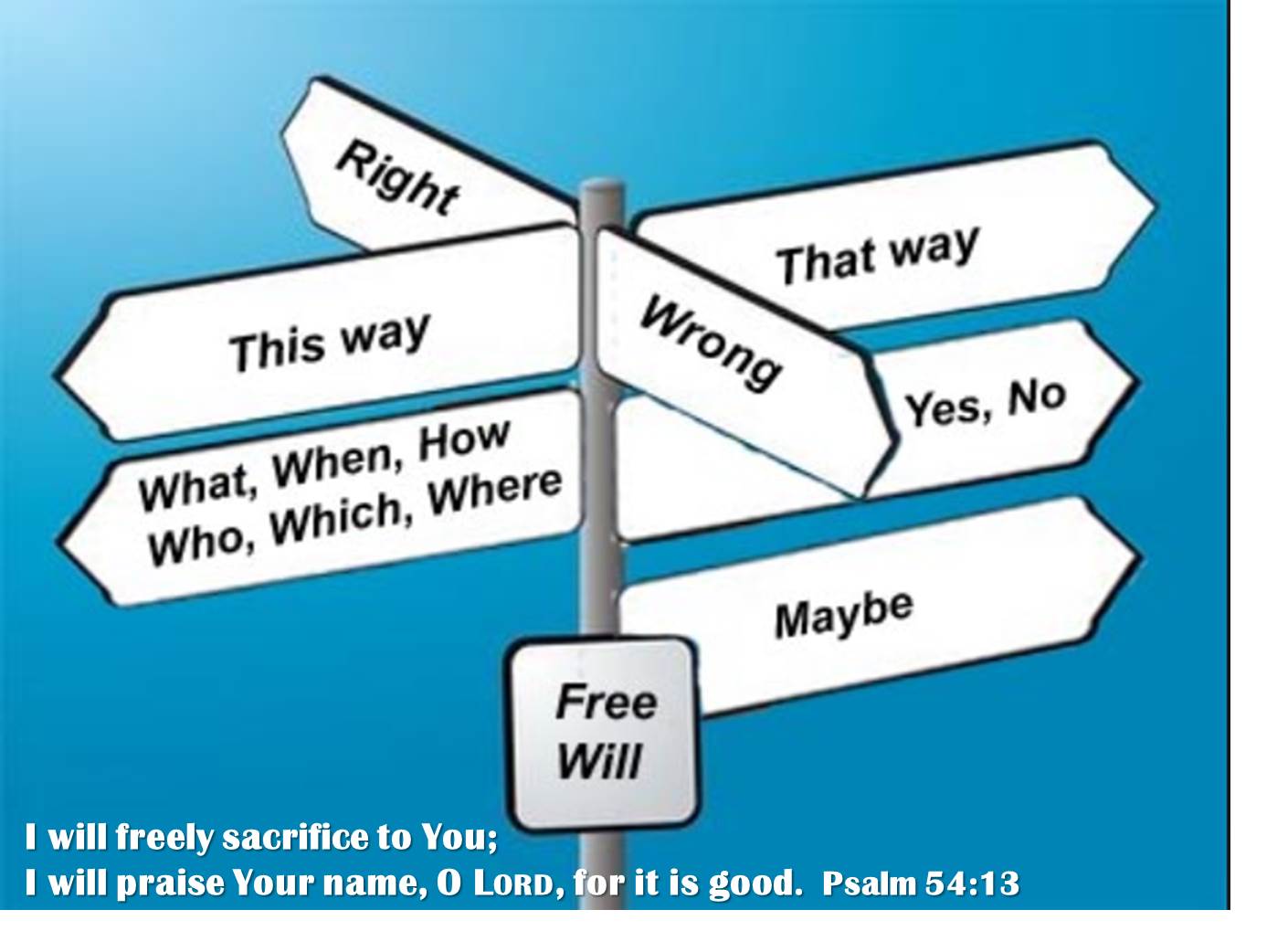
free will      So God created man in his own image, in the image of God [Elohim] he created him; male and female he created them.Genesis 1:27 [ESV]

In the first part of this series a couple of weeks ago, I dealt with the frequent questions about why God was supposedly such an angry, vengeful God in the Old Testament but now is a merciful and gracious God who declares all of His people righteous and holy through the blood of the Lamb, Yeshua HaMashiach.  Please go back and read that episode (What would you do if you were God) to get the full context if you have not done so. In today’s blog, I wanted to delve into the motives and intents of God’s heart in creating human beings, the crowning work of His creation.

When God [Elohim] first created mankind, He said, “Let us make human beings in Our image, to be like Us” (Gen 1:26 – NLT).  The first thing I noticed when I read this passage is that God spoke of Himself as a plural being.  As we have taught before, God [Elohim] is a name for a triune God representing all three persons of the Godhead (Father, Son and Holy Spirit).  So when God says He created us to be like Him, He meant all three persons of Himself.  You could loosely relate the whole essence of our being to these three persons – we certainly have a spirit (relating to God’s Holy Spirit and even able to be filled with the Holy Spirit), and we have a fleshly body, which relates to Yeshua when He came to Earth in the flesh.

But what about our soul – our mind, heart, will and emotions?  The Scriptures speak clearly about the mind of God (Num 23:13, Rom 8:27, Job 12:13, Isa 40:28, I Cor 2:16).  We know from stories like the prodigal son about the loving heart of God the Father (Luke 15:11-32).  We also know that God created us to have emotions like Himself: love, compassion, joy, anger, etc. (see Job 20:23, Ps 74:1; 86:15, Jer 7:20, Isa 62:5, Zeph 3:17).  Finally, God’s will is supreme in the universe, and He wants us to follow His will to the best of our abilities, with the help of the Holy Spirit – in Romans 12:2, Sha’ul says: “…you will learn to know God’s will for you, which is good and pleasing and perfect”.

God not only created us with a will as part of our souls; He created us with a free will to make our own life choices.  Because God is all-knowing, He knew that many of His children would make bad decisions in their lives and damage or destroy their lives.  We see people every day making bad choices that cause them physical and emotional pain either for themselves or others, falling into addictions, committing crimes against others or treating others unfairly.  So why did God give us free will, and “what would you have done if you were the Creator God”?

The Scriptures say that “God is love” and that He is the source of all love.  He created us in His image, to love Him and our fellow brothers and sisters.  Many people choose not to love God or follow His will, but rather they follow their own selfish will.  Because of their bad choices, they cause great pain and suffering to themselves and others.  So what if God had “programmed” our minds and hearts to love Him, so that we had no choice but to love Him.  Everyone would love Him unconditionally, but would God be pleased and rejoice over us?  If I were Him, I would be sad and depressed, knowing that my creation loved me, but they had no choice in the matter, so it wasn’t fulfilling and their love didn’t mean anything to me.

God is a God of relationships, and He created us to be in relationship with Him.  When we love and trust Him as our best friend, Lord and ruler of our lives, we have the greatest joy and fulfillment possible, and God smiles and rejoices over us because we have chosen the best path and because another one of His children loves Him of their own free will and has a personal relationship with Him.

What would You do if You were God (Part 1)?

Judgment and mercyOh, how great are God’s riches and wisdom and knowledge! How impossible it is for us to understand His decisions and His ways!” Romans 11:33 [NLT]

One of the most common questions I hear from people (both believers and non-believers), is “why is God so angry, or so harsh when He judges or punishes His children”?  Of course, as an inquisitive believer myself, I have asked similar questions over the years. I certainly do not claim to be an expert on answering these questions, but through our times of Scripture study, seeking the Holy Spirit’s guidance, we have been able to discern some insights from Yehovah that we thought might be helpful to others.

First, I want to dispel the false notion that Yehovah Elohim (the Creator God of the universe) is an angry God by nature.  From years of spiritual conversations with people, I believe this comes from ignorance (or misunderstanding) of the “Old Testament” [Tanach].  The way we hear Scriptural teachings tends to be from preachers, and from polls of Christians, it is quite evident that for the majority of believers, 95% of what they know about the Bible is what they hear from the pastors/teachers in their congregations.  Unfortunately, when we hear excerpts of God’s word, taken out of the full context surrounding the Biblical account, it can be very misleading to our understanding.

For instance, consider the Biblical Flood story and how all the people on the Earth (except for Noah and his family) were destroyed by the vengeance of God.  Even “innocent” women and children were drowned by the floodwaters.  Remembering that “all have sinned and come short of the glory of God” (Romans 3:23) and “as in Adam all die” (1 Corinthians 15:22), we know that because of Adam’s sin all people will ultimately die.  At the time of Noah, though, we know from Scripture that people throughout the Earth were disobedient to God and living sinful lives: “…the LORD saw that the wickedness of people was great on the Earth, and that every intent of the thoughts of their hearts was only evil continually” (Genesis 6:5).

So, what was God’s response to His rebellious children – did He condemn them and bring immediate judgment on them?  Often we hear that Yehovah was an angry, vindictive God in the “Old Testament” whereas He became a God of infinite mercy and grace in the “New Testament”.  But we know that God never changes (Hebrews 13:8), and is the same yesterday, today, and forever, so something does not add up here.  Getting back to the story, God decides that He will destroy every living creature He has created.  But then Yehovah notices that there is one person (Noah) who has remained faithful to Him and “…Noah found grace in the eyes of the Lord [Yehovah]”. (Gen 6:33)  Yehovah then tells Noah to build an ark and promises to preserve his family (and enough creatures to re-populate the Earth) even though He plans to destroy all other life (Gen 6:14-22).  So was Yehovah unjust to all the other people on the Earth?  No, because in 2 Peter 2:5 we read that: “Noah warned the world of God’s righteous judgment”.  Noah warned people to repent because he recognized that God was being merciful to them and giving them another opportunity to turn from their wicked ways.  If Noah had ignored YHVH, then YHVH would have had to start from scratch.  On the other hand, if some of the people had listened to Noah, then there would have been more than eight people delivered on the ark.

We see another clear example of Yehovah’s grace in the midst of His judgment in the story of Sodom & Gomorrah.  I will not go into the details of the story here, but this was another case where almost every person in those cities were wicked and sinful.  But for His friend Abraham’s sake, God would have relented from destroying them if at least 10 righteous people could be found there (Gen 18:20-33).  Since Lot and his family (even including the two angel visitors) still equaled less than 10, God delivered their family out of the judgment but still destroyed the cities.  Once again, because God is a righteous God, He cannot allow sin and evil to continue unchecked throughout His people.

Yehovah is a righteous and just God, and He cannot tolerate continual sin and evil because that would violate His spiritual laws and destroy everything that He has created.  This universe is founded on His truth and goodness (righteousness), and anyone who violates those founding principles is an enemy of God and must eventually be destroyed or brought into alignment with His righteous justice.  We find that it is very inspiring to meditate on the goodness and righteousness of Yehovah, and that when we follow His spiritual laws of truth and justice we have joy and peace in our lives beyond measure.  This is the first in a series of posts where I would like to explore Yehovah’s character, and how He interacts with His creation from the perspective of the people He has created to have dominion over the Earth.

My essential question to you is a hypothetical one: if you were God – Creator, Master and Lord of the universe, how would you handle things differently?  What would you do with your people if they disobeyed the instructions you had given them to help them live a peaceful, joy-filled life on this Earth?  If they rebelled against your spiritual laws, cursed you, and killed or committed evil acts against your children, would you simply slap their hands and tell them to try harder next time?  [Remember that this is what our loving God had already done many times over when He sent His prophets and told them He would forgive them if they would repent – He has unconditional love for His children].

Speaking God’s Awesome Name

LORD of Hosts“And Moses built an altar, and called the name of it the LORD my Banner [Yehovah Nissi]” Exodus 17:15

In my previous postings on God’s Name, Yehovah, I spoke about the importance of knowing and speaking God’s holy Name. We learn from the Scriptures that His Name is holy, righteous, mighty, beautiful, glorious, exalted, a high tower, the Word of God. As far as the LORD being a helper for us in our everyday lives having to live “in the world” but not being “of the world”, here are some of the titles and roles that our God [Yehovah Elohim] fulfills: The LORD my rock (tzuri) and my redeemer (goali), my banner/miracle (nissi), my provider (yireh), our shield (mageinu), our refuge (mach’seh), our righteousness (Yehovah Tsid’keinu), The LORD of peace (Yehovah Shalom), the LORD our presence – or “He is there” (Yehovah Shammah), the One who heals (Yehovah Rapha), and the LORD of hosts/armies (Yehovah Tzeva’ot).

This final name, Yehovah Tzeva’ot, is one of the most powerful – it literally means LORD of armies or LORD of hosts.  In Isaiah, we see how this Name is associated with the Messiah in several different passages – here are a couple of examples:

  • Isaiah 44:6 – “Thus says the LORD, the King of Israel and his Redeemer, the LORD of hosts [Yehovah Tzeva’ot]: ‘I am the first and I am the last; besides me there is no god’.
  • Isaiah 47:4 – “Our Redeemer—the LORD of hosts [Yehovah Tzeva’ot] is his name—is the Holy One of Israel.”

From other passages in Isaiah, we know that “The Holy One or Mighty One of Israel” is always used to refer to the Messiah. Putting these references together, it is clear that Yeshua HaMashiach is called the LORD of Hosts as He is the person of the Godhead who directs God’s armies (both heavenly and earthly armies). One other clear passage that identifies Yeshua as Yehovah Tzeva’ot is in Zechariah 14:16: “Then it will come about that any who are left of all the nations that went against Jerusalem will go up from year to year to worship the King, the LORD of hosts and to celebrate the Feast of Booths”. We have learned from these and other Scriptures (through the Holy Spirit’s inspiration) that when we are cleansing our household of evil spirits (demons), it is very effective to use this divine name of Yeshua, as He is the LORD of Hosts.

There is truly “power in the Name” as believers often quote, but what name is that? We know from Yeshua’s own words to us that we can pray to the Father in His name and whatever we ask will be done (paraphrased from John 16:23). Yeshua also says in John 17:11 (in his prayer to Abba Father): “Holy Father, you have given me Your name; now protect them by the power of Your name so that they will be one just as We are One. During My time here, I protected them by the power of the name You gave me”. Then later in His prayer He says: “I have declared to them Your name, and will declare it, that the love with which You loved Me may be in them, and I in them” (John 17:26). So we see from this that Yeshua’s name is holy and powerful, but He is also named with the same name as all persons in the triune Godhead, Yehovah.

So when you are praying, remember that the name and titles of our God, Father, Son & Holy Spirit, are powerful, not only for salvation, but for protection and deliverance from our enemies (physical and spiritual), for healing, for victory in life’s battles, and for our times of praise and worship when we are seeking His face, His guidance, and His voice speaking into our lives. Try out these names and see how Yehovah answers you.

The Lion of the Tribe of Judah

Lion of JudahJudah is a lion’s whelp…and as a lion, who shall rouse him? The scepter shall not depart from Judah, nor a lawgiver from between his feet, until Shiloh comes; and to Him shall be the obedience of the people. Gen 49:9-10

As I mentioned in a previous blog on YHVH’s Gospel message written in the stars (Messiah’s First Coming Foretold in the Stars), we can identify the beginning and ending of the story written in the star pictures, as it is confirmed in all the ancient Zodiac drawings. For instance, the great sky painting found in the Temple of Esneh in Egypt shows the whole image of the Zodiac with all of its constellations. Virgo (the virgin) is shown as the first sign of the Zodiac. Between Virgo and Leo (the Lion), there is a carved figure of the sphinx with the head of a woman and the body of a lion. The woman’s face is looking at Virgo and the lion’s tail is pointing at Leo, telling us where the Zodiac Gospel story begins and ends.

The sign of Leo the Lion (or Aryeh in Hebrew – אַרְיֵה) is not only the last of the 12 signs of the Zodiac, but it tells the end of the Gospel story if you are following it in the Scriptures. Taking the ancient star names from this sign and compiling them together, the meaning that emerges can be paraphrased as “Messiah’s final triumph”. Leo (Aryeh) represents Messiah Yeshua, returning to Earth as King of kings and LORD of lords at the end of the age as revealed in the Word of YHVH.  Aryeh is always shown and named as a lion in the drawings and languages of all the ancient Zodiac depictions.

He is sometimes shown to be treading on a serpent (Hydra), as confirmed by the ancient star name Regulus, which literally means “treading under foot”. Based on some of the other star names in this sign, Aryeh also means “a lion hunting down His prey”, or (from the Arabic star-names) “coming forth as a flame”.

The Egyptian name (Pi Mentekeon) means “the pouring out”, which symbolizes the pouring out of Divine wrath on the Old Serpent. The name of the Serpent constellation associated with this sign, Hydra, literally means “he is the abhorred” – Yeshua is the only One who is able to destroy the evil one (HaSatan). The star names in Aryeh tell the rest of the story without further explanation: “the Judge or Lord who comes”; “the exaltation”; and “the shining forth” (see Revelation 5:5-14).

The second constellation in Aryeh is Crater (the Cup, which represents the cup of Divine wrath poured out upon the Serpent. This syncs up with Scripture as “the cup of His indignation” (Rev 14:10) and “the cup of the fierceness of His wrath” (Rev 16:19). The final constellation in Aryeh is Corvus (the Raven), whose star-names in the ancient languages refer to the birds of prey devouring the Serpent. Its Arabic name is Minchir al Gorab, meaning “the Raven’s tearing to pieces”. The brightest star is Al Chiba, which means “the curse inflicted” – which refers to the birds of prey who took part in the final avenging of God’s curse on the evil forces of the world (Rev 19:17,18,21).

We can see confirmation of the Lion being used as a symbol for YHVH coming in judgment to defeat His enemies in Isaiah 42:13: “The LORD shall go forth as a mighty man, He shall stir up jealousy like a man of war; He shall cry, yea, roar; He shall prevail against His enemies”. Just as with the other “strongman” signs in the stars, Aryeh is a Lion in this case which symbolizes Yeshua as El Gibbor, “a mighty man” who is also YHVH God.

Out of all the universe, the Lion of Judah alone is worthy to judge and to reign over the Earth. In Revelation 5:5-6, after John starts weeping because no one is found worthy to open the scroll and read the final words proclaiming the end of the world, John says:

“…one of the elders said to me, ‘Do not weep. Behold, the Lion of the tribe of Judah, the Root of David, has prevailed to open the scroll and to loose its seven seals.’  And I looked, and behold, in the midst of the throne and of the four living creatures, and in the midst of the elders, stood a Lamb as though it had been slain…”

This is our Messiah Yeshua, a Mighty Man, God incarnate, the Lamb slain from the foundation of the world, the Lion of the tribe of Judah.  Even quoting His names and titles from the Scriptures sends supernatural joy and power surging through my veins. Speak His names out loud, bask in His glory, tell Him how worthy He is and how much you love and worship Him. For we know that someday, all people will bow down and worship Him, the Lion of Judah, “…the Lamb slain from the foundation of the world” (Rev 13:8). I am going to start now instead of waiting until the end of the world – how about you?

Is Persecution part of YHVH’s Plan?

persecuted for righteousnessRemember the word that I said to you, ‘A servant is not greater than their master.’ If they persecuted Me, they will also persecute you…” (John 5:20)

What do you think of when you hear the word persecution? Do you think it is something God sanctions as part of His plan, or something He is working to eliminate? Listen to Sha’ul [Paul] when he is speaking to the Corinthians (II Cor 11:21-26):

“…But whatever they dare to boast about—I’m talking like a fool again—I dare to boast about it, too…I have worked harder, been put in prison more often, been whipped times without number, and faced death again and again. Five different times the Jewish leaders gave me thirty-nine lashes. Three times I was beaten with rods. Once I was stoned. Three times I was shipwrecked. Once I spent a whole night and a day adrift at sea. I have traveled on many long journeys. I have faced danger from rivers and from robbers. I have faced danger from my own people, the Jews, as well as from the Gentiles”.

This was part of a long passage where Sha’ul was boasting in what Yeshua was doing through him – not that he was boasting because of his own merit or abilities, but because YHVH had blessed Him to be able to survive and endure through trials and unjust persecution.

So what does YHVH Father say about persecution (speaking through Yeshua, since we know that Yeshua speaks only His Father’s words (John 12:50) and that He is One with Abba Father (John 10:30). In Matthew 5:10-12 He says:

“God blesses those who are persecuted for righteousness, for the Kingdom of Heaven is theirs. God blesses you when people mock you and persecute you and lie about you and say all sorts of evil things against you because you are my followers. Be happy about it! Be very glad! For a great reward awaits you in heaven. And remember, the ancient prophets were persecuted in the same way”.

In the verse at the top of this blog (John 5:20), Yeshua says that persecution is a natural result of being His follower. Why would we not be persecuted, since He was persecuted so viciously, and as His servants we are no greater than our Master?

Sha’ul says he was persecuted by his own people, the Jews, as well as by the Gentiles (the Romans). This time period (64-68 AD) was also the beginning of the first government sponsored persecution of Christians. This was during the reign of Nero, and began a long succession of cruel and merciless tyrants who ruled the Roman Empire from the 1st – 3rd centuries AD. Nero was the last of the Caesar’s and was known for his hatred of the Christians. Tacitus the historian wrote that Nero was strongly suspected of setting the great fire in Rome (64 AD). He went on to lay the blame on the Christians, which justified his subsequent persecution of believers: “Nero fastened the guilt and inflicted the most exquisite tortures on a class hated for their abominations, called Christians” (Tacit. Annals XV).

By the mid-2nd century AD, mobs could be found willing to throw stones at Christians, and they might be mobilized by rival sects. The Persecution in Lyon in which Christians were mass-slaughtered by being thrown to wild beasts under the decree of Roman officials for reportedly refusing to renounce their faith (according to St. Irenaeus) was preceded by mob violence, including assaults, robberies and stonings.

The persecutions culminated with Diocletian and Galerius at the end of the third and beginning of the 4th century. The Great Persecution is considered the largest. Beginning with a series of four edicts banning Christian practices and ordering the imprisonment of Christian clergy, the persecution intensified until all Christians in the empire were commanded to sacrifice to the Roman gods or face immediate execution. Over 20,000 Christians are thought to have died during Diocletian’s reign. This persecution lasted until Constantine I came to power in 313 and legalized Christianity.

Over the last 1700 years, persecution against Jews has been rampant and widespread across the world, but persecution against Christians, although strong in Islamic nations and Godless nations such as China and India (and historically Russia) for many years, has greatly intensified in the Middle East over the past 10-15 years. Christians in America have not generally known true persecution, but we are now seeing the atrocities of it reported daily in places like Iraq, Syria, Pakistan and Saudi Arabia. We are seeing beheadings like we have never known in our lifetimes, and detestable acts of cruelty against men, women and children that are too horrible to even describe.

This could be a sign that the End Times are drawing closer, as Yeshua described in Matthew 24, but it could also be a warning to all believers that they will be persecuted: “Yes, and all who desire to live godly in Messiah Yeshua will suffer persecution”. (II Tim 3:12) How will you prepare yourself to be stand firm in the face of persecution – will you be able to face the worst form of persecution, and will YHVH be able to say of you that you were one of the martyrs who: “… overcame him by the blood of the Lamb and by the word of their testimony, and they did not love their lives to the death”? (Rev 12:11) The best way to prepare yourself is by strengthening your relationship with YHVH.

Yehovah is Light

light shining out of darkness We must work the works of Him who sent Me while it is day; the night is coming when no one can work. As long as I am in the world, I am the light of the world.” John 9:4-5

I John 1:5 says that God is light, but what does that really mean and why is it important to us? It seems significant that immediately after God [Elohim] created the heavens and the earth, He saw that “The earth was without form and void; and darkness was over the face of the deep”. (Gen 1:2)  It is clear that He was not pleased with the darkness, because He then said “Let there be light”, and when He saw the light, He declared that it was good (Gen 1:4). But He didn’t stop there – He was still not totally satisfied, because He then separated the light from the darkness.

At a physical level, we have a very consistent theme here – God is light and is the source of all light. There is a related theme that is just as important though – God cannot dwell in the presence of darkness, so He must separate His light from all darkness. I quoted the first part of I John 1:5 above, but I left out the last part – after John says that God is light, he goes on to say “in Him there is no darkness at all”. Throughout the Scriptures, darkness is associated with people’s sinful hearts (John 3:19), or the evil one and his Kingdom of darkness (Col 1:13).

In the same way that YHVH separated the light from the darkness in His creation, he wants to separate us from the darkness of this world. In Isaiah 52:11, YHVH says: “Depart, depart, go out from there; touch no unclean thing; go out from the midst of her; purify yourselves..”. He is telling His people to come out of the darkness and impurity of the world and to cleanse their hearts of worldly impurities. Sha’ul tells us to live in the light: “You are all children of light and of the day. We are not of the night nor of darkness”. (I Thess 5:5) Peter [Keifa] says that as followers of Yeshua we are: “…a chosen generation, a royal priesthood, a holy nation, His own special people, that we may proclaim the praises of Him who called us out of darkness into His marvelous light”. (I Pet 2:9)

From all that we have studied about the deeper (sod) spiritual meaning of YHVH’s Scriptures, everything that YHVH does has a purpose and usually teaches us some type of lesson. So let’s dig a little deeper here. We started at the front of the book with God “turning on the lights” in the beginning, and also heard John make the statement that God is light. Now let’s go to the back of the book. In Revelation 21:23, Yeshua tells John that in the end there will no longer be any need for the sun and moon because the glory of God will illuminate the city of New Jerusalem, and the Lamb [Yeshua] will be its light. When we look at the ancient Hebrew word pictures associated with the three letters in the word for light (ohr in Hebrew), we see a deeper meaning emerge: “the first Man [Yeshua the living Word] was there in the beginning when light was created”. So, we see that Yeshua was the source of light in the beginning, and He will be the source of Light again when He comes to reign on the new Earth.

Yeshua told us clearly that He is the Light of the world and we are to follow Him:

  • John 8:12: “I am the light of the world. He who follows Me shall not walk in darkness, but have the light of life.”
  • John 12:46: “I have come as a light into the world, that whoever believes in Me should not abide in darkness.”
  • Acts 26:17: Yeshua encountered Sha’ul on the road and told him to be a light to the lost: “… to open their eyes, so that they may turn from darkness to light and from the power of Satan to God…”.

Sha’ul encourages us to walk in the light of Yeshua: “For you were once darkness, but now you are light in the Lord. Walk as children of light”. (Eph 5:8) In Yeshua’s well-known teaching in the Sermon on the Mount, He says: “You are the light of the world. A city that is set on a hill cannot be hidden. Nor do they light a lamp and put it under a basket, but on a lampstand, and it gives light to all who are in the house. Let your light so shine before people, that they may see your good works and glorify your Father in heaven”. (Matt 5:14-16) At first glance, it sounds like He wants us to be out there in the world drawing attention to ourselves as we do good works. But look at the punchline at the end. What is the purpose of doing good works? So that we can “Glorify our Father in Heaven”. We are not to draw attention to ourselves through our wonderful deeds, but to Abba Father! We need to be constantly pointing to Him when people ask us why we are doing what we do, acting humbly and selflessly but boldly giving Him the glory.

Who Is YHVH?

Jesus is GodIn last week’s blog, Peter pointed out that Yeshua is YHVH. Why is it so important to make this point? Does it change your perspective of Yeshua? There is a tendency in many of us to rank God the Father as superior to Yeshua. It has even been taught in some circles that we are only to address the Father in prayer, and that it is wrong to pray to Yeshua. When Yeshua taught His disciples how to pray, He addressed the Father rather than Himself. And yet, Yeshua also tells us “Whatever you ask in My name, that will I do, so that the Father may be glorified in the Son. “If you ask Me anything in My name, I will do it (John 14:13-14). Yeshua glorifies the Father, and the Father glorifies His Son, Yeshua (John 8:54, 17:1; John 17:5).

Over the past two centuries, there have been various creeds and teachings denying that Yeshua is God. This type of heresy continues today. In fact, in some circles Yeshua is considered to be merely a thought or spiritual representation of YHVH.  Yeshua is clearly identified as YHVH’s Son in Scripture (1 Cor 15:28; Ps 2:7; Heb 1:5; Matt 3:17; John 1:14; 1 John 4:10; John 5:26; 1 John 5:9). Even we mortals produce children and they are certainly more than just a thought or a representation of us. If the name of YHVH had been known and if Scripture in its entirety had been correctly understood, then these debates would not have surfaced or, if they had, could have been quickly dismissed.

In order to get a more complete picture, it is best to start at the beginning and work from there. John 1:1-2 helps us to get started.  In the beginning was the Word, and the Word was with God, and the Word was God. He was with God in the beginning. Through him all things were made; without him nothing was made that has been made.” . This verse takes us back to the first chapter of Genesis. The Word spoke creation into being. Later the Word would speak to Abraham in front of his tent (Gen 18) and to Moses in the burning bush (Ex 3). We learn in John 1:14 that the Word became flesh and dwelt among us.

The Word not only became flesh, but put Himself in the same position as the rest of us. For a time He set aside His power and entered the world in total dependence on the Father. Who, being in very nature God, did not consider equality with God something to be grasped, but made himself nothing, taking the very nature of a servant, being made in human likeness (Phil 2:5). He showed us what we could do when empowered by the Holy Spirit as He was. “Very truly I tell you, whoever believes in me will do the works I have been doing, and they will do even greater things than these, because I am going to the Father.” (John 14:12-14)

The Jewish leaders understood that to be the Son of YHVH meant equality with YHVH.    For this reason they tried all the more to kill him; not only was he breaking the Sabbath, but he was even calling God his own Father, making himself equal with God (John 5:18).  Yeshua told them that he saw the Father at work and did the same work as His Father.  Yeshua went on to clarify the relationship between His Father and Himself (John 5:19-23).

YHVH tells us that His thoughts are above our thoughts, and His ways above our ways (Is 55:8-9). It is difficult to understand how three separate persons can be so united and act as one. Yet, YHVH has provided an example for us. The three persons of YHVH are echad, just as a husband and wife are echad.  The husband and wife can become one flesh, but they can also think and act in unity. Even so, they remain two distinct people.  In Hebrew, echad can not only mean “one” as in the number one, but it can mean thinking and acting together as one. The example we have of husband and wife is not perfect, and sometimes far from it.  But we can see how the ideal would be when a husband and wife are aligned in their thinking and acting.

The third Person (Holy Spirit) of the Godhead has been sent to us to help us understand YHVH’s thoughts and ways.  Yeshua tells us in John 16:12-14:

“I have many more things to say to you, but you cannot bear them now. “But when He, the Spirit of truth, comes, He will guide you into all the truth; for He will not speak on His own initiative, but whatever He hears, He will speak; and He will disclose to you what is to come. “He will glorify Me, for He will take of Mine and will disclose it to you.…”. 

We see clearly that the Holy Spirit is also a Person, for Yeshua refers to the Spirit repeatedly as He, not it.  Yeshua states that the Holy Spirit will not speak on His own initiative.  If Father, Son and Holy Spirit were all the same Person, there would be no need to make such a statement.  The three persons of YHVH are perfectly aligned at all times and, therefore, may seem to be only one.   Each person of the Godhead, YHVH, is wholly divine and wholly deserving of our worship, awe, and devotion.