Will You Inherit YHVH God’s Kingdom?

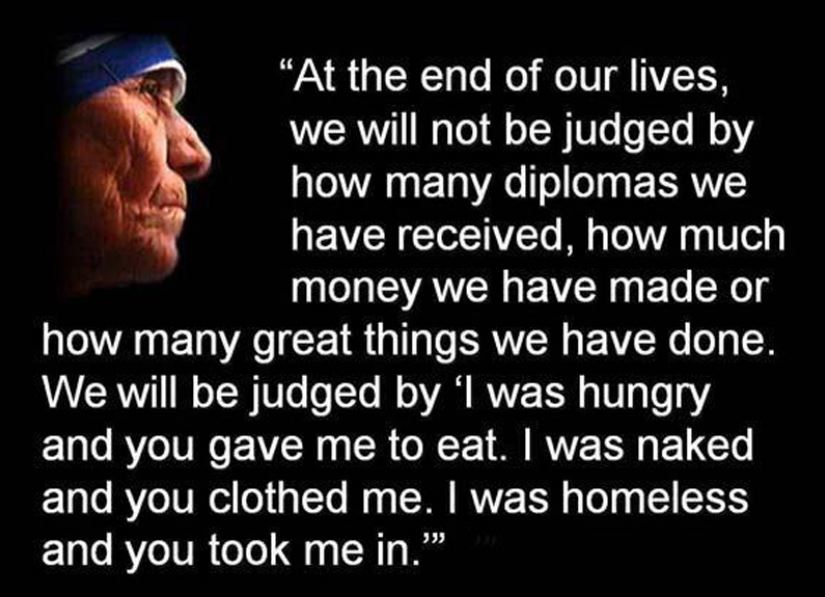
I was hungry and you gave me food“Then the King will say to those on His right, ‘Come, you who are blessed by My Father, inherit the Kingdom prepared for you from the foundation of the world.” Matt 25:34

So wait a minute – what is Yeshua (Jesus) saying to his disciples in this passage? Who are the people He speaks of who are blessed by His Father (and ours)? And what did He mean two verses earlier when King Messiah Yeshua said that He will “…separate the sheep from the goats” (Matt 25:32)? In verses 35-36, Yeshua goes on to say: “For I was hungry and you gave me food, I was thirsty and you gave me drink, I was a stranger and you welcomed me, I was naked and you clothed me, I was sick and you visited me, I was in prison and you came to me”.

If we go back to the Tanach (Old Testament) we can see prophecies of the warnings and future judgment Yeshua was speaking of in Matthew 25:

  • Ps 37:22 – For those blessed by Him shall inherit the earth, but those cursed by Him shall be cut off.
  • Isa 58:7 – Is it not to share your bread with the hungry, and that you bring to your house the poor who are cast out; when you see the naked, that you cover them, and not hide yourself from your own flesh?
  • Eze 18:7 – …but have given their bread to the hungry and covered the naked with clothing.
  • Eze 34:17 – And as for you, O My flock, thus says the Lord God: “Behold, I shall judge between sheep and sheep, between rams and goats”

These verses seem disjointed and not directly related to Yeshua’s words in His Olivet discourse, until you look at the full context surrounding these verses. You might wonder, for instance, why YHVH would be judging between sheep and sheep. Let’s look at the passage in Ezekiel 34 preceding Verse 17. YHVH had just been speaking (through Isaiah) about how He would judge the false shepherds who were mistreating the flock and leading them into pagan practices (vv. 7-10). Then in Verses 11-16 He speaks of seeking out His sheep and bringing them back from all the nations of the world where they have been scattered, so that He can bring them to a place of comfort and peace: “they shall lie down in a good fold and feed in rich pasture” (Eze 34:15).

Then in Verse 16 He says: “I will seek what was lost and bring back what was driven away, bind up the broken and strengthen what was sick; but I will destroy the fat and the strong, and feed them in judgment.” Abba is promising here to take care of His obedient sheep; those who were led astray by the false shepherds but now desire to follow the true Shepherd. But He will judge those sheep who are continuing to follow the way of the false shepherds and are not willing to trust in YHVH and follow His way.

So how do we recognize someone who is following YHVH’s path and trusting Him with their whole heart? According to Isaiah 58, Matthew 7 and other passages, we will know them by their fruit (see Matt 7:20). It is clear that in Matthew 25:35-36, Yeshua is referring back to the words YHVH was speaking to His people through Yeshayahu (Isaiah) In Isaiah 58:7. In the Isaiah passage, YHVH was instructing His children that it was far more important to Him that they care for the poor and needy, than that they follow their religious rituals.

As we have said many times before, our spiritual journey is all about relationship with YHVH. If you truly want to be pleasing to YHVH and walk in His path, then you need to learn what pleases Him. More to the point, you need to get to know Him personally, not just learn about Him. As you draw closer to Abba Father and His Son Yeshua, you will get to know what is at the core of their heart. When you dig down deep, you will find love, compassion, understanding and empathy for the oppressed and downtrodden among their people. So you might say to this: “how do I help all the poor and hungry, oppressed and abandoned people; how do I visit all the prisoners, take in all the homeless, and clothe the naked; how do I care for all the orphans and widows if the earth? This is much too daunting a task and far too overwhelming for one person.”

If you have a true relationship with YHVH, though, as your closest friend and trusted counselor, then He will show you where He wants you to help His children. Most likely He will start you off with something small, for example, working at a local soup kitchen, visiting shut-ins or elderly people in nursing homes, helping needy widows with small tasks around their homes, or a host of other things. Abba will not only point you to the places He wants you to help, but He will give you all the gifts you need for the task, however great or small. Go to Abba and ask Him what is on His heart; when you seek Him with your whole heart, you will find what is in His heart.

ALL or nothing

how long o you peopleHow committed are we in our relationship with YHVH? What is it worth to us?  How much are we willing to risk? In theory, most of us would say that we would be willing to sacrifice everything. We know what the answer should be. However, in practice what do we risk? Are we willing to tithe our income or share with others when money is tight? Are we willing to endure rejection and criticism from our family and friends because of our relationship with YHVH?  How bad would it have to get before we crumble?

A few years ago, I thought I was strong in my relationship.  However, after only two weeks in harsh conditions with demonic forces all around, I was beginning to lose it. It was an eye-opener for me. It is one thing to sit in comfort and ease at home and imagine how you would handle hardship, persecution, and danger. It is quite another matter to actually live it.

For YHVH and His Son, our relationship is worth the deepest sacrifice.  YHVH sacrificed His only child, His beloved Son. To lose a child is a parent’s worst nightmare, especially to watch an innocent child die an excruciatingly painful death at the hands of one’s worst enemies.  If YHVH wanted a perfect human, He already had one.  It wasn’t enough. He risked what was most precious to Him for the hope of relationship with all of us.

Yeshua is YHVH’s only begotten Son. He was entitled to all the praise and adoration that creation could muster. Yet, He was asked to sacrifice all in order to gain those who had been created for His pleasure, but who were now His enemies. By the time He was arrested, He had been deserted even by his closest friends. He could offer salvation, but would anyone accept it? Yeshua focused solely on YHVH’s promises instead of all the abuse and agony heaped upon Him. Even His closest friends did not comprehend what He was doing for them. If He relied solely on what His five senses told Him, the prospects were bleak.

Yeshua sacrificed all that He had and, as a result, He gained those who believe in Him.  If He had not been willing to risk His comfort, His dignity, the clothes on His back and even His life, He would have gained nothing and we would be lost forever. Only Yeshua and His Father could see the potential in us.

He relinquished everything He had to reclaim those who had lost everything.

We are called to give all of ourselves to Yeshua, for in Him we have all that He has earned for us: relationship with YHVH, eternal life, and restoration of all we have lost. If we do not give our all to Yeshua, then we have nothing.

In approximately one-third of the world today, our brothers and sisters are giving their all to Yeshua. They suffer oppression, trials, and persecution, even torture and death for the sake of their relationship with Yeshua. The rest of us, who live in relative ease and freedom may one day be called to do the same. In the meantime, we can support our brothers and sisters by speaking out on their behalf, by interceding for them and by sending funds to sustain them.

Maybe through our prayers and actions on their behalf, we will be strengthened so that we will endure if we are required to give our all.

Fountains of Living Waters

Out of their heart

“for the Lamb who is in the midst of the throne will shepherd them and lead them to fountains of living waters. And God will wipe away every tear from their eyes.” Rev 7:17

In last week’s blog about YHVH’s Feast of Shavuot, I talked about YHVH giving us His written Torah, and then pouring into our hearts the living Torah when He gave us His Holy Spirit (Ruach HaKodesh) at Pentecost (Shavuot). In Scripture, water sometimes represents the Holy Spirit. In several passages, YHVH uses the images of living or flowing water, or pouring out of water (see John 54:10-11;7:38, Joel 2:28, Zech 14:8, Rev 7:17). There is even a related scripture where YHVH speaks judgment over His people who have abandoned Him “…,Because they have forsaken the LORD [YHVH], the fountain of living waters.” (Jer 17:13)

Abba is saying that His Holy Spirit is not only active but constantly in motion, inspiring us and empowering us to flow in the gifts that He blesses us with. The clearest scriptural confirmation of this is in John 7:39, right after Yeshua said “If anyone thirsts, let them come to Me and drink. The one who believes in Me, as the Scripture has said, out of their heart will continuously flow rivers of living water.” In verse 39, John [Yochanan] commented on Yeshua’s offer to pour out His Holy Spirit on His people when he said: “But this He spoke concerning the Spirit, whom those believing in Him would receive; for the Holy Spirit was not yet given, because Yeshua was not yet glorified.” This passage also reminds us of the most beautiful prophecy about the giving of the Holy Spirit in Joel 2:28: “…I will pour out my Spirit on all flesh.”

Yehovah did not want us to miss His prophecies on the giving of the Holy Spirit, so He even wrote this message in the stars. If you grew up in the 60’s, you probably know the worldly (or New Age) significance of the Zodiac sign called Aquarius. Regrettably, the original meaning of this sign has been corrupted by pagan mythology and worldly Greek philosophy. From the original Hebrew name of this sign, “poured forth” or the pourer forth of water”, we can see that YHVH was telling us that He (The Pourer Forth of Water) would in the future be pouring out the Holy Spirit on his children. We now know that this is what happened at Pentecost [Shavuot], which was the fulfillment of Joel 2:28.

As we meditate on the beautiful message in Joel of the One who pours out His Spirit on all flesh, we remember to look to the One who is doing the pouring, and receive from Him what he desires to give us. But receiving this outpouring (or infilling) of Yehovah’s Ruach HaKodesh into our hearts through the baptism of the Holy Spirit is only the first step. How can we be active vessels of His Holy Spirit, allowing the Ruach to flow through us continuously like rivers of living water (John 7:38)? Jeremiah speaks about YHVH’s judgment on His people: “My people have forsaken me, the spring of living water. And they have dug wells, broken wells that can’t hold water.” (Jer 2:13)

Even though we are leaky vessels as imperfect humans, YHVH can use us in powerful ways when we are flowing in the power and gifts of His Ruach [Holy Spirit] within us. An active, functioning well is one that responds when someone primes the pump: the water flows out to those who need it. In the same way, we need to be open to the prompting of the Holy Spirit and ready to pour out His living water into the lives of others. The Ruach pours wisdom, gifts, and power into us – we have opportunities every day to use His gifts and power to help and disciple others.  How will you use the living waters of the Holy Spirit to bear fruit in this needy world?

Why is Shavuot (the Feast of Weeks) Important?

I will put my spirit within you

One of the least known and understood Biblical feasts of YHVH is the Feast of Weeks, Shavuot in Hebrew or Pentecost in Greek.  As believers in Yeshua the Messiah, you are probably well aware of what happened on the Pentecost following Yeshua’s resurrection and ascension.  The great outpouring of the Holy Spirit came upon Yeshua’s disciples in Jerusalem, and over 3,000 souls were added to the believing Body of Messiah on that day alone.

You are probably also familiar with the Holy Spirit-inspired miracle that occurred during that Shavuot, when the disciples started speaking in tongues of other languages, and each of the thousands of pilgrims in Jerusalem that day understood them in their own language (see Acts 2:11).  Also well known is the fact that this miracle (which represented the overturning of the confusion of languages from the Tower of Babel) was the beginning of the fulfillment of Joel 2:28-32, where YHVH prophesied through Joel that the Spirit would be poured out on all flesh.

When we dig down a little deeper into this appointed feast day of YHVH, though, we realize that many questions are raised and mysteries unveiled when we seek answers through the Holy Spirit. We know that this day of Shavuot happened 50 days after Yeshua was raised from the dead, as we have many confirmations of that time period in Scripture. It is stated clearly that Yeshua was on the earth and appeared to over 500 people during the 40 days following His resurrection (1 Cor 15:6). Then, Yeshua clearly told His disciples to wait in Jerusalem until the Holy Spirit came upon them (Luke 24:49):  “I am going to send you what my Father has promised; but stay in the city until you have been clothed with power from on high.” (also see Acts 1:4-8)

You may have studied the similarities between Pentecost and the Shavuot on Mt. Sinai when many Jews believe the Law (Torah) was given to the Israelites.  There is the obvious analogy of fire falling from heaven in both events, first on Mt. Sinai and then on each recipient of the Holy Spirit’s outpouring.  A somewhat less obvious analogy is the giving of the Torah on both occasions (once in written form and once as the Holy Spirit bringing the living Torah to dwell inside of us (see the chapter on the Baptism of the Holy Spirit in our book).  Another similarity is the loud sound (YHVH’s voice on Mt, Sinai, which compares to the loud sound from heaven as of a mighty rushing wind. (Acts 2:2)

What you may not have considered is that the Torah was written on tablets of stone at Mt. Sinai, but Abba said He would write His Torah on our hearts: “I will put My law [Torah] in their minds, and write it on their hearts; and I will be their God, and they shall be My people”. (Jer 31:33) And how did YHVH plan to accomplish this miracle? By the power of His Holy Spirit within us: “I will give you a new heart and put a new spirit within you; I will take the heart of stone out of your flesh and give you a heart of flesh. I will put My Spirit within you and cause you to walk in My statutes [Torah]” (Eze 36:26-27)

Here is the connection: when the Holy Spirit was poured out on the people at Shavuot and they received the baptism of the Holy Spirit, YHVH wrote His Torah on their hearts.  When we receive the Holy Spirit to live inside us and guide us, He causes us to walk in His Torah.  A better way to say this might be that He continuously helps us to renew our minds and hearts so that we are transformed into His likeness.  As we go through this transformation, we desire to follow His instructions because we love Him and want to be one with Him as Yeshua said He wanted to be one with us before He left the earth (John 17:21-23)

Spend some time studying God’s word this Shavuot, praising the living Word (Yeshua) and giving glory to Abba Father who sent the Holy Spirit to dwell inside us.  As you do this, you might want to meditate on how you can draw even closer to all three persons of Yehovah God by keeping the Torah that they wrote on your heart, which is kept alive and powerful by the Holy Spirit who lives within you.

Offensive Judgment

for with what judgmentIf you have ever spent time in a congregation, then you most likely have encountered at least one instance of a Christian or Messianic believer judging another. Perhaps you were even the one being judged. Perhaps you were the one who did the judging.

Over several decades, I have been a member of various congregations. I have noticed many instances of Christians or Messianic believers judging a fellow member or a newcomer who showed up at their door, I have experienced many of the examples mentioned below, either as the one who was judged or as the one who judged (or should I say misjudged?).

The effects of our misjudging, whether subtle or blatant, are powerful and can be devastating to others. Actions or reactions such as a certain “knowing” glance, turning away, keeping someone at arm’s length, gossiping, excluding another, and so on, may seem insignificant in a world full of violence and horror. And yet, if we are engaging in any of these actions, we are not following Yeshua’s command to love one another. That means we are sinning and sin is never insignificant (Matt. 5:21-22).

The sheep in wolf’s clothing: Often we judge others by their appearance. The less similar they are to us, the more we tend to suspect them. Does the person wear our kind of clothes, have a similar hairstyle, and so on? If not, then they are automatically suspect. Consider Isaiah 11:3, NLT

Assumptions and generalizations: If you are divorced, then it is your fault and you are considered sinful and loose with your morals. If you are married, then you are automatically moral and upright. The list goes on, but you get the idea. Consider John 8:7 and Rom 2:1.

Talents and gifts or lack thereof: Some gifts may be prized over others, and those with the valued gifts are welcomed more warmly. Those people whose gifts are not easily recognized or deemed less essential may be ignored or otherwise devalued. Consider 1 Cor 12:4.

 Political choices: There are no perfect people or political leaders (except Yeshua). There is no holy and perfect political party. Consider Psalms 146:3 and 118:8 and Jer 17:5.

 Racial prejudice: Belonging to a different race or associating with those of a different race means that you are less moral or upright. Alas, prejudice is still alive and kicking even among those who appear to be strong believers. Consider 1 John 2:9, 1 Cor 12:13 and Gal 3:28.

 Financial status: If you are rich, then you are greedy and selfish or else you are inevitably upright and moral. If you are poor, then you are lazy and worthless or you are good, but unjustly oppressed. In his book, The Blood of Lambs, Kamal Saleem, former terrorist-turned-Christian makes a poignant point. He used to recruit people in the United States for Islam and jihad by taking food to the poor, often in neighborhoods where there were Christian churches. None of the Christians had ever bothered to reach out to those he visited, thus making his task easier. Consider Matt 25:34-36 and Isaiah 58:6-7.

The wolf in sheep’s clothing: We seek to be broadminded sometimes even when we are steeped in ignorance. We implicitly trust people because they claim to be Christian or because they look like us or they seem to be like us in other ways. They appear to be our kind of people, so they must be alright. Many a person has trusted in such a way and lived to regret it. Consider Matt 7:8, 10:16 and 1 John 4:1.

We cannot accurately judge because we don’t see others’ motives, emotions, or past experiences (Prov 16:2; 21:2 NIV). So how do we know when a person is sincere? How do we know if someone really wants to change or is truly seeking YHVH’s help? How do we know if someone is pulling the wool over our eyes?

While it is not our duty to judge others, it is our duty to distinguish to the best of our ability. We are expected to make wise decisions concerning our friends and associates. We must have some order and regulation in our congregations. Leaders especially have a duty to protect their congregations. We obviously cannot rely on our own wisdom, so we must seek YHVH’s wisdom instead. We ask YHVH for the discernment which is provided to us by His Holy Spirit. We must proceed with a judicious mix of caution and love.

When we judge another, we risk offending that person and YHVH.  Above all, we are called to do everything in love. Yeshua commanded us to love one another, not to judge one another (John 13:34). If we perceive someone as an enemy, we are still called to love that person, even if that person has misjudged or mistreated us (Matt 5:44). These Scripture passages are very familiar to us, but how well do we live up to Yeshua’s expectations? This is a question that I must ask myself every day. What about you?

Who Is to Judge?

Who are you to judgeThe topic of judging others leads us into sensitive territory. Discussing this subject tends to unveil misunderstanding, hurt feelings, defensiveness, and a host of other negative reactions in us. It seems that most people harbor strong ideas of what they mean by judging, how and when to “judge,” who is to be judged, and so on.

 Bible verses are quoted to bolster each viewpoint. In order to settle arguments and arrive at some practical solutions, it is wise to consider the original Greek word that was used and translated into the English word “judge”.  I consulted Strong’s Exhaustive Concordance to examine the Greek word used by the authors and translated into English as “judge”. Most New Testament passages using the verb “judge” are translated from the Greek (Strong’s number 2919. krino), and include, but are not limited to, the following passages:

Matt 7:1   “Judge not lest ye be judged…”

Luke 6:37 “Judge not and ye shall not be judged…”

John 7:24 Do not judge by appearance, but judge with right judgment.”

According to Strong’s, the Greek word krino means “to distinguish”. Implied meanings include: to try, condemn, punish. It can also mean avenge, conclude, condemn, damn, decree, determine, esteem, judge, go to (sue at the) law, ordain, call in question, sentence to, think.

When krino is used in the New Testament, it is generally used in passages that discourage believers from judging. Although Ephesians 4:25 reminds us to “speak truth to our neighbor,” there is no mention of judging our neighbor. Galatians 6:1 tells us to restore transgressors in a spirit of gentleness. We are also admonished to “keep watch on yourself, lest you too be tempted.” We are living in the kingdom of darkness and are still vulnerable to sin to some degree or another.  We are in no position to judge each other, but we are encouraged to assist each other in living according to YHVH’s ways.  If we judge others who sin, then we will be judged in the same way, because we too have our moments of weakness. We may concoct our own “levels” of sin, and conclude that our sins aren’t as bad as those of our neighbor, but beware.  All sin is an abomination to YHVH.

Some may argue that in 1 Cor 5:12, Paul is telling us that we are to judge believers.  Let us look at the context.  There was a person in the congregation at Corinth who was openly engaging in sinful behavior.  Paul was advising that the person be removed from the congregation so that he would not lead other believers to follow his corrupt behavior.  If the person was removed from the congregation, it was in the hopes that he would come to his senses and realize the danger of his poor choices.  There was no need for the others to place him into Satan’s hands; the sinner was already doing that.  Whenever any of us turn from YHVH, we automatically open the door to Satan.

James 4:11-12 explains why we are not to judge.

“Speak not evil one of another, brethren. He that speaketh evil of his brother, and judgeth his brother, speaketh evil of the law, and judgeth the law, but if thou judge the law, thou are not a doer of the law, but a judge. There is one lawgiver, who is able to save and to destroy: who art thou that judgest another?”

The “lawgiver” is YHVH and the “law” or “Word” is Yeshua.  Yet, not even Yeshua judged others when He came to earth the first time, so it is not our place to judge others either (John 12:46-48). When Yeshua returns, He will judge others (2 Tim 4:1). Those who return with Yeshua to reign with Him will also judge the world (2 Cor. 6:2). While we are still in our imperfect state, we are not to judge, for we, too, are still weak enough to succumb to temptation. Therefore, we are to love and encourage each other and to gently admonish one another when necessary, but it is not our job to judge each other.

Where is Your Heart?

where your heart is“For where your treasure is, there your heart will be also.” Matthew 7:21

In the first installment of this series on the “Sermon on the Mount”, I talked about righteousness being the main focus of Yeshua’s Kingdom message. I also showed how He focused on the heart as opposed to head aspects of righteousness. In this message I want to illustrate exactly what Yeshua means by keeping the Torah and walking in righteousness at the heart level.

In order to understand how Yeshua (and therefore Abba Father) wants us to walk in righteousness in Yehovah’s Kingdom of light, we first need to dig down to a deeper level of scripture study. On the surface of these passages, it appears that Yeshua is saying things like: don’t focus on accumulating wealth (Matt 6:24), don’t judge others (Matt 7:1), don’t worry about your life (Matt 6:25), don’t show off when you’re helping out the poor (Matt 6:1), and don’t be a hypocrite about your fasting and praying (Matt 6:5,16).

However, when we dig down to the heart level of Yeshua’s message, we can quickly see that He is really talking about building healthy relationships as we are following the Torah and walking in righteousness. Let me give you a couple of brief object lessons to illustrate what I mean. Imagine for a moment that you are a member of a large congregation, and that every week when you go to worship services, you spend a few minutes before and after service saying hello and shaking hands with people that you either don’t know, or you know only as once-a-week acquaintances. You might even ask these people how they are doing or whether everyone is healthy in their family, but are you just going through the motions or sincerely reaching out to these people?

In the same way, let’s say you work with “Meals on Wheels” and take meals to home-bound people every day, but you never speak to them or show that you care about them in any way (other than just doing your job to help the poor because you know you’re supposed to). Do you think those people are going to think of you in a kind and caring way? Or will they just see that you are doing this out of obligation and you don’t really care about them personally? What is your heart motive in this scenario – are you doing this to feel good or look good, or do you truly look for ways to bring Yeshua’s love to them?

The key point Yeshua was addressing in His message is that you can be the most righteous person on earth from a human perspective (as many of the Pharisees were), doing good works every moment of the day. However, since Yehovah looks on the heart, from His perspective you could be like a whitewashed tomb (Matt 23:27), appearing to be good and righteous on the outside, but inside you are nothing but filthy rags (Isa 64:6). In this case, Yeshua could rightly say to you: ‘…I never knew you; depart from Me, you who practice lawlessness!” (Matt 7:23).

YHVH requires that we “…do justly, love mercy, and walk humbly with our God” (Micah 6:8). He certainly wants us to follow His instructions in the Torah, but He judges us by our heart attitudes and motives more than by our actions. We would do well to examine ourselves from His perspective, following His word in our hearts and not just our heads.

Seek First the Kingdom of God [Elohim]

But seek first the kingdom of God“And He came down with them and stood on a level place, with a great crowd of His disciples and a great multitude of people from all Judea and Jerusalem and the seacoast of Tyre and Sidon, who came to hear Him and to be healed of their diseases…” Luke 6:17-18

What was happening in Yeshua’s ministry on earth when He spoke the messages in the “Sermon on the Mount”? What we know from Scripture is that the Pharisees were angry with Yeshua because His teachings did not follow theirs and because He was drawing large crowds wherever He went. So what was He teaching that was so radical, and that went against the Pharisees’ teachings? Yeshua was teaching about the Kingdom of God (also called the Kingdom of Heaven) and how they could not only be a part of the Kingdom on earth, but that the Kingdom was now within them!

Yeshua spoke about righteousness as the main theme of the Kingdom in Matthew 6:33: “But seek first the kingdom of God and His righteousness, and all these things will be added to you”. Also in Matthew 5:6,10 and 13:43, Yeshua says that “the righteous will shine like the sun in the kingdom of their Father.”  The Pharisees spoke about righteousness, but their form of righteousness was from following the Law (Torah) according to their interpretation of the Law, which included all of their man-made laws. Yeshua wanted to clearly distinguish between the righteousness that God expected in His gracious Kingdom and the righteousness of the Pharisees’ legalistic (man-made) kingdom.

Yeshua followed the Torah instructions in every way, and told us that He still wanted us to follow them. In Matthew 5:18 Yeshua states that not one jot or tittle will pass away from the Torah until heaven and earth pass away.  Yeshua had a very different interpretation of how an obedient follower was to keep the Torah.  For instance, the oral law of Moses said that a man could divorce his wife by simply giving her a certificate of divorce (see Matt 5:31).  However, Yeshua said that “whoever divorces his wife for any reason except sexual immorality causes her to commit adultery” (Matt 5:32). Obviously Yeshua did not follow the oral law or any of the codes of law that were added to the Torah by the Pharisees (since He already said above that nothing in the Torah would or could be changed).

The Pharisees believed in keeping the Law with their heads but not their hearts.  Yeshua said in Matthew 12:34 that the Jewish leaders were speaking and doing good, but at the same time thinking evil in their hearts.  Yeshua, on the other hand, was teaching Abba Father’s interpretation of the Torah: that His children are to keep His Torah in their hearts and not just in their minds.  Here are a few examples of heart obedience that Yeshua gives in Matthew and Luke:

  • Matthew 5:21-26: murder begins in the heart
  • Matthew 5:27-31: adultery begins with lust which comes out of the heart
  • Luke 6:36: “Be merciful, even as your Father is merciful.” (speaking of loving our enemies)

Yeshua’s underlying guidance on how to live our lives is the same as the Father’s – follow Torah with our minds and our hearts. Our gracious God has not only given us instructions for living life to the fullest, but He forgives us when we slip up. He wants us to have a genuine relationship with Him and with each other.  A true relationship involves the heart as well as the mind.

Letting Go

your right hand upholds me

As newborns, we automatically close our little fists around objects near to us. When someone holds us, we cling to their clothing or to an offered finger or sometimes to a strand of hair. It seems that most of my life I have been clinging to treasured objects, precious dreams, or beloved people. It is difficult and painful to let go. Sometimes it seems impossible, certainly unthinkable.

We were born for love and fellowship, yet we must learn to let go of loved ones. We were created for enjoyment and pleasure, yet often we must let go of that which delights us. Why this paradox? I’m not sure I have the answers, but I will share the thoughts I have gleaned from decades of clinging, then letting go.

The more we value someone or something, the greater the pain when we must let go. The pain lasts for a long time, sometimes for the rest of our lives. At times we cling to the pain as a way of trying to hang on to what we lost. In the end, it becomes necessary to let go of even the pain if we are to move forward.

Why does YHVH allow loss and pain? He is the source of love, beauty, fellowship, joy, shalom. Why does He allow so much suffering and anguish? Doesn’t He realize how horrible it is to let go, especially to let go of someone you love and cherish?

Yes, He does know. He relinquished His only begotten Son to a fallen, cruel world to share in our sorrows and sufferings. He then allowed this precious Son to take on all the sin and pain and suffering and endure excruciating pain and misery in order to save us from an eternity of wretchedness and hopelessness. For a time, He put us ahead of even His most beloved Son.

We are on this earth to learn to let go (Matt 6:19-21; Luke 9:62)). That doesn’t mean that we are not supposed to love others, to enjoy or to cherish hopes, dreams, even objects. It means that we must be willing to release each treasure when the time comes until there is only One Whom our fists and our hearts embrace. We must put Him first.

We are on this earth to cling to the Source of all that we love and value. When we let go and cling solely to Him, we learn a valuable truth. YHVH released Yeshua and watched Him endure untold suffering and death. However, that is not the end of the story. Yeshua has been reunited with YHVH forever and sits at His right hand. All that we have relinquished will one day be restored to us if we cling to YHVH and put Him first. In the end, we can have it all.

The Overlooked Sin

no one comes to the Father

The Jews had an opportunity to accept their Messiah or reject Him at His first coming. While many Jews accepted Yeshua as their kinsmen Redeemer and King, the majority did not. Over the centuries, many peoples have hated and persecuted the Jews, citing the rejection and crucifixion of Yeshua as “justification.” Many people smugly criticize the Jews and yet are guilty of the same sin.

The same challenge is presented to each of us. Do we accept Yeshua as our Redeemer and King? Have we asked for forgiveness of our sins and invited Yeshua to be King over us?

Jewish leaders resented Yeshua’s criticism of their man-made traditions and their hypocrisy. They wanted to do things their own way (Luke 6:1-12; Luke 7:29-30). They refused the help they so desperately needed.   Some people today say that belief in God is for weak people, not recognizing that they, too, are weak people who very much need a Savior. They believe that they are capable of running their own lives and sometimes the lives of others without Yeshua’s help.

Jewish people were looking for a leader who would save them from physical oppression (John 6:14-15). They didn’t realize that the spiritual oppression Yeshua overcame is far more serious and is also the root cause of the physical oppression. Many people today are focused solely on the physical realm, unaware or misunderstanding the spiritual realm. We can choose to renounce our subjection to Satan and embrace the salvation offered by Yeshua, but it is a choice that each of us must make in order to enter the Kingdom of YHVH.

Jewish people believed that being born Jewish was sufficient or that following the traditions and rituals established by men would secure them a place with YHVH.

Many people today believe that it is enough to be a “basically good person” or to belong to a particular denomination or congregation. Many people do not recognize their own sins, especially the most glaring one, the sin of rejecting Yeshua as their Redeemer (Luke 5:32).

Yeshua died a gruesome, violent death to pay the penalty for our sins and to ransom us from the grip of the evil one. Do we honestly believe that we can ignore Yeshua’s redemptive work and make our own way into the Kingdom of YHVH? If this were true, then Yeshua’s work would have been a waste of time and effort. Do you honestly assume that YHVH made the agonizing decision to send His precious Son to be slaughtered on our behalf, but is now willing to overlook our rejection of His beloved Son and His hard-earned gift of salvation?

Do not be deceived. No matter how “good” you are and no matter how exemplary your life has been, you have absolutely nothing to offer that can save you from eternal damnation. You are like a drowning person who has been thrown a precious Lifeline. However, it is necessary to seize and cling to this Lifeline in order to be acceptable to YHVH.