Strongholds: Avoiding the Pitfalls


This  is the second of three articles in a series entitled “Living Kingdom”.  We will examine the importance of choosing to abide by YHVH’s commands as we consider the choices of individuals in Scripture.  The Good News (Gospel) is about YHVH’s kingdom.  Salvation is necessary for Kingdom Living, but it is a part of the process, not the goal.  We face the same challenges as the Israelites:  recognizing and obeying our King.     

In the first article (Law-Abiding­ Citizens?), we examined the importance of following YHVH’s commands.  Obedience provides rewards and disobedience incurs punishment.  We who claim to belong to YHVH must recognize that we serve a King.  The words of YHVH in 1 Samuel 8:7 ring just as true today as they did then.  “Do everything they say to you,” the LORD replied, “for it is me they are rejecting, not you. They don’t want me to be their king any longer.”

We sometimes stray from following YHVH without realizing it.  We, like many Israelites, are more easily influenced by physical and worldly rather than spiritual and heavenly.  We forget that we are on a battlefield and the battle is spiritual, a war being waged between YHVH and hasatan.   When we are threatened or suffer injury, we are tempted to build strongholds rather than turn to YHVH.   This article provides some examples from Scripture to help us recognize common false strongholds and their pitfalls.  First of all, what is a stronghold?

Merriam-Webster defines the word “stronghold” as follows:  1: a fortified place; 2: a place of security or survival; a place dominated by a particular group or marked by a particular characteristic  These can be geographical places or places we build within our souls.  Strongholds in our souls invite demons to move in so they can more easily torment and manipulate us.  Our first example demonstrates this clearly.

YHVH chose Saul to be his human representative because the people had difficulty following a King who is spirit.  However, Saul relied on his own judgment and didn’t fully heed YHVH’s instructions, nor was he truly repentant when Samuel pointed out his sin. (1 Sam 15).  YHVH removed the Holy Spirit  from Saul and placed His Spirit on David instead.  When the Holy Spirit departed, a demon of fear entered Saul, followed later by a tormenting spirit.  We cannot rely on ourselves; it is YHVH who equips us and supplies all our need.  When we deny YHVH access in any area of our lives, we open the door for evil spirits.  I am YHVH, there is no other, besides Me there is no God; I equip you, though you do not know me (Is 45:5).”

Although YHVH selected David to be Saul’s replacement, it was years before David ascended to the throne.  During that time, YHVH tested and strengthened David to be a more faithful representative than Saul.  David was tempted to build false strongholds, especially reliance on other people and strategic hideouts, but none of these protected him.  David learned that it was reliance on YHVH that kept him safe.  We are tempted to rely on human leaders or experts to provide solutions to problems with spiritual roots.  These are jobs that only YHVH can handle and we must turn to Him and encourage others to do likewise.  O give us help against the adversary, for deliverance by man is in vain (Ps 60:11).  Thus says the LORD, “Cursed is the man who trusts in mankind and makes flesh his strength, and whose heart turns away from YHVH (Jer 17:5).

Solomon turned to wealth, power and prestige and strayed from YHVH.  He allowed his wives to persuade him to engage in pagan worship. And the Lord was angry with Solomon because his heart had turned away from the Lord, the God of Israel, who had appeared to him twice and had commanded him concerning this thing, that he should not go after other gods. But he did not keep what the Lord commanded (1 Kings 11:10).  Many of us are racing to acquire bigger, better and more to impress others, but is YHVH impressed by our selfishness?  In the end, it doesn’t matter what anyone besides YHVH thinks of us.  YHVH is our Judge.  How can we impress Him?  “Do not neglect to do good and to share what you have, for such sacrifices are pleasing to God” (Heb 13:16).  How different might the United States be if the inalienable rights listed in the Declaration of Independence read “that among these are Life, Liberty, and the pursuit of YHVH” rather than “the pursuit of Happiness”?

Throughout history humans have built castles, forts, and other strongholds to keep out the enemy.  The people of Jericho relied on their massive walls and sturdy gates to keep them safe from harm.   However, the very walls intended to protect them actually destroyed them (Joshua 6).  We can build walls to keep others out, but is that our commission from Yeshua?  He said we would be known by our love.  “By this everyone will know that you are my disciples, if you love one another (John 13:35).” For I was hungry, and you fed me. I was thirsty, and you gave me a drink. I was a stranger, and you invited me into your home (Matt 25:35).”

Simon Peter used a sword to cut off a soldier’s ear during Yeshua’s arrest.  Yeshua warned him that physical violence was not the right choice (Matt 26:52).  We can amass armies and weapons of mass destruction, but how will this help us spread the Good News of the Kingdom of YHVH?  Yeshua has promised us that we would suffer persecution for following Him and it is YHVH who will avenge us.  “ And will not God bring about justice for his chosen ones, who cry out to him day and night? Will he keep putting them off?  I tell you, he will see that they get justice, and quickly. However, when the Son of Man comes, will he find faith on the earth (Luke 18:7-8)?”

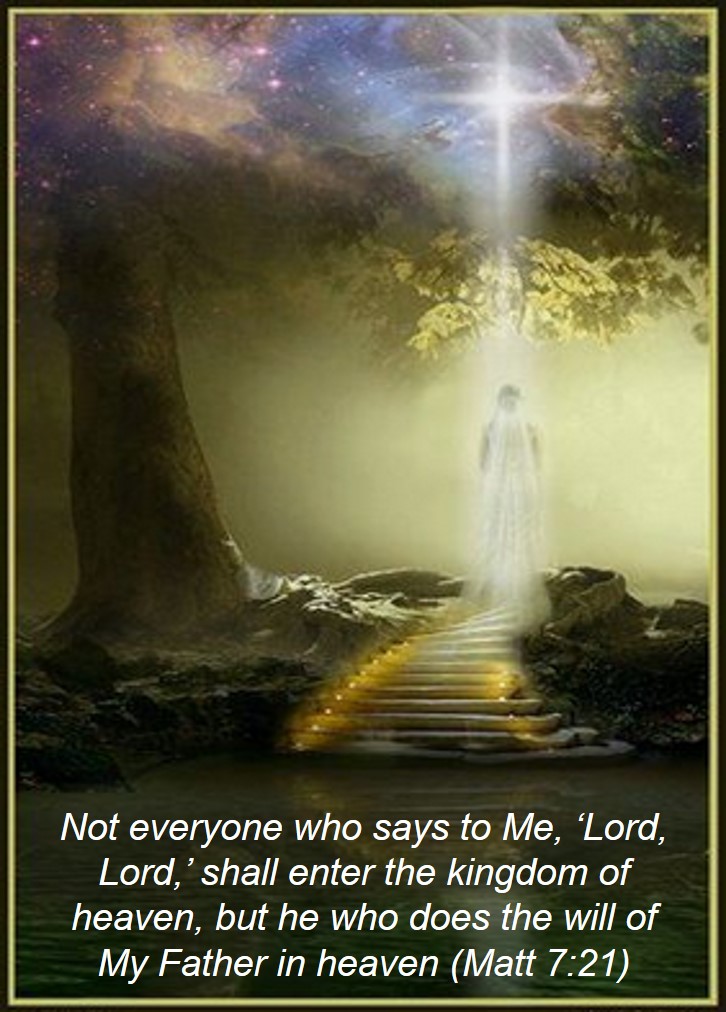
The  scribes and Pharisees thought genealogy and man-made traditions were sure guarantees, but they were wrong (Matt 3:9; Matt 15:1-20).  It is not who we are biologically but who we worship and how we worship.  YHVH tests our spirits and our hearts (Prov 16:2, 21:2).  The Jewish leaders had constructed their own religion, adding to and subtracting from YHVH’s commands (Matt 23).  Sadly, we have inherited man-made traditions and pagan worship passed down for many centuries (Jer 16:19).   Now that we know that Sunday worship, Christmas and Easter are not from YHVH but are perversions of His appointed times, how do we respond?  Will our love of traditions, pressure from our families or society prevail over what we now know to be the truth?  “Not everyone who says to me, ‘Lord, Lord,’ will enter the kingdom of heaven, but only the one who does the will of my Father who is in heaven.  Many will say to me on that day, ‘Lord, Lord, did we not prophesy in your name and in your name drive out demons and in your name perform many miracles?’  Then I will tell them plainly, ‘I never knew you. Away from me, you evildoers (Matt 7:21-23)!  ’These are not easy choices, but Yeshua warned us about that.   But small is the gate and narrow the road that leads to life, and only a few find it (Matt 7:14).

It is time to ask Yeshua to shine His glory light on any strongholds within us.  It is time to let go of that which is not of Him.  Yeshua relinquished all for us.  Now He expects the same of us.  False strongholds are the means of withholding ourselves from YHVH and are open invitations for the enemy to move in.  YHVH is our one and only true Stronghold (Ps 18:2).
Law-Abiding Citizens?

Not everyone who says to meSince the time of Martin Luther, much emphasis has been put on salvation through Yeshua as a gift of YHVH’s grace and not something we merit.  This is true, but it is only a part of the truth.  Yeshua taught about salvation and stressed that reunification with YHVH was possible only through Yeshua Himself.  However, the majority of Yeshua’s teaching focused on how to live in the Kingdom of YHVH (Matt 5-7; 16:19, 18:3, 29-30, 19:23).  Salvation supplies us citizenship in YHVH’s kingdom, but as citizens we must abide by the rules and regulations of our King.  Citizens and visitors in all countries on earth are required to obey the rules of the country where they reside or visit.  What are the consequences of ignoring YHVH’s teaching and commandments?  What are the rewards?  Two books of Scripture (Judges and Ruth) present vivid pictures of the two choices and their consequences.  As we review the stories in these two books, let us look for insights into kingdom living and see how the Body of Messiah measures up.

The Book of Judges provides examples of those who made it to the Promised Land but who failed to follow YHVH’s explicit commands (Judges 2:10).  Let us begin with the story of Micah (chapter 17).  Micah stole 1100 silver pieces from his mother (violating Ex 20: 12, 15).  He overheard his mother putting a curse on the thief.  Micah confessed his sin and returned the money.  His mother used part of the money to “honor” YHVH by creating some idols.  Mixing pagan with sacred and is strictly forbidden by YHVH (Ex 20:3-5).   Micah hired a Levite to serve as a priest in his home.  Levites were to serve YHVH in the Tabernacle, not in individual homes (Num 18:1-2).  How do these choices compare to the development of the Body of Messiah? The church early on mixed pagan with sacred (Christmas and Easter replacing the seven feasts of YHVH), misappropriated funds (selling indulgences and relics), provided idols (statues), and created roles for “priests” that YHVH never authorized.  These practices continue today.  Corruption spreads quickly but is not easily eradicated.  Over time, the Israelites’ disobedience led to their expulsion from the land.  What will be the consequence of our continued disobedience in the kingdom of YHVH?

Next,  the tribe of Dan discovered Micah’s evil setup (Judges 18).  They not only failed to root out the evil, but they stole the idols and the Levite “priest” from Micah thus spreading evil throughout an entire tribe.   Even though YHVH raised up various judges to lead the people, their influence was short-lived.  Strong godly leaders have arisen throughout the history of Christianity.  Revivals have come and gone. Leaders can inspire, exhort and teach, but we make our own choices.  Each person is responsible for establishing and maintaining a relationship with YHVH by loving Him and obeying Him.  We are also responsible for exhorting each other in the Body of Messiah (Col 3:12-17) and rooting out evil from our midst.  Each of us will appear before the Judge (Matt 7:21-23).

Finally, there is the tragic tale of the Levite and his concubine (Judges 19).  The Levite not only failed to protect his concubine, but he used her as a human shield to protect himself.  At that time travel in the Promised Land was no safer than in foreign lands (Judges 19:12).  Israel finally addressed the situation by almost eliminating an entire tribe, not to mention the loss of life in the other tribes.  The first two days Israel fought with the tribe of Benjamin (where the rape and murder had taken place), the other tribes suffered heavy losses.  Was this perhaps punishment for not purging evil from their midst earlier?  On the third day, the tribe of Benjamin was defeated and almost totally destroyed.   A lot of people were killed, but was the evil eradicated?  Being a member of a particular congregation or denomination in the Body of Messiah does not guarantee that we will be righteous before the Judge.  The many incidences of corruption, immorality, etc. within the Body of Messiah today bear witness to our failure to purge evil from our midst.  How many people have sought to know Yeshua and His Father within the Body of Messiah only to be discouraged or even destroyed?  What are we doing to purge evil from our midst?

The book of Ruth provides strong examples of Kingdom of heaven living. Ruth, Naomi and Boaz lived during the same time period as the book of Judges, but their choices brought blessings to themselves and others.  They represent the remnant, those in each generation who truly follow YHVH’s ways, the few chosen from among the many who are called (Matt 22:14).  The climax of the story takes place in the springtime during the barley harvest, the time of Pesach.  Boaz not only followed Torah (Lev 23:22) by allowing Ruth, a poor foreigner, to glean from his fields, but he provided protection and advice for her, unlike the Levite did for his concubine.  We are to welcome the “foreigners” to our faith who seek to know, love and serve YHVH.  We are called to make disciples of them, providing advice, mentoring and protection, not bias and judgment.  Ruth wholeheartedly sought to serve YHVH and her new family.  She was willing to follow the advice of both Naomi and Boaz.  We have much to learn from each other.  Are we proud and obstinate or humble and yielding?  Boaz followed the commandments of YHVH in offering to the kinsman redeemer first in line the opportunity to do his duty.  When the first kinsman redeemer refused, Boaz assumed his assigned duty.  Ruth and Boaz were harvesting barley; we are to harvest souls.  (John 4:35-36).  While bloodlines are important and respected by YHVH, they are no guarantee for eternity.  Neither is the fact that we claim to accept Yeshua as our Savior.  The litmus test for all of us is faithfulness to YHVH and His Torah.

The prevailing excuse given in Judges is that Israel had no king.  Actually, they did have a King who is Spirit, but they failed to recognize Him.  He later came to earth as a human and many still failed to recognize Him.  Our King, who is both YHVH and human resides in heaven, but also in our hearts.  Do we recognize Him as King?  Do we follow His commands?

Picturing Messiah

Snapshots of Messiah

The Old Testament contains numerous snapshots of Messiah in His many roles and aspects.  The more snapshots we examine, the more comprehensive our understanding of Messiah.  As we explore some details of Messiah, we discover implications for ourselves for it is not only our job to learn about Messiah, but to reflect His glory.  

In this article, we will focus on chapters 15 and 17 of Deuteronomy. The first three verses of chapter 15 command us to forgive debts owed to us.  Our Savior paid our debt in full and does not demand reimbursement.  In our case, the debt each of us owes is far beyond our means to repay.  Our Savior repaid all debts owed to YHVH once for all (Heb 10:12; Rom 8:9-10).  Therefore, we are not to expect payment from our debtors, but are called to forgive them even as we are forgiven and to reconcile just as we have been reconciled to YHVH.  (1 John 1:9; Matt 18:21-35).

Chapter 15, verses 4-11 illustrate the generosity that characterizes Messiah.  Our Savior not only released us from impossible debt, but liberally shares His own treasures with us (Is 55:1-2; Matt 8:16-17; Eph 1:1-18).  We are to do likewise (Matt 10:8) with those who have wronged us.  How generous are we toward our enemies, or even toward those who have not offended us but are needy?  Do we judge the poor, ignore them, or reach out to them?

Messiah rescues us from slavery to hasatan and restores us to the kingdom of YHVH.  As citizens of the kingdom of YHVH, we are to use our freedom to serve YHVH and others just as Messiah has served us (1 Pet 2:16; Gal 5:13).  We cannot reflect the glory of YHVH by serving ourselves, but only by serving others.

The sacrifices described in Deuteronomy 15:23 and 17:1 were to be without any sickness, deformity, or blemish, thus illustrating Messiah.  It is through the most perfect Sacrifice that we who are diseased, deformed and stained with sin, are made whole and perfect by the One who absorbed all our imperfections in Himself and put them to death.  The Israelites were to eat the flesh of the sacrifices for nourishment, but were forbidden to consume any of the blood, which contains life.  We gain little from consuming the life of creatures inferior to us, but we gain everything from partaking of the flesh and blood of the One who gives life to all (John 6:53).

The Israelites were ordered to keep evil from their midst.  This was so serious a matter, that a person found guilty of introducing evil was to be stoned to death.  Messiah warned people to turn from their sins (Matt 4:17; Luke 5:32).  He expelled demons from multitudes of people (Matt 8:16; Mark 1:34; Luke 4:41).  When He returns, Messiah Yeshua will eradicate all evil from the earth (Is 25:8; Rev 21:3-4).  We too are empowered and expected to purge all evil from our midst (Jude 1:14-15).

Priests and judges were appointed by YHVH (Deut 17:8-13).  The verdict of a priest or judge was final and orders were to be carried out exactly.  Yeshua did not come as judge the first time (John 3:17).  However, Messiah will return as Judge (Matt 25:31-46; James 5:9; 2 Cor 5:10).  Messiah’s judgement will be final and His orders will be carried out precisely (Is 2:2-4; Micah 4:1-3; Is 9:6-7).  Just as Yeshua came the first time to serve, not to judge, so we must focus on serving others, not judging them.  Our time for judging comes later (1 Cor 6:1-6).  We also are priests (1 Pet 2:9) and Messiah Yeshua is our High Priest (Heb 4:14-16).  Our main job as priests is to worship YHVH and show others His goodness (1 Pet 2:5, 9).

Deuteronomy 17:14-20 describes the selection and appointment of a human king and the guidelines for human kings.  A vivid picture of Messiah as our king emerges from these verses:

  • The king was selected by YHVH Himself (Ps 110: 1-2; Rev 19:11-16). If we have accepted Messiah Yeshua as Lord of our lives, then we are already citizens in His kingdom and are subject to Him first and foremost.
  • The king was a fellow Israelite. Messiah Yeshua is a fellow Israelite (2 Sam 7:12-13; Matt 1:1-17; Luke 3:21-38).  The Israelites were taught some basics of kingdom living and when Yeshua came to the earth He taught and demonstrated Kingdom living.
  • The king should not build up a large stable of horses. In Scripture horses were used for war and could become a false stronghold.  The king should not depend not on horses, but rather on His fear of YHVH (Ps 147:10-11).  Even though Messiah will return on a horse, He does not depend on the horse.  Rather, the horse depends on its Creator, Messiah Yeshua (John 1:1-3).  We must rely solely on YHVH for our strength and protection and avoid false strongholds.
  • The king was not to return or send his people to Egypt (symbolizing slavery and bondage). Messiah came free us from bondage to hasatan (Heb 2:14; Col 2:15).  When Messiah returns, He will place hasatan in bondage (Rev 20:1-3) and imprison him for the rest of eternity (Rev 20:10).
  • The king is not to have many wives, lest he turn away from YHVH. Yeshua has the Bride.  Although many individuals make up that Bride, they are all united by His Holy Spirit and operate as one (echad) (1 Cor 12:12, 27 NLT; Eph 4:3-5; 2 Cor 11:2).
  • The king is to read Torah daily to remain humble and obedient to YHVH. When hasatan tempted Yeshua in the wilderness, Yeshua responded by quoting from Deuteronomy each time.  Yeshua is the Living Torah, the Word of YHVH (John 1:1-5).  We, too, should keep Scripture within our hearts to remain humble and faithful to YHVH (Deut 6:5-6; 2 Tim 3:16).

These snapshots of Messiah give us much to ponder.  Yeshua is our perfect example of how to live and serve in YHVH’s kingdom.  How well do we reflect His glory?

YHVH’s Glory in the Eclipse

Just about everyone in the United States (and probably many other countries) was aware of the total eclipse on August 21st of this year.  Nancy and I had the privilege of seeing the total eclipse in the foothills of the NC mountains. We are so thankful that Abba blessed us with that once-in-a-lifetime experience!

I have always been fascinated with YHVH’s created heavenly bodies, so I could not resist this opportunity to see one of the many heavenly testimonies to His awesome glory and power.  Since I had never seen anything but a partial eclipse (and that was as a young child), I did not really understand the unique qualities of a total solar eclipse.  I thought of all the amazing factors that have to come together for the moon to track right along with the sun across 3,000 miles of our country, blocking the entire sun within a 30-mile-wide swath at the surface of the Earth.

 One of the things that YHVH planned and designed perfectly were the relative sizes of the Sun and Moon, and the distances between the Sun, Moon and Earth.  This would be straightforward if the three heavenly bodies were all close together, but it is complicated by the fact that the moon is only 250,000 miles from the Earth and is ¼ the size of the Earth, while the Sun is 93 million miles from the Earth and over one million times the size of the Earth.

Another aspect is the perfect alignment of these three bodies by the synchronization of their orbits around each other: the moon around the Earth and the Earth around the Sun.  To make this even more miraculous, this blocking of the Sun must be able to persist for a very long time, such as the tracking of the total eclipse across the entire US on August 21st.

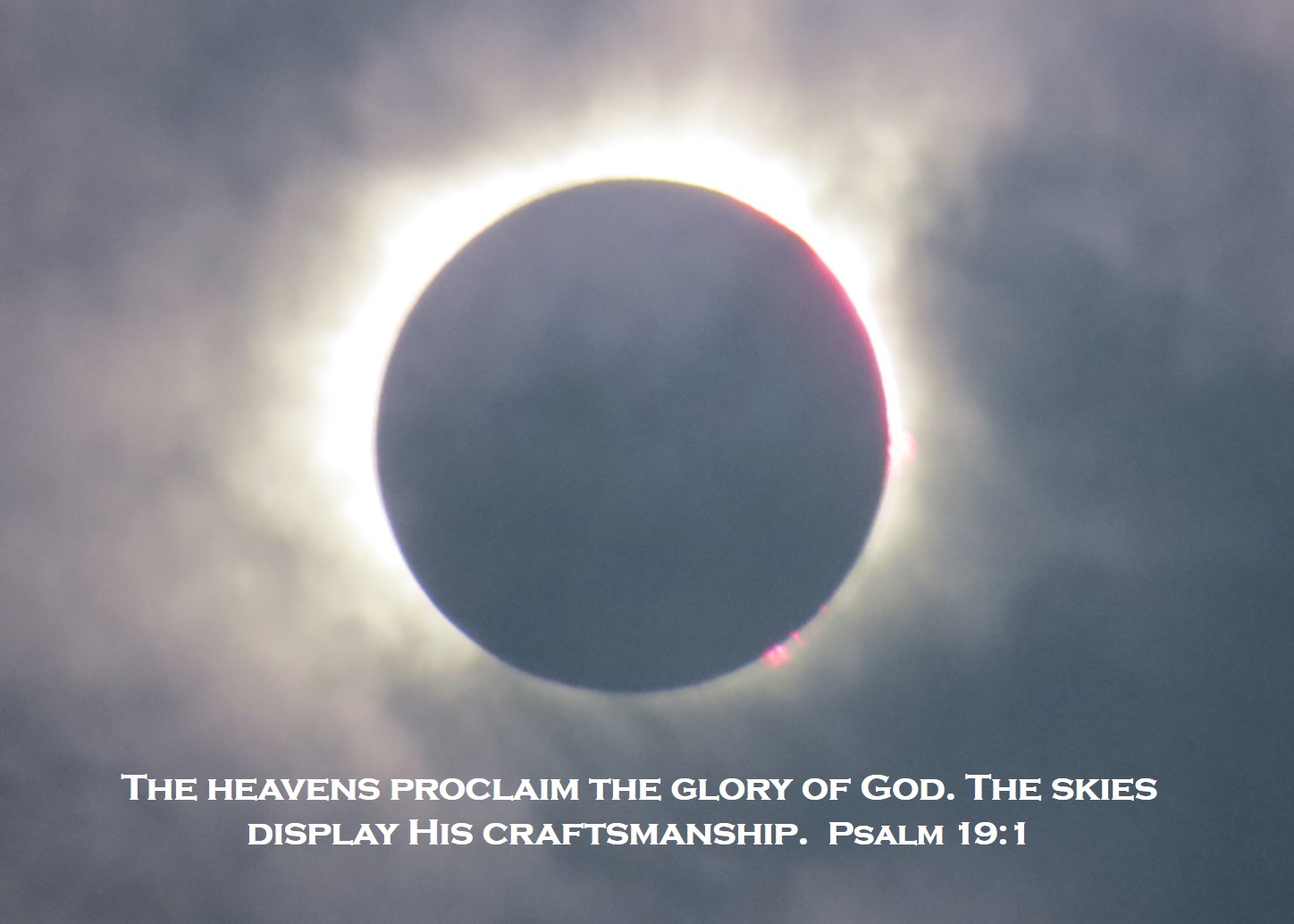
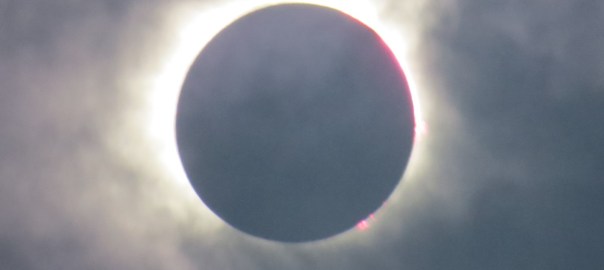
During the total eclipse, we marveled at Abba’s amazing creation, demonstrating His glory and perfection through this incredible event.  When the eclipse became total and darkness fell all around us, it was almost beyond description – even the birds were confused by this sudden darkness and flew anxiously back and forth out of the surrounding trees.  The photo at the front of this article, taken with a regular digital camera by one of my cousins, gives you some idea of the incredible view we had of the sun, looking at it with our naked eyes.

Once darkness fell, we immediately started seeing other lights in the sky.  The brightest and most obvious light was Jupiter, located to the East of the darkened Sun.  A few of the younger folk in our group spotted another light to the West of the Sun, and we later discovered that it was Venus, often called the “morning star”.  I did not learn until later that the only time you can see both Jupiter and Venus in the sky is during a total eclipse.  At all other times, Venus can be seen in the morning and Jupiter can often be seen in the evening sky.

It is hard to describe if you have never experienced anything as visually amazing as a total eclipse, but at this stage our whole group was staring in awe at the darkened sun, and we were rendered speechless – it was a truly inspiring sight, and showed us YHVH’s glory from a very different perspective.  At the time, I was thinking about the significance of seeing Jupiter in the eclipse-darkened sky in the middle of the day.  I remembered that the original Hebrew name of Jupiter was Melech, which means king.  Then I recalled that this planet symbolized the Messiah as the King of Kings according to ancient Rabbinic interpretations of Messianic prophecies.  Later, we remembered that the Sun also represents Yeshua our Messiah (Psalms 19:4-6).  Although the Sun was darkened for a time, it could not be blotted out completely, because the corona was still visible around the perimeter of the moon.  Also, as the Sun darkened, Jupiter brightened.  Our Messiah and King, the Light of the world, cannot be defeated.

This was all wonderful and we glorified YHVH for these revelations.  But there was more – when I was researching this later, I realized that the Sun had moved into the star-sign of Leo the lion before the time of the eclipse (it then moved into Virgo in the Fall when Jupiter was also said to be in “Virgo’s womb”).  The original Hebrew name of Leo is Aryeh, which also means lion, and this sign and its related constellations tell the story of Yeshua coming as Judge and King in His final victory over the enemy.  If you want to read more about the Gospel story told by this heavenly sign, see our blog from early 2016: https://missingpieces.co/2016/02/20/the-lion-of-the-tribe-of-judah/ 

While I do not predict timelines of the Second Coming, I feel that Yeshua was giving us some very powerful visions of His final victory on that darkened afternoon.  I believe He was telling us that He is coming quickly (as He said in Revelation 22:12), understanding that “quickly” in His time-frame means something very different than it does from our Earthly perspective.  It was another sign to me that we need to prepare ourselves spiritually for His second coming.  We can best prepare ourselves through worship, fasting and prayer, as He meets us at those times and gives us revelation about Himself and His plan.  I praise Yehovah’s holy Name that He gives us these glimpses into His glory.  Let us turn our hearts and minds to Him and listen for His voice so that we do not miss what He wants to place in our hearts.

Even though darkness (evil) on the Earth will increase for a while, it will not totally blot out the Light of the world, who has already overcome the world (John 16:33).  Yeshua, our Light and King, will very soon return to the Earth, triumphant over the evil one.

The Cost of Fear

He will not leave you

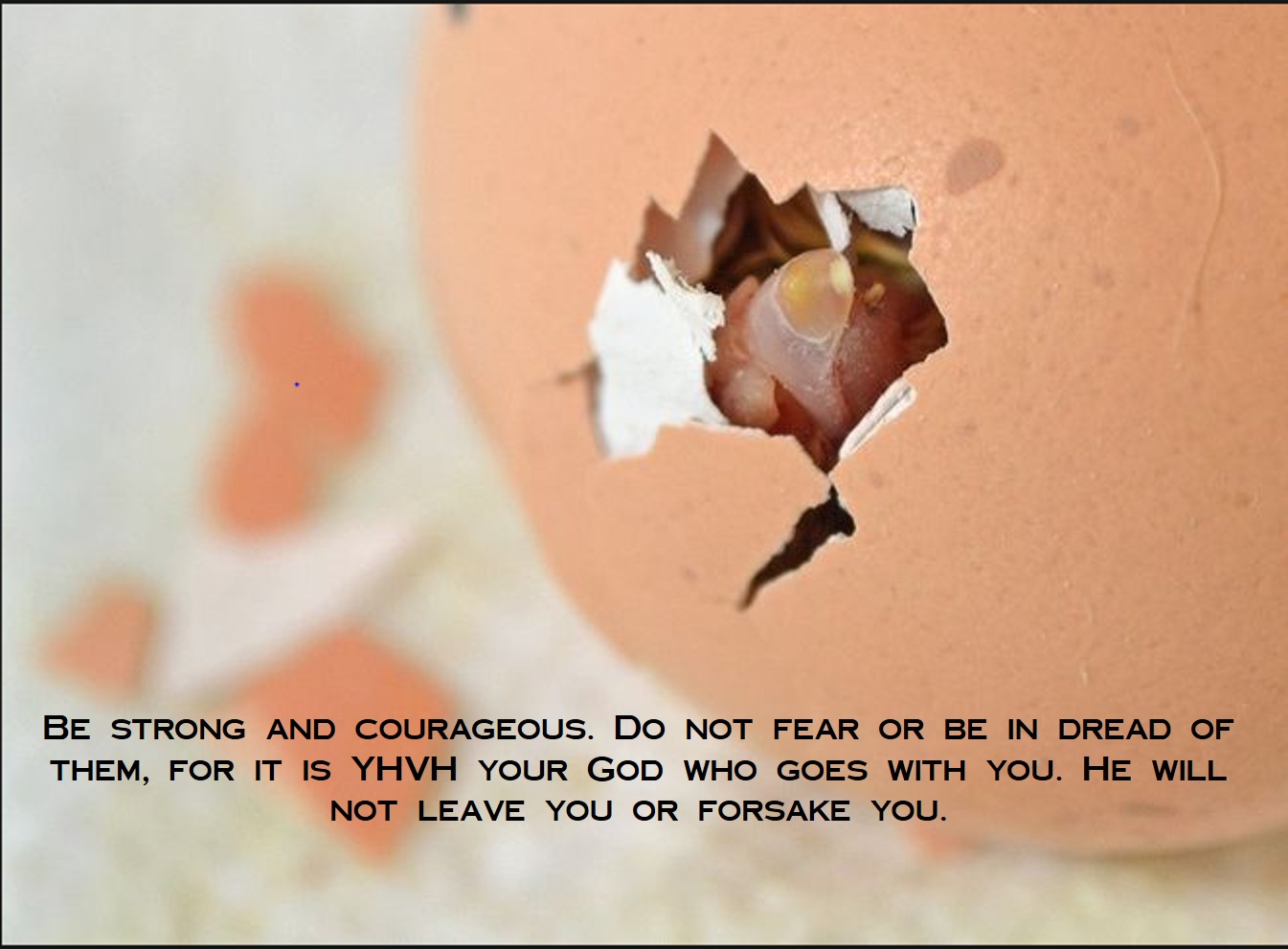
To our beloved readers:  I write this article as one who has struggled for years with fear.  Bit by bit I have overcome some of my “illegal” fears, but my struggle continues.  I write this article to myself as well as to all of you.  Let us keep our focus on the prize before us.

Fear is one of the emotions that YHVH gave to us for a specific purpose.  We are to fear only YHVH knowing that He is much greater than us and more powerful.   However, many of us fear much more than the awesome might of YHVH.  We humans have many different types of fear.    Yet Scripture tells us repeatedly not to be afraid.

In Exodus 1:19-45 and Numbers  13-14, we read that the Israelites refused to go into the Promised Land because of their fear of the giant people living there.  As they focused on the problem it seemed to magnify, distracting them so that they forgot the signs and wonders that YHVH had already performed to release them from slavery in Egypt.  As a result of yielding to their fear, the Israelites paid a heavy price.  They wandered in the wilderness for 40 years until that generation of adults died out.  They not only forfeited a much easier life in a land of abundance, but they failed to assume their divine assignment from YHVH.  Instead of carrying out their mission, they spent the rest of their lives wandering around aimlessly.  YHVH simply waited until a new generation was raised up to replace those who had yielded to fear.

What can we learn from the Israelites? In Exodus 19 and 20, we see that YHVH wants to meet with the people.  The manifestations of His presence (fire, smoke, lightening and thunder and so on) made the people afraid.  We are to have great awe and respect for the Ancient of Days, but we are not to be afraid to speak to Him and hear His voice.  Now, we do not hear YHVH’s voice thundering, but instead we listen for a still small voice inside of us.  YHVH has made it more comfortable for us to hear Him.  In the Exodus account, barriers were erected around the mountain in order to separate YHVH from the fallen, sinful humans, but Yeshua has removed those barriers for us.  The veil in the Temple has been torn and we are free to have a close personal relationship with our Father and His Son.  Do we fear having an intimate relationship with our Father or with Yeshua?  If so, what price are we paying for our fear?  What are we losing?

Our Father spoke His commandments to the Israelites, but they were too afraid to continue hearing from Him.  So He wrote out His commands on tablets of stone.  After Yeshua returned to His Father, He sent the Holy Spirit to write His law on our hearts.  The Holy Spirit not only has put the law on our hearts but works through us so that we can carry out YHVH’s commands.  Do we fear having the Holy Spirit operate in us and through us?

Just as YHVH delivered the Israelites from bondage, He desires to set us free from our bondage to sin and to demons.  Many of us deny that we can be in bondage to demons when we are already born again.  Others of us are afraid of the spiritual realm and the idea of demons, so we stay in denial and try to ignore them.  Just as termites in your house will not go away if you simply ignore them, neither will demons depart from you because you deny their existence or their presence.  Do we fear seeking deliverance from  demons who hold us in bondage and torment us?  Do we fear the spiritual realm?   As the Israelites were commanded to purge leaven from their midst during Unleavened Bread, we are expected to permanently purge sin and demonic influence from our midst.  How does our bondage hinder us from completing our mission on earth and enjoying life in abundance (John 10:10)?

When the Israelites began to fear the giants in Canaan, they abandoned the only fear they were supposed to have, fear of YHVH.  Their fear of the giants became so great that they disobeyed the only One who is to be feared.  Is it the same with us?  Do we fear that which challenges us to the point that we forget to fear YHVH and thus fail in our divine assignments? Will we fail in our mission because our fear is misplaced?  What blessings and joys are we forfeiting because we give in to forbidden fears?


Final Reflections

This is the twelfth and final article of our Living Tabernacles series, where we study the Tabernacle in depth. It is exciting to see how each element symbolizes some characteristic of Yeshua.  It is also challenging when we examine what each element means for us, since each of us is now a living tabernacle of YHVH [Yehovah].  YHVH is building His kingdom on earth as it is in heaven.  Our King reigns from His throne and also pronounces judgment from there. 

The last article focused on the Bronze Laver that was used by the priests for cleansing themselves.  We also talked about us as His kingdom of priests today, still needing to cleanse ourselves by the “water of the Word”.  We recalled that the Word is both the written Word in YHVH’s Scriptures as well as the living Word in the person of Yeshua our Savior.

In this article, I want to expand on these concepts, looking both backward and forward into the various ways that YHVH wants us to come into His presence.  Before we leave the Tabernacle, though, it is important to know the meaning of the Hebrew word for Tabernacle, Mish’kan.  The root of this word is shakan, which means presence.  Combined with the prefix “M”, Mish’kan means “In His Presence”.  We know from Scripture (Exodus 40:33-38) that the “cloud of His presence settled on it and the presence of YHVH filled the Tabernacle”.

When we go forward from the Tabernacle, we see that Solomon’s Temple included the Bronze Laver (see 1 Kings 7:23-30).  This “laver”, however, was so large it was referred to as the bronze (or molten) sea.  It was about 8’ high and 15’ across, and was supported by 12 statues of bulls around the outside.  To enhance its lavish appearance, 10 wheeled bronze laver carts surrounded the structure, each very ornate, with images of lions, oxen and cherubim carved into the side panels.

The decadence of this bronze laver was not specified in the original Temple plans that YHVH gave to David, but we can only assume that Solomon wanted each of the implements to be grand and larger than life to further glorify YHVH.  On the spiritual level the grandeur of Solomon’s laver emphasizes our need to cleanse ourselves before coming into the presence of YHVH.  The awesome presence of YHVH in the glory cloud was constantly over the Ark of the Covenant in the Holy of Holies within the Temple.  While Solomon’s Temple and all its implements are amazing, we learn even more about YHVH’s original desire to meet with us when we go back before the time of the Tabernacle.

Before the Tabernacle, we see that Moshe originally met with YHVH in the Tent of Meeting out in the desert (Exodus 33:7-11).  He had to construct this tent outside of the camp because of the idolatry (golden calf) of the Israelites at the foot of Mt Sinai.  In Hebrew, this tent was called the Ohel Mo’ed, which literally means the appointed tent to meet with YHVH, or the tent of His presence.  Before Moshe and the Israelites built the Tabernacle, YHVH had said to Moshe that His presence would not go with them when they went up into the land, because if He did He would surely destroy them (Ex 33:5).  At this point, the people grieved deeply and repented for their sins.

Then, as YHVH always does because of His incredible grace, He relented and said that He would indeed go with them, and be present in their Tabernacle once it was built.  In the meantime, though, because of Abba’s passionate desire to meet with His people face-to-face, he agreed to meet with Moshe and any others that would remove their jewelry, humble themselves, and approach Him at the Ohel Mo’ed outside the camp (Ex 33:5-7). (Note: we do not know from Scripture whether their jewelry was openly idolatrous (had symbols or images of pagan gods) or if it was just reminiscent of the jewelry they had used in a sinful way when they gave it to Aaron to create the golden calf.)

So, whenever Moshe set up the Tent of Meeting, YHVH’s glory cloud would come down and rest on top of it, and the people fell down prostrate at their tents and worship the glory of YHVH (Ex 33:8-10).  In YHVH’s infinite mercy, He allowed anyone who was willing to come out to the Ohel Mo’ed and share in His glorious presence with Moshe.  When I compare this to the glory of the Tabernacle or even the Temple, I would prefer to be face-to-face with YHVH’s glory at the Ohel Mo’ed any day of the week – this was an opportunity to meet with the Creator of the universe one-on-one – wow!

Moshe was a prototype of Messiah Yeshua when He opened the way for the people to return to YHVH’s presence.  Just as Moshe set up the Ohel Mo’ed and opened the “tent-flap” so that He and others could meet with YHVH, Yeshua has torn the veil and opened the way for us to enter the Holy of Holies and meet with YHVH face-to-face.  It would have been enough (dayeinu) for Yeshua to die for us, but then He sent us YHVH’s Holy Spirit (Ruach HaKodesh) who now lives inside of us, as we are now the Tabernacles for His presence to be with us always.

Finally, since we are YHVH’s kingdom of priests, He has supplied us with everything we need to minister to Him.  He has given us His whole armor to protect us from the fiery darts of the enemy, and the sword of the Spirit, which is His Word, living and powerful and sharper than any two-edged sword.  We now have the privilege to meet with YHVH in any time and place – we are His Tabernacle [Mish’kan], and we carry His presence with us at all times.  Let’s give Him our praise at all times, spend time with Him, get into His Word and use it for His glory – Amen!

Clean Reflections

This is the eleventh article of our Living Tabernacles series, where we study the Tabernacle in depth. It is exciting to see how each element symbolizes some characteristic of Yeshua.  It is also challenging when we examine what each element means for us, since each of us is now a living tabernacle of YHVH [Yehovah].  We are posting two articles each month as part of this series. YHVH is building His kingdom on earth as it is in heaven.  Our King reigns from His throne and also pronounces judgment from there. 

This article focuses on the significance of the Bronze Laver (basin) that YHVH instructed His people to build and place between the Brazen Altar of sacrifice and the Tabernacle. In Exodus 30:18, YHVH [Yehovah] said to Moshe: “You are to make a basin of bronze, with a base of bronze, for washing. Place it between the tent of meeting and the altar, and put water in it” [CJB].

In verses 18-21, YHVH explains to Moshe how this basin is to filled with water and used by the priests for washing before they come into His presence and before they bring sacrifices to the Altar: “Aaron and his sons will wash their hands and feet there when they enter the tent of meeting — they are to wash with water, so that they will not die. Also, when they approach the altar to minister by burning an offering for Yehovah, they are to wash their hands and feet, so that they will not die. This is to be a perpetual law for them through all their generations”.

To help the priests see their dirty places more clearly, YHVH also instructed the Israelites to embed mirrors into the bronze laver: “Bezalel made the bronze washbasin and its bronze stand from bronze mirrors donated by the women who served at the entrance of the Tabernacle” (Ex 38:8).  Since YHVH wants us to come before Him without spot or blemish (as in Ephesians 5:27), the bronze mirrors from the women helped the priests to clean up those physical spots that would keep them from full immersion into YHVH’s presence.

These instructions that YHVH gave to His people show the importance He places on purity.  When His people come before Him to minister to Him, they are to be “clean”.  So, what does Yehovah mean by clean in this context?  He has given us many examples of cleanliness in the physical world, such as His instructions to the priests to wash themselves before coming into the Tabernacle or Temple, for His people to eat clean instead of unclean foods, and to cleanse ourselves after touching a dead body or being healed of leprosy.

However, these are only physical object lessons that point to His more crucial message that we need to cleanse and purify our hearts and minds before coming into His presence, as in Psalm 24:4: “The one who has clean hands and a pure heart, who has not lifted up their soul to falsehood and has not sworn deceitfully”.  The importance to YHVH of purity of hearts and hands is also shown in Matthew 5:8: “Blessed are the pure in heart, for they shall see God” and James 4:8: “Cleanse your hands, you sinners, and purify your hearts, you double-minded”.  After David committed his most flagrant sins, he cried out to God in Psalm 51:10: “Create in me a clean heart, oh God, and renew a right spirit within me”.

Aaron and his sons were the appointed priests for the whole nation of Israel, but we know that all of YHVH’s children are to be priests ministering before Him, as in Exodus 19:6: “And you will be my kingdom of priests, my holy nation”.  Yeshua said in Revelation 5:10: “And you have caused them to become a Kingdom of priests for our God”.  We know that we are to come before YHVH’s throne and into His presence, as in these Scriptures in Hebrews:

  • Hebrews 4:16 – “So let us come boldly to the throne of our gracious God. There we will receive His mercy, and we will find grace to help us when we need it most”; and
  • Hebrews 10:22 – “…let us go right into the presence of God with sincere hearts fully trusting Him…

Now that we understand that we are to be priests before YHVH, be cleansed, and come into His presence, how do we go about cleansing ourselves?  First, look at the second part of the verse from Hebrews 10:22: “For our guilty consciences have been sprinkled with Messiah’s blood to make us clean, and our bodies have been washed with pure water”.  While it is true that Yeshua’s blood has saved us from our sins, we still need to be cleansed and made holy by “the washing of water by the word(Eph 5:26)

In James 1:25 [NLT] it says: “But if you look carefully into the perfect law [Torah] that sets you free, and if you do what it says and don’t forget what you heard, then God will bless you for doing it”.  So, YHVH says that we are to study the Torah (the Word of YHVH) and follow what it says.  The living Word is Yeshua.  As it says in John 1, verses 1 and 14: “In the beginning was the Word, and the Word was with God, and the Word was God…. And the Word became flesh and dwelled among us…”.

The Word of God (both written and Living) is our water of cleansing – it is His will for us to spend time every day soaking in His Word, being transformed by the renewing of our minds, and being cleansed in our souls so that we can constantly draw closer and closer to Abba and His precious Son, Yeshua.

Reflective Offerings

living-tabenacles

This is the tenth article of our Living Tabernacles series, where we study the Tabernacle in depth. It is exciting to see how each element symbolizes some characteristic of Yeshua.  It is also challenging when we examine what each element means for us, since each of us is now a living tabernacle of YHVH [Yehovah].  We are posting two articles each month as part of this series. YHVH is building His kingdom on earth as it is in heaven.  A king reigns from his throne and also pronounces judgment from there. 

Our previous article discussed the altar of incense.  Closely connected with that altar is the altar of burnt offering, also called the brazen altar. This altar was reserved for sacrifices and was overlaid with bronze instead of gold.  Bronze is symbolic of judgment.  Without the temporary sacrifice of the burnt offerings and the permanent sacrifice of Yeshua, human prayers (symbolized by incense) would not be acceptable to YHVH.

Using acacia wood, construct a square altar 7 feet wide, 7 feet long, and 4 feet high. Make horns for each of its four corners so that the horns and altar are all one piece. Overlay the altar with bronze. Make ash buckets, shovels, basins, meat forks, and firepans, all of bronze. Make a bronze grating for it, and attach four bronze rings at its four corners. Install the grating halfway down the side of the altar, under the ledge. For carrying the altar, make poles from acacia wood, and overlay them with bronze. Insert the poles through the rings on the two sides of the altar. The altar must be hollow, made from planks. Build it just as you were shown on the mountain (Ex 27:1-8).

The Hebrew word for altar is mizbeach (Strong’s Concordance Hebrew 4196). In Arabic, it means “place of slaughter”.  The bronze altar was placed in the courtyard of the tabernacle and was used for burning sacrifices.  There were several different types of sacrifices made on this altar which are listed below with a brief explanation of each[1].

Burnt Offering:  Sometimes called the whole burnt offering because the whole animal (except for its hide which was given to the priest) was consumed in the fire on the altar.  The Hebrew word is olah (meaning “ascending”).  This entire sacrifice was for YHVH alone and had to be made before other sacrifices would be accepted by YHVH. Burnt offerings dealt with the sinful nature of people and were offered twice daily (morning and evening) with additional offerings to be made on Sabbaths, new moons and feast days and other special occasions.  Burnt offerings were offered before other offerings could be made.

Grain Offering:  Flour and oil were offered to express gratitude to YHVH.  A small portion was burned on the altar and the rest was reserved for the priests.  A drink offering (wine) was poured out on top as a symbol of joy.

Peace Offering:  This offering was optional and ended in a meal that could be shared by the priests and the individuals offering it.  The sacrifices needed to be eaten within two days.  There were three main reasons for peace offerings:

  • Thanksgiving offering for a specific blessing from YHVH (Lev. 7:12-13)
  • Wave offering where the priest’s portion was waved before YHVH (Lev. 7:30-31)
  • Votive offering for a vow or a simple voluntary act of worship (Lev. 7:16-17)

Sin (or purification) Offering for unintentional sin (Lev 4:2-3) in order to cleanse the Tabernacle from human defilement.

Guilt (reparation) Offering:  A ram was offered after confession of the sin.  If YHVH’s sacred property was unintentionally damaged, reparation was to be made (plus an additional twenty percent) (Lev 5:16)

What can we learn from the offerings made in the Tabernacle?  How do they relate to Yeshua and to us?

  • Sin always results in death even if it is unintentional. Atonement is always necessary.  Yeshua is our Atonement.  Only through Yeshua can we approach YHVH and have a relationship with Him.
  • While some of the offerings were to atone for sin, others were voluntary gifts meant to bless YHVH, just as He blesses us abundantly.
  • The animals to be offered were young (usually one year old) and without blemish, thus representing Yeshua who was sacrificed in His prime and who was sinless. We are always to come to YHVH in Yeshua’s name and covered by His blood.
  • The best or the choicest of the herds or other offerings were to be used, for YHVH has offered to us nothing less than His own Son, Yeshua.
  • Burnt offerings were an abomination if the people did not forsake their sins (Is 1:11-15). We can ask for forgiveness and plead the blood of Yeshua over ourselves, but true repentance (teshuva meaning a complete turnaround) only is acceptable to YHVH.
  • Hosea 6:6 states “For I delight in loyalty rather than sacrifice. And in the knowledge of God rather than burnt offerings.”  Our primary goal must be always to deepen our relationship with YHVH (Mic 6:6-8).
  •  Burnt offerings were not just for the Israelites, but for all humans. Burnt offerings started long before the time of Moses.  For example, upon exiting from the Ark, Noah offered burnt offerings to YHVH, using some of the clean animals he had taken with him (Gen 8:20).  The basis of YHVH’s covenant with Noah was not because of Noah’s goodness, but rather his sacrifice.
  • Abraham was commanded to offer Isaac as a whole burnt offering (Gen 22:2 NLT).  Abraham was willing to sacrifice his long-awaited only son if YHVH requested it even though Abraham had been promised many descendants through Isaac.   Man had sinned and only through the sacrificial death of a righteous man could mankind be saved.  YHVH did not allow Abraham to go through with the sacrifice of Isaac, but provided His own Son to be the sacrifice.

In Hebrews 10:12 Paul states, “But our High Priest offered himself to God as a single sacrifice for sins, good for all time. Then he sat down in the place of honor at God’s right hand”.  Since the Temple was destroyed in 70 AD the sacrificial system has been suspended.  However, several passages of Scripture indicate that sacrifices will be resumed during Yeshua’s millennial reign (Is 56:6-8, Zech 14:16, Jer 33:15-18, Mal 3:3-4).  Why?  There are numerous proposed explanations and much speculation.  We know that YHVH will dwell with us during this time. Shout and be glad, Daughter Zion. For I am coming, and I will live among you,” declares the Lord  “Many nations will be joined with the Lord in that day and will become my people.  I will live among you and you will know that the Lord Almighty has sent me to you (Zech 2:10-13). We also know that YHVH’s throne is surrounded by fire (Dan 7:9) and that not even the slightest impurity can be in His presence.  The millennial kingdom will be a time of refinement and perfection until we are ready for the new heaven and new earth.  At that time speculation will die away as the mystery of the renewed sacrifices unfolds.  We will then more fully understand how the sacrificial offerings enable us to reflect YHVH’s glory back to Him.

[1] OFFERINGS IN LEVITICUS–WHAT THEY WERE AND WHY THEY MATTERED.  Wayne Stiles, https://www.waynestiles.com/offerings-in-leviticus-what-they-were-and-why-they-mattered/.

Reflections of Incense

living-tabenaclesThis is the ninth article of our Living Tabernacles series, where we study the Tabernacle in depth. It is exciting to see how each element symbolizes some characteristic of Yeshua.  It is also challenging when we examine what each element means for us, since each of us is now a living tabernacle of YHVH [Yehovah].  We are posting two articles each month as part of this series. YHVH is building His kingdom on earth as it is in heaven.  A king reigns from his throne and also pronounces judgment from there. 

As we continue our study of the Tabernacle, we come across a relatively small altar that holds a powerful significance in our relationship with YHVH.  The altar of incense was square with each side measuring 1.5 feet and was three feet high.  It was made of acacia wood and overlaid with pure gold. Four horns protruded from the four corners of the altar.  The altar of incense, also called the Golden Altar, (mizbach hazahav in Numbers 4:11), stood just outside the Holy of Holies.  A special mixture of incense, reserved exclusively for YHVH, was burned on this altar every morning and every evening, thus sending up a continual waft of pleasant odor to YHVH.

The incense altar was the place where YHVH met with Moshe.  Place the incense altar just outside the inner curtain that shields the Ark of the Covenant, in front of the Ark’s cover—the place of atonement—that covers the tablets inscribed with the terms of the covenant. I will meet with you there.  (Ex. 30:6 NLT).  

On Yom Kippur the incense was burned atop the Ark of the Covenant.  The high priest would fold back the curtain concealing the Most Holy Place, put the censer with the burning coals on the top of the Ark of the Covenant, then throw the two handfuls of incense into the censer.  This was the only day and time that any one (and then only the high priest) was allowed to enter the Holy of Holies, thus foreshadowing the work of our High Priest that would permanently  rend the separating curtain.

What does the incense altar represent in the spiritual realm?  It symbolizes our prayers to YHVH (Is 56:7, Ps. 141:2).  The fragrant incense also represents the prayers of Yeshua, who makes continuous intercession on our behalf (John 17:1-26, Rom 8:34) as our High Priest.  The continuous rise of the burning incense reminds us to pray without ceasing (1 Thess 5:17).

The daily burning of incense corresponded with the lighting of the menorah.  Scripture indicates that the incense was to be burned at the same time the menorah was to be cleaned and relit (Ex 30:7-8).  According to the Talmud five of the lamps on the menorah would be cleaned, then the incense would be burned before the other two lamps were cleaned.  The menorah and the Golden Altar seem to be interconnected.  If we understand that the menorah represents the light of Yeshua, then Yeshua’s light in us results in worship, praise and petitions to our Father.

In order to burn the incense, fire was taken from the brazen altar (which will be discussed in the next article) and transferred to the altar of incense (Lev 16:12-13), thus symbolizing that the fire of Yeshua’s sacrifice becomes the fire of blessing.  The horns of the golden altar were sprinkled with blood from the animal sacrifice to cleanse and purify it from the sins of the Israelites (Lev 4:7, 16:18). “Just as the horns on the brazen altar represent the power of Christ’s blood to forgive sins, the horns on golden altar signify the power of His blood in prayer as we confess our sins and ask for His forgiveness.”  (The Altar of Incense, the-tabernacle-place.com).  We come to Father in prayer only through Yeshua, cleansed from our sin by His blood and wearing His righteousness, for we have nothing of value to offer on our own.

Before Yeshua’s death on the cross, a heavy curtain separated the Holy of Holies from the rest of the Tabernacle, illustrating the separation from YHVH that sin had caused.  That veil has now been torn, so that there is no longer any separation, just as there is no separation in the heavenly Tabernacle.

The heavy curtain illustrates YHVH’s eagerness to be near His people.  He would come to them despite the barrier of sin using a curtain until reconciliation would be accomplished through Yeshua’s precious sacrifice.  The horns on the corners of the incense altar represent power, the power of prayer and intercession in this case.  Now that the curtain has been torn, YHVH not only meets with our representative (Moshe, Yeshua), but with each of us individually.

When we are offended by others, we tend to withdraw from them.  Our Father, on the other hand,  seeks all the more to be reconciled and united with us.  We are to forgive those who offend us, love them and always seek union with them if we desire to do as our heavenly Father does.  Are there curtains of separation that need to be torn down in our lives?

We, as living tabernacles, have the privilege of offering the continuous incense of our prayers and intercessions, even prayers for our enemies (Matt 5:44).  Just as the incense was a special mixture reserved solely for YHVH, our worship and prayers too must be reserved for our Father.  We are not to worship or pray to any foreign gods.  To whom are you offering your incense?

Reflections of His Light

This is the eighth article of our Living Tabernacles series, where we study the Tabernacle in depth. It is exciting to see how each element symbolizes some characteristic of Yeshua.  It is also challenging when we examine what each element means for us, since each of us is now a living tabernacle of YHVH [Yehovah].  We are posting two articles each month as part of this series. YHVH is building His kingdom on earth as it is in heaven.  A king reigns from his throne and also pronounces judgment from there. 

This article focuses on the significance of the lampstand [Menorah] that YHVH instructed His people to build and place in the Holy Place, along with the Table of Showbread and the Altar of Incense.  In Exodus 25:31-32, YHVH said to the Israelites: “You shall also make a lampstand of pure gold; the lampstand shall be of hammered work. Its shaft, its branches, its bowls, its ornamental knobs, and flowers shall be of one piece.  And six branches shall come out of its sides: three branches of the lampstand out of one side, and three branches of the lampstand out of the other side”.

The seven-branched Menorah held individual lamps that represented God’s perfect light. The lamps contained pure olive oil inside almond-shaped containers, suggesting the seven eyes of YHVH mentioned in Zechariah 4:2.  The Menorah and its seven lamps were referred to as the Perpetual Lamp (ner tamid), a source of light that illuminated the Bread of Presence and the Altar of Incense within the holy place. The lamp was to be attended to every morning and evening during the time of the burning of the sweet incense (symbolizing prayer), and was never to be extinguished (Lev 24:2).  The priests obeyed this command because they understood that light represented the word of YHVH (Ps 119:105, 150). It was the word of YHVH that sustained their lives and all that YHVH created.

A close look at the Menorah reveals a middle shaft, with the six branches extending out from this shaft.  The seven branches were a single beaten piece of gold.  The Hebrew word for this shaft is generally translated as thigh, loins, or body. The six branches extend out from the central shaft, but yet they are one with the shaft.  Note that in Romans 11, believers in Messiah Yeshua, whether Jew or non-Jew, are referred to as branches.   Even more significantly, note that these branches are said to all be one with the olive tree, which is referred to as the Body of Messiah.  Yeshua uses the lampstand to refer to His kehillat (assembly or “church”) in Revelation 1:20.

From ancient writings, the center candle was said to be the only one that always stayed lit.  After the Temple was destroyed and thus all Temple sacrifices were stopped in AD 70, the center candle of the Menorah no longer stayed lit from morning until evening, but had to be re-lit in the evening.  The six outside lamps all faced towards the center lamp, which was called the Servant lamp [Shamash].  This served to focus the light towards the center of the Menorah, making the Shamash candle even brighter.  Let’s look at a couple of the Scriptures that focus on Yeshua as the true Light of the world:

  • John 8:12: “I am the light of the world. Whoever follows me will never walk in darkness, but will have the light of life.”
  • John 12:46: “I have come into the world as a light, so that no one who believes in me should stay in darkness.”

Yeshua is the Light of the World.  The Menorah was hammered from one solid piece in order to support the six branches, just as Yeshua’s arms and legs were hammered for our sins.  In John 15:5 Yeshua says that He is the Vine and we are the branches.  The branches were also hammered, warning us of our own persecution.  We are now living as “children of light” (Ephesians 5:8) who draw our source of light from Yeshua, the one true Light.  Just as the other six lamps of the Menorah face towards the Servant [Shamash] lamp in the center, we as His followers are to keep our focus on Yeshua and magnifying His light throughout the Kingdom.

Revelation 2-3 accurately describes the condition of His branches today. In Revelation 2:1-7, there is a description of the church at Ephesus, and it begins by mentioning one of the aspects of Yeshua’s ministry. “…who walks in the midst of the seven golden lampstands”. Yeshua commends this group by reminding them of their dedication to removing imposters, of their good works, and their patience. However, He then tells them what He has against them. They have lost their first love, and will not go back to their first works and repent. He says that if they continue, He will remove their lampstand from its place.  Our love and passion for Yeshua must remain strong.

The Menorah was made of pure gold (not gold plated) and had seven branches. Pure gold is a representation of the deity and perfection of Yeshua.  Seven is the number of completeness in the Bible. The believer is made complete by the perfection of Messiah.

The Most Holy and Holy Places are completely covered in various linens and skins, which means that these inner sanctuaries were very dark.  Only the light of the Menorah was to illuminate the Holy Place, or the place of ministry.  This tells us that ministry (worship) is to be driven by the light of YHVH and not by people’s plans or desires.  Our minds are to be illuminated by God’s light. His light shines forth from His Word (Torah). It is this light that is to be a lamp unto our feet and a light unto our path (Psalm 119:105).  Are we reflecting Yeshua’s light in this dark world?

[Author’s note: we have tried to cover the main aspects of the Menorah as they relate to Yeshua and our own spiritual light, but there is so much more to cover that we might someday consider “branching out” to a deeper study (pun intended )]