Light Revelation

light-shines-in-darknessLight is essential for our survival, both physically and spiritually.  At this time of year, we celebrate light in the darkness.  The menorah symbolizes the light of Yeshua (Ps 119:105, John 8:12)  Arlene Sheldon provides an interesting study on Yeshua’s miracles that correspond with His “I AM” statements ( http://www.wellofbethlehem.witnesstoday.org/menorah.html ) as the living menorah.  The light of the Father poured forth from Yeshua.  Yet, Yeshua tells us that we are the light of the world (Matt 5:14).  What is light? How are we to be light in the darkness?

YHVH created light on the first day, but He created the sun, moon and stars on the fourth day.  What was the light that YHVH created?  Some ridicule the Bible and say that it contradicts itself.  How could YHVH create light but not create the sun until day four?  In his article entitled Sunlight Before the Sun, John D. Morris, PhD. from the Institute for Creation Resource points out that there are many types of light such as short-wave light including ultraviolet light and X-rays and long-wave light including infrared light and radio waves.  Perhaps YHVH created the materials for light on day one and then chose different combinations of materials for various types of light.  YHVH provides various combinations of spiritual light within us as we draw closer to Him, the Source of light.

We can be misled by what we do not see.  For example, when we turn on an incandescent light bulb, we may think that the light we see is the only light produced by the bulb.  However the incandescent bulb emits only around 10% of its energy as visible light and the remainder is infrared light (“Light,” Wikipedia).   We are to be light in the darkness.  Are we incandescent bulbs?  No, we are light in the sense that there is ignorance or defiance of YHVH’s truth and we can reflect the light of YHVH’s truth to those living in the chaos of darkness.  We may think that the light we provide to the world is small and insignificant, but perhaps we are unaware of the various kinds of light that YHVH is able to produce through us.

Light can also mean understanding or comprehension of Scripture.  Psalm 119:130 states, The unfolding of your words gives light; it imparts understanding to the simple (ESV).  When we read or study Scripture, we can interpret or comprehend on four levels. Peshat is the surface or literal meaning,  Remez the allegorical or symbolic meaning,  Daresh  the comparative meaning given through similar occurrences and Sod is the secret meaning given through inspiration or revelation.  Light can penetrate through layers of darkness.  As we comprehend Scripture and it becomes part of us, we emanate its light to those around us.  Light and truth are closely related to each other.  But whoever lives by the truth comes into the light, so that it may be seen plainly that what they have done has been done in the sight of God (John 3:21 NIV).

YHVH Himself is light.  1 John 1:5 states …God is light, and in Him there is no darkness.   YHVH has many mysteries hidden in the dark and as they are revealed, YHVH will be more fully revealed.  How do we reveal YHVH to others?  Isaiah 58:10 says If you extend your soul to the hungry and satisfy the afflicted soul, then your light shall dawn in the darkness and your darkness shall be as the noonday.

By steeping ourselves in YHVH’s light through His word and through personal relationship with Him, the oil of the Holy Spirit will keep our lamps burning brightly in the ever increasing darkness of this world.  Our light will shine through our words and actions to others.  Let your light shine in such a way that they may see your good works, and glorify your Father who is in heaven (Matt 5:16).  We will not only survive in the darkness, we will thrive.


Gedi Star Teachings

gedi-the-goatToday we are going to explore another of the amazing signs that YHVH placed in our heavens from the beginning of Creation.  The sign is commonly known as Capricorn, which translated from Latin literally means a horned goat.  However, as I have mentioned in the past, we cannot trust modern Greek and Latin names of stars or constellations, as their names and meanings have been corrupted over the years from the original Hebrew meanings.  In Hebrew, this sign is called Gedi, which means kid goat, but is sometimes translated as sea goat, due to the strange half-goat/half-fish image portrayed in ancient drawings of the sign.

The image we see in Egyptian, Indian, and Phoenician drawings is of a fish that is weak and dying at the head, but alive as a healthy fish at its tail end.  The stars in this sign confirm the meaning associated with this image: ma’asad: the slaying; dabih: the sacrifice slain; and sa’ad al nashira: the cutting off.  As with many Hebrew words, gedi (kid goat) has a second meaning: to be cut off.  This sign, then, represents the sacrificial Goat of atonement, Yeshua, who was slain to redeem us from our sins, was “cut off” (crucified) to bring us salvation, healing and deliverance from evil.

The fish portion of the goat’s body represents us: the people for whom the sacrifice was made.  Other star names in this sign also point to Gedi as being the goat who was sent into the wilderness for remission of our sins (so that they would be sent away as far as the east is from the west).  We know that Yeshua fulfilled both of these goat sacrifices!

To complete this awesome picture story, the three constellations associated with this sign give more of the details. The 1st constellation is Sagitta, means “the arrow of Elohim sent forth” – this connects with Psalm 38:2 where it says “Your arrows have struck deep, and Your blows are crushing Me”; and also Isaiah 53:4-5: “He was stricken, smitten of God & afflicted; He was wounded for our transgressions”.  Aquila (the eagle) is the 2nd constellation in Gedi – the stars in this constellation convey the meaning of “the smitten One falling”, “the One who comes in the Shekinah glory of God to shed His blood as a sacrifice”; and “the One who was wounded in the heel” (Gen 3:15).

The third and final constellation in Gedi is Delphinus, the original name meaning “the dead One rising”.  It is shown in ancient Zodiacs as a fish full of life, always with his head pointing upwards.  This represents Yeshua’s resurrection as “the first-fruits of them that sleep” (I Cor 15:20).  The Hebrew name is Dalaphin, which means Dolphin and also “pouring out of water”.  We see from this word picture that Yeshua fulfilled the prophecy to pour out the Holy Spirit on all flesh, symbolized in Scripture as the “fountains of living waters”.

The brightest star in Gedi is actually a double star named Deneb Al Giedi – “the Judge who is the sacrifice.”  When we think about Yeshua’s dual role as our Messiah, we know that He came to save us from our sins in His first coming to Earth, but that He will be our ultimate Judge in His second coming. As Yeshua says in John 3:36: “Whoever trusts in God’s Son has eternal life. Anyone who doesn’t obey the Son will never experience eternal life but will remain under God’s judgment”.  Draw close to Yeshua and He will draw close to you; get to know Him intimately and your greatest desire will be to trust Him with your life, walk in His way and lovingly obey all of His commandments.

Righteous Oaks

righteous-oaksWhen YHVH promises in the beginning of Verse 3 of Isaiah 61 that He will give us: “Beauty instead of ashes, the oil of joy instead of mourning, the garment of praise instead of the spirit of heaviness”, His end goal is not just to give us temporary help to get us through a crisis in our lives. Ultimately, God is building us up to be trees [oaks] of righteousness. We are the “trees” God is planting in the place He desires us to bear fruit.

Oak trees are known to be the strongest, most sturdy and resilient of all trees on Earth. They can withstand hurricanes, tornadoes, earthquakes, droughts and floods better than almost any other type of tree.  God likens His children to oak trees and says we can be just like them in our character and integrity: “They shall be like great oaks of righteousness”.  These are not the words of a long-ago prophecy that have no meaning for us today. This is the expression of God’s heart for His people down through the generations. God wants us to be strong and enduring and He has given us clear insight in His word as to how we are to make that happen.

The average large oak tree needs as much as fifty gallons of water per day, so the root system is large and goes deep to reach that water. The root system not only brings the needed nourishment to the tree but it provides the anchoring base that allows the tree to withstand all kinds of assaults, from the wind, the rain and the shaking of earthquakes.  The root system of a mature oak tree can total hundreds of miles, and the roots of an oak tree extend out underground up to two and a half times their height.  So how can we as YHVH’s children ever hope to have such deep roots?

Jeremiah 17:7-8 is a powerful amplification of what Isaiah is talking about: “But blessed is the person who trusts in the LORD, whose confidence is in Him. They will be like a tree planted by the water that sends out its roots by the stream. It does not fear when heat comes; its leaves are always green. It has no worries in a year of drought and never fails to bear fruit”.

Both in Isaiah 61 and here in Jeremiah, it is clear that YHVH plants His seeds purposefully. He does not take His seeds and scatter them to the wind, disregarding where they fall.  God picks a perfect place for each of us, personally putting the tender shoot in the ground, knowing exactly what lies ahead. God knows every detail of our lives and the place of our planting and He does not make mistakes; we were not planted in the wrong part of the garden!

We were destined to display the “splendor of the Lord.” It doesn’t matter how you feel, you are destined to display the splendor and majesty of YHVH. There are days when you may not feel that you are reflecting God’s glory to others in your world, but if you have deep spiritual roots and are standing tall in constant relationship with YHVH, you will be displaying His majesty.   In fact, He will “rejoice over you with gladness” (Zephaniah 3:17) and even “protect you from trouble and surround you with songs of victory” (Psalm 32:7).

Trees do not instantly develop deep roots, and neither do people – both must go through difficult times of physical or spiritual drought and hardship, and must be patient until their roots develop.  In the case of God’s people, we must be filled with God’s Holy Spirit and grow in our faith and spiritual maturity, learning to trust YHVH more and more for strength to overcome the attacks and temptations of the world.

Trees contribute greatly to purify the air, and render it fit for us to breathe. When the air around us passes through leaf surfaces, it is purified and invigorated.  In the same way, there is a moral atmosphere around us.  When the air around us passes through our spirit and soul, we have the ability to speak life or death, blessing or curse to those around us.  As YHVH spoke in Deuteronomy 30:19-20, “I call on heaven and earth to witness against you today that I have presented you with life and death, blessing and curse. Therefore, choose life, so that you will live, you and your descendants, loving the LORD [YHVH] your God, paying attention to what He says and clinging to Him — for that is the purpose of your life!

As YHVH’s children, when we trust in Him with all our heart and follow His ways and His instructions, our roots will go down deep into the “earth” of the Holy Spirit within us, enabling us to withstand all the trials and tribulations of life, bearing much fruit and glorifying Him through our lives.  As YHVH says in Jeremiah 17:7-8 about those whose confidence is in Him: “we will be like trees planted by the stream, that send our roots deep: we will not fear when heat [persecution] comes; our leaves will always be green. We will have no worries in a year of drought and we will never fail to bear fruit”.

Building Plans

working-together

Exodus 35 paints a beautiful picture not only of the past but of the future as YHVH’s plan unfolds.  In Exodus 35, Moshe had already received the blueprint of the tabernacle to be built for YHVH’s dwelling place on earth.  Now, the people were contributing their goods, time and talents according to what YHVH has provided for each person.  All the people were working together for the glory of YHVH!

There were no distinctions or exclusions among the people.  Every person was invited to participate if  he or she was willing.  Each had something to contribute.  Men and women were both included.

When the Israelites left Egypt, there was a mixed multitude (Ex 12:37-38).  YHVH’s demonstration of His power and the powerlessness of the false gods awakened more than just the Israelites to recognize the one true God.  An unreported number of Gentiles were in the group.  All the people were told to keep the Shabbat and the other appointed times.  YHVH, who is a God of relationship, provided in His plan set times for a family reunion three times a year after they were settled in the Promised Land.  While they were in the desert, they could all meet with YHVH each Shabbat as well.

Today Jews, lost tribes, and Gentiles are being called to help establish and be part of YHVH’s kingdom.  In this case it is not Moshe who has the blueprint, but the Holy Spirit. All are called to participate. All are called to the appointed times YHVH has provided for us.  Each person has an assignment in the work and each person is called to contribute according to the provisions of  goods, time and talent that YHVH has provided. There is  neither Jew nor Gentile, neither slave nor freeman, neither male nor female; for in union with the Messiah Yeshua, you are all one (Gal 3:28 CJB).

Every person is important to the work of YHVH’s kingdom building.  Every person is needed and has a specific role to play, a specific assignment to carry out.  In the wilderness, as the people were building a tabernacle, YHVH was building a community, a family.  So it is today.

I appeal to you, brothers and sisters, in the name of our Lord Jesus Christ, that all of you agree with one another in what you say and that there be no divisions among you, but that you be perfectly united in mind and thought (1 Cor 1:10 NIV).

Tending the Garden

producing-fruitAt creation, humans were placed in an enclosed garden and were given dominion of the earth and the assignment of tending the garden.  There was at this point no barrier between YHVH and those whom He created in His image and likeness, so it is fair to assume that there was communication between YHVH and Adam and Eve.  YHVH is a God of relationship.  Among other things, perhaps YHVH was giving advice and guidance on how best to tend their garden home.  After all, He is the Creator of all things and knows how everything best functions.

Since the fall of Adam and Eve, we are assigned another task, an additional garden to be tended, the garden of our souls.  When we are born again, our spirit is perfect and sealed (John 3:6, Eph 4:30, 1 Pet 1:23), but the soul and body remain unchanged and must be renewed or improved by our deliberate cooperation with the Holy Spirit.  Scripture tells us that our bodies will be resurrected and transformed (1 Cor 15:50, 53), but what about our souls?  Our souls are made up of mind, will and emotions.  It is here that we must do our greatest work of yielding to the Holy Spirit (Rom 12:2, Eph 4:22-23, Col 3:1-3).  Just as Satan entered the Garden of Eden with evil intent and deceit, so he sends his workers to enter the garden of our souls to wreak havoc of all sorts, especially through deceit.

Just as Adam and Eve had dominion (management) of the Garden of Eden and therefore could have ousted the intruder, hasatan, we have dominion of our souls and can yield ground either to YHVH or to His enemy.  We must oust the enemy in every part of our soul garden so that YHVH is welcome to reside there with us (Rev 3:20).

The Holy Spirit walks with us each day to provide assistance.  With the Holy Spirit’s guidance, it is our job to remove the weeds of guilt, doubt, fear, envy, selfishness, pride, and strife.  It is in these areas that we “do not do the good I want to do. Instead, I keep on doing the evil I do not want to do.” (Rom 7:19).  We must also seek the Holy Spirit to help us identify and heal soul wounds which are deep emotional pains and injuries.   It is in these areas that the enemy can sow new seeds by planting new lies.

We cannot be totally possessed by the devil when we are born again for there is at least one part of us already sealed and off limits.  However, in areas of our soul where we have built false strongholds, we have created a place to welcome and harbor demons.  What is a false stronghold?  It is any attitude or pattern of behavior where we are still in charge or where we rely on anything or anyone other than YHVH to help us.  Strongholds are built of lies and misconceptions and are places of darkness within the soul.  Demons are active in encouraging us to erect strongholds, for this is a place where they can live and get a solid foothold in their work of stealing, killing and destroying (John 10:10).

If demons have infiltrated and taken possession of part of our gardens, they must be removed through deliverance.  Many people avoid this step because of fear of the unknown.  Also, many have seen the drama that can be involved in deliverance.  It doesn’t have to be that way.  Deliverance under the guidance of the Holy Spirit can be quiet, civilized and completed in a very short time. It is our duty to remove the enemy from our garden.  Afternward, it is crucial that we identify and tear down the false strongholds that we have built.  Thus we destroy any “homes” for the enemy and can invite the Holy Spirit to move into those areas.  It is in dying to ourselves and yielding control to YHVH in every aspect of our mind, will and emotions that our soul gardens will flourish and prosper.

When we are tempted to neglect the tasks involved in tending our garden, we would be wise to read and meditate on the following Scriptures:

So every tree that does not produce good fruit is chopped down and thrown into the fire.  Yes, just as you can identify a tree by its fruit, so you can identify people by their actions (Matt 7:19-20)

Even now the ax of God’s judgment is poised, ready to sever the roots of the trees. Yes, every tree that does not produce good fruit will be chopped down and thrown into the fire (Matt 3:10).

Don’t be afraid of those who want to kill your body; they cannot touch your soul. Fear only God, who can destroy both soul and body in hell (Matt 10:28).

Let us take seriously the tending of our soul gardens and yield good fruit so that our Father may be glorified.

Safe Shelters

refuge-under-your-wingsIn my blog two weeks ago, I wrote about Yeshua as the Door of the sheep, and how He protects from us from all dangers.  Another closely related Biblical concept is that YHVH shelters us, but how does He shelter us?  In many places in the Psalms, David talks about YHVH sheltering us in His hiding place, for example:

  • Psalm 91:1 – He who dwells in the secret place of the Most High shall abide under the shadow of the Almighty [El Shaddai].
  • Psalm 27:5 – For in the time of trouble He shall hide me in His sanctuary; in the secret place of His tabernacle He shall hide me (the Orthodox Jewish Bible says that He will keep us safe in His Sukkah and shelter us in His tent)…He is our refuge and our fortress;
  • Psalm 32:7 – You are my hiding place; You shall preserve me from trouble; You shall surround me with songs of deliverance;
  • Psalm 119:117 – You are my hiding place and my shield; I hope in Your word;
  • Psalm 144:2 – My lovingkindness and my fortress, my high tower and my deliverer, my shield and the One in whom I take refuge

Other scriptures speak about God sheltering us in His high tower, on a rock that is higher than us, or in his fortress, just to name a few of the graphic images He paints.  Many times David and others speak about YHVH as not only keeping them safe in His secret hiding place, but as actually being that hiding place, refuge, fortress, high tower, stronghold, rock, sanctuary, Sukkah, etc.  As an illustration of a high / strong tower, Sh’lomo says in Proverbs: the name of Yehovah is a strong tower; and the righteous run to it [Him] and are safe.  Now we are getting to the purpose of YHVH sheltering us in all these amazing ways: He is keeping us safe from the enemy.  Psalm 32:7 above provides one of the most beautiful word pictures of God’s protection in all of Scripture: He is not only our hiding place, but He protects us from trouble and surrounds us with songs of deliverance.

In Psalm 91, David says that no evil will befall him because he has made YHVH his refuge and dwelling place.  Because David is abiding under the shelter of His wings, YHVH has promised to give His angels charge over David to keep him safe against all physical and spiritual enemies and attacks.  In Verse 14, He says that because we know and trust in His name (Yehovah), He will set us up on high places (a high rock, high tower, etc.).  He also promises that no evil will befall us, no plague will come near our dwelling, and we do not need to fear the arrows by day or the pestilence that comes in the night.  Finally, in Verse 7 He paints an even more vivid picture of how he delivers us in the middle of great battles: “Though a thousand fall at our side and ten thousand are dying around us, these evils will not touch us” (NLT).

Even from the beginning, God has always been there to shelter us and keep us safe.  When He created the Garden for Adam and Eve, He created it as an enclosed garden that was protected on all sides against enemies.  The meaning of the “Garden of Eden” [Gan Eden] from Hebrew is a sheltered or enclosed garden.  There are many examples of how God has provided for our protection in His creation. For instance, the way an eggshell protects the baby chick as the strongest shape in the world, or the way a mother’s womb protects her unborn baby against environmental dangers.

When God saved Noah and his family from the flood, He once again protected them with an Ark that provided their covering and protection from all the devastation that was going on around them.  Another example of YHVH’s protection was the lamb’s blood covering He told the Israelites to apply to their doorposts to protect them from the angel of death.  In the end times, YHVH’s remnant will be sheltered in the protective rocks of Petra (Bosrah in Hebrew), waiting for our King, Messiah Yeshua, to come and usher us into the homeland of Israel.

As you think about all the ways YHVH protects and shelters us in His fortress or high tower, think about the Hebrew letter “tet”, which in the ancient word pictures represented a shelter for protection.  It is used in the word beten to mean the house that surrounds life (the mother’s womb), and in the word for trust (batach), which pictures us being safe inside the surrounding fence.  The word seter means a hiding place or covering, and from the ancient word pictures it literally means a secret hiding place.  Whereas the word for adversary (satan) means the snake that devours life, YHVH provides the seter hiding place which protects us from evil.  Would you rather be under YHVH’s wings which protect your life from harm, or the enemy’s snake-coil which devours your life?

Loving Father

loving-father

For many years I kept my distance from God the Father mostly because He seemed so distant and impossible to please.  Over the years many people I have encountered have revealed that they had or still do regard God the Father as distant and at least somewhat cold and demanding.  Many of us imagine God the Father residing at His ease in heaven, where everything is perfect and there is no hurt or uncertainty.   How could He know what it is like to struggle  as we do?  He has everything, while we have lost much.  Yet Scripture reveals just how loving Abba is and how much he shares in our joys and sorrows.

YHVH, our Father, was not content to remain isolated and aloof in heaven, but rather created people in His own image.  He lovingly fashioned a world that would meet our needs.  He desires not to just view us from afar, but to live among us and share in every moment of our lives.  What could God the Father know of our pain and loss and heartache?  Everything, for by interacting with people, He has suffered as we do.

After establishing His people in their homeland, YHVH fashioned a home for Himself on earth so that He could dwell among His beloved ones.  Always thinking of others, His home was designed to glorify His Son, Yeshua, and to teach us about His plan of salvation.  (see other blogs on Temple and Tabernacle)  Yet, YHVH left His home in Jerusalem when His people rejected Him even after many attempts on His part to reach out to them.  He watched in sorrow as His beloved ones went their own way.  He saw His Temple destroyed three times:  the physical structure in Jerusalem twice and Yeshua’s body as an atonement for our sin.  The special implements from His earthly home were carried off to Babylon and defiled.

YHVH’s desire is to live among His people, yet so many times He has been made unwelcome.  People have denied His existence, blasphemed His name, ignored Him, or blamed Him for the results of their own bad choices or the bad choices of others.

YHVH loved His spouse, Israel, and cared for her even when she scorned His love and turned to false gods.    He knows what it is like to have a spouse leave to run off after another.  He even sent His beloved Son to become one of us so that we could see how much He loves and understands us, but even His Son was rejected.

Scripture is the story of unrelenting love.  Let us examine just a sampling of Scripture verses that describe our Father’s love for us.  “[The Father] guarded [Jacob] as the apple of his eye.” (Deuteronomy 32:10)  “A Father to the fatherless, a defender of widows, is God in his holy dwelling.  God sets the lonely in families, he leads forth the prisoners with singing.”  (Psalm 68:5-6)  “Your Father knows what you need before you ask him.” (Matthew 6:8)  “Your Father in heaven is not willing that any one of these little ones should be lost.”  (Matthew 18:14)  “How great is the love the Father has lavished on us that we should be called children of God!” (1 John 3:1)

How should we respond to our loving Father?  He tells us in His own words in Scripture:

Love Him:  “You shall love YHVH your God with all your heart, and with all your soul and with all your strength.” (Deut 6:5) 

Trust in Him:  “But I trust in Your unfailing love; my heart rejoices in Your salvation. (Ps 13:5)

Obey Him:  “You must love the Lord your God and always obey his requirements, decrees, regulations, and commands. (Deut 11:1)

Keep your promises just as He does: “But whoever keeps his word, in him truly the love of God is perfected.” (1 John 2:5)

Yeshua shows us how to love our Father, for Yeshua did all these things.  He also did one more thing:  He kept His focus on His Father at all times and learned from Him. So Jesus explained, “I tell you the truth, the Son can do nothing by himself. He does only what he sees the Father doing. Whatever the Father does, the Son also does.”  (john 5:19)

If you feel far from Father, let go of your fears and doubts and run to Him.  He is waiting for you with open arms! “But while he was still a long way off, his father saw him and was moved with pity. He ran and threw his arms around him and kissed him warmly”. (Luke 15:20)

Yeshua is the Door

the-door-of-the-sheep“Then Jesus said to them again, “Most assuredly, I say to you, I am the door of the sheep.John 10:7

In Yeshua’s “I am” statement about being the Door of the Sheep,  He teaches us that He is “the Door”, not just “a door”.  He is saying that He is not only our Shepherd who leads us into the sheepfold of the Kingdom, but He is the only door by which we can enter and be saved and find safe pasture (John 10:9).  There are deeper meanings for understanding Yeshua as our door into the Kingdom of God, so come with me now as we dig deeper into the Word to explore these meanings.

It is helpful to understand more about sheep and shepherding in general and specifically during Yeshua’s time.  Of all domesticated animals, sheep are the most helpless.  Sheep will spend their entire day grazing, wandering from place to place, never looking up. As a result, they often become lost. But sheep have no “homing instinct” as other animals do. They are totally incapable of finding their way to their sheepfold, even when it is in plain sight. By nature, sheep are followers. If the lead sheep steps off a cliff, the others are likely to follow.

Also, sheep are very susceptible to injuries and are utterly helpless against predators. If a wolf enters the pen, sheep won’t defend themselves or run away.  Sheep are totally dependent upon their shepherd for food, shelter, guidance and protection. So close is the bond between shepherd and sheep that to this day Middle Eastern shepherds can divide flocks that have mingled at a well or during the night simply by calling their sheep, who know and follow their shepherd’s voice. The shepherd leads the sheep to safe places to graze and makes them lie down for several hours in a shady place (think of the parallel to Psalm 23). Then at nightfall, the shepherd leads the sheep to the protection of a sheepfold.

In ancient times, there were two kinds of sheepfolds or pens. One kind was a public sheepfold found in villages. It would be large enough to hold several flocks of sheep. This sheep pen would be in the care of a “doorkeeper”, whose duty it was to guard the door to the sheep pen during the night and admit the shepherds in the morning. The shepherds would call their sheep, each of which knew their own shepherd’s voice, and he would lead them out to pasture (see John 10:4).

The second kind of sheep pen was in the countryside, where the shepherds would keep their flocks in good weather. This type of sheep pen was nothing more than a rough circle of rocks piled into a wall with a small open space to enter. Through it the shepherd would drive the sheep at nightfall. Since there was no gate to close—just an opening—the shepherd would keep the sheep in and wild animals out by lying across the opening. He would sleep there, in this case literally becoming the door to the sheep[fold].

Several ancient Hebrew word pictures point to Yeshua as the Door in a powerful way.  The ancient letter for door is dalet.  This meant the tent flap or door originally, but also the “path” or the “way of life”.  Devar in Hebrew means “word”. When we look at the ancient characters for Devar, though, the root meaning is “the Door of the Son”.  Since Yeshua is the living Word, Devar can also be interpreted as “The Word of YHVH”, as in the book of Deuteronomy [Devarim].  Psalm 19:14 says: “Let the words of my mouth and the meditations of my heart be acceptable in thy sight, YHVH, my rock and my redeemer”.  In Hebrew, a word for redeem is Padah and the word picture meaning is “redemption comes by the mouth of the door”. The ancient letters tell us that redemption is by the words of the door, and we know that door is Yeshua. Another significant word is the Hebrew word for Righteous, Tsedek, and the word picture tells us that  a person is righteous when their hook is the Door they follow (hook, or fishhook, refers to that which draws you – your passion or desire).

God’s name, Yehovah, is spelled yod-hey-vav-hey in Hebrew. The letter dalet is added to spell “Yehudah” [Judah], out of whose line Yeshua was descended. These 4 letters of the Name of God plus the letter dalet which means “door,” paint a different word picture:  His name tells us that Praise opens the Door to God“.  Since Yeshua is the Door, and He said everyone must enter through Him, this is a graphic picture of the pathway to YHVH – the key to the Door is praise!

Yeshua tells us that He is not only the shepherd of His sheep, but also the door of the sheep. In doing so, He is inviting us to be part of His sheepfold, where we will never have to fear or want for anything.  All we have to do is praise Him, and follow Him on His path, trusting Him with every part of our lives!

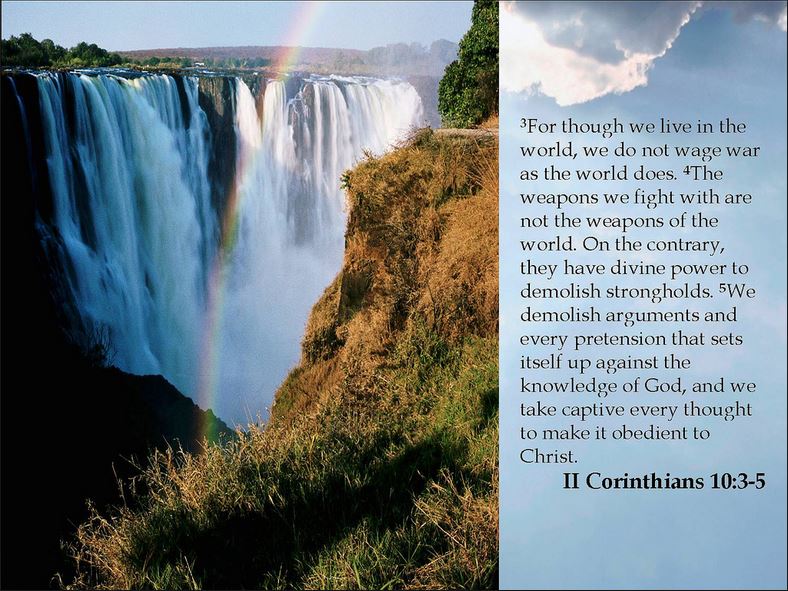
Repairing Reflections

weapons-of-our-warfareThere is great temptation these days to succumb to fear and anxiety.  Yet, Scripture tells us repeatedly not to fear.   Isaiah 35:4,  John 14:27, Joshua 1:9 and Matthew 6:34, are just a handful of examples of YHVH’s teaching on fear. We know that YHVH does not give us a spirit of fear, but of love, power and self-discipline (2 Tim 1:7).  So when trouble seems to loom ahead or is already in our midst, how do we combat those anxious thoughts and feelings that arise?

Our tendency is to tackle the job in the physical realm.  This is a mistake.  Even though our problems are in the physical realm, their source is from the spiritual realm.  The following analogy may help to better illustrate.   Athletes regularly review videos of past games in order to discover what works well and what skills or strategies still need to be honed.  Even though the video reflects what happened during the game, the problems cannot be fixed by editing the video.  Our physical realm is a video or mirror image of what is happening behind the scenes, that is the spiritual realm (Heb 8:5, 1 Cor 13:12).  In order to make effective changes in the physical realm, we have to address the issues in the spiritual realm.

For decades, perhaps centuries, many people have tried to solve the Middle East crisis on the physical level.  There have been numerous treaties, division of land, wars, and discussions.  None of these attempts has been able to resolve the conflicts.  YHVH shows us how He handles the situation.  Prime candidates for terror are experiencing life-changing dreams or visions of Yeshua.  Once these individuals discover Yeshua, their lives are transformed.  Instead of attacking their enemies, they are praying for the salvation and welfare of their enemies!  YHVH is battling in the spiritual realm to resolve terrorism and His work produces everlasting results.

Yeshua came to the earth the first time and demonstrated by signs and wonders in the physical realm that He is the Messiah.  His followers were disappointed and even disillusioned to discover that He did not mean to physically attack the Romans, the physical enemies of that time.   Instead, Yeshua attacked a much more dangerous enemy in the spiritual realm and wrought for all humans a much greater triumph with eternal implications.

Many of Yeshua’s followers today realize that the true battleground is in the spiritual realm and are now publicly engaged in intercession , worship, repentance and reconciliation with others.  In July, evangelical Christians gathered around the Washington Monument to seek YHVH’s help in breaking racism.* Breaking Christian News recently reported that 1,000  “Native American Indian tribes from the United States and Canada collectively forgave the U.S. government for breaking treaties with their ancestors during a public ceremony on the National Mall.”**  There is great power in forgiving others and releasing them from debt.  “Forgive us our debts as we forgive our debtors” (Matt 6:12).

A number of us have experienced the power of forgiveness on a more personal level.  We have discovered that when we truly forgive individuals who have hurt us, amazing things happen.  People who were estranged from us contact us seeking reconciliation.  All we did was take our case to YHVH and tell Him that we forgave and released the person(s) from any debt owed to us.  We did not disclose to anyone, not even the individuals we forgave, that we had taken such a step.  Within a short time the physical realm reflected changes made in the spiritual realm.

When Yeshua returns, His job will be to complete the reconciliation and restoration that we have been addressing (Acts 3:21 NLT).   Our adversary and any one cooperating with him want us to be divided and at odds with each other (John 10:10).  Yeshua said that we would be known by our love for one another.  We certainly want Yeshua to recognize us as His own when He returns. Judging or arguing with others stems from fear.  Yeshua said that He would only recognize those who were reaching out in love to others.  “You have heard that it was said, ‘Love your neighbor and hate your enemy.  But I tell you, love your enemies and pray for those who persecute you (Matt 3:43-44).   Does Yeshua recognize you as one of His sheep?

*   Rees, Steve.  ‘God break racism!’ Evangelicals on D.C. Mall pray for hope and reconciliation, The   Washington Post, July 16, 2016

** Zauzmer, Julie, An Kirkland and Michelle Boorstein.  “Must Read!  Native Americans are ‘Spiritual Sleeping Giants Awakened’ after Incredible Prophetic Act in Washington:  “May Go Down as One of the Most Important Days in American History,” Breaking Christian News,  Oct. 27, 2016, http://www.breakingchristiannews.com/articles/display_art.html?ID=19576


Trust in YHVH with all Your Heart

trust-in-yhvhTrust in the Lord with all your heart, and lean not on your own understanding; in all your ways acknowledge Him, and He shall direct your paths. Do not be wise in your own eyes; fear the Lord and depart from evil. It will be health to your flesh and strength to your bones.” Proverbs 3:5-8

I had memorized this well-known passage in proverbs 3:5-8 many years ago and still repeat it often in many different circumstances.  I would like to be able to say that it always calms my nerves or worries, but I can’t truthfully say that.  I usually have to spend some time with Yeshua remembering all the promises He gave us, that we are not to fear or be anxious for anything.  This tells me then that trust is not just about knowing the Scriptures that tell us God is faithful to watch over and take care of us in all situations.  It is far more about personally knowing the Living Word [Yeshua] who inspired the written Word, than it is about just knowing the written Word.

As believers, we often talk about having faith, more faith, or enough faith to endure whatever trial we are experiencing.  Unfortunately though, faith has become an overused and even watered down concept in our modern society.  Nowadays, we can have faith in Santa Claus, the Easter Bunny or the Tooth Fairy.  So what do we really mean when we say that we need to have strong faith in God?  Yeshua told his disciples that they could have cast the demon out of the young boy if they even had the faith of a grain of a mustard seed (Matt 17:20).  It is clear from this story that what they needed was not more faith, but rather a solid foundation of trust to back up the faith they had.

As human beings, we understand what it means to trust someone at a much deeper level than just having faith in someone.  Think about yourself for a moment and how you feel about trusting your neighbor. You may trust your neighbor enough to lend them your lawnmower, but do you trust them to watch out for your house when you go on a trip?  Would you trust them enough to give them a key so they can take of your plants when you are away?  Would you trust them to take care of your children for a weekend?

I would like to illustrate this point through a true story about a man named Charles Blondin, who was the greatest tightrope walker of his time, in the mid 1800’s.  He gained great fame in 1859 when he became the first person to cross Niagara Falls on a tightrope.  Charles and his friend and manager, Harry Colcord, strung a 2” diameter hemp rope from an oak tree on the American side to a large rock on the Canadian side, and used a series of guy ropes every 20’ (anchored to the shore) to keep the rope as steady as possible.  The greatest risk was the 50’ section in the center of the 1300’ span that could not be reached by anchor ropes.  The incredible thing was that Charles was able to navigate his way across the Falls without any mishaps.  He traversed the Falls a number of times over the next few weeks, carrying props such as a camera and a griddle on which he cooked an omelet, pushing a wheelbarrow, and even doing a backflip on a couple of occasions.

The most daring feat of all, though, was when he carried his manager Harry on his back during one of his crossings.  This is where the rubber meets the road – although the many fans in attendance had faith that Charles was able to cross the Falls (and even bet their money on him), it was only Harry who was able to trust Charles with his life.  A number of guy wires snapped during their crossing, but Charles never wavered.  Harry later told reporters that Charles had coached him to: “look up…you are no longer Harry, you are Charles. Until I clear this place, you are to be a part of me, mind, body and soul. If I sway, sway with me. Do not attempt to do any balancing on your own”.

Here is the essence of trusting God; not just having faith in Him. The spectators watching Charles had faith in him and believed that he was capable of traversing the Falls.  Only Harry, though, trusted him enough to climb on his back and ride across Niagara Falls with him walking on a 2” thick rope.  Is this the kind of trust you have in YHVH – do you trust Him to protect you and care for you and supply all your needs?  Do you trust Him with your whole life – body, soul and spirit – or do you trust more in your own abilities, your financial resources, or your trusted friends? In Psalm 3:6, God promised to direct our paths (keep us going in the right direction) if we would trust and acknowledge Him in every part of our lives.  Are you ready to trust YHVH with your whole heart? He is trustworthy beyond any other person or force in heaven or on Earth.  Go ahead and start trusting Him today – it will be the best decision you ever made!