Fragrant Reflections

This is the third article of our Living Tabernacles series, where we study the Tabernacle in depth. It is exciting to see how each element symbolizes some characteristic of Yeshua.  It is also more challenging when we examine what each element means for us, since each of us is now a living tabernacle of YHVH.  We are posting two articles each month as part of this series.

In the first article in this series, Nancy studied the significance of the metals used in the Tabernacle.  In the second article she examined the items YHVH specified in Exodus 25:4-5 as materials to construct and cover the Tabernacle.  In this article we will cover the oil and spices to be used for the anointing oil and the incense in the Tabernacle.

In Exodus 25:6, Abba tells Moshe that they are to gather from the people…”olive oil for the lamps; spices for the anointing oil and the fragrant incense”.  Later on, in Exodus 27:20, YHVH tells Moshe: “Command the people of Israel to bring you pure oil of pressed (beaten or pounded) olives for the light, to keep it burning continually”.  Yeshua is continuously our pure Light.  When we think of Yeshua as the Light of the world, and His command to us to shine that light throughout the world, then we can see how important it is to keep that light shining through us 24/7.

In Exodus 30:23-24 YHVH provides details of the ingredients and preparation for the anointing oil listed in Exodus 25, and how it is to be prepared – He says to Moshe: “Collect choice spices—12 1⁄2 pounds of pure myrrh, 6 1⁄4 pounds of fragrant cinnamon, 6 1⁄4 pounds of fragrant calamus, and 12 1⁄2 pounds of cassia—as measured by the weight of the sanctuary shekel. Also get one gallon of olive oil”. In Verse 25, He then explains how these ingredients are to be mixed together: “Like a skilled incense maker, blend these ingredients to make a holy anointing oil”.  Note that YHVH has added yet another qualification to the anointing oil – as I highlighted in the last verse, it is referred to as a “holy anointing oil”.  This tells us that it is to be set apart and made in a very special way compared to all other oils, such as the oil for the lamps.  Yeshua baptizes us with the anointing oil of the Holy Spirit.

Let us look at the spices to be used in the anointing oil in more detail:

  • Myrrh is a pale yellow gummy substance extracted from a small thorny shrub, typically used in spices and ointments. It is very costly and is known to be purifying to the body, and has a pleasant fragrance.
  • Fragrant cinnamon oil is distilled from the bark of a special type of cinnamon tree. It is very tasty and is often used to flavor food because of its pleasant aroma.
  • Fragrant (or sweet) calamus is a tall wetland plant with scented leaves – it is a fragrant cane whose root is highly prized as a spice. When it is crushed, it exudes a sweet fragrance. The more it is broken and crushed, the more of the fragrance that is exuded. In its spiritual application, the calamus speaks to us of brokenness, and reminds us that Yeshua was crushed and broken for us.  There are times in our lives when we must be crushed or broken in order to be purified.
  • Cassia comes from the aromatic bark of a Middle Eastern tree, and represents the true humility of anointed worship. It is sometimes used as a natural medicine. Cassia is derived from the Hebrew root “quadad”, meaning to bend or bow. This can be seen to represent us as God’s people, who are to bow down in humility before the strong hand of God (1 Pet. 5:6).
  • The main ingredient by volume in the Holy Anointing Oil is olive oil, which has both secular and sacred purposes. The olive tree is very important in secular life for cooking, cosmetics and soaps, and as a fuel for oil lamps. The olive tree has been a symbol of peace and prosperity since the time the dove returned to Noah’s Ark with an olive branch.

Let us now take a look at the spices YHVH specified to be used in the Tabernacle:

  • When Frankincense is burned it emits a fragrant odor, and hence the incense became a symbol of the Divine name (Malachi 1:11) and an emblem of prayer (Psalm 141:2; Luke 1:10; Revelation 5:8; 8:3).
  • Stacte is generally understood to be the purest kind of myrrh; and as the Hebrew name implies a drop, it would seem to refer to this type of myrrh as dropping from the tree of its own accord, without any cutting. This makes me think of Yeshua’s precious teardrops of blood in Gethsemane.
  • Onycha: Hebrew shechelet is thought to be the resin from a Mediterranean shrub that has been used for medicines and sweet perfumes for hundreds of years.
  • Galbanum: this rather foul-odored spice, when mixed with all the other spices, produces a perfect mixture for the incense. An ancient story tells of a perfumer who experimented with the biblical incense recipe and discovered that when the galbanum was left out of the mixture, the other ingredients still produced a pleasant fragrance. However, when the galbanum was added, something quite wonderful happened chemically: “the full mixture of the spices, including the foul galbanum, smelled infinitely more delicious than the mixture without galbanum”. The experiment showed that the galbanum transformed the sweet spices to produce the most beautiful incense possible. In the same way, as saved believers, we are transformed through the cleansing of our “foul” sins into beautiful children of God.

It is wonderful that YHVH explained to His people the precious spices they were to gather and use in the holy anointing oil and the incense, but we need to always remember that our obedience to Him is the sweetest aroma we can sacrifice to Him (1 Sam 15:22).  Our prayers are the most powerful incense we can offer up to YHVH (Rev 5:8).

The holy anointing oil that was to be used in the tabernacle can also be related to the oil of the Holy Spirit, flowing through our own tabernacles, purifying us and making us holy to stand before YHVH in His heavenly Tabernacle.  Let us welcome the oil of the Holy Spirit to keep our bodies and souls pure and set apart from the lusts of the world, such as power, greed, arrogance, hostility and envy.  We are called to be set apart to be with YHVH for all of our days, both here on Earth and forever in Heaven.

Material Reflections

living-tabenacles

This is the second article of a new series (Living Tabernacles)  where we study the Tabernacle in depth. It is exciting to see how each element symbolizes some characteristic of Yeshua.  However, it is more challenging when we examine what each element means for us, for each of us is now a tabernacle of YHVH.  There will be two posts each month for this series.

In the first article in this series, we studied the significance of the metals used in the Tabernacle:  gold, silver and bronze.  In this article we continue examining the list YHVH gave to Moshe itemizing the components He desired to build His Tabernacle.  We will cover the items listed in verses 4 and 5 of Exodus 25: colored threads, fine linen, goat hair, ram skins, fine goatskin leather and acacia wood.

Thread is interwoven throughout the material just as the spiritual significance of these threads should be interwoven throughout our lives.  The scarlet thread symbolizes cleansing, purification, sin, riches, a marker, and/or clothing of a valiant man.  We know what “valiant Man” has died for our sins, cleansing and purifying us.  He still wears those markers on His hands and feet.  He has gained for us untold wealth.  In Him, we must root out the sin that is interwoven in us, so that His cleansing and purifying may permeate every part of us.  We are abundantly wealthy in Yeshua and we wear His mark on us (Rev. 7:2-3).

The blue thread symbolizes holy covering, heavenly, holy service, chastening and water (Spirit).  We are no longer naked in our sin (Gen 2:25, Is 47:3), but are covered with Yeshua’s righteousness.  Yeshua came down from Heaven for the express purpose of establishing (or perhaps re-establishing) YHVH’s kingdom on earth as it is in heaven.  Yeshua baptizes us with the Holy Spirit.  The Holy Spirit fills us, chastening, strengthening and preparing us for holy service to YHVH.

The purple thread symbolizes royalty and riches. The Roman soldiers placed a purple robe on Yeshua during his trial in order to mock Him.  Little did they realize that Yeshua, above any other human, is entitled to wear the color of royalty.  Yeshua is our King and High Priest.  We are a royal priesthood and adopted children of YHVH.  Our wealth is in Messiah Yeshua, for without Him we have nothing and with Him we have an abundance of treasures.

The fine linen spoken of in Exodus 25 is the Hebrew word bad.  The word is from a root which means “separation”.  The Hebrew word for holy is kadosh which means to be set apart.  The fine linen worn by priests indicated that they were set apart to YHVH. YHVH is set apart and we are called to separate ourselves from the world and be dedicated solely to YHVH.  Our clothing must be the fine linen of Yeshua’s righteousness (Rev. 3:18), for without it we will not be welcome at the wedding of the Bridegroom (Matt 22:12).

Goat’s hair is used in Bedouin camps today for tents, tent ropes and rugs.  Goats’ hair cloth is able to stand the hard usage of a frequently shifting encampment.  We must be resilient enough to follow our Leader wherever He takes us.  Goatskin leather was used as a covering for the Tabernacle.  Yeshua is our spiritual covering.  With Yeshua’s covering, we are able to withstand many trials and persecutions.

On Yom Kippur, two goats were selected and lots were cast for them.  One goat would be sacrificed for the sins of the people and the second goat would bear the sins of the people and be sent out of the camp and into the wilderness, signifying how YHVH has removed our sins far from us (Lev 16).  Yeshua is both the sacrifice that atones for our sin (Heb 9:26) and the One who carries our sins as far as the east is from the west (Ps 103:12).

Tanned lambskins were also used to cover the Tabernacle.  Some versions translate this word as badger skins, but this is unlikely since badgers are considered to be unclean animals.  The skins of lambs have significant spiritual relevancy since Yeshua is the “Lamb of God who takes away the sins of the world” (John 1:29) and Yeshua is a covering for us.  Some versions translate the tanned lambskins as lambskins died red.  The blood of Yeshua, the Lamb of YHVH, covered His skin as He hung on the cross.  His blood now covers us.

When Adam and Eve had sinned, they realized that they were naked.  YHVH made the first animal sacrifice on their behalf and clothed them with the skins of the animals signifying a much greater and more effective covering to come (Gen 3:21).

The acacia tree mentioned is likely the gum-arabic tree.  It is a gnarled and thorny tree.  Acacia trees are plentiful in the wilderness where the Israelites traveled.  Acacia wood is not desirable to insects and is virtually indestructible.  Was the cross made from acacia wood?  Possibly, but we have no proof of the type of wood used by the Romans in Jerusalem for crucifixion.  We do know, however, that Yeshua, even though He died, is indestructible.  Was the crown of thorns woven from acacia thorns?  We do not know for sure. The tree is formed much like an umbrella, just as Yeshua’s sacrifice provides us protection from the sentence of eternal death.

What is the significance of all the wood being overlaid with gold?  The acacia wood is gnarled and crooked signifying the twistedness of sin and evil.  The long thorns are menacing.  Yeshua willingly allowed Himself to be beaten beyond recognition.  He wore a crown of thorns and was humiliated and despised.  However, the reward He has reaped for Himself and for us is eternal glory and untold riches.  What appeared to be a disgrace and defeat, has turned into triumph and victory beyond measure (Rom 6:4).  Yeshua now wears a crown of unsurpassable glory.  On our own we are defeated, but in Yeshua we are victorious!

As we reflect on these materials, let us, living temples of the Holy Spirit,  be transformed into the image and likeness of YHVH, reflecting His glory.

Metal Reflections

living-tabenacles

This is the beginning of a new series (Living Tabernacles) where we will study the Tabernacle in depth. It is exciting to see how each element symbolizes some characteristic of Yeshua.  However, it is more challenging when we examine what each element means for us, for each of us is now a tabernacle of YHVH.   There will be two posts each month for this series.

The building of the Tabernacle involved participation on the part of the Israelites from the beginning.  YHVH showed Moshe the building plans and a heavenly model so that he would understand exactly what needed to be done (Exodus 25:9, Heb 8:5).  Then YHVH gave Moshe a list of items needed for the Tabernacle.  Moshe was instructed to share the list with the Israelites.  They were to take from their possessions in order to have the necessary building materials.  Where did they get the materials in the first place?  From YHVH Himself.  Whatever is good and perfect comes down to us from God our Father, who created all the lights in the heavens. He never changes or casts a shifting shadow (James 1:17).   Since the Israelites gave of their own possessions and, later on, their time and talents, they had a significant stake in the Tabernacle and in the worship of YHVH.

The list that YHVH gave to the Israelites was as follows:

  • gold, silver, and bronze;
  • blue, purple, and scarlet thread;
  • fine linen and goat hair for cloth;
  • tanned ram skins and fine goatskin leather;
  • acacia wood;
  • olive oil for the lamps;
  • spices for the anointing oil and the fragrant incense;
  • onyx stones and other gemstones to be set in the ephod and the priest’s chestpiece.

Every item on the list points not only to Yeshua, but to us who are seeking to become like Yeshua.  Each listed item symbolizes a characteristic of Yeshua and, by extension, should symbolize a characteristic of His followers.  What can we learn from this list?

In this first article we will examine gold, silver and bronze.  Gold and silver are precious metals and, for the Tabernacle, had to be “pure” (Exodus 25:11) and “refined” (1 Chronicles 28:18).  YHVH refines us through fiery trials so that we may be purified.  “Many will be purged, purified and refined, but the wicked will act wickedly; and none of the wicked will understand, but those who have insight will understand (Dan 12:10). Gold is symbolic of YHVH’s kingship, glory and holiness and we are meant to reflect His glory and holiness.  Gold is one of the least reactive chemical elements.  When the blood was sprinkled on the Ark of the Covenant (made of pure gold), the gold did not tarnish.  When we are sprinkled with adversity, it should not discolor or corrode us.

Silver signifies redemption, which means to purchase back at a cost. Yeshua paid the highest price to redeem us.  The Hebrew word for silver is ‘kesef,’ meaning a very strong desire. According to Strong’s Concordance, the root for this Hebrew word is:

H3700 – כּסף – kâsaph – kaw-saf’ – A primitive root; properly to become pale, that is, (by implication) to pine after; also to fear: – [have] desire, be greedy, long, sore.

Generally, when we purchase something at a steep cost, we expect to possess something of substantial value.  Yeshua “pined after” us so much that He was willing to lay down His life in order to get us back.  Do we pine after Yeshua to the extent that we are willing to lay down our lives in order to follow Him?

Many scripture passages tie bronze to sin and judgment.  The bronze Sea where the priests were to wash was constructed so that they could see their reflections in order to ensure that they did not miss any dirt.  Scripture and Yeshua (the living Torah) are our “bronze Sea” where we can examine ourselves in order to remove any stains or blemishes.  For it is not the hearers of the Law who are righteous before God, but it is the doers of the Law who will be declared righteous (Rom 2:13). For if anyone is a hearer of the word and not a doer, he is like a man who looks at his natural face in a mirror— 24 for once he looks at himself and goes away, he immediately forgets what sort of person he was. 25 But the one who looks intently into the perfect Torah, the Torah that gives freedom, and continues in it, not becoming a hearer who forgets but a doer who acts—he shall be blessed in what he does (James 1:23-25)

The bronze altar signifies that YHVH is willing to take our judgment upon Himself, but only if we are willing to repent of our sins.  In the case of King Zedekiah who was not willing to repent, we see that he was carried off to Babylon in bronze shackles (2 Kings 25:i7).  If we are not willing to repent of our sins, we will have to deal with YHVH’s judgment ourselves.

Just as the Israelites offered treasures, time and talent to build a Tabernacle for YHVH, each of us must do the same as we prepare ourselves as fitting tabernacles for YHVH.  We will continue our study of the significance of the elements in the next article in this series entitled Living Tabernacles.

Each of us is now a tabernacle for YHVH.  Yeshua replied, “All who love me will do what I say. My Father will love them, and we will come and make our home with each of them (John 14:23).  The materials for the Tabernacle were costly and of the finest quality.  What does your tabernacle look like?  How are the gold, silver, and bronze reflected in your tabernacle?

YHVH’s Sanctuary

yhvh-is-a-shelterWhat did Yeshua mean when He said in His Olivet discourse: “as it was in the days of Noach” (Matt 24:39)?  In this and other Re(new)ed Covenant Scriptures (2 Pet 2; 2 Thess 2), the authors speak of a future world of great wickedness, such as has not been known since the times of Noach and Sodom.  These Scriptures also speak of YHVH’s judgment on those who are deceived by the lies of hasatan and refuse to turn to the truth of the Creator and Redeemer of the world, Yehovah Elohim.

They also speak of YHVH our Deliverer saving and protecting His people during times of past trials or judgment:

  • Noach and all his family were divinely saved from destruction by the protection of the Ark (2 Pet 2:5). Note that the Hebrew word for ark (tevah) not only means a box or covering, but it also means “word” – so you can think of Noach and his family truly being covered by YHVH’s Word!
  • In the time of Sodom & Gomorrah, we are told that the people were very immoral and ungodly, but also that God [Elohim] rescued Lot from the fiery judgment because Lot was a righteous man who followed the truth (2 Pet 2:6-7)
  • Moses (Ex 44:7), David (1 Sam :14-15) and Elijah (1 Kings 19:4-8) were all protected in the wilderness
  • In the same way, when YHVH brought all the plagues onto the people in Egypt, He spared the Hebrews from the worst of those plagues (Ex 9). Yeshua became our Passover Lamb 2000 years ago, and now we can cover ourselves with His blood for protection from the enemy’s attacks
  • Finally, in speaking about the end of days, Yeshua says in Revelation 12 verses 6 and 14 that YHVH will once again protect His people from both the unbearable attacks from the adversary hasatan, and also from His own judgments against the wicked

From these Scriptures we know that YHVH has protected His people many times in the past, and has said that He would protect us again during the Tribulation period.  We also know from Yeshua’s words in Matthew 24 and Sha’ul’s prophecies in 2 Timothy 3 that the times before the end of this current world will be characterized by great sinfulness and evil.

What will lead the people of the world into such great lawlessness, though?  We know there are plenty of greedy, boastful and wicked people throughout the world now, but Yeshua says the End will be a time like no other that has ever been seen or will ever be seen again.  Several Scriptures speak of a great apostasy, deception, or falling away (2 Thess 2:3, Matt 24:10).  Reading further in these Scriptures we see many reasons for this falling away of believers in Yeshua, so great that even some of the elect will be led astray (Matt 24:24).  Yeshua speaks of many false prophets and teachers, and the great signs and wonders they will use to try to convince believers that they are the Messiah who is prophesied to return.

There is a stronger deception than simple signs and wonders that will be leading the saints away from YHVH, though.  This deception becomes clear when you look at the expanded meaning of apostasy – it means “an abandonment of the truth”.  In spiritual terms, this means that the end times will involve a wholesale rejection of YHVH’s revelation, a further “falling away” of an already fallen world.  This “end times” falling away is confirmed as the sign that will come before the Tribulation ends and Yeshua returns for His saints (the set-apart ones) in several other Scriptures.

When Sha’ul talks about the end times in II Timothy 3, he talks first about all the wickedness that will mark that time, but then he goes on to say in Verse 7 that people at that time will be: “always learning but never able to come to a knowledge of the truth”.  This agrees with II Thessalonians 2:10-12 which states that the ones who will be judged in the latter days will be the ones who did not believe the truth of YHVH, but instead believed the enemy’s lies.  The crux of this passage in Verse 11 says: “…God will cause them to be greatly deceived, so that they will believe these lies”.

Going back to Matthew 24, Yeshua’s first answer to His disciples about the signs of the end was: “Be careful that no one leads you astray! For many will come in My name, saying, ‘I am the Messiah,’ and will lead many astray” (Matt 24:4-5).  Remember that one of Yeshua’s harshest reprimands of the religious leaders was in John 8:44 when they accused Him of casting out demons and healing people in the name and power of the devil: “For you are the children of your father the devil, and you love to do the evil things he does. He was a murderer from the beginning. He has always hated the truth, because there is no truth in him. When he lies, it is consistent with his character; for he is a liar and the father of lies”.

The essence, then, of the reason for the great falling away in the end times will be that a great majority of the people (believers and unbelievers alike) will believe the lies of the false teachers and prophets and of the anti-messiah himself.

So how do we prepare ourselves for these perilous times, so that we can discern false from true teaching and prophecy, and resist following the popular path of believing the captivating lies of the enemy’s allies?  As with all temptations and allurements of our society, we need to put all our trust in our Rock and Redeemer, Yeshua HaMashiach, and be filled with Yehovah’s Holy Spirit.  We need to ask Abba for guidance in discerning the truth from the lies, and then follow that truth no matter what are the world consequences.  While it is true that not all believers will be delivered physically through the Tribulation, we know that if we remain steadfast in our trust and obedience, YHVH will help empower us to overcome the world, by the Blood of the Lamb and the Word of our testimony.  In this world we will have tribulation, but Yeshua has overcome the world, and greater is He that is in us (the Holy Spirit) than he that is in the world (1 John 4:4).

Who’s Missing?

mind-of-spirit-is-peace

When an evil spirit leaves a person, it goes into the desert, seeking rest but finding none. 44 Then it says, ‘I will return to the person I came from.’ So it returns and finds its former home empty, swept, and in order. 45 Then the spirit finds seven other spirits more evil than itself, and they all enter the person and live there. And so that person is worse off than before. That will be the experience of this evil generation.”

Many of us are familiar with Yeshua’s words from Matthew 12:43-45.  It is possible, however, to read over this passage many times and yet miss some vital information.  This is an important message for all of us, so it is wise to spend some time reflecting on Yeshua’s warning.

First, let us look at the rest of the chapter for context.  At the beginning of the chapter, Yeshua, referring to Himself as Son of Man (Hebrew expression for a human being) is also declaring His identity and authority as Son of God, because He has authority even over the Sabbath.  We know from other Scripture verses that Yeshua emptied Himself, or divested Himself from His power as the Son of YHVH (Phil 2:7) and relied solely on the power of the Holy Spirit (Luke 4:1), as He expects His followers to do (Luke 24:49).[1]

As the chapter continues, Yeshua performs miracles by the power of the Holy Spirit.  Beginning in verse 22, Yeshua casts out a demon from a man who is both blind and mute.  The people consult with their leaders after this miracle, saying that surely Yeshua must be the Son of David, the Messiah.  The leaders, who are against Yeshua, tell the people that Yeshua is not using the power of YHVH to perform His miracles, but the power of the prince of demons.  They are denying the power of the Holy Spirit in their attempt to discredit Yeshua.

Now we come to Yeshua’s words concerning an evil spirit who leaves (or is driven out) from its dwelling within a person.  After wandering for some time, the demon returns to its former abode, which has now been swept clean and is in order.  This suggests that the person has repented, been forgiven, and/or had soul wounds healed.  But Scripture also says that the abode is empty, or unoccupied.  Who should be dwelling there now?  The Holy Spirit.  If there is any part of our souls (mind, will, emotions) that have not been yielded to Yeshua and filled with the Holy Spirit, they are prime areas for demons to move in.

In our efforts to quell demonic activity in our lives and repair the damages, we must be intentional in inviting the Holy Spirit to ensure that the former (or potential) dwelling of the demon is not only in order and swept clean, but occupied and guarded as well.   In other words, we cannot truly improve on our own, but need the help of the Holy Spirit. In Mark’s version of this story (chapter 3), Yeshua tells us no one can enter a strong man’s house without first tying him up. Then he can plunder the strong man’s house.  On our own, we are not strong enough to withstand the enemy.  The Holy Spirit is the “strong man” that cannot be overpowered by demons.

Yeshua purposely divested Himself of His power and authority as the second Person of YHVH in order to rely solely on the power of the Holy Spirit, thus demonstrating to us that we must divest ourselves of our own power and rely on the Holy Spirit.

Why did Yeshua say “that would be the experience of this evil generation”?  Because the Pharisees wanted to be in control to the extent that they not only denied the power of the Holy Spirit when it suited them, but they gave credit to hasatan for the work of the Holy Spirit.  Some believers today are still falling into that error.  Some say that speaking in tongues is of the devil, for example.  Many of us avoid the Holy Spirit out of fear or reluctance to relinquish control.

Where the Holy Spirit prevails there will be order, unity and love.  Where the Holy Spirit is not welcome, there will be chaos, division, hatred or apathy.  We cannot atone for our sins on our own, but need to rely on Yeshua’s sacrifice on our behalf.  Likewise, we cannot steer our own course through this spiritual battlefield on earth, but must rely on the power and guidance of the Holy Spirit.  Aside from some practice runs, the apostles did not get started on their assignments in YHVH’s harvest until they had been filled with “power from on high” or the Holy Spirit (Acts 2)

Are there areas in your life that are confusing or chaotic?  Are there broken or weak relationships in your life?  How will you sweep these areas clean?  Will you welcome the Holy Spirit to reign in that area of your life as your “strong man”?

[1] Yeshua did not cease to become the Son of YHVH at any time nor did He relinquish His authority as the Son of YHVH, but He operated only by the power of the Holy Spirit to demonstrate to His followers what He expected of them.


Yeshua is the Way

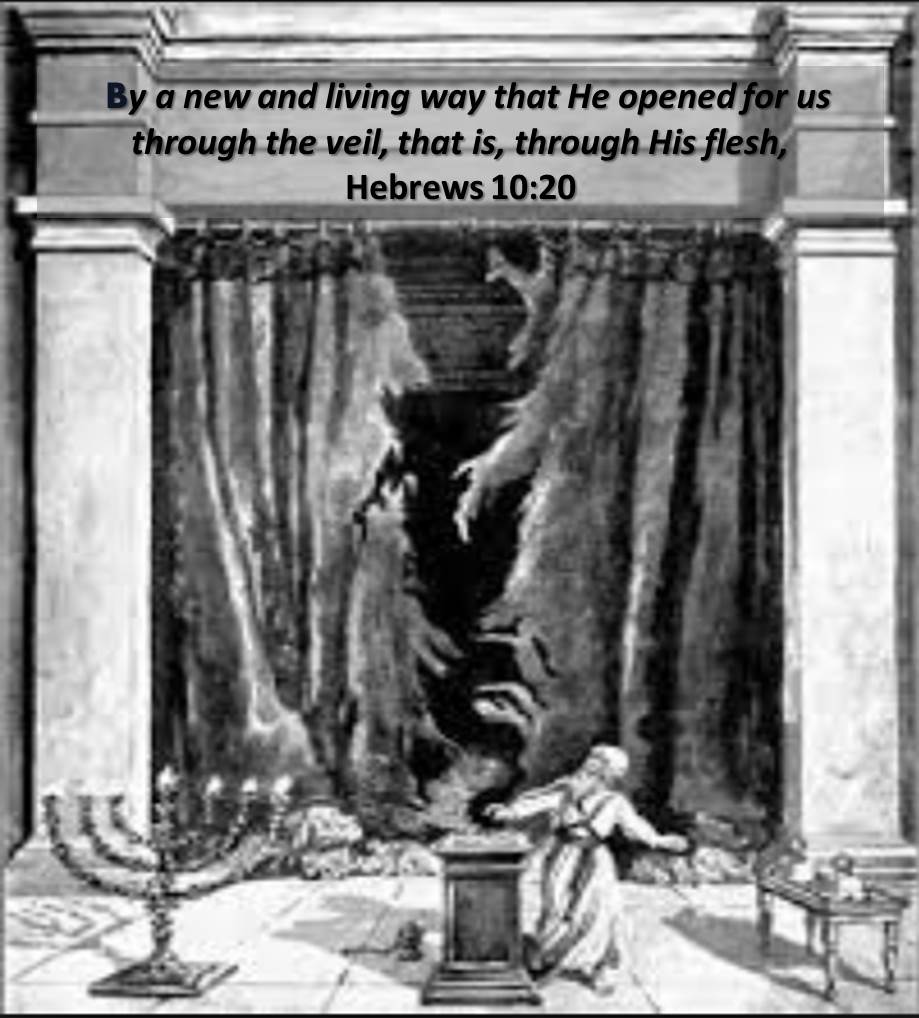
thru-the-veil-of-his-fleshIt is clear that Abba Father tore the veil separating the people from the Holy of Holies when Yeshua’s body perished, because the Scripture says it was “torn in two from top to bottom” (Matt 27:51).  The fact that it was torn from top to bottom symbolizes YHVH reaching down from Heaven and opening the way for us to “come boldly to His throne of grace, that we may obtain mercy” (Heb 4:16).  What is this place we are entering into, though?  For Torah observant Jews of Yeshua’s time, they may have wrongly believed that the way had been opened for them to come into the Holy of Holies and worship in YHVH’s presence, where His glory dwelled above the earthly Ark of the Covenant.

However, through history and the Scriptures, we find a much deeper meaning to the tearing of the veil.  From history we know that the Temple was destroyed and the Ark was hidden or taken away, just as Yeshua had prophesied in Luke 13:35.  Our entrance into the Holiest place, then, was not an entrance into an earthly place, but rather an entrance into YHVH’s heavenly throne of grace.  Sha’ul gives us some great hints as to what this means at a deeper level:

  • “We have this as a sure and steadfast anchor of the soul, a hope that enters into the inner place behind the veil, where Jesus [Yeshua] has gone as a forerunner on our behalf, having become a high priest forever..” (Hebrews 6:19-20)
  • The God who made the world and everything in it, being Lord of heaven and earth, does not live in temples made with human hands,” (Acts 17:24)

The first passage above tells us that Yeshua has gone into the inner place ahead of us, to make a way for us to come before the Father’s throne.  We know from Scripture that Yeshua ascended to Heaven after his Resurrection and now sits at the right hand of the Father, and Hebrews 6:20 tells us that Yeshua is now our high priest.  When He opened the way into the Holy place of the Father in heaven, Yeshua also did away with the sacrificial system.  He became our God-man sacrifice who took away our sins and diseases for all time, not just once a year like the earthly high priest or the animal sacrifices people brought to the Temple.

In the second Scripture above, we learn that YHVH does not live in earthly temples – rather, He dwells in His heavenly Tabernacle, where He now invites us to come and fellowship with Him, through the Way that Yeshua has made for us by tearing the veil.  Yeshua has also made us holy and righteous before Abba, as He has washed us white as snow by His blood (I Cor 6:11).  This is not only a way to the Father, but rather it is the only way to draw close to Abba – in John 14:6, Yeshua Himself said that no one can come to the Father except through Him.

Even with all these insights into the tearing of the veil, though, and the way that has been opened for us into Yehovah’s most Holy place, there is still a deeper and more personal significance to this event.  Hebrews 10:20 (NIV) says that Yeshua opened a “new and living way for us through the veil, but then it equates the veil with Yeshua’s flesh.  This means that we are actually entering into Yeshua’s body when we come before YHVH’s throne – now that is the way to come to the Father!  The next time you come before Abba’s throne in worship, remember that you are entering through the perfect, sinless flesh of the One who showed us His unconditional love by sacrificing His life for us.

Light Revelation

light-shines-in-darknessLight is essential for our survival, both physically and spiritually.  At this time of year, we celebrate light in the darkness.  The menorah symbolizes the light of Yeshua (Ps 119:105, John 8:12)  Arlene Sheldon provides an interesting study on Yeshua’s miracles that correspond with His “I AM” statements ( http://www.wellofbethlehem.witnesstoday.org/menorah.html ) as the living menorah.  The light of the Father poured forth from Yeshua.  Yet, Yeshua tells us that we are the light of the world (Matt 5:14).  What is light? How are we to be light in the darkness?

YHVH created light on the first day, but He created the sun, moon and stars on the fourth day.  What was the light that YHVH created?  Some ridicule the Bible and say that it contradicts itself.  How could YHVH create light but not create the sun until day four?  In his article entitled Sunlight Before the Sun, John D. Morris, PhD. from the Institute for Creation Resource points out that there are many types of light such as short-wave light including ultraviolet light and X-rays and long-wave light including infrared light and radio waves.  Perhaps YHVH created the materials for light on day one and then chose different combinations of materials for various types of light.  YHVH provides various combinations of spiritual light within us as we draw closer to Him, the Source of light.

We can be misled by what we do not see.  For example, when we turn on an incandescent light bulb, we may think that the light we see is the only light produced by the bulb.  However the incandescent bulb emits only around 10% of its energy as visible light and the remainder is infrared light (“Light,” Wikipedia).   We are to be light in the darkness.  Are we incandescent bulbs?  No, we are light in the sense that there is ignorance or defiance of YHVH’s truth and we can reflect the light of YHVH’s truth to those living in the chaos of darkness.  We may think that the light we provide to the world is small and insignificant, but perhaps we are unaware of the various kinds of light that YHVH is able to produce through us.

Light can also mean understanding or comprehension of Scripture.  Psalm 119:130 states, The unfolding of your words gives light; it imparts understanding to the simple (ESV).  When we read or study Scripture, we can interpret or comprehend on four levels. Peshat is the surface or literal meaning,  Remez the allegorical or symbolic meaning,  Daresh  the comparative meaning given through similar occurrences and Sod is the secret meaning given through inspiration or revelation.  Light can penetrate through layers of darkness.  As we comprehend Scripture and it becomes part of us, we emanate its light to those around us.  Light and truth are closely related to each other.  But whoever lives by the truth comes into the light, so that it may be seen plainly that what they have done has been done in the sight of God (John 3:21 NIV).

YHVH Himself is light.  1 John 1:5 states …God is light, and in Him there is no darkness.   YHVH has many mysteries hidden in the dark and as they are revealed, YHVH will be more fully revealed.  How do we reveal YHVH to others?  Isaiah 58:10 says If you extend your soul to the hungry and satisfy the afflicted soul, then your light shall dawn in the darkness and your darkness shall be as the noonday.

By steeping ourselves in YHVH’s light through His word and through personal relationship with Him, the oil of the Holy Spirit will keep our lamps burning brightly in the ever increasing darkness of this world.  Our light will shine through our words and actions to others.  Let your light shine in such a way that they may see your good works, and glorify your Father who is in heaven (Matt 5:16).  We will not only survive in the darkness, we will thrive.


Gedi Star Teachings

gedi-the-goatToday we are going to explore another of the amazing signs that YHVH placed in our heavens from the beginning of Creation.  The sign is commonly known as Capricorn, which translated from Latin literally means a horned goat.  However, as I have mentioned in the past, we cannot trust modern Greek and Latin names of stars or constellations, as their names and meanings have been corrupted over the years from the original Hebrew meanings.  In Hebrew, this sign is called Gedi, which means kid goat, but is sometimes translated as sea goat, due to the strange half-goat/half-fish image portrayed in ancient drawings of the sign.

The image we see in Egyptian, Indian, and Phoenician drawings is of a fish that is weak and dying at the head, but alive as a healthy fish at its tail end.  The stars in this sign confirm the meaning associated with this image: ma’asad: the slaying; dabih: the sacrifice slain; and sa’ad al nashira: the cutting off.  As with many Hebrew words, gedi (kid goat) has a second meaning: to be cut off.  This sign, then, represents the sacrificial Goat of atonement, Yeshua, who was slain to redeem us from our sins, was “cut off” (crucified) to bring us salvation, healing and deliverance from evil.

The fish portion of the goat’s body represents us: the people for whom the sacrifice was made.  Other star names in this sign also point to Gedi as being the goat who was sent into the wilderness for remission of our sins (so that they would be sent away as far as the east is from the west).  We know that Yeshua fulfilled both of these goat sacrifices!

To complete this awesome picture story, the three constellations associated with this sign give more of the details. The 1st constellation is Sagitta, means “the arrow of Elohim sent forth” – this connects with Psalm 38:2 where it says “Your arrows have struck deep, and Your blows are crushing Me”; and also Isaiah 53:4-5: “He was stricken, smitten of God & afflicted; He was wounded for our transgressions”.  Aquila (the eagle) is the 2nd constellation in Gedi – the stars in this constellation convey the meaning of “the smitten One falling”, “the One who comes in the Shekinah glory of God to shed His blood as a sacrifice”; and “the One who was wounded in the heel” (Gen 3:15).

The third and final constellation in Gedi is Delphinus, the original name meaning “the dead One rising”.  It is shown in ancient Zodiacs as a fish full of life, always with his head pointing upwards.  This represents Yeshua’s resurrection as “the first-fruits of them that sleep” (I Cor 15:20).  The Hebrew name is Dalaphin, which means Dolphin and also “pouring out of water”.  We see from this word picture that Yeshua fulfilled the prophecy to pour out the Holy Spirit on all flesh, symbolized in Scripture as the “fountains of living waters”.

The brightest star in Gedi is actually a double star named Deneb Al Giedi – “the Judge who is the sacrifice.”  When we think about Yeshua’s dual role as our Messiah, we know that He came to save us from our sins in His first coming to Earth, but that He will be our ultimate Judge in His second coming. As Yeshua says in John 3:36: “Whoever trusts in God’s Son has eternal life. Anyone who doesn’t obey the Son will never experience eternal life but will remain under God’s judgment”.  Draw close to Yeshua and He will draw close to you; get to know Him intimately and your greatest desire will be to trust Him with your life, walk in His way and lovingly obey all of His commandments.

Righteous Oaks

righteous-oaksWhen YHVH promises in the beginning of Verse 3 of Isaiah 61 that He will give us: “Beauty instead of ashes, the oil of joy instead of mourning, the garment of praise instead of the spirit of heaviness”, His end goal is not just to give us temporary help to get us through a crisis in our lives. Ultimately, God is building us up to be trees [oaks] of righteousness. We are the “trees” God is planting in the place He desires us to bear fruit.

Oak trees are known to be the strongest, most sturdy and resilient of all trees on Earth. They can withstand hurricanes, tornadoes, earthquakes, droughts and floods better than almost any other type of tree.  God likens His children to oak trees and says we can be just like them in our character and integrity: “They shall be like great oaks of righteousness”.  These are not the words of a long-ago prophecy that have no meaning for us today. This is the expression of God’s heart for His people down through the generations. God wants us to be strong and enduring and He has given us clear insight in His word as to how we are to make that happen.

The average large oak tree needs as much as fifty gallons of water per day, so the root system is large and goes deep to reach that water. The root system not only brings the needed nourishment to the tree but it provides the anchoring base that allows the tree to withstand all kinds of assaults, from the wind, the rain and the shaking of earthquakes.  The root system of a mature oak tree can total hundreds of miles, and the roots of an oak tree extend out underground up to two and a half times their height.  So how can we as YHVH’s children ever hope to have such deep roots?

Jeremiah 17:7-8 is a powerful amplification of what Isaiah is talking about: “But blessed is the person who trusts in the LORD, whose confidence is in Him. They will be like a tree planted by the water that sends out its roots by the stream. It does not fear when heat comes; its leaves are always green. It has no worries in a year of drought and never fails to bear fruit”.

Both in Isaiah 61 and here in Jeremiah, it is clear that YHVH plants His seeds purposefully. He does not take His seeds and scatter them to the wind, disregarding where they fall.  God picks a perfect place for each of us, personally putting the tender shoot in the ground, knowing exactly what lies ahead. God knows every detail of our lives and the place of our planting and He does not make mistakes; we were not planted in the wrong part of the garden!

We were destined to display the “splendor of the Lord.” It doesn’t matter how you feel, you are destined to display the splendor and majesty of YHVH. There are days when you may not feel that you are reflecting God’s glory to others in your world, but if you have deep spiritual roots and are standing tall in constant relationship with YHVH, you will be displaying His majesty.   In fact, He will “rejoice over you with gladness” (Zephaniah 3:17) and even “protect you from trouble and surround you with songs of victory” (Psalm 32:7).

Trees do not instantly develop deep roots, and neither do people – both must go through difficult times of physical or spiritual drought and hardship, and must be patient until their roots develop.  In the case of God’s people, we must be filled with God’s Holy Spirit and grow in our faith and spiritual maturity, learning to trust YHVH more and more for strength to overcome the attacks and temptations of the world.

Trees contribute greatly to purify the air, and render it fit for us to breathe. When the air around us passes through leaf surfaces, it is purified and invigorated.  In the same way, there is a moral atmosphere around us.  When the air around us passes through our spirit and soul, we have the ability to speak life or death, blessing or curse to those around us.  As YHVH spoke in Deuteronomy 30:19-20, “I call on heaven and earth to witness against you today that I have presented you with life and death, blessing and curse. Therefore, choose life, so that you will live, you and your descendants, loving the LORD [YHVH] your God, paying attention to what He says and clinging to Him — for that is the purpose of your life!

As YHVH’s children, when we trust in Him with all our heart and follow His ways and His instructions, our roots will go down deep into the “earth” of the Holy Spirit within us, enabling us to withstand all the trials and tribulations of life, bearing much fruit and glorifying Him through our lives.  As YHVH says in Jeremiah 17:7-8 about those whose confidence is in Him: “we will be like trees planted by the stream, that send our roots deep: we will not fear when heat [persecution] comes; our leaves will always be green. We will have no worries in a year of drought and we will never fail to bear fruit”.

Building Plans

working-together

Exodus 35 paints a beautiful picture not only of the past but of the future as YHVH’s plan unfolds.  In Exodus 35, Moshe had already received the blueprint of the tabernacle to be built for YHVH’s dwelling place on earth.  Now, the people were contributing their goods, time and talents according to what YHVH has provided for each person.  All the people were working together for the glory of YHVH!

There were no distinctions or exclusions among the people.  Every person was invited to participate if  he or she was willing.  Each had something to contribute.  Men and women were both included.

When the Israelites left Egypt, there was a mixed multitude (Ex 12:37-38).  YHVH’s demonstration of His power and the powerlessness of the false gods awakened more than just the Israelites to recognize the one true God.  An unreported number of Gentiles were in the group.  All the people were told to keep the Shabbat and the other appointed times.  YHVH, who is a God of relationship, provided in His plan set times for a family reunion three times a year after they were settled in the Promised Land.  While they were in the desert, they could all meet with YHVH each Shabbat as well.

Today Jews, lost tribes, and Gentiles are being called to help establish and be part of YHVH’s kingdom.  In this case it is not Moshe who has the blueprint, but the Holy Spirit. All are called to participate. All are called to the appointed times YHVH has provided for us.  Each person has an assignment in the work and each person is called to contribute according to the provisions of  goods, time and talent that YHVH has provided. There is  neither Jew nor Gentile, neither slave nor freeman, neither male nor female; for in union with the Messiah Yeshua, you are all one (Gal 3:28 CJB).

Every person is important to the work of YHVH’s kingdom building.  Every person is needed and has a specific role to play, a specific assignment to carry out.  In the wilderness, as the people were building a tabernacle, YHVH was building a community, a family.  So it is today.

I appeal to you, brothers and sisters, in the name of our Lord Jesus Christ, that all of you agree with one another in what you say and that there be no divisions among you, but that you be perfectly united in mind and thought (1 Cor 1:10 NIV).