What would you do if you were God (Part 5)

LORD is good“Throughout the earth the story is the same— only a remnant is left, like the stray olives left on the tree or the few grapes left on the vine after harvest.” Isaiah 24:13 [NLT]

In the previous installments of this series on God’s ways, I discussed why YHVH does things the way He does and why His plan seems so odd to us sometimes but is actually the perfect plan for our lives.  In this final blog of the series I want to look into the future and see why He has prophesied and planned out such a seemingly bizarre sequence of events for the end of this age.

From our limited human perspective, it may seem odd that the Creator of this universe would aim to judge His creation by destroying a large portion of it through catastrophic events.  Let us look in more detail at a sampling of His end-time prophecies which are spread across many of the minor and major prophets in addition to the book of Revelation.  When researching a news story, we try to answer the four “w” questions: who, what, when, why.  The “How” question is not so important to us when it comes to Abba‘s future plan, as we do not really need to know how He will perform His will, but rather how we fit into it and what we should do to prepare ourselves.

The “When” question is also not critical to us, as we have no control over it anyway, and we need to be spiritually prepared, whether the events start to play out over the next few years, further into the future, or beyond our earthly lifetime.  Yeshua said that no person would know the day or hour of the end time, not even the angels in Heaven, so we should not waste time speculating about the timing of these events (Matt 24:36).  The explanation of “What” is going to happen in the final days is somewhat more important to us, but mainly from the perspective of discerning the signs of the end times, as Yeshua outlined in Matthew 24-25.  If we get too concerned with answering the “When” and “What” questions (such as being drawn into the pre-Trib Rapture belief), then we can easily miss the more crucial truths of Yeshua’s message.

In Luke 18:8, He asks “when the Son of man returns, will He find faith in the Earth?”  Why is our Creator and Savior questioning the faith of His saints?  In Matthew 24:12, He goes on to say that “iniquity will abound and the love of many will grow cold”.  This agrees with statements in 2 Thessalonians and Daniel that speak of the Tribulation period and the 3 ½ year reign of the anti-messiah, when there will be a great falling away and the “antichrist” [anti-messiah] will be revealed.  Daniel says in his end-times prophecies that the anti-messiah will “wear out the saints of the Most High” (Dan 7:25) and “scatter the power of the holy people” (Dan 12:7).  In 2 Thessalonians 2:3, Sha’ul says “that day will not come until there is a great rebellion against God and the man of lawlessness is revealed”.

So how can we as Abba’s children keep our faith and not grow weary from the enemy?  I believe Revelation 12:11 provides us a good answer, as this passage explains how the saints persevered to the end during the Tribulation: “And they overcame him [HaSatan] by the blood of the Lamb and by the word of their testimony, and they did not love their lives to the death”.  YHVH wants our love and devotion to Him more than anything else – we need to walk with Him constantly and keep trusting Him every step of the way in our lives.

Many of the prophets (Isaiah, Jeremiah, Ezekiel, Zechariah, Malachi, etc.) speak of the believing remnant that will be preserved by YHVH in the latter days to dwell with Him in the Millennial Kingdom.  One of the key underlying themes of Isaiah (e.g. Isa 10:20-22, 11:11-16, 24:13, 27:32, 66:20) is that of the judgment of Israel overall as a nation and people, but the protection and restoration of a small remnant of YHVH’s faithful children (both Jew and non-Jew) to dwell with Him in His eternal Kingdom.  A particularly meaningful passage is located in Malachi:16-18.

Then those who feared the Lord spoke with each other, and the Lord listened to what they said. In His presence, a scroll of remembrance was written to record the names of those who feared Him and honored His name. They will be My people, says the Lord of Heaven’s Armies. On the day when I act in judgment, they will be My own special treasure. I will spare them as a father spares an obedient child. Then you will again see the difference between the righteous and the wicked, between those who serve God and those who do not.”

This passage provides us a window into YHVH’s own heart, which is what we desire as His people in relationship with Him.  It shows us that He loves us all, but He especially desires to keep track of the names of those who truly love Him with all their hearts (fear Him & honor His Name).  He wants to draw them near to Him as His special treasure, and preserve them for the last days, when He will reign on the Earth in the person of Yeshua HaMashiach.  When we look at YHVH’s heart from His perspective, we see His overwhelming love for His children, keeping us safe until He can bring us home into His eternal Kingdom.  How could we ever desire or ask for anything more than that – I give thanks and praise to our omnipotent Father who has wisdom and compassion beyond anything we could ever imagine!


Abiding (Part 2)

Abiding

Last week, we examined some of the definitions of the word abide (according to merriam-webster.com) and how Scripture verses on abiding in YHVH address each definition. We discovered that there is more to the word abide than is obvious at first glance. Here is a brief recap of last week’s blog. Abide can mean “to await”. We must await, or be on the lookout for, YHVH’s call to us so that we can respond promptly. Abide can also mean “to bear patiently or tolerate”. We must be willing to embrace opposition, persecution and suffering for the sake of our relationship with YHVH. A third definition of abide is “to accept without objection”. We must be yielded unconditionally to YHVH’s will for us.

Now, let us examine the final two definitions of abide to see whether Scripture also deals with these definitions. A fourth definition of abide is “to remain stable or fixed in a state”. In John 15:4-9, Yeshua explains what it means to abide in Him in this way.

Abide in Me, and I in you. As the branch cannot bear fruit of itself unless it abides in the vine, so neither can you unless you abide in Me. I am the vine, you are the branches; he who abides in Me and I in him, he bears much fruit, for apart from Me you can do nothing. If anyone does not abide in Me, he is thrown away as a branch and dries up; and they gather them, and cast them into the fire and they are burned.

Branches on a fruit tree or a vine do not produce fruit by concentrating on the peaches or the grapes they are to produce. In other words, they do not sit on the vine or the tree and repeat “peaches, peaches, peaches, I must produce peaches,” but rather they are so connected to the branch or vine that they naturally produce the desired fruit. If we abide in Yeshua continually, then we will produce the fruit that Yeshua expects from us because Yeshua Himself will supply the fruit in us.

Notice also that the branches that do not produce fruit are gathered up and thrown into the fire. Many of us have the idea that if we have accepted Yeshua, we are “saved” and nothing else is required. If we half-heartedly read our Bible or pray occasionally, we will not produce the fruit that Yeshua is expecting from us. We then become useless branches to be gathered up and thrown into the fire. It is not enough to accept Yeshua once and think that is all that is required. We must continue to abide in Him, which means to be closely connected to Him in an intimate relationship.

In the physical realm, a branch that is separated from the vine or tree cannot be reconnected nor will it produce fruit. It will wither up and die and be thrown into the fire. In the spiritual realm, we may be able to separate from Yeshua for a time and then be re-attached later, but what is the result of such choices? When we separate from Yeshua, we automatically attach to the enemy. We will always produce fruit of one sort or another. The fruit of the enemy is an abomination to YHVH. When we stand before YHVH one day, we do not want to be associated with the enemy’s fruit. The fruit of the enemy is designed to try to undermine or weaken the kingdom of YHVH. We cannot serve two masters (Luke 16:13).

The final definition of abide is “to continue in a place” or “sojourn”. If Yeshua has returned to His Father in heaven and we are still here on the earth, how can we sojourn with Yeshua?

Therefore, if you have been raised up with Messiah, keep seeking the things above, where Messiah is, seated at the right hand of YHVH. Set your mind on the things above, not on the things that are on earth. For you have died and your life is hidden with Messiah in God. (Col 3:1-3)

I recently heard a teaching at a class I am attending at Catch the Fire that illustrates how closely we are blended or melded with Yeshua. You are probably familiar with the story of the Israelites in the desert who were being bitten by poisonous snakes. YHVH had Moses make a bronze serpent on a pole. Those who were bitten by the snakes could look at the bronze snake and be healed. Many of us recognize that the serpent on the pole symbolizes Yeshua on the cross, taking on our sin and diseases and putting them to death in His body. But why a bronze serpent? Why not some other metal? Bronze is made by mixing tin and copper together. Once these two metals are united, they can never be separated.

Once we have been smelted with Yeshua, we can never be separated from Him. If Yeshua died on the cross, then we died with Him and we arose with Him triumphant from the grave. We are seated with Yeshua at the right hand of the Father. (Gal 2:20; Rom 6:4-6; Eph 2:6). In Colossians 2:20, we are admonished not to abuse our exalted position in Messiah.  You have died with Christ, and he has set you free from the spiritual powers of this world. So why do you keep on following the rules of the world….

We must be ever mindful that we are blended with Yeshua and in Him we are exalted in glory. Therefore, we must live a glorious life as Yeshua did. Yeshua was constantly aware of His Father and saw His Father at work. Yeshua did the works of His Father (John 5:17, 9:4). We, who are seated in Yeshua at the right hand of the Father, must also do the works of our Father.

Scripture shows us that the word abide has much depth and meaning to us who are in Yeshua. It is not a word that we should skim over lightly for it contains a treasure trove of encouragement and instruction for us. Now when we read the word abide in Scripture, we can remember who we are in Yeshua and what it means for us to abide in Him and for Him to abide in us.

Abiding

AbidingLately I have heard many teachings and exhortations concerning abiding, whether it is about us abiding in Yeshua or YHVH abiding in us.  After some thought, I realized that I did not have a clear idea of what the word “abide” means.  According to merriam-webster.com, there are several definitions for the word “abide”.  After consulting the Scriptures on passages dealing with abiding, it seems that various Scriptures deal with one or more of the definitions provided by merriam-webster.com.  Here are my perceptions and discoveries. You may also wish to do your own study. This is rather a lengthy study, so I will present it in two parts.

The first definition means “to wait for” or “await”.  Revelation 3:20 states, “Behold, I stand at the door and knock, if anyone hears my voice and opens the door ….”  YHVH often works in subtle ways, and in order to hear His knock, we have to be listening for it and be willing to respond by opening the door.   Ephesians 3:17-19 explains the reason for welcoming Yeshua into our hearts, so that we “may be able to comprehend with all the saints what is the breadth and length and height and depth, and to know the love of Messiah which surpasses knowledge, that you may be filled up to all the fullness of God.”  In order for us to be effective followers of Yeshua, we must first be saturated in His love.  It is out of this abundance of love  that we will be able to do that which He requires of us.

Romans 8:9-10 tells us that we are not in the flesh but in the Spirit.  This passage also tells us that “if Messiah is in you, though the body is dead because of sin, yet the spirit is alive because of righteousness.”  We are comprised of spirit, soul and body.  It is our spirit that is born again when we accept Yeshua as our Lord and Redeemer and our spirit is in direct communication with the Holy Spirit.  Our body and soul must learn to submit to our spirit.  Andrew Wommack provides an excellent teaching series entitled Spirit, Soul and Body that provides a clear understanding of how to get our soul and body lined up with our spirit.  The Holy Spirit does much for us, but we must do our part by cooperating with the Holy Spirit.

The second definition of abiding is “to endure without yielding or withstand and/or to bear patiently or tolerate.”  Galations 2:20 says that “I have been crucified with Messiah; it is no longer I who live, but Messiah lives in me ….”  We must daily die to self, to the demands of our soul and body.  “Therefore, as you have received Messiah Yeshua the Lord, so walk in Him…” (Col 2:6).  We must be willing to withstand persecution and suffering as we walk in Yeshua.  We must not only tolerate others, but love them with the love of Yeshua.  That does not mean that we must embrace or even condone their choices or lifestyles; often it is just the opposite.  We must love people in their sins as Yeshua loved us in our sins.  This is something that we grow into gradually, as we grow in Yeshua’s love.

The third definition is “to accept without objection”.  In John 8:31, Yeshua said to His disciples, “If you continue in My word, then you are truly disciples of Mine;”  We must be yielded to Yeshua’s will, just as Yeshua was yielded to His Father’s will.  If we are yielded to Yeshua’s will, we will also be yielded to our Father’s will, for they are echad. In 2 John 1:9, we are warned that “anyone who goes too far and does not abide in the teaching of Messiah, does not have God; the one who abides in the teaching has both the Father and the Son.”  Yeshua assures us in John 15:10 that “if you keep My commandments, you will abide in My love; just as I have kept My Father’s commandments and abide in His love.”

There is a prevalent teaching today that we live solely by grace and are not required to keep YHVH’s commands, particularly those in the Old Testament, because it is too difficult for us.  On our own, we may very well be too weak to keep every command perfectly, but we are not on our own.   We have the Holy Spirit working in us to perfect and strengthen that which is weak in us.  Yeshua paid for our sins on the cross, but He also sent us His Holy Spirit that we might be strengthened and sin no more.  In order to live in YHVH’s kingdom, we must be able to abide by His rules.

There is much for us to reflect on concerning this simple word, “abide”.  This study has been both enlightening and challenging to me.  Hopefully, it will be helpful to you as well.  Both my strengths and my weaknesses were brought to light as I studied and I clearly see areas where I need to grow.  In next week’s blog, I will present the remainder of my study on abiding.  I pray that it will be helpful to you, as it has been to me.

What would you do if you were God (Part 4)

Rom 1133 - how unserachable“Oh, how great are God’s riches and wisdom and knowledge! How impossible it is for us to understand his decisions and his ways!” Romans 11:33 [NLT]

In the previous installments of this series on God’s ways, I discussed why He does things the way He does and whether we could do any better if we had supreme control of the universe.  Now I want to focus on something a little more personal.  Putting yourself in God’s place for a moment, think about what you would do if your creatures turned away from you to the point where your relationship with them seemed irreparable.

You had designed humans so that their most primal need was to have a deep personal relationship with you, but they had chosen to abandon and deny their need for that intimate relationship.  In human terms, this seems like an impossible situation.  One party (the human being) has gone against the wishes and desires of the other party (God) by disobeying His instructions, speaking against His perfect character, and hurting Him deeply.  The first party will not admit their wrongs and refuses to apologize (repent) for their sins against the second party.

If both of these parties were human, it would be difficult if not impossible to reconcile and restore their close relationship.  The first (wronged) party would have to unilaterally forgive the other one, which requires Godlike humility and unconditional love.  Considering the extreme nature of the sins of people against God, this forgiveness would be on the level of Corrie TenBoom’s forgiveness of the concentration camp guard who brutally and mercilessly beat her sister.  However, as we know, with God “all things are possible”.  From the Romans 11:33 Scripture above, we also know that it is “impossible for us to understand God’s decisions and ways”.

So how did God choose to reconcile us back to Himself from the depths of our sin and disobedience?  Did He shout down to us in His Earth-shattering voice, speaking anger and judgment on us and our sins?  Did He accuse us of turning against Him, shaming us into such a state of humiliation and disgrace that we felt compelled to seek His forgiveness?  Did He come down to Earth, seeking retribution and justice for every sin we had committed against Him and His children?

Or did Abba draw us back to Himself (and to Yeshua) by loving us unconditionally?  It is sometimes hard to even fathom the depth of Abba’s love for us.  Think of a particularly painful time in your life, when someone has hurt you so deeply you cannot even imagine forgiving them.  Then imagine sacrificing your own child for people who despised and cruelly hurt you.  Multiply this a million or billion times and you can start to feel what our Father in heaven feels when we turn away from Him and pierce His heart to the core with our sins.

Yeshua told us to love our enemies, bless those who curse us and do good to those who hate us.  He also told us that “There is no greater love than to lay down one’s life for your friends”. (John 15:13)  But what if God told you to lay down your life (or your child’s life) for your enemies?  Would you be angry and resentful that He would ask you to do something so unfair?  Well that is exactly what Yeshua did for us – His Father asked Him to lay down His life for those who hated, mocked and abused Him, and He willingly consented to His Father’s will.  If Yehovah could do this for us, can we not forgive those who hurt and abuse us?

Instead of criticizing Abba for the ways He deals with people’s disobedience, try praising Him for his love and forgiveness which are more infinite than all the universe!


Pursuing Righteousness

Righteousness2Yeshua took on our sinfulness so that we might have His righteousness (Rom 5:6, 10; 8:1). He became like us and put to death all that is wrong in us, so that we might become like Him and share in His glory. We have heard words similar to this many times, perhaps so many times that we no longer pay much attention to them.

How much have we taken on the righteousness that Yeshua offers us? Just how like Yeshua are you? I ask myself this question from time to time, especially in moments when I’ve caught myself being very much unlike Him. It is good to spend time in Scripture and in prayer searching for the righteousness of Yeshua.

What has Yeshua revealed to us about Himself? For one, He has a unique relationship with His Father (Matt 11:27, John 6:46). He came to reveal His Father to us, so that we might call His Father our Father (John 17:24-26). Are we growing in our relationship with our Father? When did we last introduce someone to our Father?

Yeshua loved others into the kingdom (Mark 2:17, Luke 15:2). He reached out to others whom many would go out of their way to avoid. He did not approve or encourage sinfulness or join in the wayward lifestyles of others, but He saw the person who needed love, forgiveness and encouragement. He saw the potential in sinners that was not obvious to others, just as He sees the potential in us. Are there categories of people that we avoid? Have we written them off as hopeless? How can we love them as Yeshua does?

Yeshua interceded for others and continues to intercede for all of us (Rom 8:34). Do we pray for others even when it is not comfortable or convenient? Do we pray for others even when it seems hopeless? Do we spend some of our nights in prayer with our Father as Yeshua did?

Yeshua taught others in large groups, but also in one-on-one encounters (Matt 5-7; John 3-4). We may or may not be called to address large crowds, but we all have opportunities with individuals. Are we tuned in to catch those “teachable moments” and act upon them as Yeshua did?

Yeshua was totally guided by the Holy Spirit, and therefore always did His Father’s will, not His own will (Matt 4). He saw what His Father was doing and He did the same (John 5:19-30). Are we so spiritually tuned in that we can see our Father at work? Are we doing the works our Father does?

Yeshua paid a heavy price so that we could share in His righteousness. What price are we willing to pay to pursue that righteousness?

What would You do if You were God (Part 3)?

free will_2“And we know that all things work together for good to those who love God, to those who are the called according to His purpose.” Romans 8:28 [NKJV]

In the last segment of this series (Part 2), I discussed the reasons why God created us with a free will.  Please go back and read that episode: What would you do if you were God (Part 2), to get the background for this teaching. In today’s blog, we will dig deeper into God’s purpose for giving us free will. YHVH works all things together for good no matter how far we stray from His perfect plan for our lives.

We are born into the earthly realm where hasatan rules and reigns (ever since Adam and Eve gave back their dominion to him in the fall.  So you might ask: why would God have allowed our great adversary to take dominion of the Earth from us?  Well, being our all-knowing Creator, and having given us free will, He knew that we would eventually disobey Him and fall into sin.  So He created us with a conscience that steers us towards what is right and away from what is wrong.

Even young children can be influenced by other forces and willfully choose to disobey their consciences.  Parents may have taught their child right from wrong, but that child can be wrongly influenced by seeing another child doing something they know is wrong (taking something that doesn’t belong to them, or telling a fib, for instance).  If the child is caught in the act and reprimanded, but desires to please their parents, then they will resist the temptation to disobey the next time.  It is the same with our heavenly parent, Abba.  Even at a young age, children start developing a sense of what is right and wrong. They learn that their lives will be happier and less stressful if they take the “right” path in their choices.

When we come into the age of moral accountability, we generally know that we are to keep God’s commandments, but there are many forces tempting us to go astray of those commandments.  We are tempted by the snares of the world, such as the lust of the eyes and flesh around us that appear so desirable on the surface.  We are also tempted by others to stray.  At times, we can be lured by the seductive wiles of HaSatan or his evil forces to commit sinful acts.

How is God working for good through these sinful lapses on our part?  Yehovah has blessed us with intelligent minds that are able to reason through the physical consequences of sin – and a spirit ideally in tune with His Holy Spirit to help us recognize the spiritual consequences of sin, which leads to separation from God.  YHVH desires that all of His children be born again and filled with His Holy Spirit.  This means that when we fall into sin, He uses His rod and staff to correct us and pull us back into His fold.  Sometimes, we fall so far and for so long that we suffer severe consequences. These can take the form of physical or mental ailments.

As many born-again believers’ testimonies confirm, these times of falling away were the low-points in their sinful lives.  Yet God was working to bring them back and restore them to fellowship with Him.  He can work in many ways – through other believers or His angels who rescue us in dire times of great distress or danger, through Yeshua Himself who appears to people in the depths of despair, and even directly by shining His glory light into a fallen person’s heart and thoughts, giving them hope for a joyful future with Him.

There are many examples in Scripture of YHVH pulling people out of the depths of their despair.  In David’s case, he often experienced times of discouragement, desperation and even hopelessness.  Some of these times were brought about because of unjust hostility from others, such as King Sha’ul, Abimelech, etc. (1 Sam 23, Ps 22:1-8, Ps 69:1-4, Ps 56, Ps 34).  But in other cases it was his own sin that brought God’s judgment down on him (Ps 51).  In both cases, he cried out to YHVH, because he knew that God would rescue him out of his dire circumstances even when his sin had temporarily separated him from God’s presence.  At all these times, though, David was learning to trust in God’s protection and deliverance instead of trusting in people and nations to deliver him.

Similarly with Paul (Sha’ul) in the New Testament, he realized that God was his only stronghold and that was sufficient for him no matter how dire the circumstances were.  Sha’ul had sinned greatly by persecuting believers in Yeshua (Acts 7:58), before Yeshua appeared to him and saved him by grace on the road to Damascus (Acts 9:3-18).  He then came under great persecution himself and had to depend on YHVH to save him from his enemies, learning that YHVH was his strength when he was weak (2 Cor 12:8-10).

Think about the darkest times in your life, when someone has abused or hurt you deeply, or when you have fallen into the darkness of sin and depression.  If you are a believer, you know that those times were when God was working the most fervently in your life – to raise you back up to joy and glory in His kingdom, or to convict you of the destructive effects of your sin and the critical need to turn from your sinful ways and follow Him.  When I think about the freedom He has given us and the power of His love and grace to save us when we fall, I cannot imagine Him doing it any other way!

Our Darkest Hours

Light

Life is full of challenges and often we are able to rise to the occasion and overcome our trials.  However, there are times when we feel overwhelmed by our circumstances.  During these times, we realize that we are weak and vulnerable.  What causes these dark times to happen?  What can we do?  Scripture provides some insights for us.

Sometimes our suffering is a direct result of our own poor choices, such as when David succumbed to temptation and slept with another man’s wife.  He continued to yield to temptation by attempting to cover up his sin with various schemes.  At last, David confessed and repented of his sins, but there was the consequence of losing a child.  It was only after David confessed his sin and repented that he was set free from his guilt and was able to finally move forward (2 Sam 11-12) .

At other times we need to adjust our focus.  A good example is found in the book of Job.  Job was living in fear and focusing on the negative.   His fear became his focus and performance became his “god”.  “What I feared has come upon me; what I dreaded has happened to me” (Job 3:25 NIV). Only when he experienced the loss of family, health, goods, and reputation did his focus change. He met YHVH personally and YHVH became his focus.   And now, dear brothers and sisters, one final thing. Fix your thoughts on what is true, and honorable, and right, and pure, and lovely, and admirable. Think about things that are excellent and worthy of praise.  Keep putting into practice all you learned and received from me—everything you heard from me and saw me doing. Then the God of peace will be with you (Phil 4:8-9 NLT)

Another source of adversity is when we build false strongholds.  We rely on something or someone else besides YHVH to protect us.  When we are threatened or injured, we tend to develop strategies and attitudes to keep from further injury.  The strategies become our “god” and the attitudes, instead of insulating us from further hurt, only trap us and make a dark place for the enemy to reside.  We know from Yeshua that “[t]he thief comes only to steal and kill and destroy; I have come that they may have life, and have it to the full (John 10:10 NIV).  Through deliverance and inner healing, we can remove the darkness and step into the light.

 Yeshua promised us that we would endure persecution for following Him (Matt 10:16-23).  The apostles suffered much persecution and many of our brothers and sisters today are suffering severely.  We must be ready to endure whatever is required of us (1 Pet 3:13-17).  Yeshua endured tremendous persecution during his time on earth, yet He kept His focus on His Father and Abba’s promises to Him.  As a result of His faithfulness, He is exceedingly glorified and we are tremendously blessed (1 Pet 3:18-22).

Whatever the cause of our darkness, the solution is always to turn to YHVH and put our trust in Him.  YHVH will take what is meant for evil and produce glorious good for us (Gen 50:20; Rom 8:28).

What would you do if you were God? (Part 2)

free will      So God created man in his own image, in the image of God [Elohim] he created him; male and female he created them.Genesis 1:27 [ESV]

In the first part of this series a couple of weeks ago, I dealt with the frequent questions about why God was supposedly such an angry, vengeful God in the Old Testament but now is a merciful and gracious God who declares all of His people righteous and holy through the blood of the Lamb, Yeshua HaMashiach.  Please go back and read that episode (What would you do if you were God) to get the full context if you have not done so. In today’s blog, I wanted to delve into the motives and intents of God’s heart in creating human beings, the crowning work of His creation.

When God [Elohim] first created mankind, He said, “Let us make human beings in Our image, to be like Us” (Gen 1:26 – NLT).  The first thing I noticed when I read this passage is that God spoke of Himself as a plural being.  As we have taught before, God [Elohim] is a name for a triune God representing all three persons of the Godhead (Father, Son and Holy Spirit).  So when God says He created us to be like Him, He meant all three persons of Himself.  You could loosely relate the whole essence of our being to these three persons – we certainly have a spirit (relating to God’s Holy Spirit and even able to be filled with the Holy Spirit), and we have a fleshly body, which relates to Yeshua when He came to Earth in the flesh.

But what about our soul – our mind, heart, will and emotions?  The Scriptures speak clearly about the mind of God (Num 23:13, Rom 8:27, Job 12:13, Isa 40:28, I Cor 2:16).  We know from stories like the prodigal son about the loving heart of God the Father (Luke 15:11-32).  We also know that God created us to have emotions like Himself: love, compassion, joy, anger, etc. (see Job 20:23, Ps 74:1; 86:15, Jer 7:20, Isa 62:5, Zeph 3:17).  Finally, God’s will is supreme in the universe, and He wants us to follow His will to the best of our abilities, with the help of the Holy Spirit – in Romans 12:2, Sha’ul says: “…you will learn to know God’s will for you, which is good and pleasing and perfect”.

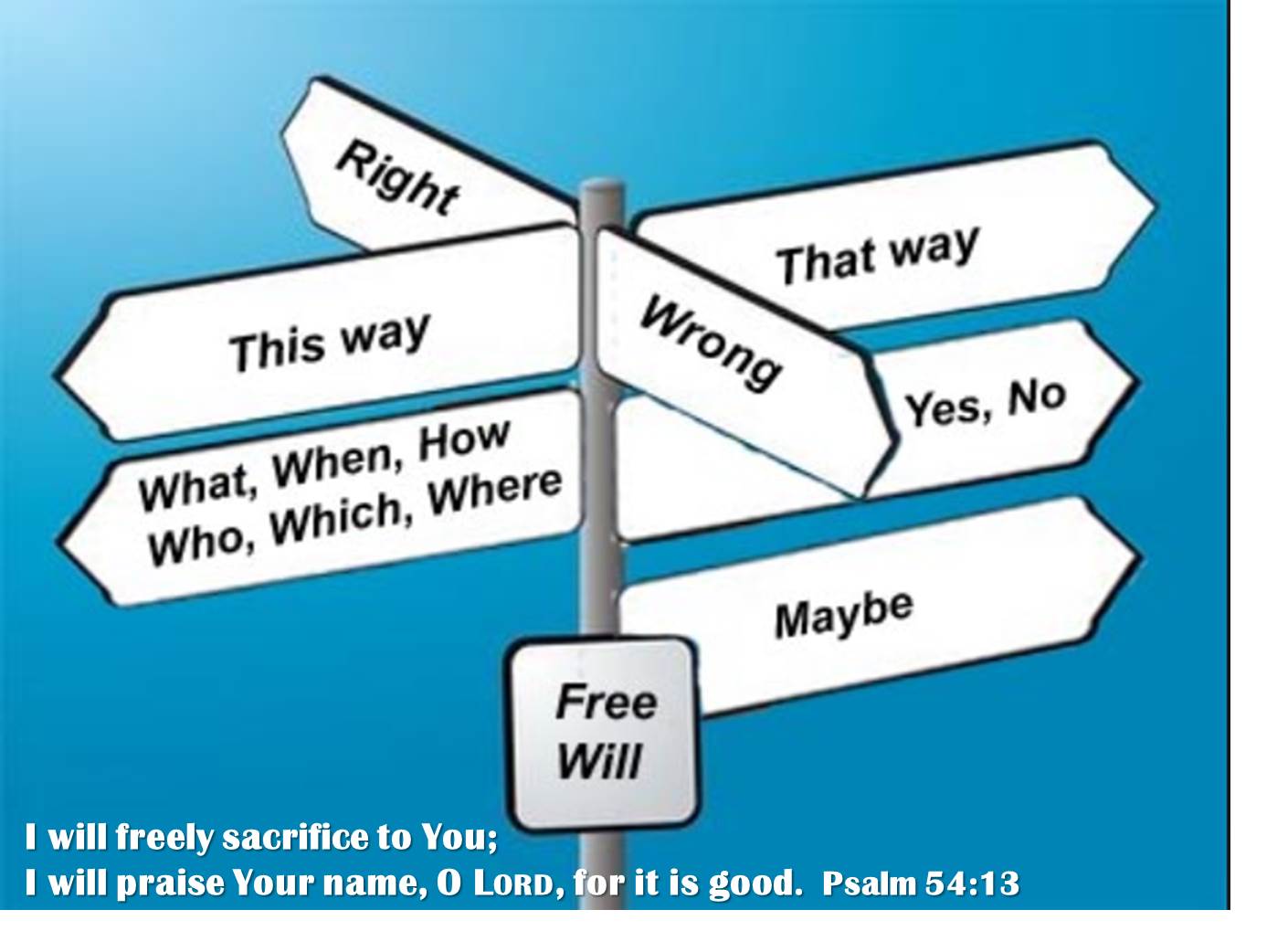
God not only created us with a will as part of our souls; He created us with a free will to make our own life choices.  Because God is all-knowing, He knew that many of His children would make bad decisions in their lives and damage or destroy their lives.  We see people every day making bad choices that cause them physical and emotional pain either for themselves or others, falling into addictions, committing crimes against others or treating others unfairly.  So why did God give us free will, and “what would you have done if you were the Creator God”?

The Scriptures say that “God is love” and that He is the source of all love.  He created us in His image, to love Him and our fellow brothers and sisters.  Many people choose not to love God or follow His will, but rather they follow their own selfish will.  Because of their bad choices, they cause great pain and suffering to themselves and others.  So what if God had “programmed” our minds and hearts to love Him, so that we had no choice but to love Him.  Everyone would love Him unconditionally, but would God be pleased and rejoice over us?  If I were Him, I would be sad and depressed, knowing that my creation loved me, but they had no choice in the matter, so it wasn’t fulfilling and their love didn’t mean anything to me.

God is a God of relationships, and He created us to be in relationship with Him.  When we love and trust Him as our best friend, Lord and ruler of our lives, we have the greatest joy and fulfillment possible, and God smiles and rejoices over us because we have chosen the best path and because another one of His children loves Him of their own free will and has a personal relationship with Him.

More Than Salvation

Eye has not seen

There is a traditional song for Passover entitled Dayenu that means “it would have been enough”.  It begins this way:  “If He had brought us out from Egypt, and had not carried out judgments against them Dayenu, it would have sufficed us!  If He had carried out judgments against them, and not against their idols Dayenu, it would have sufficed us!”  The song goes on to recount all that YHVH did for the Israelites relative to their exodus from Egypt and their move toward the Promised Land.  Actually, all that YHVH did was needed to accomplish His purpose!

For many of us, salvation seems to be all that we need.  To be forgiven for our sins and to be restored to relationship with YHVH is monumental and is far more than we have any right to expect.  Even though it seems sufficient, Yeshua’s suffering and death provide us  much more.  YHVH has so much more that He wants to accomplish.

When we accept Yeshua as our Lord and Redeemer, we are freed from slavery to hasatan and become children of the Most High God.  We are clothed in the righteousness of Yeshua, a righteousness so holy and pure that none of us could attain it on our own.   This seems more than sufficient, but there is still more.

During His first coming, Yeshua demonstrated the gifts He came to bring us.  He healed multitudes of people from physical, mental, and emotional damage and He even restored life to some who had died.  Yeshua also delivered many people from bondage to demons.  What He provided then, He provides to this day.  This should certainly be sufficient, but the blessings continue.

Yeshua taught us by His example and His words how to be effective citizens of the Kingdom of Heaven.  He explained Abba’s values to us and told parables to make His lessons easier to comprehend. He fed the hungry with a small bit of food that was miraculously multiplied.  He met everyone’s needs and He wants to meet our every need also.  Surely this is sufficient, isn’t it?  Ah, but there is still more.

Not only has Yeshua provided all these things for us, but He has empowered us to share the gifts with others.  Yeshua temporarily relinquished all His power as the second Person of the Triune God and was empowered solely by the power of the Holy Spirit in order to demonstrate to us how we could do the works He did and greater.  For many Christians this news is too good to be true, so many of YHVH’s gifts are denied and rejected and much of the work needed to build the Kingdom of YHVH is left undone.

A 2009 Barna survey reveals that the majority of Christians do not believe that Satan or the Holy Spirit are actual living entities.  Even though YHVH is spirit and we are to worship Him in spirit and in truth, many of us aren’t doing that because we deny the existence of a spiritual realm or are confused that there is a spiritual realm.  How much are these brothers and sisters in Yeshua missing because of blindness and/or stubbornness?

YHVH overflows with mercy, compassion, and generosity.  He knows that even though we have received our citizenship to the Kingdom of Heaven, we still reside in the Kingdom of Hell. YHVH provides for us not just a bright future, but a delightful present.  YHVH did not liberate the Israelite slaves in Egypt just to abandon them in the wilderness.  Instead, He worked with them to show them His ways and to prepare them to live as His special people in the land He provided just for them.  Likewise, YHVH does not provide us escape from the kingdom of darkness without equipping us to be effective citizens in the kingdom of light.

YHVH provided protection and sustenance (manna, quail and water) for the Israelites.  As long as they obeyed and trusted Him, they were not sick and even their clothing did not wear out over a 40-year period.  YHVH gave the Israelites His commandments and teachings, so that they could live in harmony and prosperity and all would be treated fairly.  He wanted them to be a light to all the other nations.  YHVH taught them how to worship Him.  The feasts He provided were meant to commemorate what they had experienced as well as to prepare them to recognize and receive their Messiah, who was coming to bring them even greater gifts than they had already received.  We read in the book of Exodus how the Israelites wanted to pick and choose among the gifts offered, and even rejected the gifts sometimes.  Many times they not only refused to live in the light, but were unable or unwilling to share that light with others.

We often shake our heads at their blindness and stubbornness, yet we fail to first remove the plank from our own eyes.  Yeshua has offered us forgiveness, salvation, His righteousness, eternal life, health, protection, teaching through Scripture, His example and the Holy Spirit, deliverance from bondage to demons, and empowerment to do the same works He did.  We fail to recognize that every single thing that Yeshua provides for us is absolutely essential to us for both our well-being and the building of YHVH’s kingdom.  Yeshua not only shares what He has with us, but He sacrificed Himself so that we might have all that He offers.  Will we continue to insult Him by devaluing some of His gifts?  Yeshua humbled Himself in every way to obtain for us what we could never get for ourselves.  Are we too proud and foolish to admit that we need what He offers?  It is not sufficient (dayenu) that we pick and choose only what appeals to us.

What would You do if You were God (Part 1)?

Judgment and mercyOh, how great are God’s riches and wisdom and knowledge! How impossible it is for us to understand His decisions and His ways!” Romans 11:33 [NLT]

One of the most common questions I hear from people (both believers and non-believers), is “why is God so angry, or so harsh when He judges or punishes His children”?  Of course, as an inquisitive believer myself, I have asked similar questions over the years. I certainly do not claim to be an expert on answering these questions, but through our times of Scripture study, seeking the Holy Spirit’s guidance, we have been able to discern some insights from Yehovah that we thought might be helpful to others.

First, I want to dispel the false notion that Yehovah Elohim (the Creator God of the universe) is an angry God by nature.  From years of spiritual conversations with people, I believe this comes from ignorance (or misunderstanding) of the “Old Testament” [Tanach].  The way we hear Scriptural teachings tends to be from preachers, and from polls of Christians, it is quite evident that for the majority of believers, 95% of what they know about the Bible is what they hear from the pastors/teachers in their congregations.  Unfortunately, when we hear excerpts of God’s word, taken out of the full context surrounding the Biblical account, it can be very misleading to our understanding.

For instance, consider the Biblical Flood story and how all the people on the Earth (except for Noah and his family) were destroyed by the vengeance of God.  Even “innocent” women and children were drowned by the floodwaters.  Remembering that “all have sinned and come short of the glory of God” (Romans 3:23) and “as in Adam all die” (1 Corinthians 15:22), we know that because of Adam’s sin all people will ultimately die.  At the time of Noah, though, we know from Scripture that people throughout the Earth were disobedient to God and living sinful lives: “…the LORD saw that the wickedness of people was great on the Earth, and that every intent of the thoughts of their hearts was only evil continually” (Genesis 6:5).

So, what was God’s response to His rebellious children – did He condemn them and bring immediate judgment on them?  Often we hear that Yehovah was an angry, vindictive God in the “Old Testament” whereas He became a God of infinite mercy and grace in the “New Testament”.  But we know that God never changes (Hebrews 13:8), and is the same yesterday, today, and forever, so something does not add up here.  Getting back to the story, God decides that He will destroy every living creature He has created.  But then Yehovah notices that there is one person (Noah) who has remained faithful to Him and “…Noah found grace in the eyes of the Lord [Yehovah]”. (Gen 6:33)  Yehovah then tells Noah to build an ark and promises to preserve his family (and enough creatures to re-populate the Earth) even though He plans to destroy all other life (Gen 6:14-22).  So was Yehovah unjust to all the other people on the Earth?  No, because in 2 Peter 2:5 we read that: “Noah warned the world of God’s righteous judgment”.  Noah warned people to repent because he recognized that God was being merciful to them and giving them another opportunity to turn from their wicked ways.  If Noah had ignored YHVH, then YHVH would have had to start from scratch.  On the other hand, if some of the people had listened to Noah, then there would have been more than eight people delivered on the ark.

We see another clear example of Yehovah’s grace in the midst of His judgment in the story of Sodom & Gomorrah.  I will not go into the details of the story here, but this was another case where almost every person in those cities were wicked and sinful.  But for His friend Abraham’s sake, God would have relented from destroying them if at least 10 righteous people could be found there (Gen 18:20-33).  Since Lot and his family (even including the two angel visitors) still equaled less than 10, God delivered their family out of the judgment but still destroyed the cities.  Once again, because God is a righteous God, He cannot allow sin and evil to continue unchecked throughout His people.

Yehovah is a righteous and just God, and He cannot tolerate continual sin and evil because that would violate His spiritual laws and destroy everything that He has created.  This universe is founded on His truth and goodness (righteousness), and anyone who violates those founding principles is an enemy of God and must eventually be destroyed or brought into alignment with His righteous justice.  We find that it is very inspiring to meditate on the goodness and righteousness of Yehovah, and that when we follow His spiritual laws of truth and justice we have joy and peace in our lives beyond measure.  This is the first in a series of posts where I would like to explore Yehovah’s character, and how He interacts with His creation from the perspective of the people He has created to have dominion over the Earth.

My essential question to you is a hypothetical one: if you were God – Creator, Master and Lord of the universe, how would you handle things differently?  What would you do with your people if they disobeyed the instructions you had given them to help them live a peaceful, joy-filled life on this Earth?  If they rebelled against your spiritual laws, cursed you, and killed or committed evil acts against your children, would you simply slap their hands and tell them to try harder next time?  [Remember that this is what our loving God had already done many times over when He sent His prophets and told them He would forgive them if they would repent – He has unconditional love for His children].