Tag Archives: atonement

Who Is Yeshua?

Yeshua is everything to us:  our salvation, our hope, our future, to name a few. It is important to get to know Him as well as possible.  We can do this by interacting with Him and also by reading the Bible.  It is the word of Yehovah and Yeshua is the living Word of Yehovah.  This series, entitled “Who Is Yeshua?” will consist of twenty-one articles. Each article will explore a different section of the Bible to discover different titles and roles of Yeshua and our response to each role. In the third article in the series, Yeshua is our Atonement.

In Leviticus 16, we discover the foreshadowing of Yeshua as our Atoning Sacrifice, our High Priest, our Scapegoat and our Covenant.  Yeshua, the perfect Lamb, was sacrificed in our place, to make atonement for our sins.  Then Aaron will come out to purify the altar that stands before the Lord. He will do this by taking some of the blood from the bull and the goat and putting it on each of the horns of the altar.Then he must sprinkle the blood with his finger seven times over the altar. In this way, he will cleanse it from Israel’s defilement and make it holy (Lev 16:18-19). This offering was to be made once each year on the 10th day of the appointed month early in autumn, the day known as Yom Kippur (day of covering) or, more accurately, Yom haKippurim (day of the coverings).  Unlike a bull and goat that had to be sacrificed each year, Yeshua was sacrificed one time to make perpetual atonement for our sins, transgressions and iniquities.

Yeshua is also our High Priest, for He offered Himself as our atoning sacrifice. No one can take my life from me. I sacrifice it voluntarily. For I have the authority to lay it down when I want to and also to take it up again. For this is what my Father has commanded.” (John 10 :18)

Yeshua is our Scapegoat.  When Aaron has finished purifying the Most Holy Place and the Tabernacle and the altar, he must present the live goat. He will lay both of his hands on the goat’s head and confess over it all the wickedness, rebellion, and sins of the people of Israel. In this way, he will transfer the people’s sins to the head of the goat. Then a man specially chosen for the task will drive the goat into the wilderness.  As the goat goes into the wilderness, it will carry all the people’s sins upon itself into a desolate land (Lev 16:20-22). Yeshua carries our sin far away so that it no longer has the power to defile. 

Yeshua’s sacrifice reconciles us to His Father.  In order to properly relate to Yehovah, we must understand the idea of covenant, because Yehovah desires a covenant relationship with us.  There are many instances of covenants in the Old Testament: in Genesis, Yehovah’s covenants with Noah (Gen 8-9), with Abraham (Gen 9-17), with Moses (Deut 28 and Ex 31) and with David (2 Sam 7).  Each of these covenants was a step toward progressing Yehovah’s plan for establishing His Kingdom on earth as it is in Heaven.  Our covenant with our Father has the same goal.

Covenants were common in ancient times and were taken very seriously.  Generally, when a covenant was made, the parties would each pledge their promises.  Then one or more animals were cut in two and placed across from each other to make a path.  Those entering into covenant would walk that path as a pledge that they would not break the covenant or they too would be cut in half. Covenants involved blood and the curse of death for the one breaking the covenant.

In ancient times, covenants were used to define social and political relationships.  Often, the covenant was between a greater king and a lesser king.  The greater king offered care and protection from enemies while the lesser king offered loyalty and obedience. The greater king then “adopted” the lesser king and his household into the greater king’s family.  Covenants involved ongoing relationship and partnering with the other party to achieve a desired common goal.  In our case, Yehovah promises to care and provide for us and protect us from our enemies.  We promise our loyalty and obedience to Him.  We partner together to establish His Kingdom on earth.  When we repent of our sins and turn our lives over to Yeshua, it means that we are to trust and obey Him.  We remain loyal and obedient to Yehovah.

An important part of covenant-making included eating a meal together featuring the sacrificed animal or animals.  In our case, we partake of what we call communion or kiddush to commemorate our covenant relationship with Yehovah. As they were eating, Jesus took some bread and blessed it. Then he broke it in pieces and gave it to the disciples, saying, “Take this and eat it, for this is my body.” And he took a cup of wine and gave thanks to God for it. He gave it to them and said, “Each of you drink from it, for this is my blood, which confirms the covenant between God and his people. It is poured out as a sacrifice to forgive the sins of many (Matt 26:26-28)  

This is an excellent time to ask forgiveness for your sins and invite Yeshua (Jesus) to be Lord of your life.  When we commit sin, we incur a debt that none of us can ever pay on our own.  It cannot be paid with earthly currency or even with great sacrifice on our part.  This debt can only be paid for by the blood of Yeshua which has already been shed for us. This is the greatest gift to ever be offered.  Don’t miss out.  After you have accepted Yeshua as your Lord and Savior, ask for baptism in the Holy Spirit.  The Holy Spirit will be your constant companion and Counselor and will equip you for Kingdom living. 

Who Is Yeshua?

Yeshua is everything to us:  our salvation, our hope, our future, to name a few. It is important to get to know Him as well as possible.  We can do this by interacting with Him and also by reading the Bible.  It is the word of Yehovah and Yeshua is the living Word of Yehovah.  This series, entitled “Who Is Yeshua?” will consist of twenty-one articles. Each article will explore a different section of the Bible to discover different titles and roles of Yeshua and our response to each role. In the second article in the series, Yeshua is the perfect Lamb.

 In Exodus, we learn about the Passover Lamb. 

Now the Lord said to Moses and Aaron in the land of Egypt,“This month shall be the beginning of months for you; it is to be the first month of the year for you. Speak to all the congregation of Israel, saying, ‘On the tenth of this month they are, each one, to take a lamb for themselves, according to the fathers’ households, a lamb for each household. Now if the household is too small for a lamb, then he and his neighbor nearest to his house are to take one according to the number of persons in them; in proportion to what each one should eat, you are to divide the lamb.Your lamb shall be an unblemished male a year old; you may take it from the sheep or from the goats.  You shall keep it until the fourteenth day of the same month, then the whole assembly of the congregation of Israel is to slaughter it at twilight. Moreover, they shall take some of the blood and put it on the two doorposts and on the lintel of the houses in which they eat it. They shall eat the flesh that same night, roasted with fire, and they shall eat it with unleavened bread and bitter herbs. Do not eat any of it raw or boiled at all with water, but rather roasted with fire, both its head and its legs along with its entrails. And you shall not leave any of it over until morning, but whatever is left of it until morning, you shall completely burn with fire (Ex 12:1-10).

Many of us, at one time or another in our lives, think that we can improve ourselves if we try hard enough.  That may be true to some extent, but the kind of improvement that is most essential to us is not attainable by our efforts.  No matter how well we clean up our act, we still owe an enormous debt, one that we cannot repay on our own.  If all humanity could come into agreement and try to pay the debt collectively for all of us, it would still be impossible.  The kind of debt we owe cannot be paid back with money or good deeds. Indeed, under the law almost everything is purified with blood, and without the shedding of blood there is no forgiveness of sins (Heb 9:22).  It takes the blood of an innocent person willing to sacrifice himself for us.  None of us fits the bill of “innocent person” no matter how good we think we are.  “…for all have sinned and fall short of the glory of God” (Rom 3:23).

It is the blood of the lamb that saved the first born in Egypt from death.  It is the blood of our Passover Lamb that saves us from the second death.  The life is in the blood. For the life of the flesh is in the blood, and I have given it for you on the altar to make atonement for your souls, for it is the blood that makes atonement by the life (Lev 17:11).

How do we know for sure that the Passover Lamb in Exodus is a representative of Yeshua?  There are many other Scriptures that explain this to us.  For example, in 1 Corinthians 5:7, we read, “Get rid of the old hametz [leaven], so that you can be a new batch of dough, because in reality you are unleavened. For our Pesach [Passover] lamb, the Messiah, has been sacrificed.

In John 1:29, John the Baptist identifies Yeshua as the Lamb of God.  The next day, Yochanan saw Yeshua coming toward him and said, “Look! God’s lamb! The one who is taking away the sin of the world!  There are many other passages that identify Yeshua as the ultimate Passover Lamb, such as Isaiah 53:7; 1 Pet 1:19, Matt 26:2, and Matt. 26:26.

According to the instructions given in Exodus, the lamb was to be selected from the flock on the 10th day of the first month, Aviv.  The lamb was to be taken into the household much as a family pet becomes part of the household today.  The lamb was being inspected to make sure there were no flaws or imperfections, but the lamb was now a dear part of the family.  This is a foreshadowing of Yeshua being born among and living with His chosen people.  Many embraced Him and loved Him, especially during His ministry. 

When He took upon Himself the sins of the world, He opened Himself up to the rejection and condemnation of His people. They put Him to death as one reviled. He was despised and rejected by men; a man of sorrows, and acquainted with grief; and as one from whom men hide their faces he was despised, and we esteemed him not (Is 53:3). They did not realize that He was dying in their place, just as the Passover lamb died in their place each year, so that they would be covered. Only this time, they would be more than covered for a year; their sin debt would be permanently removed. Surely, he took up our pain and bore our suffering, yet we considered him punished by God, stricken by him, and afflicted. But he was pierced for our transgressions, he was crushed for our iniquities; the punishment that brought us peace was on him (Is 53:4-5) and by his wounds we are healed.

Furthermore, the yearly Passover lamb was put to death and remained dead.  Our true Passover Lamb, Yeshua, was raised from the dead after three days and three nights in the grave!  The Author of life took on a new life, a new body, so that we could do the same! Jesus said to her, “I am the resurrection and the life. Whoever believes in me, though he die, yet shall he live (John 11:25). Not only are our sins forgiven, but our debt is paid and we are given new life, eternal life.  We no longer have to fear when our mortal bodies die, for we will have new bodies that will live forever and have no defects, no blemishes.  Yeshua not only pays a debt we could never pay and removes our condemnation, but He gives us immortality and glory!  A new life forever with Him!  We can now take on immortality because we wear His robe of righteousness. If the Spirit of him who raised Jesus from the dead dwells in you, he who raised Christ Jesus from the dead will also give life to your mortal bodies through his Spirit who dwells in you.  (Rom 8:11)

This is an excellent time to ask forgiveness for your sins and invite Yeshua (Jesus) to be Lord of your life.  When we commit sin, we incur a debt that none of us can ever pay on our own.  It cannot be paid with earthly currency or even with great sacrifice on our part.  This debt can only be paid for by the blood of Yeshua which has already been shed for us. This is the greatest gift to ever be offered.  Don’t miss out.  After you have accepted Yeshua as your Lord and Savior, ask for baptism in the Holy Spirit.  The Holy Spirit will be your constant companion and Counselor and will equip you for Kingdom living. 

Reflective Offerings

living-tabenacles

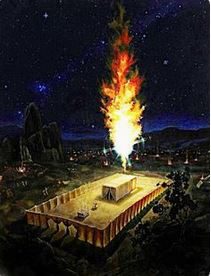
This is the tenth article of our Living Tabernacles series, where we study the Tabernacle in depth. It is exciting to see how each element symbolizes some characteristic of Yeshua.  It is also challenging when we examine what each element means for us, since each of us is now a living tabernacle of YHVH [Yehovah].  We are posting two articles each month as part of this series. YHVH is building His kingdom on earth as it is in heaven.  A king reigns from his throne and also pronounces judgment from there. 

Our previous article discussed the altar of incense.  Closely connected with that altar is the altar of burnt offering, also called the brazen altar. This altar was reserved for sacrifices and was overlaid with bronze instead of gold.  Bronze is symbolic of judgment.  Without the temporary sacrifice of the burnt offerings and the permanent sacrifice of Yeshua, human prayers (symbolized by incense) would not be acceptable to YHVH.

Using acacia wood, construct a square altar 7 feet wide, 7 feet long, and 4 feet high. Make horns for each of its four corners so that the horns and altar are all one piece. Overlay the altar with bronze. Make ash buckets, shovels, basins, meat forks, and firepans, all of bronze. Make a bronze grating for it, and attach four bronze rings at its four corners. Install the grating halfway down the side of the altar, under the ledge. For carrying the altar, make poles from acacia wood, and overlay them with bronze. Insert the poles through the rings on the two sides of the altar. The altar must be hollow, made from planks. Build it just as you were shown on the mountain (Ex 27:1-8).

The Hebrew word for altar is mizbeach (Strong’s Concordance Hebrew 4196). In Arabic, it means “place of slaughter”.  The bronze altar was placed in the courtyard of the tabernacle and was used for burning sacrifices.  There were several different types of sacrifices made on this altar which are listed below with a brief explanation of each[1].

Burnt Offering:  Sometimes called the whole burnt offering because the whole animal (except for its hide which was given to the priest) was consumed in the fire on the altar.  The Hebrew word is olah (meaning “ascending”).  This entire sacrifice was for YHVH alone and had to be made before other sacrifices would be accepted by YHVH. Burnt offerings dealt with the sinful nature of people and were offered twice daily (morning and evening) with additional offerings to be made on Sabbaths, new moons and feast days and other special occasions.  Burnt offerings were offered before other offerings could be made.

Grain Offering:  Flour and oil were offered to express gratitude to YHVH.  A small portion was burned on the altar and the rest was reserved for the priests.  A drink offering (wine) was poured out on top as a symbol of joy.

Peace Offering:  This offering was optional and ended in a meal that could be shared by the priests and the individuals offering it.  The sacrifices needed to be eaten within two days.  There were three main reasons for peace offerings:

  • Thanksgiving offering for a specific blessing from YHVH (Lev. 7:12-13)
  • Wave offering where the priest’s portion was waved before YHVH (Lev. 7:30-31)
  • Votive offering for a vow or a simple voluntary act of worship (Lev. 7:16-17)

Sin (or purification) Offering for unintentional sin (Lev 4:2-3) in order to cleanse the Tabernacle from human defilement.

Guilt (reparation) Offering:  A ram was offered after confession of the sin.  If YHVH’s sacred property was unintentionally damaged, reparation was to be made (plus an additional twenty percent) (Lev 5:16)

What can we learn from the offerings made in the Tabernacle?  How do they relate to Yeshua and to us?

  • Sin always results in death even if it is unintentional. Atonement is always necessary.  Yeshua is our Atonement.  Only through Yeshua can we approach YHVH and have a relationship with Him.
  • While some of the offerings were to atone for sin, others were voluntary gifts meant to bless YHVH, just as He blesses us abundantly.
  • The animals to be offered were young (usually one year old) and without blemish, thus representing Yeshua who was sacrificed in His prime and who was sinless. We are always to come to YHVH in Yeshua’s name and covered by His blood.
  • The best or the choicest of the herds or other offerings were to be used, for YHVH has offered to us nothing less than His own Son, Yeshua.
  • Burnt offerings were an abomination if the people did not forsake their sins (Is 1:11-15). We can ask for forgiveness and plead the blood of Yeshua over ourselves, but true repentance (teshuva meaning a complete turnaround) only is acceptable to YHVH.
  • Hosea 6:6 states “For I delight in loyalty rather than sacrifice. And in the knowledge of God rather than burnt offerings.”  Our primary goal must be always to deepen our relationship with YHVH (Mic 6:6-8).
  •  Burnt offerings were not just for the Israelites, but for all humans. Burnt offerings started long before the time of Moses.  For example, upon exiting from the Ark, Noah offered burnt offerings to YHVH, using some of the clean animals he had taken with him (Gen 8:20).  The basis of YHVH’s covenant with Noah was not because of Noah’s goodness, but rather his sacrifice.
  • Abraham was commanded to offer Isaac as a whole burnt offering (Gen 22:2 NLT).  Abraham was willing to sacrifice his long-awaited only son if YHVH requested it even though Abraham had been promised many descendants through Isaac.   Man had sinned and only through the sacrificial death of a righteous man could mankind be saved.  YHVH did not allow Abraham to go through with the sacrifice of Isaac, but provided His own Son to be the sacrifice.

In Hebrews 10:12 Paul states, “But our High Priest offered himself to God as a single sacrifice for sins, good for all time. Then he sat down in the place of honor at God’s right hand”.  Since the Temple was destroyed in 70 AD the sacrificial system has been suspended.  However, several passages of Scripture indicate that sacrifices will be resumed during Yeshua’s millennial reign (Is 56:6-8, Zech 14:16, Jer 33:15-18, Mal 3:3-4).  Why?  There are numerous proposed explanations and much speculation.  We know that YHVH will dwell with us during this time. Shout and be glad, Daughter Zion. For I am coming, and I will live among you,” declares the Lord  “Many nations will be joined with the Lord in that day and will become my people.  I will live among you and you will know that the Lord Almighty has sent me to you (Zech 2:10-13). We also know that YHVH’s throne is surrounded by fire (Dan 7:9) and that not even the slightest impurity can be in His presence.  The millennial kingdom will be a time of refinement and perfection until we are ready for the new heaven and new earth.  At that time speculation will die away as the mystery of the renewed sacrifices unfolds.  We will then more fully understand how the sacrificial offerings enable us to reflect YHVH’s glory back to Him.

[1] OFFERINGS IN LEVITICUS–WHAT THEY WERE AND WHY THEY MATTERED.  Wayne Stiles, https://www.waynestiles.com/offerings-in-leviticus-what-they-were-and-why-they-mattered/.

Life in the Rock

for they drank froim the Rock

In a previous blog (Tzur Chayeinu-Rock of Our Lives, March 12, 2016), we began a study of rocks and stones in Scripture.  We discovered that rocks can have either positive or negative connotations.  Stones and rocks had various uses in Scripture including memorials of visions or significant events and witnesses to covenants. The most important Rock in Scripture is Yeshua, who produced the most significant event in our history and is the Mediator and Guarantee of our most important covenant (Matt 26:28, Heb 7:22).

A comment in the New Revised King James Bible led me to explore the word tzur further.  I learned that not only is this word for rock or cliff a noun, but it can be a verb as well.  I did not have to search long before I uncovered a treasure trove of meaningful information and symbolism.  One cannot plunge anywhere in Scripture without encountering a bottomless depth.  My exploration produced a wealth of pictures or images of our Rock, Yeshua, and the numerous roles He has in our lives.  Each of these Scripture references uses the word tzur or a variation of it.

Yeshua (YHVH) is our Origin, the Rock from which we were cut (Is 51:1).  We see a clearer picture in Deuteronomy 32:18.  You neglected the Rock who had fathered you; you forgot the God who had given you birth.  YHVH not only created us, but He gives us a new birth in Yeshua.

Yeshua is our Defender.  A tzur is not only a mountain or a cliff, but it can contain caves or enclosures where we can hide.  One of the definitions associated with tzur is “to enclose or barricade” (Song of Songs 8:9; Ps 139:5).   David hid from the Philistines in or near a cave (1 Chron 11:15).  Although the cave and rock were physical structures that David used as a stronghold, David discovered that his only true stronghold is YHVH (Ps 18:2, 27:1, 5).  In Daniel 2:45, we see that the Rock that destroys the other nations is hewn from a mountain, but not with human hands, signifying Yeshua.  Our Rock trains us for battle (Ps. 144:1, 2 Sam 22:35).  Our Rock besieges our enemies and even us, when He needs to punish us or bring us back (Ex 23:22, Is 29:2).

Our Tzur is our Atonement (Ps. 62:6).  It is appalling how quickly we can forget Yeshuas sacrifice for us, yet we do, just as the Israelites forgot the Savior who rescued them from slavery to the Egyptians (Deut. 32:5).  Perhaps that is one reason for circumcision.  The instrument to be used was a sharp (surim) knife (flint) (Joshua 5:2-3).  The males were to be cut in a vulnerable area of their bodies, causing them much pain, just as Yeshua made Himself vulnerable to severe pain at His crucifixion.

Yeshua, our Rock, is our Righteousness.  Everything He does is perfect and everything He does is just and fair (Deut 32:4).  In Judges 6:21, we have a picture both of YHVH accepting sacrifices offered to Him as well as the perfect sacrifice of Yeshua (the meat and the unleavened bread).  YHVH is perfect holiness and righteousness (1 Sam 2:2).

Finally, our Rock, Yeshua, is our Eternal Life.  My favorite Scripture in this study is the picture presented in Exodus 17:6.  I will stand before you on the rock at Mount Sinai. Strike the rock, and water will come gushing out. Then the people will be able to drink.” So Moses struck the rock as he was told, and water gushed out as the elders looked on.  Yeshua, our Rock, was struck on our behalf and out of Him flow rivers of living water.  Yeshua Himself provides eternal life and is Life (John 11:25). With joy you will draw water from the wells of salvation (yeshua) (Is 12:3).  Yeshua invites us to come to Him to drink (John 7:37).

Although I have always been attracted to mountains and cliffs, I will now look at them with a new appreciation as I reflect on our most important and awesome Rock.  This article barely skims the surface. I encourage you to search for yourself in the treasure trove of Scripture perhaps beginning with Strong’s Exhaustive Concordance Hebrew 6696 and 6697.  You will be greatly rewarded for your efforts.