Tag Archives: heavenly hosts

Behind the Scenes

praise-to-yhvh-my-rockIn our book, What’s Missing, we discussed how the story of the Israelites in Exodus is symbolic of the redemption that Yeshua, the true Passover Lamb, brings to all of us.  The story of YHVH actively intervening on behalf of the Israelites to set them free from slavery to the Egyptians and leading them out of Egypt in a miraculous way is an account of real events.  However, these events are a type or shadow of an even greater story of YHVH working on behalf of all humanity to free us from our spiritual enemies.   A phrase or even a single word in Exodus paints a graphic picture of the ongoing battle between YHVH and His adversary.  We must keep in mind that behind the scenes of our daily dramas, YHVH is carrying out His plan to establish His kingdom on earth while His adversary is trying to do the same.  It is the greatest drama of all.

After the tenth and final plague, we find that the Israelites left Rameses, which means “born of Ra”.    Who is Ra?  Ra was the primary name for the sun god in Egypt.  We get a clear picture that those who partake of the Passover Lamb are leaving the kingdom of darkness (ruled by the sun god) and going to Succoth (ruled by the one true God, YHVH).  Succoth is derived from the Hebrew word sakah and carries several different meanings.  Let us examine these meanings to see how our “behind the scenes” picture develops.

One of the meanings of sakah is “covering” as used in 1 Kings 8:7.  Just as the cherubim provided a covering for the ark of the covenant,  YHVH provides a covering for His sheep.  In Ezekiel 28:13, we see the description of YHVH’s archenemy before his rebellion.  He was covered (derived from sakah) in precious gems just as we are covered with Yeshua’s robes of righteousness.  In 2 Kings 16:18, the word is used for the Shabbat canopy.  YHVH stands beside us and is our protective covering (Ps. 121:5 NLT).  Isaiah 1:8 uses the word sukka as a watchman’s hut.  In 2 Samuel 11:11 the same word is used to denote a protective booth for soldiers.  Leviticus 23:41-42 and Deuteronomy 16:13 require all Israelites to construct temporary shelters (sukkot) for themselves for a week each year to commemorate YHVH dwelling among them.

All those who have left the kingdom of darkness for YHVH’s kingdom of light are protected by YHVH Himself.  However, all of us are also called to be soldiers in YHVH’s campaign to establish His kingdom on earth as it is in heaven.   YHVH is fully capable of eradicating His enemies and establishing His kingdom by Himself.  However, He purposely gave dominion of the earth to humans and expects each of  us to participate in the great spiritual battle for the earth.  We are not left to fight the battle alone for YHVH Himself is our leader and protector.  It is imperative for us to get off the spiritual milk and onto meat (1 Cor 3:2) as soon as we are able so that we can fully participate in the role that YHVH has assigned for each of us.

The word selected in Exodus 12:41, 51 (tsaba) refers to the Israelites and those who joined them in the flight from Egypt as armies or hosts.  In most other places the people are referred to as Israelites or the children of Israel (b’nei yisrael). In Exodus, 13:17-18, the picture becomes crystal clear.  YHVH takes the Israelites on a detour because they are not yet ready to do battle with their Egyptian enemies.  However, YHVH still has them leave Egypt “like an army ready for battle”.  A short time later they would have the opportunity to do battle for the land promised to them.  They were still not ready and thus the nation of Israel spent 40 years wandering in the desert.  The battle must and will be fought at some point.

The children of Israel would have to fight their enemies in order to take over the land that YHVH promised them.  The children of YHVH will have to fight our enemies to reclaim the earth for YHVH.  In both cases it is YHVH who will go ahead of us and be our covering.  What role are you called to play in this great drama?

Speaking God’s Awesome Name

LORD of Hosts“And Moses built an altar, and called the name of it the LORD my Banner [Yehovah Nissi]” Exodus 17:15

In my previous postings on God’s Name, Yehovah, I spoke about the importance of knowing and speaking God’s holy Name. We learn from the Scriptures that His Name is holy, righteous, mighty, beautiful, glorious, exalted, a high tower, the Word of God. As far as the LORD being a helper for us in our everyday lives having to live “in the world” but not being “of the world”, here are some of the titles and roles that our God [Yehovah Elohim] fulfills: The LORD my rock (tzuri) and my redeemer (goali), my banner/miracle (nissi), my provider (yireh), our shield (mageinu), our refuge (mach’seh), our righteousness (Yehovah Tsid’keinu), The LORD of peace (Yehovah Shalom), the LORD our presence – or “He is there” (Yehovah Shammah), the One who heals (Yehovah Rapha), and the LORD of hosts/armies (Yehovah Tzeva’ot).

This final name, Yehovah Tzeva’ot, is one of the most powerful – it literally means LORD of armies or LORD of hosts.  In Isaiah, we see how this Name is associated with the Messiah in several different passages – here are a couple of examples:

  • Isaiah 44:6 – “Thus says the LORD, the King of Israel and his Redeemer, the LORD of hosts [Yehovah Tzeva’ot]: ‘I am the first and I am the last; besides me there is no god’.
  • Isaiah 47:4 – “Our Redeemer—the LORD of hosts [Yehovah Tzeva’ot] is his name—is the Holy One of Israel.”

From other passages in Isaiah, we know that “The Holy One or Mighty One of Israel” is always used to refer to the Messiah. Putting these references together, it is clear that Yeshua HaMashiach is called the LORD of Hosts as He is the person of the Godhead who directs God’s armies (both heavenly and earthly armies). One other clear passage that identifies Yeshua as Yehovah Tzeva’ot is in Zechariah 14:16: “Then it will come about that any who are left of all the nations that went against Jerusalem will go up from year to year to worship the King, the LORD of hosts and to celebrate the Feast of Booths”. We have learned from these and other Scriptures (through the Holy Spirit’s inspiration) that when we are cleansing our household of evil spirits (demons), it is very effective to use this divine name of Yeshua, as He is the LORD of Hosts.

There is truly “power in the Name” as believers often quote, but what name is that? We know from Yeshua’s own words to us that we can pray to the Father in His name and whatever we ask will be done (paraphrased from John 16:23). Yeshua also says in John 17:11 (in his prayer to Abba Father): “Holy Father, you have given me Your name; now protect them by the power of Your name so that they will be one just as We are One. During My time here, I protected them by the power of the name You gave me”. Then later in His prayer He says: “I have declared to them Your name, and will declare it, that the love with which You loved Me may be in them, and I in them” (John 17:26). So we see from this that Yeshua’s name is holy and powerful, but He is also named with the same name as all persons in the triune Godhead, Yehovah.

So when you are praying, remember that the name and titles of our God, Father, Son & Holy Spirit, are powerful, not only for salvation, but for protection and deliverance from our enemies (physical and spiritual), for healing, for victory in life’s battles, and for our times of praise and worship when we are seeking His face, His guidance, and His voice speaking into our lives. Try out these names and see how Yehovah answers you.

The Mighty Power of YHVH

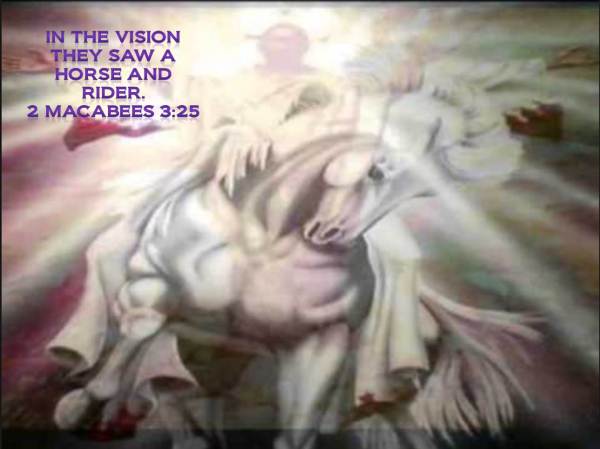
horse and riderTo celebrate Chanukah, we decided to read a portion of the story of the Maccabees each night.   The second book of Maccabees, chapter three has enlightened our understanding of the events leading up to the celebration of Chanukah. It has also provided us with insight and direction in dealing with issues that are currently challenging us.

Here is a brief summary of the chapter. There was a high priest named Onias who strictly obeyed the laws of YHVH. While Onias was high priest, Jerusalem enjoyed peace and prosperity, and received respect and generous gifts from the kings of many nations.

A man named Simon lost an argument with Onias and sought revenge by lying to Apollonius, governor of Greater Syria, and offering to him the money from the Temple treasury. Apollonius passed this misinformation on to the king, who sent a man named Heliodorus to confiscate the money. A portion of this money had been designated for the widows and orphans and a portion of it belonged to a wealthy man. To take the money would be to break YHVH’s laws concerning money deposited in the Temple treasury and would betray the trust of those who depended on the integrity of the ones in charge of the treasury. Heliodorus decided to confiscate the money anyway.

The priests and the people joined together in begging YHVH to protect the treasury money, praying on their faces before His altar. YHVH responded in a dramatic way. Heliodorus returned to the king without the money, but with a strong testimony concerning the power and faithfulness of YHVH.

This story speaks volumes to us as we seek funds to build a refuge for some widows in India. Just as the people of Jerusalem were on their faces before YHVH, the widows in our sister congregations spend much of each day on their faces, praying for the salvation of others. And yet, these women are considered curses in their society and are much oppressed.

We are in the process of raising funds for the construction of the widows’ home. As we began this process, the Holy Spirit led us to create a faith covenant with YHVH. Each day we remind YHVH of His promises towards the widows, orphans and the oppressed by reading aloud pertinent Scripture verses. Several weeks after we began our faith covenant, YHVH gave us His response to our covenant, which is Proverbs 15:25: “YHVH will tear down the house of the proud, but will establish the boundary of the widow.”

As developments unfold, we comprehend at new levels the depth of YHVH’s promise in this verse. Persecution against non-Hindus is on the rise in India. It is becoming more difficult to get the funds safely delivered to the congregational leaders. Local authorities who have been bent on persecuting our sister congregations are gaining more power. Our sister congregations, especially the leaders, are watched very carefully. We would be tempted to think that this cause is hopeless, but the Holy Spirit reminds us that this home for the widows is YHVH’s response to the cries of the congregants after the widows were thrown out of a temporary shelter and had their lives threatened.

Therefore, we believe that 2 Maccabees, chapter 3 illustrates for us our next step.   We are asking that those who support us in this effort storm heaven and remind YHVH of His promise in Proverbs 15:25. We believe He will hear our cries and respond in a powerful way if we stand on faith in this matter.

We have provided a copy of chapter 3 below for you to read and prayerfully consider. Note how many times YHVH miraculously intervenes to answer the cries of those who seek diligently to keep His laws.

II Maccabbees 3

When Onias[a] was High Priest in Jerusalem, the holy city enjoyed peace and prosperity, and its laws were strictly obeyed, because he was devout and hated evil. The kings of Syria and Egypt honored the Temple and presented it with expensive gifts, and King Seleucus, ruler of all Asia, even paid the costs of the Temple sacrifices from the revenues he collected.

But a man by the name of Simon, of the tribe of Bilgah, the chief administrative official of the Temple, lost an argument he had with Onias over the regulations governing the city market. At this time Apollonius son of Thraseus was the governor of Greater Syria. Simon went to him and said that there was so much money in the Temple treasury that it could not be counted, and since the money was not needed for sacrifices, it might as well be placed under the king’s control.

When Apollonius met with the king, he told him about the money, and the king ordered Heliodorus, his chief minister, to get it for him. Heliodorus set out at once on his mission, but he claimed that he was only making a tour of inspection of the cities of Greater Syria. After he had arrived in Jerusalem and had been warmly received by the High Priest, he explained the real reason for his visit and asked if what he had been told was true. 10-11 The High Priest then stated that Simon, that devil of a man, had not been elling the truth. There was indeed some money in the Temple treasury, but part of it was set aside for widows and orphans and part of it belonged to Hyrcanus son of Tobias, a very important man. He also pointed out that the total amount was only 30,000 pounds of silver and 15,000 pounds of gold. 12 He added that it was absolutely impossible that anyone should be permitted to take the money of those people who had placed their trust in the sanctity and safety of this world-famous Temple.

13 But Heliodorus insisted that the money should be taken for the royal treasury, as the king had ordered. 14 So he set a day and went into the Temple to supervise the counting of the money. This caused an uproar throughout the entire city. 15 Priests, wearing their priestly robes, threw themselves face downward before the altar and begged God to keep the money safe, since he had given the laws designed to protect the money that people deposited in the Temple. 16 It was heartbreaking to see the High Priest. His face turned pale, revealing the agony of his soul, 17 and his body was trembling with fear, reflecting the pain in his heart. 18 People ran from their houses to join together in prayer that the Temple might not be defiled. 19 Women, wearing nothing but skirts of sackcloth, crowded the streets. Young girls whose parents had never allowed them to be seen in public ran to the gates or to the walls of the city, or just stared out of their windows. 20 But wherever they went, they lifted their hands to God in prayer. 21 What a pitiful sight it was to see the High Priest in such great agony and frustration and to see everyone in the city confused and lying face down on the ground.

22 While everyone was begging the Lord Almighty to protect the money that had been entrusted to his care, 23 Heliodorus went on with his plan. 24 But at the very moment that he and his bodyguards arrived at the treasury, the Lord of all supernatural powers caused such a vision to appear that everyone who had dared to enter with Heliodorus was panic-stricken and weak with fear at this display of the Lord’s power. 25 In the vision they saw a horse and a rider. The horse had a richly decorated bridle, and its rider, dressed in gold armor, was frightening. Suddenly the horse rushed at Heliodorus, then reared up and struck at him with its hoofs. 26 Heliodorus also saw two unusually strong and handsome young men, wearing very fine clothes. They stood on either side of him and beat him unmercifully. 27 He immediately fell to the ground unconscious, and his men put him on a stretcher 28 and carried him out. Only a moment earlier this man had entered the treasury with a large group of men, including all his bodyguards, but now he was being carried away helpless. So they all openly acknowledged the mighty power of God.

29Heliodorus lay there unable to speak and without hope of recovery from this demonstration of God’s power. 30But the Jews praised Almighty God because he had miraculously protected his Temple and had brought great happiness where only minutes before there had been fear and confusion. 31 Some of Heliodorus’ friends quickly asked Onias the High Priest to pray that the Most High would spare the life of this man who was at the point of death. 32 So the High Priest offered a sacrifice in the hope that God would save Heliodorus, for he did not want the king to think that the Jews had done this to the man he had sent. 33 While Onias was offering the sacrifice, the two young men, wearing the same clothes as before, again appeared to Heliodorus and said,

Be grateful to the High Priest; the Lord has spared your life because of him. 34 Remember that it was the Lord of heaven who punished you. Now go and tell everyone of his great power.  When they had said this, they disappeared.

35 So Heliodorus offered a sacrifice to the Lord and made many promises, because the Lord had spared his life. Then he said good-bye to Onias and returned with his army to the king. 36 There he told everyone what the Lord, the most powerful of all gods, had done.

37 When the king asked Heliodorus who would be the best man to send on the next mission to Jerusalem, Heliodorus replied, 38If you have an enemy or know of someone plotting against your government, send him. He will come back badly beaten, if he comes back at all, for some strange power from God is at work there. 39The God of heaven watches over the Temple; he strikes down and destroys anyone who comes to harm it.

40 That is the story of how the Temple treasury was protected from Heliodorus.

The Stars Tell how YHVH will Weigh Us in the Balance Scales

Libra with verse from DanielLet God weigh me on honest scales and He will know that I am blameless. Job 31:6

In this passage, Job believed that he had been walking uprightly with YHVH, so he was not afraid to speak aloud to his friends in front of YHVH. He is essentially saying that he is willing to undergo YHVH’s righteous judgment if he has slipped up anywhere in the path of his life. Notice that Job refers to honest scales when he talks about YHVH testing him to see if he measures up to YHVH’s standard of righteousness.

Of course, having all the scriptures available to us now, we can look back and do some easy “Monday morning quarterbacking” relating to Job’s statement, knowing now as we do that no one can measure up to God’s standard of righteousness.  Romans 3:10 says: “As it is written [quoted from Psalm 14:1-3]: ’There is none righteous, no, not one’”, and then in Romans 3:23 Sha’ul (Paul) says “for all have sinned and fall short of the glory of God,”.  He then follows with the divine punch line after the comma in Romans 3:24 “being justified freely by His grace through the redemption that is in Messiah Yeshua”.  So, if I put on my 6-year-old Bible analysis hat, I could easily surmise that believers can be justified before God, but only through the blood of Yeshua our Redeemer.

The scriptures pertaining to YHVH’s judgment lead into the second major sign in the Zodiac: Libra, which means “weighing in the scales”, from the ancient Hebrew name for this sign, Mozanaim. We learned from previous postings on the “Gospel in the Stars” that the original Hebrew root word for Zodiac (Zodi) means “the way” or “path”. So, combining Job’s speech with this meaning, we can see that Job tried to the best of his human ability to follow Abba’s path, but like all of us, when he was weighed in the scales by YHVH, he fell far short of His righteous standard.

However, the Good News (Besorim in Hebrew) is that YHVH made a way for us to be saved in spite of our sins and weakness, and Messiah Yeshua provided the solution for all people for all times. I believe that Job hinted at knowing His Messiah (Yeshua), the true Savior of the world, when he said in Job 19:25: “For I know that my Redeemer lives, and that He shall stand at last on the earth.”

Digging down a bit deeper into the meaning of the ancient names of the stars in Libra, we see that a very consistent theme emerges. The key stars in Libra (from ancient Hebrew and Arabic) are: “the price which is deficient”; “the price which covers”; “the value of the redemption”; and “the price of the conflict”. From these names, it is easy to paint a picture that tells a beautiful Gospel story: human beings are hopelessly deficient in our fallen souls; we need a Redeemer to balance out the scales, which we cannot do on our own; YHVH has prepared a Redeemer for us from the foundation of the world; Yeshua our Messiah is that Redeemer, who paid the ultimate price and atoned for our sins (covered us with His blood); and now we can stand righteous before YHVH by calling on His name and trusting in Yeshua.  As seen in the image of Libra at the beginning of this posting, our scales are severely unbalanced – only Yeshua can balance them out for us.

As with all the signs of the Zodiac, there are three constellations associated with Libra: Crux (the Southern Cross); Victima (the Victim); and Corona (the Crown). It is not too difficult to see how these three fit perfectly into the rest of the story of Libra. Crux, which appears like the Hebrew letter Tav (which looked like an “X” in ancient Hebrew), graphically shows how the Messiah was to die and atone for our sins. Interestingly, the Southern Cross disappeared from the night sky in Jerusalem after Yeshua’s crucifixion and can only be seen in the Southern hemisphere now.

The second constellation in Libra, Victima, which is named Sura (Lamb) in Hebrew, points to Yeshua as the divine Victim who willingly chose to pay the ransom for our redemption. It vividly brings to light the scripture from Revelation 13:8: “…written in the Book of Life of the Lamb slain from the foundation of the world.” This scripture needs no further explanation!

The final constellation in Libra is Corona, named Atarah in Hebrew, which means “the Crown Bestowed”. Once again, this fits well into the overall picture of this sign, especially when we look at verses such as Hebrews 2:9: “But we see Yeshua — who for a little while was made lower than the angels — now crowned with glory and honor because He suffered death, so that by God’s grace He might taste death for all humanity.”

So now, armed with this knowledge, I challenge you to worship the One and only One who is worthy to balance out the scales in our favor, Yehovah our Redeemer, and Yeshua His Son, who paid the ultimate price so that we could be restored to Abba Father.

Their Voice has Gone out to All the Earth

Their voice has gone out (Rom 10 18)In my first posting on the “Gospel in the Stars”, I explained that God (YHVH) created everything in His kingdom for His own purposes (Prov 16:4), including the stars of the sky. The most tangible use of the stars in the natural world is for keeping track of God’s “appointed times” (Moedim). As I had mentioned before, the sun moves through all 12 of the Zodiac (Mazzerot in Hebrew) signs throughout the course of the year – one sign each month. So, if you were stranded on a tropical desert island for a year, where you had no noticeable change of meteorological seasons, you would still be able to keep track of the seasons of the year. Remember from my previous blog that when God speaks of His seasons in the scriptures, he does not mean the well-known seasons of Winter, Spring, Summer, and Fall, but rather He is referring to His appointed times (the seven annual Feasts of YHVH) outlined in Lev 23 and many other scriptures.

The real focus of this blog series, though, is to illustrate a more significant purpose that God had for creating and arranging the stars in the sky. Paul’s (Sha’ul’s) letter to the Romans quotes Ps 19:4 when it says “But I ask you, have they [the heathens] not heard? Indeed they have, for ‘Their voice has gone out to all the earth, and their words to the ends of the world’.” (Rom 10:18) The word their in his quotation refers to the stars from Ps 19. He quoted this verse as an irrefutable testimony that even the heathen of the nations outside Israel had seen and heard the witness of the stars, because their voice had gone out to all the earth!

So, let’s talk about some specific examples. Recall from my last posting that Yeshua (Jesus) represents the “strong man” in Ps 19:5 (“which is like a bridegroom coming out of his chamber, and rejoices like a strong man to run its race”). The association of the strong man with the bridegroom confirms that this verse is talking about the Messiah. I had introduced the strong man examples of El Gibbor (paganized to Hercules in later centuries) and Shur (Taurus in pagan astrological terminology) in my Sept 12 blog “Witness in the Stars”. I want to focus now on the Zodiac sign of Taurus or Shur (“the coming and ruling one” as translated from Hebrew), and specifically on the constellation of Orion.

Since Shur represents the coming and ruling one, there is an indisputable association to the Messiah (Yeshua), the judge and ruler of the whole earth. The three constellations in Shur (by their astrological names) are Orion, Eradinus, and Auriga. Orion (or Chesil in Hebrew) means the strong one or hero. Together with the ancient names of stars in Eradinus, this constellation literally means “the river of the Judge’s wrath breaking forth on His enemies”. This ties in with the verses in Dan 7:9-11 which talk about the final judgment at the throne of the “Ancient of Days” – verse 10 says “A river of fire was flowing, and coming out from before Him…the court sat in judgment, and the books were opened.” Auriga means shepherd (as in Isa 40:10-11), which represents Messiah Yeshua, the Good Shepherd who leads His redeemed to safety in the final “Day of Wrath”.

Now, focusing on Orion (Chesil), there are two separate but related meanings that come from these two names for the constellation. As I said above, Chesil means the Strong One; but Orion also comes from a Hebrew root meaning “coming forth as light”. So combining these concepts, we have an obvious and powerful reference to the Messiah as the Strong One and the Branch (from the star Betelgeuse, or Tzemach in Hebrew); the coming Prince (from another star in Orion); and the One who comes forth like light, swiftly crushing the enemy under His foot (from the star Rigel). These awesome testimonies of God’s “Gospel in the Stars” only increase our trust in YHVH as the One and only Creator, Redeemer and Master of the universe, who tells the end of the story from the beginning.

Witness in the Stars?

Constellations2

Have you ever wondered why God says in Scripture that He counts the stars and calls them all by name (Ps 147:4)? What does He mean by that? Why would He want to name them, and are the names significant to us? When Abba Father took Abraham out and showed him the stars, He said “look towards heaven, and TELL the stars, if you will be able to list them; and He said unto him, ‘So shall your seed be’” (Gen 15:5). The word that is translated TELL is actually the same word used for taking a census, and means to not only count the stars but to call each of them by their names! Could it be that God told His people the names of the stars and was actually telling a story to them through those names? Read Ps 19:1-4 and see how this passage tells about the witness given by the stars, which Paul quoted as an irrefutable testimony in Rom 10:18 (also see Ps 89:37: “…Even like the faithful witness in the sky.”).

God created everything for a purpose. He created the heavenly bodies to give light, to separate the day from the night and to be for signs and seasons, and for days and years (Gen 1:14). We know that the sun and moon separate the day from the night, and the sun’s daily cycle allows us to keep a count of the passing days. The moon was God’s original light to help us keep track of the months of the year. However, it is much more difficult to keep track of the seasons and years strictly based on observing the daily movements of the sun and the monthly cycles of the moon. Ancient astronomers knew how to use the movements of the sun and moon through the various constellations of the zodiac (called mazzerot in scripture) to keep track of the seasons and years.

The sun travels through all twelve of the constellations throughout the course of the year. At any one point in time, this would make it possible for our ancestors (without the benefit of modern scientific calendars) to track the progress of the year and to know the current “season”. The passage in Ps 19:5-6 describes the movement of the sun through the constellations of the mazzerot during the course of the year. However, when you meditate on this passage at a deeper spiritual level, you can see the allusion to Messiah (Ps 19:4 “In them He has set a tabernacle for the sun, which is like a bridegroom coming out of his chamber, and rejoices like a strong man to run His race.”). “Them” refers to the stars in this passage. Remember that Yeshua (Jesus) is the “Sun of righteousness” from Mal 4:2. Also, from the original Hebrew names of the stars, we know that Messiah is represented by the “strongman” in a number of the constellations (e.g. Orion, Hercules, Leo, etc.). One clear example of this strongman type pointing to Yeshua comes from the original Hebrew name of Hercules – El Gibbor, which means “The Mighty One”, a designation for both Abba and Messiah (Father and Son) in Isa 9:6.

Going back to the original Hebrew meaning behind Gen 1:14, we see that the “seasons” Elohim (God) wanted His people to keep track of were actually not the four seasons of the year we recognize, but rather His moedim (Hebrew for “God’s appointed times”) which correspond to His Feast days that occur at specific times of the year. These moedim (feasts) are associated with significant acts of Yeshua in both His first and second coming. Job 38:32 confirms the importance of the stars in keeping track of God’s seasons: “Can you direct the sequence of the seasons or guide the Bear with her cubs across the heavens?” (Hebrew meaning of the “Bear and her cubs” refers to Yeshua’s sheepfold as His flock).

One of the strongest confirmations that Elohim has given us the Gospel message in the stars can be seen within the constellation Taurus. The Hebrew name for Taurus (bull) is shur, which means “the One who comes to rule”. This “Bull” is definitely a picture of Messiah, who is coming to rule on the earth. The Pleiades, a cluster of stars, is close to the head of the Bull, and is seen “Riding on the neck of Taurus”. Pleiades is sometimes called the 7 Sisters, but its Hebrew name is kimah, which means “congregation of the judge or ruler”. This agrees with Jude 14-15, which says: “Behold the LORD comes with 10,000’s of His saints (righteous ones) to execute judgment on all and to convict all who are ungodly.” Thus, through these and the other constellations, we have a very strong testimony that Elohim put them there to teach all of His children His Gospel story (see Rom 10:18, Ps 19:4).