Tag Archives: judgment

Stand Fast to Your Convictions (Part 1)

stand firm“And they overcame him by the blood of the Lamb and by the word of their testimony, for they loved not their lives even unto death.” Revelation 12:11

Last week, Nancy and I were deeply convicted by a powerful teaching we heard at a local congregation. The pastor was focused on getting ourselves fit for the fire that is to come in the End Times (spoken of by Yeshua in Matthew 24).  Believers could interpret this fire that is coming in different ways, but in this context I am seeing it as persecution against the Body of Messiah. Sha’ul told us that we as the Body of Messiah are to “stand fast in one spirit, with one mind striving together for the faith of the gospel” (Phil 1:27).  We are also told to stand fast as individuals in our faith (I Cor 16:13).  This means that we are to hold to our convictions that there is one true God, Yehovah, and one clear standard of morality, which is the set of instructions YHVH has given us in His Torah.

The pastor went on to speak about the need to stand up for what we know is YHVH’s standard of morality in His Kingdom.  He said that as the moral fiber of our nation continues to crumble we will have plenty of opportunities to speak out about God’s stand on moral issues.  In our society today, we have an historic opportunity to stand fast in the face of the growing fires of immorality, and to speak out to others (both believers and non-believers) about God’s standard of morality.  The Supreme Court decision to require all states to conduct same-sex marriages has given us a golden opportunity to test the strength of our commitment to uphold YHVH’s standards in the face of cultural persecution. YHVH spoke often about the abomination of Homosexuality, and He judged it as harshly as any other sin (see Judges 19-20 and Gen 19 for examples). He saw this as a violation of the sin of idolatry, that people exchanged the glory YHVH gave them for a lie, and worshiped the creation instead of the Creator (Rom 1:25).

In our home worship time with Abba, the Ruach keeps bringing Nancy and I back to the passages in Ezekiel (3:16-21 and 33:1-9) where YHVH speaks to Ezekiel about being a watchman to warn God’s people about the upcoming judgment for their sins. I think YHVH is speaking to all of us when He says: “When I say to the wicked, ‘You wicked person, you will surely die,’ and you do not speak out to dissuade them from their ways, that wicked person will die for their sin, and I will hold you accountable for their blood” (Eze 33:8). As God’s people, we are not only accountable for our own sins, but we are accountable for speaking YHVH’s truth to others and warning them about God’s righteous standard. As compassionate believers seeking to be like Yeshua, though, we must speak and act out of love and humility, seasoning our words with grace. We must not condemn or judge others out of our own self-righteousness, remembering that all have sinned and fallen short of the glory of YHVH (including ourselves). See Part 2 of this Blog as we dig deeper into how we should we should act and speak graciously when we encounter unGodly attitudes, words or actions.

YHVH is a merciful Elohim who loves us with an unconditional love. However, YHVH is also a just and righteous God who cannot tolerate sin in His presence. Some see this as an irreconcilable contradiction, but in YHVH’s never-ending mercy, He chose to save His people from their sins by sending His Son to die in place of the death we deserve. This is the amazing miracle of the Good News, but we must do our part as well. In order to benefit from God’s plan of reconciliation with us, we must repent, turn from our sinful ways, and start walking on YHVH’s righteous path. We must not think that our own sin is somehow less offensive to God than the sins of others.

Yeshua told us that He would send fire on the earth. He said that He did not come to earth to bring peace, but division, and that even family members would be divided against each other in the same household (Luke 12:49-53). We know from experience that our families are the most difficult settings to speak out God’s truth, and sometimes are the places of greatest persecution. But we also know as believers that we are to “overcome by the blood of the lamb and the word of our testimony” (Rev 12:11). And what does the rest of that passage say, that we are to “love not our lives even unto death”.

In the face of persecution from our families, friends and fellow believers, we need to stand fast to God’s standard, even when we are criticized, ridiculed, shunned by others, or face possibly even more severe consequences in future times. It is good to meditate on YHVH’s truth, knowing that nothing can separate us from His love, and that He will bless us with boundless spiritual fruit when we boldly share His truth with others.
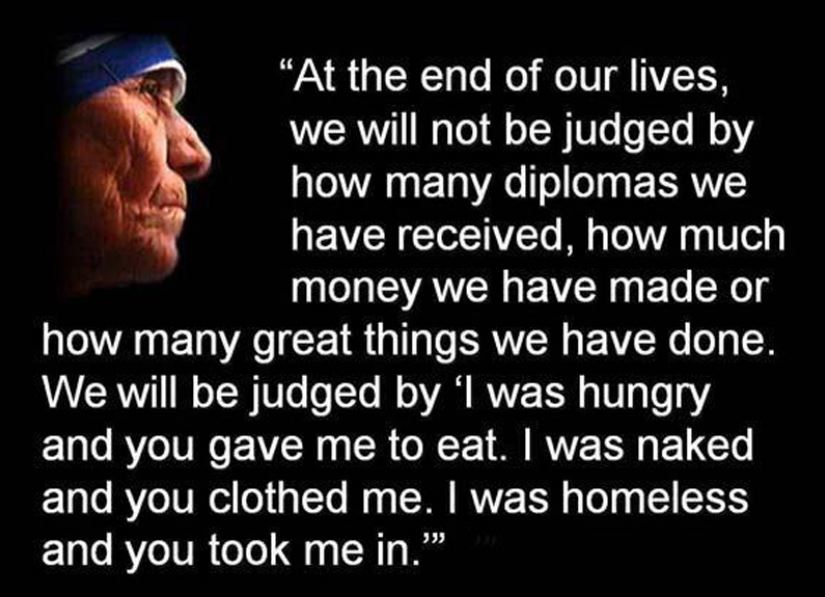
Will You Inherit YHVH God’s Kingdom?

I was hungry and you gave me food“Then the King will say to those on His right, ‘Come, you who are blessed by My Father, inherit the Kingdom prepared for you from the foundation of the world.” Matt 25:34

So wait a minute – what is Yeshua (Jesus) saying to his disciples in this passage? Who are the people He speaks of who are blessed by His Father (and ours)? And what did He mean two verses earlier when King Messiah Yeshua said that He will “…separate the sheep from the goats” (Matt 25:32)? In verses 35-36, Yeshua goes on to say: “For I was hungry and you gave me food, I was thirsty and you gave me drink, I was a stranger and you welcomed me, I was naked and you clothed me, I was sick and you visited me, I was in prison and you came to me”.

If we go back to the Tanach (Old Testament) we can see prophecies of the warnings and future judgment Yeshua was speaking of in Matthew 25:

  • Ps 37:22 – For those blessed by Him shall inherit the earth, but those cursed by Him shall be cut off.
  • Isa 58:7 – Is it not to share your bread with the hungry, and that you bring to your house the poor who are cast out; when you see the naked, that you cover them, and not hide yourself from your own flesh?
  • Eze 18:7 – …but have given their bread to the hungry and covered the naked with clothing.
  • Eze 34:17 – And as for you, O My flock, thus says the Lord God: “Behold, I shall judge between sheep and sheep, between rams and goats”

These verses seem disjointed and not directly related to Yeshua’s words in His Olivet discourse, until you look at the full context surrounding these verses. You might wonder, for instance, why YHVH would be judging between sheep and sheep. Let’s look at the passage in Ezekiel 34 preceding Verse 17. YHVH had just been speaking (through Isaiah) about how He would judge the false shepherds who were mistreating the flock and leading them into pagan practices (vv. 7-10). Then in Verses 11-16 He speaks of seeking out His sheep and bringing them back from all the nations of the world where they have been scattered, so that He can bring them to a place of comfort and peace: “they shall lie down in a good fold and feed in rich pasture” (Eze 34:15).

Then in Verse 16 He says: “I will seek what was lost and bring back what was driven away, bind up the broken and strengthen what was sick; but I will destroy the fat and the strong, and feed them in judgment.” Abba is promising here to take care of His obedient sheep; those who were led astray by the false shepherds but now desire to follow the true Shepherd. But He will judge those sheep who are continuing to follow the way of the false shepherds and are not willing to trust in YHVH and follow His way.

So how do we recognize someone who is following YHVH’s path and trusting Him with their whole heart? According to Isaiah 58, Matthew 7 and other passages, we will know them by their fruit (see Matt 7:20). It is clear that in Matthew 25:35-36, Yeshua is referring back to the words YHVH was speaking to His people through Yeshayahu (Isaiah) In Isaiah 58:7. In the Isaiah passage, YHVH was instructing His children that it was far more important to Him that they care for the poor and needy, than that they follow their religious rituals.

As we have said many times before, our spiritual journey is all about relationship with YHVH. If you truly want to be pleasing to YHVH and walk in His path, then you need to learn what pleases Him. More to the point, you need to get to know Him personally, not just learn about Him. As you draw closer to Abba Father and His Son Yeshua, you will get to know what is at the core of their heart. When you dig down deep, you will find love, compassion, understanding and empathy for the oppressed and downtrodden among their people. So you might say to this: “how do I help all the poor and hungry, oppressed and abandoned people; how do I visit all the prisoners, take in all the homeless, and clothe the naked; how do I care for all the orphans and widows if the earth? This is much too daunting a task and far too overwhelming for one person.”

If you have a true relationship with YHVH, though, as your closest friend and trusted counselor, then He will show you where He wants you to help His children. Most likely He will start you off with something small, for example, working at a local soup kitchen, visiting shut-ins or elderly people in nursing homes, helping needy widows with small tasks around their homes, or a host of other things. Abba will not only point you to the places He wants you to help, but He will give you all the gifts you need for the task, however great or small. Go to Abba and ask Him what is on His heart; when you seek Him with your whole heart, you will find what is in His heart.

Offensive Judgment

for with what judgmentIf you have ever spent time in a congregation, then you most likely have encountered at least one instance of a Christian or Messianic believer judging another. Perhaps you were even the one being judged. Perhaps you were the one who did the judging.

Over several decades, I have been a member of various congregations. I have noticed many instances of Christians or Messianic believers judging a fellow member or a newcomer who showed up at their door, I have experienced many of the examples mentioned below, either as the one who was judged or as the one who judged (or should I say misjudged?).

The effects of our misjudging, whether subtle or blatant, are powerful and can be devastating to others. Actions or reactions such as a certain “knowing” glance, turning away, keeping someone at arm’s length, gossiping, excluding another, and so on, may seem insignificant in a world full of violence and horror. And yet, if we are engaging in any of these actions, we are not following Yeshua’s command to love one another. That means we are sinning and sin is never insignificant (Matt. 5:21-22).

The sheep in wolf’s clothing: Often we judge others by their appearance. The less similar they are to us, the more we tend to suspect them. Does the person wear our kind of clothes, have a similar hairstyle, and so on? If not, then they are automatically suspect. Consider Isaiah 11:3, NLT

Assumptions and generalizations: If you are divorced, then it is your fault and you are considered sinful and loose with your morals. If you are married, then you are automatically moral and upright. The list goes on, but you get the idea. Consider John 8:7 and Rom 2:1.

Talents and gifts or lack thereof: Some gifts may be prized over others, and those with the valued gifts are welcomed more warmly. Those people whose gifts are not easily recognized or deemed less essential may be ignored or otherwise devalued. Consider 1 Cor 12:4.

 Political choices: There are no perfect people or political leaders (except Yeshua). There is no holy and perfect political party. Consider Psalms 146:3 and 118:8 and Jer 17:5.

 Racial prejudice: Belonging to a different race or associating with those of a different race means that you are less moral or upright. Alas, prejudice is still alive and kicking even among those who appear to be strong believers. Consider 1 John 2:9, 1 Cor 12:13 and Gal 3:28.

 Financial status: If you are rich, then you are greedy and selfish or else you are inevitably upright and moral. If you are poor, then you are lazy and worthless or you are good, but unjustly oppressed. In his book, The Blood of Lambs, Kamal Saleem, former terrorist-turned-Christian makes a poignant point. He used to recruit people in the United States for Islam and jihad by taking food to the poor, often in neighborhoods where there were Christian churches. None of the Christians had ever bothered to reach out to those he visited, thus making his task easier. Consider Matt 25:34-36 and Isaiah 58:6-7.

The wolf in sheep’s clothing: We seek to be broadminded sometimes even when we are steeped in ignorance. We implicitly trust people because they claim to be Christian or because they look like us or they seem to be like us in other ways. They appear to be our kind of people, so they must be alright. Many a person has trusted in such a way and lived to regret it. Consider Matt 7:8, 10:16 and 1 John 4:1.

We cannot accurately judge because we don’t see others’ motives, emotions, or past experiences (Prov 16:2; 21:2 NIV). So how do we know when a person is sincere? How do we know if someone really wants to change or is truly seeking YHVH’s help? How do we know if someone is pulling the wool over our eyes?

While it is not our duty to judge others, it is our duty to distinguish to the best of our ability. We are expected to make wise decisions concerning our friends and associates. We must have some order and regulation in our congregations. Leaders especially have a duty to protect their congregations. We obviously cannot rely on our own wisdom, so we must seek YHVH’s wisdom instead. We ask YHVH for the discernment which is provided to us by His Holy Spirit. We must proceed with a judicious mix of caution and love.

When we judge another, we risk offending that person and YHVH.  Above all, we are called to do everything in love. Yeshua commanded us to love one another, not to judge one another (John 13:34). If we perceive someone as an enemy, we are still called to love that person, even if that person has misjudged or mistreated us (Matt 5:44). These Scripture passages are very familiar to us, but how well do we live up to Yeshua’s expectations? This is a question that I must ask myself every day. What about you?

The Stars Tell how YHVH will Weigh Us in the Balance Scales

Libra with verse from DanielLet God weigh me on honest scales and He will know that I am blameless. Job 31:6

In this passage, Job believed that he had been walking uprightly with YHVH, so he was not afraid to speak aloud to his friends in front of YHVH. He is essentially saying that he is willing to undergo YHVH’s righteous judgment if he has slipped up anywhere in the path of his life. Notice that Job refers to honest scales when he talks about YHVH testing him to see if he measures up to YHVH’s standard of righteousness.

Of course, having all the scriptures available to us now, we can look back and do some easy “Monday morning quarterbacking” relating to Job’s statement, knowing now as we do that no one can measure up to God’s standard of righteousness.  Romans 3:10 says: “As it is written [quoted from Psalm 14:1-3]: ’There is none righteous, no, not one’”, and then in Romans 3:23 Sha’ul (Paul) says “for all have sinned and fall short of the glory of God,”.  He then follows with the divine punch line after the comma in Romans 3:24 “being justified freely by His grace through the redemption that is in Messiah Yeshua”.  So, if I put on my 6-year-old Bible analysis hat, I could easily surmise that believers can be justified before God, but only through the blood of Yeshua our Redeemer.

The scriptures pertaining to YHVH’s judgment lead into the second major sign in the Zodiac: Libra, which means “weighing in the scales”, from the ancient Hebrew name for this sign, Mozanaim. We learned from previous postings on the “Gospel in the Stars” that the original Hebrew root word for Zodiac (Zodi) means “the way” or “path”. So, combining Job’s speech with this meaning, we can see that Job tried to the best of his human ability to follow Abba’s path, but like all of us, when he was weighed in the scales by YHVH, he fell far short of His righteous standard.

However, the Good News (Besorim in Hebrew) is that YHVH made a way for us to be saved in spite of our sins and weakness, and Messiah Yeshua provided the solution for all people for all times. I believe that Job hinted at knowing His Messiah (Yeshua), the true Savior of the world, when he said in Job 19:25: “For I know that my Redeemer lives, and that He shall stand at last on the earth.”

Digging down a bit deeper into the meaning of the ancient names of the stars in Libra, we see that a very consistent theme emerges. The key stars in Libra (from ancient Hebrew and Arabic) are: “the price which is deficient”; “the price which covers”; “the value of the redemption”; and “the price of the conflict”. From these names, it is easy to paint a picture that tells a beautiful Gospel story: human beings are hopelessly deficient in our fallen souls; we need a Redeemer to balance out the scales, which we cannot do on our own; YHVH has prepared a Redeemer for us from the foundation of the world; Yeshua our Messiah is that Redeemer, who paid the ultimate price and atoned for our sins (covered us with His blood); and now we can stand righteous before YHVH by calling on His name and trusting in Yeshua.  As seen in the image of Libra at the beginning of this posting, our scales are severely unbalanced – only Yeshua can balance them out for us.

As with all the signs of the Zodiac, there are three constellations associated with Libra: Crux (the Southern Cross); Victima (the Victim); and Corona (the Crown). It is not too difficult to see how these three fit perfectly into the rest of the story of Libra. Crux, which appears like the Hebrew letter Tav (which looked like an “X” in ancient Hebrew), graphically shows how the Messiah was to die and atone for our sins. Interestingly, the Southern Cross disappeared from the night sky in Jerusalem after Yeshua’s crucifixion and can only be seen in the Southern hemisphere now.

The second constellation in Libra, Victima, which is named Sura (Lamb) in Hebrew, points to Yeshua as the divine Victim who willingly chose to pay the ransom for our redemption. It vividly brings to light the scripture from Revelation 13:8: “…written in the Book of Life of the Lamb slain from the foundation of the world.” This scripture needs no further explanation!

The final constellation in Libra is Corona, named Atarah in Hebrew, which means “the Crown Bestowed”. Once again, this fits well into the overall picture of this sign, especially when we look at verses such as Hebrews 2:9: “But we see Yeshua — who for a little while was made lower than the angels — now crowned with glory and honor because He suffered death, so that by God’s grace He might taste death for all humanity.”

So now, armed with this knowledge, I challenge you to worship the One and only One who is worthy to balance out the scales in our favor, Yehovah our Redeemer, and Yeshua His Son, who paid the ultimate price so that we could be restored to Abba Father.