Tag Archives: love

Who Is Yeshua?

Yeshua is everything to us:  our salvation, our hope, our future, to name a few. It is important to get to know Him as well as possible.  We can do this by interacting with Him and also by reading the Bible.  It is the word of Yehovah and Yeshua is the living Word of Yehovah.  This series, entitled “Who Is Yeshua?” will consist of twenty-one articles. Each article will explore a different section of the Bible to discover different titles and roles of Yeshua and our response to each role. In the tenth article in the series, Yeshua is our Beloved.

 In that the Messiah [Yehovah} chose us in love before the creation of the universe to be holy and without defect in his presence. He determined in advance that through Yeshua the Messiah we would be his children — in keeping with his pleasure and purpose —so that we would bring him praise commensurate with the glory of the grace he gave us through the Beloved One (Eph 1:4-6).

Yeshua is the beloved Son of YehovahYeshua was still speaking when, behold, a bright cloud overshadowed them, and a voice from the cloud said, “This is my beloved Son, with whom I am well pleased; listen to him.” (Matt 17:5). It is through Yehovah’s beloved Son we are welcomed into the Kingdom of Heaven and adopted as Yehovah’s children.  Even if our parents fell short in loving us or even if they rejected us, we are beloved children of our Heavenly Father. 

Through Yeshua we are able to escape from the kingdom of darkness we were born into and can be born again into Yeshua’s Kingdom. We are born again when we repent of our sins and ask Yeshua to be Lord of our lives.  For [Yehovah] has rescued us from the dominion of darkness and brought us into the kingdom of the Son he loves, (Col 1:13).  We who belong to Yeshua are His beloved.  “As the Father has loved me, so have I loved you. Now remain in my love” (John 15:9).

Yeshua wants to be close to us, just as He is close to his Father.  When I am raised to life again, you will know that I am in my Father, and you are in me, and I am in you (John 14:20).  We have become part of Yehovah’s family.  It is a close-knit family where each member is valued and cherished.   

Our Beloved Yeshua is always faithful to us.  When we feel isolated and misunderstood, we are not truly alone for He is always with us. I am with you always, even unto the end of the world (Matt 28:20). He has experienced every hurt and sorrow that we experience. He is despised and rejected by men, a man of sorrows and acquainted with grief (Is 53:3).

When we are afraid, we can take our fear to Yeshua.  We are safe at all times because our Beloved is at hand to protect and defend us.  Even though I walk through the darkest valley, I will fear no evil, for you are with me; your rod and your staff, they comfort me (Ps 23:4). 

The rest of the world may seem oblivious to our troubles, but Yeshua is not.  He has already borne all our trouble, sin and weakness and put them to death in His body on the cross. Surely, he has borne our griefs and carried our sorrows; yet we esteemed him stricken, smitten by God, and afflicted. But he was wounded for our transgressions; he was crushed for our iniquities; upon him was the chastisement that brought us peace, and with his stripes we are healed. … (Is 53:4-5).

Dayenu!  It would have been enough for Yeshua to rescue us from the clutches of evil, but He does so much more.  He wants us to live with Him forever.  He wants us to share in His glory.  And we all, with unveiled face, beholding the glory of the Lord, are being transformed into the same image from one degree of glory to another. (2 Cor 3:18).

Our Beloved remains faithful to us forever, no matter how much the enemy tries to thwart our relationship.  We may walk away from Yeshua, but He will never walk away from us.  Can anything ever separate us from Christ’s love? Does it mean he no longer loves us if we have trouble or calamity, or are persecuted, or hungry, or destitute, or in danger, or threatened with death?  (As the Scriptures say, “For your sake we are killed every day; we are being slaughtered like sheep.”])  No, despite all these things, overwhelming victory is ours through Christ, who loved us (Rom 8:35-37).  Let us cling to our Beloved in good times and in bad times.

This is an excellent time to ask forgiveness for your sins and invite Yeshua (Jesus) to be Lord of your life.  When we commit sin, we incur a debt that none of us can ever pay on our own.  It cannot be paid with earthly currency or even with great sacrifice on our part.  This debt can only be paid for by the blood of Yeshua which has already been shed for us. This is the greatest gift to ever be offered.  Don’t miss out.  After you have accepted Yeshua as your Lord and Savior, ask for baptism in the Holy Spirit.  The Holy Spirit will be your constant companion and Counselor and will equip you for Kingdom living.

Loving Father

loving-father

For many years I kept my distance from God the Father mostly because He seemed so distant and impossible to please.  Over the years many people I have encountered have revealed that they had or still do regard God the Father as distant and at least somewhat cold and demanding.  Many of us imagine God the Father residing at His ease in heaven, where everything is perfect and there is no hurt or uncertainty.   How could He know what it is like to struggle  as we do?  He has everything, while we have lost much.  Yet Scripture reveals just how loving Abba is and how much he shares in our joys and sorrows.

YHVH, our Father, was not content to remain isolated and aloof in heaven, but rather created people in His own image.  He lovingly fashioned a world that would meet our needs.  He desires not to just view us from afar, but to live among us and share in every moment of our lives.  What could God the Father know of our pain and loss and heartache?  Everything, for by interacting with people, He has suffered as we do.

After establishing His people in their homeland, YHVH fashioned a home for Himself on earth so that He could dwell among His beloved ones.  Always thinking of others, His home was designed to glorify His Son, Yeshua, and to teach us about His plan of salvation.  (see other blogs on Temple and Tabernacle)  Yet, YHVH left His home in Jerusalem when His people rejected Him even after many attempts on His part to reach out to them.  He watched in sorrow as His beloved ones went their own way.  He saw His Temple destroyed three times:  the physical structure in Jerusalem twice and Yeshua’s body as an atonement for our sin.  The special implements from His earthly home were carried off to Babylon and defiled.

YHVH’s desire is to live among His people, yet so many times He has been made unwelcome.  People have denied His existence, blasphemed His name, ignored Him, or blamed Him for the results of their own bad choices or the bad choices of others.

YHVH loved His spouse, Israel, and cared for her even when she scorned His love and turned to false gods.    He knows what it is like to have a spouse leave to run off after another.  He even sent His beloved Son to become one of us so that we could see how much He loves and understands us, but even His Son was rejected.

Scripture is the story of unrelenting love.  Let us examine just a sampling of Scripture verses that describe our Father’s love for us.  “[The Father] guarded [Jacob] as the apple of his eye.” (Deuteronomy 32:10)  “A Father to the fatherless, a defender of widows, is God in his holy dwelling.  God sets the lonely in families, he leads forth the prisoners with singing.”  (Psalm 68:5-6)  “Your Father knows what you need before you ask him.” (Matthew 6:8)  “Your Father in heaven is not willing that any one of these little ones should be lost.”  (Matthew 18:14)  “How great is the love the Father has lavished on us that we should be called children of God!” (1 John 3:1)

How should we respond to our loving Father?  He tells us in His own words in Scripture:

Love Him:  “You shall love YHVH your God with all your heart, and with all your soul and with all your strength.” (Deut 6:5) 

Trust in Him:  “But I trust in Your unfailing love; my heart rejoices in Your salvation. (Ps 13:5)

Obey Him:  “You must love the Lord your God and always obey his requirements, decrees, regulations, and commands. (Deut 11:1)

Keep your promises just as He does: “But whoever keeps his word, in him truly the love of God is perfected.” (1 John 2:5)

Yeshua shows us how to love our Father, for Yeshua did all these things.  He also did one more thing:  He kept His focus on His Father at all times and learned from Him. So Jesus explained, “I tell you the truth, the Son can do nothing by himself. He does only what he sees the Father doing. Whatever the Father does, the Son also does.”  (john 5:19)

If you feel far from Father, let go of your fears and doubts and run to Him.  He is waiting for you with open arms! “But while he was still a long way off, his father saw him and was moved with pity. He ran and threw his arms around him and kissed him warmly”. (Luke 15:20)

Repairing Reflections

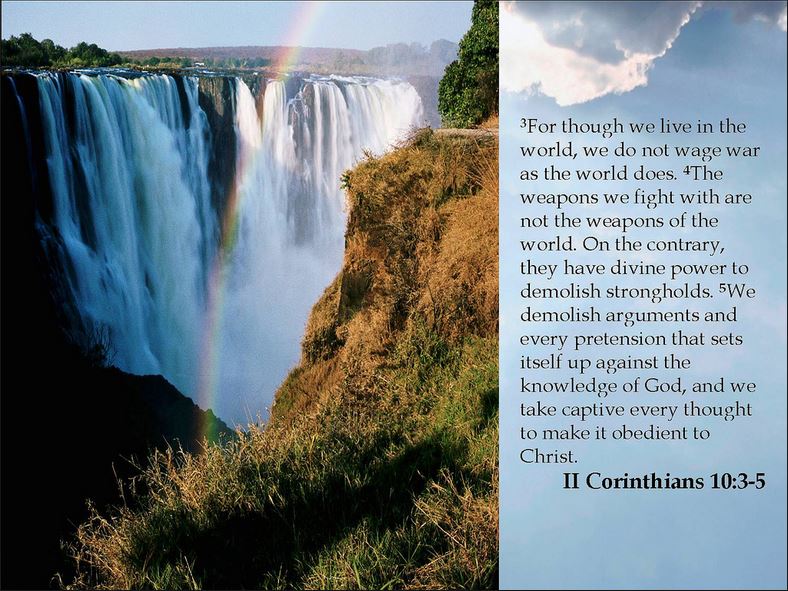
weapons-of-our-warfareThere is great temptation these days to succumb to fear and anxiety.  Yet, Scripture tells us repeatedly not to fear.   Isaiah 35:4,  John 14:27, Joshua 1:9 and Matthew 6:34, are just a handful of examples of YHVH’s teaching on fear. We know that YHVH does not give us a spirit of fear, but of love, power and self-discipline (2 Tim 1:7).  So when trouble seems to loom ahead or is already in our midst, how do we combat those anxious thoughts and feelings that arise?

Our tendency is to tackle the job in the physical realm.  This is a mistake.  Even though our problems are in the physical realm, their source is from the spiritual realm.  The following analogy may help to better illustrate.   Athletes regularly review videos of past games in order to discover what works well and what skills or strategies still need to be honed.  Even though the video reflects what happened during the game, the problems cannot be fixed by editing the video.  Our physical realm is a video or mirror image of what is happening behind the scenes, that is the spiritual realm (Heb 8:5, 1 Cor 13:12).  In order to make effective changes in the physical realm, we have to address the issues in the spiritual realm.

For decades, perhaps centuries, many people have tried to solve the Middle East crisis on the physical level.  There have been numerous treaties, division of land, wars, and discussions.  None of these attempts has been able to resolve the conflicts.  YHVH shows us how He handles the situation.  Prime candidates for terror are experiencing life-changing dreams or visions of Yeshua.  Once these individuals discover Yeshua, their lives are transformed.  Instead of attacking their enemies, they are praying for the salvation and welfare of their enemies!  YHVH is battling in the spiritual realm to resolve terrorism and His work produces everlasting results.

Yeshua came to the earth the first time and demonstrated by signs and wonders in the physical realm that He is the Messiah.  His followers were disappointed and even disillusioned to discover that He did not mean to physically attack the Romans, the physical enemies of that time.   Instead, Yeshua attacked a much more dangerous enemy in the spiritual realm and wrought for all humans a much greater triumph with eternal implications.

Many of Yeshua’s followers today realize that the true battleground is in the spiritual realm and are now publicly engaged in intercession , worship, repentance and reconciliation with others.  In July, evangelical Christians gathered around the Washington Monument to seek YHVH’s help in breaking racism.* Breaking Christian News recently reported that 1,000  “Native American Indian tribes from the United States and Canada collectively forgave the U.S. government for breaking treaties with their ancestors during a public ceremony on the National Mall.”**  There is great power in forgiving others and releasing them from debt.  “Forgive us our debts as we forgive our debtors” (Matt 6:12).

A number of us have experienced the power of forgiveness on a more personal level.  We have discovered that when we truly forgive individuals who have hurt us, amazing things happen.  People who were estranged from us contact us seeking reconciliation.  All we did was take our case to YHVH and tell Him that we forgave and released the person(s) from any debt owed to us.  We did not disclose to anyone, not even the individuals we forgave, that we had taken such a step.  Within a short time the physical realm reflected changes made in the spiritual realm.

When Yeshua returns, His job will be to complete the reconciliation and restoration that we have been addressing (Acts 3:21 NLT).   Our adversary and any one cooperating with him want us to be divided and at odds with each other (John 10:10).  Yeshua said that we would be known by our love for one another.  We certainly want Yeshua to recognize us as His own when He returns. Judging or arguing with others stems from fear.  Yeshua said that He would only recognize those who were reaching out in love to others.  “You have heard that it was said, ‘Love your neighbor and hate your enemy.  But I tell you, love your enemies and pray for those who persecute you (Matt 3:43-44).   Does Yeshua recognize you as one of His sheep?

*   Rees, Steve.  ‘God break racism!’ Evangelicals on D.C. Mall pray for hope and reconciliation, The   Washington Post, July 16, 2016

** Zauzmer, Julie, An Kirkland and Michelle Boorstein.  “Must Read!  Native Americans are ‘Spiritual Sleeping Giants Awakened’ after Incredible Prophetic Act in Washington:  “May Go Down as One of the Most Important Days in American History,” Breaking Christian News,  Oct. 27, 2016, http://www.breakingchristiannews.com/articles/display_art.html?ID=19576


Releasing Love

God's Love

Many of us have accepted Yeshua as our Lord and Redeemer, yet we are unable to trust what He has accomplished for us.  Yeshua bore our punishment for all time so that we could maintain a relationship with YHVH and be a part of His family and His kingdom.  We have all heard this message preached, taught, argued and dissected until the words have perhaps become meaningless to us.   Words are not enough; each of us must experience the love of YHVH.

Too often Yeshua’s sheep silently struggle with guilt, regret, and shame that bog us down and block us from enjoying our Father’s overwhelming love.  Instead, we are inundated with misery that YHVH never intended for us to experience.  Do we believe that if we suffer enough, we can somehow make up for our sins?  Truly, there is no way that we can pay for even one sin.  It doesn’t seem right to us that we can repent and walk away free.  Perhaps that is why we find it so difficult to forgive those who have wronged us.  If others have made us suffer, then we feel justified in wanting them to suffer also.  We do not see things from YHVH’s perspective.  We forget how He rejoices over recovering the lost sheep (Luke 15:1-7) or re-uniting with the prodigal son (Luke 15:11-32).  When things go wrong, we think that YHVH is punishing us, even when we have repented and turned away from sin.  It is right to loathe the sin, but we must not loathe ourselves.

Our experiences in this world color our perception.  We assume that YHVH loves the way people love:  half-heartedly, sporadically, conditionally, and so on.  Over the last several months, I have encountered numerous others who are struggling to see themselves as YHVH sees them.  I, too, tend to see myself from a worldly perspective rather than as YHVH sees me.  YHVH loves us extravagantly not because of us, but because of who He is.  What does it mean to us that God is love?   1 Cor 13:4-7 provides some helpful insights.

YHVH does not keep a record of our wrongs and is not easily angered.  He is focused on us, not on Himself.  He believes in us, trusts us and hopes in us.  He is willing to endure all things so that we might be loved into reaching our full potential.  Derek Prince in a work entitled “The Divine Exchange” has provided a beautiful illustration of YHVH’s love through Yeshua’s sacrifice.  Below is a summary of “The Divine Exchange”.

  1. [Yeshua] was punished that we might be forgiven
  2. [Yeshua] was wounded that we might be healed
  3. [Yeshua] was made sin with our sinfulness, that we might be made righteous with His righteousness
  4. [Yeshua] tasted death for us that we might share His life
  5. [Yeshua] was made a curse that we might receive the blessing
  6. [Yeshua] endured our poverty that we might share His abundance
  7. [Yeshua] bore our shame that we might share His glory
  8. [Yeshua] endured my rejection that I might have His acceptance with the Father
  9. He was cut off that we might be joined to [YHVH]
  10. Our Old Man was put to death in Him that the New Man might come to life in us

Sin causes damage and loss.  In John 10:10, Yeshua tells us that the thief comes to steal, kill and destroy.  Yeshua came so that we might have abundant life.  Yeshua came to recover, restore, replace, re-unite and revive.   Let us throw off the temptation to dwell on the past, on what has been lost or destroyed, and focus instead on what Yeshua has done, is doing, and will do.

YHVH’s love releases us from every burden and barrier, so that we are free to release His divine love to others, including ourselves.  When we are truly set free by His love, we will be able to love as YHVH loves.


How can We Love?

if you love Me keep me commandmentsIn the first blog of this series, Nancy explained why Torah is still valid in YHVH’s Kingdom on Earth today.  Last week’s blog talked about becoming all that YHVH intends for us to be in this life, including following the loving instructions He gave in His Torah.  This week, I would like to show you why faulty Scripture translation and unclear terminology can confuse us and distort our perception of the truth.

Many Christian churches and denominations use Ephesians 2:8 as their banner verse and state at the core of their doctrines that we are “saved by grace and not by works, lest anyone should boast”.  In many cases, they have taken these words out of context and to such an extreme that they no longer believe we should follow the law (Torah) as that would mean that we are trying to earn our salvation by our works.

However, when we remember that Torah is better translated as instruction than law, we realize that Torah was something God created to help guide us through life in a more joyful, fulfilling way, not something He designed as a set of laws to burden or frustrate us.  Using a more accurate translation of Ephesians 2 (CJB), and moving down from Verse 8 to Verse 10, we see that YHVH has a purpose for our lives that goes far beyond salvation.  Verse 10 says: “For we are His workmanship, as we have been created in Messiah Yeshua for good works, which God prepared beforehand, so that we would walk in them, the good works”.

From this verse and many others in the Scriptures, we know that these good works relate to following God’s will and keeping His commandments (Torah).  Remember what Yeshua said: “If you love Me, you will keep My commandments” (John 14:15).  And what are Yeshua’s commandments?  They are the same as Abba Father’s commandments (the Torah), as Yeshua said He only does what the Father does.  We also know that Yeshua did not do away with the Torah, which Nancy explained well in the first blog of this series – she paraphrased Matthew 5:18 “…until heaven and earth pass away, not one jot or tittle of the Torah will pass away”.

She did a great job of explaining why the Torah is still in effect, but she asked me to go a little deeper into the history of the Scripture translations and interpretations.  To point out one of the many areas of the New Testament where there are glaring differences among different translations, let’s look at Romans 10:4, which is often cited as justification for the law being done away with.  In the original King James Version, this verse reads “For Christ (Messiah) is the end of the law for righteousness to everyone that believeth”.  This indeed could be (and has been) interpreted to mean that when Messiah Yeshua came on the scene, he replaced the law so that it is now obsolete.  However, let’s look at a Messianic translation (the Complete Jewish Bible) which has re-translated the ancient scrolls from a Jewish cultural and religious perspective.  Here is the CJB translation of Romans 10:4: “For the goal at which the Torah aims is the Messiah, who offers righteousness to everyone who trusts”.  This sheds a very different light on this passage.

Earlier in Romans Chapter 10, Sha’ul was talking about how Israel had set up their own system of righteousness, based on what they referred to as the “Oral Law”, but which was actually created by Rabbis who interpreted the Torah based on their own point-of-view and biases.  What Sha’ul is saying in Verses 1-4 of Romans 10 is that the Jewish people (directed by the leaders) had made up their own form of righteousness, whereas Yeshua came to show them the true righteousness they could have by following Him.

Now we can see the vast differences in doctrine from one translation to another; but the burning question is: why are they so different in their spiritual concepts and principles?  I certainly do not profess to be an authoritative expert on Bible translations or exegesis, so I have consulted true scholars in this area.  In  “The Jewish Gospel of John”, author Eli Lizorkin-Eyzenberg helps us dig deeper into the meaning of John 1:17, which in the ESV says: “For the law was given through Moses; grace and truth came through Jesus Christ”.  From his studies, Eli gives us new insights into the dichotomy of law and grace as we know it today from mainstream Christian doctrines.  He says that up until the time of the Reformation, Christian leaders debated among themselves the importance of keeping the Torah (law).  However, when the Protestant Christian movement started, they wanted to emphasize the truth that salvation comes to the believer by faith alone, and not by their works.

The reason for this at the time was because they wanted to contrast this new doctrine with the Catholic dogma that burdened members with so many requirements that it seemed almost impossible to be truly forgiven from their sins.  This was very similar to the religious leaders at the time of Yeshua, who weighed the people down with so many of their man-made laws that they could never hope to be truly righteous before YHVH.  Mr. Lizorkin-Eyzenberg says that the Protestants were so insistent about their new doctrines that many Scriptures (both in the Gospels and in Sha’ul’s letters) were actually re-translated into very different interpretations than were originally intended.  About the passage in John 1:17, Eli says that it would be more accurate to translate it as: “For the Torah was given through Moses and grace and truth came through Jesus Christ”.  The obvious difference is the addition of “and” between the two phrases, now giving the meaning that Torah came through Moses, and Yeshua has now given us grace to keep the Torah, because He has taken away the penalty of the Torah by forgiving our sins and sending them off into the desert to be forever forgotten.

If we were to summarize what Yeshua added to our ability to keep the Torah in one word, it would be “love”. In teachings such as the “Sermon on the Mount”, he clarified and explained the Torah so it would be easier to understand and follow.  And then with His incredible sacrifice on the Cross, He saved us from all our sins and set us free from bondage to hasatan.  As it says in Scripture, He first loved us, so let us love Him by keeping His commandments (John 14:15).

What would you do if you were God (Part 5)

LORD is good“Throughout the earth the story is the same— only a remnant is left, like the stray olives left on the tree or the few grapes left on the vine after harvest.” Isaiah 24:13 [NLT]

In the previous installments of this series on God’s ways, I discussed why YHVH does things the way He does and why His plan seems so odd to us sometimes but is actually the perfect plan for our lives.  In this final blog of the series I want to look into the future and see why He has prophesied and planned out such a seemingly bizarre sequence of events for the end of this age.

From our limited human perspective, it may seem odd that the Creator of this universe would aim to judge His creation by destroying a large portion of it through catastrophic events.  Let us look in more detail at a sampling of His end-time prophecies which are spread across many of the minor and major prophets in addition to the book of Revelation.  When researching a news story, we try to answer the four “w” questions: who, what, when, why.  The “How” question is not so important to us when it comes to Abba‘s future plan, as we do not really need to know how He will perform His will, but rather how we fit into it and what we should do to prepare ourselves.

The “When” question is also not critical to us, as we have no control over it anyway, and we need to be spiritually prepared, whether the events start to play out over the next few years, further into the future, or beyond our earthly lifetime.  Yeshua said that no person would know the day or hour of the end time, not even the angels in Heaven, so we should not waste time speculating about the timing of these events (Matt 24:36).  The explanation of “What” is going to happen in the final days is somewhat more important to us, but mainly from the perspective of discerning the signs of the end times, as Yeshua outlined in Matthew 24-25.  If we get too concerned with answering the “When” and “What” questions (such as being drawn into the pre-Trib Rapture belief), then we can easily miss the more crucial truths of Yeshua’s message.

In Luke 18:8, He asks “when the Son of man returns, will He find faith in the Earth?”  Why is our Creator and Savior questioning the faith of His saints?  In Matthew 24:12, He goes on to say that “iniquity will abound and the love of many will grow cold”.  This agrees with statements in 2 Thessalonians and Daniel that speak of the Tribulation period and the 3 ½ year reign of the anti-messiah, when there will be a great falling away and the “antichrist” [anti-messiah] will be revealed.  Daniel says in his end-times prophecies that the anti-messiah will “wear out the saints of the Most High” (Dan 7:25) and “scatter the power of the holy people” (Dan 12:7).  In 2 Thessalonians 2:3, Sha’ul says “that day will not come until there is a great rebellion against God and the man of lawlessness is revealed”.

So how can we as Abba’s children keep our faith and not grow weary from the enemy?  I believe Revelation 12:11 provides us a good answer, as this passage explains how the saints persevered to the end during the Tribulation: “And they overcame him [HaSatan] by the blood of the Lamb and by the word of their testimony, and they did not love their lives to the death”.  YHVH wants our love and devotion to Him more than anything else – we need to walk with Him constantly and keep trusting Him every step of the way in our lives.

Many of the prophets (Isaiah, Jeremiah, Ezekiel, Zechariah, Malachi, etc.) speak of the believing remnant that will be preserved by YHVH in the latter days to dwell with Him in the Millennial Kingdom.  One of the key underlying themes of Isaiah (e.g. Isa 10:20-22, 11:11-16, 24:13, 27:32, 66:20) is that of the judgment of Israel overall as a nation and people, but the protection and restoration of a small remnant of YHVH’s faithful children (both Jew and non-Jew) to dwell with Him in His eternal Kingdom.  A particularly meaningful passage is located in Malachi:16-18.

Then those who feared the Lord spoke with each other, and the Lord listened to what they said. In His presence, a scroll of remembrance was written to record the names of those who feared Him and honored His name. They will be My people, says the Lord of Heaven’s Armies. On the day when I act in judgment, they will be My own special treasure. I will spare them as a father spares an obedient child. Then you will again see the difference between the righteous and the wicked, between those who serve God and those who do not.”

This passage provides us a window into YHVH’s own heart, which is what we desire as His people in relationship with Him.  It shows us that He loves us all, but He especially desires to keep track of the names of those who truly love Him with all their hearts (fear Him & honor His Name).  He wants to draw them near to Him as His special treasure, and preserve them for the last days, when He will reign on the Earth in the person of Yeshua HaMashiach.  When we look at YHVH’s heart from His perspective, we see His overwhelming love for His children, keeping us safe until He can bring us home into His eternal Kingdom.  How could we ever desire or ask for anything more than that – I give thanks and praise to our omnipotent Father who has wisdom and compassion beyond anything we could ever imagine!


What would you do if you were God (Part 4)

Rom 1133 - how unserachable“Oh, how great are God’s riches and wisdom and knowledge! How impossible it is for us to understand his decisions and his ways!” Romans 11:33 [NLT]

In the previous installments of this series on God’s ways, I discussed why He does things the way He does and whether we could do any better if we had supreme control of the universe.  Now I want to focus on something a little more personal.  Putting yourself in God’s place for a moment, think about what you would do if your creatures turned away from you to the point where your relationship with them seemed irreparable.

You had designed humans so that their most primal need was to have a deep personal relationship with you, but they had chosen to abandon and deny their need for that intimate relationship.  In human terms, this seems like an impossible situation.  One party (the human being) has gone against the wishes and desires of the other party (God) by disobeying His instructions, speaking against His perfect character, and hurting Him deeply.  The first party will not admit their wrongs and refuses to apologize (repent) for their sins against the second party.

If both of these parties were human, it would be difficult if not impossible to reconcile and restore their close relationship.  The first (wronged) party would have to unilaterally forgive the other one, which requires Godlike humility and unconditional love.  Considering the extreme nature of the sins of people against God, this forgiveness would be on the level of Corrie TenBoom’s forgiveness of the concentration camp guard who brutally and mercilessly beat her sister.  However, as we know, with God “all things are possible”.  From the Romans 11:33 Scripture above, we also know that it is “impossible for us to understand God’s decisions and ways”.

So how did God choose to reconcile us back to Himself from the depths of our sin and disobedience?  Did He shout down to us in His Earth-shattering voice, speaking anger and judgment on us and our sins?  Did He accuse us of turning against Him, shaming us into such a state of humiliation and disgrace that we felt compelled to seek His forgiveness?  Did He come down to Earth, seeking retribution and justice for every sin we had committed against Him and His children?

Or did Abba draw us back to Himself (and to Yeshua) by loving us unconditionally?  It is sometimes hard to even fathom the depth of Abba’s love for us.  Think of a particularly painful time in your life, when someone has hurt you so deeply you cannot even imagine forgiving them.  Then imagine sacrificing your own child for people who despised and cruelly hurt you.  Multiply this a million or billion times and you can start to feel what our Father in heaven feels when we turn away from Him and pierce His heart to the core with our sins.

Yeshua told us to love our enemies, bless those who curse us and do good to those who hate us.  He also told us that “There is no greater love than to lay down one’s life for your friends”. (John 15:13)  But what if God told you to lay down your life (or your child’s life) for your enemies?  Would you be angry and resentful that He would ask you to do something so unfair?  Well that is exactly what Yeshua did for us – His Father asked Him to lay down His life for those who hated, mocked and abused Him, and He willingly consented to His Father’s will.  If Yehovah could do this for us, can we not forgive those who hurt and abuse us?

Instead of criticizing Abba for the ways He deals with people’s disobedience, try praising Him for his love and forgiveness which are more infinite than all the universe!


Call to Action

not everyoneOur role as followers of Yeshua is to be an active role. Even the Hebrew language is an active language with the emphasis on verbs rather than nouns.  Yeshua modeled the type of action He expects to see from each of us.  He taught, healed, encouraged, fed the hungry, and admonished wayward leaders, even at the cost of His life.

Many disciples of Yeshua in our culture have devoted themselves almost exclusively to improving themselves and studying Scripture. These things are undoubtedly important, but there must be a healthy balance between improving self and helping others. We are required to meditate on and study Scripture, but it is useless if we do not also live it (James 1:22).

In His Sermon on the Mount, Yeshua describes those who will be welcomed into His Kingdom.

“Then the King will say to those on His right, ‘Come, you who are blessed of My Father, inherit the kingdom prepared for you from the foundation of the world. For I was hungry, and you gave Me something to eat; I was thirsty, and you gave Me something to drink; I was a stranger, and you invited Me in; naked, and you clothed Me; I was sick, and you visited Me; I was in prison, and you came to Me.’…   (Matt 25:34-36)

No mention is made in this passage concerning how well we know the Bible, although in other passages Scripture makes it clear that this is important ( Josh 1:8; 2 Tim 2:15, 3:16-17). In the past, I have been complacent with acquiring and storing knowledge of Scripture, but did not always put it into practice. It was only after I heard a missionary point out that Americans are great at acquiring knowledge, but we are deficient in actively building up the kingdom of YHVH, that I woke up. As I heard of new converts to Yeshua, with barely the rudiments of the Gospel, preaching, teaching and working miracles with the power of the Holy Spirit, I was truly convicted. They were doing so much with so little.

Secular news reports rarely discuss persecution and oppression of Yeshua’s followers, so pro-active research on our part is needed. Some of the things I have discovered: many of our brothers and sisters all over the globe are being persecuted for their faith, yet preach the gospel despite daily risk of imprisonment or death.  Political and/or religious leaders in numerous countries, seek to control all religious thought and activity and to eradicate any group that does not conform. North Korea is just one example.   In Iraq, Islamic extremists are beheading Christians. One tactic is to invade each home and demand that the children renounce Yeshua and embrace Allah. The children thus far have refused to give up Yeshua and were consequently beheaded in front of their parents. Leaders in India are routinely and consistently adding restrictions to hinder the spread of Christianity. Radical groups’ violence goes unchecked and police often “fail” to find sufficient evidence against the perpetrators. Christian refugees from Syria are being attacked by Muslims in some of the countries where they have sought refuge. The men are beaten and their wives and children are being raped and sodomized.   We must do more than shake our heads. Love is an action, not a feeling.

Martin Luther King, Jr. correctly stated that “It may well be that we will have to repent in this generation. Not merely for the vitriolic words and the violent actions of the bad people, but for the appalling silence and indifference of the good people who sit around and say, “Wait on time.” (Martin Luther King Jr., A Testament of Hope: The Essential Writings and Speeches)

Rather than randomly search out a worthy cause and plunge in, ask YHVH to direct you to the job He has appointed for you. There is much work to be done and windows of opportunity are closing rapidly. YHVH is still in control and is orchestrating His plan, so the best use of our time and effort is to yield ourselves to His assignment for us. Let us not be the generation who has to repent for keeping silent and doing nothing. Let us be the generation that accomplishes His will and is rewarded. Let us be the generation that is known by our love for one another, whatever the cost

Why do you call me, ‘Lord, Lord,’ and do not do what I say?
I will show you what he is like who comes to me and hears my words and puts them into practice.  He is like a man building a house, who dug down deep and laid the foundation on rock. When a flood came, the torrent struck that house but could not shake it, because it was well built.  But the one who hears my words and does not put them into practice is like a man who built a house on the ground without a foundation. The moment the torrent struck that house, it collapsed and its destruction was complete.” (Luke 6:46-69)

Witnessing in Love

the truth in love“Though I speak with the tongues of men and of angels, but have not love, I have become sounding brass or a clanging cymbal. And though I have the gift of prophecy, and understand all mysteries and all knowledge, and though I have all faith, so that I could remove mountains, but have not love, I am nothing. And though I bestow all my goods to feed the poor, and though I give my body to be burned, but have not love, it profits me nothing.” I Corinthians 13:1-3

In a recent blog series, I had spoken about Standing Fast to your Convictions, but at the same time remembering to Speak the Truth in Love (Ephesians 4:15) when you are discipling or confronting someone with the truth of YHVH’s word. This week I want to give you a real-life example of this which is etched into my heart right now due to the passing of my only brother.

Over the 27+ years since I have been a born-again believer in Yeshua, I have witnessed to people within my circle of friends and family, as well as casual acquaintances and strangers. However, the two people I witnessed to most fervently over those years were my father (deceased in 2001) and my brother, who passed on earlier this week. As I felt a special burden from the Holy Spirit to witness to these two significant people in my life, I tried a number of different approaches to spiritual seed-planting, attempting to tear down the intellectual and emotional barriers that kept those seeds from taking root and bearing fruit.

Many of my approaches did not bear fruit, because I was trying to prove the truth of the Scriptures and the existence of a Creator God through intellectual debate, which only spoke to their minds and not their hearts. I was far more effective when I stopped trying to “win the argument” with them, and started giving them my personal testimony of how God changed my life and brought meaning and purpose to my brief existence on this earth. This brought our conversations down to a heart level, and even though they still were not ready to accept all the truths I shared with them, they no longer felt threatened that I was trying to change them or prove them wrong.

While I do not recommend experimenting on your family members with different witnessing techniques, we do need to always remember to speak the truth in love and let our words be seasoned with the salt of grace. Once you learn to keep the focus on your own personal spiritual journey and your relationship with Abba Father and His Son, Yeshua, then you have a greater opportunity to break through all the barriers that inhibit people from receiving the truth. With this approach, the people you are witnessing to feel less threatened and are more receptive to your message, since you are just sharing from your own personal experience.

I will not tell you the specific results of years of witnessing to my father and my brother, but I will say that our spiritual conversations brought us closer together in our own relationships with each other. One great benefit of sharing your personal testimony is that people feel closer to you as you share with them in confidence and they get to know you on a deeper and more intimate level. Although I lived 3000 miles away from my brother and did not get to see him face-to-face more than once every few years, I felt very close to him in spirit and soul in spite of the miles separating us. I feel a great empty space in my soul now that he has left his earthly home, but I also feel great assurance that he is with Abba in heaven and is experiencing joy and Shalom as he never could in the limitations of his physical body.

The central mission of our ministry is to help believers stand firm to their convictions and hold fast to their faith under persecution, equipping them to become the overcomers they always wanted to be – and that the Scriptures promise them they can be. We want you to become all that you can in YHVH’s kingdom, and overcome your fears and self-consciousness so that you can share Yehovah’s love with as many people as possible before you depart this planet.

How About You?

the least of these

My beloved father passed away in April 2007. Peter and I, along with other family members, were privileged to be with him to the last. I wrote the following thoughts down shortly before my dad went on to his reward. It was meant to be both a tribute to him and a challenge to others. It is now time to share these private thoughts to challenge us all, both Messianic believers and Christians.

I am sitting here listening to the clock ticking away the precious little time I have left with my dad. I loathe every ticking sound because I can do nothing to stop the time from slipping away.

As it turns out, my father is Jewish. He never felt free enough to share this with us until a little over a year ago. Do I see a Jewish person when I look at my father? Not really. I never really knew him that way. But I will tell you what I see when I look at him. I see a man who loves Yeshua, only Dad calls him Jesus. I see a man who has worked hard all his life, who is almost ridiculously honest and fair, and who quietly gives to others and shares without asking anything in return. I see a man who is wasting away and who endures horrifying suffering, yet uses the tiny bits of strength and energy left to him to love and care for others. I see a man who is not wrapped up in his ethnicity; instead, he is following his Messiah to the best of his ability. I see a man who truly knows Jesus and tries to be like Him.

A few days before his death, my younger brother and his son sat with Dad for hours, one on each side and each holding one of his hands. As they were leaving, he said, “I love you. Remember, if you need anything, I’m here.” Dad was so weak he couldn’t even leave his bed. My father showed his love for us through quiet service. He did not seek to draw attention to himself. His faith was quiet, but strong.

Dad did not tell others of Yeshua in words. Instead, he showed them Yeshua’s love through his actions. Many people approached us after he died to mourn with us. Most of them shared stories of how he had helped them, whether it was by making repairs or running them to doctors’ appointments. I truly believed that when Dad met his Master, he was welcomed home with open arms.

The minutes are ticking away for each of us. Do we think that our ethnicity, our “correct” observance of religious rituals, or our intellectual abilities are going to win us any points with the Master? What are you doing with your life? Would your Master be pleased? Will He know you when you stand before Him?

We know that we have passed from death to life, because we love each other. Anyone who does not love remains in death (1 John 3:14).