Tag Archives: relationship

Trust in YHVH with all Your Heart

trust-in-yhvhTrust in the Lord with all your heart, and lean not on your own understanding; in all your ways acknowledge Him, and He shall direct your paths. Do not be wise in your own eyes; fear the Lord and depart from evil. It will be health to your flesh and strength to your bones.” Proverbs 3:5-8

I had memorized this well-known passage in proverbs 3:5-8 many years ago and still repeat it often in many different circumstances.  I would like to be able to say that it always calms my nerves or worries, but I can’t truthfully say that.  I usually have to spend some time with Yeshua remembering all the promises He gave us, that we are not to fear or be anxious for anything.  This tells me then that trust is not just about knowing the Scriptures that tell us God is faithful to watch over and take care of us in all situations.  It is far more about personally knowing the Living Word [Yeshua] who inspired the written Word, than it is about just knowing the written Word.

As believers, we often talk about having faith, more faith, or enough faith to endure whatever trial we are experiencing.  Unfortunately though, faith has become an overused and even watered down concept in our modern society.  Nowadays, we can have faith in Santa Claus, the Easter Bunny or the Tooth Fairy.  So what do we really mean when we say that we need to have strong faith in God?  Yeshua told his disciples that they could have cast the demon out of the young boy if they even had the faith of a grain of a mustard seed (Matt 17:20).  It is clear from this story that what they needed was not more faith, but rather a solid foundation of trust to back up the faith they had.

As human beings, we understand what it means to trust someone at a much deeper level than just having faith in someone.  Think about yourself for a moment and how you feel about trusting your neighbor. You may trust your neighbor enough to lend them your lawnmower, but do you trust them to watch out for your house when you go on a trip?  Would you trust them enough to give them a key so they can take of your plants when you are away?  Would you trust them to take care of your children for a weekend?

I would like to illustrate this point through a true story about a man named Charles Blondin, who was the greatest tightrope walker of his time, in the mid 1800’s.  He gained great fame in 1859 when he became the first person to cross Niagara Falls on a tightrope.  Charles and his friend and manager, Harry Colcord, strung a 2” diameter hemp rope from an oak tree on the American side to a large rock on the Canadian side, and used a series of guy ropes every 20’ (anchored to the shore) to keep the rope as steady as possible.  The greatest risk was the 50’ section in the center of the 1300’ span that could not be reached by anchor ropes.  The incredible thing was that Charles was able to navigate his way across the Falls without any mishaps.  He traversed the Falls a number of times over the next few weeks, carrying props such as a camera and a griddle on which he cooked an omelet, pushing a wheelbarrow, and even doing a backflip on a couple of occasions.

The most daring feat of all, though, was when he carried his manager Harry on his back during one of his crossings.  This is where the rubber meets the road – although the many fans in attendance had faith that Charles was able to cross the Falls (and even bet their money on him), it was only Harry who was able to trust Charles with his life.  A number of guy wires snapped during their crossing, but Charles never wavered.  Harry later told reporters that Charles had coached him to: “look up…you are no longer Harry, you are Charles. Until I clear this place, you are to be a part of me, mind, body and soul. If I sway, sway with me. Do not attempt to do any balancing on your own”.

Here is the essence of trusting God; not just having faith in Him. The spectators watching Charles had faith in him and believed that he was capable of traversing the Falls.  Only Harry, though, trusted him enough to climb on his back and ride across Niagara Falls with him walking on a 2” thick rope.  Is this the kind of trust you have in YHVH – do you trust Him to protect you and care for you and supply all your needs?  Do you trust Him with your whole life – body, soul and spirit – or do you trust more in your own abilities, your financial resources, or your trusted friends? In Psalm 3:6, God promised to direct our paths (keep us going in the right direction) if we would trust and acknowledge Him in every part of our lives.  Are you ready to trust YHVH with your whole heart? He is trustworthy beyond any other person or force in heaven or on Earth.  Go ahead and start trusting Him today – it will be the best decision you ever made!

Releasing Love

God's Love

Many of us have accepted Yeshua as our Lord and Redeemer, yet we are unable to trust what He has accomplished for us.  Yeshua bore our punishment for all time so that we could maintain a relationship with YHVH and be a part of His family and His kingdom.  We have all heard this message preached, taught, argued and dissected until the words have perhaps become meaningless to us.   Words are not enough; each of us must experience the love of YHVH.

Too often Yeshua’s sheep silently struggle with guilt, regret, and shame that bog us down and block us from enjoying our Father’s overwhelming love.  Instead, we are inundated with misery that YHVH never intended for us to experience.  Do we believe that if we suffer enough, we can somehow make up for our sins?  Truly, there is no way that we can pay for even one sin.  It doesn’t seem right to us that we can repent and walk away free.  Perhaps that is why we find it so difficult to forgive those who have wronged us.  If others have made us suffer, then we feel justified in wanting them to suffer also.  We do not see things from YHVH’s perspective.  We forget how He rejoices over recovering the lost sheep (Luke 15:1-7) or re-uniting with the prodigal son (Luke 15:11-32).  When things go wrong, we think that YHVH is punishing us, even when we have repented and turned away from sin.  It is right to loathe the sin, but we must not loathe ourselves.

Our experiences in this world color our perception.  We assume that YHVH loves the way people love:  half-heartedly, sporadically, conditionally, and so on.  Over the last several months, I have encountered numerous others who are struggling to see themselves as YHVH sees them.  I, too, tend to see myself from a worldly perspective rather than as YHVH sees me.  YHVH loves us extravagantly not because of us, but because of who He is.  What does it mean to us that God is love?   1 Cor 13:4-7 provides some helpful insights.

YHVH does not keep a record of our wrongs and is not easily angered.  He is focused on us, not on Himself.  He believes in us, trusts us and hopes in us.  He is willing to endure all things so that we might be loved into reaching our full potential.  Derek Prince in a work entitled “The Divine Exchange” has provided a beautiful illustration of YHVH’s love through Yeshua’s sacrifice.  Below is a summary of “The Divine Exchange”.

  1. [Yeshua] was punished that we might be forgiven
  2. [Yeshua] was wounded that we might be healed
  3. [Yeshua] was made sin with our sinfulness, that we might be made righteous with His righteousness
  4. [Yeshua] tasted death for us that we might share His life
  5. [Yeshua] was made a curse that we might receive the blessing
  6. [Yeshua] endured our poverty that we might share His abundance
  7. [Yeshua] bore our shame that we might share His glory
  8. [Yeshua] endured my rejection that I might have His acceptance with the Father
  9. He was cut off that we might be joined to [YHVH]
  10. Our Old Man was put to death in Him that the New Man might come to life in us

Sin causes damage and loss.  In John 10:10, Yeshua tells us that the thief comes to steal, kill and destroy.  Yeshua came so that we might have abundant life.  Yeshua came to recover, restore, replace, re-unite and revive.   Let us throw off the temptation to dwell on the past, on what has been lost or destroyed, and focus instead on what Yeshua has done, is doing, and will do.

YHVH’s love releases us from every burden and barrier, so that we are free to release His divine love to others, including ourselves.  When we are truly set free by His love, we will be able to love as YHVH loves.


How Can We Live?

The key to your lifeIn last week’s blog we examined why Torah is still valid.  This week, I would like to add some additional thoughts and clarification on this subject.  Understanding what YHVH expects of us is important.  Some may argue that YHVH loves us no matter what.  That is true, but just as parents love their children, they still have household rules and expectations.  It is more than just obeying YHVH; it is about becoming all that He intends for us.

Peter and I became aware of our Hebrew roots and Torah about twelve years ago.  At the time, we were in our late forties and our children were all grown.  We attended church regularly, were involved in Bible study, and participated in various outreach programs.  We considered ourselves to be mature Christians.  When we began seriously looking into our Hebrew roots and Torah, we realized that we were finally at the grownups’ table.  It was an epiphany for us.  We were finally off the milk and into the meat (1 Cor 3:21).

Faulty translation and unclear terminology can confuse us and distort our perception of the truth.  Peter will expound more fully on these topics in next week’s blog.  For now, however, it is important that we know that YHVH’s purpose in establishing His kingdom on earth is to have relationship with us.  Torah is more than just law; it is instruction and guidelines as well.  YHVH’s desire is to have relationship with us and His Torah shows us how to draw ever closer to Him.  Those who think there is no need for law, ignore it and drift away from YHVH.  Those who try to keep the law “perfectly” do not understand that the Torah is meant to “perfect” us; that is, to make us whole and complete.  They focus on the letter of the law and also drift from YHVH.   The word “perfect” in Hebrew is shalom shalomShalom means wholeness and completeness, reaching full potential.

YHVH calls us to be holy, just as He is holy (Lev 20:26).  To be holy means to be set apart from those who do not follow YHVH.  Ultimately, we are to be set apart from demons and anyone else who is adamant about operating in the kingdom of darkness.  The Israelites were called to be set apart.  They were to follow Torah and be a light to the nations.  For the past 2,000 years, people from other nations have been called to follow Yeshua (the living Torah) and have been grafted in to the olive tree known as Israel.  They, too, are to be set apart and learn how to live in YHVH’s kingdom.

Romans 11:17 can be a touchy subject for Jews and non-Jews alike. We are all called to follow and obey YHVH, regardless of our ethnicity (Gal 3, Col 3 CJB).  YHVH keeps His promises.  If He has made promises that are specifically for physical members of the twelve tribes of Israel, He will keep them.  If He has made promises to anyone else, He will keep those promises also.  It is helpful to remember that we are spirit-beings who reside in a physical body (James 2:26, 1 Thess 5:23).  Galatians 3:26-29 CJB points out that our trust and obedience are what matters; not our ethnicity, gender, or socioeconomic status.

It is crucial that we always keep in mind the big picture.  YHVH is working through the process of salvation and kingdom building on earth that began either before or at creation (Rev. 13:8).  Everything in Scripture is about that process.  YHVH reveals only what is necessary at each phase of the process since YHVH’s enemy, hasatan, is ever vigilant about destroying or interrupting YHVH’s work (John 10:10, 1 Pet 5:8).  YHVH’s kingdom is already established in heaven and hasatan was exiled from YHVH’s heavenly kingdom for trying to take it over.  Now hasatan is trying to do the same with YHVH’s kingdom on earth.

YHVH created the earth and its inhabitants to be a reflection of His heavenly kingdom.   It has always been about establishing His kingdom on earth as it is in heaven.  Humans are created in YHVH’s image and likeness (Gen 1:26).  However, we are fallen since the sin of Adam and Eve.  Therefore, YHVH often has to work through and around our ignorance and stubbornness.  We, in our limitedness, tend to lose sight of the big picture and focus only on the latest phase of YHVH’s plan.  As more of His plan and process are revealed, we tend to think that anything that came before is automatically obsolete.  If we are capable of taking one verse of Scripture out of context, then we are certainly capable of taking one action of YHVH’s out of context.  YHVH is not doing away with former phases; rather, He is building on to former phases.

In summary, our focus is to be on loving and obeying YHVH, so that we can become all that YHVH intends for us to be in His kingdom.  YHVH is in control and will keep all His promises.  As always with YHVH, He will exceed even our wildest expectations.  Dayenu!  Now that is truly living!

Ancient Hebrew Confirms Yeshua’s Work on the Cross

How to live Torah“So Jesus said, “When you have lifted up the Son of Man on the cross, then you will understand that I am He.” John 8:28

We have spoken before about all the amazing prophecies of the Messiah in the Nevi’im (prophets) that foretold the first coming of Yeshua and how He would die and be resurrected to atone for our sins and bring us back into relationship with Abba Father.  When we go deeper into the history of the Hebrew language and look at the paleo-Hebrew word pictures, even more incredible Messianic prophecies are revealed to us.

The most elemental aspects of our relationship with YHVH [Yehovah] are the life instructions He gave us in His Torah, and the covenant(s) He made with us from the beginning of His creation.  Looking at the ancient Hebrew symbols for Torah first, we see that the final letter is hey, which appears like a person with their arms raised, meaning “to reveal or behold”.  As the final letter, it actually means “what is revealed from”.  Looking back at the first three letters, they tell us where the law [Torah] originates from.  The third letter, resh, which looks like a person’s head, means “the man”.  The second letter, vav, means “nail”, and the first letter, tav, means “cross”.  So, putting all these together, torah means “what is revealed from the Man nailed to the cross”.

Covenant in Hebrew is b’rit (pronounced breet).  This word starts off with the letter bet, which means “house” in ancient Hebrew word pictures, and then is followed by the letter resh, meaning a person, man or leader.  When these two letters are placed together, they mean “the man of the house” or more commonly “the son of the house”.  The next letter is yod, which means hand or arm, but when used at the end of the first two letters, it becomes possessive, or “my”.  So the first three letters now give us the meaning of “my son”.  Finally, we have the tav at the end of the word, which we saw above meant “cross”.  Putting these together, we get the awesome prophetic meaning of the word covenant as “the cross of My Son”!  This was prophesied in Psalms 22:16 as “they pierced My hands and My feet.” And Zechariah 12:10 as “they shall look upon Me [Yeshua] whom they have pierced”.  We know that YHVH’s covenant with His people started with Abraham, but it was prophesied that the final covenant would be fulfilled through the Messiah, our Redeemer.  Through Isaiah, Abba Father said to Yeshua the Messiah: “I will preserve You and give You as a covenant to the people” (Isa 49:8).

If we go full circle back to the name of the Hebrew language, iv’rit, in the ancient word pictures it is written the same as covenant [b’rit] with one addition – the letter ayin (meaning reveal) is added to the front of the word.  Putting these letters together, we can see the purpose of the Hebrew language stated in its name, meaning in English “to reveal the covenant”, which is “the cross of My Son”.

These are beautiful insights into the Scriptures and the Hebrew language, but what does it all mean for our lives?  If we study YHVH’s Word, then His Son will be revealed to us more and more, and we will come to know Yeshua and His Father, our Creator and Redeemer, who desires only good things for our lives (Jer 29:11).

Abiding (Part 2)

Abiding

Last week, we examined some of the definitions of the word abide (according to merriam-webster.com) and how Scripture verses on abiding in YHVH address each definition. We discovered that there is more to the word abide than is obvious at first glance. Here is a brief recap of last week’s blog. Abide can mean “to await”. We must await, or be on the lookout for, YHVH’s call to us so that we can respond promptly. Abide can also mean “to bear patiently or tolerate”. We must be willing to embrace opposition, persecution and suffering for the sake of our relationship with YHVH. A third definition of abide is “to accept without objection”. We must be yielded unconditionally to YHVH’s will for us.

Now, let us examine the final two definitions of abide to see whether Scripture also deals with these definitions. A fourth definition of abide is “to remain stable or fixed in a state”. In John 15:4-9, Yeshua explains what it means to abide in Him in this way.

Abide in Me, and I in you. As the branch cannot bear fruit of itself unless it abides in the vine, so neither can you unless you abide in Me. I am the vine, you are the branches; he who abides in Me and I in him, he bears much fruit, for apart from Me you can do nothing. If anyone does not abide in Me, he is thrown away as a branch and dries up; and they gather them, and cast them into the fire and they are burned.

Branches on a fruit tree or a vine do not produce fruit by concentrating on the peaches or the grapes they are to produce. In other words, they do not sit on the vine or the tree and repeat “peaches, peaches, peaches, I must produce peaches,” but rather they are so connected to the branch or vine that they naturally produce the desired fruit. If we abide in Yeshua continually, then we will produce the fruit that Yeshua expects from us because Yeshua Himself will supply the fruit in us.

Notice also that the branches that do not produce fruit are gathered up and thrown into the fire. Many of us have the idea that if we have accepted Yeshua, we are “saved” and nothing else is required. If we half-heartedly read our Bible or pray occasionally, we will not produce the fruit that Yeshua is expecting from us. We then become useless branches to be gathered up and thrown into the fire. It is not enough to accept Yeshua once and think that is all that is required. We must continue to abide in Him, which means to be closely connected to Him in an intimate relationship.

In the physical realm, a branch that is separated from the vine or tree cannot be reconnected nor will it produce fruit. It will wither up and die and be thrown into the fire. In the spiritual realm, we may be able to separate from Yeshua for a time and then be re-attached later, but what is the result of such choices? When we separate from Yeshua, we automatically attach to the enemy. We will always produce fruit of one sort or another. The fruit of the enemy is an abomination to YHVH. When we stand before YHVH one day, we do not want to be associated with the enemy’s fruit. The fruit of the enemy is designed to try to undermine or weaken the kingdom of YHVH. We cannot serve two masters (Luke 16:13).

The final definition of abide is “to continue in a place” or “sojourn”. If Yeshua has returned to His Father in heaven and we are still here on the earth, how can we sojourn with Yeshua?

Therefore, if you have been raised up with Messiah, keep seeking the things above, where Messiah is, seated at the right hand of YHVH. Set your mind on the things above, not on the things that are on earth. For you have died and your life is hidden with Messiah in God. (Col 3:1-3)

I recently heard a teaching at a class I am attending at Catch the Fire that illustrates how closely we are blended or melded with Yeshua. You are probably familiar with the story of the Israelites in the desert who were being bitten by poisonous snakes. YHVH had Moses make a bronze serpent on a pole. Those who were bitten by the snakes could look at the bronze snake and be healed. Many of us recognize that the serpent on the pole symbolizes Yeshua on the cross, taking on our sin and diseases and putting them to death in His body. But why a bronze serpent? Why not some other metal? Bronze is made by mixing tin and copper together. Once these two metals are united, they can never be separated.

Once we have been smelted with Yeshua, we can never be separated from Him. If Yeshua died on the cross, then we died with Him and we arose with Him triumphant from the grave. We are seated with Yeshua at the right hand of the Father. (Gal 2:20; Rom 6:4-6; Eph 2:6). In Colossians 2:20, we are admonished not to abuse our exalted position in Messiah.  You have died with Christ, and he has set you free from the spiritual powers of this world. So why do you keep on following the rules of the world….

We must be ever mindful that we are blended with Yeshua and in Him we are exalted in glory. Therefore, we must live a glorious life as Yeshua did. Yeshua was constantly aware of His Father and saw His Father at work. Yeshua did the works of His Father (John 5:17, 9:4). We, who are seated in Yeshua at the right hand of the Father, must also do the works of our Father.

Scripture shows us that the word abide has much depth and meaning to us who are in Yeshua. It is not a word that we should skim over lightly for it contains a treasure trove of encouragement and instruction for us. Now when we read the word abide in Scripture, we can remember who we are in Yeshua and what it means for us to abide in Him and for Him to abide in us.

What would you do if you were God (Part 4)

Rom 1133 - how unserachable“Oh, how great are God’s riches and wisdom and knowledge! How impossible it is for us to understand his decisions and his ways!” Romans 11:33 [NLT]

In the previous installments of this series on God’s ways, I discussed why He does things the way He does and whether we could do any better if we had supreme control of the universe.  Now I want to focus on something a little more personal.  Putting yourself in God’s place for a moment, think about what you would do if your creatures turned away from you to the point where your relationship with them seemed irreparable.

You had designed humans so that their most primal need was to have a deep personal relationship with you, but they had chosen to abandon and deny their need for that intimate relationship.  In human terms, this seems like an impossible situation.  One party (the human being) has gone against the wishes and desires of the other party (God) by disobeying His instructions, speaking against His perfect character, and hurting Him deeply.  The first party will not admit their wrongs and refuses to apologize (repent) for their sins against the second party.

If both of these parties were human, it would be difficult if not impossible to reconcile and restore their close relationship.  The first (wronged) party would have to unilaterally forgive the other one, which requires Godlike humility and unconditional love.  Considering the extreme nature of the sins of people against God, this forgiveness would be on the level of Corrie TenBoom’s forgiveness of the concentration camp guard who brutally and mercilessly beat her sister.  However, as we know, with God “all things are possible”.  From the Romans 11:33 Scripture above, we also know that it is “impossible for us to understand God’s decisions and ways”.

So how did God choose to reconcile us back to Himself from the depths of our sin and disobedience?  Did He shout down to us in His Earth-shattering voice, speaking anger and judgment on us and our sins?  Did He accuse us of turning against Him, shaming us into such a state of humiliation and disgrace that we felt compelled to seek His forgiveness?  Did He come down to Earth, seeking retribution and justice for every sin we had committed against Him and His children?

Or did Abba draw us back to Himself (and to Yeshua) by loving us unconditionally?  It is sometimes hard to even fathom the depth of Abba’s love for us.  Think of a particularly painful time in your life, when someone has hurt you so deeply you cannot even imagine forgiving them.  Then imagine sacrificing your own child for people who despised and cruelly hurt you.  Multiply this a million or billion times and you can start to feel what our Father in heaven feels when we turn away from Him and pierce His heart to the core with our sins.

Yeshua told us to love our enemies, bless those who curse us and do good to those who hate us.  He also told us that “There is no greater love than to lay down one’s life for your friends”. (John 15:13)  But what if God told you to lay down your life (or your child’s life) for your enemies?  Would you be angry and resentful that He would ask you to do something so unfair?  Well that is exactly what Yeshua did for us – His Father asked Him to lay down His life for those who hated, mocked and abused Him, and He willingly consented to His Father’s will.  If Yehovah could do this for us, can we not forgive those who hurt and abuse us?

Instead of criticizing Abba for the ways He deals with people’s disobedience, try praising Him for his love and forgiveness which are more infinite than all the universe!


Pursuing Righteousness

Righteousness2Yeshua took on our sinfulness so that we might have His righteousness (Rom 5:6, 10; 8:1). He became like us and put to death all that is wrong in us, so that we might become like Him and share in His glory. We have heard words similar to this many times, perhaps so many times that we no longer pay much attention to them.

How much have we taken on the righteousness that Yeshua offers us? Just how like Yeshua are you? I ask myself this question from time to time, especially in moments when I’ve caught myself being very much unlike Him. It is good to spend time in Scripture and in prayer searching for the righteousness of Yeshua.

What has Yeshua revealed to us about Himself? For one, He has a unique relationship with His Father (Matt 11:27, John 6:46). He came to reveal His Father to us, so that we might call His Father our Father (John 17:24-26). Are we growing in our relationship with our Father? When did we last introduce someone to our Father?

Yeshua loved others into the kingdom (Mark 2:17, Luke 15:2). He reached out to others whom many would go out of their way to avoid. He did not approve or encourage sinfulness or join in the wayward lifestyles of others, but He saw the person who needed love, forgiveness and encouragement. He saw the potential in sinners that was not obvious to others, just as He sees the potential in us. Are there categories of people that we avoid? Have we written them off as hopeless? How can we love them as Yeshua does?

Yeshua interceded for others and continues to intercede for all of us (Rom 8:34). Do we pray for others even when it is not comfortable or convenient? Do we pray for others even when it seems hopeless? Do we spend some of our nights in prayer with our Father as Yeshua did?

Yeshua taught others in large groups, but also in one-on-one encounters (Matt 5-7; John 3-4). We may or may not be called to address large crowds, but we all have opportunities with individuals. Are we tuned in to catch those “teachable moments” and act upon them as Yeshua did?

Yeshua was totally guided by the Holy Spirit, and therefore always did His Father’s will, not His own will (Matt 4). He saw what His Father was doing and He did the same (John 5:19-30). Are we so spiritually tuned in that we can see our Father at work? Are we doing the works our Father does?

Yeshua paid a heavy price so that we could share in His righteousness. What price are we willing to pay to pursue that righteousness?

Heart to Heart

that they may be one

There are many reasons why YHVH established Shabbat and the Feasts.  These are His set-apart times for teaching us, preparing us, celebrating with us, and bringing order to His Kingdom.  The end result is that YHVH desires is to be intimate with us individually and corporately.  One of my favorite verses in Scripture is from Deuteronomy 30:19 and the first part of verse 20, in the Complete Jewish Bible translation..

I call on heaven and earth to witness against you today that I have presented you with life and death, the blessing and the curse. Therefore, choose life, so that you will live, you and your descendants, loving [YHVH] your God, paying attention to what he says and clinging to him – for that is the purpose of your life!

Shabbats are very important to YHVH and, whether or not we know it, they are important to us.  The 23rd chapter of Leviticus designates clearly all the days that are Shabbats, whether weekly or during the Feasts.  Later in Leviticus, YHVH points out the consequences for working during a Shabbat.

For six days work is to be done, but the seventh day is a day of sabbath rest, holy to the LORD. Whoever does any work on the Sabbath day is to be put to death (Lev. 31:15).

The consequences for disobedience are harsh and hardly seem an invitation for intimacy, but it is most likely a necessary starting place. In the Exodus account of the Israelites in Egypt, we see a people that are unruly and often wayward. They had been immersed in idolatry and enslaved to cruel taskmasters.   To win their trust, YHVH demonstrated through signs and wonders that He is to be both feared and respected and also that He is able to protect and provide for His people. YHVH was formidable to their enemies, while protecting and providing for the Israelites..

When they were in the wilderness, YHVH gave them new commands and imposed strict consequences for disobedience, so that He would be taken seriously. Despite all the signs and wonders people still complained that He wouldn’t provide for them and tried to return to their idols. There was at least one person who ignored YHVH’s commands concerning Shabbat. YHVH had to follow through with the consequences He had established and the man was put to death (Num 15:30-36).  Were such harsh consequences necessary?

As a former teacher, I quickly learned that at the beginning of a new school year, teachers must be stricter than normal. The more unruly the students the more critical it becomes to establish authority and order. Once the students are settled, a proper atmosphere is established where students can learn and a healthy relationship with the teacher can be fostered.  If teachers are extra strict at the start, the focus can more quickly shift from the rules to learning.

Once each of us comprehends that YHVH is sovereign and is to be obeyed, then we are in a position to learn what He has to teach us. As we progress with our learning and interact more with YHVH, we grow closer to our sovereign King. Over time, we set aside our old ways and take on His ways. We experience His concern for our hearts. Eventually, we are ready to hear what is on His heart.

We make the transition from obeying the “no work” command simply because it is a command to refraining from work because we are eager to spend time with our Teacher.  We value what is important to YHVH.  Sometimes it is necessary to do His work even on ShabbatYeshua demonstrated this when He healed on Shabbat.  He was showing us that the purpose of Shabbat is to be in tune with our Father’s heart. It is not to become fascinated with rules and regulations.

Even as we grow closer to YHVH, we must be mindful that we are dealing with our Creator and our Sovereign. We are not to take His words lightly or take Him for granted. We must maintain a balance between healthy respect and intimacy with YHVH. Otherwise, we will find ourselves slipping from following His heart on Shabbat to following our own concerns. If that happens, our relationship with YHVH will quickly deteriorate as we move away from Him.

Yeshua spent time on Shabbat teaching, being taught, and healing. He was closely aligned with Abba’s heart and could easily transition to whatever His Father desired for Him to do at any given moment. Such intimacy is our Father’s desire for us and the reason He created us.

If we keep in mind the real purpose for our existence, we will remain focused on our Father’s heart and not fall into legalistic traps.  We will reap all the rewards that YHVH intends for us.

Witnessing in Love

the truth in love“Though I speak with the tongues of men and of angels, but have not love, I have become sounding brass or a clanging cymbal. And though I have the gift of prophecy, and understand all mysteries and all knowledge, and though I have all faith, so that I could remove mountains, but have not love, I am nothing. And though I bestow all my goods to feed the poor, and though I give my body to be burned, but have not love, it profits me nothing.” I Corinthians 13:1-3

In a recent blog series, I had spoken about Standing Fast to your Convictions, but at the same time remembering to Speak the Truth in Love (Ephesians 4:15) when you are discipling or confronting someone with the truth of YHVH’s word. This week I want to give you a real-life example of this which is etched into my heart right now due to the passing of my only brother.

Over the 27+ years since I have been a born-again believer in Yeshua, I have witnessed to people within my circle of friends and family, as well as casual acquaintances and strangers. However, the two people I witnessed to most fervently over those years were my father (deceased in 2001) and my brother, who passed on earlier this week. As I felt a special burden from the Holy Spirit to witness to these two significant people in my life, I tried a number of different approaches to spiritual seed-planting, attempting to tear down the intellectual and emotional barriers that kept those seeds from taking root and bearing fruit.

Many of my approaches did not bear fruit, because I was trying to prove the truth of the Scriptures and the existence of a Creator God through intellectual debate, which only spoke to their minds and not their hearts. I was far more effective when I stopped trying to “win the argument” with them, and started giving them my personal testimony of how God changed my life and brought meaning and purpose to my brief existence on this earth. This brought our conversations down to a heart level, and even though they still were not ready to accept all the truths I shared with them, they no longer felt threatened that I was trying to change them or prove them wrong.

While I do not recommend experimenting on your family members with different witnessing techniques, we do need to always remember to speak the truth in love and let our words be seasoned with the salt of grace. Once you learn to keep the focus on your own personal spiritual journey and your relationship with Abba Father and His Son, Yeshua, then you have a greater opportunity to break through all the barriers that inhibit people from receiving the truth. With this approach, the people you are witnessing to feel less threatened and are more receptive to your message, since you are just sharing from your own personal experience.

I will not tell you the specific results of years of witnessing to my father and my brother, but I will say that our spiritual conversations brought us closer together in our own relationships with each other. One great benefit of sharing your personal testimony is that people feel closer to you as you share with them in confidence and they get to know you on a deeper and more intimate level. Although I lived 3000 miles away from my brother and did not get to see him face-to-face more than once every few years, I felt very close to him in spirit and soul in spite of the miles separating us. I feel a great empty space in my soul now that he has left his earthly home, but I also feel great assurance that he is with Abba in heaven and is experiencing joy and Shalom as he never could in the limitations of his physical body.

The central mission of our ministry is to help believers stand firm to their convictions and hold fast to their faith under persecution, equipping them to become the overcomers they always wanted to be – and that the Scriptures promise them they can be. We want you to become all that you can in YHVH’s kingdom, and overcome your fears and self-consciousness so that you can share Yehovah’s love with as many people as possible before you depart this planet.

Will You Inherit YHVH God’s Kingdom?

I was hungry and you gave me food“Then the King will say to those on His right, ‘Come, you who are blessed by My Father, inherit the Kingdom prepared for you from the foundation of the world.” Matt 25:34

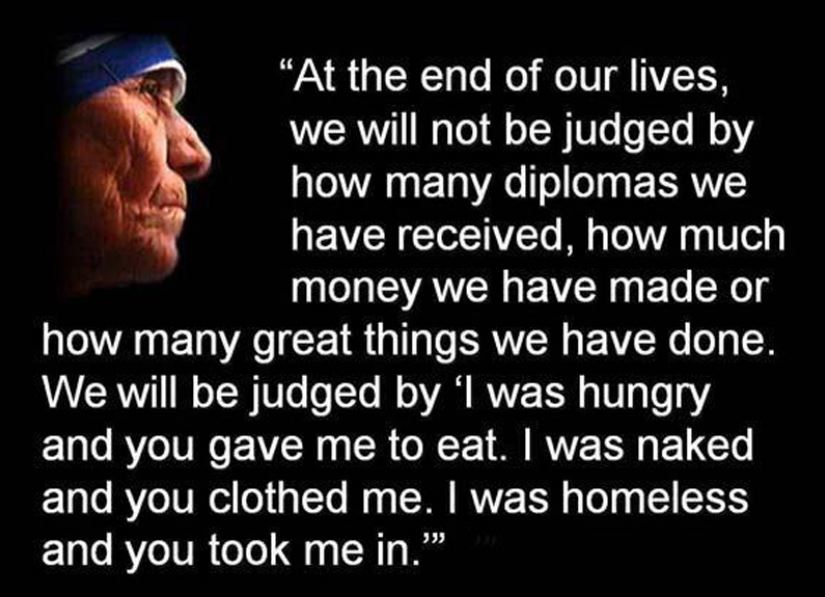
So wait a minute – what is Yeshua (Jesus) saying to his disciples in this passage? Who are the people He speaks of who are blessed by His Father (and ours)? And what did He mean two verses earlier when King Messiah Yeshua said that He will “…separate the sheep from the goats” (Matt 25:32)? In verses 35-36, Yeshua goes on to say: “For I was hungry and you gave me food, I was thirsty and you gave me drink, I was a stranger and you welcomed me, I was naked and you clothed me, I was sick and you visited me, I was in prison and you came to me”.

If we go back to the Tanach (Old Testament) we can see prophecies of the warnings and future judgment Yeshua was speaking of in Matthew 25:

  • Ps 37:22 – For those blessed by Him shall inherit the earth, but those cursed by Him shall be cut off.
  • Isa 58:7 – Is it not to share your bread with the hungry, and that you bring to your house the poor who are cast out; when you see the naked, that you cover them, and not hide yourself from your own flesh?
  • Eze 18:7 – …but have given their bread to the hungry and covered the naked with clothing.
  • Eze 34:17 – And as for you, O My flock, thus says the Lord God: “Behold, I shall judge between sheep and sheep, between rams and goats”

These verses seem disjointed and not directly related to Yeshua’s words in His Olivet discourse, until you look at the full context surrounding these verses. You might wonder, for instance, why YHVH would be judging between sheep and sheep. Let’s look at the passage in Ezekiel 34 preceding Verse 17. YHVH had just been speaking (through Isaiah) about how He would judge the false shepherds who were mistreating the flock and leading them into pagan practices (vv. 7-10). Then in Verses 11-16 He speaks of seeking out His sheep and bringing them back from all the nations of the world where they have been scattered, so that He can bring them to a place of comfort and peace: “they shall lie down in a good fold and feed in rich pasture” (Eze 34:15).

Then in Verse 16 He says: “I will seek what was lost and bring back what was driven away, bind up the broken and strengthen what was sick; but I will destroy the fat and the strong, and feed them in judgment.” Abba is promising here to take care of His obedient sheep; those who were led astray by the false shepherds but now desire to follow the true Shepherd. But He will judge those sheep who are continuing to follow the way of the false shepherds and are not willing to trust in YHVH and follow His way.

So how do we recognize someone who is following YHVH’s path and trusting Him with their whole heart? According to Isaiah 58, Matthew 7 and other passages, we will know them by their fruit (see Matt 7:20). It is clear that in Matthew 25:35-36, Yeshua is referring back to the words YHVH was speaking to His people through Yeshayahu (Isaiah) In Isaiah 58:7. In the Isaiah passage, YHVH was instructing His children that it was far more important to Him that they care for the poor and needy, than that they follow their religious rituals.

As we have said many times before, our spiritual journey is all about relationship with YHVH. If you truly want to be pleasing to YHVH and walk in His path, then you need to learn what pleases Him. More to the point, you need to get to know Him personally, not just learn about Him. As you draw closer to Abba Father and His Son Yeshua, you will get to know what is at the core of their heart. When you dig down deep, you will find love, compassion, understanding and empathy for the oppressed and downtrodden among their people. So you might say to this: “how do I help all the poor and hungry, oppressed and abandoned people; how do I visit all the prisoners, take in all the homeless, and clothe the naked; how do I care for all the orphans and widows if the earth? This is much too daunting a task and far too overwhelming for one person.”

If you have a true relationship with YHVH, though, as your closest friend and trusted counselor, then He will show you where He wants you to help His children. Most likely He will start you off with something small, for example, working at a local soup kitchen, visiting shut-ins or elderly people in nursing homes, helping needy widows with small tasks around their homes, or a host of other things. Abba will not only point you to the places He wants you to help, but He will give you all the gifts you need for the task, however great or small. Go to Abba and ask Him what is on His heart; when you seek Him with your whole heart, you will find what is in His heart.