Tag Archives: sin

Who Is Yeshua?

Yeshua is everything to us:  our salvation, our hope, our future, to name a few. It is important to get to know Him as well as possible.  We can do this by interacting with Him and also by reading the Bible.  It is the word of Yehovah and Yeshua is the living Word of Yehovah.  This series, entitled “Who Is Yeshua?” will consist of twenty-one articles. Each article will explore a different section of the Bible to discover different titles and roles of Yeshua and our response to each role. In the fourteenth article in the series, Yeshua is Advocate.

My little children, I am writing these things to you so that you may not sin. And if anyone sins, we have an Advocate with the Father, Jesus Christ the righteous; and He Himself is the propitiation for our sins; and not for ours only, but also for those of the whole world (1 John 2:1-2).

If you look closely throughout Scripture, you may notice that our Heavenly Father is also the King and Judge over all that He has created and, in particular, over all the earth.  There are times, as in the days of Noah, that our Father warned the inhabitants of the earth that they were straying far from His ways and entrenching themselves in evil. When they continued to disregard Him, our Father, who is also King and Judge, pronounced sentence upon them.  Only Noah and his family were spared because they heeded Yehovah and followed his ways (Gen 5:32-10:1). Other examples include Sodom and Gomorrah (Gen 19); Nineveh, although that sentence was revoked due to their repentance (Jonah 3); and the dispersion of the Jews and the destruction of the second Temple in 70 AD (as Yeshua prophesied in Matt 24). 

As humans, we stray from Yehovah’s laws and we don’t always heed His warnings right away.  We need an advocate in Heaven to represent us before the Judge.  According to Easton’s Bible dictionary, an advocate is one who pleads another’s cause, who helps another by defending or comforting him.  Yeshua is our Advocate in Heaven, seated at the right hand of Yehovah.  Since the courtroom is in Heaven and we are residing on earth, we have another Advocate on earth to represent us and counsel us here. The Holy Spirit is our Advocate on earth (John 14:16, 15:26, 16:7). The roles of an advocate are to defend rights, to fight for needs and rights for other people, and assist others. 

It is a frightening thing to try to defend yourself in an earthly court; how much more so to try to defend yourself before the King and Judge of all creation. It is wise to repent and ask forgiveness as soon as we realize that we have sinned. We are not alone for we have advocates to assist us and advise us. Both advocates represent us in Heaven’s Court and both counsel us.  The Holy Spirit not only counsels us directly, but also relays Yeshua’s advise to us (John 16:14). If we will heed their advice and submit to our Father’s rule, we will have no need to be judged.  However, if we stray, we have two powerful advocates to plead our cause before the Judge and to advise us. They are clearly on our side, so it is in our best interest to heed their advice.

When another person complains to the Father about us or when the adversary, who constantly seeks opportunities to destroy us (1 Pet 5:8) raises accusations against us, the Righteous Judge must address the matters brought before Him.  Thanks to His merciful provision, we already have two court-appointed advocates to plead our cause and intercede for us.   

Since Yeshua has lived upon this earth as one of us and has suffered as we suffer, He understands our weakness and is an empathetic Advocate.  He knows our hearts and can plead for us based on what’s inside of us, unlike an advocate in an earthly court who can only work with external evidence.

Every time we are found guilty or plead guilty in Heaven’s court, there is a corresponding debt to be paid, one that we cannot pay for ourselves.  Our Father, the righteous Judge, does not cancel our debt and pretend our sin hasn’t happened when we stand before Him.  However, in His infinite mercy, our Father has provided the payment for our sin, through the sacrifice and blood of His first-born, His precious YeshuaYeshua is not only our Advocate in Heaven, but He has already given His life for us and provides the payment for our debt with His own blood. Once our debt has been paid, our sin is stricken from the record.  We see a picture of this in the commands concerning the scapegoat on the Day of Atonement as described in Leviticus 16. 

When we cooperate with the Righteous Judge and our two Advocates, everything works out beautifully in our favor and our rewards and benefits are bountiful.

This is an excellent time to ask forgiveness for your sins and invite Yeshua (Jesus) to be Lord of your life.  When we commit sin, we incur a debt that none of us can ever pay on our own.  It cannot be paid with earthly currency or even with great sacrifice on our part.  This debt can only be paid for by the blood of Yeshua which has already been shed for us. This is the greatest gift to ever be offered.  Don’t miss out.  After you have accepted Yeshua as your Lord and Savior, ask for baptism in the Holy Spirit.  The Holy Spirit will be your constant companion and Counselor and will equip you for Kingdom living.

Metal Reflections

living-tabenacles

This is the beginning of a new series (Living Tabernacles) where we will study the Tabernacle in depth. It is exciting to see how each element symbolizes some characteristic of Yeshua.  However, it is more challenging when we examine what each element means for us, for each of us is now a tabernacle of YHVH.   There will be two posts each month for this series.

The building of the Tabernacle involved participation on the part of the Israelites from the beginning.  YHVH showed Moshe the building plans and a heavenly model so that he would understand exactly what needed to be done (Exodus 25:9, Heb 8:5).  Then YHVH gave Moshe a list of items needed for the Tabernacle.  Moshe was instructed to share the list with the Israelites.  They were to take from their possessions in order to have the necessary building materials.  Where did they get the materials in the first place?  From YHVH Himself.  Whatever is good and perfect comes down to us from God our Father, who created all the lights in the heavens. He never changes or casts a shifting shadow (James 1:17).   Since the Israelites gave of their own possessions and, later on, their time and talents, they had a significant stake in the Tabernacle and in the worship of YHVH.

The list that YHVH gave to the Israelites was as follows:

  • gold, silver, and bronze;
  • blue, purple, and scarlet thread;
  • fine linen and goat hair for cloth;
  • tanned ram skins and fine goatskin leather;
  • acacia wood;
  • olive oil for the lamps;
  • spices for the anointing oil and the fragrant incense;
  • onyx stones and other gemstones to be set in the ephod and the priest’s chestpiece.

Every item on the list points not only to Yeshua, but to us who are seeking to become like Yeshua.  Each listed item symbolizes a characteristic of Yeshua and, by extension, should symbolize a characteristic of His followers.  What can we learn from this list?

In this first article we will examine gold, silver and bronze.  Gold and silver are precious metals and, for the Tabernacle, had to be “pure” (Exodus 25:11) and “refined” (1 Chronicles 28:18).  YHVH refines us through fiery trials so that we may be purified.  “Many will be purged, purified and refined, but the wicked will act wickedly; and none of the wicked will understand, but those who have insight will understand (Dan 12:10). Gold is symbolic of YHVH’s kingship, glory and holiness and we are meant to reflect His glory and holiness.  Gold is one of the least reactive chemical elements.  When the blood was sprinkled on the Ark of the Covenant (made of pure gold), the gold did not tarnish.  When we are sprinkled with adversity, it should not discolor or corrode us.

Silver signifies redemption, which means to purchase back at a cost. Yeshua paid the highest price to redeem us.  The Hebrew word for silver is ‘kesef,’ meaning a very strong desire. According to Strong’s Concordance, the root for this Hebrew word is:

H3700 – כּסף – kâsaph – kaw-saf’ – A primitive root; properly to become pale, that is, (by implication) to pine after; also to fear: – [have] desire, be greedy, long, sore.

Generally, when we purchase something at a steep cost, we expect to possess something of substantial value.  Yeshua “pined after” us so much that He was willing to lay down His life in order to get us back.  Do we pine after Yeshua to the extent that we are willing to lay down our lives in order to follow Him?

Many scripture passages tie bronze to sin and judgment.  The bronze Sea where the priests were to wash was constructed so that they could see their reflections in order to ensure that they did not miss any dirt.  Scripture and Yeshua (the living Torah) are our “bronze Sea” where we can examine ourselves in order to remove any stains or blemishes.  For it is not the hearers of the Law who are righteous before God, but it is the doers of the Law who will be declared righteous (Rom 2:13). For if anyone is a hearer of the word and not a doer, he is like a man who looks at his natural face in a mirror— 24 for once he looks at himself and goes away, he immediately forgets what sort of person he was. 25 But the one who looks intently into the perfect Torah, the Torah that gives freedom, and continues in it, not becoming a hearer who forgets but a doer who acts—he shall be blessed in what he does (James 1:23-25)

The bronze altar signifies that YHVH is willing to take our judgment upon Himself, but only if we are willing to repent of our sins.  In the case of King Zedekiah who was not willing to repent, we see that he was carried off to Babylon in bronze shackles (2 Kings 25:i7).  If we are not willing to repent of our sins, we will have to deal with YHVH’s judgment ourselves.

Just as the Israelites offered treasures, time and talent to build a Tabernacle for YHVH, each of us must do the same as we prepare ourselves as fitting tabernacles for YHVH.  We will continue our study of the significance of the elements in the next article in this series entitled Living Tabernacles.

Each of us is now a tabernacle for YHVH.  Yeshua replied, “All who love me will do what I say. My Father will love them, and we will come and make our home with each of them (John 14:23).  The materials for the Tabernacle were costly and of the finest quality.  What does your tabernacle look like?  How are the gold, silver, and bronze reflected in your tabernacle?

Releasing Love

God's Love

Many of us have accepted Yeshua as our Lord and Redeemer, yet we are unable to trust what He has accomplished for us.  Yeshua bore our punishment for all time so that we could maintain a relationship with YHVH and be a part of His family and His kingdom.  We have all heard this message preached, taught, argued and dissected until the words have perhaps become meaningless to us.   Words are not enough; each of us must experience the love of YHVH.

Too often Yeshua’s sheep silently struggle with guilt, regret, and shame that bog us down and block us from enjoying our Father’s overwhelming love.  Instead, we are inundated with misery that YHVH never intended for us to experience.  Do we believe that if we suffer enough, we can somehow make up for our sins?  Truly, there is no way that we can pay for even one sin.  It doesn’t seem right to us that we can repent and walk away free.  Perhaps that is why we find it so difficult to forgive those who have wronged us.  If others have made us suffer, then we feel justified in wanting them to suffer also.  We do not see things from YHVH’s perspective.  We forget how He rejoices over recovering the lost sheep (Luke 15:1-7) or re-uniting with the prodigal son (Luke 15:11-32).  When things go wrong, we think that YHVH is punishing us, even when we have repented and turned away from sin.  It is right to loathe the sin, but we must not loathe ourselves.

Our experiences in this world color our perception.  We assume that YHVH loves the way people love:  half-heartedly, sporadically, conditionally, and so on.  Over the last several months, I have encountered numerous others who are struggling to see themselves as YHVH sees them.  I, too, tend to see myself from a worldly perspective rather than as YHVH sees me.  YHVH loves us extravagantly not because of us, but because of who He is.  What does it mean to us that God is love?   1 Cor 13:4-7 provides some helpful insights.

YHVH does not keep a record of our wrongs and is not easily angered.  He is focused on us, not on Himself.  He believes in us, trusts us and hopes in us.  He is willing to endure all things so that we might be loved into reaching our full potential.  Derek Prince in a work entitled “The Divine Exchange” has provided a beautiful illustration of YHVH’s love through Yeshua’s sacrifice.  Below is a summary of “The Divine Exchange”.

  1. [Yeshua] was punished that we might be forgiven
  2. [Yeshua] was wounded that we might be healed
  3. [Yeshua] was made sin with our sinfulness, that we might be made righteous with His righteousness
  4. [Yeshua] tasted death for us that we might share His life
  5. [Yeshua] was made a curse that we might receive the blessing
  6. [Yeshua] endured our poverty that we might share His abundance
  7. [Yeshua] bore our shame that we might share His glory
  8. [Yeshua] endured my rejection that I might have His acceptance with the Father
  9. He was cut off that we might be joined to [YHVH]
  10. Our Old Man was put to death in Him that the New Man might come to life in us

Sin causes damage and loss.  In John 10:10, Yeshua tells us that the thief comes to steal, kill and destroy.  Yeshua came so that we might have abundant life.  Yeshua came to recover, restore, replace, re-unite and revive.   Let us throw off the temptation to dwell on the past, on what has been lost or destroyed, and focus instead on what Yeshua has done, is doing, and will do.

YHVH’s love releases us from every burden and barrier, so that we are free to release His divine love to others, including ourselves.  When we are truly set free by His love, we will be able to love as YHVH loves.


Inside Out

fruit of the Spirit 2

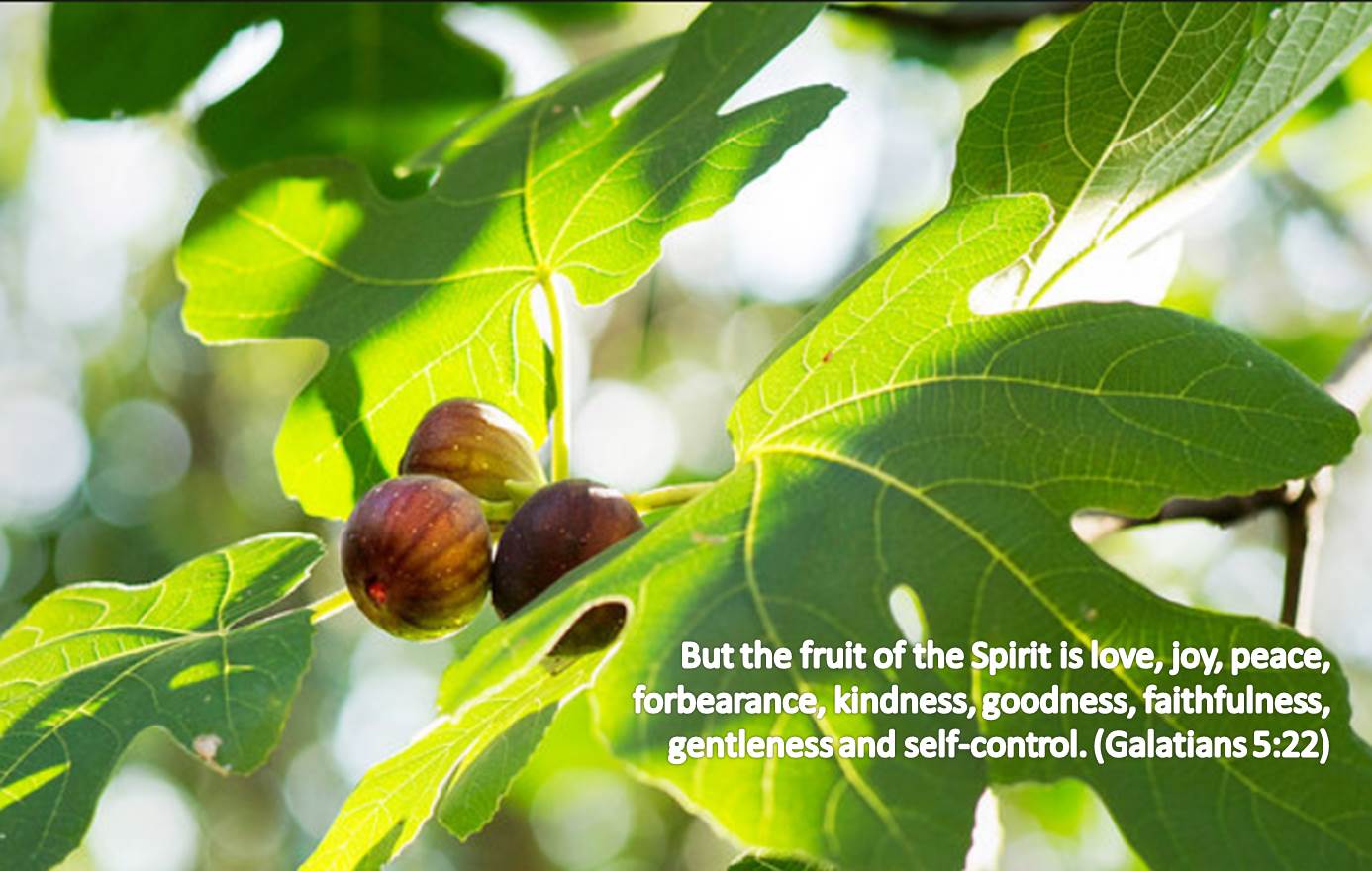
The account of the fig tree that Yeshua cursed (Matt 21:18-22, Mark 11:12-14) provides many lessons such as the power we have through Yeshua over our environment or the power of faith and trust. It also shows that we must bear good fruit. Since humans are sometimes referred to as trees in Scripture (Ps 1:3 52:8; Is 44:4) this fig tree may very well represent what can happen to us.

We usually do not think of a fig tree as having free will, yet because this fig tree did not perform in compliance with the way it was created, Yeshua cursed it. The fig tree withered and died. Whatever was wrong with the fig tree seems to have been happening “behind the scenes”. The tree was able to produce leaves to provide for its own sustenance, but it did not produce fruit for the sustenance of others. The fig tree had been provided with all that it needed in its creation to produce the expected fruit. It failed in its assigned task.

What lessons does this story hold for us? Yeshua has equipped us mightily so that we might bear good fruit. He has provided a way for us to reconcile with our Creator (Rom 5:10) so that we might learn wisdom (1 Cor 1: 28-31) from Him and have His protection (2 Thess 3:3). Yeshua Himself became our perfect example of how to produce excellent fruit (Luke 6:40). Before He returned to His Father, Yeshua further equipped us with the Holy Spirit so that we might bear the fruit of His Spirit (John 14:26). The Holy Spirit guides and equips us with spiritual gifts for the purpose of making us fruitful.

In addition to being our Comforter and personal Guide, the Holy Spirit works within our hearts and minds, refashioning us so that we might produce optimum fruit. It is our responsibility to yield ourselves to the work of the Spirit and to cooperate with Him. It is easy to let things slide and to drift along thinking everything is alright. On the outside, we may appear to be doing fine, but inside we may be in trouble.

The failure of trees to produce fruit may stem from one or more pests such as borers or fungi or a variety of diseases. The more one knows how a healthy tree is supposed to function and how to identify the culprit(s), the better the chances for correctly addressing the problem. It Is important to determine exactly what is causing the problem, so that the correct remedy may be applied.

The same is true for us. It is our responsibility to understand how we are expected to function and how to identify the culprit(s) that are eating away at our growth and effectiveness. It is also important for us to be on the lookout for any evil or weakness that may be hindering us.

In order to cooperate with the Holy Spirit, we must understand the spiritual realm. We are not as familiar with this realm as with the physical realm, so it takes more effort (Gal 3:1-3) to operate in the spirit realm. This is perhaps one of our biggest battles.

If we are not paying attention, spiritual diseases and pests may begin to eat away at us from the inside. We may not notice it until it is too late, until we are withering up and dying. We must make sure that it is the Holy Spirit who works in us and not the enemy. Let us be vigilant, so that when our Master approaches us expecting good fruit, He may delight in our yield.

Who Is to Judge?

Who are you to judgeThe topic of judging others leads us into sensitive territory. Discussing this subject tends to unveil misunderstanding, hurt feelings, defensiveness, and a host of other negative reactions in us. It seems that most people harbor strong ideas of what they mean by judging, how and when to “judge,” who is to be judged, and so on.

 Bible verses are quoted to bolster each viewpoint. In order to settle arguments and arrive at some practical solutions, it is wise to consider the original Greek word that was used and translated into the English word “judge”.  I consulted Strong’s Exhaustive Concordance to examine the Greek word used by the authors and translated into English as “judge”. Most New Testament passages using the verb “judge” are translated from the Greek (Strong’s number 2919. krino), and include, but are not limited to, the following passages:

Matt 7:1   “Judge not lest ye be judged…”

Luke 6:37 “Judge not and ye shall not be judged…”

John 7:24 Do not judge by appearance, but judge with right judgment.”

According to Strong’s, the Greek word krino means “to distinguish”. Implied meanings include: to try, condemn, punish. It can also mean avenge, conclude, condemn, damn, decree, determine, esteem, judge, go to (sue at the) law, ordain, call in question, sentence to, think.

When krino is used in the New Testament, it is generally used in passages that discourage believers from judging. Although Ephesians 4:25 reminds us to “speak truth to our neighbor,” there is no mention of judging our neighbor. Galatians 6:1 tells us to restore transgressors in a spirit of gentleness. We are also admonished to “keep watch on yourself, lest you too be tempted.” We are living in the kingdom of darkness and are still vulnerable to sin to some degree or another.  We are in no position to judge each other, but we are encouraged to assist each other in living according to YHVH’s ways.  If we judge others who sin, then we will be judged in the same way, because we too have our moments of weakness. We may concoct our own “levels” of sin, and conclude that our sins aren’t as bad as those of our neighbor, but beware.  All sin is an abomination to YHVH.

Some may argue that in 1 Cor 5:12, Paul is telling us that we are to judge believers.  Let us look at the context.  There was a person in the congregation at Corinth who was openly engaging in sinful behavior.  Paul was advising that the person be removed from the congregation so that he would not lead other believers to follow his corrupt behavior.  If the person was removed from the congregation, it was in the hopes that he would come to his senses and realize the danger of his poor choices.  There was no need for the others to place him into Satan’s hands; the sinner was already doing that.  Whenever any of us turn from YHVH, we automatically open the door to Satan.

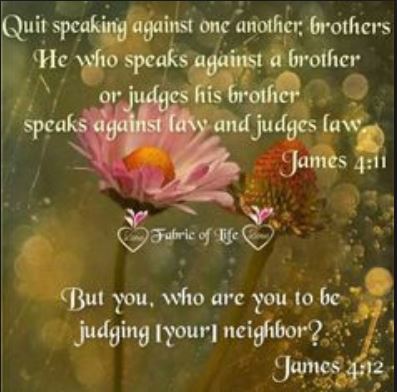
James 4:11-12 explains why we are not to judge.

“Speak not evil one of another, brethren. He that speaketh evil of his brother, and judgeth his brother, speaketh evil of the law, and judgeth the law, but if thou judge the law, thou are not a doer of the law, but a judge. There is one lawgiver, who is able to save and to destroy: who art thou that judgest another?”

The “lawgiver” is YHVH and the “law” or “Word” is Yeshua.  Yet, not even Yeshua judged others when He came to earth the first time, so it is not our place to judge others either (John 12:46-48). When Yeshua returns, He will judge others (2 Tim 4:1). Those who return with Yeshua to reign with Him will also judge the world (2 Cor. 6:2). While we are still in our imperfect state, we are not to judge, for we, too, are still weak enough to succumb to temptation. Therefore, we are to love and encourage each other and to gently admonish one another when necessary, but it is not our job to judge each other.

The Overlooked Sin

no one comes to the Father

The Jews had an opportunity to accept their Messiah or reject Him at His first coming. While many Jews accepted Yeshua as their kinsmen Redeemer and King, the majority did not. Over the centuries, many peoples have hated and persecuted the Jews, citing the rejection and crucifixion of Yeshua as “justification.” Many people smugly criticize the Jews and yet are guilty of the same sin.

The same challenge is presented to each of us. Do we accept Yeshua as our Redeemer and King? Have we asked for forgiveness of our sins and invited Yeshua to be King over us?

Jewish leaders resented Yeshua’s criticism of their man-made traditions and their hypocrisy. They wanted to do things their own way (Luke 6:1-12; Luke 7:29-30). They refused the help they so desperately needed.   Some people today say that belief in God is for weak people, not recognizing that they, too, are weak people who very much need a Savior. They believe that they are capable of running their own lives and sometimes the lives of others without Yeshua’s help.

Jewish people were looking for a leader who would save them from physical oppression (John 6:14-15). They didn’t realize that the spiritual oppression Yeshua overcame is far more serious and is also the root cause of the physical oppression. Many people today are focused solely on the physical realm, unaware or misunderstanding the spiritual realm. We can choose to renounce our subjection to Satan and embrace the salvation offered by Yeshua, but it is a choice that each of us must make in order to enter the Kingdom of YHVH.

Jewish people believed that being born Jewish was sufficient or that following the traditions and rituals established by men would secure them a place with YHVH.

Many people today believe that it is enough to be a “basically good person” or to belong to a particular denomination or congregation. Many people do not recognize their own sins, especially the most glaring one, the sin of rejecting Yeshua as their Redeemer (Luke 5:32).

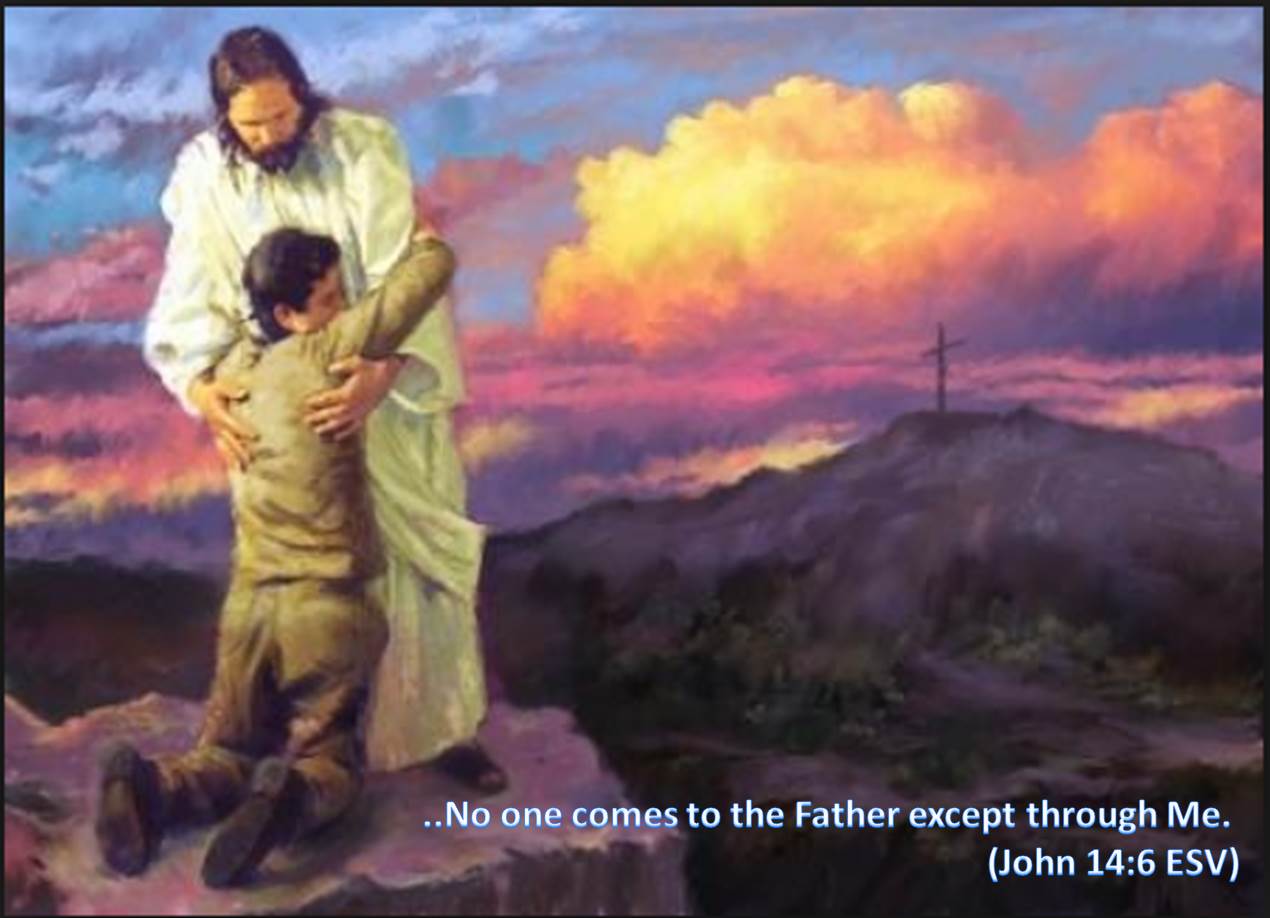
Yeshua died a gruesome, violent death to pay the penalty for our sins and to ransom us from the grip of the evil one. Do we honestly believe that we can ignore Yeshua’s redemptive work and make our own way into the Kingdom of YHVH? If this were true, then Yeshua’s work would have been a waste of time and effort. Do you honestly assume that YHVH made the agonizing decision to send His precious Son to be slaughtered on our behalf, but is now willing to overlook our rejection of His beloved Son and His hard-earned gift of salvation?

Do not be deceived. No matter how “good” you are and no matter how exemplary your life has been, you have absolutely nothing to offer that can save you from eternal damnation. You are like a drowning person who has been thrown a precious Lifeline. However, it is necessary to seize and cling to this Lifeline in order to be acceptable to YHVH.