Tag Archives: widows

Does God care about Genes or Jeans (Part 2)?

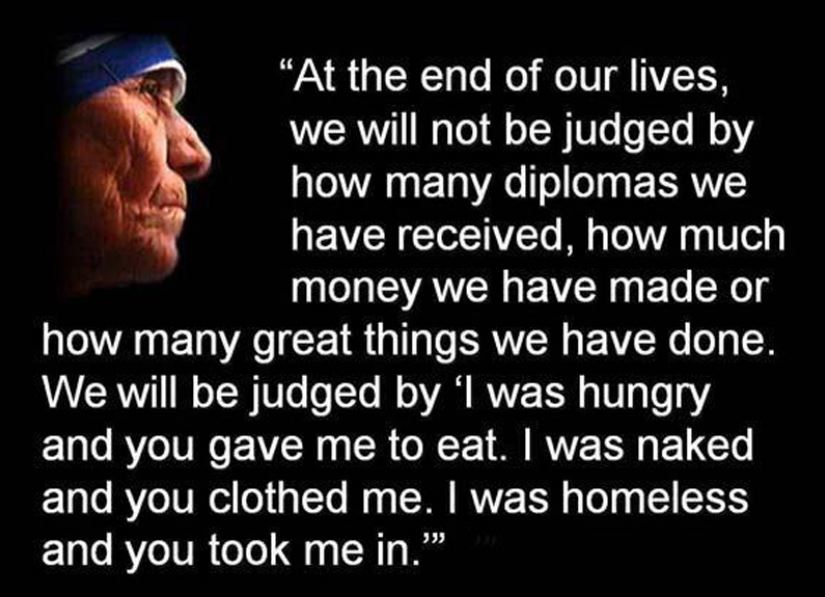
least of these

In Part 1 of this blog last week, I talked about who are YHVH’s children and those who should keep His Torah, and concluded that it is not Abraham’s biological descendants, but rather those who are His spiritual descendants.  The true children of YHVH’s covenant are those are following His will and trusting Him, keeping His Torah and striving to be pleasing to Him in every part of their lives.  That covered the “genes” part of this 2-part series.  This week I want to focus on what God sees when He looks at us: we know from Scripture that He looks on the inside of us and does not focus on our outer appearance or the level of recognition we merit from the world.  In other words, He doesn’t care whether we wear threadbare jeans vs. classy suits, or how many degrees we have achieved or awards we have won.

What is YHVH truly looking for when He looks deep down inside of our souls?  From Hebrews 4:12, we know that He “discerns the thoughts and intents of our heart”.  But what are His criteria in evaluating our hearts – does He look to see how perfectly we are following His Torah, or how diligently we are working to serve our congregation?  Psalm 58 gives us a beautiful window into YHVH’s heart, and we know that our hearts should line up with His heart as we seek to renew ourselves more into His image every day.

God is conveying a very strong message through Isaiah when He tells Him to shout it out with a shofar blast. (Isa 58:1)  He chastises His people for their false piety – they are trying to impress God by putting on sackcloth and ashes, and afflicting themselves severely when they fast.  The only ones they are impressing are people around them though, not YHVH.  He desires them to fast from their hearts when He says:

“..this is the kind of fasting I want: free those who are wrongly imprisoned; lighten the burden of those who work for you. Let the oppressed go free, and remove the chains that bind people. Share your food with the hungry, and give shelter to the homeless. Give clothes to those who need them, and do not hide from relatives who need your help”. (Isa 58:6-7)

If these concepts sound familiar to New Testament readers, that’s because they are.  Listen to what Yeshua said when He was speaking to the goats on His left and the sheep on His right:

“Then the King will say to those on His right, ‘Come, you who are blessed by My Father, inherit the Kingdom prepared for you from the creation of the world. For I was hungry, and you fed Me. I was thirsty, and you gave Me a drink. I was a stranger, and you invited Me into your home.  I was naked, and you gave Me clothing. I was sick, and you cared for Me. I was in prison, and you visited Me.’  “Then these righteous ones will reply, ‘Lord, when did we ever see You hungry and feed You? Or thirsty and give You something to drink? Or a stranger and show You hospitality? Or naked and give You clothing? When did we ever see You sick or in prison and visit You?’  “And the King will say, ‘I tell you the truth, when you did it to one of the least of these My brothers and sisters,[f] you were doing it to Me!’

“Then the King will turn to those on the left and say, ‘Away with you, you cursed ones, into the eternal fire prepared for the devil and his demons. For I was hungry, and you didn’t feed Me. I was thirsty, and you didn’t give Me a drink. I was a stranger, and you didn’t invite Me into your home. I was naked, and you didn’t give Me clothing. I was sick and in prison, and you didn’t visit Me.’  “Then they will reply, ‘Lord, when did we ever see You hungry or thirsty or a stranger or naked or sick or in prison, and not help You?’  “And He will answer, ‘I tell you the truth, when you refused to help the least of these My brothers and sisters, you were refusing to help Me.’  “And they will go away into eternal punishment, but the righteous will go into eternal life.”

What, then, is truly important to Abba Father when He looks into our souls?  From Yeshua’s words in Matthew 5:7, we know that He desires for us to be pure in heart, not obeying Him out of obligation but because we sincerely want to please Him from the depths of our heart.  And what does He say about those who are pure in heart?  ‘They shall see God’.

This takes us right back to the essence of our relationship with Yehovah – if we want to know Him intimately, we need to align our hearts with His, which means we will automatically do the things that please Him: feed the poor, take care of orphans and widows, shelter the homeless, etc.  In your life, try not to focus on the outward things, but look deep inside your heart.  In the ‘intents and desires of your heart’, after stripping away everything superficial, do you see what YHVH is looking for?

The Mighty Power of YHVH

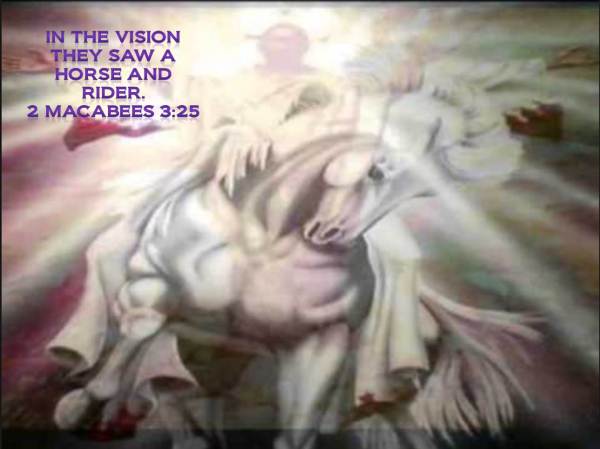
horse and riderTo celebrate Chanukah, we decided to read a portion of the story of the Maccabees each night.   The second book of Maccabees, chapter three has enlightened our understanding of the events leading up to the celebration of Chanukah. It has also provided us with insight and direction in dealing with issues that are currently challenging us.

Here is a brief summary of the chapter. There was a high priest named Onias who strictly obeyed the laws of YHVH. While Onias was high priest, Jerusalem enjoyed peace and prosperity, and received respect and generous gifts from the kings of many nations.

A man named Simon lost an argument with Onias and sought revenge by lying to Apollonius, governor of Greater Syria, and offering to him the money from the Temple treasury. Apollonius passed this misinformation on to the king, who sent a man named Heliodorus to confiscate the money. A portion of this money had been designated for the widows and orphans and a portion of it belonged to a wealthy man. To take the money would be to break YHVH’s laws concerning money deposited in the Temple treasury and would betray the trust of those who depended on the integrity of the ones in charge of the treasury. Heliodorus decided to confiscate the money anyway.

The priests and the people joined together in begging YHVH to protect the treasury money, praying on their faces before His altar. YHVH responded in a dramatic way. Heliodorus returned to the king without the money, but with a strong testimony concerning the power and faithfulness of YHVH.

This story speaks volumes to us as we seek funds to build a refuge for some widows in India. Just as the people of Jerusalem were on their faces before YHVH, the widows in our sister congregations spend much of each day on their faces, praying for the salvation of others. And yet, these women are considered curses in their society and are much oppressed.

We are in the process of raising funds for the construction of the widows’ home. As we began this process, the Holy Spirit led us to create a faith covenant with YHVH. Each day we remind YHVH of His promises towards the widows, orphans and the oppressed by reading aloud pertinent Scripture verses. Several weeks after we began our faith covenant, YHVH gave us His response to our covenant, which is Proverbs 15:25: “YHVH will tear down the house of the proud, but will establish the boundary of the widow.”

As developments unfold, we comprehend at new levels the depth of YHVH’s promise in this verse. Persecution against non-Hindus is on the rise in India. It is becoming more difficult to get the funds safely delivered to the congregational leaders. Local authorities who have been bent on persecuting our sister congregations are gaining more power. Our sister congregations, especially the leaders, are watched very carefully. We would be tempted to think that this cause is hopeless, but the Holy Spirit reminds us that this home for the widows is YHVH’s response to the cries of the congregants after the widows were thrown out of a temporary shelter and had their lives threatened.

Therefore, we believe that 2 Maccabees, chapter 3 illustrates for us our next step.   We are asking that those who support us in this effort storm heaven and remind YHVH of His promise in Proverbs 15:25. We believe He will hear our cries and respond in a powerful way if we stand on faith in this matter.

We have provided a copy of chapter 3 below for you to read and prayerfully consider. Note how many times YHVH miraculously intervenes to answer the cries of those who seek diligently to keep His laws.

II Maccabbees 3

When Onias[a] was High Priest in Jerusalem, the holy city enjoyed peace and prosperity, and its laws were strictly obeyed, because he was devout and hated evil. The kings of Syria and Egypt honored the Temple and presented it with expensive gifts, and King Seleucus, ruler of all Asia, even paid the costs of the Temple sacrifices from the revenues he collected.

But a man by the name of Simon, of the tribe of Bilgah, the chief administrative official of the Temple, lost an argument he had with Onias over the regulations governing the city market. At this time Apollonius son of Thraseus was the governor of Greater Syria. Simon went to him and said that there was so much money in the Temple treasury that it could not be counted, and since the money was not needed for sacrifices, it might as well be placed under the king’s control.

When Apollonius met with the king, he told him about the money, and the king ordered Heliodorus, his chief minister, to get it for him. Heliodorus set out at once on his mission, but he claimed that he was only making a tour of inspection of the cities of Greater Syria. After he had arrived in Jerusalem and had been warmly received by the High Priest, he explained the real reason for his visit and asked if what he had been told was true. 10-11 The High Priest then stated that Simon, that devil of a man, had not been elling the truth. There was indeed some money in the Temple treasury, but part of it was set aside for widows and orphans and part of it belonged to Hyrcanus son of Tobias, a very important man. He also pointed out that the total amount was only 30,000 pounds of silver and 15,000 pounds of gold. 12 He added that it was absolutely impossible that anyone should be permitted to take the money of those people who had placed their trust in the sanctity and safety of this world-famous Temple.

13 But Heliodorus insisted that the money should be taken for the royal treasury, as the king had ordered. 14 So he set a day and went into the Temple to supervise the counting of the money. This caused an uproar throughout the entire city. 15 Priests, wearing their priestly robes, threw themselves face downward before the altar and begged God to keep the money safe, since he had given the laws designed to protect the money that people deposited in the Temple. 16 It was heartbreaking to see the High Priest. His face turned pale, revealing the agony of his soul, 17 and his body was trembling with fear, reflecting the pain in his heart. 18 People ran from their houses to join together in prayer that the Temple might not be defiled. 19 Women, wearing nothing but skirts of sackcloth, crowded the streets. Young girls whose parents had never allowed them to be seen in public ran to the gates or to the walls of the city, or just stared out of their windows. 20 But wherever they went, they lifted their hands to God in prayer. 21 What a pitiful sight it was to see the High Priest in such great agony and frustration and to see everyone in the city confused and lying face down on the ground.

22 While everyone was begging the Lord Almighty to protect the money that had been entrusted to his care, 23 Heliodorus went on with his plan. 24 But at the very moment that he and his bodyguards arrived at the treasury, the Lord of all supernatural powers caused such a vision to appear that everyone who had dared to enter with Heliodorus was panic-stricken and weak with fear at this display of the Lord’s power. 25 In the vision they saw a horse and a rider. The horse had a richly decorated bridle, and its rider, dressed in gold armor, was frightening. Suddenly the horse rushed at Heliodorus, then reared up and struck at him with its hoofs. 26 Heliodorus also saw two unusually strong and handsome young men, wearing very fine clothes. They stood on either side of him and beat him unmercifully. 27 He immediately fell to the ground unconscious, and his men put him on a stretcher 28 and carried him out. Only a moment earlier this man had entered the treasury with a large group of men, including all his bodyguards, but now he was being carried away helpless. So they all openly acknowledged the mighty power of God.

29Heliodorus lay there unable to speak and without hope of recovery from this demonstration of God’s power. 30But the Jews praised Almighty God because he had miraculously protected his Temple and had brought great happiness where only minutes before there had been fear and confusion. 31 Some of Heliodorus’ friends quickly asked Onias the High Priest to pray that the Most High would spare the life of this man who was at the point of death. 32 So the High Priest offered a sacrifice in the hope that God would save Heliodorus, for he did not want the king to think that the Jews had done this to the man he had sent. 33 While Onias was offering the sacrifice, the two young men, wearing the same clothes as before, again appeared to Heliodorus and said,

Be grateful to the High Priest; the Lord has spared your life because of him. 34 Remember that it was the Lord of heaven who punished you. Now go and tell everyone of his great power.  When they had said this, they disappeared.

35 So Heliodorus offered a sacrifice to the Lord and made many promises, because the Lord had spared his life. Then he said good-bye to Onias and returned with his army to the king. 36 There he told everyone what the Lord, the most powerful of all gods, had done.

37 When the king asked Heliodorus who would be the best man to send on the next mission to Jerusalem, Heliodorus replied, 38If you have an enemy or know of someone plotting against your government, send him. He will come back badly beaten, if he comes back at all, for some strange power from God is at work there. 39The God of heaven watches over the Temple; he strikes down and destroys anyone who comes to harm it.

40 That is the story of how the Temple treasury was protected from Heliodorus.

Will You Inherit YHVH God’s Kingdom?

I was hungry and you gave me food“Then the King will say to those on His right, ‘Come, you who are blessed by My Father, inherit the Kingdom prepared for you from the foundation of the world.” Matt 25:34

So wait a minute – what is Yeshua (Jesus) saying to his disciples in this passage? Who are the people He speaks of who are blessed by His Father (and ours)? And what did He mean two verses earlier when King Messiah Yeshua said that He will “…separate the sheep from the goats” (Matt 25:32)? In verses 35-36, Yeshua goes on to say: “For I was hungry and you gave me food, I was thirsty and you gave me drink, I was a stranger and you welcomed me, I was naked and you clothed me, I was sick and you visited me, I was in prison and you came to me”.

If we go back to the Tanach (Old Testament) we can see prophecies of the warnings and future judgment Yeshua was speaking of in Matthew 25:

  • Ps 37:22 – For those blessed by Him shall inherit the earth, but those cursed by Him shall be cut off.
  • Isa 58:7 – Is it not to share your bread with the hungry, and that you bring to your house the poor who are cast out; when you see the naked, that you cover them, and not hide yourself from your own flesh?
  • Eze 18:7 – …but have given their bread to the hungry and covered the naked with clothing.
  • Eze 34:17 – And as for you, O My flock, thus says the Lord God: “Behold, I shall judge between sheep and sheep, between rams and goats”

These verses seem disjointed and not directly related to Yeshua’s words in His Olivet discourse, until you look at the full context surrounding these verses. You might wonder, for instance, why YHVH would be judging between sheep and sheep. Let’s look at the passage in Ezekiel 34 preceding Verse 17. YHVH had just been speaking (through Isaiah) about how He would judge the false shepherds who were mistreating the flock and leading them into pagan practices (vv. 7-10). Then in Verses 11-16 He speaks of seeking out His sheep and bringing them back from all the nations of the world where they have been scattered, so that He can bring them to a place of comfort and peace: “they shall lie down in a good fold and feed in rich pasture” (Eze 34:15).

Then in Verse 16 He says: “I will seek what was lost and bring back what was driven away, bind up the broken and strengthen what was sick; but I will destroy the fat and the strong, and feed them in judgment.” Abba is promising here to take care of His obedient sheep; those who were led astray by the false shepherds but now desire to follow the true Shepherd. But He will judge those sheep who are continuing to follow the way of the false shepherds and are not willing to trust in YHVH and follow His way.

So how do we recognize someone who is following YHVH’s path and trusting Him with their whole heart? According to Isaiah 58, Matthew 7 and other passages, we will know them by their fruit (see Matt 7:20). It is clear that in Matthew 25:35-36, Yeshua is referring back to the words YHVH was speaking to His people through Yeshayahu (Isaiah) In Isaiah 58:7. In the Isaiah passage, YHVH was instructing His children that it was far more important to Him that they care for the poor and needy, than that they follow their religious rituals.

As we have said many times before, our spiritual journey is all about relationship with YHVH. If you truly want to be pleasing to YHVH and walk in His path, then you need to learn what pleases Him. More to the point, you need to get to know Him personally, not just learn about Him. As you draw closer to Abba Father and His Son Yeshua, you will get to know what is at the core of their heart. When you dig down deep, you will find love, compassion, understanding and empathy for the oppressed and downtrodden among their people. So you might say to this: “how do I help all the poor and hungry, oppressed and abandoned people; how do I visit all the prisoners, take in all the homeless, and clothe the naked; how do I care for all the orphans and widows if the earth? This is much too daunting a task and far too overwhelming for one person.”

If you have a true relationship with YHVH, though, as your closest friend and trusted counselor, then He will show you where He wants you to help His children. Most likely He will start you off with something small, for example, working at a local soup kitchen, visiting shut-ins or elderly people in nursing homes, helping needy widows with small tasks around their homes, or a host of other things. Abba will not only point you to the places He wants you to help, but He will give you all the gifts you need for the task, however great or small. Go to Abba and ask Him what is on His heart; when you seek Him with your whole heart, you will find what is in His heart.

Spiritual Maturity: Dying for Justice

Blessed are they

In Isaiah 1:17, YHVH tells us “Learn to do good. Seek justice, relieve the oppressed, defend orphans and plead for the widow.” If Yeshua were to return today, would He find justice in the world? Let us examine some statistics on each of the three categories mentioned in Isaiah, both worldwide and in the United States.

Oppressed people are often homeless, jobless or underemployed, and usually lack basic necessities. They are among the most vulnerable and abused of people, but are the least able to defend themselves or to make their voices heard. They are the “Lazarus” of Yeshua’s parable found in Luke 16:19-31.

  •  The United Nations Commission on Human Rights reports that as of 2005, over 100 million people were homeless worldwide.
  •  In a 2004 study on homelessness in 50 United States cities, the National Law Center on Homelessness and Poverty reported that each city’s official estimate of homeless people greatly exceeded the number of emergency shelter and transitional housing spaces available. As of 2008, an average of 26 percent of homeless people were considered mentally ill, 13 percent were physically disabled, 19 percent were victims of domestic violence, and 13 percent were veterans (U.S. Conference of Mayors, 2008).
  • According to UNICEF, 22 million children worldwide die from poverty each day.
  • Almost 1 in 4 (16 million) children in the United States live in families with income below the federal poverty level (National Center for Children in Poverty, 2014).
  •  According to the Christian Alliance for Orphans, there are 153 million orphans worldwide.
  • Approximately 245 million women around the world have been widowed and more than 115 million of them live in devastating poverty (“Invisible Forgotten Sufferers: The Plight of Widows around the World”, 2010).
  • In the United States over 48% of the elderly poor are widows, even though widowed women are only 26% of the over-65 population (“Invisible Forgotten Sufferers: The Plight of Widows around the World”, 2010).

Multitudes in the world are dying from a lack of justice.  For individuals these figures are overwhelming.  What can one person or a small group of people do to make any significant impact? However, as of 2010 there were over 2 billion Christians worldwide.   (“Global Christianity—A Report on the Size and Distribution of the World’s Christian Population,” Dec. 19 2011).  It is time to die to ourselves, set aside our differences, and unite with our brothers and sisters in Yeshua.  As a united Body of Messiah Yeshua what could we do to address these and many other injustices in the world?  As an individual, what is YHVH calling you to do?

Getting to Know YHVH

WidowsInCloudsWho is YHVH and what is He like? We do not see Him, but we see the work that He does. Although our planet is relatively small compared to the planets in the rest of the solar system, humans have yet to discover everything about it. Each ecosystem, creature, and plant has been carefully designed and crafted to fulfill His purpose. Consider the intricacies of interdependence among the plants and animals in just one ecosystem.

 We know even less about our universe and beyond. YHVH demonstrates through His creation that He is more complex than we can imagine. The Book of Job describes some elements of YHVH’s majesty (Job 26:7-14). YHVH not only created the stars, but He arranged them to tell the story of our salvation. (See “The Gospel Witness in the Stars” posting)

YHVH tracks the smallest particulars of His creation. He knows our thoughts and actions Ps 139:2) and keeps track of the hairs on our heads (Luke 12:7, Matt 10:30). He is concerned with the details of our lives (Matt. 6:25-34).  Nothing escapes His notice.

The Israelites had the opportunity to hear YHVH’s voice and witness some of His glory (Exodus 19) and it frightened them. They were overwhelmed by His power and majesty. And yet our awesome God demonstrates incredible patience and longsuffering in the face of abuse from those whom He created. He patiently worked with the Israelites for over forty years just as He continues to do with us. The most graphic example of His longsuffering is the cruel agony and death Yeshua endured in order to take our punishment and pay our ransom so that we could be reunited with YHVH.

Think of our individual size compared to the earth. We are like miniscule ants on this planet. Yet, our Creator fashioned us in His image and likeness and then took on human form in order to dwell with us. It is wise to have deep reverence and respect for the awesome power and majesty of YHVH. And yet, He desires to call us His children and to take care of us individually. (2 Cor 6:19-20, John 1:12, 1 John 3:1). We are not to forget that He is our Creator and King, but we must balance this with His incredibly deep love and tenderness towards us as our Father. One glimpse of YHVH’s compassion can be found in Jonah, chapter 4.

 YHVH is especially compassionate towards those who are defenseless in our fallen world. Search the Scriptures for YHVH’s attitude towards widows, orphans, the newcomers (strangers or sojourners in the land), and others who are particularly vulnerable. You will see that YHVH is consistently adamant about fair treatment and dignity for those considered the least in society.

 YHVH wants a personal relationship with you. He wants to bless you and show you how to live life to the fullest. Do not disregard the best relationship you can ever have for it is the purpose of your life (Deut 30>19-20).