Tag Archives: Yeshua

Will You Inherit YHVH God’s Kingdom?

I was hungry and you gave me food“Then the King will say to those on His right, ‘Come, you who are blessed by My Father, inherit the Kingdom prepared for you from the foundation of the world.” Matt 25:34

So wait a minute – what is Yeshua (Jesus) saying to his disciples in this passage? Who are the people He speaks of who are blessed by His Father (and ours)? And what did He mean two verses earlier when King Messiah Yeshua said that He will “…separate the sheep from the goats” (Matt 25:32)? In verses 35-36, Yeshua goes on to say: “For I was hungry and you gave me food, I was thirsty and you gave me drink, I was a stranger and you welcomed me, I was naked and you clothed me, I was sick and you visited me, I was in prison and you came to me”.

If we go back to the Tanach (Old Testament) we can see prophecies of the warnings and future judgment Yeshua was speaking of in Matthew 25:

  • Ps 37:22 – For those blessed by Him shall inherit the earth, but those cursed by Him shall be cut off.
  • Isa 58:7 – Is it not to share your bread with the hungry, and that you bring to your house the poor who are cast out; when you see the naked, that you cover them, and not hide yourself from your own flesh?
  • Eze 18:7 – …but have given their bread to the hungry and covered the naked with clothing.
  • Eze 34:17 – And as for you, O My flock, thus says the Lord God: “Behold, I shall judge between sheep and sheep, between rams and goats”

These verses seem disjointed and not directly related to Yeshua’s words in His Olivet discourse, until you look at the full context surrounding these verses. You might wonder, for instance, why YHVH would be judging between sheep and sheep. Let’s look at the passage in Ezekiel 34 preceding Verse 17. YHVH had just been speaking (through Isaiah) about how He would judge the false shepherds who were mistreating the flock and leading them into pagan practices (vv. 7-10). Then in Verses 11-16 He speaks of seeking out His sheep and bringing them back from all the nations of the world where they have been scattered, so that He can bring them to a place of comfort and peace: “they shall lie down in a good fold and feed in rich pasture” (Eze 34:15).

Then in Verse 16 He says: “I will seek what was lost and bring back what was driven away, bind up the broken and strengthen what was sick; but I will destroy the fat and the strong, and feed them in judgment.” Abba is promising here to take care of His obedient sheep; those who were led astray by the false shepherds but now desire to follow the true Shepherd. But He will judge those sheep who are continuing to follow the way of the false shepherds and are not willing to trust in YHVH and follow His way.

So how do we recognize someone who is following YHVH’s path and trusting Him with their whole heart? According to Isaiah 58, Matthew 7 and other passages, we will know them by their fruit (see Matt 7:20). It is clear that in Matthew 25:35-36, Yeshua is referring back to the words YHVH was speaking to His people through Yeshayahu (Isaiah) In Isaiah 58:7. In the Isaiah passage, YHVH was instructing His children that it was far more important to Him that they care for the poor and needy, than that they follow their religious rituals.

As we have said many times before, our spiritual journey is all about relationship with YHVH. If you truly want to be pleasing to YHVH and walk in His path, then you need to learn what pleases Him. More to the point, you need to get to know Him personally, not just learn about Him. As you draw closer to Abba Father and His Son Yeshua, you will get to know what is at the core of their heart. When you dig down deep, you will find love, compassion, understanding and empathy for the oppressed and downtrodden among their people. So you might say to this: “how do I help all the poor and hungry, oppressed and abandoned people; how do I visit all the prisoners, take in all the homeless, and clothe the naked; how do I care for all the orphans and widows if the earth? This is much too daunting a task and far too overwhelming for one person.”

If you have a true relationship with YHVH, though, as your closest friend and trusted counselor, then He will show you where He wants you to help His children. Most likely He will start you off with something small, for example, working at a local soup kitchen, visiting shut-ins or elderly people in nursing homes, helping needy widows with small tasks around their homes, or a host of other things. Abba will not only point you to the places He wants you to help, but He will give you all the gifts you need for the task, however great or small. Go to Abba and ask Him what is on His heart; when you seek Him with your whole heart, you will find what is in His heart.

ALL or nothing

how long o you peopleHow committed are we in our relationship with YHVH? What is it worth to us?  How much are we willing to risk? In theory, most of us would say that we would be willing to sacrifice everything. We know what the answer should be. However, in practice what do we risk? Are we willing to tithe our income or share with others when money is tight? Are we willing to endure rejection and criticism from our family and friends because of our relationship with YHVH?  How bad would it have to get before we crumble?

A few years ago, I thought I was strong in my relationship.  However, after only two weeks in harsh conditions with demonic forces all around, I was beginning to lose it. It was an eye-opener for me. It is one thing to sit in comfort and ease at home and imagine how you would handle hardship, persecution, and danger. It is quite another matter to actually live it.

For YHVH and His Son, our relationship is worth the deepest sacrifice.  YHVH sacrificed His only child, His beloved Son. To lose a child is a parent’s worst nightmare, especially to watch an innocent child die an excruciatingly painful death at the hands of one’s worst enemies.  If YHVH wanted a perfect human, He already had one.  It wasn’t enough. He risked what was most precious to Him for the hope of relationship with all of us.

Yeshua is YHVH’s only begotten Son. He was entitled to all the praise and adoration that creation could muster. Yet, He was asked to sacrifice all in order to gain those who had been created for His pleasure, but who were now His enemies. By the time He was arrested, He had been deserted even by his closest friends. He could offer salvation, but would anyone accept it? Yeshua focused solely on YHVH’s promises instead of all the abuse and agony heaped upon Him. Even His closest friends did not comprehend what He was doing for them. If He relied solely on what His five senses told Him, the prospects were bleak.

Yeshua sacrificed all that He had and, as a result, He gained those who believe in Him.  If He had not been willing to risk His comfort, His dignity, the clothes on His back and even His life, He would have gained nothing and we would be lost forever. Only Yeshua and His Father could see the potential in us.

He relinquished everything He had to reclaim those who had lost everything.

We are called to give all of ourselves to Yeshua, for in Him we have all that He has earned for us: relationship with YHVH, eternal life, and restoration of all we have lost. If we do not give our all to Yeshua, then we have nothing.

In approximately one-third of the world today, our brothers and sisters are giving their all to Yeshua. They suffer oppression, trials, and persecution, even torture and death for the sake of their relationship with Yeshua. The rest of us, who live in relative ease and freedom may one day be called to do the same. In the meantime, we can support our brothers and sisters by speaking out on their behalf, by interceding for them and by sending funds to sustain them.

Maybe through our prayers and actions on their behalf, we will be strengthened so that we will endure if we are required to give our all.

Where is Your Heart?

where your heart is“For where your treasure is, there your heart will be also.” Matthew 7:21

In the first installment of this series on the “Sermon on the Mount”, I talked about righteousness being the main focus of Yeshua’s Kingdom message. I also showed how He focused on the heart as opposed to head aspects of righteousness. In this message I want to illustrate exactly what Yeshua means by keeping the Torah and walking in righteousness at the heart level.

In order to understand how Yeshua (and therefore Abba Father) wants us to walk in righteousness in Yehovah’s Kingdom of light, we first need to dig down to a deeper level of scripture study. On the surface of these passages, it appears that Yeshua is saying things like: don’t focus on accumulating wealth (Matt 6:24), don’t judge others (Matt 7:1), don’t worry about your life (Matt 6:25), don’t show off when you’re helping out the poor (Matt 6:1), and don’t be a hypocrite about your fasting and praying (Matt 6:5,16).

However, when we dig down to the heart level of Yeshua’s message, we can quickly see that He is really talking about building healthy relationships as we are following the Torah and walking in righteousness. Let me give you a couple of brief object lessons to illustrate what I mean. Imagine for a moment that you are a member of a large congregation, and that every week when you go to worship services, you spend a few minutes before and after service saying hello and shaking hands with people that you either don’t know, or you know only as once-a-week acquaintances. You might even ask these people how they are doing or whether everyone is healthy in their family, but are you just going through the motions or sincerely reaching out to these people?

In the same way, let’s say you work with “Meals on Wheels” and take meals to home-bound people every day, but you never speak to them or show that you care about them in any way (other than just doing your job to help the poor because you know you’re supposed to). Do you think those people are going to think of you in a kind and caring way? Or will they just see that you are doing this out of obligation and you don’t really care about them personally? What is your heart motive in this scenario – are you doing this to feel good or look good, or do you truly look for ways to bring Yeshua’s love to them?

The key point Yeshua was addressing in His message is that you can be the most righteous person on earth from a human perspective (as many of the Pharisees were), doing good works every moment of the day. However, since Yehovah looks on the heart, from His perspective you could be like a whitewashed tomb (Matt 23:27), appearing to be good and righteous on the outside, but inside you are nothing but filthy rags (Isa 64:6). In this case, Yeshua could rightly say to you: ‘…I never knew you; depart from Me, you who practice lawlessness!” (Matt 7:23).

YHVH requires that we “…do justly, love mercy, and walk humbly with our God” (Micah 6:8). He certainly wants us to follow His instructions in the Torah, but He judges us by our heart attitudes and motives more than by our actions. We would do well to examine ourselves from His perspective, following His word in our hearts and not just our heads.

Seek First the Kingdom of God [Elohim]

But seek first the kingdom of God“And He came down with them and stood on a level place, with a great crowd of His disciples and a great multitude of people from all Judea and Jerusalem and the seacoast of Tyre and Sidon, who came to hear Him and to be healed of their diseases…” Luke 6:17-18

What was happening in Yeshua’s ministry on earth when He spoke the messages in the “Sermon on the Mount”? What we know from Scripture is that the Pharisees were angry with Yeshua because His teachings did not follow theirs and because He was drawing large crowds wherever He went. So what was He teaching that was so radical, and that went against the Pharisees’ teachings? Yeshua was teaching about the Kingdom of God (also called the Kingdom of Heaven) and how they could not only be a part of the Kingdom on earth, but that the Kingdom was now within them!

Yeshua spoke about righteousness as the main theme of the Kingdom in Matthew 6:33: “But seek first the kingdom of God and His righteousness, and all these things will be added to you”. Also in Matthew 5:6,10 and 13:43, Yeshua says that “the righteous will shine like the sun in the kingdom of their Father.”  The Pharisees spoke about righteousness, but their form of righteousness was from following the Law (Torah) according to their interpretation of the Law, which included all of their man-made laws. Yeshua wanted to clearly distinguish between the righteousness that God expected in His gracious Kingdom and the righteousness of the Pharisees’ legalistic (man-made) kingdom.

Yeshua followed the Torah instructions in every way, and told us that He still wanted us to follow them. In Matthew 5:18 Yeshua states that not one jot or tittle will pass away from the Torah until heaven and earth pass away.  Yeshua had a very different interpretation of how an obedient follower was to keep the Torah.  For instance, the oral law of Moses said that a man could divorce his wife by simply giving her a certificate of divorce (see Matt 5:31).  However, Yeshua said that “whoever divorces his wife for any reason except sexual immorality causes her to commit adultery” (Matt 5:32). Obviously Yeshua did not follow the oral law or any of the codes of law that were added to the Torah by the Pharisees (since He already said above that nothing in the Torah would or could be changed).

The Pharisees believed in keeping the Law with their heads but not their hearts.  Yeshua said in Matthew 12:34 that the Jewish leaders were speaking and doing good, but at the same time thinking evil in their hearts.  Yeshua, on the other hand, was teaching Abba Father’s interpretation of the Torah: that His children are to keep His Torah in their hearts and not just in their minds.  Here are a few examples of heart obedience that Yeshua gives in Matthew and Luke:

  • Matthew 5:21-26: murder begins in the heart
  • Matthew 5:27-31: adultery begins with lust which comes out of the heart
  • Luke 6:36: “Be merciful, even as your Father is merciful.” (speaking of loving our enemies)

Yeshua’s underlying guidance on how to live our lives is the same as the Father’s – follow Torah with our minds and our hearts. Our gracious God has not only given us instructions for living life to the fullest, but He forgives us when we slip up. He wants us to have a genuine relationship with Him and with each other.  A true relationship involves the heart as well as the mind.

When Will Yeshua Return?

blessed is He who comesAmid endless speculation and discussion concerning end times events, and especially the timing of Messiah Yeshua’s return, one important factor is often overlooked. Both the Old and New Testaments agree that one thing must happen before Yeshua will return (Matt 23:39). The Jews as a group must invite Yeshua to return.

At Yeshua’s first coming, He announced that He was the long-awaited Messiah and performed signs and wonders that only Messiah would be able to perform. However, many of the Jewish leaders were threatened by Messiah’s coming. Yeshua criticized their practices and leadership. They did not humble themselves and submit to Messiah’s kingship, but rejected Yeshua and many Jews followed the guidance of their leaders and rejected Him as well.

 Yeshua warned them that He would not return to them until they proclaimed, “Blessed is He that comes in the name of YHVH.” In 70 AD the Temple was destroyed as and the Jews were killed or driven from Israel. Although, there has always been a small remnant of Jews who remained in the land, the Jewish people would not again reside in the land as a nation until 1948.

 It is now over 70 years since Israel was declared a nation once again. So, why hasn’t the nation of Israel made the statement necessary to usher in Messiah Yeshua’s return? What are the obstacles to Israel welcoming Yeshua as Messiah? The list below provides some insight:

  • Persecution of Jews at the hand of Christians in the name of Jesus for 2000 years
  • Reading the New Testament is forbidden or discouraged for many Jews since it is viewed not only as heresy, but is perceived as a hate document due to the aforementioned persecution
  • Key passages of Old Testament Scripture pointing to Yeshua are forbidden reading or are not included in the Parasha series in most Jewish congregations.
  • False teaching and tradition regarding Yeshua from both Jewish and Christian leaders
  • Fear of the loss of identity as Jews due to false Christian teaching (having to relinquish worship, feasts, Sabbaths, etc. and adopting practices that are not only foreign, but are even expressly forbidden by YHVH
  • Speaking the name of YHVH. Current common practice is that the name of YHVH is too sacred to be written or pronounced aloud, rendering it impossible to welcome the One Who comes in the name of YHVH.
  • Misunderstanding of the tri-une God and thus rejection of Yeshua as the Son of YHVH or as equal to YHVH because YHVH is one (echad). Actually, echad not only designates the number one in Hebrew, but can also designate unity, such as a husband and wife who are one (echad).

 Both Jewish and non-Jewish believers in Messiah Yeshua who yearn for Yeshua’s return can play a vital and active role in addressing and removing these obstacles. How can we make a difference?

 First, pray for the salvation of Israel and for the Jewish people still scattered throughout the world (Gen 12:2-3).

 Second, educate yourself and seek the truth concerning the history and development of Christianity, the various forms of persecution of the Jews by Christians over the past two thousand years, the reasons for avoiding the name of YHVH, and so on. Seek to understand the misconceptions of the Jewish people as well as your own misconceptions. Some suggested resources are listed at the end of this article (Hosea 4:6).

Third, reach out to the Jewish people with love and understanding. Seek forgiveness and reconciliation where needed (Ps. 133:1).

 YHVH has always known that the enemy would go all out to bring about the rejection of Messiah Yeshua and to try to prevent Yeshua’s return in glory. YHVH is well aware that the enemy would succeed in deceiving humans into cooperating with him. However, YHVH has graciously provided opportunities to each of us to shake off the lies, embrace the truth and reverse the present course

 YHVH carries out His plan through us even when our own efforts are misguided. This is clearly demonstrated in the gospel accounts of Yeshua’s entry into Jerusalem on a donkey just days before His crucifixion. The people were lined up with palm branches silently awaiting the arrival of the high priest’s spotless Passover lamb. His followers recognized the true spotless Lamb (Yeshua) and began to hail Him. The others, thinking that the high priest’s lamb had been spotted, joined in the chorus, not realizing that they were “accidentally” hailing the ultimate High Priest and Lamb.

 YHVH will see to it that the Jewish people recognize their Messiah. Yeshua will return to Jerusalem to begin His reign on earth. We can have the privilege of helping in YHVH’s plan by doing our part to bring about this glorious event.

Suggested Resources

Our Hands Are Stained with Blood by Michael L. Brown

Answering Jewish Objections to Jesus by Michael L. Brown (3 volumes)

Introducing Your Jewish Friend to Yeshua by Daniel Nessim and Mark Surey

The Messianic Church Arising!:Restoring the Church to Our Covenant Roots by Robert D. Heidler and Chuck D. Pierce

Restoring The Jewishness of the Gospel:  A Message for Christians Condensed from Messianic Judaism by David H. Stern

Messiah in the Feasts of Israel by Sam Nadler

Invisible Treasure

keep pursuing the goalAs discussed in previous article, Yeshua paid a heavy price for His treasure. We are His pearls of great value. Yeshua is our Pearl of great value, a value far beyond what we can comprehend. Yeshua was once on this earth, but we can no longer see Him. However, He is real and still very much alive, even though to us He is invisible right now.

Let us examine Scripture to learn some of the aspects of Yeshua’s value. The following list is but a fragment of all that describes Messiah Yeshua, but it is plenty for us to contemplate. Yeshua is fully human, but He is also fully God (Matt 16:16; 1 Tim 3:16)). Our treasure is God Himself! Our Father refers to Yeshua as “My Beloved Son. (Matt 17:5).” In western thinking, we tend to view Yeshua as somewhat inferior to Father, but in Hebrew thinking the firstborn son is equal to his father. Colossians 1:15 refers to Yeshua as the first-born of every creature. Yeshua came to restore all creation.

 Our Redeemer is the Creator and Upholder of all things. (Col. 1:16; Heb.1:3). Yeshua refers to Himself as the Alef and the Tav (in Greek, the Alpha and Omega) (Rev. 1:8, 22:3). In ancient Hebrew, each letter was a picture. The alef is the first letter of the Hebrew alphabet and was a picture of a strong bull designating both a leader and a protector. The tav, which is the last letter of the alphabet, was a picture of a cross being carried. Yeshua, Who is first and strongest, made Himself to be last and weakest for our sake (John 1:29).

 Yeshua is eternal life (1 John 1:2; John 11:25). We all face death in our mortal bodies, but we have hope of eternal life in and through Yeshua. In our present life, we may have many trials and tribulations, but we can look forward with hope to a joyous and triumphant life in Messiah Yeshua for eternity.

 Everything we will ever need or desire is in Yeshua. He is our Shepherd (John 10:16). He is the true Vine and we, the branches, receive power and abundant life through Him (John 10:10; John 15:5). It is only with His lifeblood flowing through us that we are able to be fruitful in the Kingdom of God.

 Yeshua is our Provider (John 6:35) and with Him we will want for nothing. We need never fear for Yeshua is also our Rock (Ps. 19:14; 1 Cor 10:4); and our Refuge in all the storms that threaten us (Isa 25:4). Yeshua is our wisdom, righteousness, holiness and redemption (1 Cor 1:30).

 Many people mistakenly believe that there are many ways to God. Yeshua has revealed to us that no one comes to the Father except through Him (John 14:6). Even if it were possible to find another way to the Father, why would we desire anyone or anything else? Yeshua is everything to us (Col 3:11). Therefore, it is our joy and privilege to die to ourselves, so that we may have life in Him. If we are willing to give up all that we have, we will be abundantly compensated (Mark 10:29-30). Our Pearl is priceless indeed!

The Real Meaning of Chanukkah

History of HanukahProbably the most well-known Jewish feast in the modern-day world is Chanukkah (more commonly spelled Hanukah). Chanukkah (1 Maccabees 2-4) is not one of the original feasts Yehovah instructed us to observe. It is a feast to commemorate a series of miracles God performed for the Jews in the dark days of Antiochus Epiphanes, so my belief is that Yehovah honors our celebration of this feast, as long as we stay focused on Him as the “reason for the season”.

Antiochus Epiphanes, theSyrian King of the Jews within the Greek empire, had forbidden all observance of the true Sabbath, YHVH’s Feasts, and circumcision (in I Macc 2:8-12). He mandated that anyone who studied or kept the Torah would be put to death. He also defiled the Temple and erected a statue of Zeus in the Temple on the 25th of the Hebrew month of Kislev, in 168 BC. In fact, all the ancient chief pagan gods had their birthday on Kislev 25 – note that the modern solar-based calendar was not adopted until 46 BC, so the Roman world was still using the lunar-based calendar at this time.

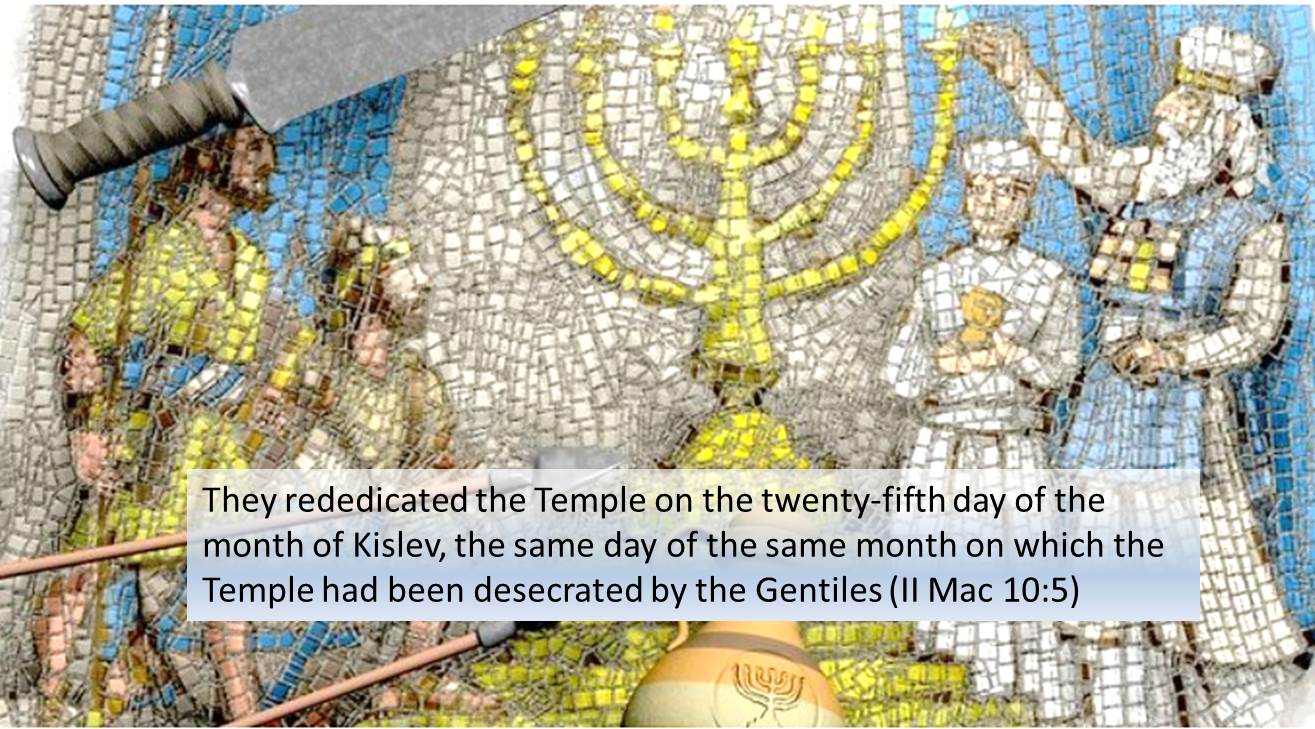
Judas Maccabeus and his four brothers (all Jewish priests) took up their swords and battle hammers to defeat the Syrian rulers and their pagan sun god religious system in 165 BC. Interestingly, Maccabee (iaB<q;j) means “hammer”, so one could rightly say that they “hammered” their enemy. Once they had defeated the Syrians and taken back their temple, the Maccabee brothers and their followers spent seven days cleansing the Temple of all the pagan altars and idols, and then re-dedicated the Temple on the eighth day. Once they had won this victory and purified their Temple, the leaders mandated that a feast called Chanukkah be observed every year starting on Kislev 25 and lasting for 8 days. The Hebrew word Chanukkah (חֲנֻכָּה) actually means “to dedicate”, so this feast is most often referred to as the Feast of Dedication. This feast celebrates the miracle of Yehovah giving them the victory over pagan sun god worship, as well as the cleansing and re-dedication of their temple to the true God, Yehovah.

There are many Jewish traditions and legends surrounding Chanukkah, such as the story of the oil in the Menorah lasting 8 days when it should have only lasted 1 day. However, the real reasons for the 8-day duration of the feast are two-fold: to commemorate Yehovah’s miracle that allowed them to defeat the Syrians and re-dedicate the Temple; and, to celebrate the Feast of Tabernacles (Sukkot) which they had not been able to do for 3 years (see II Maccabees 10:6).

One strong confirmation that Yehovah honors our celebration of Chanukkah is that Yeshua looked favorably on the feast, as He went up to the Jerusalem Temple mount and taught the people during the feast (John 10:22-23). Based on Jewish tradition, rabbis at the time of Yeshua believed that the Messiah would reveal Himself at the time of Channukah (from the Talmud). In John 10:24, the leaders asked Yeshua: “Why do You keep us in suspense? Are You the Messiah?” In John 9, Yeshua had just done the one miracle that was undeniable proof of His Messiah-ship; He had healed a man born blind, which the leaders said only the Messiah could do!

But because the people were expecting a political/military Messiah who would rescue them from the Romans, they did not recognize Him as the Messiah. Yeshua answered them (John 10:25-26) “I told you, but you did not believe: the works that I do in My Father’s Name, they bear witness of Me. But you do not believe, because you are not of My sheep, as I said to you”. The Jewish leaders denied His miracles in John 10:20-21: “And many of them said, ‘He has a demon, and is mad; why hear ye Him?’  Others said, ‘these are not the words of one who has a demon. Can a demon open the eyes of the blind?’”

Yeshua then presented people with an eternal solution to their problems. In John 10:27-28), He said: “My sheep hear my voice, and I know them, and they follow me: and I give unto them eternal life; and they shall never perish, neither shall any man pluck them out of my hand. He turned the people from the short-term, physical solution they wanted to a spiritual solution. He said that we are the desecrated temple and need to be cleansed and rededicated to Yehovah. Remember that we are now the temples of the Holy Spirit and we must keep our temples clean (I Cor 6:19). He taught us that we need a long-term (eternal) relationship with Yehovah to fix our spiritual emptiness, because a physical solution cannot fix spiritual problems.

The defeat of their enemies and the re-dedication of the Temple brought back fresh hope to the Jewish people. How fitting that this month, called Kislev in Hebrew, means hope. This relates to the people looking hopefully to the longer, brighter days of Spring, since Kislev 25 occurs very close to the Winter solstice (the shortest day of the year). Yeshua, the Light of the world, brings us eternal hope.