All posts by peterryall

Unknown's avatar

About peterryall

My wife (Nancy) and I have been Messianic believers in Yeshua for 20 years now and continue to glean revelations from our God (Yehovah) through His Holy Spirit (Ruach HaKodesh).

Gedi Star Teachings

gedi-the-goatToday we are going to explore another of the amazing signs that YHVH placed in our heavens from the beginning of Creation.  The sign is commonly known as Capricorn, which translated from Latin literally means a horned goat.  However, as I have mentioned in the past, we cannot trust modern Greek and Latin names of stars or constellations, as their names and meanings have been corrupted over the years from the original Hebrew meanings.  In Hebrew, this sign is called Gedi, which means kid goat, but is sometimes translated as sea goat, due to the strange half-goat/half-fish image portrayed in ancient drawings of the sign.

The image we see in Egyptian, Indian, and Phoenician drawings is of a fish that is weak and dying at the head, but alive as a healthy fish at its tail end.  The stars in this sign confirm the meaning associated with this image: ma’asad: the slaying; dabih: the sacrifice slain; and sa’ad al nashira: the cutting off.  As with many Hebrew words, gedi (kid goat) has a second meaning: to be cut off.  This sign, then, represents the sacrificial Goat of atonement, Yeshua, who was slain to redeem us from our sins, was “cut off” (crucified) to bring us salvation, healing and deliverance from evil.

The fish portion of the goat’s body represents us: the people for whom the sacrifice was made.  Other star names in this sign also point to Gedi as being the goat who was sent into the wilderness for remission of our sins (so that they would be sent away as far as the east is from the west).  We know that Yeshua fulfilled both of these goat sacrifices!

To complete this awesome picture story, the three constellations associated with this sign give more of the details. The 1st constellation is Sagitta, means “the arrow of Elohim sent forth” – this connects with Psalm 38:2 where it says “Your arrows have struck deep, and Your blows are crushing Me”; and also Isaiah 53:4-5: “He was stricken, smitten of God & afflicted; He was wounded for our transgressions”.  Aquila (the eagle) is the 2nd constellation in Gedi – the stars in this constellation convey the meaning of “the smitten One falling”, “the One who comes in the Shekinah glory of God to shed His blood as a sacrifice”; and “the One who was wounded in the heel” (Gen 3:15).

The third and final constellation in Gedi is Delphinus, the original name meaning “the dead One rising”.  It is shown in ancient Zodiacs as a fish full of life, always with his head pointing upwards.  This represents Yeshua’s resurrection as “the first-fruits of them that sleep” (I Cor 15:20).  The Hebrew name is Dalaphin, which means Dolphin and also “pouring out of water”.  We see from this word picture that Yeshua fulfilled the prophecy to pour out the Holy Spirit on all flesh, symbolized in Scripture as the “fountains of living waters”.

The brightest star in Gedi is actually a double star named Deneb Al Giedi – “the Judge who is the sacrifice.”  When we think about Yeshua’s dual role as our Messiah, we know that He came to save us from our sins in His first coming to Earth, but that He will be our ultimate Judge in His second coming. As Yeshua says in John 3:36: “Whoever trusts in God’s Son has eternal life. Anyone who doesn’t obey the Son will never experience eternal life but will remain under God’s judgment”.  Draw close to Yeshua and He will draw close to you; get to know Him intimately and your greatest desire will be to trust Him with your life, walk in His way and lovingly obey all of His commandments.

Righteous Oaks

righteous-oaksWhen YHVH promises in the beginning of Verse 3 of Isaiah 61 that He will give us: “Beauty instead of ashes, the oil of joy instead of mourning, the garment of praise instead of the spirit of heaviness”, His end goal is not just to give us temporary help to get us through a crisis in our lives. Ultimately, God is building us up to be trees [oaks] of righteousness. We are the “trees” God is planting in the place He desires us to bear fruit.

Oak trees are known to be the strongest, most sturdy and resilient of all trees on Earth. They can withstand hurricanes, tornadoes, earthquakes, droughts and floods better than almost any other type of tree.  God likens His children to oak trees and says we can be just like them in our character and integrity: “They shall be like great oaks of righteousness”.  These are not the words of a long-ago prophecy that have no meaning for us today. This is the expression of God’s heart for His people down through the generations. God wants us to be strong and enduring and He has given us clear insight in His word as to how we are to make that happen.

The average large oak tree needs as much as fifty gallons of water per day, so the root system is large and goes deep to reach that water. The root system not only brings the needed nourishment to the tree but it provides the anchoring base that allows the tree to withstand all kinds of assaults, from the wind, the rain and the shaking of earthquakes.  The root system of a mature oak tree can total hundreds of miles, and the roots of an oak tree extend out underground up to two and a half times their height.  So how can we as YHVH’s children ever hope to have such deep roots?

Jeremiah 17:7-8 is a powerful amplification of what Isaiah is talking about: “But blessed is the person who trusts in the LORD, whose confidence is in Him. They will be like a tree planted by the water that sends out its roots by the stream. It does not fear when heat comes; its leaves are always green. It has no worries in a year of drought and never fails to bear fruit”.

Both in Isaiah 61 and here in Jeremiah, it is clear that YHVH plants His seeds purposefully. He does not take His seeds and scatter them to the wind, disregarding where they fall.  God picks a perfect place for each of us, personally putting the tender shoot in the ground, knowing exactly what lies ahead. God knows every detail of our lives and the place of our planting and He does not make mistakes; we were not planted in the wrong part of the garden!

We were destined to display the “splendor of the Lord.” It doesn’t matter how you feel, you are destined to display the splendor and majesty of YHVH. There are days when you may not feel that you are reflecting God’s glory to others in your world, but if you have deep spiritual roots and are standing tall in constant relationship with YHVH, you will be displaying His majesty.   In fact, He will “rejoice over you with gladness” (Zephaniah 3:17) and even “protect you from trouble and surround you with songs of victory” (Psalm 32:7).

Trees do not instantly develop deep roots, and neither do people – both must go through difficult times of physical or spiritual drought and hardship, and must be patient until their roots develop.  In the case of God’s people, we must be filled with God’s Holy Spirit and grow in our faith and spiritual maturity, learning to trust YHVH more and more for strength to overcome the attacks and temptations of the world.

Trees contribute greatly to purify the air, and render it fit for us to breathe. When the air around us passes through leaf surfaces, it is purified and invigorated.  In the same way, there is a moral atmosphere around us.  When the air around us passes through our spirit and soul, we have the ability to speak life or death, blessing or curse to those around us.  As YHVH spoke in Deuteronomy 30:19-20, “I call on heaven and earth to witness against you today that I have presented you with life and death, blessing and curse. Therefore, choose life, so that you will live, you and your descendants, loving the LORD [YHVH] your God, paying attention to what He says and clinging to Him — for that is the purpose of your life!

As YHVH’s children, when we trust in Him with all our heart and follow His ways and His instructions, our roots will go down deep into the “earth” of the Holy Spirit within us, enabling us to withstand all the trials and tribulations of life, bearing much fruit and glorifying Him through our lives.  As YHVH says in Jeremiah 17:7-8 about those whose confidence is in Him: “we will be like trees planted by the stream, that send our roots deep: we will not fear when heat [persecution] comes; our leaves will always be green. We will have no worries in a year of drought and we will never fail to bear fruit”.

Safe Shelters

refuge-under-your-wingsIn my blog two weeks ago, I wrote about Yeshua as the Door of the sheep, and how He protects from us from all dangers.  Another closely related Biblical concept is that YHVH shelters us, but how does He shelter us?  In many places in the Psalms, David talks about YHVH sheltering us in His hiding place, for example:

  • Psalm 91:1 – He who dwells in the secret place of the Most High shall abide under the shadow of the Almighty [El Shaddai].
  • Psalm 27:5 – For in the time of trouble He shall hide me in His sanctuary; in the secret place of His tabernacle He shall hide me (the Orthodox Jewish Bible says that He will keep us safe in His Sukkah and shelter us in His tent)…He is our refuge and our fortress;
  • Psalm 32:7 – You are my hiding place; You shall preserve me from trouble; You shall surround me with songs of deliverance;
  • Psalm 119:117 – You are my hiding place and my shield; I hope in Your word;
  • Psalm 144:2 – My lovingkindness and my fortress, my high tower and my deliverer, my shield and the One in whom I take refuge

Other scriptures speak about God sheltering us in His high tower, on a rock that is higher than us, or in his fortress, just to name a few of the graphic images He paints.  Many times David and others speak about YHVH as not only keeping them safe in His secret hiding place, but as actually being that hiding place, refuge, fortress, high tower, stronghold, rock, sanctuary, Sukkah, etc.  As an illustration of a high / strong tower, Sh’lomo says in Proverbs: the name of Yehovah is a strong tower; and the righteous run to it [Him] and are safe.  Now we are getting to the purpose of YHVH sheltering us in all these amazing ways: He is keeping us safe from the enemy.  Psalm 32:7 above provides one of the most beautiful word pictures of God’s protection in all of Scripture: He is not only our hiding place, but He protects us from trouble and surrounds us with songs of deliverance.

In Psalm 91, David says that no evil will befall him because he has made YHVH his refuge and dwelling place.  Because David is abiding under the shelter of His wings, YHVH has promised to give His angels charge over David to keep him safe against all physical and spiritual enemies and attacks.  In Verse 14, He says that because we know and trust in His name (Yehovah), He will set us up on high places (a high rock, high tower, etc.).  He also promises that no evil will befall us, no plague will come near our dwelling, and we do not need to fear the arrows by day or the pestilence that comes in the night.  Finally, in Verse 7 He paints an even more vivid picture of how he delivers us in the middle of great battles: “Though a thousand fall at our side and ten thousand are dying around us, these evils will not touch us” (NLT).

Even from the beginning, God has always been there to shelter us and keep us safe.  When He created the Garden for Adam and Eve, He created it as an enclosed garden that was protected on all sides against enemies.  The meaning of the “Garden of Eden” [Gan Eden] from Hebrew is a sheltered or enclosed garden.  There are many examples of how God has provided for our protection in His creation. For instance, the way an eggshell protects the baby chick as the strongest shape in the world, or the way a mother’s womb protects her unborn baby against environmental dangers.

When God saved Noah and his family from the flood, He once again protected them with an Ark that provided their covering and protection from all the devastation that was going on around them.  Another example of YHVH’s protection was the lamb’s blood covering He told the Israelites to apply to their doorposts to protect them from the angel of death.  In the end times, YHVH’s remnant will be sheltered in the protective rocks of Petra (Bosrah in Hebrew), waiting for our King, Messiah Yeshua, to come and usher us into the homeland of Israel.

As you think about all the ways YHVH protects and shelters us in His fortress or high tower, think about the Hebrew letter “tet”, which in the ancient word pictures represented a shelter for protection.  It is used in the word beten to mean the house that surrounds life (the mother’s womb), and in the word for trust (batach), which pictures us being safe inside the surrounding fence.  The word seter means a hiding place or covering, and from the ancient word pictures it literally means a secret hiding place.  Whereas the word for adversary (satan) means the snake that devours life, YHVH provides the seter hiding place which protects us from evil.  Would you rather be under YHVH’s wings which protect your life from harm, or the enemy’s snake-coil which devours your life?

Yeshua is the Door

the-door-of-the-sheep“Then Jesus said to them again, “Most assuredly, I say to you, I am the door of the sheep.John 10:7

In Yeshua’s “I am” statement about being the Door of the Sheep,  He teaches us that He is “the Door”, not just “a door”.  He is saying that He is not only our Shepherd who leads us into the sheepfold of the Kingdom, but He is the only door by which we can enter and be saved and find safe pasture (John 10:9).  There are deeper meanings for understanding Yeshua as our door into the Kingdom of God, so come with me now as we dig deeper into the Word to explore these meanings.

It is helpful to understand more about sheep and shepherding in general and specifically during Yeshua’s time.  Of all domesticated animals, sheep are the most helpless.  Sheep will spend their entire day grazing, wandering from place to place, never looking up. As a result, they often become lost. But sheep have no “homing instinct” as other animals do. They are totally incapable of finding their way to their sheepfold, even when it is in plain sight. By nature, sheep are followers. If the lead sheep steps off a cliff, the others are likely to follow.

Also, sheep are very susceptible to injuries and are utterly helpless against predators. If a wolf enters the pen, sheep won’t defend themselves or run away.  Sheep are totally dependent upon their shepherd for food, shelter, guidance and protection. So close is the bond between shepherd and sheep that to this day Middle Eastern shepherds can divide flocks that have mingled at a well or during the night simply by calling their sheep, who know and follow their shepherd’s voice. The shepherd leads the sheep to safe places to graze and makes them lie down for several hours in a shady place (think of the parallel to Psalm 23). Then at nightfall, the shepherd leads the sheep to the protection of a sheepfold.

In ancient times, there were two kinds of sheepfolds or pens. One kind was a public sheepfold found in villages. It would be large enough to hold several flocks of sheep. This sheep pen would be in the care of a “doorkeeper”, whose duty it was to guard the door to the sheep pen during the night and admit the shepherds in the morning. The shepherds would call their sheep, each of which knew their own shepherd’s voice, and he would lead them out to pasture (see John 10:4).

The second kind of sheep pen was in the countryside, where the shepherds would keep their flocks in good weather. This type of sheep pen was nothing more than a rough circle of rocks piled into a wall with a small open space to enter. Through it the shepherd would drive the sheep at nightfall. Since there was no gate to close—just an opening—the shepherd would keep the sheep in and wild animals out by lying across the opening. He would sleep there, in this case literally becoming the door to the sheep[fold].

Several ancient Hebrew word pictures point to Yeshua as the Door in a powerful way.  The ancient letter for door is dalet.  This meant the tent flap or door originally, but also the “path” or the “way of life”.  Devar in Hebrew means “word”. When we look at the ancient characters for Devar, though, the root meaning is “the Door of the Son”.  Since Yeshua is the living Word, Devar can also be interpreted as “The Word of YHVH”, as in the book of Deuteronomy [Devarim].  Psalm 19:14 says: “Let the words of my mouth and the meditations of my heart be acceptable in thy sight, YHVH, my rock and my redeemer”.  In Hebrew, a word for redeem is Padah and the word picture meaning is “redemption comes by the mouth of the door”. The ancient letters tell us that redemption is by the words of the door, and we know that door is Yeshua. Another significant word is the Hebrew word for Righteous, Tsedek, and the word picture tells us that  a person is righteous when their hook is the Door they follow (hook, or fishhook, refers to that which draws you – your passion or desire).

God’s name, Yehovah, is spelled yod-hey-vav-hey in Hebrew. The letter dalet is added to spell “Yehudah” [Judah], out of whose line Yeshua was descended. These 4 letters of the Name of God plus the letter dalet which means “door,” paint a different word picture:  His name tells us that Praise opens the Door to God“.  Since Yeshua is the Door, and He said everyone must enter through Him, this is a graphic picture of the pathway to YHVH – the key to the Door is praise!

Yeshua tells us that He is not only the shepherd of His sheep, but also the door of the sheep. In doing so, He is inviting us to be part of His sheepfold, where we will never have to fear or want for anything.  All we have to do is praise Him, and follow Him on His path, trusting Him with every part of our lives!

Trust in YHVH with all Your Heart

trust-in-yhvhTrust in the Lord with all your heart, and lean not on your own understanding; in all your ways acknowledge Him, and He shall direct your paths. Do not be wise in your own eyes; fear the Lord and depart from evil. It will be health to your flesh and strength to your bones.” Proverbs 3:5-8

I had memorized this well-known passage in proverbs 3:5-8 many years ago and still repeat it often in many different circumstances.  I would like to be able to say that it always calms my nerves or worries, but I can’t truthfully say that.  I usually have to spend some time with Yeshua remembering all the promises He gave us, that we are not to fear or be anxious for anything.  This tells me then that trust is not just about knowing the Scriptures that tell us God is faithful to watch over and take care of us in all situations.  It is far more about personally knowing the Living Word [Yeshua] who inspired the written Word, than it is about just knowing the written Word.

As believers, we often talk about having faith, more faith, or enough faith to endure whatever trial we are experiencing.  Unfortunately though, faith has become an overused and even watered down concept in our modern society.  Nowadays, we can have faith in Santa Claus, the Easter Bunny or the Tooth Fairy.  So what do we really mean when we say that we need to have strong faith in God?  Yeshua told his disciples that they could have cast the demon out of the young boy if they even had the faith of a grain of a mustard seed (Matt 17:20).  It is clear from this story that what they needed was not more faith, but rather a solid foundation of trust to back up the faith they had.

As human beings, we understand what it means to trust someone at a much deeper level than just having faith in someone.  Think about yourself for a moment and how you feel about trusting your neighbor. You may trust your neighbor enough to lend them your lawnmower, but do you trust them to watch out for your house when you go on a trip?  Would you trust them enough to give them a key so they can take of your plants when you are away?  Would you trust them to take care of your children for a weekend?

I would like to illustrate this point through a true story about a man named Charles Blondin, who was the greatest tightrope walker of his time, in the mid 1800’s.  He gained great fame in 1859 when he became the first person to cross Niagara Falls on a tightrope.  Charles and his friend and manager, Harry Colcord, strung a 2” diameter hemp rope from an oak tree on the American side to a large rock on the Canadian side, and used a series of guy ropes every 20’ (anchored to the shore) to keep the rope as steady as possible.  The greatest risk was the 50’ section in the center of the 1300’ span that could not be reached by anchor ropes.  The incredible thing was that Charles was able to navigate his way across the Falls without any mishaps.  He traversed the Falls a number of times over the next few weeks, carrying props such as a camera and a griddle on which he cooked an omelet, pushing a wheelbarrow, and even doing a backflip on a couple of occasions.

The most daring feat of all, though, was when he carried his manager Harry on his back during one of his crossings.  This is where the rubber meets the road – although the many fans in attendance had faith that Charles was able to cross the Falls (and even bet their money on him), it was only Harry who was able to trust Charles with his life.  A number of guy wires snapped during their crossing, but Charles never wavered.  Harry later told reporters that Charles had coached him to: “look up…you are no longer Harry, you are Charles. Until I clear this place, you are to be a part of me, mind, body and soul. If I sway, sway with me. Do not attempt to do any balancing on your own”.

Here is the essence of trusting God; not just having faith in Him. The spectators watching Charles had faith in him and believed that he was capable of traversing the Falls.  Only Harry, though, trusted him enough to climb on his back and ride across Niagara Falls with him walking on a 2” thick rope.  Is this the kind of trust you have in YHVH – do you trust Him to protect you and care for you and supply all your needs?  Do you trust Him with your whole life – body, soul and spirit – or do you trust more in your own abilities, your financial resources, or your trusted friends? In Psalm 3:6, God promised to direct our paths (keep us going in the right direction) if we would trust and acknowledge Him in every part of our lives.  Are you ready to trust YHVH with your whole heart? He is trustworthy beyond any other person or force in heaven or on Earth.  Go ahead and start trusting Him today – it will be the best decision you ever made!

Let all Creation Praise YHVH !

every-created-thingI have often marveled at Psalm 148 that speaks about everything and everyone in Heaven and on the Earth praising the LORD [YHVH].  We know that our LORD God [Yehovah Elohim] created everything in the universe with His spoken Word.  We also know that the Living Word (Yeshua) was there at the beginning participating in every aspect of Creation (John 1:3).

It is not so amazing that people praise YHVH, since He created us to praise and glorify Him.  He says in Isaiah 43:7 when speaking about His people: “Everyone who is called by My name, whom I created for My glory…”.  In I Chronicles 16:29, David says in his song of praise to YHVH: “Give to the LORD the glory due His name…Worship the LORD in His holy splendor.”  The beautiful thing about glorifying God is that it brings the greatest joy to our hearts because that’s how YHVH created us.  C.S. Lewis once said: “In commanding us to glorify Him, God is inviting us to enjoy Him”.   All through Psalm 16, David talks about praising and glorifying God, and then in Verse 11 He says: “You show me the path of life, granting me the joy of Your presence and the pleasures of living with You forever”.

If we literally believe that “everything that has breath praises YHVH” (Psalm 150:6), then we can look around us and listen to all the voices of God’s creatures.  We are all familiar with the beautiful songs of the birds of the air.  There are also other less familiar voices that are beautifully expressed in the animal world.  Experts say that Fin whales can hear the bleeps of other fin whales from more than 500 miles away, and under the right conditions, Blue whales can hear each other from over 1,000 miles away!

Humpback whales are famous for singing songs that can last up to 30 minutes. They sing in rhyme, and the songs can be heard by other whales. The songs are passed along in the water so that an entire ocean may have all the humpback whales singing the exact same song at the same time—a kind of great whale choir.  How incredible is our God who created these amazing sea creatures, and how incredible is the sound of their praises sung to their Creator!

Any of us who have children (and we ourselves are children of our parents of course), know that when children praise and respect their parents, their relationship is strengthened and there is much greater joy and peace in the household.  In the same way, the right response from us toward God is praise because He deserves it.  When we show our love for YHVH by praising Him, we fulfill the purpose for which YHVH created us.  When we fulfill this purpose, we experience the greatest possible joy—God is pleased, our relationship with Him is enhanced, and He has received what He deserves.

What is even more incredible to me is that all of Creation is praising YHVH (from Psalm 148:1-8): “…His angels; His heavenly army (recall that Yeshua is the LORD of Heaven’s armies); the sun and the moon; all the shining stars (and scientists know that the stars “sing”); the highest heaven of the heavens; the waters above the heavens; the Earth; large sea creatures and the ocean depths; lightning and hail; snow and fog; strong winds that obey His commands; mountains and all hills; fruit trees and all cedars; wild and domestic animals; crawling animals and birds”.  Verse 13 sums up the whole Psalm by saying: “All creation, come praise the name of the Lord. Praise His name alone”.

Fortunately for us, YHVH’s command to praise Him and glorify His Name is not difficult to follow, for when we truly love Him, our praise will flow naturally from that love.  Start praising Him and rejoicing in His name today in this season of joy (Sukkot) and you will experience the greatest joy possible in His presence.

Yom Teruah helps us Remember and Rehearse

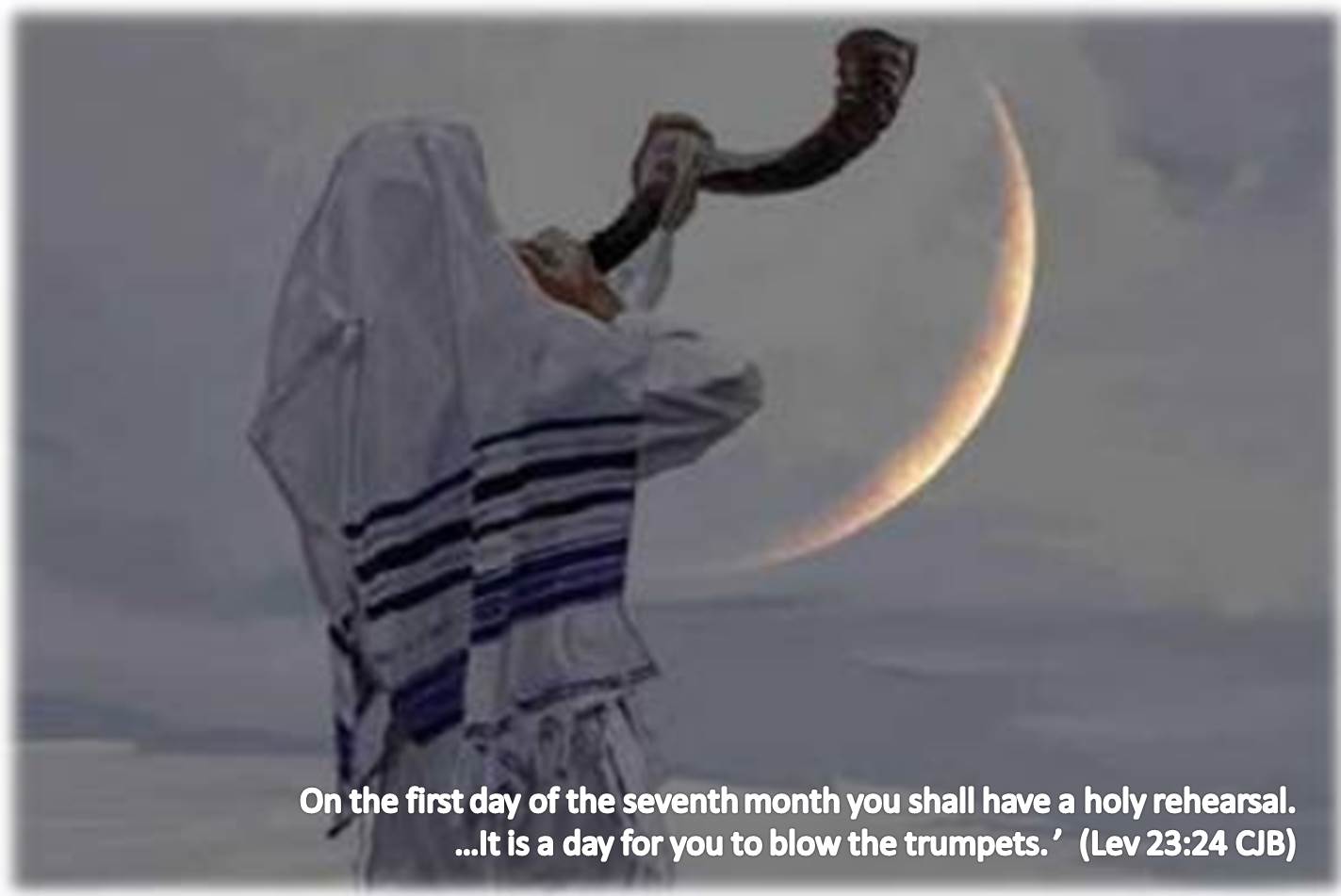
yom-teruahWhen we talk about YHVH’s feasts or festivals, we sometimes think of big celebrations with lots of festive foods along with family and friends.  Although some of YHVH’s feasts are meant to be joyous celebrations (such as Sukkot – the Feast of Tabernacles), others are meant to be more somber and introspective.  Yom Teruah (literally the “feast of the blowing of trumpets (shofarot)”) is a combination of both joyous and somber emotions.  In a previous blog (When Yeshua Returns), we have already dealt with the misconception that Yom Teruah is actually the Jewish new year, or what is called Rosh Hashanah (literally “the head of the year”).  Yom Teruah marks the beginning of the seventh month on God’s calendar, so by definition it cannot be the start of the year.

The Hebrew word used most often for YHVH’s feast days in the Scriptures is Mo’ed (feast) or Mo’edim (feasts plural).  However, this word is much better translated as “appointment” or more accurately “divine appointment”.  YHVH meant for these appointments to be holy (set-apart) times on His calendar to meet with Him.  They were also called “Holy Convocations”, which in the Hebrew is Miqra, meaning an “assembly” but also a “Dress Rehearsal”.

Whenever one of YHVH’s divine appointments arrives, we are supposed to look back and remember something that God has done for us in the past, but we are also supposed to look forward to what He will do in the future.  In His Mo’edim, God has essentially given us a “roadmap” of the most important events in human history.  Leviticus 23:24 describes Yom Teruah in this way: “In the seventh month, on the first day of the month, you shall have a sabbath-rest, a memorial of blowing of trumpets, a holy convocation (rehearsal)”.  Where it says “memorial” in this verse, another name is being used for the Feast of Trumpets – it is also called Zihk’ron Teruah which means a call for remembering through the loud blowing of trumpets.  So what are we remembering from the past and what are we rehearsing for the future?

By Jewish tradition and ancient calendars, it is believed that Yom Teruah commemorates the first day of Elohim’s Creation of the universe.  This fits with God’s biblical calendar.  When the Israelites were delivered out of Egypt, YHVH then said to them: This month shall be the beginning of months for you; it is to be the first month of the year to you” (Exodus 12:2).  This was of course the first day (new moon) of the Passover month (Aviv), which had been their seventh month but was now their first month by God’s instruction.  Thus we know that the seventh month (Ethanim) had been the first month on God’s calendar, which is the calendar He created for us at the time He created the world.  We can give thanks to Yehovah Elohim on Yom Teruah for creating the universe and us as His children.

As far as rehearsing the future on Yom Teruah, we need to look to the verses where the shofar blast is described as a warning or announcement of a future event.  There are a number of Scriptures where we see the shofar being blown as a call to repent and turn back (teshuvah) to YHVH, warning us of the God’s great judgment at the end times, in the “Day of the LORD”. (Joel 2:1, Zech 9:14, Rev 11:15)  In Matthew 24, Yeshua tells us of the great shofar blast when He comes in judgment and to gather His remnant together from the whole Earth: “And He will send out his angels with the mighty blast of a trumpet, and they will gather His chosen ones from all over the world—from the farthest ends of the earth and heaven”.

Abba, as we are celebrating your appointed time to be with You on Yom Teruah, help us to remember all that You have done for us in the past, including the great sacrifice of Your Son for our salvation and deliverance.  Help us to also look ahead at what You are going to do in the future, and make sure we are prepared like the wise virgins who had an abundance of oil for their lamps.  We want to be a part of Your remnant, pleasing to you and prepared in our hearts and spirits to receive Your blessing when You return to this Earth to reign and rule.

Joy through Obedience

well-watered-gardenIn a previous blog, I talked about God wanting to bless us with happiness, as He says in Psalm 37:4 “Delight yourself in YHVH, and He will give you the desires of your heart”.  What brings us the greatest joy on this Earth, though?  We know it is not “seeking after our own pleasure on His holy day” that YHVH speaks against in Psalm 58.  YHVH is speaking about His Shabbat, and He goes on to say in a positive way: “if you call the Sabbath a delight, the holy day of the Lord honorable, and shall honor Him, not doing your own ways, nor finding your own pleasure, nor speaking your own words, then you shall delight yourself in the Lord; and I will cause you to ride on the high hills of the earth, and feed you with the heritage of Jacob your father. The mouth of the Lord has spoken”.

This is one of my favorite passages from all of Scripture, and one of the most amazing promises YHVH makes, to bless us to the highest degree possible!  Can we be truly blessed by YHVH if we are not following His instructions in the Torah?  Consider the example of the remnant of Israel who returned from Babylon: they were back in Israel for almost 100 years before they re-discovered the Torah scrolls and the people asked for them to be read.

In Nehemiah 8, when the people came together as one in the city center, they appealed to Ezra the scribe to read the Torah Scriptures to them.  When they heard the words of the Torah, they were convicted of their sins and they bowed their faces to the ground and began to mourn and weep.  It is obvious from their reactions that they did not just come to listen to the scrolls for entertainment or casual curiosity, but rather they wanted to know the truth of the Torah commands they had broken before the captivity.  They came to hear, listen and then obey what they heard.  This is the meaning of Sh’ma in connection with the greatest of the Torah commandments: “Hear oh Israel, the LORD our God, the LORD is One” Deut 6:4.  We are to hear YHVH’s word, take it deep down into our hearts, and then act on it by obeying what He says.

Going back to the promise from Isaiah 58, YHVH says that if we obey and honor Him, He will cause us to ride on the high hills of the earth.  When YHVH first brought His children out of Egypt, He also said He would make them ride in the heights of the Earth (Deut 32:13).  We know from the other passages that He meant He would give them prosperity, fruitfulness, and blessings in the land.

In Habakkuk 3:18-19, the prophet says: “Yet I will rejoice in the LORD, I will joy in the God of my salvation. The LORD God is my strength; He will make my feet like deer’s feet, and He will make me walk on His high hills”.  God describes Himself as one “Who treads the high places of the earth” (Amos 4:13).   YHVH created us in His image, and He wants us to keep growing closer to Him so that we can walk on His high hills and experience those same high places where He roams in both His earthly and heavenly realms.

YHVH’s thoughts and ways are higher than ours, but He has given us the ability to draw closer to Him through keeping His Torah and His appointed times (Sabbaths and feasts), coming into His presence more and more so that we can enjoy intimate fellowship with Him.  When we walk in our own paths and fail to follow YHVH’s guidance, we are like dry plants in a desert.  I would much rather be a “follower of the way”, keeping YHVH’s commands and enjoying His blessings to be “like a well-watered garden, like a spring whose waters never fail” (Isa 58:11).  Give it a try – walk with YHVH and follow his instructions and the blessings of joy will flow through your life like a never-ending spring.

Oh the Depth of God !

God's love has no limitWhy do we want to limit God?  I have often heard it said that we should not limit God, but what does that really mean?  Recall the time in the wilderness when God was grieved because His people forgot how He had done many signs and wonders to protect and deliver them from Pharaoh and his army.  In Psalm 78, David tells us how the Israelites provoked YHVH by their sin and disobedience, but how YHVH loved them so much, that whether they turned back to Him or not, He would be divinely forgiving and gracious to them.

What grieved YHVH the most was not so much their sin or disobedience as their lack of trust in Him.  They had forgotten all that He had done for them.  He always had their best interest in mind.  YHVH was saddened that His people limited Him: “Again and again they turned back and tested God, and imposed limits on the Holy One of Israel” Psalm 78:41.  What they had forgotten was that no matter how far they strayed from Him and how many times they grieved Him by their sins, He was always merciful to them and forgave and blessed them.

When I think about YHVH as a limitless God who has no beginning and no end (Rev 1:8; 4:8) and who never changes (Mal 3:6, I Sam 15:29), I think about the times in my life that I have meditated on these attributes of God.  When I was a young child, I would lay on my back watching the clouds float by, thinking about how huge the universe was.  Even at a young age, people had told me that God was infinite, that He existed before anything in the Earth or heavens was made, and that He had no beginning.  I could not wrap my mind around the concept that God had no beginning and that He had always existed, before anything in the universe was created.

Knowing about God and His divine attributes intellectually is one thing, but it’s not the same as knowing God personally.  Even now as an adult, I cannot fully understand our God (Yehovah) who has always existed and always will.  But I do not believe YHVH intends for us to understand everything about Him, since He tells us in Isaiah 55:9 – “..just as the heavens are higher than the earth, so My ways are higher than your ways and My thoughts higher than your thoughts”.

At this point, you may be thinking that God is so far beyond us that understanding Him is impossible, and relating to Him in any meaningful way is an insurmountable goal.  We know through Scripture, though, that YHVH has given us the opportunity to have a personal relationship with Him, and that as we draw closer to Him, He will reveal things to us that can help us understand Him better and expand our limited thinking and expectations.  In James 4:8, right after he says to submit to God and resist the devil, he tells that if we draw near to God, then He will draw near to us.

Although we are limited and He is limitless, if we draw near to Him, YHVH will reveal great things to us: “But as it is written:Eye has not seen, nor ear heard, nor have entered into the heart of people the things which God has prepared for those who love Him.’ But God has revealed them to us through His Spirit“ (I Cor 2:9-10).  Notice in this passage that it is God’s Holy Spirit who reveals His secrets to those who love Him.  This tells me that we cannot understand the deep things of God in the flesh / physical realm, but only in the Spiritual realm.  As we age in spiritual maturity in YHVH’s kingdom, we learn to draw closer and closer to God by spending time with Him and listening to the voice of His Spirit.

At the same time we understand our limitations and God’s limitlessness, we know that YHVH desires us to seek knowledge and wisdom from Him.  In Jeremiah 29:13, He tells us: “And you will seek Me and find Me, when you search for Me with all your heart”.  This is the essence of our walk with YHVH – when we seek Him with our whole heart, we will find Him, and He will reveal His incredible secrets to us as He desires.  Seek this type of relationship with your Creator and Lord and He will give you an abundant life that is so full of wonder and miracles you will not be able to contain them within yourself.

Does God care about Genes or Jeans (Part 2)?

least of these

In Part 1 of this blog last week, I talked about who are YHVH’s children and those who should keep His Torah, and concluded that it is not Abraham’s biological descendants, but rather those who are His spiritual descendants.  The true children of YHVH’s covenant are those are following His will and trusting Him, keeping His Torah and striving to be pleasing to Him in every part of their lives.  That covered the “genes” part of this 2-part series.  This week I want to focus on what God sees when He looks at us: we know from Scripture that He looks on the inside of us and does not focus on our outer appearance or the level of recognition we merit from the world.  In other words, He doesn’t care whether we wear threadbare jeans vs. classy suits, or how many degrees we have achieved or awards we have won.

What is YHVH truly looking for when He looks deep down inside of our souls?  From Hebrews 4:12, we know that He “discerns the thoughts and intents of our heart”.  But what are His criteria in evaluating our hearts – does He look to see how perfectly we are following His Torah, or how diligently we are working to serve our congregation?  Psalm 58 gives us a beautiful window into YHVH’s heart, and we know that our hearts should line up with His heart as we seek to renew ourselves more into His image every day.

God is conveying a very strong message through Isaiah when He tells Him to shout it out with a shofar blast. (Isa 58:1)  He chastises His people for their false piety – they are trying to impress God by putting on sackcloth and ashes, and afflicting themselves severely when they fast.  The only ones they are impressing are people around them though, not YHVH.  He desires them to fast from their hearts when He says:

“..this is the kind of fasting I want: free those who are wrongly imprisoned; lighten the burden of those who work for you. Let the oppressed go free, and remove the chains that bind people. Share your food with the hungry, and give shelter to the homeless. Give clothes to those who need them, and do not hide from relatives who need your help”. (Isa 58:6-7)

If these concepts sound familiar to New Testament readers, that’s because they are.  Listen to what Yeshua said when He was speaking to the goats on His left and the sheep on His right:

“Then the King will say to those on His right, ‘Come, you who are blessed by My Father, inherit the Kingdom prepared for you from the creation of the world. For I was hungry, and you fed Me. I was thirsty, and you gave Me a drink. I was a stranger, and you invited Me into your home.  I was naked, and you gave Me clothing. I was sick, and you cared for Me. I was in prison, and you visited Me.’  “Then these righteous ones will reply, ‘Lord, when did we ever see You hungry and feed You? Or thirsty and give You something to drink? Or a stranger and show You hospitality? Or naked and give You clothing? When did we ever see You sick or in prison and visit You?’  “And the King will say, ‘I tell you the truth, when you did it to one of the least of these My brothers and sisters,[f] you were doing it to Me!’

“Then the King will turn to those on the left and say, ‘Away with you, you cursed ones, into the eternal fire prepared for the devil and his demons. For I was hungry, and you didn’t feed Me. I was thirsty, and you didn’t give Me a drink. I was a stranger, and you didn’t invite Me into your home. I was naked, and you didn’t give Me clothing. I was sick and in prison, and you didn’t visit Me.’  “Then they will reply, ‘Lord, when did we ever see You hungry or thirsty or a stranger or naked or sick or in prison, and not help You?’  “And He will answer, ‘I tell you the truth, when you refused to help the least of these My brothers and sisters, you were refusing to help Me.’  “And they will go away into eternal punishment, but the righteous will go into eternal life.”

What, then, is truly important to Abba Father when He looks into our souls?  From Yeshua’s words in Matthew 5:7, we know that He desires for us to be pure in heart, not obeying Him out of obligation but because we sincerely want to please Him from the depths of our heart.  And what does He say about those who are pure in heart?  ‘They shall see God’.

This takes us right back to the essence of our relationship with Yehovah – if we want to know Him intimately, we need to align our hearts with His, which means we will automatically do the things that please Him: feed the poor, take care of orphans and widows, shelter the homeless, etc.  In your life, try not to focus on the outward things, but look deep inside your heart.  In the ‘intents and desires of your heart’, after stripping away everything superficial, do you see what YHVH is looking for?