This is the tenth article in the “New Life” series, written to address the needs of those seeking or those new to their faith in Jesus. This series may also be helpful to anyone who suspects that something is missing from their faith walk.
In last week’s article, entitled Hatred and Heresies, we encountered some of the lies and heresies that have been passed down through the centuries since the Gentile and Jewish followers of Jesus separated. This week, let us turn to more pleasant topics to learn how we are called to be rooted in Yehovah.
Who is Yehovah? Yehovah is the name of the God we worship, the only true God, our Creator. His name has been hidden from us for centuries, but He is once again making it known to His people. There are many false gods who are impostors introduced by hasatan. Hasatan means “the adversary” in Hebrew. In English, we call him Satan, but it is not really a name.
Even though I have used Hebrew words in previous articles, I used English terms at the beginning of this series because they are familiar to most people. The Hebrew terms I will use from this point on were lost to Gentile followers of Jesus for centuries. Gentiles have much to learn from Jews, and Jews have much to learn from Gentiles. This is not a new religion or a strange cult. Our Father’s plan from the beginning is to establish His kingdom on Earth as it is in Heaven, and he intends to include everyone who chooses to belong to His Son.
As I mentioned in last week’s article, the Gentiles established Sunday as the day of worship to honor their sun god. Our Father, Yehovah, commands that the seventh day of the week shall be a day of rest, a day of fellowship with Yehovah. We can worship and visit with Yehovah any day of the week, but the seventh day, Shabbat (Sabbath), is our special day with Yehovah.
So God blessed the seventh day and made it holy, because on it God rested from all his work that he had done in creation (Genesis 2:3).
“Remember the Sabbath day, to keep it holy. Six days you shall labor, and do all your work, but the seventh day is a Sabbath to the Lord your God. On it you shall not do any work, you, or your son, or your daughter, your male servant, or your female servant, or your livestock, or the sojourner who is within your gates. For in six days the Lord made heaven and earth, the sea, and all that is in them, and rested on the seventh day. Therefore the Lord blessed the Sabbath day and made it holy (Exodus 20:8-11).
Moreover, I gave them my Sabbaths, as a sign between me and them, that they might know that I am [Yehovah] who sanctifies them (Ezekiel 20:12).
It is a sign forever between me and the people of Israel that in six days the Lord made heaven and earth, and on the seventh day he rested and was refreshed (Exodus 31:17).
For centuries, we have believed that we were honoring Jesus by celebrating Christmas and Easter. However, Christmas and Easter are pagan holidays. The Gentile leaders added Jesus to their pagan celebrations when they separated from the Jews. Thus, they started a new religion, mixing the sacred with the pagan. Yehovah established seven appointed times throughout the year to honor His Son, Yeshua. In Hebrew, Yeshua means “salvation” and “deliverance.”
The appointed times (also called Feasts) begin in Spring. The first is called Passover, and we remember when the angel of death passed over the homes where blood had been placed on the doorposts and lintels of the houses. The death of the firstborn was the last of the ten plagues against Egypt. Later, the firstborn Son of Yehovah, would be sacrificed to set people free and to pay their sin debt.
In this manner you shall eat it: with your belt fastened, your sandals on your feet, and your staff in your hand. And you shall eat it in haste. It is the Lord’s Passover. For I will pass through the land of Egypt that night, and I will strike all the firstborn in the land of Egypt, both man and beast; and on all the gods of Egypt I will execute judgments: I am [Yehovah]. The blood shall be a sign for you, on the houses where you are. And when I see the blood, I will pass over you, and no plague will befall you to destroy you, when I strike the land of Egypt (Exodus 12:11-13).
The next day he saw [Yeshua] coming toward him, and said, “Behold, the Lamb of God, who takes away the sin of the world (John 1:29)!
The Feast of Unleavened Bread begins on the day after Passover and continues for seven days. During this time, we remove the leaven from our houses and eat only unleavened bread. The leaven represents sin. We are reminded to remove any sin from our lives.
“[Yehovah’s] Passover begins at sundown on the fourteenth day of the first month. On the next day, the fifteenth day of the month, you must begin celebrating the Festival of Unleavened Bread (Leviticus 23:5-6).
Your boasting is not good. Do you not know that a little leaven leavens the whole lump? Cleanse out the old leaven that you may be a new lump, as you really are unleavened. For [Yeshua], our Passover lamb, has been sacrificed. Let us therefore celebrate the festival, not with the old leaven, the leaven of malice and evil, but with the unleavened bread of sincerity and truth (1 Corinthians 5:6-8).
Truly, truly, I say to you, whoever believes has eternal life. I am the bread of life. Your fathers ate the manna in the wilderness, and they died. This is the bread that comes down from heaven, so that one may eat of it and not die (John 6:47-50).
The third feast is called First Fruits. The Feasts are centered around the three harvest times in Israel. Barley is harvested in Spring, wheat is harvested in Summer, and produce such as olives and grapes is harvested in Autumn. The Israelites were commanded to bring to Yehovah the best part of their harvest to honor Yehovah for blessing them with good food. We bring our best because Yehovah always gives His best. Yeshua (Jesus) is our First Fruits, the promise of resurrection for all of us.
Honor the Lord with your wealth and with the firstfruits of all your produce; then your barns will be filled with plenty, and your vats will be bursting with wine (Proverbs 3:9-10).
But in fact [Yeshua] has been raised from the dead, the firstfruits of those who have fallen asleep (1 Corinthians 15-20).
The fourth feast is celebrated approximately seven weeks later and is called the Feast of Weeks (Shavuot in Hebrew). This is the day that Yehovah gave His commands on stone tablets at Mt. Sinai and made a covenant with the Israelites. The Israelites broke the covenant right away and worshipped false gods. Three thousand people lost their lives as a result. This is also the day, many years later, when the Holy Spirit descended on the followers of Yeshua and wrote Yehovah’s law on their hearts. Three thousand people gave their lives to Yeshua and became His followers.
All the people took the gold rings from their ears and brought them to Aaron. Then Aaron took the gold, melted it down, and molded it into the shape of a calf. When the people saw it, they exclaimed, “O Israel, these are the gods who brought you out of the land of Egypt!” (Exodus 32:3-4)
Moses told them, “This is what the Lord, the God of Israel, says: Each of you, take your swords and go back and forth from one end of the camp to the other. Kill everyone—even your brothers, friends, and neighbors.” The Levites obeyed Moses’ command, and about 3,000 people died that day (Exodus 32:27-28).
The festival of Shavu‘ot arrived, and the believers all gathered together in one place. Suddenly there came a sound from the sky like the roar of a violent wind, and it filled the whole house where they were sitting. Then they saw what looked like tongues of fire, which separated and came to rest on each one of them. They were all filled with the Ruach HaKodesh (Holy Spirit) and began to talk in different languages, as the Spirit enabled them to speak (Acts 2:1-4).
Peter replied, “Each of you must repent of your sins and turn to God, and be baptized in the name of [Yeshua] for the forgiveness of your sins. Then you will receive the gift of the Holy Spirit. This promise is to you, to your children, and to those far away all who have been called by the Lord our God.” Then Peter continued preaching for a long time, strongly urging all his listeners, “Save yourselves from this crooked generation!”
Those who believed what Peter said were baptized and added to the church that day—about 3,000 in all (Acts 2:38-41).
The feasts of Yehovah are both memorials to what Yehovah has already done for us and teaching tools to prepare us for what He will do for us in the future. The last three feasts are held in the autumn and are rehearsals for what is still to come.
The fall feasts begin with the Feast of Trumpets or Yom Teruah (day of blowing, shouting). The Jewish people today call this day Rosh Hashanah (the head of the civil year).
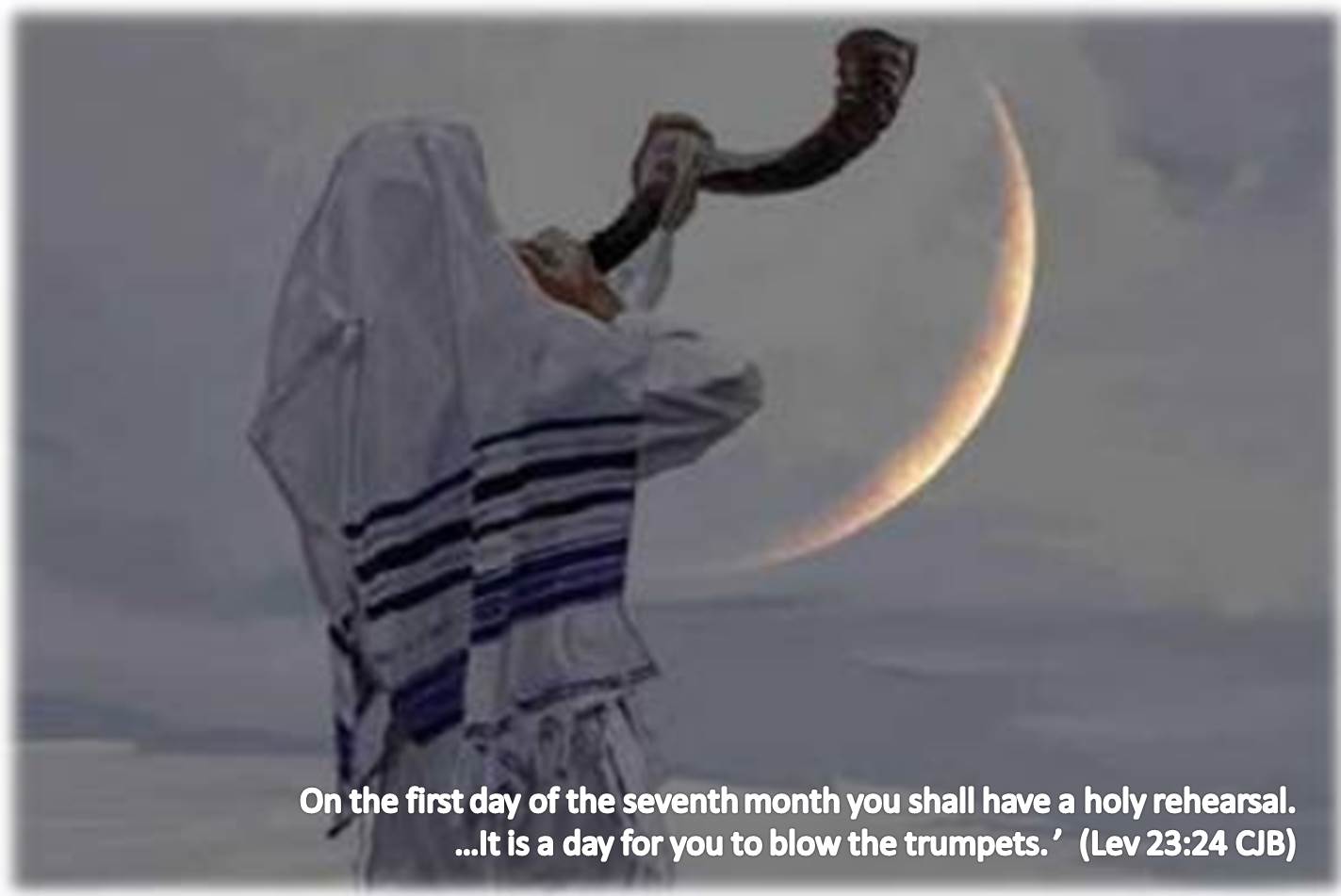
The Feast of Trumpets is a day for blowing shofars and trumpets and for shouting. The blast of trumpets or shofars often signaled the people to go to war or to march. Many believe that this will be the time when Yeshua returns to rescue His people and to rout hasatan and his followers.
And [Yehovah] spoke to Moses, saying, “Speak to the people of Israel, saying, In the seventh month, on the first day of the month, you shall observe a day of solemn rest, a memorial proclaimed with blast of trumpets, a holy rehearsal. You shall not do any ordinary work, and you shall present a food offering to [Yehovah].” (Leviticus 23:23-25)
The blowing of trumpets or shofars also begins a ten-day period in which we remove any sin in our lives. It is a time for serious reflection as we ready ourselves for the Day of Atonement, known in the Bible as Yom HaKippurim (day of coverings). It is often called today Yom Kippur (day of covering). This was the day when the High Priest entered the Holy of Holies in the Temple to make atonement for the people. Yehovah explains how this day is to be observed in Leviticus 16. Today, we connect this to our High Priest, Yeshua, who made atonement for our sins by dying in our place.
[Yehovah] said to Moses,“The tenth day of this seventh month is the Day of Atonement. Hold a sacred assembly and deny yourselves, and present a food offering to [Yehovah]. Do not do any work on that day, because it is the Day of Atonement, when atonement is made for you before [Yehovah] your God. Those who do not deny themselves on that day must be cut off from their people. I will destroy from among their people anyone who does any work on that day. You shall do no work at all. This is to be a lasting ordinance for the generations to come, wherever you live. It is a day of sabbath rest for you, and you must deny yourselves. From the evening of the ninth day of the month until the following evening you are to observe your sabbath (Leviticus 23:26-32).
For [Yeshua] did not enter into a holy place made with human hands, which was only a copy of the true one in heaven. He entered into heaven itself to appear now before [Yehovah] on our behalf. And he did not enter heaven to offer himself again and again, like the high priest here on earth who enters the Most Holy Place year after year with the blood of an animal. If that had been necessary, [Yeshua] would have had to die again and again, ever since the world began. But now, once for all time, he has appeared at the end of the age to remove sin by his own death as a sacrifice.
And just as each person is destined to die once and after that comes judgment, so also [Yeshua] was offered once for all time as a sacrifice to take away the sins of many people. He will come again, not to deal with our sins, but to bring salvation to all who are eagerly waiting for him (Hebrews 9:24-28).
The seventh and final celebration that Yehovah provides is called Sukkot or the Feast of Tabernacles or the Festival of Shelters. The Israelites recalled and celebrated how Yehovah dwelt with them for forty years in the wilderness as they dwelt in temporary shelters called sukkot in Hebrew. Today, we also recall that Yeshua, Son of Yehovah, came to live with us and among us. We eagerly await His return to remove evil from our midst and reign over us (Revelation 7 and 21).
And [Yehovah] said to Moses, “Give the following instructions to the people of Israel. Begin celebrating the Festival of Shelters on the fifteenth day of the appointed month—five days after the Day of Atonement. This festival to [Yehovah] will last for seven days. On the first day of the festival you must proclaim an official day for holy assembly, when you do no ordinary work. For seven days you must present special gifts to [Yehovah]. The eighth day is another holy day on which you present your special gifts to [Yehovah]. This will be a solemn occasion, and no ordinary work may be done that day (Leviticus 23:33-36).
This is a brief introduction to the appointed times of Yehovah. The appointed times celebrate what Yehovah has done for us, but they are also teaching tools from our Father. There is a lot of good information online and in books about this topic. Peter and I have written other articles on each of the appointed times. As always, ask the Holy Spirit (Ruach haKodesh) to guide you. Yehovah is calling us to be rooted in Him.