All posts by peterryall

Unknown's avatar

About peterryall

My wife (Nancy) and I have been Messianic believers in Yeshua for 20 years now and continue to glean revelations from our God (Yehovah) through His Holy Spirit (Ruach HaKodesh).

Dwelling in YHVH’s Rest

o that I had wingsWhat does it mean to “find rest for your soul” (Matthew 11:29) or to “enter into His rest” (Psalm 95:11)? When Solomon (Sh’lomo) dedicated the Temple, he prayed for YHVH’s awesome power and presence to dwell over the Ark: “Arise, O Lord God, to Your resting place, You and the ark of Your strength…” (II Chron 6:41). He wanted YHVH’s presence to come into the Temple and dwell with all the people of Israel forever, residing in the Holy of Holies. When Israel rebelled against YHVH and His Covenant, they were sent into captivity in Babylon, and the “Ark of His presence” was never returned to the Temple when it was rebuilt seventy years later.

We know that the Ark of the Covenant is where YHVH chose to rest, and that His presence was there wherever the Ark resided: in the wilderness when YHVH was leading Israel; in enemy territory where YHVH was defeating their enemies; and then in the Temple where His presence was seen and felt. When Moshe built the Tabernacle In the wilderness and communed with YHVH there, he asked YHVH to show him the Way. YHVH’s response was: “My Presence will go with you, and I will give you rest” (Ex 33:14).

When Israel no longer had the Ark in the Temple, where was YHVH’s Presence, and how could YHVH give His people rest, as He had promised in Exodus 33:14 above? We have a hint of how to be in YHVH’s place of rest in Nehemiah 8:10 where Nehemiah said to the people: “…for the joy of the Lord is your strength”.   Nehemiah had been telling the people to set themselves apart (be holy) to YHVH as they were celebrating the Feast of Tabernacles (Sukkot) for the first time in hundreds of years. Just as the Ark of the Covenant had been their strength in the First Temple times, the “joy of YHVH” was now their strength. We believe YHVH was teaching them to trust Him even more than symbols of His Presence like the Ark and its contents.

Believers in Yeshua can rightly claim that Messiah Himself has given us rest in our souls (Matthew 11:28-29). We are now the dwelling place of YHVH’s presence, as we are living tabernacles and His Holy Spirit resides within our hearts when we are baptized and filled with His Spirit.

However, YHVH has always wanted to dwell with us (Lev 26:12) as He did with Adam and Eve before the Fall: “And they heard the sound of the Lord [YHVH] God walking in the garden in the cool of the day…” (Genesis 3:7). It is apparent from this passage that Adam and Eve had a very intimate relationship with YHVH and spent time with Him every day in the Garden.

There are many ways to seek YHVH’s presence and spend time with Him, resting in Him.  We need to trust Him (Heb 3:19), obey His covenant (Heb 4:3,6; Jer 6:16; Ps 95:11), seek Him with our whole heart (Jer 29:13) and meditate on His word (Ps 1:2). YHVH’s desire to dwell with us is so strong that He gave His only begotten Son to redeem us so that we might always dwell with Him and He with us (John 3:16, Rev. 3:20).  Are you dwelling in the rest that YHVH provides?
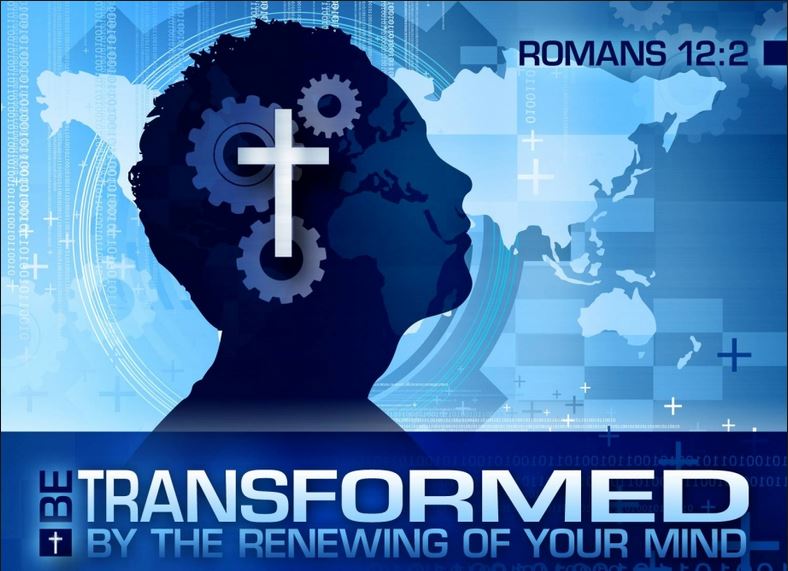
Is Your Brain Wired for Worship?

renewing of your mind“For God has not given us a spirit of fear, but of power and of love and of a sound mind.” (2 Timothy 1:7).

The part of this Scripture I want to focus on today is that God has given us a sound mind. He is not a God who wants us to suffer in mind or body, so He has created us with the tools to repair ourselves. It is well-known that certain types of creatures can regenerate parts of their bodies when they are wounded: deer grow new antlers, lizards grow new legs and tails, starfish grow new arms, and worms can grow entire new bodies. While it is true that humans cannot grow new arms or legs (except by the miraculous power of the Holy Spirit), we can regenerate our minds. Let me explain what I mean.

Believers in Yeshua understand the concept of renewing our minds (Rom 12:2) but that seems like a fairly obscure process to most of us, and it is hard to explain to someone how they can go about renewing their minds so they can line up with YHVH’s perfect will. However, when we look at the deeper meaning of the Hebrew word for renewal in this verse (hitchadshut), we see that it actually means regeneration, which is the same word used to describe creatures that grow new body parts. Over the last 30 years, brain research has greatly increased our understanding of how the brain functions physically, but it has also helped scientists’ understanding of the forces outside the physical brain (referred to as quantum mechanics) that trigger the conscious thought processes within the brain.

From a spiritual and Biblical perspective, we would call these external forces the mind or soul, as the mind is what enables our thoughts to be world-centered, self-centered or God-centered. The mind/soul encompasses the intellect, free will, and emotions. From God’s word, we know that we have power over our mind, to be able to renew it to be more God-centered, or to take our thoughts captive to the obedience of Messiah Yeshua (2 Cor 10:5). New scientific findings indicate that when we are actively thinking in our minds, we are actually changing our DNA, switching genes on and off, and causing cells to function differently. These actions do not happen merely by physical functions of the brain – they must be enabled by the mind, or conscious thought processes (see Dr. Caroline Leaf’s “Switch on Your Brain” study for more details on this research: https://drleaf.com/store/switch-on-your-brain/).

Psychologists and therapists have known for many years that the way we think affects our mental, physical, and emotional health. You may be familiar with a famous teaching about the power of our thoughts: “The Power of Positive Thinking” by Dr. Norman Vincent Peale. James 1:21 tells us (paraphrased) that if we lay aside all sinfulness in our lives and embrace God’s implanted word, this will “…save our souls”. Once again, though, we have a concept for renewing our souls which is easy to discuss but hard to implement in our lives.

So how do we go about regenerating our minds to bring healing and wholeness to our bodies and souls? The Holy Spirit is our helper and healer and leads us into all of YHVH’s truth and wisdom. So how do we tap into the Holy Spirit’s healing and restoring power?   We can only learn the Holy Spirit’s wisdom and truth and experience His healing power if we spend time with Him!   It says in James 1:27 that true worship is keeping yourself unspotted by the world. In order to resist the wiles of the devil and the temptations of the world, we must separate ourselves from the world – Isa 52:11 and II Cor 6:17-18: “Therefore go out from their midst, and be separate from them, says the LORD [YHVH], and touch no unclean thing; then I will welcome you, and I will be a father to you…”.

We understand from these Scriptures and others that true worship means setting yourself apart from the world and spending time with the Holy Spirit, praying and meditating on YHVH’s word. You do not have to be in a corporate sanctuary to “do worship”, and you do not have to be alone in your closet. You can be worshipping everywhere you go. What we really need to do is to renew our minds so that we live in a constant state of worship, meaning that we keep YHVH’s presence with us wherever we are, listening to His guidance and constantly interacting with Him through internal dialogue. This will keep our minds stayed on Him, because we are trusting in Him (Isa 26:3). And when we keep our minds focused on Him, then we will be sending positive impulses into all the organs and cells of our body, healing us of all infirmities, anxieties and fears (2 Timothy 1:7).

Our Strength in Battle

be strong

“…Be strong and of good courage; do not be afraid, nor be dismayed, for the Lord your God is with you wherever you go.” (Joshua 1:9)

This verse from Joshua along with Deuteronomy 20:1-4 are well-known battle verses, meant to encourage troops before they head off into conflict. However, what about the daily battles we face, which are not usually against flesh and blood but rather against spiritual enemies and people who are influenced by spiritual forces (demons) from the kingdom of darkness?

Psalm 144:1 contains an even stronger verse relating to preparation for battle: – “Blessed be the Lord [YHVH] my Rock, who trains my hands for war and my fingers for battle—“. When we look further down in this passage, though, we see that David is talking about spiritual warfare as much as physical combat. In Verses 7-8 he says: “Rescue me and deliver me out of great waters, from the hand of foreigners, whose mouth speaks lying words, and whose right hand is a right hand of falsehood.” We see from these verses that David is not getting training in face-to-face physical combat techniques so much as he is learning to trust YHVH his Rock in all situations, knowing that Yehovah will be fighting alongside him and rescuing him from the enemy’s attacks.

Where then do David and other warriors get their courage and strength? Looking back at the Joshua 1 passage once again, we see that Joshua is told to be strong and courageous, but not because of his own prowess or battle-worn experience. He is told that Yehovah will be with him in the battles, and because of that he does not need to fear. In 2 Chronicles 32:7-8 King Hezekiah says: “Be strong and courageous; do not be afraid nor dismayed before the king of Assyria, nor before all the multitude that is with him; for there are more with us than with him. With him is an arm of flesh; but with us is the Lord [YHVH] our God, to help us and to fight our battles…” Verse 8 clearly states that their army is greater than the army of Assyria, but not because of physical numbers. Rather, their strength and numbers are bolstered by having God Himself with them. In fact, God is not only with them, but He is fighting the battles for them!

If we need YHVH to be with us when we fight the physical and spiritual battles of life, then how do we ensure that YHVH is with us? The answer is in a single word, trust. It sounds simple, but it requires us to trust YHVH with our life, which is not simple. We learn this deep level of trust day-by-day by experiencing YHVH’s Hand of victory throughout the trials and conflicts of our lives. One of the clearest testimonies to trusting YHVH is in 2 Chronicles 14:11 when Asa cried out to YHVH and said, “LORD [YHVH], it is nothing for You to help, whether with many or with those who have no power; help us, O LORD our God, for we rest on You, and in Your name we go against this multitude. O LORD, You are our God; do not let people prevail against You!”

Another example of this type of unquestioning trust is in Exodus 33:15-16 when Moses says to YHVH: “If Your Presence does not go with us, do not bring us up from here. For how then will it be known that Your people and I have found grace in Your sight, except You go with us?” In this statement to YHVH, Moses is saying that he knows they will not be successful if YHVH does not go with them, and the Israelites will not have the testimony that they cannot succeed without YHVH.

So, where did these leaders find the strength to go out before their enemies, knowing their armies were physically inferior and that they did not have the courage and strength in themselves to be victorious? They found their strength in YHVH. There are many verses in the Torah, Psalms and Prophets that talk about people putting all their trust in YHVH’s strength. In fact they say that YHVH is their strength (Ex 15:2, Ps 18:2; 19:4; 118:14, Isa 12:2, etc.). I believe David sums this up in Psalm 27:1: “…The LORD [YHVH] is the strength of my life; of whom shall I be afraid?” (Ps 27:1) Even Sh’aul came to this conclusion in all his struggles when YHVH said to him: “…‘My grace is sufficient for you, for My strength is made perfect in [your] weakness’.” (2 Cor 12:9)

I aspire to have this kind of trust, where I have no anxiety or fear when I am going through the severe trials of life; only believing that YHVH will get me through those trials and that He will give me the victory over whatever enemy I am facing, whether physical, emotional or spiritual. My desire is that you will also learn to have this type of unwavering trust in YHVH, the Creator of the universe, and in His Son, Yeshua our Redeemer.

Fasting from Your Heart

fasting and praying on knees

“Is this not the fast that I have chosen: to loose the bonds of wickedness, to undo the heavy burdens, to let the oppressed go free, and that you break every yoke? Is it not to share your bread with the hungry, and that you bring to your house the poor who are cast out; when you see the naked, that you cover them…”  Isaiah 58:6-7

In Isaiah 58, YHVH tells His people Israel that they are not to be hypocrites when they fast, going through the motions with their head and body but not their heart (Isa 58:3-5, Jer 14:12, etc.). In Isaiah 58:6, He is talking about repenting for exploiting their workers. He tells them to turn back to Him and make a genuine change in their lives, showing compassion to others. In verse 7, Yehovah gets more specific when He describes the nature of a truly sincere fast, which would cause the people to exhibit the fruit of the Spirit in their actions, such as taking care of the poor and hungry, and clothing the naked.

To me, this is one of the most beautiful passages in all of Scripture, as YHVH is pointing out to His people how they have fallen short (as we all have in our lives), telling them they need to repent, guiding them (and us) as to what they should be doing, and then promising them wonderful blessings if they will follow His instructions (Isa 58:8-11).

Many Scriptures talk about the positive results of fasting sincerely from your heart:

  • In Joel 2:12, YHVH tells the people to turn to Him with their whole heart, with fasting and weeping; He goes on to say that they are to rend their heart and not their garments, and then Joel says that YHVH is gracious and merciful and will bless them for turning back to Him (Joel 2:13-14). This is similar to what He says through Jeremiah when He tells His people to circumcise their hearts and turn back to Him (also see Deut 10:16 and 30:6).
  • Yeshua adds meaning to these words when He tells people that they need to fast inwardly (in secret) and not outwardly (walking around in sackcloth and showing everyone how they are being so righteous with their fasting). As in Isaiah and other Scriptures, He also says that Abba Father will reward them openly when they fast secretly (Matt 6:16-18).
  • When King Darius had to throw Daniel into the lion’s den because he had broken the decree that no one was to worship a different god than the official god of their kingdom, Darius stayed up all night fasting. When he came down to check on Daniel in the morning, he found him alive and well. What really fascinates me about Darius is that he called Daniel the “servant of the living God” even before he knew that he had been saved from the lions (Daniel 6:18-23). This tells me that Darius was sincerely fasting from his heart and that he was praying to the true living God and not one of his false gods. It is also apparent from this passage that Darius was moved with compassion, which inspired his fasting.

What do these Scriptures teach us about our heart attitude when we are fasting and praying? If we are fasting because we think it makes us a better Christian, or we think it’s the right thing to do to get God to answer our prayers, or we are simply following Abba’s instructions to fast but our heart is not in it, what are we accomplishing? We are only fasting outwardly to convince others (or ourselves) that we are righteous people who are following God’s will. We need to look into our hearts and find out what our true motives are when we fast or pray.

Are we truly seeking to draw closer to YHVH and to be pleasing to Him? If that is true, then the fruit of the Spirit should be evident in our lives, starting with our love and compassion for others.

Look again at Isaiah 58 and ask these questions of yourself: are you helping to undo the heavy burdens of others; are you sharing your bread with the hungry and bringing to your house the poor who are cast out; are you clothing the naked and taking care of the widows and fatherless? If you are, then Yehovah will reward you openly: your light shall break forth like the morning, your healing shall spring forth speedily…Then you shall call, and YHVH will answer; you shall cry, and He will say, ‘Here I am.’ Isaiah 58:6-9

Where do we look on Yom Teruah?

blowing of trumpets

Then the sign of the Son of Man will appear in the sky: all the tribes of the Land will mourn, and they will see the Son of Man coming on the clouds of heaven with tremendous power and glory. He [Messiah] will send out His angels with a great trumpet [shofar] blast; and they will gather together His chosen people from the four winds, from one end of heaven to the other.

Yeshua tells us in Matthew 24:30-31 (CJB) that in the last days, He [Messiah] will sound a great shofar, and send out His angels to gather His Body from all the ends of the Earth. YHVH has provided the Feast of Trumpets [Yom Teruah] as a rehearsal to help us prepare for this great End Times event.

When you see phrases like the “blowing of the trumpets” or “loud shouting”, these are translated from the same Hebrew word, Teruah, which simply means a loud noise. One of my favorite uses of this word in Scripture relates to the moving of the Ark of the Covenant in II Samuel 6:15: “So David and all the house of Israel brought up the ark of YHVH with shouting and with the sound of the trumpet [shofar]”. This same event was described in I Chronicles 15:28: “So all Israel brought up the ark of the covenant of YHVH with shouting, to the sound of the ram’s horn [shofar], trumpets, and cymbals, and made loud music on harps and lyres.” In both descriptions, you see the combination of loud shouting and the blowing of the Shofar, which both come from the word Teruah. An occasion like the moving of the Ark elicited many loud sounds from the people in the procession, both from instruments and with their voices raised in praise to Yehovah.

There are many other passages in Scripture that tell us how the Shofar is used: as a wake-up call to turn people back to YHVH (Jer 6:17, Eze 33:3-6), a call to battle (Isa 18:3, Jer 4:19, Josh 6, Judges 7), or the announcement of an appointed time with Yehovah (Ex 19:16-19, Lev 23:23-25, Num 29:1). These last two verses refer to the blowing of the Shofar and “loud shouting” on the Feast of Yom Teruah, or the Day of the Blowing of Trumpets.

Going back to the original Hebrew, a better translation of Numbers 29:1 would be: “On the first day of the seventh month you shall have a holy rehearsal. You shall not do any ordinary work. It is a day for you to blow the trumpets”. Leviticus 23:24 could also be more accurately translated as: “Speak to the people of Israel, saying, In the seventh month, on the first day of the month, you shall observe a day of solemn rest, a memorial proclaimed with the blast of trumpets, a holy rehearsal”. Why would this and other Fall Feasts be described as rehearsals? Most likely because the Fall Feasts have not yet been fulfilled. Putting all these Scriptures together, it seems clear that Yom Teruah will find its ultimate fulfillment in the “great shofar blast” described in Isaiah 27:13 (and quoted by Yeshua in Matthew 24:31): “And in that day a great trumpet [shofar] will be blown, and those who were lost in the land of Assyria and those who were driven out to the land of Egypt will come and worship YHVH on the holy mountain at Jerusalem”.

So, what does all this mean to us as the Body of Messiah? No matter whether or not end times prophecy is fulfilled this year and this is indeed the Great Shofar blast that signals the return of Yeshua to reign on the Earth, the blowing of the Shofar on Yom Teruah is nevertheless very significant for believers. Yom Teruah is always meant to be a special time of awakening for our souls and repentance for our hearts so that we are prepared to be received by Yeshua as the Bride of Messiah when He returns. So on this Yom Teruah, we need to look at our inner selves and take stock of how we are doing at lining up our souls with our born-again spirits (Rom 12:2). I know I have areas that need work based on my report card – how about you?

Witnessing in Love

the truth in love“Though I speak with the tongues of men and of angels, but have not love, I have become sounding brass or a clanging cymbal. And though I have the gift of prophecy, and understand all mysteries and all knowledge, and though I have all faith, so that I could remove mountains, but have not love, I am nothing. And though I bestow all my goods to feed the poor, and though I give my body to be burned, but have not love, it profits me nothing.” I Corinthians 13:1-3

In a recent blog series, I had spoken about Standing Fast to your Convictions, but at the same time remembering to Speak the Truth in Love (Ephesians 4:15) when you are discipling or confronting someone with the truth of YHVH’s word. This week I want to give you a real-life example of this which is etched into my heart right now due to the passing of my only brother.

Over the 27+ years since I have been a born-again believer in Yeshua, I have witnessed to people within my circle of friends and family, as well as casual acquaintances and strangers. However, the two people I witnessed to most fervently over those years were my father (deceased in 2001) and my brother, who passed on earlier this week. As I felt a special burden from the Holy Spirit to witness to these two significant people in my life, I tried a number of different approaches to spiritual seed-planting, attempting to tear down the intellectual and emotional barriers that kept those seeds from taking root and bearing fruit.

Many of my approaches did not bear fruit, because I was trying to prove the truth of the Scriptures and the existence of a Creator God through intellectual debate, which only spoke to their minds and not their hearts. I was far more effective when I stopped trying to “win the argument” with them, and started giving them my personal testimony of how God changed my life and brought meaning and purpose to my brief existence on this earth. This brought our conversations down to a heart level, and even though they still were not ready to accept all the truths I shared with them, they no longer felt threatened that I was trying to change them or prove them wrong.

While I do not recommend experimenting on your family members with different witnessing techniques, we do need to always remember to speak the truth in love and let our words be seasoned with the salt of grace. Once you learn to keep the focus on your own personal spiritual journey and your relationship with Abba Father and His Son, Yeshua, then you have a greater opportunity to break through all the barriers that inhibit people from receiving the truth. With this approach, the people you are witnessing to feel less threatened and are more receptive to your message, since you are just sharing from your own personal experience.

I will not tell you the specific results of years of witnessing to my father and my brother, but I will say that our spiritual conversations brought us closer together in our own relationships with each other. One great benefit of sharing your personal testimony is that people feel closer to you as you share with them in confidence and they get to know you on a deeper and more intimate level. Although I lived 3000 miles away from my brother and did not get to see him face-to-face more than once every few years, I felt very close to him in spirit and soul in spite of the miles separating us. I feel a great empty space in my soul now that he has left his earthly home, but I also feel great assurance that he is with Abba in heaven and is experiencing joy and Shalom as he never could in the limitations of his physical body.

The central mission of our ministry is to help believers stand firm to their convictions and hold fast to their faith under persecution, equipping them to become the overcomers they always wanted to be – and that the Scriptures promise them they can be. We want you to become all that you can in YHVH’s kingdom, and overcome your fears and self-consciousness so that you can share Yehovah’s love with as many people as possible before you depart this planet.

They Shall Know that I Am Yehovah

they shall know that I am YHVH

So I will make My holy name known in the midst of My people Israel, and I will not let them profane My holy name anymore. Then the nations shall know that I am YHVH, the Holy One of Israel.” Eze 39:7

In my previous postings on the Name of the Creator and sovereign God of the universe, Yehovah, I talked about the importance of knowing and speaking His Name, as well as the sad history of the silencing of God’s Name for the past 2300 years (see There is Power in the Name). If you recall from that blog, after the return from exile in Babylon, priests of the Second Temple era decided that God’s name was too holy to pronounce, and they banned the speaking of the Name among the Jewish population in general and even within the Temple. In this blog, I wanted to present some encouraging words to believers who feel discouraged and helpless, knowing that the Name of Yehovah is known by so few of God’s people, and even a smaller number of people across the Globe.

We know from Scripture that Yehovah wants His name to be known throughout the Earth, by Jews and non-Jews alike (see Ps 91:14, Isa 52:6, Jer 16:21, Eze 12:15; 22:16; 30:26; 36:23; 39:7; Amos 5:8, John 17:6). We also see clearly in Scripture that YHVH wants everyone to speak His name (Gen 12:8; 26:25, Isa 44:5; 54:5, Jer 10:25). While it is true that most people on earth (believers and non-believers alike) do not know what to call YHVH, we have heard recently about how Yehovah is starting to reveal His name to His people in diverse places. We have experienced this especially among non-Jews who are keeping the Biblical feasts and celebrating YHVH’s Sabbaths.

I recently saw a very interesting example of the unveiling of YHVH’s name in a newsletter that comes out Israel on a daily basis. It is called Jerusalem365 and each article is a combination of a Scripture verse (in English, Hebrew, and transliterated Hebrew), and a photo and story of something happening in Jerusalem that relates to the verse (you can subscribe to the newsletter at the Israel365 site: Israel365 Subscribe). The photographers and authors of the articles are all Israeli Jews, many of whom have made aliyah to Israel (meaning they have emigrated there from other countries).

Here’s the thing that fascinated me about some of their articles: whenever the verse contained YHVH’s Name (“The LORD” in English translations), the Hebrew lettering included the vowels and spelled out YHVH so that it would be pronounced as Yehovah. To be more accurate, YHVH was actually spelled out two different ways in various articles: sometimes it was spelled out exactly as Yehovah, and other times they used a common technique of obscuring the exact Name of God (they reversed the first and last letters).

          Here are the two different forms of YHVH [Yehovah] written in Hebrew:The Name There are several amazing things about the Hebrew Name of God being spelled out fully in these articles:

  1. Because of the ban on speaking or writing the fully pronounceable Name of God, Jewish people would be required to spell God’s Name as HaShem (simply “The Name”), Adonai (Lord as a title for God), or one of the abbreviations used for YHVH in the Torah and other ancient Jewish writings.
  2. When the Hebrew was transliterated into English, it was written as Adonai, which would be acceptable to Rabbis and Orthodox Jews.
  3. The Name in the English text is written as “The LORD”, which is the standard translation found in most English Bibles.

The key point here is that God’s true Name, which Jews refer to as the unpronounceable Name of God, is being revealed to individuals in Israel, and is now being communicated out to thousands of people around the world. While it is true that most Christians and many non-Orthodox Jews would not be able to read the Hebrew or understand the significance if they could read it, YHVH is nevertheless revealing His Name to Israel and the Nations as He said He would (Eze 39:7).

In the greatest prayer that Yeshua prayed, He first said that He had glorified the Father by finishing the work that Abba had given Him to do. (John 17:4) And what work had He completed? In Verse 6, Yeshua says that He made YHVH’s Name known to the disciples that Abba gave Him “out of the world”. From this verse we can see that one of Yeshua’s primary missions was to make known the person, character and true Name of YHVH, so that He could glorify God the Father on earth. [Remember that even in Yeshua’s time there was a ban on speaking the Name of God]. Verse 5 says that after Yeshua’s work was done on Earth, then Abba would glorify His Son by bringing Him back to heaven to be with Him again.

So what does all this mean to us as followers of the Way? If Yeshua made Abba Father known to us by revealing His true Name, then I do not want to waste Yeshua’s hard-earned fruit produced while He was here on the Earth. I hope you will also want to know YHVH’s true Name and that you will want to speak it in your praise and prayers to AbbaYehovah wants His name to be known, spoken, praised, feared, and glorified throughout the Earth!

Stand Firm in Love (Part 2)

Let all you do be done with love

“Watch, stand fast in the faith, be brave, be strong. Let all that you do be done with love.” I Corinthians 16:13-14

Last week, I focused on Verse 13 above as I spoke about holding fast to our convictions when we know they are clear instructions from YHVH’s word. In Part 2 this week I will focus on the second part of this passage above, which says that everything we do should be done in love. From I Corinthians 13 Verse 2 we know that even if we are working miracles through Holy Spirit gifts and have greater faith than the Apostles, “so that we could remove mountains, but have not love, we are nothing”.

The same adage goes for mentoring and discipling other believers – if we are not “speaking the truth in love” (Eph 4:15), then we are better off not speaking at all. Whenever the Holy Spirit puts on our heart that we are to speak with someone, our words need to be spoken “with grace, seasoned with salt, that we may know how we ought to answer each one” (Col 4:6).

When we put this together with Verse 13 above, it means that we are to stand firm in our convictions and not be swayed by the world’s compromise with YHVH’s word, but when we do speak out we need to be sensitive to the beliefs and feelings of others. Does this sensitivity to their beliefs mean that we are to be silent and avoid delicate topics like homosexuality? No, most certainly not! If we were silent, then we would no longer be watchman for YHVH’s Word to others in the world.

So how do we keep the delicate balance between offending people (even friends and family) and speaking the truth in love? Actually, we cannot avoid offending people when we speak God’s truth.  Didn’t Yeshua say:”And blessed is the one who is not offended because of Me” (Matt 11:6), and then: “…you will be hated by all for My name’s sake” (Luke 21:17). Many people were offended by Yeshua’s words, and He told His disciples (including us) that we would be hated when we speak His words and His name.

I believe we need to state the Godly convictions we stand on and why we are so passionate about them. This way, the person will not think we are judging them, and we will not so easily repel them with our strong words. We need to come from the perspective that we love God and want to follow His instructions because He first loved us, and because He made the most incredible sacrifice of all time for us. He hung on a tree for us when we were still sinners and didn’t deserve His love or His sacrifice.

It is only God’s amazing love that will draw people to Him. Until people understand the depth of Yehovah’s love and concern for them as individuals, and that He wants to have a personal relationship with them, there is no hope that they will listen to more serious matters. Once they reach this understanding in their heart, then you can gently start speaking to them about obedience and being pleasing to God in the way they live their lives.

Unless we speak to people out of love, we are like clanging symbols: “If I speak in the tongues of men and of angels, but have not love, I am a noisy gong or a clanging cymbal. And if I have prophetic powers, and understand all mysteries and all knowledge, and if I have all faith, so as to remove mountains, but have not love, I am nothing.” (I Cor 13:1-2) When we share the truth with others, we must season our words with grace so that we allow Abba Father to draw them to Yeshua and the Holy Spirit to convict them in their sinful lifestyle. Then the door is open for us to disciple them and pray with them so that they want change their lifestyle so that they can be pleasing to Yehovah.

We need to look at our heart motives behind our words. When we approach people about their lifestyle or behavior, do we come to them with an air of superiority or self-righteousness, or do we come to them with humility, speaking the truth to them out of love?

Stand Fast to Your Convictions (Part 1)

stand firm“And they overcame him by the blood of the Lamb and by the word of their testimony, for they loved not their lives even unto death.” Revelation 12:11

Last week, Nancy and I were deeply convicted by a powerful teaching we heard at a local congregation. The pastor was focused on getting ourselves fit for the fire that is to come in the End Times (spoken of by Yeshua in Matthew 24).  Believers could interpret this fire that is coming in different ways, but in this context I am seeing it as persecution against the Body of Messiah. Sha’ul told us that we as the Body of Messiah are to “stand fast in one spirit, with one mind striving together for the faith of the gospel” (Phil 1:27).  We are also told to stand fast as individuals in our faith (I Cor 16:13).  This means that we are to hold to our convictions that there is one true God, Yehovah, and one clear standard of morality, which is the set of instructions YHVH has given us in His Torah.

The pastor went on to speak about the need to stand up for what we know is YHVH’s standard of morality in His Kingdom.  He said that as the moral fiber of our nation continues to crumble we will have plenty of opportunities to speak out about God’s stand on moral issues.  In our society today, we have an historic opportunity to stand fast in the face of the growing fires of immorality, and to speak out to others (both believers and non-believers) about God’s standard of morality.  The Supreme Court decision to require all states to conduct same-sex marriages has given us a golden opportunity to test the strength of our commitment to uphold YHVH’s standards in the face of cultural persecution. YHVH spoke often about the abomination of Homosexuality, and He judged it as harshly as any other sin (see Judges 19-20 and Gen 19 for examples). He saw this as a violation of the sin of idolatry, that people exchanged the glory YHVH gave them for a lie, and worshiped the creation instead of the Creator (Rom 1:25).

In our home worship time with Abba, the Ruach keeps bringing Nancy and I back to the passages in Ezekiel (3:16-21 and 33:1-9) where YHVH speaks to Ezekiel about being a watchman to warn God’s people about the upcoming judgment for their sins. I think YHVH is speaking to all of us when He says: “When I say to the wicked, ‘You wicked person, you will surely die,’ and you do not speak out to dissuade them from their ways, that wicked person will die for their sin, and I will hold you accountable for their blood” (Eze 33:8). As God’s people, we are not only accountable for our own sins, but we are accountable for speaking YHVH’s truth to others and warning them about God’s righteous standard. As compassionate believers seeking to be like Yeshua, though, we must speak and act out of love and humility, seasoning our words with grace. We must not condemn or judge others out of our own self-righteousness, remembering that all have sinned and fallen short of the glory of YHVH (including ourselves). See Part 2 of this Blog as we dig deeper into how we should we should act and speak graciously when we encounter unGodly attitudes, words or actions.

YHVH is a merciful Elohim who loves us with an unconditional love. However, YHVH is also a just and righteous God who cannot tolerate sin in His presence. Some see this as an irreconcilable contradiction, but in YHVH’s never-ending mercy, He chose to save His people from their sins by sending His Son to die in place of the death we deserve. This is the amazing miracle of the Good News, but we must do our part as well. In order to benefit from God’s plan of reconciliation with us, we must repent, turn from our sinful ways, and start walking on YHVH’s righteous path. We must not think that our own sin is somehow less offensive to God than the sins of others.

Yeshua told us that He would send fire on the earth. He said that He did not come to earth to bring peace, but division, and that even family members would be divided against each other in the same household (Luke 12:49-53). We know from experience that our families are the most difficult settings to speak out God’s truth, and sometimes are the places of greatest persecution. But we also know as believers that we are to “overcome by the blood of the lamb and the word of our testimony” (Rev 12:11). And what does the rest of that passage say, that we are to “love not our lives even unto death”.

In the face of persecution from our families, friends and fellow believers, we need to stand fast to God’s standard, even when we are criticized, ridiculed, shunned by others, or face possibly even more severe consequences in future times. It is good to meditate on YHVH’s truth, knowing that nothing can separate us from His love, and that He will bless us with boundless spiritual fruit when we boldly share His truth with others.

Will the True Messiah Please Stand Up?

Gemini

Many passages in scripture talk about the dual nature of Messiah Yeshua, that He is both God and man. So how do we know that Yeshua the Messiah is both divine (YHVH Elohim) and human? Scripture makes very clear this dual nature of Yeshua, and we know that we can believe the testimony of Scripture because all Scripture is inspired by God and is true and good for doctrine, teaching, etc. (2 Tim 3:16).

Galatians 4:4 shows the humanity of Yeshua: “…God sent forth His Son, born of a woman, born under the Torah..”. Luke 1:35 provides clear evidence of the divine nature of Yeshua – the angel said to Miriam: “…The Holy Spirit will come upon you, and the power of the Most High will overshadow you; therefore, also, that Holy One who is to be born will be called the Son of God.”

God did not just manifest Himself in flesh as a human being, but rather “The Word became flesh and dwelt among us, and we beheld His glory, the glory as of the only begotten of the Father..” (John 1:14) God the Father took Yeshua who was already His Son from the beginning, and made Him to be born through a human woman by the power of the Holy Spirit. So why did Messiah need to be fully human as well as fully divine? Because we had to have a High Priest [our Messiah Yeshua] who could understand our weaknesses – One who had been tempted in all things just as we are, yet without sin. (from Heb 4:15) Even more specifically, Hebrews 2:17 says: “Therefore, it was necessary for him to be made in every respect like us, his brothers and sisters, so that he could be our merciful and faithful High Priest before God. Then he could offer a sacrifice that would take away the sins of all people. Scripture confirms this in Philippians 2:7-8, where it says that Yeshua took on the “form of a bondservant, and [came] in the likeness of a human being. And being found in appearance as a man, He humbled Himself and became obedient to the point of death, even the death of the cross.”

We can see clearly from these scriptures that Yeshua could not have taken away our sins unless He was both fully human (so He could identify with us in our human weakness) and fully divine (so that He had the power of the Holy Spirit to defeat the enemy, HaSatan). It is true that we now have the power of the Holy Spirit within us, when we have been baptized into that power. However, Yeshua has a special relationship with the Holy Spirit and Abba Father, in that He is One (Echad) with them as persons of the triune God, Yehovah Elohim.

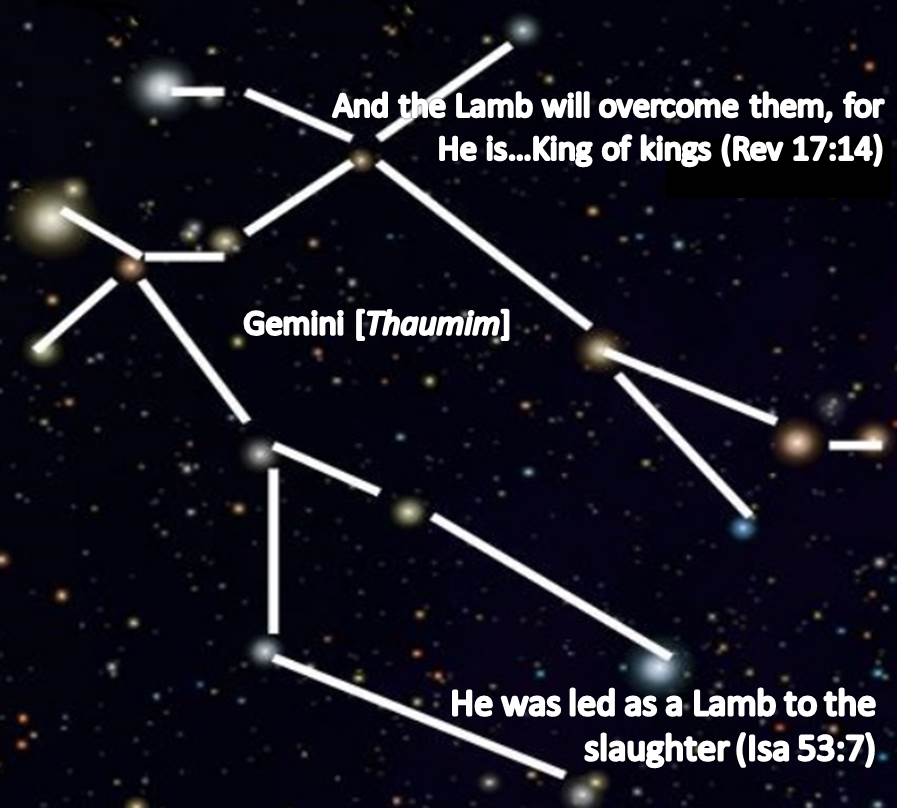
To put this into a context that might be easier for us mortal beings to understand, YHVH has painted the entire Gospel message into His star-pictures in the sky. We have looked at some of these in depth in previous blogs, but here I just want to give you a brief snapshot of one of them to help clarify Yeshua’s duality as God and man. Most people have heard of Gemini as one of the 12 signs of the Zodiac. However, as with the others, its meaning has been corrupted over the ages through pagan mythology and astrology. The original Hebrew name for this sign was Thaumim, which means united, or twinned, as in Exodus 26:24.

In most of the myths about Gemini, twin brothers are represented; they are sometimes seen as heads of armies or great pirates on the seas (sons of Jupiter), which is why they were looked on as “patron saints” of marine navigation. The ancient star-names paint a very different picture, though, of a single person with a twofold nature–God and Man. They tell the story of His twofold work of suffering and glory, and His twofold coming in humiliation and in triumph. Two of the 85 stars in this sign point this out very clearly; the star Apollo in the head of one means ruler or judge, while the star Hercules in the other’s head means “the One who comes to suffer”. The best translation of the Hebrew name of the sign (Thaumim) is “united into one”, in the same sense that Yeshua is one person of the Godhead, but has two distinct natures united together in His one essence.

There are not two separate persons, but rather two natures joined together in one Person, “God and man in one Messiah.” We can’t have one without the other – if we accept Yeshua as a man, suffering for our redemption, then we must also accept Him as our God (Yehovah), coming to judge all people and reign as King of kings for eternity. When we remember what Yeshua said to His disciples before He left the earth, it helps us understand what it means to be a part of His Kingdom: “If you love me, you will keep My commandments”. (John 14:15) In verse 21, He goes on to say: “If anyone loves Me, they will keep My word; and My Father will love them, and We will come to them and make Our home with them.”

This sounds like the greatest thing that could ever happen to us, that Abba Father and Yeshua His Son would come make their home with us! Do you want this? It means sacrifice and commitment for someone to keep His commandments (His word) day-by-day. As Yeshua promised, Abba sent the Ruach HaKodesh to help us every moment of our lives – do you think the Holy Spirit can also help you to stay faithful to Yehovah’s Word? Is it worth trying?