Category Archives: Nancy’s blogs

Become an Overcomer

soar high on eagle's wingsThe one who overcomes, I will grant to them to sit down with Me on My throne, as I also overcame and sat down with My Father on His throne (Rev 3:21).

Several passages in Scripture stress the importance of being overcomers, but exactly what does that mean?   At first glance, it seems a fairly simple thing to be an overcomer. For example, we read in 1 John 5:4,5:  For everyone who has been born of God overcomes the world. And this is the victory that has overcome the world—our faith. Who is it that overcomes the world except the one who believes that Jesus [Yeshua] is the Son of God?

It might seem that all we need is faith that Yeshua is the Son of God. Ephesians 2:8 tells us that we have been delivered by grace through faith and that even our faith is a gift. This is all true (for Scripture does not lie). However, it is not the complete picture. Faith is more than a sentiment or a creed. Our faith must lead to action. Faith is a gift, but it matters greatly what we do with that gift.

Consider Yeshua’s words in Matthew 25:14-30. We believe that one of the “talents” we have been given is faith. We have also been given other gifts or “talents” corresponding with the purpose YHVH has for each of us in building His kingdom. It is not acceptable for us to bury our gift of faith or let it lay sleeping on a pew. Our faith must spur us into action.

Our faith begins inside, but it should at some point manifest outside as well. Are we becoming more like Yeshua in our attitudes and actions?  2 Corinthians 5:10 shows us that we are accountable: “For we must all appear before the judgment seat of Christ [Messiah], so that each one may be recompensed for their deeds in the body, according to what they have done, whether good or bad.”

So how do we become more like Yeshua? One clear statement is in Romans 12:1-2: “Therefore I urge you, brethren, by the mercies of God, to present your bodies a living and holy sacrifice, acceptable to God, which is your spiritual service of worship. And do not be conformed to this world, but be transformed by the renewing of your mind [soul]…”.  The concept of renewing our minds seems abstract and difficult to accomplish.  Several Scriptures help clarify this process: Ezra 10:11 – Honor the LORD [YHVH]…and do His will. Separate yourselves from the [worldly] people around you…; Ephesians 5:17 – Therefore do not be foolish, but understand what the Lord’s will is; I Peter 1:14 – As obedient children, do not conform to the evil desires you had when you lived in ignorance;  and          I John 2:15 – Do not love the world or anything in the world…

Psalm 103:5 tells us that: [YHVH] contents you with good as long as you live, so that your youth is renewed like an eagle’s.

What does it mean that our youth will be renewed like an eagle’s? An eagle can live up to 70 years, but only if at age 40 the eagle makes a very difficult decision. The eagle has to subject itself to a painful transformation. By age 40, the eagles talons are overgrown and inflexible, the feathers weigh down its wings, and its beak is too bent to be useful. So, over a period of 150 days, the eagle must pluck out beak, talons, and feathers and wait for replacement parts to grow in. He cannot eat and he is completely defenseless. If at any time, the eagle decides that this process is too troublesome, it can give up, but it will die. However, if the eagle persists and “overcomes,” it can regain its youth and live for another 30 years.

What about us? We also must make tough decisions and endure sometimes painful transformations. We must turn our backs on much that might seem desirable in this world and focus on our future with Yeshua. We may be asked to give up everything, even our lives. “And they overcame him because of the blood of the Lamb and because of the word of their testimony, and they did not love their life even when faced with death” (Rev 12:11). However, if we overcome, we will have more than just an extra 30 years of life. We will have eternal life with YHVH. However, we will have much more than that, more than we can imagine.

He who overcomes will thus be clothed in white garments; and I will not erase his name from the book of life, and I will confess his name before My Father and before His angels (Rev 3:5).

He who overcomes, and he who keeps My deeds until the end, TO HIM I WILL GIVE AUTHORITY OVER THE NATIONS; (Rev 2:26)

Call to Action

not everyoneOur role as followers of Yeshua is to be an active role. Even the Hebrew language is an active language with the emphasis on verbs rather than nouns.  Yeshua modeled the type of action He expects to see from each of us.  He taught, healed, encouraged, fed the hungry, and admonished wayward leaders, even at the cost of His life.

Many disciples of Yeshua in our culture have devoted themselves almost exclusively to improving themselves and studying Scripture. These things are undoubtedly important, but there must be a healthy balance between improving self and helping others. We are required to meditate on and study Scripture, but it is useless if we do not also live it (James 1:22).

In His Sermon on the Mount, Yeshua describes those who will be welcomed into His Kingdom.

“Then the King will say to those on His right, ‘Come, you who are blessed of My Father, inherit the kingdom prepared for you from the foundation of the world. For I was hungry, and you gave Me something to eat; I was thirsty, and you gave Me something to drink; I was a stranger, and you invited Me in; naked, and you clothed Me; I was sick, and you visited Me; I was in prison, and you came to Me.’…   (Matt 25:34-36)

No mention is made in this passage concerning how well we know the Bible, although in other passages Scripture makes it clear that this is important ( Josh 1:8; 2 Tim 2:15, 3:16-17). In the past, I have been complacent with acquiring and storing knowledge of Scripture, but did not always put it into practice. It was only after I heard a missionary point out that Americans are great at acquiring knowledge, but we are deficient in actively building up the kingdom of YHVH, that I woke up. As I heard of new converts to Yeshua, with barely the rudiments of the Gospel, preaching, teaching and working miracles with the power of the Holy Spirit, I was truly convicted. They were doing so much with so little.

Secular news reports rarely discuss persecution and oppression of Yeshua’s followers, so pro-active research on our part is needed. Some of the things I have discovered: many of our brothers and sisters all over the globe are being persecuted for their faith, yet preach the gospel despite daily risk of imprisonment or death.  Political and/or religious leaders in numerous countries, seek to control all religious thought and activity and to eradicate any group that does not conform. North Korea is just one example.   In Iraq, Islamic extremists are beheading Christians. One tactic is to invade each home and demand that the children renounce Yeshua and embrace Allah. The children thus far have refused to give up Yeshua and were consequently beheaded in front of their parents. Leaders in India are routinely and consistently adding restrictions to hinder the spread of Christianity. Radical groups’ violence goes unchecked and police often “fail” to find sufficient evidence against the perpetrators. Christian refugees from Syria are being attacked by Muslims in some of the countries where they have sought refuge. The men are beaten and their wives and children are being raped and sodomized.   We must do more than shake our heads. Love is an action, not a feeling.

Martin Luther King, Jr. correctly stated that “It may well be that we will have to repent in this generation. Not merely for the vitriolic words and the violent actions of the bad people, but for the appalling silence and indifference of the good people who sit around and say, “Wait on time.” (Martin Luther King Jr., A Testament of Hope: The Essential Writings and Speeches)

Rather than randomly search out a worthy cause and plunge in, ask YHVH to direct you to the job He has appointed for you. There is much work to be done and windows of opportunity are closing rapidly. YHVH is still in control and is orchestrating His plan, so the best use of our time and effort is to yield ourselves to His assignment for us. Let us not be the generation who has to repent for keeping silent and doing nothing. Let us be the generation that accomplishes His will and is rewarded. Let us be the generation that is known by our love for one another, whatever the cost

Why do you call me, ‘Lord, Lord,’ and do not do what I say?
I will show you what he is like who comes to me and hears my words and puts them into practice.  He is like a man building a house, who dug down deep and laid the foundation on rock. When a flood came, the torrent struck that house but could not shake it, because it was well built.  But the one who hears my words and does not put them into practice is like a man who built a house on the ground without a foundation. The moment the torrent struck that house, it collapsed and its destruction was complete.” (Luke 6:46-69)

Trees of Righteousness

trees of righteousness,

Have you ever wondered how we as humans can be compared to trees? There are a number of places in Scripture where it speaks of people of us as trees (e.g. Ps 1:3, 92:12; Isa 61:3), or our actions as representing the attributes of trees. In Isaiah 61:3, the prophet says that when we are brought back out of grief and mourning into praise and joy, that we resemble trees of righteousness. Psalm 92:2 says that the righteous will flourish like palm trees, and Psalm 1:3 says that when a person delights in YHVH’s Word, then they shall be like a tree planted by the rivers of water…and whatever they do will prosper.

In Proverbs 15:4 YHVH says that our tongue is like a tree of life when we speak gentle words to people. Proverbs 3:18 states that when we embrace YHVH’s wisdom in our lives, we are blessed with happiness and YHVH’s wisdom is like a tree of life to us. In Proverbs 11:30, we learn that when we are walking a righteous path of life, the fruit of the Spirit is a “tree of life“, and we exhibit wisdom when we are winning souls into YHVH’s Kingdom.

What is it that is so significant about trees and that we are like them? Botany and anatomy show us that human skeletons are constructed similar to trees, where our backbone is the trunk that holds our bodies upright and allows us to walk and move about without discomfort or pain. Beyond this obvious physical comparison, though, Scripture says that when we are rooted and grounded in YHVH’s Word, we will be like trees planted firmly in the love of Messiah, with the promised blessing that we will “be filled with all the fullness of God” (Eph 3:17-19).

How do we become like trees of righteousness? After Adam and Eve [Chavah] were cast out of the Garden for their disobedience, angels were placed all around the Tree of Life so that they could not eat from it. It is no coincidence that Yeshua was crucified on a tree. Through His righteous atonement, He allowed us to be righteous and holy before Abba Father, just as we were told to be like trees of righteousness in Isaiah 61:3. When we believe and accept Yeshua’s precious gift, we become righteous like Him.

Yeshua’s atonement provides our new life in Him: “who Himself bore our sins in His own body on the tree, that we, having died to sins, might live for righteousness—by whose wounds you were healed” (1 Peter 2:24). The tree features prominently in the Gospel story, and Yeshua brings righteousness to us through His unswerving obedience to the Father and His willingness to give His life for those who hated and persecuted Him.

When Yeshua spoke to the congregations through John in Revelation 2, He told them that although they had been diligent in doing YHVH’s works, they had lost their first love (Himself). But then He promised that “the one who overcomes I will grant to eat of the tree of life, which is in the paradise of God” (Rev 2:7). Since the time of Adam and Chavah, people had been expelled from the Garden and from being able to eat of the Tree of Life, but in the Millennial Kingdom, the paradise of God will be re-established. Those who keep YHVH’s commandments will “have the right to the tree of life..” (Rev 2:14)

There will be a physical Tree of Life in YHVH’s future Kingdom, which will bear different fruit every month, and its leaves will be for the healing of the nations. However, we believe that Yeshua will be the ultimate Tree of Life who will dwell at the center of the true “paradise of God”. He is the Seed, Root, Trunk, Branches, and Fruit that come from heaven. The first Adam (in the Garden of Eden paradise) lost access to God because of his sin, but the last Adam reclaimed our access by means of His obedience, resisting the power of evil even to the point of death upon the tree (Phil 2:8). His resurrection life is the “firstfruits” of all who put their trust in Him; “For as in Adam all die, even so in Messiah Yeshua shall all be made alive” (I Cor 15:22). Those who have put their trust in Yeshua and continue to keep His commandments to the end will be made alive in Him and will spend eternity in Paradise with Him. Will you be one of those blessed people?

A Pleasing Fragrance

aroma pleasing to GodIn Exodus 30:34-38, YHVH instructs Moses concerning the incense that is to be made for YHVH’s altar. This incense was to be used solely for YHVH and not for anyone else. Each of the ingredients has much significance for us, both spiritually and physically.

The first ingredient mentioned is stacte, which is a product of myrrh. Modern authorities believe that the stacte was taken from other sources, but ancient authorities equate stacte with myrrh.  It seems more likely that the stacte YHVH intended was from myrrh because of its spiritual significance in Scripture. The wise men offered myrrh to Yeshua as a child (Matt 2:11) and Nicodemus supplied a mixture of myrrh and aloes for Yeshua’s burial (John 19:39). When Yeshua returns, Psalm 45:8 tells us that His robes will be scented with myrrh, aloes, and cassia (cinnamon).

The Hebrew word for stacte is nataph. Both words mean drop or tear. The resin is naturally produced, but sometimes the plant is bruised In order to release more resin. To obtain stacte, the bark of the tree must be cut. The resin is placed in a container and hot water is poured over it. Lumps of myrrh resin and oil sink to the bottom and the water is drained off. Stacte is the liquid taken from within the lumps of myrrh. The lumps must be broken in order to obtain the stacte.

Since ancient times, myrrh has been used in salves for cuts and sores, in rejuvenating facial creams, and in perfumes. Today, myrrh can be found in toothpastes, creams and cosmetics, and is recommended for healing a variety of illnesses including digestive disorders, arthritic pain, and regeneration of healthy cells, to name a few.

The second ingredient is onycha, a Greek word meaning fingernail or claw. The Hebrew word is shecheleth, which means “to roar as a lion”. The root of the Hebrew word means to exude a fragrance. Once again, there are various opinions as to the source of onycha, but the most likely seems to be a type of rock rose. The flower petals resemble a human fingernail that has been painted red.   The twigs and roots of the rock rose are still used for medicinal purposes.

The third ingredient is galbanum, a gum resin with a musky odor. The resin comes in either lumps or tears and has a bitter taste. Both Hippocrates and Pliny extolled its medicinal qualities. Pliny asserted that “the very touch of it mixed with oil of spondylium is sufficient to kill a serpent.”

The final ingredient for the incense is pure frankincense, another aromatic resin. It is produced by slashing the bark in a process called “striping”. The hardened resins are called tears. The Boswellia sacra trees that produce frankincense are able to live in harsh, unforgiving environments and can even grow out of solid rock. The Hebrew word for frankincense is lebonah, which means “white”. YHVH commanded that frankincense be included in the grain offerings (Lev. 2:1) and meat offerings (Lev 2:15). A very pure type of frankincense known as lebonah zakkah in Hebrew, was to be presented with the showbread (Lev 24:7).

Just as Yeshua shed His blood for our healing and restoration, the sap in the tree or shrub produces the resins that are so healing for us.  The sap is the “lifeblood” of the tree or shrub.  Yeshua only is pure enough to be our perfect sacrifice, even more pure than the purest frankincense.  Sap or resin leaks out only when a tree is damaged or cut, just as Yeshua’s blood was released during His suffering and crucifixion.  We can readily see how each ingredient in the incense points to Yeshua’s most precious sacrifice on our behalf. The incense was to be used only for YHVH just as Yeshua alone was worthy to be our sacrifice. Yeshua’s sacrifice is the most pleasing odor to YHVH, the most perfect expression of love.

What does this mean for us? We see that the ingredients of this most sacred incense glorify Yeshua and point to His precious work of redemption. We are restored to YHVH and healed in body and soul. In Yeshua’s righteousness, we can offer ourselves as living sacrifices to YHVH (Rom 12:1).   We too can be pleasing fragrances to YHVH.

Dwelling in YHVH’s Rest

o that I had wingsWhat does it mean to “find rest for your soul” (Matthew 11:29) or to “enter into His rest” (Psalm 95:11)? When Solomon (Sh’lomo) dedicated the Temple, he prayed for YHVH’s awesome power and presence to dwell over the Ark: “Arise, O Lord God, to Your resting place, You and the ark of Your strength…” (II Chron 6:41). He wanted YHVH’s presence to come into the Temple and dwell with all the people of Israel forever, residing in the Holy of Holies. When Israel rebelled against YHVH and His Covenant, they were sent into captivity in Babylon, and the “Ark of His presence” was never returned to the Temple when it was rebuilt seventy years later.

We know that the Ark of the Covenant is where YHVH chose to rest, and that His presence was there wherever the Ark resided: in the wilderness when YHVH was leading Israel; in enemy territory where YHVH was defeating their enemies; and then in the Temple where His presence was seen and felt. When Moshe built the Tabernacle In the wilderness and communed with YHVH there, he asked YHVH to show him the Way. YHVH’s response was: “My Presence will go with you, and I will give you rest” (Ex 33:14).

When Israel no longer had the Ark in the Temple, where was YHVH’s Presence, and how could YHVH give His people rest, as He had promised in Exodus 33:14 above? We have a hint of how to be in YHVH’s place of rest in Nehemiah 8:10 where Nehemiah said to the people: “…for the joy of the Lord is your strength”.   Nehemiah had been telling the people to set themselves apart (be holy) to YHVH as they were celebrating the Feast of Tabernacles (Sukkot) for the first time in hundreds of years. Just as the Ark of the Covenant had been their strength in the First Temple times, the “joy of YHVH” was now their strength. We believe YHVH was teaching them to trust Him even more than symbols of His Presence like the Ark and its contents.

Believers in Yeshua can rightly claim that Messiah Himself has given us rest in our souls (Matthew 11:28-29). We are now the dwelling place of YHVH’s presence, as we are living tabernacles and His Holy Spirit resides within our hearts when we are baptized and filled with His Spirit.

However, YHVH has always wanted to dwell with us (Lev 26:12) as He did with Adam and Eve before the Fall: “And they heard the sound of the Lord [YHVH] God walking in the garden in the cool of the day…” (Genesis 3:7). It is apparent from this passage that Adam and Eve had a very intimate relationship with YHVH and spent time with Him every day in the Garden.

There are many ways to seek YHVH’s presence and spend time with Him, resting in Him.  We need to trust Him (Heb 3:19), obey His covenant (Heb 4:3,6; Jer 6:16; Ps 95:11), seek Him with our whole heart (Jer 29:13) and meditate on His word (Ps 1:2). YHVH’s desire to dwell with us is so strong that He gave His only begotten Son to redeem us so that we might always dwell with Him and He with us (John 3:16, Rev. 3:20).  Are you dwelling in the rest that YHVH provides?

Reflections

beholding as in a mirror

Evil is increasing and many are falling away from YHVH’s commands.  Corruption, violence and immorality are becoming more the norm than the exception.  The time for judgment is fast approaching for this world.   What is our attitude towards the evil and the sinful people around us? What should our response be as we await YHVH’s impending judgment?

In Genesis 19:16:33, YHVH reveals to Abraham His concerns about two particularly sinful cities.  Abraham’s response was not to become self-righteous because he did not live in either of those cities, nor did he point an accusing finger and judge the residents of Sodom and Gomorrah.  He does not ask YHVH to change His commandments.  Abraham instead pleads for mercy on behalf of those who are righteous in the midst of so much evil.  YHVH agrees that if ten men can be found who are righteous, then He will reconsider His course of action towards Sodom and Gomorrah.

What is our attitude toward those who engage in corruption, violence or immorality today?  Do we recall that from YHVH’s perspective all sin is an abomination?  Does that include us?  “…for all have sinned and fall short of the glory of God.”  We should never condone or excuse sin.  However, our first priority is to check ourselves for sin (Matt 7:5).  We may not be engaged in violent acts or dishonest dealings with others, but do we fail to forgive others?  Do we reach out to others to warn them in love to turn back to YHVH or do we shun those who might be saved?  Do we reach out to the poor and needy around us or do we shut ourselves away from their misery?

Yeshua came to the earth the first time to pay the debt for our sinfulness and restore us to relationship to YHVH.  He has given us His Holy Spirit and the means to be freed from bondage to Satan.  He is restoring us to the dignity that humans once had before Adam and Eve sinned.  Adam and Eve were given dominion over the earth and were to be subject only to YHVH. Humans were created in YHVH’s image and are intended to reflect His glory.   If we are now free from the bonds of Satan and are restored to our former position as managers over the earth, then are we not to some degree accountable for its present condition?  It is true that other people have just as much right as we do to make their own decisions.  Nevertheless, it is our duty to reach out to others in love just as Yeshua reached out to us in our sinfulness.  In Matthew 28:18-19, Yeshua states, “All authority has been given to Me in heaven and on earth. Go therefore and make disciples of all the nations, baptizing them in the name of the Father and the Son and the Holy Spirit…”  These are the marching orders and first priority of those who have been accepted into YHVH’s kingdom.”  Where does this command fall in our personal list of priorities?

Some of us sin by making excuses about being a lowly sinner.  Many of us grew up or are currently in congregations that fostered this attitude of helplessness.  We are worms or larvae who never develop into butterflies, but are doomed to remain worms while we are on this earth.  We never seem to throw off our own sinfulness and allow ourselves to be transformed by the work of the Holy Spirit just as a butterfly is formed in its chrysalis.  How can we expect to help others to throw off their mantles of sin and corruption if we won’t even help ourselves?

In Ezekiel 3:17-18, YHVH appoints Ezekiel as watchman over Israel.  If Ezekiel failed to warn others of their sins and the impending consequences, then he would be just as liable for their sins as they are.  Likewise, we are appointed to the same task today.

But you, dear friends, by building yourselves up in your most holy faith and praying in the Holy Spirit, keep yourselves in God’s love as you wait for the mercy of our Lord Jesus Christ to bring you to eternal life.  Be merciful to those who doubt; save others by snatching them from the fire; to others show mercy, mixed with fear—hating even the clothing stained by corrupted flesh (Jude 1:20-23).

On Judgment Day, will we be rewarded or punished for our attitude and behavior towards others?  Are we living up to Yeshua’s standards and expectations?  Are we a true reflection of YHVH’s glory?

Heart to Heart

that they may be one

There are many reasons why YHVH established Shabbat and the Feasts.  These are His set-apart times for teaching us, preparing us, celebrating with us, and bringing order to His Kingdom.  The end result is that YHVH desires is to be intimate with us individually and corporately.  One of my favorite verses in Scripture is from Deuteronomy 30:19 and the first part of verse 20, in the Complete Jewish Bible translation..

I call on heaven and earth to witness against you today that I have presented you with life and death, the blessing and the curse. Therefore, choose life, so that you will live, you and your descendants, loving [YHVH] your God, paying attention to what he says and clinging to him – for that is the purpose of your life!

Shabbats are very important to YHVH and, whether or not we know it, they are important to us.  The 23rd chapter of Leviticus designates clearly all the days that are Shabbats, whether weekly or during the Feasts.  Later in Leviticus, YHVH points out the consequences for working during a Shabbat.

For six days work is to be done, but the seventh day is a day of sabbath rest, holy to the LORD. Whoever does any work on the Sabbath day is to be put to death (Lev. 31:15).

The consequences for disobedience are harsh and hardly seem an invitation for intimacy, but it is most likely a necessary starting place. In the Exodus account of the Israelites in Egypt, we see a people that are unruly and often wayward. They had been immersed in idolatry and enslaved to cruel taskmasters.   To win their trust, YHVH demonstrated through signs and wonders that He is to be both feared and respected and also that He is able to protect and provide for His people. YHVH was formidable to their enemies, while protecting and providing for the Israelites..

When they were in the wilderness, YHVH gave them new commands and imposed strict consequences for disobedience, so that He would be taken seriously. Despite all the signs and wonders people still complained that He wouldn’t provide for them and tried to return to their idols. There was at least one person who ignored YHVH’s commands concerning Shabbat. YHVH had to follow through with the consequences He had established and the man was put to death (Num 15:30-36).  Were such harsh consequences necessary?

As a former teacher, I quickly learned that at the beginning of a new school year, teachers must be stricter than normal. The more unruly the students the more critical it becomes to establish authority and order. Once the students are settled, a proper atmosphere is established where students can learn and a healthy relationship with the teacher can be fostered.  If teachers are extra strict at the start, the focus can more quickly shift from the rules to learning.

Once each of us comprehends that YHVH is sovereign and is to be obeyed, then we are in a position to learn what He has to teach us. As we progress with our learning and interact more with YHVH, we grow closer to our sovereign King. Over time, we set aside our old ways and take on His ways. We experience His concern for our hearts. Eventually, we are ready to hear what is on His heart.

We make the transition from obeying the “no work” command simply because it is a command to refraining from work because we are eager to spend time with our Teacher.  We value what is important to YHVH.  Sometimes it is necessary to do His work even on ShabbatYeshua demonstrated this when He healed on Shabbat.  He was showing us that the purpose of Shabbat is to be in tune with our Father’s heart. It is not to become fascinated with rules and regulations.

Even as we grow closer to YHVH, we must be mindful that we are dealing with our Creator and our Sovereign. We are not to take His words lightly or take Him for granted. We must maintain a balance between healthy respect and intimacy with YHVH. Otherwise, we will find ourselves slipping from following His heart on Shabbat to following our own concerns. If that happens, our relationship with YHVH will quickly deteriorate as we move away from Him.

Yeshua spent time on Shabbat teaching, being taught, and healing. He was closely aligned with Abba’s heart and could easily transition to whatever His Father desired for Him to do at any given moment. Such intimacy is our Father’s desire for us and the reason He created us.

If we keep in mind the real purpose for our existence, we will remain focused on our Father’s heart and not fall into legalistic traps.  We will reap all the rewards that YHVH intends for us.

Authentic Preparation

be anxious for nothing

If you are alive and conscious on this planet, you have to work hard to avoid the glaring headlines that accost us each day.  Wars and rumors of wars, severe weather and other natural disasters, famine, persecution, terrorism, and the list goes on.  For many countries, the danger is not merely headlines, but everyday harsh reality.  How do people stand strong at such times?  Those of us in the United States are challenged to comprehend such evils.  In my own life, I have endured poverty, abuse, injustice and oppression, but my trials were trifling compared to the suffering that many people are enduring today.  Sometimes my trials made me fearful and anxious, but at other times, my character and perseverance were strengthened, especially when I learned to trust Yeshua.

What is going on in the world?  Natural disasters such as floods, landslides, and forest fires, to name a few,  have killed thousands and left countless others homeless.  Economies and governments are faltering and even collapsing.  Terrorists are seeking out and gaining strong footholds in many countries.  Genocide is becoming more rampant as terrorist and extremist groups take control, torturing and murdering countless people as hundreds of thousands flee in desperation.*

What do we do?  How do we prepare ourselves for what may befall us?  Many have taken to storing and hoarding gold, food, weapons.  Others are formulating emergency plans of survival and/or escape.  Escape to where?  What is a safe place?  Will it be safe tomorrow?  No matter how diligent and excellent our planning, how can we possibly be prepared for every possible disaster?  Consider Yeshua‘s parable of the man who built extra buildings to store his excess (Luke 12:13-21).  Yeshua warns us that to build up earthly treasures does not make us rich towards YHVH.  Contrast this with the young fellow who selflessly shared his loaves and fishes.  He was perhaps facing immediate starvation, not some future unforeseen disaster, yet he shared the little he had and was richly rewarded (John 6:1-14).

Our culture values self-sufficiency, so it is not intuitive for us to prepare ourselves as Scripture teaches us.  Yeshua tells us not to be anxious for physical provisions and security (Luke 12:22-32).  We are to build up treasures, but they are spiritual, not physical, treasures.   Also, it is natural in our flesh to fight for protection and survival, but there is a greater survival at stake and we must learn to value it above our fleshly well-being.   Yeshua teaches us that we are not to rely on weapons (Matt 26:51-52).

These are difficult lessons that take much prayer and effort.  Peter and I have struggled over the years and continue to struggle to take on the mind of Yeshua and not allow our flesh to dictate our attitudes and actions.   We are learning to let go of our earthly treasures, for they are not our security.  YHVH is our provider (Ps 104:27-28).  We are realizing that our true battles are not physical, but spiritual (Eph 6:12) and that YHVH is our only true refuge (Ps 46-:1-3).   Our severest trials are ahead of us.  Yet, we are discovering that if we can be faithful in little matters or trials, we will be more fully prepared as the severity of our trials increases (Luke 16:10).

All of us face trials of some sort at the present.  How are we reacting?  Are we fearful and anxious, perhaps indulging in self-pity?  Or are we learning to let go and trust our Father?  How are we preparing ourselves for the severe trials that seem inevitable?  Are we strengthening our relationship with our Father and Yeshua?  Are we yielding ourselves ever more to the gifts and empowerment of the Holy Spirit?  We have plenty of opportunities to practice as we support our brothers and sisters who are currently facing severe trials.  We can begin to share not only our surplus, but even our loaves and fishes.  When others treat us hatefully, we can respond with love.  We can stop accusing errant leaders and pray for them instead.  When the severe trials come, then we will not falter or collapse, but we will be strong and able to continue the work our Master has assigned to us, even to the end (Luke 12:35-40).

*A  list of the top 50 countries that are under severe trial can be found at https://www.opendoorsusa.org/christian-persecution/world-watch-list/.  Please pray for them.

When Yeshua Returns

when Yeshua returns

Is it Rosh Hashanah or Yom Teruah?  What is the meaning of blood moons?  Is this the beginning of the Jubilee of Jubilees? There are currently numerous arguments and speculations concerning the fall feasts and current events.  As we reviewed the Scriptures (Lev 23:23-25, 25:8, Num 29:1) on keeping the feast of Yom Teruah, we began asking questions during our praise and worship time with YHVH.

The Bible indicates that this fall feast is provided so that we may rehearse the sounding of the trumpets as a warning to look inwardly to ensure that we know and are keeping YHVH’s commandments (Neh 8:2-6).  Yom Teruah is not the beginning of another year, but it may signal a new beginning yet to come, the release of all the inhabitants of the land (Lev 25:8-10).  Scripture teaches us that every seven years (smitah) the land must be rested and anyone in the tribes of Israel was to be released from indentured servitude.  Every fifty years is a jubilee (juval) when all debts are forgiven and everything in Israel is restored and every person in Israel is released.  Any land sold to another tribe is to revert back to the original tribe.  All people in Israel are to be set free (Lev. 25:10).  According to the reckoning of others, the next Jubilee will be the 70th Jubilee. Since years were lost during the Babylonian exile, how do we determine which is the correct year to celebrate it?  How will we know?

As we reviewed the Scriptures on Yom Teruah, the shmitah and Jubilee, we began asking questions about how to correctly celebrate the appointed times and how to best understand current events.  We believe that the Holy Spirit provided the following explanation.  Yeshua will return amid the blowing of trumpets and shofars on the Yom Teruah before we are to celebrate the Jubilee of Jubilees (70th Jubilee).  It is Messiah Himself Who will announce release to all the inhabitants not only of Israel, but all the earth.  The King of Kings will judge His enemies and provide covering for His sheep on Yom Kippur.  Our spiritual enemies will be confined for 1,000 years and we will be released from their torment.  There will be joyous celebration and Yeshua will celebrate with us!  We will then know it is time to blow the shofar on Yom Kippur to indicate the Jubilee of Jubilees.  The first time Yeshua came was to provide atonement and a way for us to be released from slavery to the enemy (salvation and deliverance).  The second time, Yeshua will take captive our enemies, both human and spiritual, and remove them from our presence.

We know from Scripture that Yeshua will return to a desolated world (Matt 24:29).  We also know from Scripture that Israel is not to plant or harvest during a shmitah or Jubilee year.  So, if there is much destruction in the land, how will people eat?  Scripture tells us that Israel’s former enemies and oppressors will come bearing many gifts (Is 60:11).  We believe these will be mainly people from the enemy nations who were not personally guilty of oppression against Israel.  We believe the remnants of the enemy nations will be eager to reconcile with Yeshua and with Israel.  Just as the Israelites took possession of Canaan and enjoyed the products of others’ labors, the inhabitants of Israel will now have the products of their enemies’ labors delivered to their doorstep (Is 60:5).

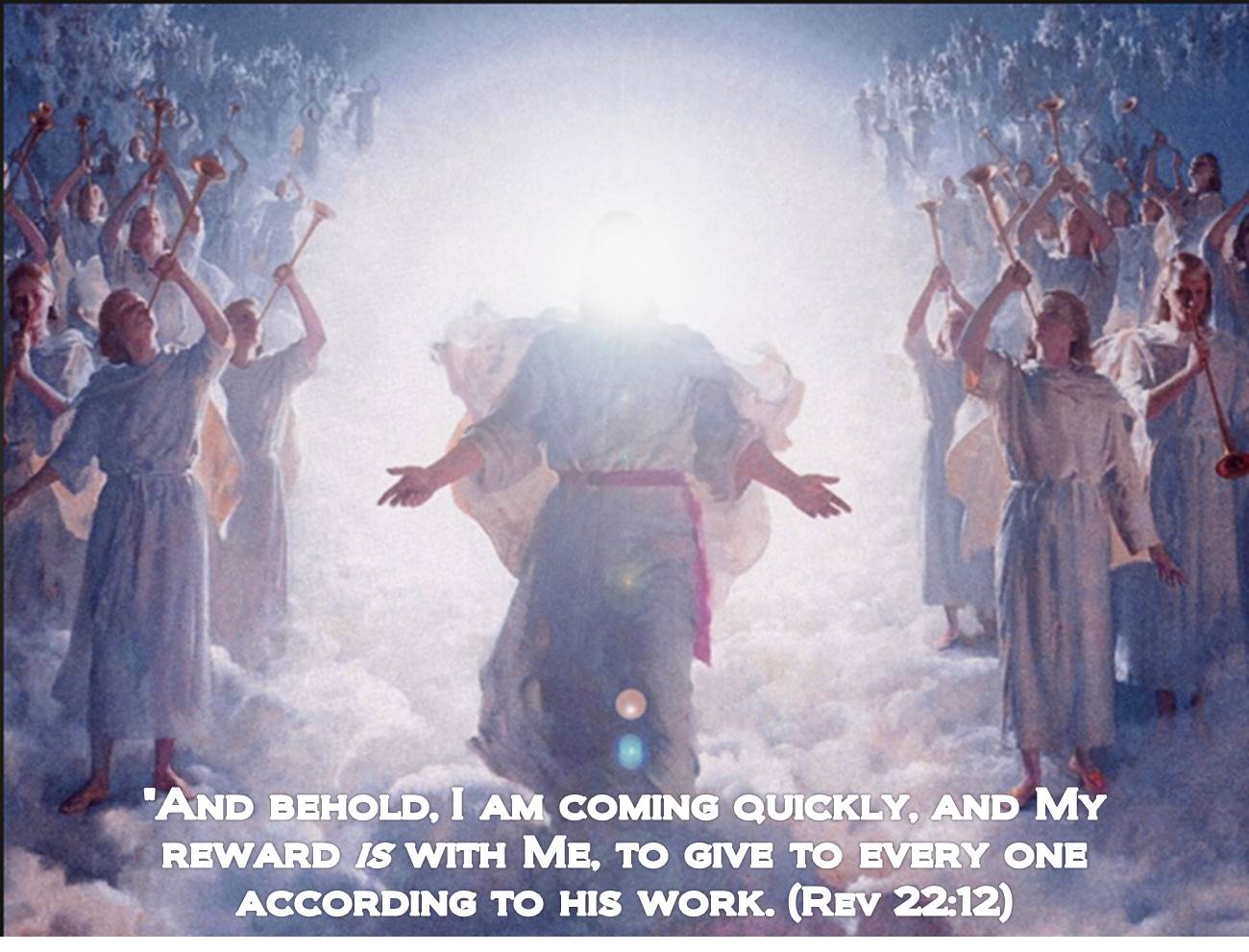
It is useless for us to try to mesh current events and Scriptural prophecy to fit into our own time frame as many people are doing now.  The one thing we know for sure is that YHVH is in control and will do all that He has promised in His own way and in His own time.  It is not our job to predict or even speculate how everything will play out.  It is our job to be working in the harvest and doing our individual assignments from YHVH.  Then, when Yeshua returns, He will find the faithful servants He expects to find (Matt 24:45-51).  What will you be doing when Yeshua returns?

“And behold, I am coming quickly, and My reward is with Me, to give to every one according to his work.  I am the [alef] and the [tav}, the Beginning and the End, the First and the Last.”

 Blessed are those who do [téreó, meaning to keep, guard or observe] His commandments [entolé],  that they may have the right to the tree of life, and may enter through the gates into the city (Rev 22:12-14).

Inside Job

above all elseAs a born-again believer, have you ever tried to explain your experience with YHVH to a non-believer? Have you been met with doubt and misunderstanding or even ridicule?  We can tell others of our experience, but we cannot transfer our experience to another person. No one else can truly experience what another has experienced. They can hear and try to put themselves into the other person’s place, but it isn’t the same thing. They will not truly understand what Yeshua has done for them until they experience His love, forgiveness, and presence for themselves.

At the time I asked forgiveness for my sins and invited Yeshua to be Lord of my life, I was only vaguely aware that I needed Him. It was only after I experienced Him personally that I began to get a glimpse of just how much I needed Him. Through an ongoing relationship with Yeshua for the past 30+ years, I have realized on ever deeper levels just how much I need Him and how much He has done for me. I have learned to love, appreciate, respect, adore, obey and trust my beloved Shepherd. There have been changes in my behavior and attitude that may be perceived by others, but the actual work inside my heart is invisible to others.

When I was baptized in the Holy Spirit, there were outward signs of speaking in tongues and other gifts of the Holy Spirit. The inside work, however, was much more significant. The Holy Spirit worked with me to show me areas where I needed to change and grow, so that I would not be merely a noisy gong as I used the precious gifts I had received. Also, the Spirit emboldened me to step out in faith and take risks in order to work in YHVH’s harvest.

If you have experienced baptism in the Holy Spirit, then you probably understand how difficult it is to convey to others how important it is that they take this step. Many people are satisfied with salvation in Yeshua and are content to have a foot in the door to the Kingdom of Heaven.  We are empowered and equipped by the Holy Spirit in order to develop into harvest workers and soldiers in YHVH’s kingdom. It is not enough to remain spiritual babies any more than we should expect to be human babies forever.

Those of us who have experienced baptism in the Holy Spirit understand what a wonderful gift we have been given, but how do we convey that wonder to others? We cannot convince others by speaking to the intellect. We must speak to the heart and challenge the person to try it for themselves.

The greatest difficulty I have faced is convincing born-again believers of their need for deliverance.   Many believe that once they have been saved, they do not have to worry too much about the enemy.  It is true that Satan had hold of me before I became a born-again believer. He lost control in some areas of my heart after I accepted salvation, but he still had a foothold in areas that I had not yet yielded to YHVH. When I went through prophetic deliverance, I became aware of just how much influence demons still had on me. For one thing, they had clouded my perception of truth. I am now able to see more clearly how demons operate to influence and manipulate us. Now that I better understand how the enemy functions, I have been able to incorporate more effective combat strategies into my spiritual warfare. The greatest discovery for me has been insight into distinguishing the precious person YHVH created from the demon(s) who are working within the person to steal, kill, and destroy in many ways.  However, these experiences and insights are particularly difficult to explain to others.

The best way I can describe it is to ask you to imagine that someone dear to you is being used and manipulated by another person. Wouldn’t you do everything you could to assist that person in getting free? What if the person rejected your every effort and refused to believe that you might have a solution to the problem? What if that person accused you of judging them or criticizing them for getting themselves into such a situation? I experience the same anguish and frustration when I see a demon holding someone I love in bondage. I see the torment that person endures while unwittingly cooperating with the enemy.

If you have not yet repented of your sins and asked Yeshua to be Lord of your life, then I challenge you to try it for yourself. If you have not yet sought the baptism that only Yeshua can offer, then I challenge you to ask Yeshua for this precious gift. If you have not yet sought deliverance so that you can be free from any remaining bondage to Satan, then I challenge you to ask Yeshua to guide you. Yeshua came to set the captives free. The Hebrew name Yeshua means both salvation and deliverance.  We need everything that Yeshua offers to us.  Don’t take my word for it.  Try it for yourself.

I will give you a new heart and put a new spirit in you; I will remove from you your heart of stone and give you a heart of flesh. And I will put my Spirit in you and move you to follow my decrees and be careful to keep my laws (Ezek. 36:26-27 NIV).