Category Archives: Peter’s blogs

There is Power in The Name

In my first posting on this topic (What’s in a Name?), I established through a chain of scriptural references that God wants His Name to be known and spoken, although it has been hidden from the majority of Jews and Christians for 2,000+ years. The true pronunciation of God’s (Yehovah’s) Name was hidden before Yeshua (Jesus) came to earth the first time, as the Jewish leaders had decided it was too holy for the common people to speak. Yeshua said that one of the main reasons Abba had sent Him to Earth was to reveal the true name of the Father (Yehovah) to His disciples while He was on the earth (John 17:6).

Since there were no vowels in Hebrew scrolls at that time, there was no way to know the pronunciation of God’s Name from reading the scrolls. However, Jewish scribes painstakingly transcribed the scriptures in the 10th and 11th centuries into what are now known as the Aleppo and the Leningrad Codex. These scrolls are unique because vowel points were added so that unfamiliar words, such as God’s Name, could be pronounced properly. The image at the top of this posting contains the Hebrew letters for God’s Name, including the vowel points as found in the two Codexes mentioned above. According to 100+ instances in these two Codexes, the Name is clearly pronounced as Yehovah or Y’hovah.

What is even more crucial, though, is how we use His Name. In Zechariah 13:9, YHVH says to His people that they will call upon His Name and He will answer them. In the Aaronic blessing, Yehovah spoke to Aaron through Moses and told him what words he was to speak to the people of Israel to bless them (Num 6:23-26). Very few people know that what YHVH said in the next verse is the most important part of the blessing. He was explaining the significance of the blessing when He said: “So shall they [the priests] put My Name upon the people of Israel, and I will bless them” (Num 6:27). Each verse of the blessing contains God’s holy Name, and YHVH was saying that if they would place (speak) God’s Name over the people, He would promise to bless them.

God loves to hear His Name spoken and there are so many different ways to speak His Name: in praise and worship (Ps 8:1, 66:4, 148, etc.), in blessings (as in Num 6), in prayers (Isa 1:4, Ps 105:1) and in the joys and sorrows of everyday life (as a greeting in Ruth 2:4). There is power in God’s Name; the greatest power in all the universe. In Isa 45:22, Yehovah is telling everyone to look to Him and be saved; He is saying that He Alone is God and there is no other god. Then in the next verse (Isa 45:23) He says “That to Me every knee shall bow, every tongue shall confess.” Finally in Verse 24 He says that all Israel will glorify Yehovah as the true Creator and Redeemer God of the universe.

The power of YHVH’s Name is best seen through His attributes that are contained in His compound names in scripture. One of the most powerful is in the graphic at the beginning of this posting: “Yehovah my Miracle [YHVH Nissi]” – this illustrates that we can call on the Name of Yehovah and trust Him to work miracles in our lives, and then give glory to His Name once again when they happen. Another descriptive name for God is Yehovah Yireh (sometimes written as Jevohah Jireh). This is usually translated as “The LORD my Provider”; however, a more accurate translation is “Yehovah who sees”, meaning in essence that He not only sees and knows our needs but that He satisfies them.

The many other names for God in the scriptures powerfully illustrate YHVH’s mercy, forgiveness, and unconditional love for His people. To know God’s Name is important, but it is more relevant to experience the power and beauty of using His Name when we pray. Such prayers are like sweet fragrant incense rising up to our Father in heaven (Rev 5:8).

For instance, when we are interceding for another who is suffering from illness, we can speak His Name along with the attribute of His character that relates to healing: “Yehovah Rapha (The LORD our Healer)”. When we do this, we can sense the Holy Spirit going into action, bringing healing. In the same way, when we cry out to God that He is our Rock (Yehovah Tsuri) we feel comforted in our soul that we can lean on him as our solid Rock and He will never leave us or forsake us. Many people have experienced peace and comfort when they recite the 23rd Psalm, but when you realize that “The LORD our shepherd” is actually “Yehovah Ro’i” in Hebrew and we can call our Shepherd by His Name, then it makes Yeshua’s words in John 10 so much more personal. Yeshua said in John 10:27: “My sheep hear My voice, and I know them, and they follow Me.” (Isn’t it easier to hear His voice and discern it from all other (false) shepherds when we know His Name as well as His voice? Finally, He says: “I am the good Shepherd. The good Shepherd lays down His life for the sheep.” (John 10:11) How comforting to know that our Creator and Lord is willing to lay down His life for us (and did just that when He died on the cross)?

I will leave you with the words that Yeshua spoke to His disciples near the end of His first mission to the earth: “Peace I leave with you, My peace I give unto you; not as the world gives do I give to you. Let not your heart be troubled, neither let it be afraid.” (John 14:27) If you want to see more about the Hebrew Names for God, see this Web site (remember that “Y” is usually written as “J” in English translations): Names of God – Blue Letter Bible

What’s in a Name ?

They know My Name

When we meet someone, one of the first questions we ask is “what is your name”? Jesus (Yeshua) died for our sins, to restore our relationship with our Father. We relate to God as our heavenly Father, so it is good to call Him Abba (Aramaic for Father or Daddy). But we also know from scripture that He has a name, and that His children are even called by His name – see II Chron 7:14 and Isa 43:7 (“…everyone who is called by My name, whom I created for My glory…”). And should you believe that knowing and speaking God’s name is only for Israel, see Amos 9:12 where God speaks through Amos and says “…And all the Gentiles [nations] who are called by My name, says the LORD…”.

So, how do we know that God wants us to know and speak His name? There are over 100 scriptures in the Torah, Psalms and Prophets where God says that He wants all the earth to know, speak, and praise His name (e.g. Ex 9:16; Num 6:27; Ps 9:10; Ps 66:4; Ps 91:14; Ps 105:1,3; Ps 105:1,3; Ps 119:132; Ps 148:13; Isa 42:8; Isa 52:6; Jer 16:21; Mal 4:2). The other question that pops up is whether God’s name is to be remembered by everyone for all time? This question is answered soundly by David in Ps 45:17 “I will cause Your name to be remembered in all generations; therefore nations will praise You forever and ever”. A prime example of God blessing His people when they remember His name is in Ex 20:27 “In every place where I cause My name to be remembered I will come to you and bless you.”

What does Yeshua have to say about the name of God? In Matt 23:39, when He was weeping over the people of Jerusalem because they had not recognized Him as their Messiah, He said “for I say to you, you shall see Me no more till you say, ‘Blessed is He who comes in the name of the LORD!’ ”. “The LORD“ in this verse is actually YHVH (Yehovah), not Adonai (the Hebrew word for Lord). Yeshua was quoting directly from the prophecy in Ps 118:26, which was talking about the future end times when people would speak those words, and use God’s true name in place of the generic title of “The LORD”. In John 17:6, when Yeshua was praying to Abba Father on behalf of his disciples, He said “I made your name known to the people you gave me out of the world. They were yours, you gave them to me, and they have kept your word.”

In Acts 2:21, Peter quotes Joel 2 when he says “And it shall come to pass that all who call upon the name of the Lord [YHVH] shall be saved”. Just as in Matt 23 above, “the Lord” in this verse is not the generic title for Lord, but rather YHVH (written as The LORD in the Old Testament). In the end times (as reported in Zech 13:9), YHVH says “They will call on My name, and I will answer them. I will say, ‘This is My people’; and each one will say, ‘The LORD [YHVH] is my God.’”

So now that we have established that YHVH wants His name to be known, spoken, praised and glorified in all the earth, how can we know how to speak and pronounce His name? I will go into this in more detail in future blogs in this series, but in summary we know the following to be true:

  • God always wanted us to know His name (from the time He spoke His name to Moses in Ex 3:15)
  • God’s name (the full pronunciation of YHVH) was spoken regularly by people up until the time of the Second Temple, after the return from Babylon – see Ruth 2:4
  • The speaking of God’s name was progressively restricted to a smaller and smaller group of Jews during the Second Temple period (first only the priests, and eventually only the high priest, before and during Yeshua’s time)
  • As stated in John 17:6 above, Yeshua revealed the true name of YHVH to His disciples while He was on the earth (which had been hidden from the common people for several hundred years)

As far as the actual pronunciation of God’s name, there is great dispute, but through our research over a number of years, we believe that His name (YHVH), which is written 6828 times in the Hebrew scriptures, is pronounced as Yehovah (or Y’hovah). We also believe that His name is being revealed to many in this age, as another of the many signs of the approach of the end times that are now unfolding. Finally, we believe it is all part of Yehovah’s plan, that His name would be hidden for a time, and then revealed again to His remnant when the time was right. Stay tuned for further chapters in this story and why we and others believe as we do.

YHVH’s Glory in the Eclipse

Just about everyone in the United States (and probably many other countries) was aware of the total eclipse on August 21st of this year.  Nancy and I had the privilege of seeing the total eclipse in the foothills of the NC mountains. We are so thankful that Abba blessed us with that once-in-a-lifetime experience!

I have always been fascinated with YHVH’s created heavenly bodies, so I could not resist this opportunity to see one of the many heavenly testimonies to His awesome glory and power.  Since I had never seen anything but a partial eclipse (and that was as a young child), I did not really understand the unique qualities of a total solar eclipse.  I thought of all the amazing factors that have to come together for the moon to track right along with the sun across 3,000 miles of our country, blocking the entire sun within a 30-mile-wide swath at the surface of the Earth.

 One of the things that YHVH planned and designed perfectly were the relative sizes of the Sun and Moon, and the distances between the Sun, Moon and Earth.  This would be straightforward if the three heavenly bodies were all close together, but it is complicated by the fact that the moon is only 250,000 miles from the Earth and is ¼ the size of the Earth, while the Sun is 93 million miles from the Earth and over one million times the size of the Earth.

Another aspect is the perfect alignment of these three bodies by the synchronization of their orbits around each other: the moon around the Earth and the Earth around the Sun.  To make this even more miraculous, this blocking of the Sun must be able to persist for a very long time, such as the tracking of the total eclipse across the entire US on August 21st.

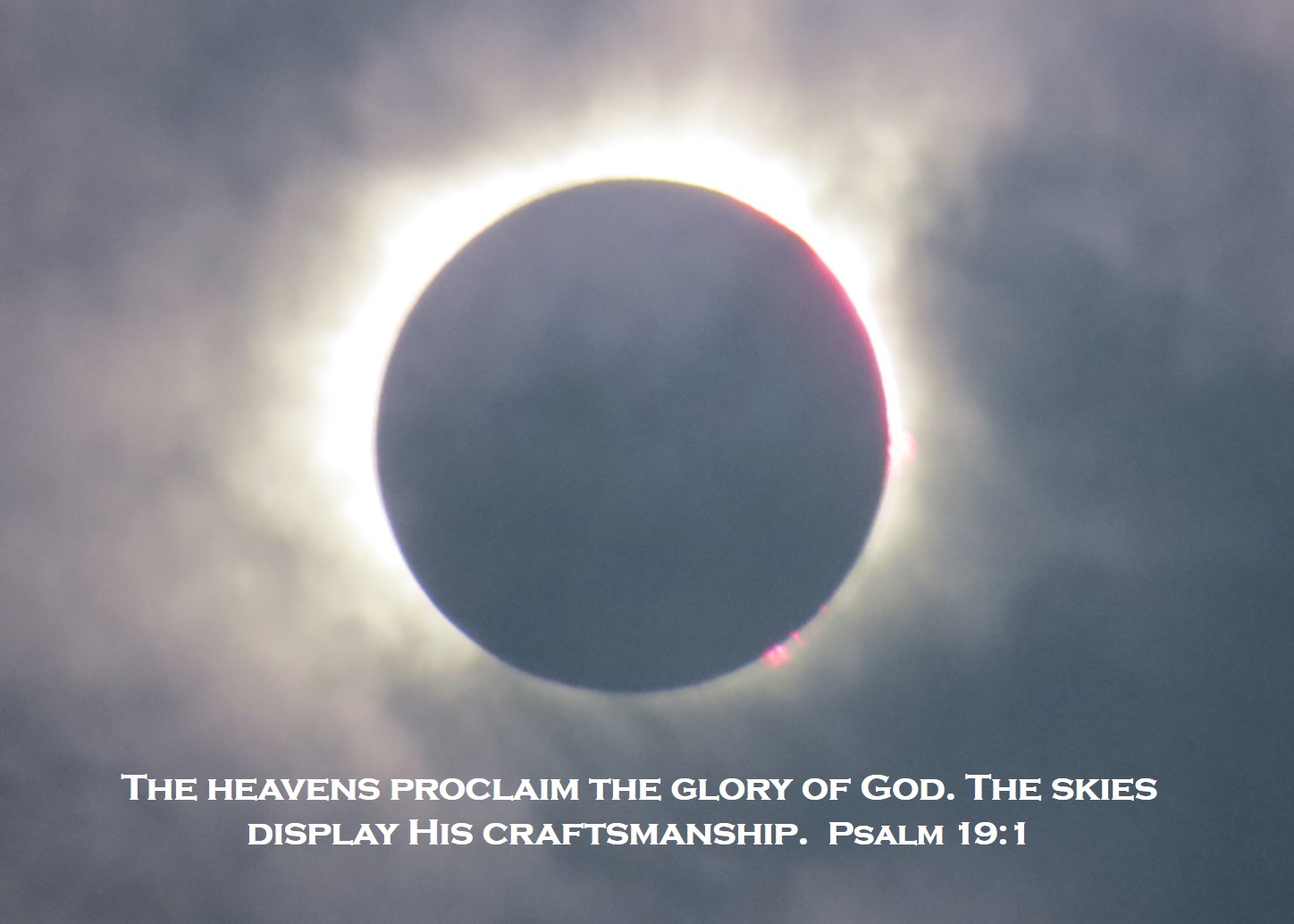
During the total eclipse, we marveled at Abba’s amazing creation, demonstrating His glory and perfection through this incredible event.  When the eclipse became total and darkness fell all around us, it was almost beyond description – even the birds were confused by this sudden darkness and flew anxiously back and forth out of the surrounding trees.  The photo at the front of this article, taken with a regular digital camera by one of my cousins, gives you some idea of the incredible view we had of the sun, looking at it with our naked eyes.

Once darkness fell, we immediately started seeing other lights in the sky.  The brightest and most obvious light was Jupiter, located to the East of the darkened Sun.  A few of the younger folk in our group spotted another light to the West of the Sun, and we later discovered that it was Venus, often called the “morning star”.  I did not learn until later that the only time you can see both Jupiter and Venus in the sky is during a total eclipse.  At all other times, Venus can be seen in the morning and Jupiter can often be seen in the evening sky.

It is hard to describe if you have never experienced anything as visually amazing as a total eclipse, but at this stage our whole group was staring in awe at the darkened sun, and we were rendered speechless – it was a truly inspiring sight, and showed us YHVH’s glory from a very different perspective.  At the time, I was thinking about the significance of seeing Jupiter in the eclipse-darkened sky in the middle of the day.  I remembered that the original Hebrew name of Jupiter was Melech, which means king.  Then I recalled that this planet symbolized the Messiah as the King of Kings according to ancient Rabbinic interpretations of Messianic prophecies.  Later, we remembered that the Sun also represents Yeshua our Messiah (Psalms 19:4-6).  Although the Sun was darkened for a time, it could not be blotted out completely, because the corona was still visible around the perimeter of the moon.  Also, as the Sun darkened, Jupiter brightened.  Our Messiah and King, the Light of the world, cannot be defeated.

This was all wonderful and we glorified YHVH for these revelations.  But there was more – when I was researching this later, I realized that the Sun had moved into the star-sign of Leo the lion before the time of the eclipse (it then moved into Virgo in the Fall when Jupiter was also said to be in “Virgo’s womb”).  The original Hebrew name of Leo is Aryeh, which also means lion, and this sign and its related constellations tell the story of Yeshua coming as Judge and King in His final victory over the enemy.  If you want to read more about the Gospel story told by this heavenly sign, see our blog from early 2016: https://missingpieces.co/2016/02/20/the-lion-of-the-tribe-of-judah/ 

While I do not predict timelines of the Second Coming, I feel that Yeshua was giving us some very powerful visions of His final victory on that darkened afternoon.  I believe He was telling us that He is coming quickly (as He said in Revelation 22:12), understanding that “quickly” in His time-frame means something very different than it does from our Earthly perspective.  It was another sign to me that we need to prepare ourselves spiritually for His second coming.  We can best prepare ourselves through worship, fasting and prayer, as He meets us at those times and gives us revelation about Himself and His plan.  I praise Yehovah’s holy Name that He gives us these glimpses into His glory.  Let us turn our hearts and minds to Him and listen for His voice so that we do not miss what He wants to place in our hearts.

Even though darkness (evil) on the Earth will increase for a while, it will not totally blot out the Light of the world, who has already overcome the world (John 16:33).  Yeshua, our Light and King, will very soon return to the Earth, triumphant over the evil one.

YHVH’s Sanctuary

yhvh-is-a-shelterWhat did Yeshua mean when He said in His Olivet discourse: “as it was in the days of Noach” (Matt 24:39)?  In this and other Re(new)ed Covenant Scriptures (2 Pet 2; 2 Thess 2), the authors speak of a future world of great wickedness, such as has not been known since the times of Noach and Sodom.  These Scriptures also speak of YHVH’s judgment on those who are deceived by the lies of hasatan and refuse to turn to the truth of the Creator and Redeemer of the world, Yehovah Elohim.

They also speak of YHVH our Deliverer saving and protecting His people during times of past trials or judgment:

  • Noach and all his family were divinely saved from destruction by the protection of the Ark (2 Pet 2:5). Note that the Hebrew word for ark (tevah) not only means a box or covering, but it also means “word” – so you can think of Noach and his family truly being covered by YHVH’s Word!
  • In the time of Sodom & Gomorrah, we are told that the people were very immoral and ungodly, but also that God [Elohim] rescued Lot from the fiery judgment because Lot was a righteous man who followed the truth (2 Pet 2:6-7)
  • Moses (Ex 44:7), David (1 Sam :14-15) and Elijah (1 Kings 19:4-8) were all protected in the wilderness
  • In the same way, when YHVH brought all the plagues onto the people in Egypt, He spared the Hebrews from the worst of those plagues (Ex 9). Yeshua became our Passover Lamb 2000 years ago, and now we can cover ourselves with His blood for protection from the enemy’s attacks
  • Finally, in speaking about the end of days, Yeshua says in Revelation 12 verses 6 and 14 that YHVH will once again protect His people from both the unbearable attacks from the adversary hasatan, and also from His own judgments against the wicked

From these Scriptures we know that YHVH has protected His people many times in the past, and has said that He would protect us again during the Tribulation period.  We also know from Yeshua’s words in Matthew 24 and Sha’ul’s prophecies in 2 Timothy 3 that the times before the end of this current world will be characterized by great sinfulness and evil.

What will lead the people of the world into such great lawlessness, though?  We know there are plenty of greedy, boastful and wicked people throughout the world now, but Yeshua says the End will be a time like no other that has ever been seen or will ever be seen again.  Several Scriptures speak of a great apostasy, deception, or falling away (2 Thess 2:3, Matt 24:10).  Reading further in these Scriptures we see many reasons for this falling away of believers in Yeshua, so great that even some of the elect will be led astray (Matt 24:24).  Yeshua speaks of many false prophets and teachers, and the great signs and wonders they will use to try to convince believers that they are the Messiah who is prophesied to return.

There is a stronger deception than simple signs and wonders that will be leading the saints away from YHVH, though.  This deception becomes clear when you look at the expanded meaning of apostasy – it means “an abandonment of the truth”.  In spiritual terms, this means that the end times will involve a wholesale rejection of YHVH’s revelation, a further “falling away” of an already fallen world.  This “end times” falling away is confirmed as the sign that will come before the Tribulation ends and Yeshua returns for His saints (the set-apart ones) in several other Scriptures.

When Sha’ul talks about the end times in II Timothy 3, he talks first about all the wickedness that will mark that time, but then he goes on to say in Verse 7 that people at that time will be: “always learning but never able to come to a knowledge of the truth”.  This agrees with II Thessalonians 2:10-12 which states that the ones who will be judged in the latter days will be the ones who did not believe the truth of YHVH, but instead believed the enemy’s lies.  The crux of this passage in Verse 11 says: “…God will cause them to be greatly deceived, so that they will believe these lies”.

Going back to Matthew 24, Yeshua’s first answer to His disciples about the signs of the end was: “Be careful that no one leads you astray! For many will come in My name, saying, ‘I am the Messiah,’ and will lead many astray” (Matt 24:4-5).  Remember that one of Yeshua’s harshest reprimands of the religious leaders was in John 8:44 when they accused Him of casting out demons and healing people in the name and power of the devil: “For you are the children of your father the devil, and you love to do the evil things he does. He was a murderer from the beginning. He has always hated the truth, because there is no truth in him. When he lies, it is consistent with his character; for he is a liar and the father of lies”.

The essence, then, of the reason for the great falling away in the end times will be that a great majority of the people (believers and unbelievers alike) will believe the lies of the false teachers and prophets and of the anti-messiah himself.

So how do we prepare ourselves for these perilous times, so that we can discern false from true teaching and prophecy, and resist following the popular path of believing the captivating lies of the enemy’s allies?  As with all temptations and allurements of our society, we need to put all our trust in our Rock and Redeemer, Yeshua HaMashiach, and be filled with Yehovah’s Holy Spirit.  We need to ask Abba for guidance in discerning the truth from the lies, and then follow that truth no matter what are the world consequences.  While it is true that not all believers will be delivered physically through the Tribulation, we know that if we remain steadfast in our trust and obedience, YHVH will help empower us to overcome the world, by the Blood of the Lamb and the Word of our testimony.  In this world we will have tribulation, but Yeshua has overcome the world, and greater is He that is in us (the Holy Spirit) than he that is in the world (1 John 4:4).

Yeshua is the Way

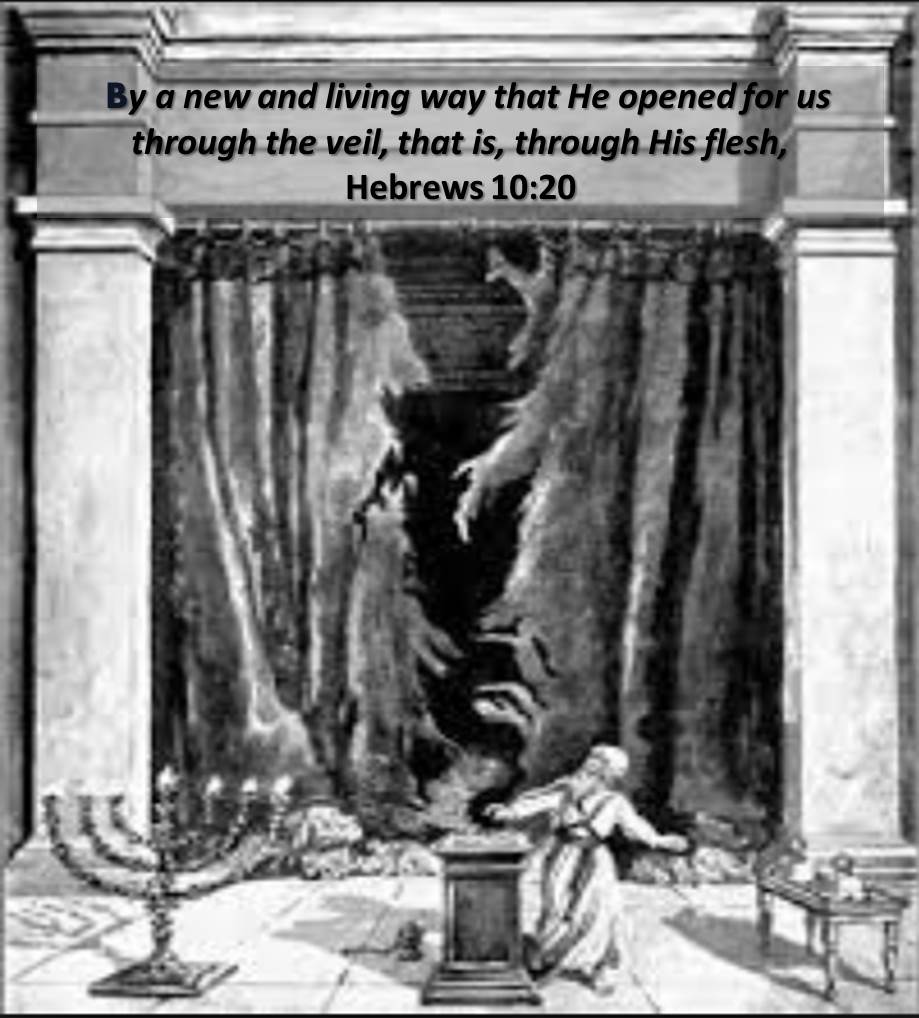
thru-the-veil-of-his-fleshIt is clear that Abba Father tore the veil separating the people from the Holy of Holies when Yeshua’s body perished, because the Scripture says it was “torn in two from top to bottom” (Matt 27:51).  The fact that it was torn from top to bottom symbolizes YHVH reaching down from Heaven and opening the way for us to “come boldly to His throne of grace, that we may obtain mercy” (Heb 4:16).  What is this place we are entering into, though?  For Torah observant Jews of Yeshua’s time, they may have wrongly believed that the way had been opened for them to come into the Holy of Holies and worship in YHVH’s presence, where His glory dwelled above the earthly Ark of the Covenant.

However, through history and the Scriptures, we find a much deeper meaning to the tearing of the veil.  From history we know that the Temple was destroyed and the Ark was hidden or taken away, just as Yeshua had prophesied in Luke 13:35.  Our entrance into the Holiest place, then, was not an entrance into an earthly place, but rather an entrance into YHVH’s heavenly throne of grace.  Sha’ul gives us some great hints as to what this means at a deeper level:

  • “We have this as a sure and steadfast anchor of the soul, a hope that enters into the inner place behind the veil, where Jesus [Yeshua] has gone as a forerunner on our behalf, having become a high priest forever..” (Hebrews 6:19-20)
  • The God who made the world and everything in it, being Lord of heaven and earth, does not live in temples made with human hands,” (Acts 17:24)

The first passage above tells us that Yeshua has gone into the inner place ahead of us, to make a way for us to come before the Father’s throne.  We know from Scripture that Yeshua ascended to Heaven after his Resurrection and now sits at the right hand of the Father, and Hebrews 6:20 tells us that Yeshua is now our high priest.  When He opened the way into the Holy place of the Father in heaven, Yeshua also did away with the sacrificial system.  He became our God-man sacrifice who took away our sins and diseases for all time, not just once a year like the earthly high priest or the animal sacrifices people brought to the Temple.

In the second Scripture above, we learn that YHVH does not live in earthly temples – rather, He dwells in His heavenly Tabernacle, where He now invites us to come and fellowship with Him, through the Way that Yeshua has made for us by tearing the veil.  Yeshua has also made us holy and righteous before Abba, as He has washed us white as snow by His blood (I Cor 6:11).  This is not only a way to the Father, but rather it is the only way to draw close to Abba – in John 14:6, Yeshua Himself said that no one can come to the Father except through Him.

Even with all these insights into the tearing of the veil, though, and the way that has been opened for us into Yehovah’s most Holy place, there is still a deeper and more personal significance to this event.  Hebrews 10:20 (NIV) says that Yeshua opened a “new and living way for us through the veil, but then it equates the veil with Yeshua’s flesh.  This means that we are actually entering into Yeshua’s body when we come before YHVH’s throne – now that is the way to come to the Father!  The next time you come before Abba’s throne in worship, remember that you are entering through the perfect, sinless flesh of the One who showed us His unconditional love by sacrificing His life for us.

Gedi Star Teachings

gedi-the-goatToday we are going to explore another of the amazing signs that YHVH placed in our heavens from the beginning of Creation.  The sign is commonly known as Capricorn, which translated from Latin literally means a horned goat.  However, as I have mentioned in the past, we cannot trust modern Greek and Latin names of stars or constellations, as their names and meanings have been corrupted over the years from the original Hebrew meanings.  In Hebrew, this sign is called Gedi, which means kid goat, but is sometimes translated as sea goat, due to the strange half-goat/half-fish image portrayed in ancient drawings of the sign.

The image we see in Egyptian, Indian, and Phoenician drawings is of a fish that is weak and dying at the head, but alive as a healthy fish at its tail end.  The stars in this sign confirm the meaning associated with this image: ma’asad: the slaying; dabih: the sacrifice slain; and sa’ad al nashira: the cutting off.  As with many Hebrew words, gedi (kid goat) has a second meaning: to be cut off.  This sign, then, represents the sacrificial Goat of atonement, Yeshua, who was slain to redeem us from our sins, was “cut off” (crucified) to bring us salvation, healing and deliverance from evil.

The fish portion of the goat’s body represents us: the people for whom the sacrifice was made.  Other star names in this sign also point to Gedi as being the goat who was sent into the wilderness for remission of our sins (so that they would be sent away as far as the east is from the west).  We know that Yeshua fulfilled both of these goat sacrifices!

To complete this awesome picture story, the three constellations associated with this sign give more of the details. The 1st constellation is Sagitta, means “the arrow of Elohim sent forth” – this connects with Psalm 38:2 where it says “Your arrows have struck deep, and Your blows are crushing Me”; and also Isaiah 53:4-5: “He was stricken, smitten of God & afflicted; He was wounded for our transgressions”.  Aquila (the eagle) is the 2nd constellation in Gedi – the stars in this constellation convey the meaning of “the smitten One falling”, “the One who comes in the Shekinah glory of God to shed His blood as a sacrifice”; and “the One who was wounded in the heel” (Gen 3:15).

The third and final constellation in Gedi is Delphinus, the original name meaning “the dead One rising”.  It is shown in ancient Zodiacs as a fish full of life, always with his head pointing upwards.  This represents Yeshua’s resurrection as “the first-fruits of them that sleep” (I Cor 15:20).  The Hebrew name is Dalaphin, which means Dolphin and also “pouring out of water”.  We see from this word picture that Yeshua fulfilled the prophecy to pour out the Holy Spirit on all flesh, symbolized in Scripture as the “fountains of living waters”.

The brightest star in Gedi is actually a double star named Deneb Al Giedi – “the Judge who is the sacrifice.”  When we think about Yeshua’s dual role as our Messiah, we know that He came to save us from our sins in His first coming to Earth, but that He will be our ultimate Judge in His second coming. As Yeshua says in John 3:36: “Whoever trusts in God’s Son has eternal life. Anyone who doesn’t obey the Son will never experience eternal life but will remain under God’s judgment”.  Draw close to Yeshua and He will draw close to you; get to know Him intimately and your greatest desire will be to trust Him with your life, walk in His way and lovingly obey all of His commandments.

Righteous Oaks

righteous-oaksWhen YHVH promises in the beginning of Verse 3 of Isaiah 61 that He will give us: “Beauty instead of ashes, the oil of joy instead of mourning, the garment of praise instead of the spirit of heaviness”, His end goal is not just to give us temporary help to get us through a crisis in our lives. Ultimately, God is building us up to be trees [oaks] of righteousness. We are the “trees” God is planting in the place He desires us to bear fruit.

Oak trees are known to be the strongest, most sturdy and resilient of all trees on Earth. They can withstand hurricanes, tornadoes, earthquakes, droughts and floods better than almost any other type of tree.  God likens His children to oak trees and says we can be just like them in our character and integrity: “They shall be like great oaks of righteousness”.  These are not the words of a long-ago prophecy that have no meaning for us today. This is the expression of God’s heart for His people down through the generations. God wants us to be strong and enduring and He has given us clear insight in His word as to how we are to make that happen.

The average large oak tree needs as much as fifty gallons of water per day, so the root system is large and goes deep to reach that water. The root system not only brings the needed nourishment to the tree but it provides the anchoring base that allows the tree to withstand all kinds of assaults, from the wind, the rain and the shaking of earthquakes.  The root system of a mature oak tree can total hundreds of miles, and the roots of an oak tree extend out underground up to two and a half times their height.  So how can we as YHVH’s children ever hope to have such deep roots?

Jeremiah 17:7-8 is a powerful amplification of what Isaiah is talking about: “But blessed is the person who trusts in the LORD, whose confidence is in Him. They will be like a tree planted by the water that sends out its roots by the stream. It does not fear when heat comes; its leaves are always green. It has no worries in a year of drought and never fails to bear fruit”.

Both in Isaiah 61 and here in Jeremiah, it is clear that YHVH plants His seeds purposefully. He does not take His seeds and scatter them to the wind, disregarding where they fall.  God picks a perfect place for each of us, personally putting the tender shoot in the ground, knowing exactly what lies ahead. God knows every detail of our lives and the place of our planting and He does not make mistakes; we were not planted in the wrong part of the garden!

We were destined to display the “splendor of the Lord.” It doesn’t matter how you feel, you are destined to display the splendor and majesty of YHVH. There are days when you may not feel that you are reflecting God’s glory to others in your world, but if you have deep spiritual roots and are standing tall in constant relationship with YHVH, you will be displaying His majesty.   In fact, He will “rejoice over you with gladness” (Zephaniah 3:17) and even “protect you from trouble and surround you with songs of victory” (Psalm 32:7).

Trees do not instantly develop deep roots, and neither do people – both must go through difficult times of physical or spiritual drought and hardship, and must be patient until their roots develop.  In the case of God’s people, we must be filled with God’s Holy Spirit and grow in our faith and spiritual maturity, learning to trust YHVH more and more for strength to overcome the attacks and temptations of the world.

Trees contribute greatly to purify the air, and render it fit for us to breathe. When the air around us passes through leaf surfaces, it is purified and invigorated.  In the same way, there is a moral atmosphere around us.  When the air around us passes through our spirit and soul, we have the ability to speak life or death, blessing or curse to those around us.  As YHVH spoke in Deuteronomy 30:19-20, “I call on heaven and earth to witness against you today that I have presented you with life and death, blessing and curse. Therefore, choose life, so that you will live, you and your descendants, loving the LORD [YHVH] your God, paying attention to what He says and clinging to Him — for that is the purpose of your life!

As YHVH’s children, when we trust in Him with all our heart and follow His ways and His instructions, our roots will go down deep into the “earth” of the Holy Spirit within us, enabling us to withstand all the trials and tribulations of life, bearing much fruit and glorifying Him through our lives.  As YHVH says in Jeremiah 17:7-8 about those whose confidence is in Him: “we will be like trees planted by the stream, that send our roots deep: we will not fear when heat [persecution] comes; our leaves will always be green. We will have no worries in a year of drought and we will never fail to bear fruit”.

Safe Shelters

refuge-under-your-wingsIn my blog two weeks ago, I wrote about Yeshua as the Door of the sheep, and how He protects from us from all dangers.  Another closely related Biblical concept is that YHVH shelters us, but how does He shelter us?  In many places in the Psalms, David talks about YHVH sheltering us in His hiding place, for example:

  • Psalm 91:1 – He who dwells in the secret place of the Most High shall abide under the shadow of the Almighty [El Shaddai].
  • Psalm 27:5 – For in the time of trouble He shall hide me in His sanctuary; in the secret place of His tabernacle He shall hide me (the Orthodox Jewish Bible says that He will keep us safe in His Sukkah and shelter us in His tent)…He is our refuge and our fortress;
  • Psalm 32:7 – You are my hiding place; You shall preserve me from trouble; You shall surround me with songs of deliverance;
  • Psalm 119:117 – You are my hiding place and my shield; I hope in Your word;
  • Psalm 144:2 – My lovingkindness and my fortress, my high tower and my deliverer, my shield and the One in whom I take refuge

Other scriptures speak about God sheltering us in His high tower, on a rock that is higher than us, or in his fortress, just to name a few of the graphic images He paints.  Many times David and others speak about YHVH as not only keeping them safe in His secret hiding place, but as actually being that hiding place, refuge, fortress, high tower, stronghold, rock, sanctuary, Sukkah, etc.  As an illustration of a high / strong tower, Sh’lomo says in Proverbs: the name of Yehovah is a strong tower; and the righteous run to it [Him] and are safe.  Now we are getting to the purpose of YHVH sheltering us in all these amazing ways: He is keeping us safe from the enemy.  Psalm 32:7 above provides one of the most beautiful word pictures of God’s protection in all of Scripture: He is not only our hiding place, but He protects us from trouble and surrounds us with songs of deliverance.

In Psalm 91, David says that no evil will befall him because he has made YHVH his refuge and dwelling place.  Because David is abiding under the shelter of His wings, YHVH has promised to give His angels charge over David to keep him safe against all physical and spiritual enemies and attacks.  In Verse 14, He says that because we know and trust in His name (Yehovah), He will set us up on high places (a high rock, high tower, etc.).  He also promises that no evil will befall us, no plague will come near our dwelling, and we do not need to fear the arrows by day or the pestilence that comes in the night.  Finally, in Verse 7 He paints an even more vivid picture of how he delivers us in the middle of great battles: “Though a thousand fall at our side and ten thousand are dying around us, these evils will not touch us” (NLT).

Even from the beginning, God has always been there to shelter us and keep us safe.  When He created the Garden for Adam and Eve, He created it as an enclosed garden that was protected on all sides against enemies.  The meaning of the “Garden of Eden” [Gan Eden] from Hebrew is a sheltered or enclosed garden.  There are many examples of how God has provided for our protection in His creation. For instance, the way an eggshell protects the baby chick as the strongest shape in the world, or the way a mother’s womb protects her unborn baby against environmental dangers.

When God saved Noah and his family from the flood, He once again protected them with an Ark that provided their covering and protection from all the devastation that was going on around them.  Another example of YHVH’s protection was the lamb’s blood covering He told the Israelites to apply to their doorposts to protect them from the angel of death.  In the end times, YHVH’s remnant will be sheltered in the protective rocks of Petra (Bosrah in Hebrew), waiting for our King, Messiah Yeshua, to come and usher us into the homeland of Israel.

As you think about all the ways YHVH protects and shelters us in His fortress or high tower, think about the Hebrew letter “tet”, which in the ancient word pictures represented a shelter for protection.  It is used in the word beten to mean the house that surrounds life (the mother’s womb), and in the word for trust (batach), which pictures us being safe inside the surrounding fence.  The word seter means a hiding place or covering, and from the ancient word pictures it literally means a secret hiding place.  Whereas the word for adversary (satan) means the snake that devours life, YHVH provides the seter hiding place which protects us from evil.  Would you rather be under YHVH’s wings which protect your life from harm, or the enemy’s snake-coil which devours your life?

Yeshua is the Door

the-door-of-the-sheep“Then Jesus said to them again, “Most assuredly, I say to you, I am the door of the sheep.John 10:7

In Yeshua’s “I am” statement about being the Door of the Sheep,  He teaches us that He is “the Door”, not just “a door”.  He is saying that He is not only our Shepherd who leads us into the sheepfold of the Kingdom, but He is the only door by which we can enter and be saved and find safe pasture (John 10:9).  There are deeper meanings for understanding Yeshua as our door into the Kingdom of God, so come with me now as we dig deeper into the Word to explore these meanings.

It is helpful to understand more about sheep and shepherding in general and specifically during Yeshua’s time.  Of all domesticated animals, sheep are the most helpless.  Sheep will spend their entire day grazing, wandering from place to place, never looking up. As a result, they often become lost. But sheep have no “homing instinct” as other animals do. They are totally incapable of finding their way to their sheepfold, even when it is in plain sight. By nature, sheep are followers. If the lead sheep steps off a cliff, the others are likely to follow.

Also, sheep are very susceptible to injuries and are utterly helpless against predators. If a wolf enters the pen, sheep won’t defend themselves or run away.  Sheep are totally dependent upon their shepherd for food, shelter, guidance and protection. So close is the bond between shepherd and sheep that to this day Middle Eastern shepherds can divide flocks that have mingled at a well or during the night simply by calling their sheep, who know and follow their shepherd’s voice. The shepherd leads the sheep to safe places to graze and makes them lie down for several hours in a shady place (think of the parallel to Psalm 23). Then at nightfall, the shepherd leads the sheep to the protection of a sheepfold.

In ancient times, there were two kinds of sheepfolds or pens. One kind was a public sheepfold found in villages. It would be large enough to hold several flocks of sheep. This sheep pen would be in the care of a “doorkeeper”, whose duty it was to guard the door to the sheep pen during the night and admit the shepherds in the morning. The shepherds would call their sheep, each of which knew their own shepherd’s voice, and he would lead them out to pasture (see John 10:4).

The second kind of sheep pen was in the countryside, where the shepherds would keep their flocks in good weather. This type of sheep pen was nothing more than a rough circle of rocks piled into a wall with a small open space to enter. Through it the shepherd would drive the sheep at nightfall. Since there was no gate to close—just an opening—the shepherd would keep the sheep in and wild animals out by lying across the opening. He would sleep there, in this case literally becoming the door to the sheep[fold].

Several ancient Hebrew word pictures point to Yeshua as the Door in a powerful way.  The ancient letter for door is dalet.  This meant the tent flap or door originally, but also the “path” or the “way of life”.  Devar in Hebrew means “word”. When we look at the ancient characters for Devar, though, the root meaning is “the Door of the Son”.  Since Yeshua is the living Word, Devar can also be interpreted as “The Word of YHVH”, as in the book of Deuteronomy [Devarim].  Psalm 19:14 says: “Let the words of my mouth and the meditations of my heart be acceptable in thy sight, YHVH, my rock and my redeemer”.  In Hebrew, a word for redeem is Padah and the word picture meaning is “redemption comes by the mouth of the door”. The ancient letters tell us that redemption is by the words of the door, and we know that door is Yeshua. Another significant word is the Hebrew word for Righteous, Tsedek, and the word picture tells us that  a person is righteous when their hook is the Door they follow (hook, or fishhook, refers to that which draws you – your passion or desire).

God’s name, Yehovah, is spelled yod-hey-vav-hey in Hebrew. The letter dalet is added to spell “Yehudah” [Judah], out of whose line Yeshua was descended. These 4 letters of the Name of God plus the letter dalet which means “door,” paint a different word picture:  His name tells us that Praise opens the Door to God“.  Since Yeshua is the Door, and He said everyone must enter through Him, this is a graphic picture of the pathway to YHVH – the key to the Door is praise!

Yeshua tells us that He is not only the shepherd of His sheep, but also the door of the sheep. In doing so, He is inviting us to be part of His sheepfold, where we will never have to fear or want for anything.  All we have to do is praise Him, and follow Him on His path, trusting Him with every part of our lives!

Trust in YHVH with all Your Heart

trust-in-yhvhTrust in the Lord with all your heart, and lean not on your own understanding; in all your ways acknowledge Him, and He shall direct your paths. Do not be wise in your own eyes; fear the Lord and depart from evil. It will be health to your flesh and strength to your bones.” Proverbs 3:5-8

I had memorized this well-known passage in proverbs 3:5-8 many years ago and still repeat it often in many different circumstances.  I would like to be able to say that it always calms my nerves or worries, but I can’t truthfully say that.  I usually have to spend some time with Yeshua remembering all the promises He gave us, that we are not to fear or be anxious for anything.  This tells me then that trust is not just about knowing the Scriptures that tell us God is faithful to watch over and take care of us in all situations.  It is far more about personally knowing the Living Word [Yeshua] who inspired the written Word, than it is about just knowing the written Word.

As believers, we often talk about having faith, more faith, or enough faith to endure whatever trial we are experiencing.  Unfortunately though, faith has become an overused and even watered down concept in our modern society.  Nowadays, we can have faith in Santa Claus, the Easter Bunny or the Tooth Fairy.  So what do we really mean when we say that we need to have strong faith in God?  Yeshua told his disciples that they could have cast the demon out of the young boy if they even had the faith of a grain of a mustard seed (Matt 17:20).  It is clear from this story that what they needed was not more faith, but rather a solid foundation of trust to back up the faith they had.

As human beings, we understand what it means to trust someone at a much deeper level than just having faith in someone.  Think about yourself for a moment and how you feel about trusting your neighbor. You may trust your neighbor enough to lend them your lawnmower, but do you trust them to watch out for your house when you go on a trip?  Would you trust them enough to give them a key so they can take of your plants when you are away?  Would you trust them to take care of your children for a weekend?

I would like to illustrate this point through a true story about a man named Charles Blondin, who was the greatest tightrope walker of his time, in the mid 1800’s.  He gained great fame in 1859 when he became the first person to cross Niagara Falls on a tightrope.  Charles and his friend and manager, Harry Colcord, strung a 2” diameter hemp rope from an oak tree on the American side to a large rock on the Canadian side, and used a series of guy ropes every 20’ (anchored to the shore) to keep the rope as steady as possible.  The greatest risk was the 50’ section in the center of the 1300’ span that could not be reached by anchor ropes.  The incredible thing was that Charles was able to navigate his way across the Falls without any mishaps.  He traversed the Falls a number of times over the next few weeks, carrying props such as a camera and a griddle on which he cooked an omelet, pushing a wheelbarrow, and even doing a backflip on a couple of occasions.

The most daring feat of all, though, was when he carried his manager Harry on his back during one of his crossings.  This is where the rubber meets the road – although the many fans in attendance had faith that Charles was able to cross the Falls (and even bet their money on him), it was only Harry who was able to trust Charles with his life.  A number of guy wires snapped during their crossing, but Charles never wavered.  Harry later told reporters that Charles had coached him to: “look up…you are no longer Harry, you are Charles. Until I clear this place, you are to be a part of me, mind, body and soul. If I sway, sway with me. Do not attempt to do any balancing on your own”.

Here is the essence of trusting God; not just having faith in Him. The spectators watching Charles had faith in him and believed that he was capable of traversing the Falls.  Only Harry, though, trusted him enough to climb on his back and ride across Niagara Falls with him walking on a 2” thick rope.  Is this the kind of trust you have in YHVH – do you trust Him to protect you and care for you and supply all your needs?  Do you trust Him with your whole life – body, soul and spirit – or do you trust more in your own abilities, your financial resources, or your trusted friends? In Psalm 3:6, God promised to direct our paths (keep us going in the right direction) if we would trust and acknowledge Him in every part of our lives.  Are you ready to trust YHVH with your whole heart? He is trustworthy beyond any other person or force in heaven or on Earth.  Go ahead and start trusting Him today – it will be the best decision you ever made!