Category Archives: Peter’s blogs

Let all Creation Praise YHVH !

every-created-thingI have often marveled at Psalm 148 that speaks about everything and everyone in Heaven and on the Earth praising the LORD [YHVH].  We know that our LORD God [Yehovah Elohim] created everything in the universe with His spoken Word.  We also know that the Living Word (Yeshua) was there at the beginning participating in every aspect of Creation (John 1:3).

It is not so amazing that people praise YHVH, since He created us to praise and glorify Him.  He says in Isaiah 43:7 when speaking about His people: “Everyone who is called by My name, whom I created for My glory…”.  In I Chronicles 16:29, David says in his song of praise to YHVH: “Give to the LORD the glory due His name…Worship the LORD in His holy splendor.”  The beautiful thing about glorifying God is that it brings the greatest joy to our hearts because that’s how YHVH created us.  C.S. Lewis once said: “In commanding us to glorify Him, God is inviting us to enjoy Him”.   All through Psalm 16, David talks about praising and glorifying God, and then in Verse 11 He says: “You show me the path of life, granting me the joy of Your presence and the pleasures of living with You forever”.

If we literally believe that “everything that has breath praises YHVH” (Psalm 150:6), then we can look around us and listen to all the voices of God’s creatures.  We are all familiar with the beautiful songs of the birds of the air.  There are also other less familiar voices that are beautifully expressed in the animal world.  Experts say that Fin whales can hear the bleeps of other fin whales from more than 500 miles away, and under the right conditions, Blue whales can hear each other from over 1,000 miles away!

Humpback whales are famous for singing songs that can last up to 30 minutes. They sing in rhyme, and the songs can be heard by other whales. The songs are passed along in the water so that an entire ocean may have all the humpback whales singing the exact same song at the same time—a kind of great whale choir.  How incredible is our God who created these amazing sea creatures, and how incredible is the sound of their praises sung to their Creator!

Any of us who have children (and we ourselves are children of our parents of course), know that when children praise and respect their parents, their relationship is strengthened and there is much greater joy and peace in the household.  In the same way, the right response from us toward God is praise because He deserves it.  When we show our love for YHVH by praising Him, we fulfill the purpose for which YHVH created us.  When we fulfill this purpose, we experience the greatest possible joy—God is pleased, our relationship with Him is enhanced, and He has received what He deserves.

What is even more incredible to me is that all of Creation is praising YHVH (from Psalm 148:1-8): “…His angels; His heavenly army (recall that Yeshua is the LORD of Heaven’s armies); the sun and the moon; all the shining stars (and scientists know that the stars “sing”); the highest heaven of the heavens; the waters above the heavens; the Earth; large sea creatures and the ocean depths; lightning and hail; snow and fog; strong winds that obey His commands; mountains and all hills; fruit trees and all cedars; wild and domestic animals; crawling animals and birds”.  Verse 13 sums up the whole Psalm by saying: “All creation, come praise the name of the Lord. Praise His name alone”.

Fortunately for us, YHVH’s command to praise Him and glorify His Name is not difficult to follow, for when we truly love Him, our praise will flow naturally from that love.  Start praising Him and rejoicing in His name today in this season of joy (Sukkot) and you will experience the greatest joy possible in His presence.
Healing Our Souls

the-righteous-personYHVH tells us in His Word that He is our Healer (Ex 15:26, Ps 103:1-5; Is 53:4-5).  We know through the sacrifice of Yeshua we can be set free from sin.   And that would have been enough, but Dayenu!  We have a God who always does more.  He heals our bodies and souls completely!  Today, let us focus on healing for our soul wounds.

We all have them.  Some are just under the surface and others are buried deep within us.  It is nearly impossible to reside in this fallen world and remain unscathed.  However, it is up to us whether or not we will remain injured and broken.  It is possible for YHVH to heal  all our soul wounds if we are willing to cooperate with Him. This is often easier said than done, but well worth the effort.

What are soul wounds?  Our souls are made up of mind, will, and emotions.  Many types of wrongs can damage to our souls.  In many societies, we feel pressured to bury emotional  pain and proceed as if nothing happened.  Over time, some hurts get buried deep for so long that we seem to forget about them.  Isn’t it best to forget and move on?  It is best to forgive and move on, but it is also necessary to take the time to work on healing the soul wounds that often remain.  We must not confuse forgiving others with healing the wounds they have inflicted.  The two are separate although closely connected.

Just as untended flesh wounds get worse and cause complications, so do untended soul wounds fester within us.  Fear, anger, bitterness, resentment, rejection, pain, or guilt must be dealt with properly.  Holding onto such burdens slows us down and weakens our relationships with YHVH and others.  We build walls or strongholds to “protect” ourselves from being hurt again.  However, the strongholds do not guarantee that we will be safe from future harm;  they actually imprison us, making us more vulnerable to our enemies.

YHVH is aware of all our injuries and promises in His word to restore us to perfect wholeness (shalom).  Let us examine some of YHVH’s promises.

Fear, anxietyPeace I leave with you; my peace I give to you. Not as the world gives do I give to you. Let not your hearts be troubled, neither let them be afraid (John 14:27).

For you did not receive the spirit of slavery to fall back into fear, but you have received the Spirit of adoption as sons, by whom we cry, “Abba! Father!” The Spirit himself bears witness with our spirit that we are children of God, (Rom 7:15-16)

For God gave us a spirit not of fear but of power and love and self-control (2 Tim 1:7).

So we can confidently say, “The Lord is my helper; I will not fear; what can man do to me?” (Heb 13:6)

Fear not, for I am with you; be not dismayed, for I am your God; I will strengthen you, I will help you, I will uphold you with my righteous right hand (Is 41:10).

Anger, bitterness, resentment:  [YHVH] will fight for you, and you have only to be silent.” (Ex. 14:14)

In your anger do not sin, do not let the sun go down on your anger and do not give the devil a foothold.  Get rid of all bitterness, rage and anger, brawling and slander, along with every form of malice.  (Eph 4: 26-27, 31)

Do not say, “I will repay evil”; wait for the Lord, and he will deliver you (Prov 20:22).

Whoever says he is in the light and hates his brother is still in darkness. Whoever loves his brother abides in the light, and in him there is no cause for stumbling. But whoever hates his brother is in the darkness and walks in the darkness, and does not know where he is going, because the darkness has blinded his eyes (1 John 2:9-11).

And after you have suffered a little while, the God of all grace, who has called you to his eternal glory in Christ, will himself restore, confirm, strengthen, and establish you (1 Pet 5:10).

Loss, mourning, rejection: When the righteous cry for help, the Lord hears and delivers them out of all their troubles. The Lord is near to the brokenhearted and saves the crushed in spirit. Many are the afflictions of the righteous, but the Lord delivers him out of them all. He keeps all his bones; not one of them is broken (Ps. 34:17-20)

 He heals the brokenhearted and binds up their wounds (Ps. 147:3).

You have turned for me my mourning into dancing; you have loosed my sackcloth and clothed me with gladness, (Ps. 20:11)

Sin, guiltTherefore, confess your sins to one another and pray for one another, that you may be healed. The prayer of a righteous person has great power as it is working (James 5:16).

Create in me a clean heart, O God, and renew a right spirit within me (Ps. 51:10).

There is therefore now no condemnation for those who are in Christ Jesus (Rom 8:1).

For I will be merciful toward their iniquities, and I will remember their sins no more.” (Heb 8:12)

But when they heard it, they went away one by one, beginning with the older ones, and Jesus was left alone with the woman standing before him. Jesus stood up and said to her, “Woman, where are they? Has no one condemned you?” She said, “No one, Lord.” And Jesus said, “Neither do I condemn you; go, and from now on sin no more.” (John 8:9-11)

How can we cooperate with YHVH to make ourselves whole again?  First, we need to examine ourselves and ask the Holy Spirit to bring soul wounds to our attention.  Next, we take our wounds and lay them at the feet of Yeshua.  Then, we ask YHVH to heal our wounds according to His promises.  We meditate on His promises until they become not mere words, but reality for us.  Healing of soul wounds can lead to physical healing.

Only when we are made whole do we reach the full potential YHVH has planned for us.  During these ten days of awe, let us seek YHVH’s help in examining and healing our souls.

Yom Teruah helps us Remember and Rehearse

yom-teruahWhen we talk about YHVH’s feasts or festivals, we sometimes think of big celebrations with lots of festive foods along with family and friends.  Although some of YHVH’s feasts are meant to be joyous celebrations (such as Sukkot – the Feast of Tabernacles), others are meant to be more somber and introspective.  Yom Teruah (literally the “feast of the blowing of trumpets (shofarot)”) is a combination of both joyous and somber emotions.  In a previous blog (When Yeshua Returns), we have already dealt with the misconception that Yom Teruah is actually the Jewish new year, or what is called Rosh Hashanah (literally “the head of the year”).  Yom Teruah marks the beginning of the seventh month on God’s calendar, so by definition it cannot be the start of the year.

The Hebrew word used most often for YHVH’s feast days in the Scriptures is Mo’ed (feast) or Mo’edim (feasts plural).  However, this word is much better translated as “appointment” or more accurately “divine appointment”.  YHVH meant for these appointments to be holy (set-apart) times on His calendar to meet with Him.  They were also called “Holy Convocations”, which in the Hebrew is Miqra, meaning an “assembly” but also a “Dress Rehearsal”.

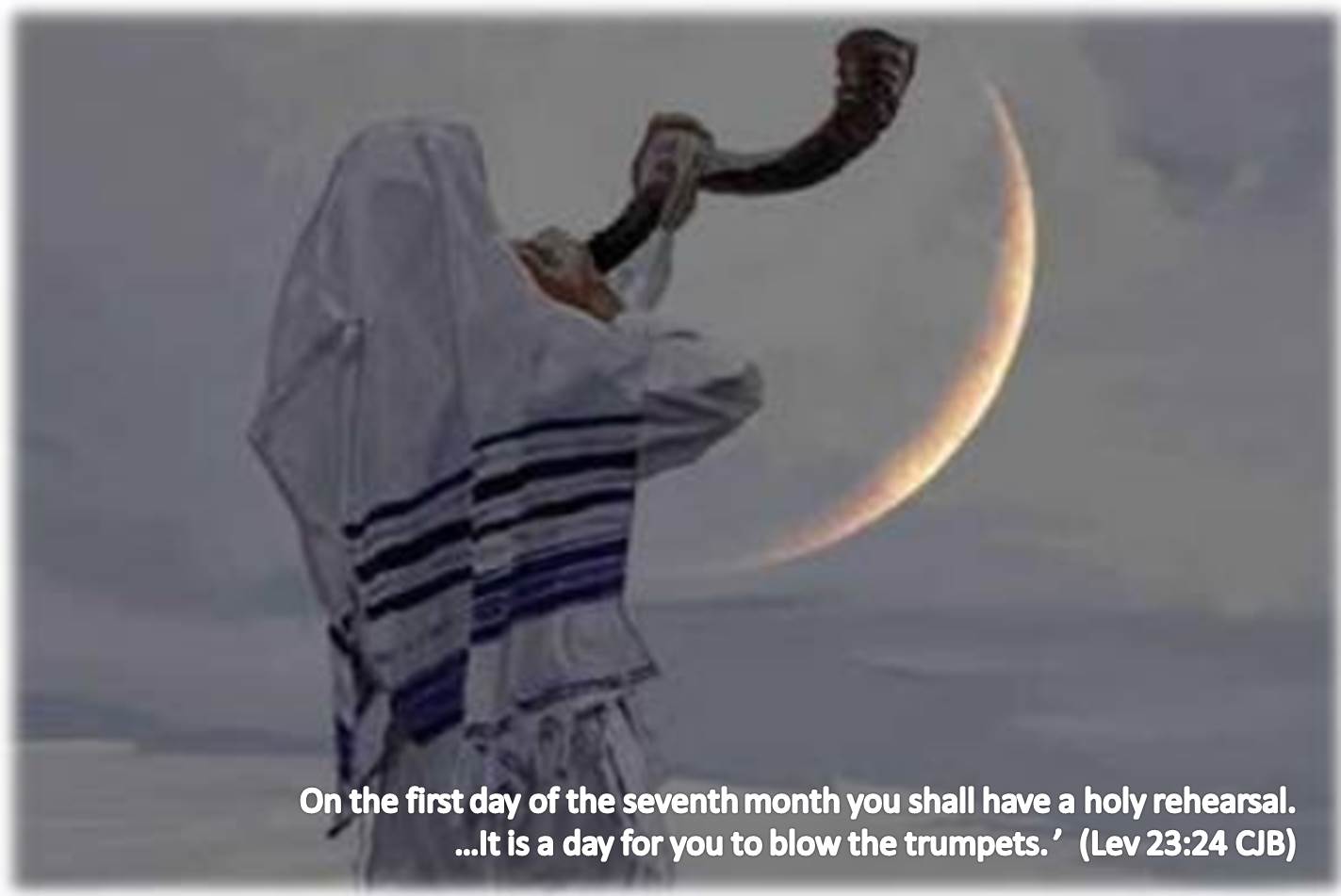
Whenever one of YHVH’s divine appointments arrives, we are supposed to look back and remember something that God has done for us in the past, but we are also supposed to look forward to what He will do in the future.  In His Mo’edim, God has essentially given us a “roadmap” of the most important events in human history.  Leviticus 23:24 describes Yom Teruah in this way: “In the seventh month, on the first day of the month, you shall have a sabbath-rest, a memorial of blowing of trumpets, a holy convocation (rehearsal)”.  Where it says “memorial” in this verse, another name is being used for the Feast of Trumpets – it is also called Zihk’ron Teruah which means a call for remembering through the loud blowing of trumpets.  So what are we remembering from the past and what are we rehearsing for the future?

By Jewish tradition and ancient calendars, it is believed that Yom Teruah commemorates the first day of Elohim’s Creation of the universe.  This fits with God’s biblical calendar.  When the Israelites were delivered out of Egypt, YHVH then said to them: This month shall be the beginning of months for you; it is to be the first month of the year to you” (Exodus 12:2).  This was of course the first day (new moon) of the Passover month (Aviv), which had been their seventh month but was now their first month by God’s instruction.  Thus we know that the seventh month (Ethanim) had been the first month on God’s calendar, which is the calendar He created for us at the time He created the world.  We can give thanks to Yehovah Elohim on Yom Teruah for creating the universe and us as His children.

As far as rehearsing the future on Yom Teruah, we need to look to the verses where the shofar blast is described as a warning or announcement of a future event.  There are a number of Scriptures where we see the shofar being blown as a call to repent and turn back (teshuvah) to YHVH, warning us of the God’s great judgment at the end times, in the “Day of the LORD”. (Joel 2:1, Zech 9:14, Rev 11:15)  In Matthew 24, Yeshua tells us of the great shofar blast when He comes in judgment and to gather His remnant together from the whole Earth: “And He will send out his angels with the mighty blast of a trumpet, and they will gather His chosen ones from all over the world—from the farthest ends of the earth and heaven”.

Abba, as we are celebrating your appointed time to be with You on Yom Teruah, help us to remember all that You have done for us in the past, including the great sacrifice of Your Son for our salvation and deliverance.  Help us to also look ahead at what You are going to do in the future, and make sure we are prepared like the wise virgins who had an abundance of oil for their lamps.  We want to be a part of Your remnant, pleasing to you and prepared in our hearts and spirits to receive Your blessing when You return to this Earth to reign and rule.

Joy through Obedience

well-watered-gardenIn a previous blog, I talked about God wanting to bless us with happiness, as He says in Psalm 37:4 “Delight yourself in YHVH, and He will give you the desires of your heart”.  What brings us the greatest joy on this Earth, though?  We know it is not “seeking after our own pleasure on His holy day” that YHVH speaks against in Psalm 58.  YHVH is speaking about His Shabbat, and He goes on to say in a positive way: “if you call the Sabbath a delight, the holy day of the Lord honorable, and shall honor Him, not doing your own ways, nor finding your own pleasure, nor speaking your own words, then you shall delight yourself in the Lord; and I will cause you to ride on the high hills of the earth, and feed you with the heritage of Jacob your father. The mouth of the Lord has spoken”.

This is one of my favorite passages from all of Scripture, and one of the most amazing promises YHVH makes, to bless us to the highest degree possible!  Can we be truly blessed by YHVH if we are not following His instructions in the Torah?  Consider the example of the remnant of Israel who returned from Babylon: they were back in Israel for almost 100 years before they re-discovered the Torah scrolls and the people asked for them to be read.

In Nehemiah 8, when the people came together as one in the city center, they appealed to Ezra the scribe to read the Torah Scriptures to them.  When they heard the words of the Torah, they were convicted of their sins and they bowed their faces to the ground and began to mourn and weep.  It is obvious from their reactions that they did not just come to listen to the scrolls for entertainment or casual curiosity, but rather they wanted to know the truth of the Torah commands they had broken before the captivity.  They came to hear, listen and then obey what they heard.  This is the meaning of Sh’ma in connection with the greatest of the Torah commandments: “Hear oh Israel, the LORD our God, the LORD is One” Deut 6:4.  We are to hear YHVH’s word, take it deep down into our hearts, and then act on it by obeying what He says.

Going back to the promise from Isaiah 58, YHVH says that if we obey and honor Him, He will cause us to ride on the high hills of the earth.  When YHVH first brought His children out of Egypt, He also said He would make them ride in the heights of the Earth (Deut 32:13).  We know from the other passages that He meant He would give them prosperity, fruitfulness, and blessings in the land.

In Habakkuk 3:18-19, the prophet says: “Yet I will rejoice in the LORD, I will joy in the God of my salvation. The LORD God is my strength; He will make my feet like deer’s feet, and He will make me walk on His high hills”.  God describes Himself as one “Who treads the high places of the earth” (Amos 4:13).   YHVH created us in His image, and He wants us to keep growing closer to Him so that we can walk on His high hills and experience those same high places where He roams in both His earthly and heavenly realms.

YHVH’s thoughts and ways are higher than ours, but He has given us the ability to draw closer to Him through keeping His Torah and His appointed times (Sabbaths and feasts), coming into His presence more and more so that we can enjoy intimate fellowship with Him.  When we walk in our own paths and fail to follow YHVH’s guidance, we are like dry plants in a desert.  I would much rather be a “follower of the way”, keeping YHVH’s commands and enjoying His blessings to be “like a well-watered garden, like a spring whose waters never fail” (Isa 58:11).  Give it a try – walk with YHVH and follow his instructions and the blessings of joy will flow through your life like a never-ending spring.

Oh the Depth of God !

God's love has no limitWhy do we want to limit God?  I have often heard it said that we should not limit God, but what does that really mean?  Recall the time in the wilderness when God was grieved because His people forgot how He had done many signs and wonders to protect and deliver them from Pharaoh and his army.  In Psalm 78, David tells us how the Israelites provoked YHVH by their sin and disobedience, but how YHVH loved them so much, that whether they turned back to Him or not, He would be divinely forgiving and gracious to them.

What grieved YHVH the most was not so much their sin or disobedience as their lack of trust in Him.  They had forgotten all that He had done for them.  He always had their best interest in mind.  YHVH was saddened that His people limited Him: “Again and again they turned back and tested God, and imposed limits on the Holy One of Israel” Psalm 78:41.  What they had forgotten was that no matter how far they strayed from Him and how many times they grieved Him by their sins, He was always merciful to them and forgave and blessed them.

When I think about YHVH as a limitless God who has no beginning and no end (Rev 1:8; 4:8) and who never changes (Mal 3:6, I Sam 15:29), I think about the times in my life that I have meditated on these attributes of God.  When I was a young child, I would lay on my back watching the clouds float by, thinking about how huge the universe was.  Even at a young age, people had told me that God was infinite, that He existed before anything in the Earth or heavens was made, and that He had no beginning.  I could not wrap my mind around the concept that God had no beginning and that He had always existed, before anything in the universe was created.

Knowing about God and His divine attributes intellectually is one thing, but it’s not the same as knowing God personally.  Even now as an adult, I cannot fully understand our God (Yehovah) who has always existed and always will.  But I do not believe YHVH intends for us to understand everything about Him, since He tells us in Isaiah 55:9 – “..just as the heavens are higher than the earth, so My ways are higher than your ways and My thoughts higher than your thoughts”.

At this point, you may be thinking that God is so far beyond us that understanding Him is impossible, and relating to Him in any meaningful way is an insurmountable goal.  We know through Scripture, though, that YHVH has given us the opportunity to have a personal relationship with Him, and that as we draw closer to Him, He will reveal things to us that can help us understand Him better and expand our limited thinking and expectations.  In James 4:8, right after he says to submit to God and resist the devil, he tells that if we draw near to God, then He will draw near to us.

Although we are limited and He is limitless, if we draw near to Him, YHVH will reveal great things to us: “But as it is written:Eye has not seen, nor ear heard, nor have entered into the heart of people the things which God has prepared for those who love Him.’ But God has revealed them to us through His Spirit“ (I Cor 2:9-10).  Notice in this passage that it is God’s Holy Spirit who reveals His secrets to those who love Him.  This tells me that we cannot understand the deep things of God in the flesh / physical realm, but only in the Spiritual realm.  As we age in spiritual maturity in YHVH’s kingdom, we learn to draw closer and closer to God by spending time with Him and listening to the voice of His Spirit.

At the same time we understand our limitations and God’s limitlessness, we know that YHVH desires us to seek knowledge and wisdom from Him.  In Jeremiah 29:13, He tells us: “And you will seek Me and find Me, when you search for Me with all your heart”.  This is the essence of our walk with YHVH – when we seek Him with our whole heart, we will find Him, and He will reveal His incredible secrets to us as He desires.  Seek this type of relationship with your Creator and Lord and He will give you an abundant life that is so full of wonder and miracles you will not be able to contain them within yourself.

What is True Delight?

delight yourselfMost believers are familiar with the verse in Psalm 37:4 that says “Delight yourself in the LORD [YHVH] and He will give you the desires of your heart.”  What is the first thing that comes to mind when you think of this verse?  Before I understood this spiritual concept completely, I thought it meant that if I worked hard enough at praising and glorifying God, He would answer all my prayers and give me everything I wanted, but later on when I became more spiritually mature I realized I was mistaken.

The first fallacy I discovered with this interpretation was that David was not talking about God satisfying our worldly desires in the verse.  Looking more carefully at the Scripture, we see that he says that YHVH will give us the desires of our heart.  In previous blogs we have talked about what is meant by the “heart” when used in Bible verses.  It is usually used to denote our conscience, or the part of our soul that guides us in knowing and doing what is right in God’s eyes.  Recall verses like Psalm 119:11, where David said that he hid YHVH’s Word in his heart so that he would not sin, and then in Proverbs 23:7, where Solomon [Sh’lomo] says “as a man thinks in his heart, so is he”.

One of my favorite passages on the importance of focusing our heart on YHVH is in Proverbs 4 in verses 20-21 where Sh’lomo shares his wisdom about YHVH’s word: ”My child, pay attention to what I say. Listen carefully to My words. Don’t lose sight of them. Let them penetrate deep into your heart”.  Then in verse 22, Sh’lomo tells us how YHVH blesses us when we do this: “for they (YHVH’s words in our heart) bring life to those who find them, and healing to their whole body”. He shares his final bit of wisdom in verse 23: “Guard your heart above all else, for it determines the course of your life”.

Finally, in Philippians 3:8, Paul (Sh’au)] says that “everything else in life is worthless compared to the incomparable value of knowing Messiah Yeshua my Lord”.  Putting all these passages together, they tell me that if I focus my heart (the deepest inner part of my soul) on YHVH and His word, then the desires of my heart will be fulfilled in knowing Abba Father and His Son, Yeshua, at a deep intimate level that brings joy beyond anything else I can experience in this life on Earth.

So now we have covered the second half of Psalm 37:4 at a deeper level, but what exactly does the first half mean, “Delight yourself in YHVH…”?  The Hebrew word used in this passage for delight is aw-nag, which is in the imperative form, so it is a command from YHVH to delight in Him.  A more complete translation is: ”to be wholly dependent upon God and to derive one’s pleasure from Him”.  It is true that I derive great joy from spending time with YHVH, worshiping Him and fellowshipping with Him, meditating on His word and gaining understanding of who He is and what is in His heart.  However, it is also true that there are times when I desire to watch a mindless TV show or read a book that reveals its plot from the first page.

Another great concept from Scripture that helps us understand what it means to delight ourselves in YHVH comes from Isaiah 58, where YHVH says that if we honor His Sabbath (Shabbat) in everything we do (verse 13), then He will be our delight and He will give us great honor (verse 14).

How do we delight ourselves in YHVH?  How do we keep our minds and hearts focused on YHVH so He is able to give us the desires of our hearts?  We need to stay laser-focused on guarding our heart and mind from being consumed by the desires of this world, keeping ourselves tuned into the Holy Spirit who is able to guide us into all truth and guard our hearts from the wiles of the enemy and the distractions of the world.  He will help us to stay set apart from the world, spending our most precious time in fellowship with YHVH.

Ancient Hebrew Confirms Yeshua’s Work on the Cross

How to live Torah“So Jesus said, “When you have lifted up the Son of Man on the cross, then you will understand that I am He.” John 8:28

We have spoken before about all the amazing prophecies of the Messiah in the Nevi’im (prophets) that foretold the first coming of Yeshua and how He would die and be resurrected to atone for our sins and bring us back into relationship with Abba Father.  When we go deeper into the history of the Hebrew language and look at the paleo-Hebrew word pictures, even more incredible Messianic prophecies are revealed to us.

The most elemental aspects of our relationship with YHVH [Yehovah] are the life instructions He gave us in His Torah, and the covenant(s) He made with us from the beginning of His creation.  Looking at the ancient Hebrew symbols for Torah first, we see that the final letter is hey, which appears like a person with their arms raised, meaning “to reveal or behold”.  As the final letter, it actually means “what is revealed from”.  Looking back at the first three letters, they tell us where the law [Torah] originates from.  The third letter, resh, which looks like a person’s head, means “the man”.  The second letter, vav, means “nail”, and the first letter, tav, means “cross”.  So, putting all these together, torah means “what is revealed from the Man nailed to the cross”.

Covenant in Hebrew is b’rit (pronounced breet).  This word starts off with the letter bet, which means “house” in ancient Hebrew word pictures, and then is followed by the letter resh, meaning a person, man or leader.  When these two letters are placed together, they mean “the man of the house” or more commonly “the son of the house”.  The next letter is yod, which means hand or arm, but when used at the end of the first two letters, it becomes possessive, or “my”.  So the first three letters now give us the meaning of “my son”.  Finally, we have the tav at the end of the word, which we saw above meant “cross”.  Putting these together, we get the awesome prophetic meaning of the word covenant as “the cross of My Son”!  This was prophesied in Psalms 22:16 as “they pierced My hands and My feet.” And Zechariah 12:10 as “they shall look upon Me [Yeshua] whom they have pierced”.  We know that YHVH’s covenant with His people started with Abraham, but it was prophesied that the final covenant would be fulfilled through the Messiah, our Redeemer.  Through Isaiah, Abba Father said to Yeshua the Messiah: “I will preserve You and give You as a covenant to the people” (Isa 49:8).

If we go full circle back to the name of the Hebrew language, iv’rit, in the ancient word pictures it is written the same as covenant [b’rit] with one addition – the letter ayin (meaning reveal) is added to the front of the word.  Putting these letters together, we can see the purpose of the Hebrew language stated in its name, meaning in English “to reveal the covenant”, which is “the cross of My Son”.

These are beautiful insights into the Scriptures and the Hebrew language, but what does it all mean for our lives?  If we study YHVH’s Word, then His Son will be revealed to us more and more, and we will come to know Yeshua and His Father, our Creator and Redeemer, who desires only good things for our lives (Jer 29:11).

Living Torah

Torah on HeartOn this feast of Shavuot (“weeks” in Hebrew), we celebrate both the giving of the Torah on Mount Sinai and the re-issuing of the Torah in human hearts as the Holy Spirit was poured out on the followers of Yeshua.  I am writing this blog on Shavuot and will post it today rather than on Friday.  Hopefully this article will clear up misunderstandings about the work that YHVH has planned from the beginning of creation.

The English word for the feast of Shavuot is Pentecost which means “fifty”.   YHVH told the Israelites to count seven weeks (Shavuot) and one day to remember the time He dwelled with them while they were in the wilderness.

The word Pentecost originates from the Greek “pentēkostē and means fiftieth day.  Either way, it comes out to the same amount of time.  However, the similarity between Christian and Jewish perspective ends there.

As I browsed various websites discussing Pentecost, I discovered that many Christians believe that Pentecost was a brand new event totally unconnected to anything YHVH had done before.  There seems to be no awareness of a much older celebration known as Shavuot.  On the other hand, as I visited Jewish websites, there was no recognition of the work that YHVH continues to do in humans through His Holy Spirit.  This lack of knowledge and understanding has led to some grave errors in both Christianity and Judaism.

Let us examine the Christian perspective first.  Many Christians mistakenly believe that the “church” was born on Pentecost.  They do not understand the background that YHVH began His kingdom building long ago and the outpouring of the Holy Spirit was a continuation of this work, not a whole new idea.  The outpouring of the Holy Spirit was the next step in the process YHVH started long ago.  In other words, YHVH was not “scrapping” His work with the Israelites (Jews) and starting over with other people.  This is evident by the fact that the Holy Spirit was first given to Jewish followers of Yeshua (Acts 2).  What was the purpose of this outpouring?  To empower and perfect us in keeping the Torah (instruction or “law” of YHVH).  We must be holy as He is holy (1 Pet 1:14-16).

There is confusion among Christians concerning the writings of Paul, especially his letter to the Romans.  Much confusion arises from faulty translation and lack of background knowledge.  In Romans 1:5, Paul tells us Through Christ, God has given us the privilege and authority as apostles to tell [all people] everywhere what God has done for them, so that they will believe and obey him, bringing glory to his name (NLT, emphasis mine).  How can we obey YHVH if there is no law to follow?  YHVH is building a kingdom, not a church (Dan 2:44, Matt 3:2, 4:17).  It is true that we are not saved by our own efforts (Eph 2:8), but it is also true that once we are admitted as citizens into YHVH’s kingdom, we are to obey His laws.  Romans 2:5 states, But because you are stubborn and refuse to turn from your sin, you are storing up terrible punishment for yourself. For a day of anger is coming, when God’s righteous judgment will be revealed.  Christians have mistakenly generalized YHVH’s mercy to mean that He not only did away with the guilt from our sin, but that He also did away with His Torah, thereby eliminating any possibility to transgress His law.   We no longer are subject to death when we sin (disobey YHVH’s Torah) if we repent.  In Hebrew, the word for repent is teshuvah which means turning back to YHVH.  We do not merely ask for forgiveness when we sin, and then keep on sinning, knowing we can ask forgiveness each time.  We are to literally turn ourselves away from sin and return to YHVH and His ways.  How can we do this?  That is where the Holy Spirit comes in to empower us to do what YHVH requires of us.  When we rely on the Holy Spirit, we have our own personal teacher, showing us how to be obedient, convicting us when we stray, and empowering us to follow YHVH’s ways (John 14:26, 16:13).

 On the other end of the spectrum, those who follow Judaism understand that the Torah was first given to the Israelites at Mount Sinai after YHVH delivered them from slavery to the Egyptians.  They celebrate this giving of Torah (instruction), because YHVH is teaching them how He intends for us to live.  Many Jews today are diligent about following Torah.  However, they are relying on themselves and their own efforts are enough to make them right with YHVH.  They do not realize that they need to first be reconciled to YHVH through Yeshua. 

 Jews who do not recognize that Yeshua is their long-awaited Messiah, believe that Yeshua did not keep Torah and taught others to do the same.  They are confusing Torah with the extra writings and teachings of generations of rabbis who have added to and subtracted from Torah in direct violation of YHVH’s command (Deut 4:2).  Yeshua refused to obey man-made traditions, especially when they went against the true intention of Torah (Matt 9:1-14, Luke 13:15-16).  The purpose of Sabbath is to put aside working for our own gain to spend quality time with YHVH.  Yeshua did His Father’s work of kingdom building.  Healing those who are broken is so important, that it can be done even on Shabbat.

 Messianic believers hopefully recognize that the Torah is still valid and that the Holy Spirit is very much needed in order to carry out our Father’s commands.  They recognize Yeshua as the embodiment of the true Torah and refer to Him as the living Torah.  In Matthew chapters 5-7, Yeshua not only reinforces the validity of Torah, but raises the bar.  Why would he raise the bar when people already had enough trouble in obeying Torah?  Yeshua knew that He would be sending the Holy Spirit to guide and empower us.  When Yeshua returns He will still require us to follow Torah.  We will have a new Temple so that we can fulfill all the requirements.  He will rule with an iron rod (Ps 2:9, Rev 2:27. 12:5).  Until then, we welcome the Holy Spirit’s help as we follow the instructions of our loving Father and King.

Made in the Image of God’s DNA

Knit me TogetherIn my previous postings on the evidence of God’s brilliant hand in Creation, I talked about why we should believe that God [Elohim] is the Creator of everything in the universe.  I also spoke about the evidence of ingenious design we see all around us in the Earth and skies.  Finally, I have cited examples of creatures that have amazing characteristics and abilities that could only be conferred on them by an intelligent designer as awesome as our supreme being, YHVH Elohim.  One of my Creation blogs focused on all the indisputable evidence of the young age of the Earth – in this blog, I want to dig deeper in this exploration, specifically looking at the young age of the human population.

Without getting into too many technical details of human DNA, even from a high-level point of view we know that it is the most complex but at the same time easily traceable element of our physical bodies.  The DNA in each of cells is what makes us uniquely who we are, in terms of how others see us externally, as well as the nature of our mind and heart tendencies and emotional characteristics deep within our souls.  Staying on the surface level, we also know that each subsequent human generation experiences a certain number of mutations (copying errors) in their DNA.

Through extensive research over the years*, scientists have found consistent rates of mutations from one generation to the next.  Focusing on the average mutations of the male Y chromosome from one generation to the next, these have been recorded at a higher rate of about 1 mutation per generation.  The average number of total Y chromosome mutations per person area about 300, giving a complete genealogy of only 300 generations in humankind’s history.  If we figure that a generation is somewhere around 20 years, then this would calculate out to about 6,000 since Adam and Eve were created.  In addition, at this standard rate of mutations, it would be impossible for humans to be able to function as living beings past 1,000 Y mutations, meaning that we could not have existed for more than 20,000 years as a race.  We have a similar type of scenario when we look at the Mitochondrial DNA (mtDNA), which is only inherited from the mother, with the total number of years since the first woman also coming out to about 6,000.

In the evolutionary science camp, it is believed that a great percentage of our DNA (approx.. 95%) is “junk DNA”, meaning that it is left over from all the trial-and-error attempts of “natural selection” to produce a higher level of species.  However, it has recently been found that the vast majority (98%) of all DNA serves a useful purpose, much of it in support of producing new DNA by replicating itself.  And because DNA is loaded with more information than all the Wikipedias contained in all the world’s computers, it would take a divine Programmer to reprogram one animal kind’s DNA into another’s (e.g. an ape into a human).

If we go back to the source of all human beings, we see that we were made in the image of YHVH: “So God [Elohim] created human beings in His own image. In the image of God He created them; male and female He created them” (Genesis 1:27).  Without going into too much detail about it means to be created in the image of YHVH Elohim as far as our spirit, soul and body, we can at least say with confidence that we have some portion of God’s DNA within us.  We know that “God is Spirit” (John 4:24), so we cannot even speculate what it means to be created in the image of God’s DNA.  We know that Yeshua is a perfect image of God: “ For in Him dwells all the fullness of the Godhead bodily” (Col 2:9).  We can extrapolate from this (I know, I’m a computer geek – what can I say) that we as humans are made in the perfect image of God, Father, Son and Holy Spirit!

Since Yeshua said that He wants us to be one [echad] with Him as He is one with the Father, does that mean we are just meant to have the same physical DNA in our bodies?  I believe from Scripture that it means far more than this.  We are body, soul and spirit just as YHVH is body, soul and Spirit.  However, our bodies do not endure – only our soul and spirit last beyond this earthly life, into eternity.  The focus of our lives should be on renewing and perfecting our souls and spirits, not our bodies.  When we are “born again” (born from above), our spirits are perfect and sealed forever (Eph 4:30).  However, it is our responsibility to work on our souls, bringing them closer in line with YHVH every day.  When we get the DNA of our souls and spirits in line with the Creator and Master of the universe, then we can truly feel the Echad closeness with Yehovah that Yeshua spoke about – let’s renew our minds day-by-day: “even though our outward person is perishing, yet our inward person [our soul] is being renewed day by day” (II Cor 4:16).

  • Thomas, Brian, MS “Does Modern Genetics Confirm a Historical Adam?,” in Acts & Facts, Vol 45, Number 4 (Texas, Institute for Creation Research, 2016), page 20.

Lessons from Bees

bees and creationOur Creator God (Yehovah Elohim) has made some awesome creatures, and I’ve written about some of them in previous blogs.  From my vantage point as a human being, though, there is none more awesome than the humble honey bee.  Evolutionary scientists used to describe the bee and their brain and body functions as being very simple.  However, the more that is discovered about these amazing creatures, the less you hear them described in this way.  As recently as 2006, a well-known scientist said this about bees’ brainpower: The brain of the honeybee is “relatively simple.” (Evolution Research – General Evolution News, August 5, 2006).

Let’s look at some known facts from scientific studies of bees and their anatomy and behavior.  A number of years ago a study was done to compare the processing power and speed of a bee’s brain to that of a supercomputer. The findings showed that the bee’s brain was 7-8 times more efficient than the most advanced computer chips, and about 1,000 times faster in processing instructions.  A bee’s brain can process one trillion instructions per second.  With the latest generation of supercomputers, it is now possible for them to process information faster than the brain of a bee, but there is no comparison in efficiency.  The Fujistsu “K” computer runs 8 times faster than a bee’s brain, but it takes enough electricity to power a city of 10,000 people, while a bee’s brain fits on the head of a pin and takes less than a microwatt of power!

Much of the bee’s incredible brainpower is used to control and process information from their two compound eyes, each of which contains 7,000 hexagonal facets.  Using these light-detecting facets, each pointed in a slightly different direction, the bee has an uncanny ability to detect different types and colors of objects, how far away they are, and how quickly they are moving towards them.  This allows them to see flowers quickly (with a built-in mechanism for detecting whether or not they have pollen), know exactly how far away they are and to find them in any type of weather.  The bee’s eyes (and other sensors in their bodies) also allow them to tell if a food source has been moved to a different location.  Being a God of meticulous design and possessing a great sense of humor, Yehovah’s amazing bee creatures are programmed to do a little “waggling” dance to tell their fellow workers how far away a food source is, and when and where it has been moved.

If Abba put so much thought and creativity into making these tiny pollinating creatures, then how much more does He love us, who have far more intricate, complex bodies than our miniature friends?  In a recent Independent news story, a beekeeper in the UK witnessed the most amazing episode of loyalty to a hive’s queen bee.  As the beekeeper was moving a hive, the box she was transporting them in blew over in the wind, and somehow the queen bee was attracted to something sweet in the trunk of a Mitsubishi Outlander.  She then got herself lodged into the back of the SUV.  About 20,000 bees (from her hive that was being moved) attached themselves to the back of the SUV.  When the car drove off, the swarm of bees followed it for over 48 hours, while the SUV was driving around various parts of western Wales.  They were seeking to rescue their queen!

When I thought about the unwavering loyalty of these bees to their queen, I realized that God has put a deep desire into human beings as well to be loyal to their leaders, or to the homeland where they dwell.  On this Memorial Day weekend in the US, I reflected on how this relates to our soldiers’ pledge to fight for our nation under the most severe conditions, risking their lives to preserve the security of our country.  We know from God’s word that “There is no greater love than to lay down one’s life for one’s friends” (John 15:13).  But what about Yeshua and what He did for us – He laid down His life for his enemies; those who persecuted and hated Him and put Him to death in the most brutal, painful way.  He gave up His life willingly – He said: “No one can take My life from Me; I sacrifice it voluntarily” (John 10:18).  While it is true that bees would sacrifice their lives for their queen, and soldiers for their country, they are sacrificing for the one that gives them safety and livelihood, not for someone who beat and cursed them and then put them to death.

If we are loyal to our family, friends and nation, how much more should we be loyal to our Savior.  We should be willing to lay down our lives for our Lord at any time, just as we see modeled for us by martyred believers in terrorized nations across the world.  When we think of our awesome God who created bees and humans, our greatest desire should be to follow Him at all costs, boldly telling others of His amazing love and sacrifice for us, and praising Him for who He is and what He has done for us.