The Stars Tell how YHVH will Weigh Us in the Balance Scales

Libra with verse from DanielLet God weigh me on honest scales and He will know that I am blameless. Job 31:6

In this passage, Job believed that he had been walking uprightly with YHVH, so he was not afraid to speak aloud to his friends in front of YHVH. He is essentially saying that he is willing to undergo YHVH’s righteous judgment if he has slipped up anywhere in the path of his life. Notice that Job refers to honest scales when he talks about YHVH testing him to see if he measures up to YHVH’s standard of righteousness.

Of course, having all the scriptures available to us now, we can look back and do some easy “Monday morning quarterbacking” relating to Job’s statement, knowing now as we do that no one can measure up to God’s standard of righteousness.  Romans 3:10 says: “As it is written [quoted from Psalm 14:1-3]: ’There is none righteous, no, not one’”, and then in Romans 3:23 Sha’ul (Paul) says “for all have sinned and fall short of the glory of God,”.  He then follows with the divine punch line after the comma in Romans 3:24 “being justified freely by His grace through the redemption that is in Messiah Yeshua”.  So, if I put on my 6-year-old Bible analysis hat, I could easily surmise that believers can be justified before God, but only through the blood of Yeshua our Redeemer.

The scriptures pertaining to YHVH’s judgment lead into the second major sign in the Zodiac: Libra, which means “weighing in the scales”, from the ancient Hebrew name for this sign, Mozanaim. We learned from previous postings on the “Gospel in the Stars” that the original Hebrew root word for Zodiac (Zodi) means “the way” or “path”. So, combining Job’s speech with this meaning, we can see that Job tried to the best of his human ability to follow Abba’s path, but like all of us, when he was weighed in the scales by YHVH, he fell far short of His righteous standard.

However, the Good News (Besorim in Hebrew) is that YHVH made a way for us to be saved in spite of our sins and weakness, and Messiah Yeshua provided the solution for all people for all times. I believe that Job hinted at knowing His Messiah (Yeshua), the true Savior of the world, when he said in Job 19:25: “For I know that my Redeemer lives, and that He shall stand at last on the earth.”

Digging down a bit deeper into the meaning of the ancient names of the stars in Libra, we see that a very consistent theme emerges. The key stars in Libra (from ancient Hebrew and Arabic) are: “the price which is deficient”; “the price which covers”; “the value of the redemption”; and “the price of the conflict”. From these names, it is easy to paint a picture that tells a beautiful Gospel story: human beings are hopelessly deficient in our fallen souls; we need a Redeemer to balance out the scales, which we cannot do on our own; YHVH has prepared a Redeemer for us from the foundation of the world; Yeshua our Messiah is that Redeemer, who paid the ultimate price and atoned for our sins (covered us with His blood); and now we can stand righteous before YHVH by calling on His name and trusting in Yeshua.  As seen in the image of Libra at the beginning of this posting, our scales are severely unbalanced – only Yeshua can balance them out for us.

As with all the signs of the Zodiac, there are three constellations associated with Libra: Crux (the Southern Cross); Victima (the Victim); and Corona (the Crown). It is not too difficult to see how these three fit perfectly into the rest of the story of Libra. Crux, which appears like the Hebrew letter Tav (which looked like an “X” in ancient Hebrew), graphically shows how the Messiah was to die and atone for our sins. Interestingly, the Southern Cross disappeared from the night sky in Jerusalem after Yeshua’s crucifixion and can only be seen in the Southern hemisphere now.

The second constellation in Libra, Victima, which is named Sura (Lamb) in Hebrew, points to Yeshua as the divine Victim who willingly chose to pay the ransom for our redemption. It vividly brings to light the scripture from Revelation 13:8: “…written in the Book of Life of the Lamb slain from the foundation of the world.” This scripture needs no further explanation!

The final constellation in Libra is Corona, named Atarah in Hebrew, which means “the Crown Bestowed”. Once again, this fits well into the overall picture of this sign, especially when we look at verses such as Hebrews 2:9: “But we see Yeshua — who for a little while was made lower than the angels — now crowned with glory and honor because He suffered death, so that by God’s grace He might taste death for all humanity.”

So now, armed with this knowledge, I challenge you to worship the One and only One who is worthy to balance out the scales in our favor, Yehovah our Redeemer, and Yeshua His Son, who paid the ultimate price so that we could be restored to Abba Father.
What Is Wrong with Church?

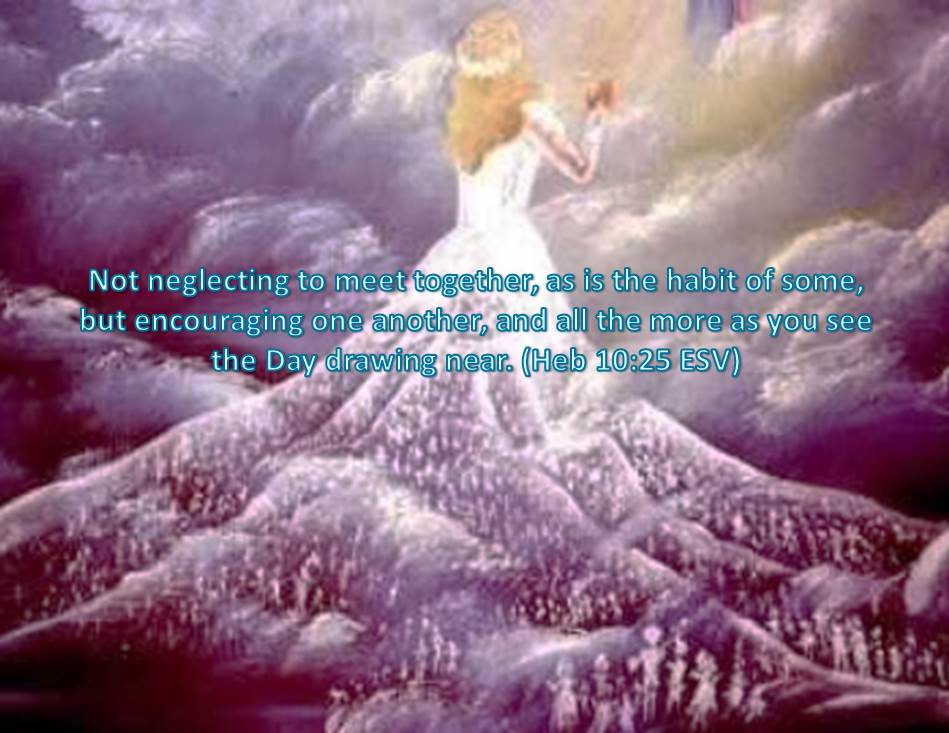
Bride of Messiah

Scripture has much to say about fellowship among followers of Yeshua. Many people have construed passages such as Heb 10:24-25 and 1 Pet 2:5 to urge us to join a congregation. For centuries people have sought fellowship in church, seeking community, accountability, support and encouragement. However, currently there are multitudes of believers fleeing the established church setting. Why?

 Scripture exhorts us to meet together, to support and encourage one another, to call one another to account and to be accountable to others, to bear one another’s burdens, and so on. While it is true that we need to do these things, it is not necessarily true that a church setting is the best environment to foster such activities. In fact, traditional church practices often hinder or discourage people from following Scripture’s mandates. Here are some examples of how we can lose focus in a church setting:

 Focus shifts to a human agenda rather than the Holy Spirit’s agenda. We can get caught up in our programs and projects and lose sight of our true mission (John 3:6-8; Acts 8:39; 1 John 5:6; John 14:26). We fail to seek guidance daily from the Holy Spirit and draw away from our Father’s plan.

  • Focus centers on the needs of the church entity while neglecting individual needs. Many times people come to service week after week heavily burdened with trials or sin and leave carrying the same burdens. Even if the congregation has an established order of service, does it also provide opportunities through small groups, prayer ministers, or some other means to assist individuals? Is there effective prayer for healing? Are demons expelled? (Matthew 10:7-14)
  • Focus settles on certain truths to the exclusion of the rest of the truth. Is the emphasis on adhering to established doctrines or on learning more about YHVH and His will for us? (John 16:13)
  • Focus turns inward with little or no outreach from the congregation. Do we reach out to those around us who do not yet know the joy of salvation in Yeshua?   Do we help others in need or do we judge them? Do we have an exclusive “club” where we feel comfortable and outsiders remain outsiders? (Matt 25: 35-40; Mark 16:25; Rom. 10:14; Acts 1:8)
  • There is strong temptation to settle into a comfort zone and stagnate. Spiritual growth becomes a threat. Change becomes an unwelcome challenge. (Eph 3:17-19; 2 Pet 3:18)
  • The agenda of an established hierarchy replaces the agenda of the Holy Spirit. (Matt 15:3; Mark 7:3-9)

Recently, we have attended services where the congregations are working hard to address these shortcomings. Even within a worship service, there is room for the Holy Spirit to take over the meeting. Active outreach to the community is passionately pursued by the congregation. There are opportunities for people to seek individual prayer and support so that they do not carry burdens alone.

 We need to broaden our definition of fellowship. There are numerous opportunities to have “church” daily. Tim Mather explains in his book, Escaping Church, that any time we share the good news with another, encourage or advise or pray for another, or have discussions about our faith with others, we are “doing church.”

There are other ways for congregations to restore what is missing that I will discuss in my next article. It is time to repair Messiah’s broken body. It is time for the bride to prepare herself to meet her Husband. It is time for us to have true fellowship with one another.

His Name Alone is Holy

His Holy NameFrom my first two postings about God’s Name, we know that YHVH [Yehovah] wants us to know and speak His name, and that His name (Yehovah) has been written in Hebrew over 100 times in ancient Scripture texts. I have given examples of how we can use His name when we are speaking healing, deliverance, or blessings of any kind over another person. I have also explained how the pronunciation of His Name has been hidden from the majority of Jews and Christians for more than 2000 years.

What I have not talked about yet is why we are to treat His name as holy and to revere it above all else. In Psalm 138[ESV]: David says to YHVH: “I bow down toward Your holy temple and give thanks to Your name for Your steadfast love and Your faithfulness, for You have exalted above all things Your name and Your word.” The key is that David says YHVH has exalted His name and His word above all else – if we want to focus on what is most important to Abba, then we need to listen to what He says about exalting His name.

There are also many scriptures that talk about the holiness of YHVH’s name: “…all flesh shall bless His holy name Forever and ever.” (Ps 145:21); “…He has commanded His covenant forever: holy and awesome is His name.” (Ps 111:9); “Bless the Lord, O my soul; and all that is within me, bless His holy name!” (Ps 103:1); “For our hearts shall rejoice in Him, because we have trusted in His holy name.” (Ps 33:21); “Let them praise His great and awesome name — He is holy.” (Ps 99:3). So what exactly does holy mean in this context? The Hebrew word for holy (kadosh) actually means “set apart”, and we know from Scripture study that YHVH (His name and His word) is set apart from everything else in the universe, just as David implied in the Psalm 138 quote from the previous paragraph. YHVH also wants us to be set apart from the world, as we are told by Him to be holy as He is holy (Lev 11:45, quoted in 1 Pet 1:16).

My favorite example of the holiness of God’s name [Yehovah] is the display of His awesome power in I Kings 17-18. In the beginning of this story, YHVH is prophesying to Ahab through Elijah that there will be a drought in the land for three years, until YHVH speaks His word to end the drought (I Kings 17:1). During this time, there are signs and wonders to confirm that YHVH is working through Elijah, such as the miracle of the widow’s food lasting through the drought and her son being raised from the dead (I Kings 17:8-24).

When Elijah returns to confront Ahab and his false prophets of Ba’al and Asherah, he knows he can trust in the name of YHVH to overcome the evil powers, and to prove to them who is the true God [Elohim], Creator and Master of the universe. Although Ahab and Jezebel and their warriors had been seeking to kill Elijah, he now confronts his enemies boldly and challenges their false god to a duel (I Kings 18:21). He compels them to make a decision as to whom they will serve: YHVH or Ba’al. This is a decision we must all make at some point in our lives, because there is no middle ground – either we serve the world (Satan and his kingdom of darkness) or the true God, YHVH.

In the familiar story of the confrontation between good and evil, Ba’al and YHVH, there is no contest of course, and YHVH is victorious. Elijah tells the false prophets to call on the name of their gods, and says that he will call on the name of his God (I Kings 18:24). Working through Elijah, YHVH then graphically demonstrates that God’s name is unique and set apart (kadosh – holy) from everything else in the universe. Elijah first built an altar and dedicated it to YHVH, then asked YHVH to show the people that he was the only true God, and prayed that He would turn their hearts back to Him (I Kings 18:46-37). YHVH then answered Elijah’s prayer convincingly by sending fire from heaven to burn up not only the wood and the sacrificial bull, but also the water in the trench around the altar (I Kings 18:38).

The response of the people was to immediately prostrate themselves on the ground and start worshipping the true God, Yehovah: “Now when all the people saw it, they fell on their faces; and they said, “The LORD, He is God! The LORD, He is God!” (I Kings 18:39). The people’s declaration is even more powerful when translated directly from the Hebrew, as they said: Yehovah, He is the God [Elohim]; Yehovah, He is the God [Elohim]. Since they had previously been worshipping many (false) gods, the key point of their declaration is that Yehovah is the one and only true God of the universe, set apart (holy) from the world and all other false gods!

There is power in the name Yehovah. His name is to be revered and praised, just as He is revered and praised. We can trust in Yehovah and in His name to protect us and provide for us. We can call on His name with confidence, and He wants us to be set apart from the world as He is set apart (holy).

Hidden Strength

I have said these things (John 16 33)

Yeshua warned that we would face persecution and tribulation because of our relationship with Him. As I ponder having to suffer or die for my faith, I feel weak and afraid. Will I be able to endure to the end?

I think about Simon Peter and his struggles (Mark 14:66-72). His love for Yeshua was genuine and strong. Yet, at his first test of loyalty, Peter succumbed to fear and denied Yeshua as strongly as he had earlier declared his willingness to die for his faith.

When all was said and done and Peter was not arrested, he agonized over his disloyalty and his weakness. Perhaps it tormented him day and night. Yet, Peter learned a valuable lesson, one that we must all learn. He could not be brave on his own.

When the resurrected Yeshua visited His apostles, how hard it must have been for Peter to face Him, to look Him in the eye. Yeshua addressed this matter with love. He did not tell Peter that his cowardly act was alright. Instead, Yeshua gave Peter an opportunity to declare his love and commitment the same number of times that he had formerly denied even knowing Yeshua.

Yeshua understands our weakness. That is why He promised to send the Holy Spirit to us (Luke 24:49). What a difference it made to Peter after the Holy Spirit came upon him at Shavuot (Pentecost). Peter was no longer cowering, but now boldly proclaimed his faith to the multitudes. It is the same for us. We must welcome any and all assistance of the Holy Spirit in order to do what is required of us.

We can be sure that when we face trials and persecution, the Holy Spirit is with us (1 Pet 4:14). The Holy Spirit leads us into all truth (John 16:12) and strengthens us (Rom. 5:3-5). All that we need to perform any task YHVH assigns to us will be supplied by the Holy Spirit.

We will never have to face persecution alone. It will not be our strength that will overcomes, just as it is not our righteousness that reconciles us to our Father. YHVH is so good that He supplies all that we need and if we just use what He offers, we have the dignity and gratification of having accomplished great things. It is much like a child who proudly performs a task while the parent gently guides the child’s little hands. If we welcome the help of the Holy Spirit, our Father will guide us even in times of trial.

Spiritual Maturity: Dying for the Kingdom

But the one who endures

What does it mean to follow the King? For Yeshua’s first followers, it meant leaving family, jobs, security and comfort in order to build up the Kingdom of YHVH. Yeshua Himself gave up everything for the sake of the kingdom. What does building up the kingdom require of us?

 Recently I wrestled with the challenge posed to all of us in Mark 10:17-27. The rich young ruler wants to know what is required for eternal life. Yeshua responds that he is to keep the commandments. The young man presses on to see if there is anything else required. Yeshua tells him that he lacks one thing: to sell all that he has, give to the poor, and follow Yeshua.

 All my life, I have been content with trying to keep the commandments, sometimes succeeding, sometimes failing miserably. I have ignored the rest of the story of the rich young man. I didn’t even consider that I could be called to relinquish all my material goods, let alone ties to family and friends.

 In the documentary, The Father of Lights, there is a story of a young couple who had much wealth. When the Holy Spirit challenged them, the husband gave up his lucrative career, they relinquished their material wealth and took their young children to China. At first, they lived in squalor and the young mother struggled mightily with her decision. What was she doing to her children? Was she a responsible parent? Today, the couple runs an orphanage for handicapped children in a beautiful facility they call home. They are building up the kingdom, one abandoned child at a time.

 Daily Peter and I dedicate our house and all our belongings to YHVH to be used for His glory. Do we realize what we are saying? If YHVH tells us to give up everything, will we obey His command? During a recent prayer session with YHVH, the Holy Spirit challenged me as I was once again dedicating everything to YHVH. Would I be willing to relinquish my possessions for the sake of the kingdom? The words have long been on my lips, but were they in my heart?

 I struggled for over two hours during that session. For well over a decade, I had lived in poverty. As I learned to trust and obey YHVH more, I moved out of poverty into abundant material blessing. It was a long, tough process. Now that I am nearing retirement age, I relish this comfort and security. I tried to reason that perhaps it wasn’t necessary to be so radical. Wouldn’t it be irresponsible to become potential burdens on society, especially at our age? What sense does it make to give away our security? Deep down I knew that my logic could not stand up to the command, “sell all that you have, give to the poor, and come follow Me” challenged me. Yet, I could not bring my heart to accept the truth. Like the rich young man, I walked away from that session saddened because I too was not able to give it all up.

 A few minutes later I received an email from a friend reporting that ISIS had challenged a group of chidlren in Iraq to relinquish Yeshua and convert to Islam. Every child refused to give up Yeshua and every child was beheaded for his or her faith. I was humbled to the dust. These youngsters gave up their lives for their faith without hesitation while I balked over material goods. May I soon acquire their level of maturity. Yeshua’s words challenge each of us.  What is our response?

The Real Meaning of Chanukkah

History of HanukahProbably the most well-known Jewish feast in the modern-day world is Chanukkah (more commonly spelled Hanukah). Chanukkah (1 Maccabees 2-4) is not one of the original feasts Yehovah instructed us to observe. It is a feast to commemorate a series of miracles God performed for the Jews in the dark days of Antiochus Epiphanes, so my belief is that Yehovah honors our celebration of this feast, as long as we stay focused on Him as the “reason for the season”.

Antiochus Epiphanes, theSyrian King of the Jews within the Greek empire, had forbidden all observance of the true Sabbath, YHVH’s Feasts, and circumcision (in I Macc 2:8-12). He mandated that anyone who studied or kept the Torah would be put to death. He also defiled the Temple and erected a statue of Zeus in the Temple on the 25th of the Hebrew month of Kislev, in 168 BC. In fact, all the ancient chief pagan gods had their birthday on Kislev 25 – note that the modern solar-based calendar was not adopted until 46 BC, so the Roman world was still using the lunar-based calendar at this time.

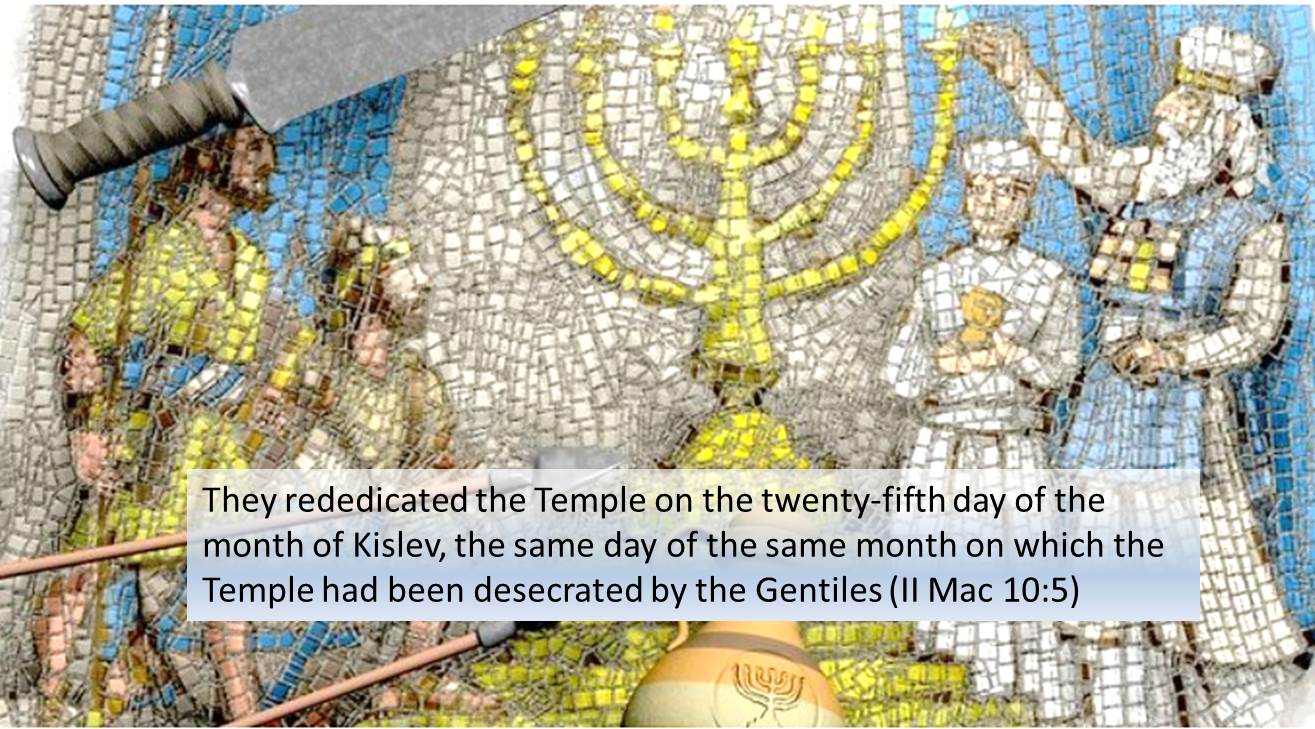
Judas Maccabeus and his four brothers (all Jewish priests) took up their swords and battle hammers to defeat the Syrian rulers and their pagan sun god religious system in 165 BC. Interestingly, Maccabee (iaB<q;j) means “hammer”, so one could rightly say that they “hammered” their enemy. Once they had defeated the Syrians and taken back their temple, the Maccabee brothers and their followers spent seven days cleansing the Temple of all the pagan altars and idols, and then re-dedicated the Temple on the eighth day. Once they had won this victory and purified their Temple, the leaders mandated that a feast called Chanukkah be observed every year starting on Kislev 25 and lasting for 8 days. The Hebrew word Chanukkah (חֲנֻכָּה) actually means “to dedicate”, so this feast is most often referred to as the Feast of Dedication. This feast celebrates the miracle of Yehovah giving them the victory over pagan sun god worship, as well as the cleansing and re-dedication of their temple to the true God, Yehovah.

There are many Jewish traditions and legends surrounding Chanukkah, such as the story of the oil in the Menorah lasting 8 days when it should have only lasted 1 day. However, the real reasons for the 8-day duration of the feast are two-fold: to commemorate Yehovah’s miracle that allowed them to defeat the Syrians and re-dedicate the Temple; and, to celebrate the Feast of Tabernacles (Sukkot) which they had not been able to do for 3 years (see II Maccabees 10:6).

One strong confirmation that Yehovah honors our celebration of Chanukkah is that Yeshua looked favorably on the feast, as He went up to the Jerusalem Temple mount and taught the people during the feast (John 10:22-23). Based on Jewish tradition, rabbis at the time of Yeshua believed that the Messiah would reveal Himself at the time of Channukah (from the Talmud). In John 10:24, the leaders asked Yeshua: “Why do You keep us in suspense? Are You the Messiah?” In John 9, Yeshua had just done the one miracle that was undeniable proof of His Messiah-ship; He had healed a man born blind, which the leaders said only the Messiah could do!

But because the people were expecting a political/military Messiah who would rescue them from the Romans, they did not recognize Him as the Messiah. Yeshua answered them (John 10:25-26) “I told you, but you did not believe: the works that I do in My Father’s Name, they bear witness of Me. But you do not believe, because you are not of My sheep, as I said to you”. The Jewish leaders denied His miracles in John 10:20-21: “And many of them said, ‘He has a demon, and is mad; why hear ye Him?’  Others said, ‘these are not the words of one who has a demon. Can a demon open the eyes of the blind?’”

Yeshua then presented people with an eternal solution to their problems. In John 10:27-28), He said: “My sheep hear my voice, and I know them, and they follow me: and I give unto them eternal life; and they shall never perish, neither shall any man pluck them out of my hand. He turned the people from the short-term, physical solution they wanted to a spiritual solution. He said that we are the desecrated temple and need to be cleansed and rededicated to Yehovah. Remember that we are now the temples of the Holy Spirit and we must keep our temples clean (I Cor 6:19). He taught us that we need a long-term (eternal) relationship with Yehovah to fix our spiritual emptiness, because a physical solution cannot fix spiritual problems.

The defeat of their enemies and the re-dedication of the Temple brought back fresh hope to the Jewish people. How fitting that this month, called Kislev in Hebrew, means hope. This relates to the people looking hopefully to the longer, brighter days of Spring, since Kislev 25 occurs very close to the Winter solstice (the shortest day of the year). Yeshua, the Light of the world, brings us eternal hope.

Spiritual Maturity: Dying for Justice

Blessed are they

In Isaiah 1:17, YHVH tells us “Learn to do good. Seek justice, relieve the oppressed, defend orphans and plead for the widow.” If Yeshua were to return today, would He find justice in the world? Let us examine some statistics on each of the three categories mentioned in Isaiah, both worldwide and in the United States.

Oppressed people are often homeless, jobless or underemployed, and usually lack basic necessities. They are among the most vulnerable and abused of people, but are the least able to defend themselves or to make their voices heard. They are the “Lazarus” of Yeshua’s parable found in Luke 16:19-31.

  •  The United Nations Commission on Human Rights reports that as of 2005, over 100 million people were homeless worldwide.
  •  In a 2004 study on homelessness in 50 United States cities, the National Law Center on Homelessness and Poverty reported that each city’s official estimate of homeless people greatly exceeded the number of emergency shelter and transitional housing spaces available. As of 2008, an average of 26 percent of homeless people were considered mentally ill, 13 percent were physically disabled, 19 percent were victims of domestic violence, and 13 percent were veterans (U.S. Conference of Mayors, 2008).
  • According to UNICEF, 22 million children worldwide die from poverty each day.
  • Almost 1 in 4 (16 million) children in the United States live in families with income below the federal poverty level (National Center for Children in Poverty, 2014).
  •  According to the Christian Alliance for Orphans, there are 153 million orphans worldwide.
  • Approximately 245 million women around the world have been widowed and more than 115 million of them live in devastating poverty (“Invisible Forgotten Sufferers: The Plight of Widows around the World”, 2010).
  • In the United States over 48% of the elderly poor are widows, even though widowed women are only 26% of the over-65 population (“Invisible Forgotten Sufferers: The Plight of Widows around the World”, 2010).

Multitudes in the world are dying from a lack of justice.  For individuals these figures are overwhelming.  What can one person or a small group of people do to make any significant impact? However, as of 2010 there were over 2 billion Christians worldwide.   (“Global Christianity—A Report on the Size and Distribution of the World’s Christian Population,” Dec. 19 2011).  It is time to die to ourselves, set aside our differences, and unite with our brothers and sisters in Yeshua.  As a united Body of Messiah Yeshua what could we do to address these and many other injustices in the world?  As an individual, what is YHVH calling you to do?

Messiah’s First Coming Foretold in the Stars

Messiah's 1st coming foretold (Isa 11 1)“A virgin shall conceive and bear a Son called the Branch, the gloriously beautiful, who shall come down and have dominion. He shall be desired and longed for, but also He shall be despised and be a sin offering. He shall be pierced, but will also pierce. He is the heretofore and the hereafter. He will come suddenly to rule, subdue, govern and tread under foot” (paraphrased from a combination of passages in Isa 4:2, 7:14, 9:6-7, 11:1, 53:3,5; Hag 2:7; Zech 3:8, 6:12; Rev 1:8)

Although this quote is not taken directly from the scriptures, it can be pieced together from the above list of scriptures, and agrees in every detail with the ancient constellation and star names. The word “Zodiac” comes from the Hebrew word zodi, meaning “the way” or “path”.  The Greeks use the term ‘Zodiakos’, meaning ‘circle’ to designate the twelve signs and ecliptic circle of the path they follow through the twelve months of the year. We understand Yeshua’s statement that He is “the Way, the truth and the life”, and remember that Yeshua represents the “Strong Man” moving through the circle of the Mazzerot throughout the year (Ps 19:5-6). So based on these two concepts, we recognize that we are meant to follow Yeshua as the Way, and that He is figuratively leading us around the circle of the Zodiac, the signs that tell the Gospel story of Yeshua’s birth, ministry, death, resurrection and final judgment as King of kings.

The first sign of the Mazzerot (Zodiac) is named Virgo (Latin) or Betulah (Hebrew). The reason we know Virgo (Betulah) is the first sign of the Zodiac is because of the great sky painting found in the Temple of Esneh in Egypt, which shows the whole image of the zodiac with all of its constellations. Between Virgo and Leo, there is carved the figure of the sphinx with the head of a woman and the body of a lion. The woman’s face is looking at the Virgin and the lion’s tail is pointing at the Lion, telling us where the Zodiac Gospel story begins and ends. Although I don’t recommend the Latin Vulgate as the most accurate Bible translation source, in this case it helps us understand the meaning of this sign relating to the prophetic passages about the Messiah. Two of the names for this sign are connected – Virgo (Latin) which means a virgin (Isa 7:14); and Virga (Arabic), which means a branch (Isa 11:1).

To confirm the reference to the Branch, the brightest star in Virgo is Tzemach (Hebrew). Although there are 20 different Hebrew words that are translated as “branch”, Tzemach is the only word for branch used to represent the Messiah (example Isa 4:2 – “In that day shall the Branch of Yehovah be beautiful and glorious.”) Virgo’s left hand is shown holding ears of corn – in her left hand is a bright star named Spica, which in Latin means “an ear or seed of corn”.  The Hebrews called this star Zerah, which means “the seed” and is the same exact word used in Genesis 3:14-15. Remember how Yeshua used the figure “grain of wheat” or “seed of corn” (depending on the translation): unless the seed [of corn] falls into the ground and dies, it abides alone; but if it dies, it bears much fruit.” He was indicating here how He had to die in order to bring salvation and eternal life to His people.

The other constellations within the sign of Betulah [Virgo] confirm the prophesied roles and attributes of the Messiah. The first constellation is name Coma in Hebrew, which means the “desired” or “longed for” One, as in Haggai 2:7 – “The Desire of all nations shall come”. Ancient Zodiac depictions show a woman with a child in her arms, with the star representing the child designated by an ancient Persian name meaning the “anointed one”. In some ancient teachings thought to have originated from Daniel the prophet, a new star appeared within Coma which represented the newborn Messiah they were seeking.

The second constellation within Virgo is Centaurus (Latin), which is a well-known mythological character purported to be half-man and half-horse. The ancient Hebrew name of this constellation, though, was Bezeh, meaning “despised” as in Isa 53:3 – “He was despised and rejected of men”. Incredibly, the other name for this constellation is Asmeat, which means “a sin offering”, as in Isa 53:10 – “When You make His soul an offering for sin,..”. So, we have a creature here who is the Son of God, both man and sacrificial animal (probably a goat and not an unclean animal such as a horse), who is despised by people but still willing to sacrifice Himself for us. This is a clear picture of Yeshua our Messiah!

The final Virgo constellation is called Bootes (Hebrew), which means “The Coming One”. He is generally shown as a shepherd, with a shepherd’s crook in one hand and a sickle in his other hand. This could represent many things, but most clearly it shows a picture of the Messiah, coming the first time as our shepherd, and at the end of the age as the judge who comes to reap His harvest of souls and cut off those who will still not turn to Him and His Father after their final call to repent. Even in the stars we see Abba Father and Yeshua beckoning to us to repent – how will we respond?

Spiritual Maturity: Dying to Serve

GrowingUp2

We speak and think of living in YHVH’s kingdom with blissful images of peace, light and joy. It is true that YHVH’s kingdom will be all these things (1 Cor 6:9-10, Rev. 22:5, Rom 14:17). We imagine what the kingdom will be like, but do we imagine what we will be like? How does YHVH’s kingdom run? What are the King’s subjects like? What is their mindset and attitude? What is expected of them?

Life in YHVH’s kingdom is very different from living in a democracy or republic. We seek YHVH’s desires and approval, not our own (Mark 9:35). We live to do His work, not to work for ourselves. We must die to our own desires and seek YHVH’s pleasure. The gospel story of the centurion gives us a clear example of living obediently.

 For I too am a man under authority, with soldiers under me. And I say to one, ‘Go,’ and he goes, and to another, ‘Come,’ and he comes, and to my servant, ‘Do this,’ and he does it.” When [Yeshua] heard this, he marveled and said to those who followed him, “Truly, I tell you, with no one in Israel have I found such faith (Matt 8:9-10).

 We are not self-reliant, but are dependent on our King (Ezek 34:26-29). We do not elect a king or express our opinions of the king’s actions. Our King is the source of all wisdom, love, justice and mercy (Ps 19:9-12). His ways are above our ways and His wisdom far surpasses ours (Is 59:8-9).

We are to keep His commands, His laws (John 15:10, 1 John 2:4). YHVH’s laws are designed to justly and mercifully meet everyone’s needs. That cannot always be said of human governments. Yeshua often warned the Pharisees and Scribes about their man-made laws or interpretations of the Torah. Sometimes the man-made laws were in direct violation of the written Torah. That was not acceptable to YHVH 2,000 years ago and it is still not acceptable to YHVH today.

 We are to become like little children in order to live in YHVH’s kingdom (Matt 18:3). Little children depend totally on their parents and are expected to follow the rules of the household. When we are born, we are focused entirely on ourselves, but as we mature we should become less self-centered and more other centered. Are we spiritual adults as well as physical adults? Are we prepared for life in the kingdom?