Tag Archives: Yehovah

Made in the Image of God’s DNA

Knit me TogetherIn my previous postings on the evidence of God’s brilliant hand in Creation, I talked about why we should believe that God [Elohim] is the Creator of everything in the universe.  I also spoke about the evidence of ingenious design we see all around us in the Earth and skies.  Finally, I have cited examples of creatures that have amazing characteristics and abilities that could only be conferred on them by an intelligent designer as awesome as our supreme being, YHVH Elohim.  One of my Creation blogs focused on all the indisputable evidence of the young age of the Earth – in this blog, I want to dig deeper in this exploration, specifically looking at the young age of the human population.

Without getting into too many technical details of human DNA, even from a high-level point of view we know that it is the most complex but at the same time easily traceable element of our physical bodies.  The DNA in each of cells is what makes us uniquely who we are, in terms of how others see us externally, as well as the nature of our mind and heart tendencies and emotional characteristics deep within our souls.  Staying on the surface level, we also know that each subsequent human generation experiences a certain number of mutations (copying errors) in their DNA.

Through extensive research over the years*, scientists have found consistent rates of mutations from one generation to the next.  Focusing on the average mutations of the male Y chromosome from one generation to the next, these have been recorded at a higher rate of about 1 mutation per generation.  The average number of total Y chromosome mutations per person area about 300, giving a complete genealogy of only 300 generations in humankind’s history.  If we figure that a generation is somewhere around 20 years, then this would calculate out to about 6,000 since Adam and Eve were created.  In addition, at this standard rate of mutations, it would be impossible for humans to be able to function as living beings past 1,000 Y mutations, meaning that we could not have existed for more than 20,000 years as a race.  We have a similar type of scenario when we look at the Mitochondrial DNA (mtDNA), which is only inherited from the mother, with the total number of years since the first woman also coming out to about 6,000.

In the evolutionary science camp, it is believed that a great percentage of our DNA (approx.. 95%) is “junk DNA”, meaning that it is left over from all the trial-and-error attempts of “natural selection” to produce a higher level of species.  However, it has recently been found that the vast majority (98%) of all DNA serves a useful purpose, much of it in support of producing new DNA by replicating itself.  And because DNA is loaded with more information than all the Wikipedias contained in all the world’s computers, it would take a divine Programmer to reprogram one animal kind’s DNA into another’s (e.g. an ape into a human).

If we go back to the source of all human beings, we see that we were made in the image of YHVH: “So God [Elohim] created human beings in His own image. In the image of God He created them; male and female He created them” (Genesis 1:27).  Without going into too much detail about it means to be created in the image of YHVH Elohim as far as our spirit, soul and body, we can at least say with confidence that we have some portion of God’s DNA within us.  We know that “God is Spirit” (John 4:24), so we cannot even speculate what it means to be created in the image of God’s DNA.  We know that Yeshua is a perfect image of God: “ For in Him dwells all the fullness of the Godhead bodily” (Col 2:9).  We can extrapolate from this (I know, I’m a computer geek – what can I say) that we as humans are made in the perfect image of God, Father, Son and Holy Spirit!

Since Yeshua said that He wants us to be one [echad] with Him as He is one with the Father, does that mean we are just meant to have the same physical DNA in our bodies?  I believe from Scripture that it means far more than this.  We are body, soul and spirit just as YHVH is body, soul and Spirit.  However, our bodies do not endure – only our soul and spirit last beyond this earthly life, into eternity.  The focus of our lives should be on renewing and perfecting our souls and spirits, not our bodies.  When we are “born again” (born from above), our spirits are perfect and sealed forever (Eph 4:30).  However, it is our responsibility to work on our souls, bringing them closer in line with YHVH every day.  When we get the DNA of our souls and spirits in line with the Creator and Master of the universe, then we can truly feel the Echad closeness with Yehovah that Yeshua spoke about – let’s renew our minds day-by-day: “even though our outward person is perishing, yet our inward person [our soul] is being renewed day by day” (II Cor 4:16).

  • Thomas, Brian, MS “Does Modern Genetics Confirm a Historical Adam?,” in Acts & Facts, Vol 45, Number 4 (Texas, Institute for Creation Research, 2016), page 20.

Lessons from Bees

bees and creationOur Creator God (Yehovah Elohim) has made some awesome creatures, and I’ve written about some of them in previous blogs.  From my vantage point as a human being, though, there is none more awesome than the humble honey bee.  Evolutionary scientists used to describe the bee and their brain and body functions as being very simple.  However, the more that is discovered about these amazing creatures, the less you hear them described in this way.  As recently as 2006, a well-known scientist said this about bees’ brainpower: The brain of the honeybee is “relatively simple.” (Evolution Research – General Evolution News, August 5, 2006).

Let’s look at some known facts from scientific studies of bees and their anatomy and behavior.  A number of years ago a study was done to compare the processing power and speed of a bee’s brain to that of a supercomputer. The findings showed that the bee’s brain was 7-8 times more efficient than the most advanced computer chips, and about 1,000 times faster in processing instructions.  A bee’s brain can process one trillion instructions per second.  With the latest generation of supercomputers, it is now possible for them to process information faster than the brain of a bee, but there is no comparison in efficiency.  The Fujistsu “K” computer runs 8 times faster than a bee’s brain, but it takes enough electricity to power a city of 10,000 people, while a bee’s brain fits on the head of a pin and takes less than a microwatt of power!

Much of the bee’s incredible brainpower is used to control and process information from their two compound eyes, each of which contains 7,000 hexagonal facets.  Using these light-detecting facets, each pointed in a slightly different direction, the bee has an uncanny ability to detect different types and colors of objects, how far away they are, and how quickly they are moving towards them.  This allows them to see flowers quickly (with a built-in mechanism for detecting whether or not they have pollen), know exactly how far away they are and to find them in any type of weather.  The bee’s eyes (and other sensors in their bodies) also allow them to tell if a food source has been moved to a different location.  Being a God of meticulous design and possessing a great sense of humor, Yehovah’s amazing bee creatures are programmed to do a little “waggling” dance to tell their fellow workers how far away a food source is, and when and where it has been moved.

If Abba put so much thought and creativity into making these tiny pollinating creatures, then how much more does He love us, who have far more intricate, complex bodies than our miniature friends?  In a recent Independent news story, a beekeeper in the UK witnessed the most amazing episode of loyalty to a hive’s queen bee.  As the beekeeper was moving a hive, the box she was transporting them in blew over in the wind, and somehow the queen bee was attracted to something sweet in the trunk of a Mitsubishi Outlander.  She then got herself lodged into the back of the SUV.  About 20,000 bees (from her hive that was being moved) attached themselves to the back of the SUV.  When the car drove off, the swarm of bees followed it for over 48 hours, while the SUV was driving around various parts of western Wales.  They were seeking to rescue their queen!

When I thought about the unwavering loyalty of these bees to their queen, I realized that God has put a deep desire into human beings as well to be loyal to their leaders, or to the homeland where they dwell.  On this Memorial Day weekend in the US, I reflected on how this relates to our soldiers’ pledge to fight for our nation under the most severe conditions, risking their lives to preserve the security of our country.  We know from God’s word that “There is no greater love than to lay down one’s life for one’s friends” (John 15:13).  But what about Yeshua and what He did for us – He laid down His life for his enemies; those who persecuted and hated Him and put Him to death in the most brutal, painful way.  He gave up His life willingly – He said: “No one can take My life from Me; I sacrifice it voluntarily” (John 10:18).  While it is true that bees would sacrifice their lives for their queen, and soldiers for their country, they are sacrificing for the one that gives them safety and livelihood, not for someone who beat and cursed them and then put them to death.

If we are loyal to our family, friends and nation, how much more should we be loyal to our Savior.  We should be willing to lay down our lives for our Lord at any time, just as we see modeled for us by martyred believers in terrorized nations across the world.  When we think of our awesome God who created bees and humans, our greatest desire should be to follow Him at all costs, boldly telling others of His amazing love and sacrifice for us, and praising Him for who He is and what He has done for us.

What would you do if you were God (Part 4)

Rom 1133 - how unserachable“Oh, how great are God’s riches and wisdom and knowledge! How impossible it is for us to understand his decisions and his ways!” Romans 11:33 [NLT]

In the previous installments of this series on God’s ways, I discussed why He does things the way He does and whether we could do any better if we had supreme control of the universe.  Now I want to focus on something a little more personal.  Putting yourself in God’s place for a moment, think about what you would do if your creatures turned away from you to the point where your relationship with them seemed irreparable.

You had designed humans so that their most primal need was to have a deep personal relationship with you, but they had chosen to abandon and deny their need for that intimate relationship.  In human terms, this seems like an impossible situation.  One party (the human being) has gone against the wishes and desires of the other party (God) by disobeying His instructions, speaking against His perfect character, and hurting Him deeply.  The first party will not admit their wrongs and refuses to apologize (repent) for their sins against the second party.

If both of these parties were human, it would be difficult if not impossible to reconcile and restore their close relationship.  The first (wronged) party would have to unilaterally forgive the other one, which requires Godlike humility and unconditional love.  Considering the extreme nature of the sins of people against God, this forgiveness would be on the level of Corrie TenBoom’s forgiveness of the concentration camp guard who brutally and mercilessly beat her sister.  However, as we know, with God “all things are possible”.  From the Romans 11:33 Scripture above, we also know that it is “impossible for us to understand God’s decisions and ways”.

So how did God choose to reconcile us back to Himself from the depths of our sin and disobedience?  Did He shout down to us in His Earth-shattering voice, speaking anger and judgment on us and our sins?  Did He accuse us of turning against Him, shaming us into such a state of humiliation and disgrace that we felt compelled to seek His forgiveness?  Did He come down to Earth, seeking retribution and justice for every sin we had committed against Him and His children?

Or did Abba draw us back to Himself (and to Yeshua) by loving us unconditionally?  It is sometimes hard to even fathom the depth of Abba’s love for us.  Think of a particularly painful time in your life, when someone has hurt you so deeply you cannot even imagine forgiving them.  Then imagine sacrificing your own child for people who despised and cruelly hurt you.  Multiply this a million or billion times and you can start to feel what our Father in heaven feels when we turn away from Him and pierce His heart to the core with our sins.

Yeshua told us to love our enemies, bless those who curse us and do good to those who hate us.  He also told us that “There is no greater love than to lay down one’s life for your friends”. (John 15:13)  But what if God told you to lay down your life (or your child’s life) for your enemies?  Would you be angry and resentful that He would ask you to do something so unfair?  Well that is exactly what Yeshua did for us – His Father asked Him to lay down His life for those who hated, mocked and abused Him, and He willingly consented to His Father’s will.  If Yehovah could do this for us, can we not forgive those who hurt and abuse us?

Instead of criticizing Abba for the ways He deals with people’s disobedience, try praising Him for his love and forgiveness which are more infinite than all the universe!


What would You do if You were God (Part 3)?

free will_2“And we know that all things work together for good to those who love God, to those who are the called according to His purpose.” Romans 8:28 [NKJV]

In the last segment of this series (Part 2), I discussed the reasons why God created us with a free will.  Please go back and read that episode: What would you do if you were God (Part 2), to get the background for this teaching. In today’s blog, we will dig deeper into God’s purpose for giving us free will. YHVH works all things together for good no matter how far we stray from His perfect plan for our lives.

We are born into the earthly realm where hasatan rules and reigns (ever since Adam and Eve gave back their dominion to him in the fall.  So you might ask: why would God have allowed our great adversary to take dominion of the Earth from us?  Well, being our all-knowing Creator, and having given us free will, He knew that we would eventually disobey Him and fall into sin.  So He created us with a conscience that steers us towards what is right and away from what is wrong.

Even young children can be influenced by other forces and willfully choose to disobey their consciences.  Parents may have taught their child right from wrong, but that child can be wrongly influenced by seeing another child doing something they know is wrong (taking something that doesn’t belong to them, or telling a fib, for instance).  If the child is caught in the act and reprimanded, but desires to please their parents, then they will resist the temptation to disobey the next time.  It is the same with our heavenly parent, Abba.  Even at a young age, children start developing a sense of what is right and wrong. They learn that their lives will be happier and less stressful if they take the “right” path in their choices.

When we come into the age of moral accountability, we generally know that we are to keep God’s commandments, but there are many forces tempting us to go astray of those commandments.  We are tempted by the snares of the world, such as the lust of the eyes and flesh around us that appear so desirable on the surface.  We are also tempted by others to stray.  At times, we can be lured by the seductive wiles of HaSatan or his evil forces to commit sinful acts.

How is God working for good through these sinful lapses on our part?  Yehovah has blessed us with intelligent minds that are able to reason through the physical consequences of sin – and a spirit ideally in tune with His Holy Spirit to help us recognize the spiritual consequences of sin, which leads to separation from God.  YHVH desires that all of His children be born again and filled with His Holy Spirit.  This means that when we fall into sin, He uses His rod and staff to correct us and pull us back into His fold.  Sometimes, we fall so far and for so long that we suffer severe consequences. These can take the form of physical or mental ailments.

As many born-again believers’ testimonies confirm, these times of falling away were the low-points in their sinful lives.  Yet God was working to bring them back and restore them to fellowship with Him.  He can work in many ways – through other believers or His angels who rescue us in dire times of great distress or danger, through Yeshua Himself who appears to people in the depths of despair, and even directly by shining His glory light into a fallen person’s heart and thoughts, giving them hope for a joyful future with Him.

There are many examples in Scripture of YHVH pulling people out of the depths of their despair.  In David’s case, he often experienced times of discouragement, desperation and even hopelessness.  Some of these times were brought about because of unjust hostility from others, such as King Sha’ul, Abimelech, etc. (1 Sam 23, Ps 22:1-8, Ps 69:1-4, Ps 56, Ps 34).  But in other cases it was his own sin that brought God’s judgment down on him (Ps 51).  In both cases, he cried out to YHVH, because he knew that God would rescue him out of his dire circumstances even when his sin had temporarily separated him from God’s presence.  At all these times, though, David was learning to trust in God’s protection and deliverance instead of trusting in people and nations to deliver him.

Similarly with Paul (Sha’ul) in the New Testament, he realized that God was his only stronghold and that was sufficient for him no matter how dire the circumstances were.  Sha’ul had sinned greatly by persecuting believers in Yeshua (Acts 7:58), before Yeshua appeared to him and saved him by grace on the road to Damascus (Acts 9:3-18).  He then came under great persecution himself and had to depend on YHVH to save him from his enemies, learning that YHVH was his strength when he was weak (2 Cor 12:8-10).

Think about the darkest times in your life, when someone has abused or hurt you deeply, or when you have fallen into the darkness of sin and depression.  If you are a believer, you know that those times were when God was working the most fervently in your life – to raise you back up to joy and glory in His kingdom, or to convict you of the destructive effects of your sin and the critical need to turn from your sinful ways and follow Him.  When I think about the freedom He has given us and the power of His love and grace to save us when we fall, I cannot imagine Him doing it any other way!

Speaking God’s Awesome Name

LORD of Hosts“And Moses built an altar, and called the name of it the LORD my Banner [Yehovah Nissi]” Exodus 17:15

In my previous postings on God’s Name, Yehovah, I spoke about the importance of knowing and speaking God’s holy Name. We learn from the Scriptures that His Name is holy, righteous, mighty, beautiful, glorious, exalted, a high tower, the Word of God. As far as the LORD being a helper for us in our everyday lives having to live “in the world” but not being “of the world”, here are some of the titles and roles that our God [Yehovah Elohim] fulfills: The LORD my rock (tzuri) and my redeemer (goali), my banner/miracle (nissi), my provider (yireh), our shield (mageinu), our refuge (mach’seh), our righteousness (Yehovah Tsid’keinu), The LORD of peace (Yehovah Shalom), the LORD our presence – or “He is there” (Yehovah Shammah), the One who heals (Yehovah Rapha), and the LORD of hosts/armies (Yehovah Tzeva’ot).

This final name, Yehovah Tzeva’ot, is one of the most powerful – it literally means LORD of armies or LORD of hosts.  In Isaiah, we see how this Name is associated with the Messiah in several different passages – here are a couple of examples:

  • Isaiah 44:6 – “Thus says the LORD, the King of Israel and his Redeemer, the LORD of hosts [Yehovah Tzeva’ot]: ‘I am the first and I am the last; besides me there is no god’.
  • Isaiah 47:4 – “Our Redeemer—the LORD of hosts [Yehovah Tzeva’ot] is his name—is the Holy One of Israel.”

From other passages in Isaiah, we know that “The Holy One or Mighty One of Israel” is always used to refer to the Messiah. Putting these references together, it is clear that Yeshua HaMashiach is called the LORD of Hosts as He is the person of the Godhead who directs God’s armies (both heavenly and earthly armies). One other clear passage that identifies Yeshua as Yehovah Tzeva’ot is in Zechariah 14:16: “Then it will come about that any who are left of all the nations that went against Jerusalem will go up from year to year to worship the King, the LORD of hosts and to celebrate the Feast of Booths”. We have learned from these and other Scriptures (through the Holy Spirit’s inspiration) that when we are cleansing our household of evil spirits (demons), it is very effective to use this divine name of Yeshua, as He is the LORD of Hosts.

There is truly “power in the Name” as believers often quote, but what name is that? We know from Yeshua’s own words to us that we can pray to the Father in His name and whatever we ask will be done (paraphrased from John 16:23). Yeshua also says in John 17:11 (in his prayer to Abba Father): “Holy Father, you have given me Your name; now protect them by the power of Your name so that they will be one just as We are One. During My time here, I protected them by the power of the name You gave me”. Then later in His prayer He says: “I have declared to them Your name, and will declare it, that the love with which You loved Me may be in them, and I in them” (John 17:26). So we see from this that Yeshua’s name is holy and powerful, but He is also named with the same name as all persons in the triune Godhead, Yehovah.

So when you are praying, remember that the name and titles of our God, Father, Son & Holy Spirit, are powerful, not only for salvation, but for protection and deliverance from our enemies (physical and spiritual), for healing, for victory in life’s battles, and for our times of praise and worship when we are seeking His face, His guidance, and His voice speaking into our lives. Try out these names and see how Yehovah answers you.

Yehovah is Light

light shining out of darkness We must work the works of Him who sent Me while it is day; the night is coming when no one can work. As long as I am in the world, I am the light of the world.” John 9:4-5

I John 1:5 says that God is light, but what does that really mean and why is it important to us? It seems significant that immediately after God [Elohim] created the heavens and the earth, He saw that “The earth was without form and void; and darkness was over the face of the deep”. (Gen 1:2)  It is clear that He was not pleased with the darkness, because He then said “Let there be light”, and when He saw the light, He declared that it was good (Gen 1:4). But He didn’t stop there – He was still not totally satisfied, because He then separated the light from the darkness.

At a physical level, we have a very consistent theme here – God is light and is the source of all light. There is a related theme that is just as important though – God cannot dwell in the presence of darkness, so He must separate His light from all darkness. I quoted the first part of I John 1:5 above, but I left out the last part – after John says that God is light, he goes on to say “in Him there is no darkness at all”. Throughout the Scriptures, darkness is associated with people’s sinful hearts (John 3:19), or the evil one and his Kingdom of darkness (Col 1:13).

In the same way that YHVH separated the light from the darkness in His creation, he wants to separate us from the darkness of this world. In Isaiah 52:11, YHVH says: “Depart, depart, go out from there; touch no unclean thing; go out from the midst of her; purify yourselves..”. He is telling His people to come out of the darkness and impurity of the world and to cleanse their hearts of worldly impurities. Sha’ul tells us to live in the light: “You are all children of light and of the day. We are not of the night nor of darkness”. (I Thess 5:5) Peter [Keifa] says that as followers of Yeshua we are: “…a chosen generation, a royal priesthood, a holy nation, His own special people, that we may proclaim the praises of Him who called us out of darkness into His marvelous light”. (I Pet 2:9)

From all that we have studied about the deeper (sod) spiritual meaning of YHVH’s Scriptures, everything that YHVH does has a purpose and usually teaches us some type of lesson. So let’s dig a little deeper here. We started at the front of the book with God “turning on the lights” in the beginning, and also heard John make the statement that God is light. Now let’s go to the back of the book. In Revelation 21:23, Yeshua tells John that in the end there will no longer be any need for the sun and moon because the glory of God will illuminate the city of New Jerusalem, and the Lamb [Yeshua] will be its light. When we look at the ancient Hebrew word pictures associated with the three letters in the word for light (ohr in Hebrew), we see a deeper meaning emerge: “the first Man [Yeshua the living Word] was there in the beginning when light was created”. So, we see that Yeshua was the source of light in the beginning, and He will be the source of Light again when He comes to reign on the new Earth.

Yeshua told us clearly that He is the Light of the world and we are to follow Him:

  • John 8:12: “I am the light of the world. He who follows Me shall not walk in darkness, but have the light of life.”
  • John 12:46: “I have come as a light into the world, that whoever believes in Me should not abide in darkness.”
  • Acts 26:17: Yeshua encountered Sha’ul on the road and told him to be a light to the lost: “… to open their eyes, so that they may turn from darkness to light and from the power of Satan to God…”.

Sha’ul encourages us to walk in the light of Yeshua: “For you were once darkness, but now you are light in the Lord. Walk as children of light”. (Eph 5:8) In Yeshua’s well-known teaching in the Sermon on the Mount, He says: “You are the light of the world. A city that is set on a hill cannot be hidden. Nor do they light a lamp and put it under a basket, but on a lampstand, and it gives light to all who are in the house. Let your light so shine before people, that they may see your good works and glorify your Father in heaven”. (Matt 5:14-16) At first glance, it sounds like He wants us to be out there in the world drawing attention to ourselves as we do good works. But look at the punchline at the end. What is the purpose of doing good works? So that we can “Glorify our Father in Heaven”. We are not to draw attention to ourselves through our wonderful deeds, but to Abba Father! We need to be constantly pointing to Him when people ask us why we are doing what we do, acting humbly and selflessly but boldly giving Him the glory.

Who Is YHVH?

Jesus is GodIn last week’s blog, Peter pointed out that Yeshua is YHVH. Why is it so important to make this point? Does it change your perspective of Yeshua? There is a tendency in many of us to rank God the Father as superior to Yeshua. It has even been taught in some circles that we are only to address the Father in prayer, and that it is wrong to pray to Yeshua. When Yeshua taught His disciples how to pray, He addressed the Father rather than Himself. And yet, Yeshua also tells us “Whatever you ask in My name, that will I do, so that the Father may be glorified in the Son. “If you ask Me anything in My name, I will do it (John 14:13-14). Yeshua glorifies the Father, and the Father glorifies His Son, Yeshua (John 8:54, 17:1; John 17:5).

Over the past two centuries, there have been various creeds and teachings denying that Yeshua is God. This type of heresy continues today. In fact, in some circles Yeshua is considered to be merely a thought or spiritual representation of YHVH.  Yeshua is clearly identified as YHVH’s Son in Scripture (1 Cor 15:28; Ps 2:7; Heb 1:5; Matt 3:17; John 1:14; 1 John 4:10; John 5:26; 1 John 5:9). Even we mortals produce children and they are certainly more than just a thought or a representation of us. If the name of YHVH had been known and if Scripture in its entirety had been correctly understood, then these debates would not have surfaced or, if they had, could have been quickly dismissed.

In order to get a more complete picture, it is best to start at the beginning and work from there. John 1:1-2 helps us to get started.  In the beginning was the Word, and the Word was with God, and the Word was God. He was with God in the beginning. Through him all things were made; without him nothing was made that has been made.” . This verse takes us back to the first chapter of Genesis. The Word spoke creation into being. Later the Word would speak to Abraham in front of his tent (Gen 18) and to Moses in the burning bush (Ex 3). We learn in John 1:14 that the Word became flesh and dwelt among us.

The Word not only became flesh, but put Himself in the same position as the rest of us. For a time He set aside His power and entered the world in total dependence on the Father. Who, being in very nature God, did not consider equality with God something to be grasped, but made himself nothing, taking the very nature of a servant, being made in human likeness (Phil 2:5). He showed us what we could do when empowered by the Holy Spirit as He was. “Very truly I tell you, whoever believes in me will do the works I have been doing, and they will do even greater things than these, because I am going to the Father.” (John 14:12-14)

The Jewish leaders understood that to be the Son of YHVH meant equality with YHVH.    For this reason they tried all the more to kill him; not only was he breaking the Sabbath, but he was even calling God his own Father, making himself equal with God (John 5:18).  Yeshua told them that he saw the Father at work and did the same work as His Father.  Yeshua went on to clarify the relationship between His Father and Himself (John 5:19-23).

YHVH tells us that His thoughts are above our thoughts, and His ways above our ways (Is 55:8-9). It is difficult to understand how three separate persons can be so united and act as one. Yet, YHVH has provided an example for us. The three persons of YHVH are echad, just as a husband and wife are echad.  The husband and wife can become one flesh, but they can also think and act in unity. Even so, they remain two distinct people.  In Hebrew, echad can not only mean “one” as in the number one, but it can mean thinking and acting together as one. The example we have of husband and wife is not perfect, and sometimes far from it.  But we can see how the ideal would be when a husband and wife are aligned in their thinking and acting.

The third Person (Holy Spirit) of the Godhead has been sent to us to help us understand YHVH’s thoughts and ways.  Yeshua tells us in John 16:12-14:

“I have many more things to say to you, but you cannot bear them now. “But when He, the Spirit of truth, comes, He will guide you into all the truth; for He will not speak on His own initiative, but whatever He hears, He will speak; and He will disclose to you what is to come. “He will glorify Me, for He will take of Mine and will disclose it to you.…”. 

We see clearly that the Holy Spirit is also a Person, for Yeshua refers to the Spirit repeatedly as He, not it.  Yeshua states that the Holy Spirit will not speak on His own initiative.  If Father, Son and Holy Spirit were all the same Person, there would be no need to make such a statement.  The three persons of YHVH are perfectly aligned at all times and, therefore, may seem to be only one.   Each person of the Godhead, YHVH, is wholly divine and wholly deserving of our worship, awe, and devotion.

Jesus is LORD [Yeshua is Yehovah]

Yeshua is YehovahSo that at the name of Jesus every knee will bow, of those who are in heaven and on earth and under the earth, and that every tongue will confess that Jesus Christ [Yeshua the Messiah] is Lord [YHVH], to the glory of God the Father. Phil 2:10-11

In previous postings on the Name of the sovereign God of the universe, YHVH [Yehovah], I talked about the importance of knowing and speaking His Name, as well as the sad history of the silencing of God’s Name for the past 2300 years. If you recall from those blogs, after the return from exile in Babylon, priests of the Second Temple era decided that God’s name was too holy to pronounce, and they banned the speaking of the Name among the common Jewish people (the priests still knew how to pronounce the Name).

In this blog, I continue this history up into the New Testament period and show how there was even further obfuscation of the Name leading up to the time of Yeshua’s first coming. The first translation of the Old Testament [Tanach] into Greek was the Septuagint, which was completed in 132 BCE. By this time, it was well established that the Name of YHVH was not to be written in any texts (even within Greco-Roman writings). Since the Jews had already been substituting Adonai (Lord) for YHVH, the Septuagint scribes continued the same tradition. When more modern English translators strove to come up with translations that were more faithful to the original Hebrew Tanach Scriptures, they reverted the references to God’s Name (as opposed to His holy title of Lord) back to “LORD”, leaving the other references as “Lord”. Thus, we have a clear way to distinguish God’s Name (YHVH) from his title (Lord) in the Old Testament Scriptures.

When the translators of the Greek New Testament translated the Greek into Latin and modern languages such as English, though, they could not distinguish between the references to the Name YHVH and Lord (as a title). Both words are written as Kurios in Greek. What we have in the New Testament, then, are many verses that are ambiguous as to which meaning is being expressed, God’s Name or His title. I want to focus here on the places in the New Testament where Yeshua is referred to as Lord. Many times this truly is a holy title given to our Messiah and Savior. However, there are quite a few places where Yeshua is being addressed by the Name of God Almighty, YHVH [Yehovah].

Some of the most obvious references to Yeshua as YHVH are quotes or paraphrases of Old Testament verses. The most vivid example of this is the Scripture quoted at the top of this blog, Philippians 2:10-11. Just before this passage (vv. 6-8), the author is saying that Yeshua did not take advantage of the fact that He was in His very nature part of the Godhead, but lowered Himself to be born as a human and then of His own will gave up His life to die on a cross. Then in Verse 9, Sha’ul says that Abba Father gave Him the Name that is above every name. Believers in Yeshua, having the English translations available to them for the New Testament, have always assumed that this Name above all names is Jesus [Yeshua]. However, remember that Yeshua was the name given to the Son of God when He was born on Earth as a human – this name represents His mission, since Yeshua means salvation or deliverance.

Here are a few other verses where it speaks of Yeshua as Lord (which should have been translated as LORD [YHVH]:

  • Rom 10:9-10: ..if you confess with your mouth that Jesus is Lord [YHVH] and believe in your heart that God raised him from the dead, you will be saved. For with the heart one believes and is justified, and with the mouth one confesses and is saved.
  • I Cor 12:3: and no one can say “Jesus is Lord [YHVH]” except in the Holy Spirit.
  • Matt 23:39: [Yeshua said to the people on “Palm Sunday”] – for I say to you, you shall see Me no more till you say, ‘Blessed is He who comes in the name of the Lord [YHVH]!’

Some of these verses include quotes or paraphrases from the Old Testament:

  • Phil 2:10-11 was patterned after Isa 45:3: That to Me every knee shall bow, every tongue shall confess. They shall say, ‘Surely in the Lord [YHVH] I have righteousness and strength.
  • Matt 23:39 was a direct quote from Psalm 118:26 (with LORD in all caps): Blessed is He who comes in the name of the Lord [YHVH]!

You’re probably asking yourself at this stage – so what is the point of all this? Here’s the bottom line – Jesus [Yeshua] was the Messiah’s name when He was on the Earth fulfilling prophecy as our Savior, but His eternal name is the same as the Father’s – YHVH or Yehovah! He is one of the three persons of the Godhead. He existed from the beginning and was there directing the Creation of the universe along with Abba and the Holy Spirit (John 1:3). To know Yehovah the Father is to know Yehovah the Son and Yehovah the Ruach HaKodesh – they are one [echad] in Spirit but different in character and roles.

[We usually address people by using formal titles (Mr, Mrs, Doctor, and so forth) when we don’t know them well, of if they are entitled to a higher level of respect. Only when we have established some degree of intimacy, do we begin calling people by their given names.] For example, if we are Yeshua’s servants, we would call Him Master; but we are His friends so we call Him by His name, Yehovah. If you want to draw even closer to our Creator, Redeemer, Miracle-Worker, and Lord, call on His Name and you will be able to speak to any or all of the holy and awesome persons of the Godhead who created and love us!

Follow the World or YHVH?

do not worship their godsIn this second blog of our series on Chanukah and the Maccabbees, we show the distinction between the people of Israel who were staying faithful to YHVH’s appointed times and commandments, and those who were following the pagan ways of the Greeks and Romans. In our previous blog (The Mighty Power of YHVH), we saw that Onias, the high priest of the Jews, stayed faithful to YHVH’s Laws, even when Simon, an Israelite from the tribe of Benjamin plotted with the king to confiscate money from the Temple treasury that was designated for widows and orphans. When the Israelites prayed fervently, YHVH showed great signs and thwarted the intentions of the pagan government to keep the Temple from being defiled.

In II Maccabees 4, Onias’ brother Jason betrayed Onias by telling lies about him and even claiming that he had plotted against the government. He then became the High Priest deceitfully by offering large sums of silver and gold to the king.  He even offered additional silver to build a gymnasium beneath the Temple, and convinced the people to use this pagan facility for nude games in the style of the Greeks. He encouraged the people to follow Greek customs that were contrary to the Law [Torah] and even the priests lost interest in Temple services and sacrifices and would rush off to participate in the games that were forbidden by the Law (II Maccabees 4:14). The people stopped keeping the Feasts and Sabbaths and kept Greek celebrations instead.

Jason was so corrupt that he sent men to the “games” in Tyre with a large amount of silver for a sacrifice to the pagan god Hercules (II Maccabees 4:18-19). Once the Jews moved into actively participating in the ways of the world instead of YHVH’s ways, things went downhill for them very quickly. As recounted in Maccabees 6, There was dissension and jealously among the priests and Jewish leaders, and they killed and bore false testimony to the king about each other, until finally the king decided to become more vindictive about having the Jews abandon their Feasts and Sabbaths, and he defiled the Temple by dedicating it to their chief god, Zeus.

Jason had started the downward spiral of the Jews into the abominations that were committed in the following months. The verse in II Maccabees 4:17 gives the reason for the serious judgments against the Jews that followed their disobedience: “It is a serious thing to disregard God’s Law”. Persecution increased greatly from this time forward, and the Greeks defiled the Temple by holding drinking parties and conducting their immoral sexual rituals with prostitutes there. The altar was filed with unclean animal sacrifices. King Antiochus then prohibited the Jews from keeping their Sabbaths and Feasts, and forced them to eat unclean meats that were sacrificed to the false gods. “Then, during the festival in honor of the wine god Dionysus, they were required to wear ivy wreaths on their heads and march in procession” (II Maccabees 6:7). From this time on, as described in II Maccabees 6:9, the Greek leaders “were told to put to death every Jew who refused to adopt the Greek way of life”.

When Onias was high priest, the people kept the Torah. However, our suspicion is that they were more into following the leaders than they were truly seeking YHVH and His ways. When Jason unjustly replaced Onias, many of the Jews were all too ready to follow him into every type of evil and apostasy. When we look at our modern times, we see that most people (Christian, Messianic or otherwise) tend to follow the ways and customs of the world’s culture, rather than seeking to follow God’s ways and keep His appointed times.

Many today do not realize that they are fighting a battle. Even those who do often fail to recognize that the battle is spiritual. Many followers of Yeshua do not understand the spiritual realm and do not operate in the spirit. However, there is no excuse for ignorance since we have ready access to many versions of Scripture and study tools. We also have the Holy Spirit to guide us.   We must not blindly follow human leaders, but must realize that we as individuals are accountable to YHVH for our choices.

The most glaring examples of this relate to the holidays of Christmas and Easter. Our ancestors celebrated these holidays and many continue to follow suit. When we look at the ancient pagan celebrations, the birth of their chief gods was always celebrated on December 25th. These gods include Zeus/Jupiter, Dionysus/Bacchus, Hercules, Tammuz, Apollo, Mithras, Sol Invictus and others. Birthday celebrations for these pagan gods date back to the time of Nimrod, who was alleged to be Tammuz’ father. Note that Zeus, Dionysus, and Hercules were all being worshiped by the Greeks, and then were adopted by the Jews as part of their apostasy. YHVH established seven feasts to point to the work of His Son. We sin against YHVH when we seek to “honor” Him by celebrating holidays that have always been an abomination to Him. Many try to justify celebrating Yeshua during these pagan holidays, but to mix the pagan and the sacred is an even worse abomination to YHVH. We must not yield to the predominating culture any more than the Jews should have yielded to the predominating Greek culture of their day.

We know that HaSatan attracts followers by counterfeiting the true God. From pagan beliefs, we see a counterfeit parallel between the Greek god Dionysus (Roman god Bacchus) and Yeshua. Dionysus was purported to have been born of a virgin (Ishtar/Isis), son of the heavenly father (Zeus), performed miracles such as turning water into wine (he is the god of wine), died and was raised again on the 3rd day (on March 25th), was identified with the lamb, and given titles such as: “only begotten son“, “king of kings”, “god of gods”, “sin bearer”, “redeemer“,  “anointed one” and “the alpha and omega“.

We do not have space for full discussion here, but many of the other rituals and symbols of Christmas and Easter (whose name comes from Ishtar) originated from pagan rituals and symbols. The wreath comes from the wreath worn at pagan sports celebrations, the tree comes from a pagan ceremony at the time of Nimrod, which claimed that the resurrected Nimrod returned each year to leave gifts under a decorated tree. Read Jeremiah 10 if you want to find out what YHVH says about cutting down and decorating trees for pagan celebrations, and Jeremiah 44:17-19 to read God’s admonition against worshiping the Queen of Heaven (Ishtar in pagan lore).

Armed with this knowledge, how does this affect your view of the main Christian holidays, and more importantly, what does it say to your heart about keeping YHVH’s Feasts and Sabbaths and not the festival celebrations of the world? As we read the story of the Maccabees, it is easy to condemn the Jews who strayed from Yehovah’s commands. Are we guilty of the same thing?

”You shall not worship the LORD your God in that way, for every abominable thing that the LORD [YHVH] hates they have done for their gods…” (Deut 12:31).

Fasting from Your Heart

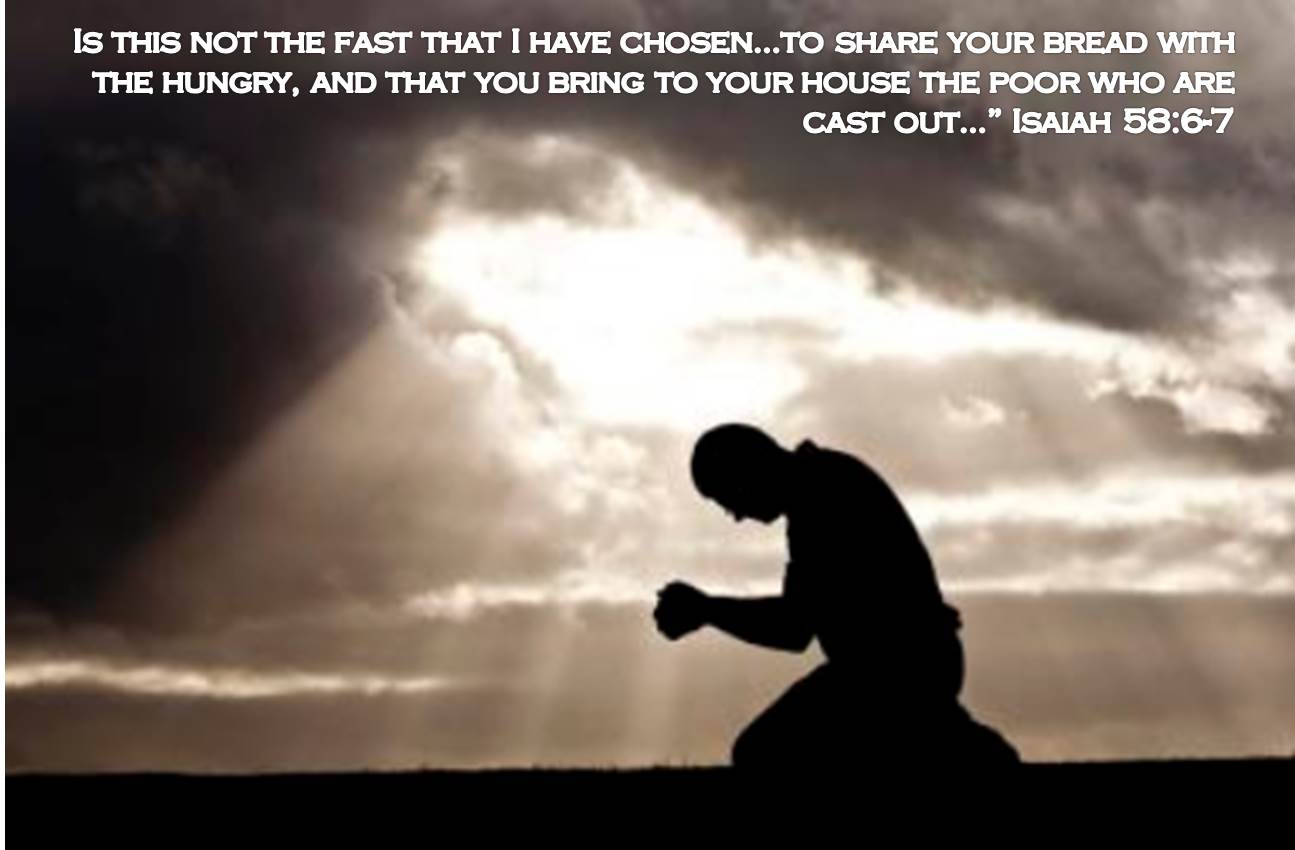
fasting and praying on knees

“Is this not the fast that I have chosen: to loose the bonds of wickedness, to undo the heavy burdens, to let the oppressed go free, and that you break every yoke? Is it not to share your bread with the hungry, and that you bring to your house the poor who are cast out; when you see the naked, that you cover them…”  Isaiah 58:6-7

In Isaiah 58, YHVH tells His people Israel that they are not to be hypocrites when they fast, going through the motions with their head and body but not their heart (Isa 58:3-5, Jer 14:12, etc.). In Isaiah 58:6, He is talking about repenting for exploiting their workers. He tells them to turn back to Him and make a genuine change in their lives, showing compassion to others. In verse 7, Yehovah gets more specific when He describes the nature of a truly sincere fast, which would cause the people to exhibit the fruit of the Spirit in their actions, such as taking care of the poor and hungry, and clothing the naked.

To me, this is one of the most beautiful passages in all of Scripture, as YHVH is pointing out to His people how they have fallen short (as we all have in our lives), telling them they need to repent, guiding them (and us) as to what they should be doing, and then promising them wonderful blessings if they will follow His instructions (Isa 58:8-11).

Many Scriptures talk about the positive results of fasting sincerely from your heart:

  • In Joel 2:12, YHVH tells the people to turn to Him with their whole heart, with fasting and weeping; He goes on to say that they are to rend their heart and not their garments, and then Joel says that YHVH is gracious and merciful and will bless them for turning back to Him (Joel 2:13-14). This is similar to what He says through Jeremiah when He tells His people to circumcise their hearts and turn back to Him (also see Deut 10:16 and 30:6).
  • Yeshua adds meaning to these words when He tells people that they need to fast inwardly (in secret) and not outwardly (walking around in sackcloth and showing everyone how they are being so righteous with their fasting). As in Isaiah and other Scriptures, He also says that Abba Father will reward them openly when they fast secretly (Matt 6:16-18).
  • When King Darius had to throw Daniel into the lion’s den because he had broken the decree that no one was to worship a different god than the official god of their kingdom, Darius stayed up all night fasting. When he came down to check on Daniel in the morning, he found him alive and well. What really fascinates me about Darius is that he called Daniel the “servant of the living God” even before he knew that he had been saved from the lions (Daniel 6:18-23). This tells me that Darius was sincerely fasting from his heart and that he was praying to the true living God and not one of his false gods. It is also apparent from this passage that Darius was moved with compassion, which inspired his fasting.

What do these Scriptures teach us about our heart attitude when we are fasting and praying? If we are fasting because we think it makes us a better Christian, or we think it’s the right thing to do to get God to answer our prayers, or we are simply following Abba’s instructions to fast but our heart is not in it, what are we accomplishing? We are only fasting outwardly to convince others (or ourselves) that we are righteous people who are following God’s will. We need to look into our hearts and find out what our true motives are when we fast or pray.

Are we truly seeking to draw closer to YHVH and to be pleasing to Him? If that is true, then the fruit of the Spirit should be evident in our lives, starting with our love and compassion for others.

Look again at Isaiah 58 and ask these questions of yourself: are you helping to undo the heavy burdens of others; are you sharing your bread with the hungry and bringing to your house the poor who are cast out; are you clothing the naked and taking care of the widows and fatherless? If you are, then Yehovah will reward you openly: your light shall break forth like the morning, your healing shall spring forth speedily…Then you shall call, and YHVH will answer; you shall cry, and He will say, ‘Here I am.’ Isaiah 58:6-9