Tag Archives: Yehovah

Jesus is LORD [Yeshua is Yehovah]

Yeshua is YehovahSo that at the name of Jesus every knee will bow, of those who are in heaven and on earth and under the earth, and that every tongue will confess that Jesus Christ [Yeshua the Messiah] is Lord [YHVH], to the glory of God the Father. Phil 2:10-11

In previous postings on the Name of the sovereign God of the universe, YHVH [Yehovah], I talked about the importance of knowing and speaking His Name, as well as the sad history of the silencing of God’s Name for the past 2300 years. If you recall from those blogs, after the return from exile in Babylon, priests of the Second Temple era decided that God’s name was too holy to pronounce, and they banned the speaking of the Name among the common Jewish people (the priests still knew how to pronounce the Name).

In this blog, I continue this history up into the New Testament period and show how there was even further obfuscation of the Name leading up to the time of Yeshua’s first coming. The first translation of the Old Testament [Tanach] into Greek was the Septuagint, which was completed in 132 BCE. By this time, it was well established that the Name of YHVH was not to be written in any texts (even within Greco-Roman writings). Since the Jews had already been substituting Adonai (Lord) for YHVH, the Septuagint scribes continued the same tradition. When more modern English translators strove to come up with translations that were more faithful to the original Hebrew Tanach Scriptures, they reverted the references to God’s Name (as opposed to His holy title of Lord) back to “LORD”, leaving the other references as “Lord”. Thus, we have a clear way to distinguish God’s Name (YHVH) from his title (Lord) in the Old Testament Scriptures.

When the translators of the Greek New Testament translated the Greek into Latin and modern languages such as English, though, they could not distinguish between the references to the Name YHVH and Lord (as a title). Both words are written as Kurios in Greek. What we have in the New Testament, then, are many verses that are ambiguous as to which meaning is being expressed, God’s Name or His title. I want to focus here on the places in the New Testament where Yeshua is referred to as Lord. Many times this truly is a holy title given to our Messiah and Savior. However, there are quite a few places where Yeshua is being addressed by the Name of God Almighty, YHVH [Yehovah].

Some of the most obvious references to Yeshua as YHVH are quotes or paraphrases of Old Testament verses. The most vivid example of this is the Scripture quoted at the top of this blog, Philippians 2:10-11. Just before this passage (vv. 6-8), the author is saying that Yeshua did not take advantage of the fact that He was in His very nature part of the Godhead, but lowered Himself to be born as a human and then of His own will gave up His life to die on a cross. Then in Verse 9, Sha’ul says that Abba Father gave Him the Name that is above every name. Believers in Yeshua, having the English translations available to them for the New Testament, have always assumed that this Name above all names is Jesus [Yeshua]. However, remember that Yeshua was the name given to the Son of God when He was born on Earth as a human – this name represents His mission, since Yeshua means salvation or deliverance.

Here are a few other verses where it speaks of Yeshua as Lord (which should have been translated as LORD [YHVH]:

  • Rom 10:9-10: ..if you confess with your mouth that Jesus is Lord [YHVH] and believe in your heart that God raised him from the dead, you will be saved. For with the heart one believes and is justified, and with the mouth one confesses and is saved.
  • I Cor 12:3: and no one can say “Jesus is Lord [YHVH]” except in the Holy Spirit.
  • Matt 23:39: [Yeshua said to the people on “Palm Sunday”] – for I say to you, you shall see Me no more till you say, ‘Blessed is He who comes in the name of the Lord [YHVH]!’

Some of these verses include quotes or paraphrases from the Old Testament:

  • Phil 2:10-11 was patterned after Isa 45:3: That to Me every knee shall bow, every tongue shall confess. They shall say, ‘Surely in the Lord [YHVH] I have righteousness and strength.
  • Matt 23:39 was a direct quote from Psalm 118:26 (with LORD in all caps): Blessed is He who comes in the name of the Lord [YHVH]!

You’re probably asking yourself at this stage – so what is the point of all this? Here’s the bottom line – Jesus [Yeshua] was the Messiah’s name when He was on the Earth fulfilling prophecy as our Savior, but His eternal name is the same as the Father’s – YHVH or Yehovah! He is one of the three persons of the Godhead. He existed from the beginning and was there directing the Creation of the universe along with Abba and the Holy Spirit (John 1:3). To know Yehovah the Father is to know Yehovah the Son and Yehovah the Ruach HaKodesh – they are one [echad] in Spirit but different in character and roles.

[We usually address people by using formal titles (Mr, Mrs, Doctor, and so forth) when we don’t know them well, of if they are entitled to a higher level of respect. Only when we have established some degree of intimacy, do we begin calling people by their given names.] For example, if we are Yeshua’s servants, we would call Him Master; but we are His friends so we call Him by His name, Yehovah. If you want to draw even closer to our Creator, Redeemer, Miracle-Worker, and Lord, call on His Name and you will be able to speak to any or all of the holy and awesome persons of the Godhead who created and love us!

Follow the World or YHVH?

do not worship their godsIn this second blog of our series on Chanukah and the Maccabbees, we show the distinction between the people of Israel who were staying faithful to YHVH’s appointed times and commandments, and those who were following the pagan ways of the Greeks and Romans. In our previous blog (The Mighty Power of YHVH), we saw that Onias, the high priest of the Jews, stayed faithful to YHVH’s Laws, even when Simon, an Israelite from the tribe of Benjamin plotted with the king to confiscate money from the Temple treasury that was designated for widows and orphans. When the Israelites prayed fervently, YHVH showed great signs and thwarted the intentions of the pagan government to keep the Temple from being defiled.

In II Maccabees 4, Onias’ brother Jason betrayed Onias by telling lies about him and even claiming that he had plotted against the government. He then became the High Priest deceitfully by offering large sums of silver and gold to the king.  He even offered additional silver to build a gymnasium beneath the Temple, and convinced the people to use this pagan facility for nude games in the style of the Greeks. He encouraged the people to follow Greek customs that were contrary to the Law [Torah] and even the priests lost interest in Temple services and sacrifices and would rush off to participate in the games that were forbidden by the Law (II Maccabees 4:14). The people stopped keeping the Feasts and Sabbaths and kept Greek celebrations instead.

Jason was so corrupt that he sent men to the “games” in Tyre with a large amount of silver for a sacrifice to the pagan god Hercules (II Maccabees 4:18-19). Once the Jews moved into actively participating in the ways of the world instead of YHVH’s ways, things went downhill for them very quickly. As recounted in Maccabees 6, There was dissension and jealously among the priests and Jewish leaders, and they killed and bore false testimony to the king about each other, until finally the king decided to become more vindictive about having the Jews abandon their Feasts and Sabbaths, and he defiled the Temple by dedicating it to their chief god, Zeus.

Jason had started the downward spiral of the Jews into the abominations that were committed in the following months. The verse in II Maccabees 4:17 gives the reason for the serious judgments against the Jews that followed their disobedience: “It is a serious thing to disregard God’s Law”. Persecution increased greatly from this time forward, and the Greeks defiled the Temple by holding drinking parties and conducting their immoral sexual rituals with prostitutes there. The altar was filed with unclean animal sacrifices. King Antiochus then prohibited the Jews from keeping their Sabbaths and Feasts, and forced them to eat unclean meats that were sacrificed to the false gods. “Then, during the festival in honor of the wine god Dionysus, they were required to wear ivy wreaths on their heads and march in procession” (II Maccabees 6:7). From this time on, as described in II Maccabees 6:9, the Greek leaders “were told to put to death every Jew who refused to adopt the Greek way of life”.

When Onias was high priest, the people kept the Torah. However, our suspicion is that they were more into following the leaders than they were truly seeking YHVH and His ways. When Jason unjustly replaced Onias, many of the Jews were all too ready to follow him into every type of evil and apostasy. When we look at our modern times, we see that most people (Christian, Messianic or otherwise) tend to follow the ways and customs of the world’s culture, rather than seeking to follow God’s ways and keep His appointed times.

Many today do not realize that they are fighting a battle. Even those who do often fail to recognize that the battle is spiritual. Many followers of Yeshua do not understand the spiritual realm and do not operate in the spirit. However, there is no excuse for ignorance since we have ready access to many versions of Scripture and study tools. We also have the Holy Spirit to guide us.   We must not blindly follow human leaders, but must realize that we as individuals are accountable to YHVH for our choices.

The most glaring examples of this relate to the holidays of Christmas and Easter. Our ancestors celebrated these holidays and many continue to follow suit. When we look at the ancient pagan celebrations, the birth of their chief gods was always celebrated on December 25th. These gods include Zeus/Jupiter, Dionysus/Bacchus, Hercules, Tammuz, Apollo, Mithras, Sol Invictus and others. Birthday celebrations for these pagan gods date back to the time of Nimrod, who was alleged to be Tammuz’ father. Note that Zeus, Dionysus, and Hercules were all being worshiped by the Greeks, and then were adopted by the Jews as part of their apostasy. YHVH established seven feasts to point to the work of His Son. We sin against YHVH when we seek to “honor” Him by celebrating holidays that have always been an abomination to Him. Many try to justify celebrating Yeshua during these pagan holidays, but to mix the pagan and the sacred is an even worse abomination to YHVH. We must not yield to the predominating culture any more than the Jews should have yielded to the predominating Greek culture of their day.

We know that HaSatan attracts followers by counterfeiting the true God. From pagan beliefs, we see a counterfeit parallel between the Greek god Dionysus (Roman god Bacchus) and Yeshua. Dionysus was purported to have been born of a virgin (Ishtar/Isis), son of the heavenly father (Zeus), performed miracles such as turning water into wine (he is the god of wine), died and was raised again on the 3rd day (on March 25th), was identified with the lamb, and given titles such as: “only begotten son“, “king of kings”, “god of gods”, “sin bearer”, “redeemer“,  “anointed one” and “the alpha and omega“.

We do not have space for full discussion here, but many of the other rituals and symbols of Christmas and Easter (whose name comes from Ishtar) originated from pagan rituals and symbols. The wreath comes from the wreath worn at pagan sports celebrations, the tree comes from a pagan ceremony at the time of Nimrod, which claimed that the resurrected Nimrod returned each year to leave gifts under a decorated tree. Read Jeremiah 10 if you want to find out what YHVH says about cutting down and decorating trees for pagan celebrations, and Jeremiah 44:17-19 to read God’s admonition against worshiping the Queen of Heaven (Ishtar in pagan lore).

Armed with this knowledge, how does this affect your view of the main Christian holidays, and more importantly, what does it say to your heart about keeping YHVH’s Feasts and Sabbaths and not the festival celebrations of the world? As we read the story of the Maccabees, it is easy to condemn the Jews who strayed from Yehovah’s commands. Are we guilty of the same thing?

”You shall not worship the LORD your God in that way, for every abominable thing that the LORD [YHVH] hates they have done for their gods…” (Deut 12:31).

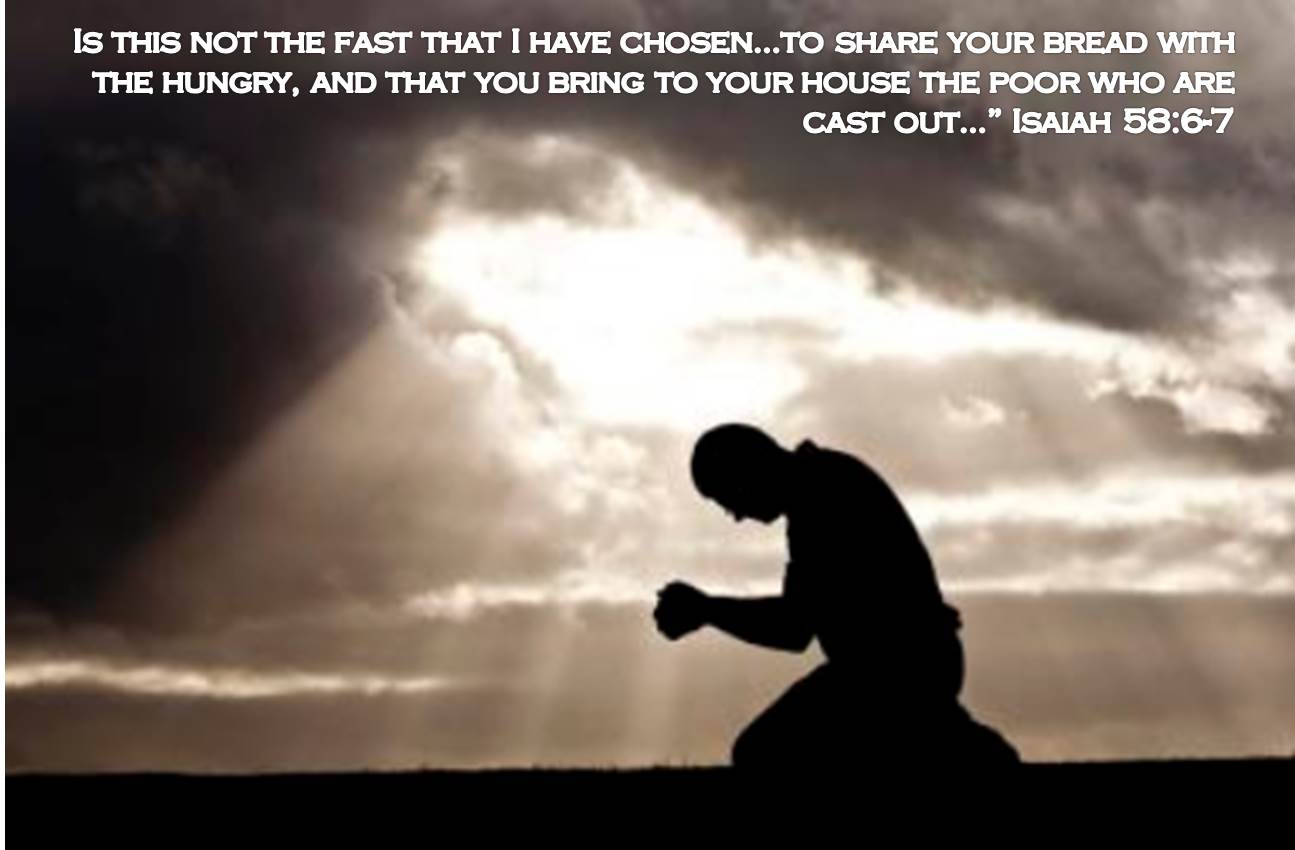
Fasting from Your Heart

fasting and praying on knees

“Is this not the fast that I have chosen: to loose the bonds of wickedness, to undo the heavy burdens, to let the oppressed go free, and that you break every yoke? Is it not to share your bread with the hungry, and that you bring to your house the poor who are cast out; when you see the naked, that you cover them…”  Isaiah 58:6-7

In Isaiah 58, YHVH tells His people Israel that they are not to be hypocrites when they fast, going through the motions with their head and body but not their heart (Isa 58:3-5, Jer 14:12, etc.). In Isaiah 58:6, He is talking about repenting for exploiting their workers. He tells them to turn back to Him and make a genuine change in their lives, showing compassion to others. In verse 7, Yehovah gets more specific when He describes the nature of a truly sincere fast, which would cause the people to exhibit the fruit of the Spirit in their actions, such as taking care of the poor and hungry, and clothing the naked.

To me, this is one of the most beautiful passages in all of Scripture, as YHVH is pointing out to His people how they have fallen short (as we all have in our lives), telling them they need to repent, guiding them (and us) as to what they should be doing, and then promising them wonderful blessings if they will follow His instructions (Isa 58:8-11).

Many Scriptures talk about the positive results of fasting sincerely from your heart:

  • In Joel 2:12, YHVH tells the people to turn to Him with their whole heart, with fasting and weeping; He goes on to say that they are to rend their heart and not their garments, and then Joel says that YHVH is gracious and merciful and will bless them for turning back to Him (Joel 2:13-14). This is similar to what He says through Jeremiah when He tells His people to circumcise their hearts and turn back to Him (also see Deut 10:16 and 30:6).
  • Yeshua adds meaning to these words when He tells people that they need to fast inwardly (in secret) and not outwardly (walking around in sackcloth and showing everyone how they are being so righteous with their fasting). As in Isaiah and other Scriptures, He also says that Abba Father will reward them openly when they fast secretly (Matt 6:16-18).
  • When King Darius had to throw Daniel into the lion’s den because he had broken the decree that no one was to worship a different god than the official god of their kingdom, Darius stayed up all night fasting. When he came down to check on Daniel in the morning, he found him alive and well. What really fascinates me about Darius is that he called Daniel the “servant of the living God” even before he knew that he had been saved from the lions (Daniel 6:18-23). This tells me that Darius was sincerely fasting from his heart and that he was praying to the true living God and not one of his false gods. It is also apparent from this passage that Darius was moved with compassion, which inspired his fasting.

What do these Scriptures teach us about our heart attitude when we are fasting and praying? If we are fasting because we think it makes us a better Christian, or we think it’s the right thing to do to get God to answer our prayers, or we are simply following Abba’s instructions to fast but our heart is not in it, what are we accomplishing? We are only fasting outwardly to convince others (or ourselves) that we are righteous people who are following God’s will. We need to look into our hearts and find out what our true motives are when we fast or pray.

Are we truly seeking to draw closer to YHVH and to be pleasing to Him? If that is true, then the fruit of the Spirit should be evident in our lives, starting with our love and compassion for others.

Look again at Isaiah 58 and ask these questions of yourself: are you helping to undo the heavy burdens of others; are you sharing your bread with the hungry and bringing to your house the poor who are cast out; are you clothing the naked and taking care of the widows and fatherless? If you are, then Yehovah will reward you openly: your light shall break forth like the morning, your healing shall spring forth speedily…Then you shall call, and YHVH will answer; you shall cry, and He will say, ‘Here I am.’ Isaiah 58:6-9

They Shall Know that I Am Yehovah

they shall know that I am YHVH

So I will make My holy name known in the midst of My people Israel, and I will not let them profane My holy name anymore. Then the nations shall know that I am YHVH, the Holy One of Israel.” Eze 39:7

In my previous postings on the Name of the Creator and sovereign God of the universe, Yehovah, I talked about the importance of knowing and speaking His Name, as well as the sad history of the silencing of God’s Name for the past 2300 years (see There is Power in the Name). If you recall from that blog, after the return from exile in Babylon, priests of the Second Temple era decided that God’s name was too holy to pronounce, and they banned the speaking of the Name among the Jewish population in general and even within the Temple. In this blog, I wanted to present some encouraging words to believers who feel discouraged and helpless, knowing that the Name of Yehovah is known by so few of God’s people, and even a smaller number of people across the Globe.

We know from Scripture that Yehovah wants His name to be known throughout the Earth, by Jews and non-Jews alike (see Ps 91:14, Isa 52:6, Jer 16:21, Eze 12:15; 22:16; 30:26; 36:23; 39:7; Amos 5:8, John 17:6). We also see clearly in Scripture that YHVH wants everyone to speak His name (Gen 12:8; 26:25, Isa 44:5; 54:5, Jer 10:25). While it is true that most people on earth (believers and non-believers alike) do not know what to call YHVH, we have heard recently about how Yehovah is starting to reveal His name to His people in diverse places. We have experienced this especially among non-Jews who are keeping the Biblical feasts and celebrating YHVH’s Sabbaths.

I recently saw a very interesting example of the unveiling of YHVH’s name in a newsletter that comes out Israel on a daily basis. It is called Jerusalem365 and each article is a combination of a Scripture verse (in English, Hebrew, and transliterated Hebrew), and a photo and story of something happening in Jerusalem that relates to the verse (you can subscribe to the newsletter at the Israel365 site: Israel365 Subscribe). The photographers and authors of the articles are all Israeli Jews, many of whom have made aliyah to Israel (meaning they have emigrated there from other countries).

Here’s the thing that fascinated me about some of their articles: whenever the verse contained YHVH’s Name (“The LORD” in English translations), the Hebrew lettering included the vowels and spelled out YHVH so that it would be pronounced as Yehovah. To be more accurate, YHVH was actually spelled out two different ways in various articles: sometimes it was spelled out exactly as Yehovah, and other times they used a common technique of obscuring the exact Name of God (they reversed the first and last letters).

          Here are the two different forms of YHVH [Yehovah] written in Hebrew:The Name There are several amazing things about the Hebrew Name of God being spelled out fully in these articles:

  1. Because of the ban on speaking or writing the fully pronounceable Name of God, Jewish people would be required to spell God’s Name as HaShem (simply “The Name”), Adonai (Lord as a title for God), or one of the abbreviations used for YHVH in the Torah and other ancient Jewish writings.
  2. When the Hebrew was transliterated into English, it was written as Adonai, which would be acceptable to Rabbis and Orthodox Jews.
  3. The Name in the English text is written as “The LORD”, which is the standard translation found in most English Bibles.

The key point here is that God’s true Name, which Jews refer to as the unpronounceable Name of God, is being revealed to individuals in Israel, and is now being communicated out to thousands of people around the world. While it is true that most Christians and many non-Orthodox Jews would not be able to read the Hebrew or understand the significance if they could read it, YHVH is nevertheless revealing His Name to Israel and the Nations as He said He would (Eze 39:7).

In the greatest prayer that Yeshua prayed, He first said that He had glorified the Father by finishing the work that Abba had given Him to do. (John 17:4) And what work had He completed? In Verse 6, Yeshua says that He made YHVH’s Name known to the disciples that Abba gave Him “out of the world”. From this verse we can see that one of Yeshua’s primary missions was to make known the person, character and true Name of YHVH, so that He could glorify God the Father on earth. [Remember that even in Yeshua’s time there was a ban on speaking the Name of God]. Verse 5 says that after Yeshua’s work was done on Earth, then Abba would glorify His Son by bringing Him back to heaven to be with Him again.

So what does all this mean to us as followers of the Way? If Yeshua made Abba Father known to us by revealing His true Name, then I do not want to waste Yeshua’s hard-earned fruit produced while He was here on the Earth. I hope you will also want to know YHVH’s true Name and that you will want to speak it in your praise and prayers to AbbaYehovah wants His name to be known, spoken, praised, feared, and glorified throughout the Earth!

Stand Firm in Love (Part 2)

Let all you do be done with love

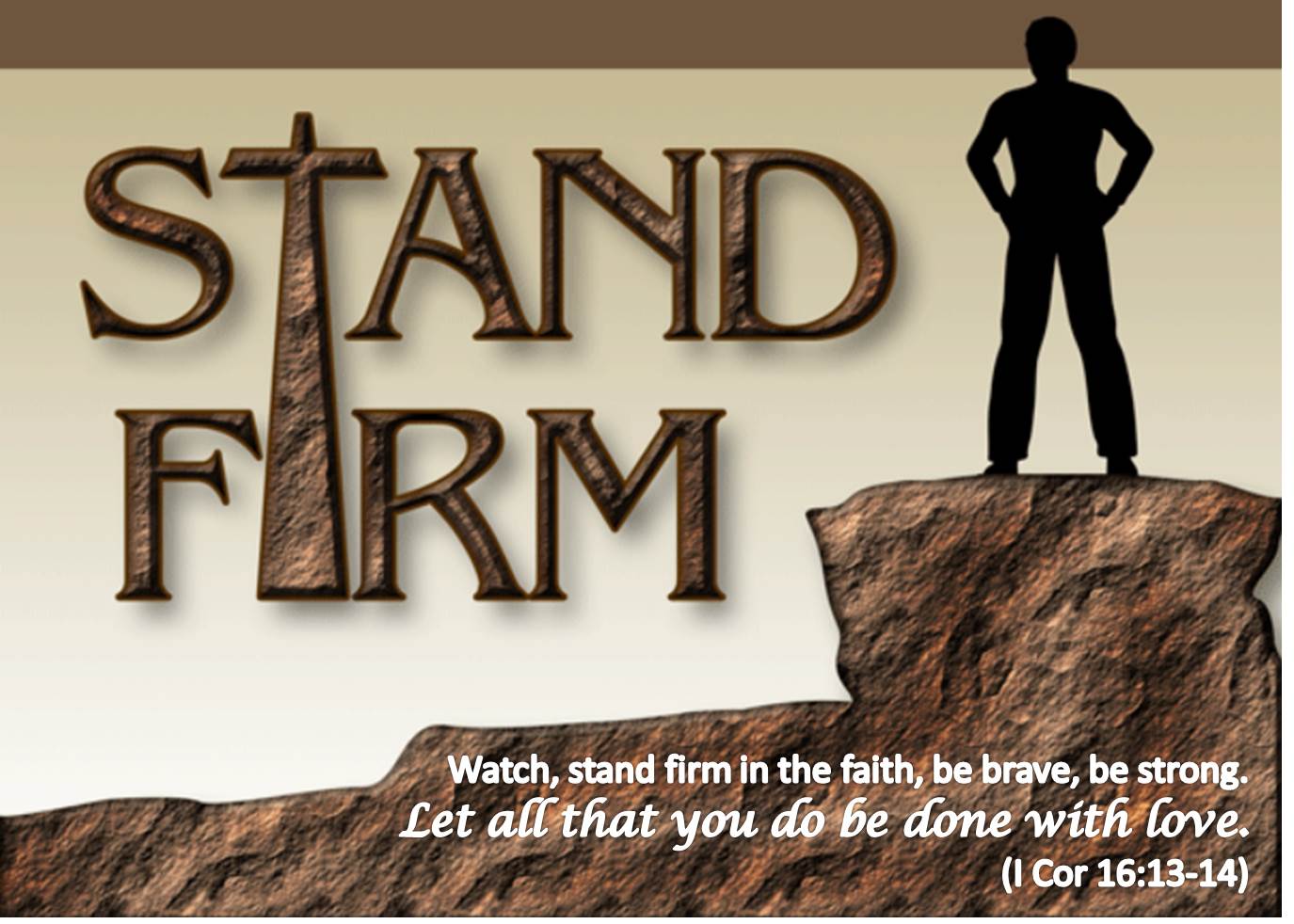
“Watch, stand fast in the faith, be brave, be strong. Let all that you do be done with love.” I Corinthians 16:13-14

Last week, I focused on Verse 13 above as I spoke about holding fast to our convictions when we know they are clear instructions from YHVH’s word. In Part 2 this week I will focus on the second part of this passage above, which says that everything we do should be done in love. From I Corinthians 13 Verse 2 we know that even if we are working miracles through Holy Spirit gifts and have greater faith than the Apostles, “so that we could remove mountains, but have not love, we are nothing”.

The same adage goes for mentoring and discipling other believers – if we are not “speaking the truth in love” (Eph 4:15), then we are better off not speaking at all. Whenever the Holy Spirit puts on our heart that we are to speak with someone, our words need to be spoken “with grace, seasoned with salt, that we may know how we ought to answer each one” (Col 4:6).

When we put this together with Verse 13 above, it means that we are to stand firm in our convictions and not be swayed by the world’s compromise with YHVH’s word, but when we do speak out we need to be sensitive to the beliefs and feelings of others. Does this sensitivity to their beliefs mean that we are to be silent and avoid delicate topics like homosexuality? No, most certainly not! If we were silent, then we would no longer be watchman for YHVH’s Word to others in the world.

So how do we keep the delicate balance between offending people (even friends and family) and speaking the truth in love? Actually, we cannot avoid offending people when we speak God’s truth.  Didn’t Yeshua say:”And blessed is the one who is not offended because of Me” (Matt 11:6), and then: “…you will be hated by all for My name’s sake” (Luke 21:17). Many people were offended by Yeshua’s words, and He told His disciples (including us) that we would be hated when we speak His words and His name.

I believe we need to state the Godly convictions we stand on and why we are so passionate about them. This way, the person will not think we are judging them, and we will not so easily repel them with our strong words. We need to come from the perspective that we love God and want to follow His instructions because He first loved us, and because He made the most incredible sacrifice of all time for us. He hung on a tree for us when we were still sinners and didn’t deserve His love or His sacrifice.

It is only God’s amazing love that will draw people to Him. Until people understand the depth of Yehovah’s love and concern for them as individuals, and that He wants to have a personal relationship with them, there is no hope that they will listen to more serious matters. Once they reach this understanding in their heart, then you can gently start speaking to them about obedience and being pleasing to God in the way they live their lives.

Unless we speak to people out of love, we are like clanging symbols: “If I speak in the tongues of men and of angels, but have not love, I am a noisy gong or a clanging cymbal. And if I have prophetic powers, and understand all mysteries and all knowledge, and if I have all faith, so as to remove mountains, but have not love, I am nothing.” (I Cor 13:1-2) When we share the truth with others, we must season our words with grace so that we allow Abba Father to draw them to Yeshua and the Holy Spirit to convict them in their sinful lifestyle. Then the door is open for us to disciple them and pray with them so that they want change their lifestyle so that they can be pleasing to Yehovah.

We need to look at our heart motives behind our words. When we approach people about their lifestyle or behavior, do we come to them with an air of superiority or self-righteousness, or do we come to them with humility, speaking the truth to them out of love?

Will the True Messiah Please Stand Up?

Gemini

Many passages in scripture talk about the dual nature of Messiah Yeshua, that He is both God and man. So how do we know that Yeshua the Messiah is both divine (YHVH Elohim) and human? Scripture makes very clear this dual nature of Yeshua, and we know that we can believe the testimony of Scripture because all Scripture is inspired by God and is true and good for doctrine, teaching, etc. (2 Tim 3:16).

Galatians 4:4 shows the humanity of Yeshua: “…God sent forth His Son, born of a woman, born under the Torah..”. Luke 1:35 provides clear evidence of the divine nature of Yeshua – the angel said to Miriam: “…The Holy Spirit will come upon you, and the power of the Most High will overshadow you; therefore, also, that Holy One who is to be born will be called the Son of God.”

God did not just manifest Himself in flesh as a human being, but rather “The Word became flesh and dwelt among us, and we beheld His glory, the glory as of the only begotten of the Father..” (John 1:14) God the Father took Yeshua who was already His Son from the beginning, and made Him to be born through a human woman by the power of the Holy Spirit. So why did Messiah need to be fully human as well as fully divine? Because we had to have a High Priest [our Messiah Yeshua] who could understand our weaknesses – One who had been tempted in all things just as we are, yet without sin. (from Heb 4:15) Even more specifically, Hebrews 2:17 says: “Therefore, it was necessary for him to be made in every respect like us, his brothers and sisters, so that he could be our merciful and faithful High Priest before God. Then he could offer a sacrifice that would take away the sins of all people. Scripture confirms this in Philippians 2:7-8, where it says that Yeshua took on the “form of a bondservant, and [came] in the likeness of a human being. And being found in appearance as a man, He humbled Himself and became obedient to the point of death, even the death of the cross.”

We can see clearly from these scriptures that Yeshua could not have taken away our sins unless He was both fully human (so He could identify with us in our human weakness) and fully divine (so that He had the power of the Holy Spirit to defeat the enemy, HaSatan). It is true that we now have the power of the Holy Spirit within us, when we have been baptized into that power. However, Yeshua has a special relationship with the Holy Spirit and Abba Father, in that He is One (Echad) with them as persons of the triune God, Yehovah Elohim.

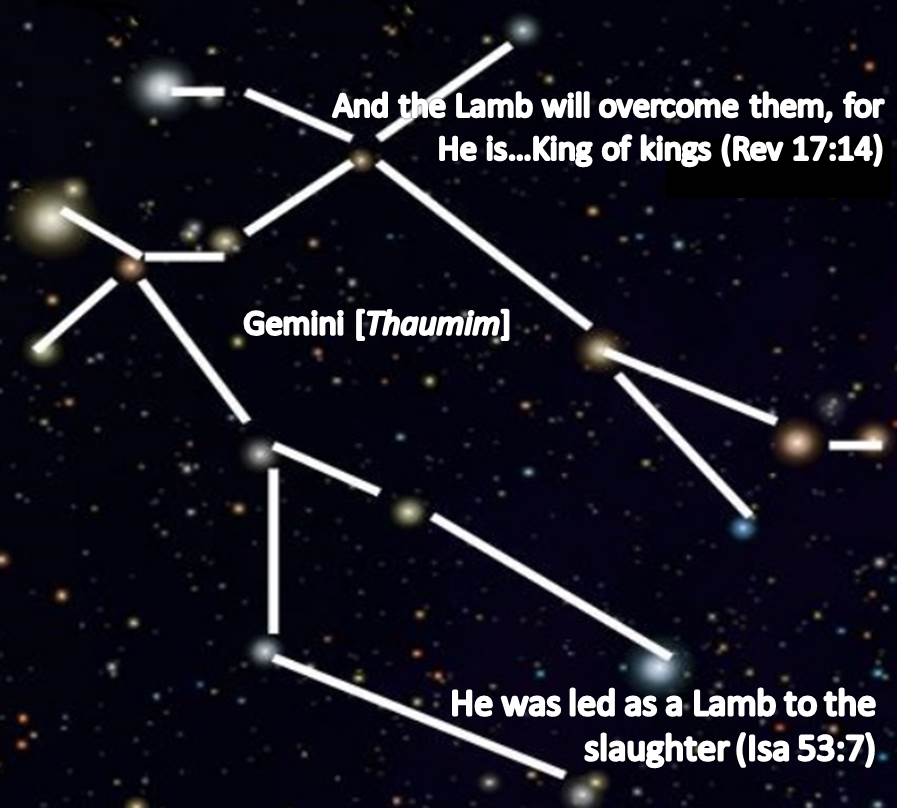
To put this into a context that might be easier for us mortal beings to understand, YHVH has painted the entire Gospel message into His star-pictures in the sky. We have looked at some of these in depth in previous blogs, but here I just want to give you a brief snapshot of one of them to help clarify Yeshua’s duality as God and man. Most people have heard of Gemini as one of the 12 signs of the Zodiac. However, as with the others, its meaning has been corrupted over the ages through pagan mythology and astrology. The original Hebrew name for this sign was Thaumim, which means united, or twinned, as in Exodus 26:24.

In most of the myths about Gemini, twin brothers are represented; they are sometimes seen as heads of armies or great pirates on the seas (sons of Jupiter), which is why they were looked on as “patron saints” of marine navigation. The ancient star-names paint a very different picture, though, of a single person with a twofold nature–God and Man. They tell the story of His twofold work of suffering and glory, and His twofold coming in humiliation and in triumph. Two of the 85 stars in this sign point this out very clearly; the star Apollo in the head of one means ruler or judge, while the star Hercules in the other’s head means “the One who comes to suffer”. The best translation of the Hebrew name of the sign (Thaumim) is “united into one”, in the same sense that Yeshua is one person of the Godhead, but has two distinct natures united together in His one essence.

There are not two separate persons, but rather two natures joined together in one Person, “God and man in one Messiah.” We can’t have one without the other – if we accept Yeshua as a man, suffering for our redemption, then we must also accept Him as our God (Yehovah), coming to judge all people and reign as King of kings for eternity. When we remember what Yeshua said to His disciples before He left the earth, it helps us understand what it means to be a part of His Kingdom: “If you love me, you will keep My commandments”. (John 14:15) In verse 21, He goes on to say: “If anyone loves Me, they will keep My word; and My Father will love them, and We will come to them and make Our home with them.”

This sounds like the greatest thing that could ever happen to us, that Abba Father and Yeshua His Son would come make their home with us! Do you want this? It means sacrifice and commitment for someone to keep His commandments (His word) day-by-day. As Yeshua promised, Abba sent the Ruach HaKodesh to help us every moment of our lives – do you think the Holy Spirit can also help you to stay faithful to Yehovah’s Word? Is it worth trying?

Invisible Treasure

keep pursuing the goalAs discussed in previous article, Yeshua paid a heavy price for His treasure. We are His pearls of great value. Yeshua is our Pearl of great value, a value far beyond what we can comprehend. Yeshua was once on this earth, but we can no longer see Him. However, He is real and still very much alive, even though to us He is invisible right now.

Let us examine Scripture to learn some of the aspects of Yeshua’s value. The following list is but a fragment of all that describes Messiah Yeshua, but it is plenty for us to contemplate. Yeshua is fully human, but He is also fully God (Matt 16:16; 1 Tim 3:16)). Our treasure is God Himself! Our Father refers to Yeshua as “My Beloved Son. (Matt 17:5).” In western thinking, we tend to view Yeshua as somewhat inferior to Father, but in Hebrew thinking the firstborn son is equal to his father. Colossians 1:15 refers to Yeshua as the first-born of every creature. Yeshua came to restore all creation.

 Our Redeemer is the Creator and Upholder of all things. (Col. 1:16; Heb.1:3). Yeshua refers to Himself as the Alef and the Tav (in Greek, the Alpha and Omega) (Rev. 1:8, 22:3). In ancient Hebrew, each letter was a picture. The alef is the first letter of the Hebrew alphabet and was a picture of a strong bull designating both a leader and a protector. The tav, which is the last letter of the alphabet, was a picture of a cross being carried. Yeshua, Who is first and strongest, made Himself to be last and weakest for our sake (John 1:29).

 Yeshua is eternal life (1 John 1:2; John 11:25). We all face death in our mortal bodies, but we have hope of eternal life in and through Yeshua. In our present life, we may have many trials and tribulations, but we can look forward with hope to a joyous and triumphant life in Messiah Yeshua for eternity.

 Everything we will ever need or desire is in Yeshua. He is our Shepherd (John 10:16). He is the true Vine and we, the branches, receive power and abundant life through Him (John 10:10; John 15:5). It is only with His lifeblood flowing through us that we are able to be fruitful in the Kingdom of God.

 Yeshua is our Provider (John 6:35) and with Him we will want for nothing. We need never fear for Yeshua is also our Rock (Ps. 19:14; 1 Cor 10:4); and our Refuge in all the storms that threaten us (Isa 25:4). Yeshua is our wisdom, righteousness, holiness and redemption (1 Cor 1:30).

 Many people mistakenly believe that there are many ways to God. Yeshua has revealed to us that no one comes to the Father except through Him (John 14:6). Even if it were possible to find another way to the Father, why would we desire anyone or anything else? Yeshua is everything to us (Col 3:11). Therefore, it is our joy and privilege to die to ourselves, so that we may have life in Him. If we are willing to give up all that we have, we will be abundantly compensated (Mark 10:29-30). Our Pearl is priceless indeed!

Fear and Glorify His Name

great is your mercy toward me

In my previous postings about God’s name, I talked about the many scripture passages relating to speaking, fearing, and trusting in YHVH’s name [Yehovah]. YHVH goes beyond just saying that we are honoring and pleasing Him when we do these things. YHVH also pours out His blessings on us when we fear, glorify, praise, and trust in His name.

The banner verse for this posting from Psalm 86:12-13 states “…I will glorify Your name forevermore. For great is your mercy toward me, and You have delivered my soul from the depths of sheol.” David knew he deserved to be cast off forever and doomed to hell for his sin against Uriah. The prophet Nathan assured David that YHVH had taken away his sin and delivered him from hell. David knew that God’s mercy towards him was awesome and unconditional. In the verse before this (Psalm 86:11), David says “I will walk in Your truth; unite my heart to fear Your name.” And then in verse 12 he says: “I will glorify Your name forevermore.” Clearly David understood the importance of fearing and glorifying YHVH’s name.

In Isaiah 52:6, YHVH says: “Therefore My people shall know My name; therefore they shall know in that day that I am He who speaks: ‘Behold, it is I’” (Isa 52:6). The word translated as “behold, it is I” is hineni in Hebrew, which is what Isaiah answered to YHVH when He first called him to be a prophet (Isa 6:8): “Here I am [hineni], send me.” This is a very powerful promise to people who know His name (Yehovah), that He will be right there for them – it essentially means “Here I am, waiting for you.”

One of the greatest blessings King David ever spoke over his people was in 2 Sam 6:18 – “And when David had finished offering burnt offerings and peace offerings, he blessed the people in the name of the LORD of hosts [Yehovah Tzava’ot].” You are truly blessed when someone blesses you in the name of YHVH. Numbers 6:27 confirms this truth. Immediately following the Aaronic blessing YHVH says: “So they shall put My name [Yehovah] on the children of Israel, and I will bless them.” (Num 6:27)

Although all of YHVH’s promises are powerful to meditate on, the passage in Malachi 3:16 is especially meaningful to me, as Yehovah speaks directly about blessing His people because they are fearing and meditating on His name: “Then those who feared the LORD [Yehovah] spoke to one another, and the LORD listened and heard them; so a book of remembrance was written before Him for those who fear the LORD and who meditate on His name.”

YHVH provides the perfect follow-up to the verse above in the next chapter of Malachi: “But for you who fear my name, the Sun of Righteousness will rise with healing in His wings. And you will go free, leaping with joy like calves let out to pasture.” (Mal 4:2) From the study of Messianic prophecy, we learn that this verse points to the healing miracles Messiah Yeshua would perform when He came to earth the first time. The “wings” spoken of here are Kanaph in Hebrew, which literally means the fringes of the garment which all observant Jews wore. This prophecy was fulfilled in Matt 9:20, when the woman who had the flow of blood for 12 years came up behind Yeshua and touched the fringes of His garment.

This woman had faith in the scripture promise that she would be healed if she “feared His name” (trusted in Yehovah). It was her faith (trust) that healed her more than the physical act of touching the fringes of Yeshua’s garment. What about us? Will we trust in His name the way this woman did, laying our life on the altar and risking everything we have to follow Him? If so, Yehovah is faithful to keep His promises.

Is God Weak?

God's emotions

When we think of God’s nature or character, what comes to mind? We certainly think of His supernatural qualities (omnipotent, omniscient, omnipresent), since they are astonishing to us as mortal humans.  Next we might think of His qualities in interacting with His creation, such as His love, compassion, mercy, kindness, and forgiveness. These qualities are not quite so amazing to us, since He wants us to learn to take these on personally as we grow closer to Him. The most awesome aspect of these qualities is their absolute perfection within our Creator (e.g. unconditional love).

There is a tendency to think that emotions attributed to YHVH are only mentioned in scripture to help people relate better to Yehovah. In other words, some scriptural commentators teach that the apparently human emotions ascribed to YHVH in His Word are meant to be merely anthropomorphic, as we wouldn’t understand Yehovah’s words and actions if we didn’t bring His character down to a human emotional level.

However, if the scriptures are inspired by the Holy Spirit of YHVH, then they would not lie to us or mislead us by wrongly ascribing contrived human emotions to the Creator and Redeemer of the universe! As we have said in other postings, Yehovah Elohim is all about relationship, both within the triune Godhead and between Himself and all of His human children on earth. So, wouldn’t He want us to know His emotions as well as His will, His heart, His intellect and other aspects of His character? Nancy and I believe that YHVH has powerful and awesome emotions which He exhibits all through His Word. It is apparent from even a simple perusal of the passages where He shows strong feelings that He has good reason for His emotions, and understanding those emotions helps us to know Him better and draw closer to Him.

We know that we are made in Yehovah’s image (Gen 1:27), so it makes perfect sense that our emotions are reflective of His emotions. The only difference is that we are subject to sin whereas He is sinless. For example, He gets angry but does not sin, unlike us. Yehovah is pleased with us sometimes (1 Kings 3:10), but at other times He can be angry with us (Deut 1:37); He is truly grieved at times, with His heart full of pain (Ps 78:40), but at other times He is full of joy (Jer 33:9). We even see YHVH laughing (Ps 2:4) and also weeping as illustrated passionately by Yeshua in John 11:35 and Luke 19:41.

Here are a few other key examples illustrating Yehovah’s emotions in scripture: He was “moved by pity” (Judges 2:18), had “compassion on His children” (Ps 103:13), “rejoices over them [His people] with singing” (Zeph 3:17), shows great anger – Isa 54:8 “In a surge of anger I hid my face from you for a moment..”, and even has regrets – “So the LORD was sorry He had ever made them and put them on the earth. It broke His heart” (Gen 6:6). We also know that Yeshua was fully human and fully divine (Heb 2:17; 4:15), representing YHVH on this earth (Immanuel, literally “God with us”). Being fully human means that Yeshua has a mind, will, heart and emotions just like any created human, except that He is without sin. Yeshua also said that if we have seen Him we have seen the Father, so Yeshua’s emotions cannot be attributed merely to His being human.

Recognizing that YHVH has emotions helps us understand YHVH better, and there is comfort in knowing that He identifies with every one of the emotions we feel, because they originated from Him and He feels every one of them just as we do (Heb 2:17).   When we search for evidences of Yehovah’s Kingdom being manifested here on earth as Yeshua prayed in Matthew 6:10, we need to look for YHVH-like qualities in people. We can certainly see people’s actions easily – but how do we see their heart motives underneath as YHVH sees them? One of the best ways is through the emotions they’re exhibiting. Are they God-like – kind, compassionate, patient, gracious, and caring more about others than themselves?

When I think of the best movies and books I’ve enjoyed over the years, I realize that they are the life stories of people who have struggled with various human issues and eventually overcome the sinful nature and frailties of character that we are all born into this fallen world with. So what touches us about these stories? Is it the great victories these people won, or the relationships that were healed, or the way they have (or God has) changed their lives for the better and overcome their sinful natures? It is all of these, but what really touches us (from my experience anyway) are the powerful, passionate emotions shown by these people as they are going through these life-changing experiences and transformations in their character and their relationships.

Yehovah is a God filled with emotions, and one of the best ways to get in touch with His emotions is to spend time with Him. When we praise and worship Him in Spirit and truth (John 4:24) we draw close to Him and learn to empathize with His emotions and His heart. This may result in physical manifestations like weeping or feeling an electrical current flowing through our body, or in a deeper spiritual connection with the Creator of the universe, lining up our emotions with His emotions and feeling what He is feeling.

Our Western society does not value or respect human emotions, and many people (like myself) grew up in families where it is considered wrong or weak to show emotions. I find it so comforting to know that my capacity to feel and show emotions comes from our Abba Father, who is God that expresses Himself through His emotions. Since we know that YHVH is not weak in any way, then the emotions we feel can no longer be seen as a human weakness but rather as a strength that allows to connect with our Creator in a deeper way.

The Real Meaning of Chanukkah

History of HanukahProbably the most well-known Jewish feast in the modern-day world is Chanukkah (more commonly spelled Hanukah). Chanukkah (1 Maccabees 2-4) is not one of the original feasts Yehovah instructed us to observe. It is a feast to commemorate a series of miracles God performed for the Jews in the dark days of Antiochus Epiphanes, so my belief is that Yehovah honors our celebration of this feast, as long as we stay focused on Him as the “reason for the season”.

Antiochus Epiphanes, theSyrian King of the Jews within the Greek empire, had forbidden all observance of the true Sabbath, YHVH’s Feasts, and circumcision (in I Macc 2:8-12). He mandated that anyone who studied or kept the Torah would be put to death. He also defiled the Temple and erected a statue of Zeus in the Temple on the 25th of the Hebrew month of Kislev, in 168 BC. In fact, all the ancient chief pagan gods had their birthday on Kislev 25 – note that the modern solar-based calendar was not adopted until 46 BC, so the Roman world was still using the lunar-based calendar at this time.

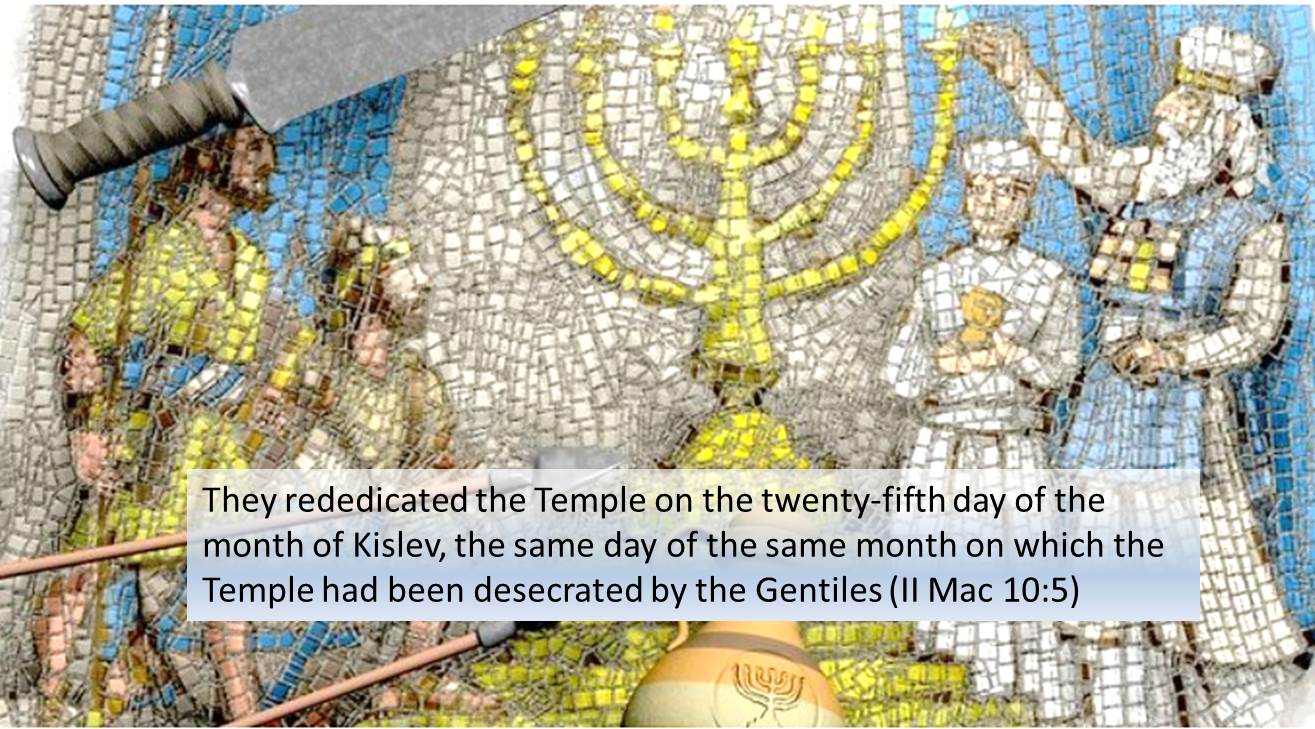
Judas Maccabeus and his four brothers (all Jewish priests) took up their swords and battle hammers to defeat the Syrian rulers and their pagan sun god religious system in 165 BC. Interestingly, Maccabee (iaB<q;j) means “hammer”, so one could rightly say that they “hammered” their enemy. Once they had defeated the Syrians and taken back their temple, the Maccabee brothers and their followers spent seven days cleansing the Temple of all the pagan altars and idols, and then re-dedicated the Temple on the eighth day. Once they had won this victory and purified their Temple, the leaders mandated that a feast called Chanukkah be observed every year starting on Kislev 25 and lasting for 8 days. The Hebrew word Chanukkah (חֲנֻכָּה) actually means “to dedicate”, so this feast is most often referred to as the Feast of Dedication. This feast celebrates the miracle of Yehovah giving them the victory over pagan sun god worship, as well as the cleansing and re-dedication of their temple to the true God, Yehovah.

There are many Jewish traditions and legends surrounding Chanukkah, such as the story of the oil in the Menorah lasting 8 days when it should have only lasted 1 day. However, the real reasons for the 8-day duration of the feast are two-fold: to commemorate Yehovah’s miracle that allowed them to defeat the Syrians and re-dedicate the Temple; and, to celebrate the Feast of Tabernacles (Sukkot) which they had not been able to do for 3 years (see II Maccabees 10:6).

One strong confirmation that Yehovah honors our celebration of Chanukkah is that Yeshua looked favorably on the feast, as He went up to the Jerusalem Temple mount and taught the people during the feast (John 10:22-23). Based on Jewish tradition, rabbis at the time of Yeshua believed that the Messiah would reveal Himself at the time of Channukah (from the Talmud). In John 10:24, the leaders asked Yeshua: “Why do You keep us in suspense? Are You the Messiah?” In John 9, Yeshua had just done the one miracle that was undeniable proof of His Messiah-ship; He had healed a man born blind, which the leaders said only the Messiah could do!

But because the people were expecting a political/military Messiah who would rescue them from the Romans, they did not recognize Him as the Messiah. Yeshua answered them (John 10:25-26) “I told you, but you did not believe: the works that I do in My Father’s Name, they bear witness of Me. But you do not believe, because you are not of My sheep, as I said to you”. The Jewish leaders denied His miracles in John 10:20-21: “And many of them said, ‘He has a demon, and is mad; why hear ye Him?’  Others said, ‘these are not the words of one who has a demon. Can a demon open the eyes of the blind?’”

Yeshua then presented people with an eternal solution to their problems. In John 10:27-28), He said: “My sheep hear my voice, and I know them, and they follow me: and I give unto them eternal life; and they shall never perish, neither shall any man pluck them out of my hand. He turned the people from the short-term, physical solution they wanted to a spiritual solution. He said that we are the desecrated temple and need to be cleansed and rededicated to Yehovah. Remember that we are now the temples of the Holy Spirit and we must keep our temples clean (I Cor 6:19). He taught us that we need a long-term (eternal) relationship with Yehovah to fix our spiritual emptiness, because a physical solution cannot fix spiritual problems.

The defeat of their enemies and the re-dedication of the Temple brought back fresh hope to the Jewish people. How fitting that this month, called Kislev in Hebrew, means hope. This relates to the people looking hopefully to the longer, brighter days of Spring, since Kislev 25 occurs very close to the Winter solstice (the shortest day of the year). Yeshua, the Light of the world, brings us eternal hope.