Tag Archives: Yehovah

Yeshua is the Door

the-door-of-the-sheep“Then Jesus said to them again, “Most assuredly, I say to you, I am the door of the sheep.John 10:7

In Yeshua’s “I am” statement about being the Door of the Sheep,  He teaches us that He is “the Door”, not just “a door”.  He is saying that He is not only our Shepherd who leads us into the sheepfold of the Kingdom, but He is the only door by which we can enter and be saved and find safe pasture (John 10:9).  There are deeper meanings for understanding Yeshua as our door into the Kingdom of God, so come with me now as we dig deeper into the Word to explore these meanings.

It is helpful to understand more about sheep and shepherding in general and specifically during Yeshua’s time.  Of all domesticated animals, sheep are the most helpless.  Sheep will spend their entire day grazing, wandering from place to place, never looking up. As a result, they often become lost. But sheep have no “homing instinct” as other animals do. They are totally incapable of finding their way to their sheepfold, even when it is in plain sight. By nature, sheep are followers. If the lead sheep steps off a cliff, the others are likely to follow.

Also, sheep are very susceptible to injuries and are utterly helpless against predators. If a wolf enters the pen, sheep won’t defend themselves or run away.  Sheep are totally dependent upon their shepherd for food, shelter, guidance and protection. So close is the bond between shepherd and sheep that to this day Middle Eastern shepherds can divide flocks that have mingled at a well or during the night simply by calling their sheep, who know and follow their shepherd’s voice. The shepherd leads the sheep to safe places to graze and makes them lie down for several hours in a shady place (think of the parallel to Psalm 23). Then at nightfall, the shepherd leads the sheep to the protection of a sheepfold.

In ancient times, there were two kinds of sheepfolds or pens. One kind was a public sheepfold found in villages. It would be large enough to hold several flocks of sheep. This sheep pen would be in the care of a “doorkeeper”, whose duty it was to guard the door to the sheep pen during the night and admit the shepherds in the morning. The shepherds would call their sheep, each of which knew their own shepherd’s voice, and he would lead them out to pasture (see John 10:4).

The second kind of sheep pen was in the countryside, where the shepherds would keep their flocks in good weather. This type of sheep pen was nothing more than a rough circle of rocks piled into a wall with a small open space to enter. Through it the shepherd would drive the sheep at nightfall. Since there was no gate to close—just an opening—the shepherd would keep the sheep in and wild animals out by lying across the opening. He would sleep there, in this case literally becoming the door to the sheep[fold].

Several ancient Hebrew word pictures point to Yeshua as the Door in a powerful way.  The ancient letter for door is dalet.  This meant the tent flap or door originally, but also the “path” or the “way of life”.  Devar in Hebrew means “word”. When we look at the ancient characters for Devar, though, the root meaning is “the Door of the Son”.  Since Yeshua is the living Word, Devar can also be interpreted as “The Word of YHVH”, as in the book of Deuteronomy [Devarim].  Psalm 19:14 says: “Let the words of my mouth and the meditations of my heart be acceptable in thy sight, YHVH, my rock and my redeemer”.  In Hebrew, a word for redeem is Padah and the word picture meaning is “redemption comes by the mouth of the door”. The ancient letters tell us that redemption is by the words of the door, and we know that door is Yeshua. Another significant word is the Hebrew word for Righteous, Tsedek, and the word picture tells us that  a person is righteous when their hook is the Door they follow (hook, or fishhook, refers to that which draws you – your passion or desire).

God’s name, Yehovah, is spelled yod-hey-vav-hey in Hebrew. The letter dalet is added to spell “Yehudah” [Judah], out of whose line Yeshua was descended. These 4 letters of the Name of God plus the letter dalet which means “door,” paint a different word picture:  His name tells us that Praise opens the Door to God“.  Since Yeshua is the Door, and He said everyone must enter through Him, this is a graphic picture of the pathway to YHVH – the key to the Door is praise!

Yeshua tells us that He is not only the shepherd of His sheep, but also the door of the sheep. In doing so, He is inviting us to be part of His sheepfold, where we will never have to fear or want for anything.  All we have to do is praise Him, and follow Him on His path, trusting Him with every part of our lives!
Yom Teruah helps us Remember and Rehearse

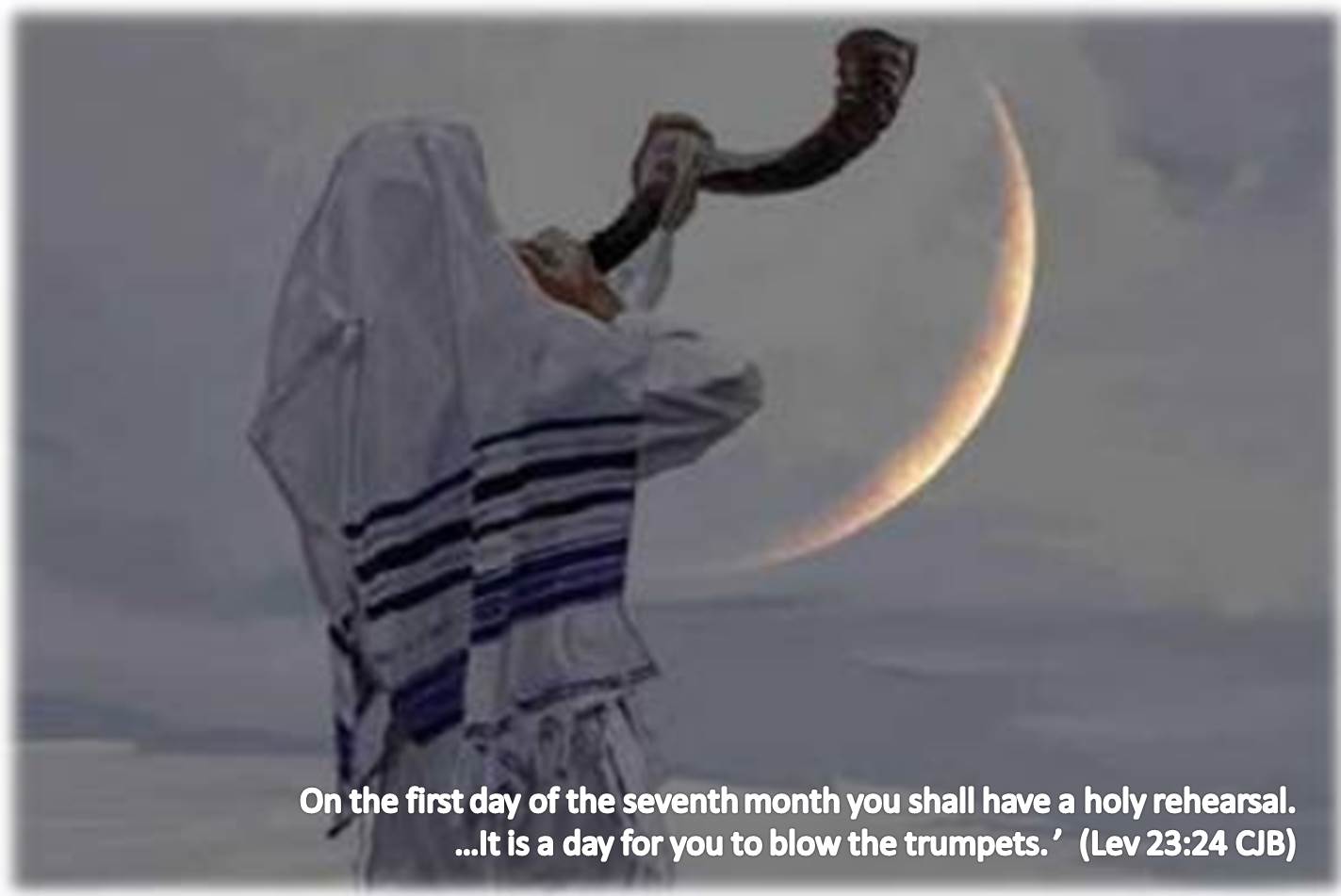
yom-teruahWhen we talk about YHVH’s feasts or festivals, we sometimes think of big celebrations with lots of festive foods along with family and friends.  Although some of YHVH’s feasts are meant to be joyous celebrations (such as Sukkot – the Feast of Tabernacles), others are meant to be more somber and introspective.  Yom Teruah (literally the “feast of the blowing of trumpets (shofarot)”) is a combination of both joyous and somber emotions.  In a previous blog (When Yeshua Returns), we have already dealt with the misconception that Yom Teruah is actually the Jewish new year, or what is called Rosh Hashanah (literally “the head of the year”).  Yom Teruah marks the beginning of the seventh month on God’s calendar, so by definition it cannot be the start of the year.

The Hebrew word used most often for YHVH’s feast days in the Scriptures is Mo’ed (feast) or Mo’edim (feasts plural).  However, this word is much better translated as “appointment” or more accurately “divine appointment”.  YHVH meant for these appointments to be holy (set-apart) times on His calendar to meet with Him.  They were also called “Holy Convocations”, which in the Hebrew is Miqra, meaning an “assembly” but also a “Dress Rehearsal”.

Whenever one of YHVH’s divine appointments arrives, we are supposed to look back and remember something that God has done for us in the past, but we are also supposed to look forward to what He will do in the future.  In His Mo’edim, God has essentially given us a “roadmap” of the most important events in human history.  Leviticus 23:24 describes Yom Teruah in this way: “In the seventh month, on the first day of the month, you shall have a sabbath-rest, a memorial of blowing of trumpets, a holy convocation (rehearsal)”.  Where it says “memorial” in this verse, another name is being used for the Feast of Trumpets – it is also called Zihk’ron Teruah which means a call for remembering through the loud blowing of trumpets.  So what are we remembering from the past and what are we rehearsing for the future?

By Jewish tradition and ancient calendars, it is believed that Yom Teruah commemorates the first day of Elohim’s Creation of the universe.  This fits with God’s biblical calendar.  When the Israelites were delivered out of Egypt, YHVH then said to them: This month shall be the beginning of months for you; it is to be the first month of the year to you” (Exodus 12:2).  This was of course the first day (new moon) of the Passover month (Aviv), which had been their seventh month but was now their first month by God’s instruction.  Thus we know that the seventh month (Ethanim) had been the first month on God’s calendar, which is the calendar He created for us at the time He created the world.  We can give thanks to Yehovah Elohim on Yom Teruah for creating the universe and us as His children.

As far as rehearsing the future on Yom Teruah, we need to look to the verses where the shofar blast is described as a warning or announcement of a future event.  There are a number of Scriptures where we see the shofar being blown as a call to repent and turn back (teshuvah) to YHVH, warning us of the God’s great judgment at the end times, in the “Day of the LORD”. (Joel 2:1, Zech 9:14, Rev 11:15)  In Matthew 24, Yeshua tells us of the great shofar blast when He comes in judgment and to gather His remnant together from the whole Earth: “And He will send out his angels with the mighty blast of a trumpet, and they will gather His chosen ones from all over the world—from the farthest ends of the earth and heaven”.

Abba, as we are celebrating your appointed time to be with You on Yom Teruah, help us to remember all that You have done for us in the past, including the great sacrifice of Your Son for our salvation and deliverance.  Help us to also look ahead at what You are going to do in the future, and make sure we are prepared like the wise virgins who had an abundance of oil for their lamps.  We want to be a part of Your remnant, pleasing to you and prepared in our hearts and spirits to receive Your blessing when You return to this Earth to reign and rule.

Ancient Hebrew Confirms Yeshua’s Work on the Cross

How to live Torah“So Jesus said, “When you have lifted up the Son of Man on the cross, then you will understand that I am He.” John 8:28

We have spoken before about all the amazing prophecies of the Messiah in the Nevi’im (prophets) that foretold the first coming of Yeshua and how He would die and be resurrected to atone for our sins and bring us back into relationship with Abba Father.  When we go deeper into the history of the Hebrew language and look at the paleo-Hebrew word pictures, even more incredible Messianic prophecies are revealed to us.

The most elemental aspects of our relationship with YHVH [Yehovah] are the life instructions He gave us in His Torah, and the covenant(s) He made with us from the beginning of His creation.  Looking at the ancient Hebrew symbols for Torah first, we see that the final letter is hey, which appears like a person with their arms raised, meaning “to reveal or behold”.  As the final letter, it actually means “what is revealed from”.  Looking back at the first three letters, they tell us where the law [Torah] originates from.  The third letter, resh, which looks like a person’s head, means “the man”.  The second letter, vav, means “nail”, and the first letter, tav, means “cross”.  So, putting all these together, torah means “what is revealed from the Man nailed to the cross”.

Covenant in Hebrew is b’rit (pronounced breet).  This word starts off with the letter bet, which means “house” in ancient Hebrew word pictures, and then is followed by the letter resh, meaning a person, man or leader.  When these two letters are placed together, they mean “the man of the house” or more commonly “the son of the house”.  The next letter is yod, which means hand or arm, but when used at the end of the first two letters, it becomes possessive, or “my”.  So the first three letters now give us the meaning of “my son”.  Finally, we have the tav at the end of the word, which we saw above meant “cross”.  Putting these together, we get the awesome prophetic meaning of the word covenant as “the cross of My Son”!  This was prophesied in Psalms 22:16 as “they pierced My hands and My feet.” And Zechariah 12:10 as “they shall look upon Me [Yeshua] whom they have pierced”.  We know that YHVH’s covenant with His people started with Abraham, but it was prophesied that the final covenant would be fulfilled through the Messiah, our Redeemer.  Through Isaiah, Abba Father said to Yeshua the Messiah: “I will preserve You and give You as a covenant to the people” (Isa 49:8).

If we go full circle back to the name of the Hebrew language, iv’rit, in the ancient word pictures it is written the same as covenant [b’rit] with one addition – the letter ayin (meaning reveal) is added to the front of the word.  Putting these letters together, we can see the purpose of the Hebrew language stated in its name, meaning in English “to reveal the covenant”, which is “the cross of My Son”.

These are beautiful insights into the Scriptures and the Hebrew language, but what does it all mean for our lives?  If we study YHVH’s Word, then His Son will be revealed to us more and more, and we will come to know Yeshua and His Father, our Creator and Redeemer, who desires only good things for our lives (Jer 29:11).

Made in the Image of God’s DNA

Knit me TogetherIn my previous postings on the evidence of God’s brilliant hand in Creation, I talked about why we should believe that God [Elohim] is the Creator of everything in the universe.  I also spoke about the evidence of ingenious design we see all around us in the Earth and skies.  Finally, I have cited examples of creatures that have amazing characteristics and abilities that could only be conferred on them by an intelligent designer as awesome as our supreme being, YHVH Elohim.  One of my Creation blogs focused on all the indisputable evidence of the young age of the Earth – in this blog, I want to dig deeper in this exploration, specifically looking at the young age of the human population.

Without getting into too many technical details of human DNA, even from a high-level point of view we know that it is the most complex but at the same time easily traceable element of our physical bodies.  The DNA in each of cells is what makes us uniquely who we are, in terms of how others see us externally, as well as the nature of our mind and heart tendencies and emotional characteristics deep within our souls.  Staying on the surface level, we also know that each subsequent human generation experiences a certain number of mutations (copying errors) in their DNA.

Through extensive research over the years*, scientists have found consistent rates of mutations from one generation to the next.  Focusing on the average mutations of the male Y chromosome from one generation to the next, these have been recorded at a higher rate of about 1 mutation per generation.  The average number of total Y chromosome mutations per person area about 300, giving a complete genealogy of only 300 generations in humankind’s history.  If we figure that a generation is somewhere around 20 years, then this would calculate out to about 6,000 since Adam and Eve were created.  In addition, at this standard rate of mutations, it would be impossible for humans to be able to function as living beings past 1,000 Y mutations, meaning that we could not have existed for more than 20,000 years as a race.  We have a similar type of scenario when we look at the Mitochondrial DNA (mtDNA), which is only inherited from the mother, with the total number of years since the first woman also coming out to about 6,000.

In the evolutionary science camp, it is believed that a great percentage of our DNA (approx.. 95%) is “junk DNA”, meaning that it is left over from all the trial-and-error attempts of “natural selection” to produce a higher level of species.  However, it has recently been found that the vast majority (98%) of all DNA serves a useful purpose, much of it in support of producing new DNA by replicating itself.  And because DNA is loaded with more information than all the Wikipedias contained in all the world’s computers, it would take a divine Programmer to reprogram one animal kind’s DNA into another’s (e.g. an ape into a human).

If we go back to the source of all human beings, we see that we were made in the image of YHVH: “So God [Elohim] created human beings in His own image. In the image of God He created them; male and female He created them” (Genesis 1:27).  Without going into too much detail about it means to be created in the image of YHVH Elohim as far as our spirit, soul and body, we can at least say with confidence that we have some portion of God’s DNA within us.  We know that “God is Spirit” (John 4:24), so we cannot even speculate what it means to be created in the image of God’s DNA.  We know that Yeshua is a perfect image of God: “ For in Him dwells all the fullness of the Godhead bodily” (Col 2:9).  We can extrapolate from this (I know, I’m a computer geek – what can I say) that we as humans are made in the perfect image of God, Father, Son and Holy Spirit!

Since Yeshua said that He wants us to be one [echad] with Him as He is one with the Father, does that mean we are just meant to have the same physical DNA in our bodies?  I believe from Scripture that it means far more than this.  We are body, soul and spirit just as YHVH is body, soul and Spirit.  However, our bodies do not endure – only our soul and spirit last beyond this earthly life, into eternity.  The focus of our lives should be on renewing and perfecting our souls and spirits, not our bodies.  When we are “born again” (born from above), our spirits are perfect and sealed forever (Eph 4:30).  However, it is our responsibility to work on our souls, bringing them closer in line with YHVH every day.  When we get the DNA of our souls and spirits in line with the Creator and Master of the universe, then we can truly feel the Echad closeness with Yehovah that Yeshua spoke about – let’s renew our minds day-by-day: “even though our outward person is perishing, yet our inward person [our soul] is being renewed day by day” (II Cor 4:16).

  • Thomas, Brian, MS “Does Modern Genetics Confirm a Historical Adam?,” in Acts & Facts, Vol 45, Number 4 (Texas, Institute for Creation Research, 2016), page 20.

Lessons from Bees

bees and creationOur Creator God (Yehovah Elohim) has made some awesome creatures, and I’ve written about some of them in previous blogs.  From my vantage point as a human being, though, there is none more awesome than the humble honey bee.  Evolutionary scientists used to describe the bee and their brain and body functions as being very simple.  However, the more that is discovered about these amazing creatures, the less you hear them described in this way.  As recently as 2006, a well-known scientist said this about bees’ brainpower: The brain of the honeybee is “relatively simple.” (Evolution Research – General Evolution News, August 5, 2006).

Let’s look at some known facts from scientific studies of bees and their anatomy and behavior.  A number of years ago a study was done to compare the processing power and speed of a bee’s brain to that of a supercomputer. The findings showed that the bee’s brain was 7-8 times more efficient than the most advanced computer chips, and about 1,000 times faster in processing instructions.  A bee’s brain can process one trillion instructions per second.  With the latest generation of supercomputers, it is now possible for them to process information faster than the brain of a bee, but there is no comparison in efficiency.  The Fujistsu “K” computer runs 8 times faster than a bee’s brain, but it takes enough electricity to power a city of 10,000 people, while a bee’s brain fits on the head of a pin and takes less than a microwatt of power!

Much of the bee’s incredible brainpower is used to control and process information from their two compound eyes, each of which contains 7,000 hexagonal facets.  Using these light-detecting facets, each pointed in a slightly different direction, the bee has an uncanny ability to detect different types and colors of objects, how far away they are, and how quickly they are moving towards them.  This allows them to see flowers quickly (with a built-in mechanism for detecting whether or not they have pollen), know exactly how far away they are and to find them in any type of weather.  The bee’s eyes (and other sensors in their bodies) also allow them to tell if a food source has been moved to a different location.  Being a God of meticulous design and possessing a great sense of humor, Yehovah’s amazing bee creatures are programmed to do a little “waggling” dance to tell their fellow workers how far away a food source is, and when and where it has been moved.

If Abba put so much thought and creativity into making these tiny pollinating creatures, then how much more does He love us, who have far more intricate, complex bodies than our miniature friends?  In a recent Independent news story, a beekeeper in the UK witnessed the most amazing episode of loyalty to a hive’s queen bee.  As the beekeeper was moving a hive, the box she was transporting them in blew over in the wind, and somehow the queen bee was attracted to something sweet in the trunk of a Mitsubishi Outlander.  She then got herself lodged into the back of the SUV.  About 20,000 bees (from her hive that was being moved) attached themselves to the back of the SUV.  When the car drove off, the swarm of bees followed it for over 48 hours, while the SUV was driving around various parts of western Wales.  They were seeking to rescue their queen!

When I thought about the unwavering loyalty of these bees to their queen, I realized that God has put a deep desire into human beings as well to be loyal to their leaders, or to the homeland where they dwell.  On this Memorial Day weekend in the US, I reflected on how this relates to our soldiers’ pledge to fight for our nation under the most severe conditions, risking their lives to preserve the security of our country.  We know from God’s word that “There is no greater love than to lay down one’s life for one’s friends” (John 15:13).  But what about Yeshua and what He did for us – He laid down His life for his enemies; those who persecuted and hated Him and put Him to death in the most brutal, painful way.  He gave up His life willingly – He said: “No one can take My life from Me; I sacrifice it voluntarily” (John 10:18).  While it is true that bees would sacrifice their lives for their queen, and soldiers for their country, they are sacrificing for the one that gives them safety and livelihood, not for someone who beat and cursed them and then put them to death.

If we are loyal to our family, friends and nation, how much more should we be loyal to our Savior.  We should be willing to lay down our lives for our Lord at any time, just as we see modeled for us by martyred believers in terrorized nations across the world.  When we think of our awesome God who created bees and humans, our greatest desire should be to follow Him at all costs, boldly telling others of His amazing love and sacrifice for us, and praising Him for who He is and what He has done for us.

What would you do if you were God (Part 4)

Rom 1133 - how unserachable“Oh, how great are God’s riches and wisdom and knowledge! How impossible it is for us to understand his decisions and his ways!” Romans 11:33 [NLT]

In the previous installments of this series on God’s ways, I discussed why He does things the way He does and whether we could do any better if we had supreme control of the universe.  Now I want to focus on something a little more personal.  Putting yourself in God’s place for a moment, think about what you would do if your creatures turned away from you to the point where your relationship with them seemed irreparable.

You had designed humans so that their most primal need was to have a deep personal relationship with you, but they had chosen to abandon and deny their need for that intimate relationship.  In human terms, this seems like an impossible situation.  One party (the human being) has gone against the wishes and desires of the other party (God) by disobeying His instructions, speaking against His perfect character, and hurting Him deeply.  The first party will not admit their wrongs and refuses to apologize (repent) for their sins against the second party.

If both of these parties were human, it would be difficult if not impossible to reconcile and restore their close relationship.  The first (wronged) party would have to unilaterally forgive the other one, which requires Godlike humility and unconditional love.  Considering the extreme nature of the sins of people against God, this forgiveness would be on the level of Corrie TenBoom’s forgiveness of the concentration camp guard who brutally and mercilessly beat her sister.  However, as we know, with God “all things are possible”.  From the Romans 11:33 Scripture above, we also know that it is “impossible for us to understand God’s decisions and ways”.

So how did God choose to reconcile us back to Himself from the depths of our sin and disobedience?  Did He shout down to us in His Earth-shattering voice, speaking anger and judgment on us and our sins?  Did He accuse us of turning against Him, shaming us into such a state of humiliation and disgrace that we felt compelled to seek His forgiveness?  Did He come down to Earth, seeking retribution and justice for every sin we had committed against Him and His children?

Or did Abba draw us back to Himself (and to Yeshua) by loving us unconditionally?  It is sometimes hard to even fathom the depth of Abba’s love for us.  Think of a particularly painful time in your life, when someone has hurt you so deeply you cannot even imagine forgiving them.  Then imagine sacrificing your own child for people who despised and cruelly hurt you.  Multiply this a million or billion times and you can start to feel what our Father in heaven feels when we turn away from Him and pierce His heart to the core with our sins.

Yeshua told us to love our enemies, bless those who curse us and do good to those who hate us.  He also told us that “There is no greater love than to lay down one’s life for your friends”. (John 15:13)  But what if God told you to lay down your life (or your child’s life) for your enemies?  Would you be angry and resentful that He would ask you to do something so unfair?  Well that is exactly what Yeshua did for us – His Father asked Him to lay down His life for those who hated, mocked and abused Him, and He willingly consented to His Father’s will.  If Yehovah could do this for us, can we not forgive those who hurt and abuse us?

Instead of criticizing Abba for the ways He deals with people’s disobedience, try praising Him for his love and forgiveness which are more infinite than all the universe!


What would You do if You were God (Part 3)?

free will_2“And we know that all things work together for good to those who love God, to those who are the called according to His purpose.” Romans 8:28 [NKJV]

In the last segment of this series (Part 2), I discussed the reasons why God created us with a free will.  Please go back and read that episode: What would you do if you were God (Part 2), to get the background for this teaching. In today’s blog, we will dig deeper into God’s purpose for giving us free will. YHVH works all things together for good no matter how far we stray from His perfect plan for our lives.

We are born into the earthly realm where hasatan rules and reigns (ever since Adam and Eve gave back their dominion to him in the fall.  So you might ask: why would God have allowed our great adversary to take dominion of the Earth from us?  Well, being our all-knowing Creator, and having given us free will, He knew that we would eventually disobey Him and fall into sin.  So He created us with a conscience that steers us towards what is right and away from what is wrong.

Even young children can be influenced by other forces and willfully choose to disobey their consciences.  Parents may have taught their child right from wrong, but that child can be wrongly influenced by seeing another child doing something they know is wrong (taking something that doesn’t belong to them, or telling a fib, for instance).  If the child is caught in the act and reprimanded, but desires to please their parents, then they will resist the temptation to disobey the next time.  It is the same with our heavenly parent, Abba.  Even at a young age, children start developing a sense of what is right and wrong. They learn that their lives will be happier and less stressful if they take the “right” path in their choices.

When we come into the age of moral accountability, we generally know that we are to keep God’s commandments, but there are many forces tempting us to go astray of those commandments.  We are tempted by the snares of the world, such as the lust of the eyes and flesh around us that appear so desirable on the surface.  We are also tempted by others to stray.  At times, we can be lured by the seductive wiles of HaSatan or his evil forces to commit sinful acts.

How is God working for good through these sinful lapses on our part?  Yehovah has blessed us with intelligent minds that are able to reason through the physical consequences of sin – and a spirit ideally in tune with His Holy Spirit to help us recognize the spiritual consequences of sin, which leads to separation from God.  YHVH desires that all of His children be born again and filled with His Holy Spirit.  This means that when we fall into sin, He uses His rod and staff to correct us and pull us back into His fold.  Sometimes, we fall so far and for so long that we suffer severe consequences. These can take the form of physical or mental ailments.

As many born-again believers’ testimonies confirm, these times of falling away were the low-points in their sinful lives.  Yet God was working to bring them back and restore them to fellowship with Him.  He can work in many ways – through other believers or His angels who rescue us in dire times of great distress or danger, through Yeshua Himself who appears to people in the depths of despair, and even directly by shining His glory light into a fallen person’s heart and thoughts, giving them hope for a joyful future with Him.

There are many examples in Scripture of YHVH pulling people out of the depths of their despair.  In David’s case, he often experienced times of discouragement, desperation and even hopelessness.  Some of these times were brought about because of unjust hostility from others, such as King Sha’ul, Abimelech, etc. (1 Sam 23, Ps 22:1-8, Ps 69:1-4, Ps 56, Ps 34).  But in other cases it was his own sin that brought God’s judgment down on him (Ps 51).  In both cases, he cried out to YHVH, because he knew that God would rescue him out of his dire circumstances even when his sin had temporarily separated him from God’s presence.  At all these times, though, David was learning to trust in God’s protection and deliverance instead of trusting in people and nations to deliver him.

Similarly with Paul (Sha’ul) in the New Testament, he realized that God was his only stronghold and that was sufficient for him no matter how dire the circumstances were.  Sha’ul had sinned greatly by persecuting believers in Yeshua (Acts 7:58), before Yeshua appeared to him and saved him by grace on the road to Damascus (Acts 9:3-18).  He then came under great persecution himself and had to depend on YHVH to save him from his enemies, learning that YHVH was his strength when he was weak (2 Cor 12:8-10).

Think about the darkest times in your life, when someone has abused or hurt you deeply, or when you have fallen into the darkness of sin and depression.  If you are a believer, you know that those times were when God was working the most fervently in your life – to raise you back up to joy and glory in His kingdom, or to convict you of the destructive effects of your sin and the critical need to turn from your sinful ways and follow Him.  When I think about the freedom He has given us and the power of His love and grace to save us when we fall, I cannot imagine Him doing it any other way!

Speaking God’s Awesome Name

LORD of Hosts“And Moses built an altar, and called the name of it the LORD my Banner [Yehovah Nissi]” Exodus 17:15

In my previous postings on God’s Name, Yehovah, I spoke about the importance of knowing and speaking God’s holy Name. We learn from the Scriptures that His Name is holy, righteous, mighty, beautiful, glorious, exalted, a high tower, the Word of God. As far as the LORD being a helper for us in our everyday lives having to live “in the world” but not being “of the world”, here are some of the titles and roles that our God [Yehovah Elohim] fulfills: The LORD my rock (tzuri) and my redeemer (goali), my banner/miracle (nissi), my provider (yireh), our shield (mageinu), our refuge (mach’seh), our righteousness (Yehovah Tsid’keinu), The LORD of peace (Yehovah Shalom), the LORD our presence – or “He is there” (Yehovah Shammah), the One who heals (Yehovah Rapha), and the LORD of hosts/armies (Yehovah Tzeva’ot).

This final name, Yehovah Tzeva’ot, is one of the most powerful – it literally means LORD of armies or LORD of hosts.  In Isaiah, we see how this Name is associated with the Messiah in several different passages – here are a couple of examples:

  • Isaiah 44:6 – “Thus says the LORD, the King of Israel and his Redeemer, the LORD of hosts [Yehovah Tzeva’ot]: ‘I am the first and I am the last; besides me there is no god’.
  • Isaiah 47:4 – “Our Redeemer—the LORD of hosts [Yehovah Tzeva’ot] is his name—is the Holy One of Israel.”

From other passages in Isaiah, we know that “The Holy One or Mighty One of Israel” is always used to refer to the Messiah. Putting these references together, it is clear that Yeshua HaMashiach is called the LORD of Hosts as He is the person of the Godhead who directs God’s armies (both heavenly and earthly armies). One other clear passage that identifies Yeshua as Yehovah Tzeva’ot is in Zechariah 14:16: “Then it will come about that any who are left of all the nations that went against Jerusalem will go up from year to year to worship the King, the LORD of hosts and to celebrate the Feast of Booths”. We have learned from these and other Scriptures (through the Holy Spirit’s inspiration) that when we are cleansing our household of evil spirits (demons), it is very effective to use this divine name of Yeshua, as He is the LORD of Hosts.

There is truly “power in the Name” as believers often quote, but what name is that? We know from Yeshua’s own words to us that we can pray to the Father in His name and whatever we ask will be done (paraphrased from John 16:23). Yeshua also says in John 17:11 (in his prayer to Abba Father): “Holy Father, you have given me Your name; now protect them by the power of Your name so that they will be one just as We are One. During My time here, I protected them by the power of the name You gave me”. Then later in His prayer He says: “I have declared to them Your name, and will declare it, that the love with which You loved Me may be in them, and I in them” (John 17:26). So we see from this that Yeshua’s name is holy and powerful, but He is also named with the same name as all persons in the triune Godhead, Yehovah.

So when you are praying, remember that the name and titles of our God, Father, Son & Holy Spirit, are powerful, not only for salvation, but for protection and deliverance from our enemies (physical and spiritual), for healing, for victory in life’s battles, and for our times of praise and worship when we are seeking His face, His guidance, and His voice speaking into our lives. Try out these names and see how Yehovah answers you.

Yehovah is Light

light shining out of darkness We must work the works of Him who sent Me while it is day; the night is coming when no one can work. As long as I am in the world, I am the light of the world.” John 9:4-5

I John 1:5 says that God is light, but what does that really mean and why is it important to us? It seems significant that immediately after God [Elohim] created the heavens and the earth, He saw that “The earth was without form and void; and darkness was over the face of the deep”. (Gen 1:2)  It is clear that He was not pleased with the darkness, because He then said “Let there be light”, and when He saw the light, He declared that it was good (Gen 1:4). But He didn’t stop there – He was still not totally satisfied, because He then separated the light from the darkness.

At a physical level, we have a very consistent theme here – God is light and is the source of all light. There is a related theme that is just as important though – God cannot dwell in the presence of darkness, so He must separate His light from all darkness. I quoted the first part of I John 1:5 above, but I left out the last part – after John says that God is light, he goes on to say “in Him there is no darkness at all”. Throughout the Scriptures, darkness is associated with people’s sinful hearts (John 3:19), or the evil one and his Kingdom of darkness (Col 1:13).

In the same way that YHVH separated the light from the darkness in His creation, he wants to separate us from the darkness of this world. In Isaiah 52:11, YHVH says: “Depart, depart, go out from there; touch no unclean thing; go out from the midst of her; purify yourselves..”. He is telling His people to come out of the darkness and impurity of the world and to cleanse their hearts of worldly impurities. Sha’ul tells us to live in the light: “You are all children of light and of the day. We are not of the night nor of darkness”. (I Thess 5:5) Peter [Keifa] says that as followers of Yeshua we are: “…a chosen generation, a royal priesthood, a holy nation, His own special people, that we may proclaim the praises of Him who called us out of darkness into His marvelous light”. (I Pet 2:9)

From all that we have studied about the deeper (sod) spiritual meaning of YHVH’s Scriptures, everything that YHVH does has a purpose and usually teaches us some type of lesson. So let’s dig a little deeper here. We started at the front of the book with God “turning on the lights” in the beginning, and also heard John make the statement that God is light. Now let’s go to the back of the book. In Revelation 21:23, Yeshua tells John that in the end there will no longer be any need for the sun and moon because the glory of God will illuminate the city of New Jerusalem, and the Lamb [Yeshua] will be its light. When we look at the ancient Hebrew word pictures associated with the three letters in the word for light (ohr in Hebrew), we see a deeper meaning emerge: “the first Man [Yeshua the living Word] was there in the beginning when light was created”. So, we see that Yeshua was the source of light in the beginning, and He will be the source of Light again when He comes to reign on the new Earth.

Yeshua told us clearly that He is the Light of the world and we are to follow Him:

  • John 8:12: “I am the light of the world. He who follows Me shall not walk in darkness, but have the light of life.”
  • John 12:46: “I have come as a light into the world, that whoever believes in Me should not abide in darkness.”
  • Acts 26:17: Yeshua encountered Sha’ul on the road and told him to be a light to the lost: “… to open their eyes, so that they may turn from darkness to light and from the power of Satan to God…”.

Sha’ul encourages us to walk in the light of Yeshua: “For you were once darkness, but now you are light in the Lord. Walk as children of light”. (Eph 5:8) In Yeshua’s well-known teaching in the Sermon on the Mount, He says: “You are the light of the world. A city that is set on a hill cannot be hidden. Nor do they light a lamp and put it under a basket, but on a lampstand, and it gives light to all who are in the house. Let your light so shine before people, that they may see your good works and glorify your Father in heaven”. (Matt 5:14-16) At first glance, it sounds like He wants us to be out there in the world drawing attention to ourselves as we do good works. But look at the punchline at the end. What is the purpose of doing good works? So that we can “Glorify our Father in Heaven”. We are not to draw attention to ourselves through our wonderful deeds, but to Abba Father! We need to be constantly pointing to Him when people ask us why we are doing what we do, acting humbly and selflessly but boldly giving Him the glory.

Who Is YHVH?

Jesus is GodIn last week’s blog, Peter pointed out that Yeshua is YHVH. Why is it so important to make this point? Does it change your perspective of Yeshua? There is a tendency in many of us to rank God the Father as superior to Yeshua. It has even been taught in some circles that we are only to address the Father in prayer, and that it is wrong to pray to Yeshua. When Yeshua taught His disciples how to pray, He addressed the Father rather than Himself. And yet, Yeshua also tells us “Whatever you ask in My name, that will I do, so that the Father may be glorified in the Son. “If you ask Me anything in My name, I will do it (John 14:13-14). Yeshua glorifies the Father, and the Father glorifies His Son, Yeshua (John 8:54, 17:1; John 17:5).

Over the past two centuries, there have been various creeds and teachings denying that Yeshua is God. This type of heresy continues today. In fact, in some circles Yeshua is considered to be merely a thought or spiritual representation of YHVH.  Yeshua is clearly identified as YHVH’s Son in Scripture (1 Cor 15:28; Ps 2:7; Heb 1:5; Matt 3:17; John 1:14; 1 John 4:10; John 5:26; 1 John 5:9). Even we mortals produce children and they are certainly more than just a thought or a representation of us. If the name of YHVH had been known and if Scripture in its entirety had been correctly understood, then these debates would not have surfaced or, if they had, could have been quickly dismissed.

In order to get a more complete picture, it is best to start at the beginning and work from there. John 1:1-2 helps us to get started.  In the beginning was the Word, and the Word was with God, and the Word was God. He was with God in the beginning. Through him all things were made; without him nothing was made that has been made.” . This verse takes us back to the first chapter of Genesis. The Word spoke creation into being. Later the Word would speak to Abraham in front of his tent (Gen 18) and to Moses in the burning bush (Ex 3). We learn in John 1:14 that the Word became flesh and dwelt among us.

The Word not only became flesh, but put Himself in the same position as the rest of us. For a time He set aside His power and entered the world in total dependence on the Father. Who, being in very nature God, did not consider equality with God something to be grasped, but made himself nothing, taking the very nature of a servant, being made in human likeness (Phil 2:5). He showed us what we could do when empowered by the Holy Spirit as He was. “Very truly I tell you, whoever believes in me will do the works I have been doing, and they will do even greater things than these, because I am going to the Father.” (John 14:12-14)

The Jewish leaders understood that to be the Son of YHVH meant equality with YHVH.    For this reason they tried all the more to kill him; not only was he breaking the Sabbath, but he was even calling God his own Father, making himself equal with God (John 5:18).  Yeshua told them that he saw the Father at work and did the same work as His Father.  Yeshua went on to clarify the relationship between His Father and Himself (John 5:19-23).

YHVH tells us that His thoughts are above our thoughts, and His ways above our ways (Is 55:8-9). It is difficult to understand how three separate persons can be so united and act as one. Yet, YHVH has provided an example for us. The three persons of YHVH are echad, just as a husband and wife are echad.  The husband and wife can become one flesh, but they can also think and act in unity. Even so, they remain two distinct people.  In Hebrew, echad can not only mean “one” as in the number one, but it can mean thinking and acting together as one. The example we have of husband and wife is not perfect, and sometimes far from it.  But we can see how the ideal would be when a husband and wife are aligned in their thinking and acting.

The third Person (Holy Spirit) of the Godhead has been sent to us to help us understand YHVH’s thoughts and ways.  Yeshua tells us in John 16:12-14:

“I have many more things to say to you, but you cannot bear them now. “But when He, the Spirit of truth, comes, He will guide you into all the truth; for He will not speak on His own initiative, but whatever He hears, He will speak; and He will disclose to you what is to come. “He will glorify Me, for He will take of Mine and will disclose it to you.…”. 

We see clearly that the Holy Spirit is also a Person, for Yeshua refers to the Spirit repeatedly as He, not it.  Yeshua states that the Holy Spirit will not speak on His own initiative.  If Father, Son and Holy Spirit were all the same Person, there would be no need to make such a statement.  The three persons of YHVH are perfectly aligned at all times and, therefore, may seem to be only one.   Each person of the Godhead, YHVH, is wholly divine and wholly deserving of our worship, awe, and devotion.