Tag Archives: Yeshua

Who Is Yeshua?

Yeshua is everything to us:  our salvation, our hope, our future, to name a few. It is important to get to know Him as well as possible.  We can do this by interacting with Him and also by reading the Bible.  It is the word of Yehovah and Yeshua is the living Word of Yehovah.  This series, entitled “Who Is Yeshua?” will consist of twenty-one articles. Each article will explore a different section of the Bible to discover different titles and roles of Yeshua and our response to each role. In the fourth article in the series, Yeshua is our Kinsman Redeemer.

In the Gospels, Yeshua identified Himself often as “Son of Man”.  In Hebrew, if you want to refer to a human being you refer to the person as “son of man”, or actually “son of Adam” (ben adam).  Yeshua was pointing out that He was a human being just like the rest of us.  One reason that He became human was so that He would be eligible to redeem us.  Thus, He could identify Himself as our Kinsman.

‘Now if the means of a stranger or of a sojourner with you becomes sufficient, and a countryman of yours becomes so poor with regard to him as to sell himself to a stranger who is sojourning with you, or to the descendants of a stranger’s family, then he shall have redemption right after he has been sold. One of his brothers may redeem him, or his uncle, or his uncle’s son, may redeem him, or one of his blood relatives from his family may redeem him; or if he prospers, he may redeem himself… (Lev 25:47-55)

While it is possible for a person to acquire enough wealth to redeem himself from bondage in the physical realm, in the spiritual realm it is impossible for any of us or all of us collectively to redeem ourselves from bondage to spiritual enemies.  Therefore, we need a kinsman who is qualified to redeem us.  Since none of us qualifies, Yeshua became one of us so that we would have the necessary kinsman to rescue us.

If a fellow countryman of yours becomes so poor he has to sell part of his property, then his nearest kinsman is to come and buy back what his relative has sold (Lev 25:25).

Yeshua not only redeemed us, but He also restores what we have lost.  Yeshua was wounded so that we could be healed.  But He was pierced for our transgressions, He was crushed for our iniquities; the punishment that brought us peace was upon Him, and by His stripes we are healed (Is 53:3). 

Adam and Eve were driven from the Garden of Eden, a paradise free from useless toil, pestilence, death, disease, and so on.  Consequently, as their descendants we have lived with poverty, disease, violence, death, injury and sorrow.  Paradise was lost to us but, through our faith in Yeshua, we are welcome in Yehovahs heavenly paradise.  And He said to him [the thief on the cross], “Truly I say to you, today you will be with Me in Paradise (Luke 23:43).

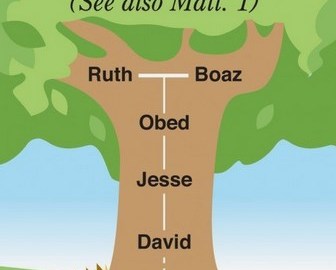
In the book of Ruth, Boaz accepts responsibility as Ruth and Naomi’s kinsman redeemer.  Then Boaz said to the elders and to the crowd standing around, “You are witnesses that today I have bought from Naomi all the property of Elimelech, Kilion, and Mahlon.  And with the land I have acquired Ruth, the Moabite widow of Mahlon, to be my wife. This way she can have a son to carry on the family name of her dead husband and to inherit the family property here in his hometown. You are all witnesses today.” (Ruth 4:9-10)

Just as Boaz married Ruth, our Kinsman Redeemer will marry us.  For I am jealous for you with God’s kind of jealousy; since I promised to present you as a pure virgin in marriage to your one husband, the Messiah; (2 Cor 11:2).  Why would Yeshua want to do this?  Why not just redeem us and be done with it? Yeshua desires an intimate relationship with us corporately and also individually. I stand at the door and knock. If anyone hears my voice and opens the door, I will come in and eat with him, and he with me (Rev 3:20).  Yeshua wants to be involved in our daily lives.  He is aware of all our thoughts, actions, attitudes, dreams and fears.  “Come to me, all you who are weary and burdened, and I will give you rest. Take my yoke upon you and learn from me, for I am gentle and humble in heart, and you will find rest for your souls.  For my yoke is easy and my burden is light” (Matt 11:28-30). He desires to restore what has been lost to us.  Instead of your shame there shall be a double portion; instead of dishonor they shall rejoice in their lot; therefore, in their land they shall possess a double portion; they shall have everlasting joy (Is 61:7). Yeshua wants to protect us and provide for us.  He promises to be with us always.  He does not leave us to the mercy of our enemies.  “And lo, I am with you always, even unto the end of the world” (Matt 28:20)   Just as a husband and wife are meant to share their daily lives, dreams, hopes, frustrations and challenges, we are welcomed and encouraged by Yeshua to share every detail of our daily lives with Him.  We are never alone for He is our constant Companion.  He is our Kinsman Redeemer.

This is an excellent time to ask forgiveness for your sins and invite Yeshua (Jesus) to be Lord of your life.  When we commit sin, we incur a debt that none of us can ever pay on our own.  It cannot be paid with earthly currency or even with great sacrifice on our part.  This debt can only be paid for by the blood of Yeshua which has already been shed for us. This is the greatest gift to ever be offered.  Don’t miss out.  After you have accepted Yeshua as your Lord and Savior, ask for baptism in the Holy Spirit.  The Holy Spirit will be your constant companion and Counselor and will equip you for Kingdom living. 

Who Is Yeshua?

Yeshua is everything to us:  our salvation, our hope, our future, to name a few. It is important to get to know Him as well as possible.  We can do this by interacting with Him and also by reading the Bible.  It is the word of Yehovah and Yeshua is the living Word of Yehovah.  This series, entitled “Who Is Yeshua?” will consist of twenty-one articles. Each article will explore a different section of the Bible to discover different titles and roles of Yeshua and our response to each role. In the third article in the series, Yeshua is our Atonement.

In Leviticus 16, we discover the foreshadowing of Yeshua as our Atoning Sacrifice, our High Priest, our Scapegoat and our Covenant.  Yeshua, the perfect Lamb, was sacrificed in our place, to make atonement for our sins.  Then Aaron will come out to purify the altar that stands before the Lord. He will do this by taking some of the blood from the bull and the goat and putting it on each of the horns of the altar.Then he must sprinkle the blood with his finger seven times over the altar. In this way, he will cleanse it from Israel’s defilement and make it holy (Lev 16:18-19). This offering was to be made once each year on the 10th day of the appointed month early in autumn, the day known as Yom Kippur (day of covering) or, more accurately, Yom haKippurim (day of the coverings).  Unlike a bull and goat that had to be sacrificed each year, Yeshua was sacrificed one time to make perpetual atonement for our sins, transgressions and iniquities.

Yeshua is also our High Priest, for He offered Himself as our atoning sacrifice. No one can take my life from me. I sacrifice it voluntarily. For I have the authority to lay it down when I want to and also to take it up again. For this is what my Father has commanded.” (John 10 :18)

Yeshua is our Scapegoat.  When Aaron has finished purifying the Most Holy Place and the Tabernacle and the altar, he must present the live goat. He will lay both of his hands on the goat’s head and confess over it all the wickedness, rebellion, and sins of the people of Israel. In this way, he will transfer the people’s sins to the head of the goat. Then a man specially chosen for the task will drive the goat into the wilderness.  As the goat goes into the wilderness, it will carry all the people’s sins upon itself into a desolate land (Lev 16:20-22). Yeshua carries our sin far away so that it no longer has the power to defile. 

Yeshua’s sacrifice reconciles us to His Father.  In order to properly relate to Yehovah, we must understand the idea of covenant, because Yehovah desires a covenant relationship with us.  There are many instances of covenants in the Old Testament: in Genesis, Yehovah’s covenants with Noah (Gen 8-9), with Abraham (Gen 9-17), with Moses (Deut 28 and Ex 31) and with David (2 Sam 7).  Each of these covenants was a step toward progressing Yehovah’s plan for establishing His Kingdom on earth as it is in Heaven.  Our covenant with our Father has the same goal.

Covenants were common in ancient times and were taken very seriously.  Generally, when a covenant was made, the parties would each pledge their promises.  Then one or more animals were cut in two and placed across from each other to make a path.  Those entering into covenant would walk that path as a pledge that they would not break the covenant or they too would be cut in half. Covenants involved blood and the curse of death for the one breaking the covenant.

In ancient times, covenants were used to define social and political relationships.  Often, the covenant was between a greater king and a lesser king.  The greater king offered care and protection from enemies while the lesser king offered loyalty and obedience. The greater king then “adopted” the lesser king and his household into the greater king’s family.  Covenants involved ongoing relationship and partnering with the other party to achieve a desired common goal.  In our case, Yehovah promises to care and provide for us and protect us from our enemies.  We promise our loyalty and obedience to Him.  We partner together to establish His Kingdom on earth.  When we repent of our sins and turn our lives over to Yeshua, it means that we are to trust and obey Him.  We remain loyal and obedient to Yehovah.

An important part of covenant-making included eating a meal together featuring the sacrificed animal or animals.  In our case, we partake of what we call communion or kiddush to commemorate our covenant relationship with Yehovah. As they were eating, Jesus took some bread and blessed it. Then he broke it in pieces and gave it to the disciples, saying, “Take this and eat it, for this is my body.” And he took a cup of wine and gave thanks to God for it. He gave it to them and said, “Each of you drink from it, for this is my blood, which confirms the covenant between God and his people. It is poured out as a sacrifice to forgive the sins of many (Matt 26:26-28)  

This is an excellent time to ask forgiveness for your sins and invite Yeshua (Jesus) to be Lord of your life.  When we commit sin, we incur a debt that none of us can ever pay on our own.  It cannot be paid with earthly currency or even with great sacrifice on our part.  This debt can only be paid for by the blood of Yeshua which has already been shed for us. This is the greatest gift to ever be offered.  Don’t miss out.  After you have accepted Yeshua as your Lord and Savior, ask for baptism in the Holy Spirit.  The Holy Spirit will be your constant companion and Counselor and will equip you for Kingdom living. 

Who Is Yeshua?

Yeshua is everything to us:  our salvation, our hope, our future, to name a few. It is important to get to know Him as well as possible.  We can do this by interacting with Him and also by reading the Bible.  It is the word of Yehovah and Yeshua is the living Word of Yehovah.  This series, entitled “Who Is Yeshua?” will consist of twenty-one articles. Each article will explore a different section of the Bible to discover different titles and roles of Yeshua and our response to each role. In the second article in the series, Yeshua is the perfect Lamb.

 In Exodus, we learn about the Passover Lamb. 

Now the Lord said to Moses and Aaron in the land of Egypt,“This month shall be the beginning of months for you; it is to be the first month of the year for you. Speak to all the congregation of Israel, saying, ‘On the tenth of this month they are, each one, to take a lamb for themselves, according to the fathers’ households, a lamb for each household. Now if the household is too small for a lamb, then he and his neighbor nearest to his house are to take one according to the number of persons in them; in proportion to what each one should eat, you are to divide the lamb.Your lamb shall be an unblemished male a year old; you may take it from the sheep or from the goats.  You shall keep it until the fourteenth day of the same month, then the whole assembly of the congregation of Israel is to slaughter it at twilight. Moreover, they shall take some of the blood and put it on the two doorposts and on the lintel of the houses in which they eat it. They shall eat the flesh that same night, roasted with fire, and they shall eat it with unleavened bread and bitter herbs. Do not eat any of it raw or boiled at all with water, but rather roasted with fire, both its head and its legs along with its entrails. And you shall not leave any of it over until morning, but whatever is left of it until morning, you shall completely burn with fire (Ex 12:1-10).

Many of us, at one time or another in our lives, think that we can improve ourselves if we try hard enough.  That may be true to some extent, but the kind of improvement that is most essential to us is not attainable by our efforts.  No matter how well we clean up our act, we still owe an enormous debt, one that we cannot repay on our own.  If all humanity could come into agreement and try to pay the debt collectively for all of us, it would still be impossible.  The kind of debt we owe cannot be paid back with money or good deeds. Indeed, under the law almost everything is purified with blood, and without the shedding of blood there is no forgiveness of sins (Heb 9:22).  It takes the blood of an innocent person willing to sacrifice himself for us.  None of us fits the bill of “innocent person” no matter how good we think we are.  “…for all have sinned and fall short of the glory of God” (Rom 3:23).

It is the blood of the lamb that saved the first born in Egypt from death.  It is the blood of our Passover Lamb that saves us from the second death.  The life is in the blood. For the life of the flesh is in the blood, and I have given it for you on the altar to make atonement for your souls, for it is the blood that makes atonement by the life (Lev 17:11).

How do we know for sure that the Passover Lamb in Exodus is a representative of Yeshua?  There are many other Scriptures that explain this to us.  For example, in 1 Corinthians 5:7, we read, “Get rid of the old hametz [leaven], so that you can be a new batch of dough, because in reality you are unleavened. For our Pesach [Passover] lamb, the Messiah, has been sacrificed.

In John 1:29, John the Baptist identifies Yeshua as the Lamb of God.  The next day, Yochanan saw Yeshua coming toward him and said, “Look! God’s lamb! The one who is taking away the sin of the world!  There are many other passages that identify Yeshua as the ultimate Passover Lamb, such as Isaiah 53:7; 1 Pet 1:19, Matt 26:2, and Matt. 26:26.

According to the instructions given in Exodus, the lamb was to be selected from the flock on the 10th day of the first month, Aviv.  The lamb was to be taken into the household much as a family pet becomes part of the household today.  The lamb was being inspected to make sure there were no flaws or imperfections, but the lamb was now a dear part of the family.  This is a foreshadowing of Yeshua being born among and living with His chosen people.  Many embraced Him and loved Him, especially during His ministry. 

When He took upon Himself the sins of the world, He opened Himself up to the rejection and condemnation of His people. They put Him to death as one reviled. He was despised and rejected by men; a man of sorrows, and acquainted with grief; and as one from whom men hide their faces he was despised, and we esteemed him not (Is 53:3). They did not realize that He was dying in their place, just as the Passover lamb died in their place each year, so that they would be covered. Only this time, they would be more than covered for a year; their sin debt would be permanently removed. Surely, he took up our pain and bore our suffering, yet we considered him punished by God, stricken by him, and afflicted. But he was pierced for our transgressions, he was crushed for our iniquities; the punishment that brought us peace was on him (Is 53:4-5) and by his wounds we are healed.

Furthermore, the yearly Passover lamb was put to death and remained dead.  Our true Passover Lamb, Yeshua, was raised from the dead after three days and three nights in the grave!  The Author of life took on a new life, a new body, so that we could do the same! Jesus said to her, “I am the resurrection and the life. Whoever believes in me, though he die, yet shall he live (John 11:25). Not only are our sins forgiven, but our debt is paid and we are given new life, eternal life.  We no longer have to fear when our mortal bodies die, for we will have new bodies that will live forever and have no defects, no blemishes.  Yeshua not only pays a debt we could never pay and removes our condemnation, but He gives us immortality and glory!  A new life forever with Him!  We can now take on immortality because we wear His robe of righteousness. If the Spirit of him who raised Jesus from the dead dwells in you, he who raised Christ Jesus from the dead will also give life to your mortal bodies through his Spirit who dwells in you.  (Rom 8:11)

This is an excellent time to ask forgiveness for your sins and invite Yeshua (Jesus) to be Lord of your life.  When we commit sin, we incur a debt that none of us can ever pay on our own.  It cannot be paid with earthly currency or even with great sacrifice on our part.  This debt can only be paid for by the blood of Yeshua which has already been shed for us. This is the greatest gift to ever be offered.  Don’t miss out.  After you have accepted Yeshua as your Lord and Savior, ask for baptism in the Holy Spirit.  The Holy Spirit will be your constant companion and Counselor and will equip you for Kingdom living. 

Who Is Yeshua?

Yeshua is everything to us:  our salvation, our hope, our future, to name a few. It is important to get to know Him as well as possible.  We can do this by interacting with Him and also by reading the Bible.  It is the word of Yehovah and Yeshua is the living Word of Yehovah.  This series, entitled “Who Is Yeshua?” will consist of twenty-one articles. Each article will explore a different section of the Bible to discover different titles and roles of Yeshua and our response to each role. In the first article in the series, Yeshua is the Seed.

In Genesis, we learn that Yeshua is the Seed of the Woman. And I will put enmity between you and the woman, and between your seed and her Seed; He shall bruise your head, and you shall bruise His heel” (Gen 3:15). (See also 1 John 3:8 and Gal 4:4) Why is this important?  It is because we are humans and we have sinned.  It is humankind that owes a tremendous debt, a debt that we cannot pay collectively, let alone individually. Only a human who is totally righteous, takes on the sin and weakness of everyone and who willingly gives up His life can pay the price.  Among all of humankind, there is no one else besides Yeshua who fits the requirements. “Although you wash yourself with lye and use much soap, the stain of your iniquity is before Me,” declares the Lord God (Jer 2:22).

What would it take to pay this enormous debt and reconcile with Yehovah?  It would take the sacrifice of a human who is totally free from blemish, from any hint of sin.  In fact, the law requires that nearly everything be cleansed with blood, and without the shedding of blood there is no forgiveness (Heb 9:22).  The animals who were sacrificed in the place of the guilty humans were innocent and were supposed to be without blemish.  Do not present an animal with defects, because the LORD will not accept it on your behalf (Lev 22:20).

A woman was the first to sin, but Yehovah in His infinite mercy and provision, had already provided a way for the woman and all her descendants to be saved.  It would be through the seed of a woman, that Yeshua (salvation) would come and sacrifice Himself so that we could be reunited to Yehovah and so that we could share in all that had been planned for us from the beginning.  What was planned for us?  Each one of us is designed to be an integral part of His kingdom.  For I know the plans I have for you,” declares the Lord, “plans to prosper you and not to harm you, plans to give you hope and a future (Jer 29:11).  We are part of something much greater than any of us individually, yet as individuals each one of us is loved and valued. 

Yeshua came to establish the Kingdom of Yehovah on earth.  [Yeshua] was going throughout all Galilee, teaching in their synagogues and proclaiming the gospel of the kingdom, and healing every kind of disease and every kind of sickness among the people (Matt 4:23).

How do each of us participate in the Kingdom?  Then Jesus came to them and said, “All authority in heaven and on earth has been given to me. Therefore, go and make disciples of all nations, baptizing them in the name of the Father and of the Son and of the Holy Spirit, and teaching them to obey everything I have commanded you. And truly I am with you always, to the very end of the age.” (Matt 28:18-20)   We are called to spread the word of His glorious plan.  When we share this message with others, we are scattering seed, the seed that comes from the SeedI tell you the truth, unless a kernel of wheat is planted in the soil and dies, it remains alone. But its death will produce many new kernels—a plentiful harvest of new lives (John 12:24)

In the parable of the sower (Matt 13:1-9), Yeshua tells us that when we spread the word (sow the seed) that some of the seed will fall onto poor soil or wither under challenging conditions.  This is not necessarily failure on our part.  After all, Yeshua died for all of us, yet not all of us will accept His precious gift of salvation.  When a farmer sows seeds, only some of the seeds will germinate.  Of the seed that germinates, only some will produce a good crop.  Plants can get too much rain, not enough rain, not enough sun, or pests can come and weaken or kill the plant.  And yet, the farmer continues to sow seed year after year.  It is the same with us.  We must continue to sow seed (the word of Yehovah) even though we cannot control the outcome of each seed.  It will require sacrifice on our part, perhaps even our very lives, to carry out our assignment.

“Listen! A farmer went out to plant some seeds. As he scattered them across his field, some seeds fell on a footpath, and the birds came and ate them. Other seeds fell on shallow soil with underlying rock. The seeds sprouted quickly because the soil was shallow. But the plants soon wilted under the hot sun, and since they didn’t have deep roots, they died. Other seeds fell among thorns that grew up and choked out the tender plants. Still other seeds fell on fertile soil, and they produced a crop that was thirty, sixty, and even a hundred times as much as had been planted! Anyone with ears to hear should listen and understand.”  (Matt 13:3-9)

 “Now listen to the explanation of the parable about the farmer planting seeds.  The seed that fell on the footpath represents those who hear the message about the Kingdom and don’t understand it. Then the evil one comes and snatches away the seed that was planted in their hearts.  The seed on the rocky soil represents those who hear the message and immediately receive it with joy.  But since they don’t have deep roots, they don’t last long. They fall away as soon as they have problems or are persecuted for believing God’s word. The seed that fell among the thorns represents those who hear God’s word, but all too quickly the message is crowded out by the worries of this life and the lure of wealth, so no fruit is produced. The seed that fell on good soil represents those who truly hear and understand God’s word and produce a harvest of thirty, sixty, or even a hundred times as much as had been planted!” (Matt 13:18-23) Yeshua is the original Seed as explained in Genesis.  When Yeshua is put to death, new life springs from Him and many seeds are now available.  Very truly I tell you, unless a kernel of wheat falls to the ground and dies, it remains only a single seed. But if it dies, it produces many seeds. Anyone who loves their life will lose it, while anyone who hates their life in this world will keep it for eternal life (John 12:24). The seeds produced by Yeshua’s death were first planted in His followers.  They then produced fruit that bore more seeds which they then sowed in others.  It is that seed which was planted in each of us who are led to accept Him as our Lord and Redeemer.  We are then to bear fruit which produces seed (the good news of the Kingdom) and it is that seed that we are to sow in others in order to increase the Kingdom.

This is an excellent time to ask forgiveness for your sins and invite Yeshua (Jesus) to be Lord of your life.  When we commit sin, we incur a debt that none of us can ever pay on our own.  It cannot be paid with earthly currency or even with great sacrifice on our part.  This debt can only be paid for by the blood of Yeshua which has already been shed for us. This is the greatest gift to ever be offered.  Don’t miss out.  After you have accepted Yeshua as your Lord and Savior, ask for baptism in the Holy Spirit.  The Holy Spirit will be your constant companion and Counselor and will equip you for Kingdom living. 

Picturing Messiah

Snapshots of Messiah

The Old Testament contains numerous snapshots of Messiah in His many roles and aspects.  The more snapshots we examine, the more comprehensive our understanding of Messiah.  As we explore some details of Messiah, we discover implications for ourselves for it is not only our job to learn about Messiah, but to reflect His glory.  

In this article, we will focus on chapters 15 and 17 of Deuteronomy. The first three verses of chapter 15 command us to forgive debts owed to us.  Our Savior paid our debt in full and does not demand reimbursement.  In our case, the debt each of us owes is far beyond our means to repay.  Our Savior repaid all debts owed to YHVH once for all (Heb 10:12; Rom 8:9-10).  Therefore, we are not to expect payment from our debtors, but are called to forgive them even as we are forgiven and to reconcile just as we have been reconciled to YHVH.  (1 John 1:9; Matt 18:21-35).

Chapter 15, verses 4-11 illustrate the generosity that characterizes Messiah.  Our Savior not only released us from impossible debt, but liberally shares His own treasures with us (Is 55:1-2; Matt 8:16-17; Eph 1:1-18).  We are to do likewise (Matt 10:8) with those who have wronged us.  How generous are we toward our enemies, or even toward those who have not offended us but are needy?  Do we judge the poor, ignore them, or reach out to them?

Messiah rescues us from slavery to hasatan and restores us to the kingdom of YHVH.  As citizens of the kingdom of YHVH, we are to use our freedom to serve YHVH and others just as Messiah has served us (1 Pet 2:16; Gal 5:13).  We cannot reflect the glory of YHVH by serving ourselves, but only by serving others.

The sacrifices described in Deuteronomy 15:23 and 17:1 were to be without any sickness, deformity, or blemish, thus illustrating Messiah.  It is through the most perfect Sacrifice that we who are diseased, deformed and stained with sin, are made whole and perfect by the One who absorbed all our imperfections in Himself and put them to death.  The Israelites were to eat the flesh of the sacrifices for nourishment, but were forbidden to consume any of the blood, which contains life.  We gain little from consuming the life of creatures inferior to us, but we gain everything from partaking of the flesh and blood of the One who gives life to all (John 6:53).

The Israelites were ordered to keep evil from their midst.  This was so serious a matter, that a person found guilty of introducing evil was to be stoned to death.  Messiah warned people to turn from their sins (Matt 4:17; Luke 5:32).  He expelled demons from multitudes of people (Matt 8:16; Mark 1:34; Luke 4:41).  When He returns, Messiah Yeshua will eradicate all evil from the earth (Is 25:8; Rev 21:3-4).  We too are empowered and expected to purge all evil from our midst (Jude 1:14-15).

Priests and judges were appointed by YHVH (Deut 17:8-13).  The verdict of a priest or judge was final and orders were to be carried out exactly.  Yeshua did not come as judge the first time (John 3:17).  However, Messiah will return as Judge (Matt 25:31-46; James 5:9; 2 Cor 5:10).  Messiah’s judgement will be final and His orders will be carried out precisely (Is 2:2-4; Micah 4:1-3; Is 9:6-7).  Just as Yeshua came the first time to serve, not to judge, so we must focus on serving others, not judging them.  Our time for judging comes later (1 Cor 6:1-6).  We also are priests (1 Pet 2:9) and Messiah Yeshua is our High Priest (Heb 4:14-16).  Our main job as priests is to worship YHVH and show others His goodness (1 Pet 2:5, 9).

Deuteronomy 17:14-20 describes the selection and appointment of a human king and the guidelines for human kings.  A vivid picture of Messiah as our king emerges from these verses:

  • The king was selected by YHVH Himself (Ps 110: 1-2; Rev 19:11-16). If we have accepted Messiah Yeshua as Lord of our lives, then we are already citizens in His kingdom and are subject to Him first and foremost.
  • The king was a fellow Israelite. Messiah Yeshua is a fellow Israelite (2 Sam 7:12-13; Matt 1:1-17; Luke 3:21-38).  The Israelites were taught some basics of kingdom living and when Yeshua came to the earth He taught and demonstrated Kingdom living.
  • The king should not build up a large stable of horses. In Scripture horses were used for war and could become a false stronghold.  The king should not depend not on horses, but rather on His fear of YHVH (Ps 147:10-11).  Even though Messiah will return on a horse, He does not depend on the horse.  Rather, the horse depends on its Creator, Messiah Yeshua (John 1:1-3).  We must rely solely on YHVH for our strength and protection and avoid false strongholds.
  • The king was not to return or send his people to Egypt (symbolizing slavery and bondage). Messiah came free us from bondage to hasatan (Heb 2:14; Col 2:15).  When Messiah returns, He will place hasatan in bondage (Rev 20:1-3) and imprison him for the rest of eternity (Rev 20:10).
  • The king is not to have many wives, lest he turn away from YHVH. Yeshua has the Bride.  Although many individuals make up that Bride, they are all united by His Holy Spirit and operate as one (echad) (1 Cor 12:12, 27 NLT; Eph 4:3-5; 2 Cor 11:2).
  • The king is to read Torah daily to remain humble and obedient to YHVH. When hasatan tempted Yeshua in the wilderness, Yeshua responded by quoting from Deuteronomy each time.  Yeshua is the Living Torah, the Word of YHVH (John 1:1-5).  We, too, should keep Scripture within our hearts to remain humble and faithful to YHVH (Deut 6:5-6; 2 Tim 3:16).

These snapshots of Messiah give us much to ponder.  Yeshua is our perfect example of how to live and serve in YHVH’s kingdom.  How well do we reflect His glory?

Reflections of His Presence

This is the seventh article of our Living Tabernacles series, where we study the Tabernacle in depth. It is exciting to see how each element symbolizes some characteristic of Yeshua.  It is also challenging when we examine what each element means for us, since each of us is now a living tabernacle of YHVH [Yehovah].  We are posting two articles each month as part of this series. YHVH is building His kingdom on earth as it is in heaven.  A king reigns from his throne and also pronounces judgment from there. 

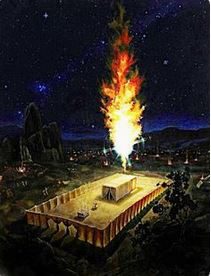
This article focuses on the significance of the “Table of Showbread” and the Showbread itself that YHVH instructed His people to place in the Holy Place in front of the Holy of Holies.  In Exodus 25:23-30, YHVH told the Israelites to: “Make a table of acacia wood, 36 inches long, 18 inches wide, and 27 inches high.  Overlay it with pure gold and run a gold molding around the edge.  Decorate it with a 3-inch border all around, and run a gold molding along the border.  Make four gold rings for the table and attach them at the four corners next to the four legs. Attach the rings near the border to hold the poles that are used to carry the table. Make these poles from acacia wood, and overlay them with gold. Make special containers of pure gold for the table – bowls, ladles, pitchers, and jars – to be used in pouring out liquid offerings. Place the Bread of the Presence on the table to remain before me at all times”.

This table (often called the “Table of Showbread”) was to be set up next to the lampstand (Menorah) outside the Holy of Holies, so that the light from the lamps could illumine the table.  As with the Ark of the Covenant and the lampstand, this was made of acacia wood and overlaid with gold, so we know it was meant to be one of the most precious items YHVH wanted to be in His holy place.  We have spoken in earlier articles about the special place that both gold and acacia wood hold in YHVH’s heart, so we can say that the Table had to be made of materials worthy of the King of creation – our King, Messiah Yeshua.  The acacia wood covered in gold that composed the Table of Showbread can also be seen as symbols pointing to both the humanity and divinity of Yeshua.

I will just mention one other thing about the Table – in a typical Hebrew home at that time, it would have been common to have a table set with plates and dishes for bread and incense, and pitchers and bowls for liquid offerings (although probably not of pure gold!).  By having this Table in the Tabernacle, YHVH was showing that He wants us to regard the Tabernacle as His house – this includes both the Earthly tabernacle as well as His heavenly Tabernacle (after which the Earthly tabernacle was modeled).

Moving on now to the bread that Abba instructed His people to place on the Table, we see that “Showbread” is not an accurate translation.  The original Hebrew phrase for this bread is Lechem haPanim, which literally means “Bread of the Presence” or “Bread of the Face [of God]”.

The historian Josephus indicates that the Bread of the Presence was unleavened, pointing to Yeshua as our sinless Savior who is the true Bread of the Presence.  In John 6:35, Yeshua said: “I am the bread which gives life! Whoever comes to Me will never go hungry, and whoever trusts in Me will never be thirsty”.   Then in Verses 48-51 of John 6, Yeshua says that He is the true Bread that came down from Heaven and that if anyone eats of this Bread, they will live forever.  Yeshua gives us life to the fullest; life more abundant on this Earth and life everlasting in Heaven!

When we look again at the Bread of the Presence in the Tabernacle, we see that it symbolized being in YHVH’s presence, so when the priests ate the bread they were fellowshipping with Abba Father in His presence, face-to-face.  The bread on the Table in the Tabernacle, as well as the bread in Messiah’s communion, reminds us that our life is in the true Bread from Heaven, Yeshua HaMashiachYeshua went even further than this, though, because He told His disciples [talmadim] that he didn’t need physical bread to eat (John 4:32-34),  but rather He had “food to eat that they knew nothing about”.  When they asked what food He had, He said that His food was to do the will of the Father (the One who sent Him).  When Yeshua shared the communion bread of His body, He was teaching His disciples to be filled with the Bread of His presence, satisfied with doing the will of our Father.

Yeshua gives us more spiritual food when He says in Matthew 4:4 that people do not “live by bread alone, but on every Word that comes from the mouth of God”.  In Matthew 6:11, He also teaches us to pray to our Father that He will give us our daily bread, but I believe this means spiritual Bread as well – that He will tell us what He desires for us to do each day.  I want to leave you with a story about one of my favorite composers – it is said that when Handel wrote the Messiah, food trays stacked up outside his door for 17 days.  He was too busy and too fulfilled to eat – he was eating the Bread of life, the Bread of the presence of YHVH, and it sustained and nourished him.  What is the Bread of YHVH’s presence for you?

Fragrant Reflections

This is the third article of our Living Tabernacles series, where we study the Tabernacle in depth. It is exciting to see how each element symbolizes some characteristic of Yeshua.  It is also more challenging when we examine what each element means for us, since each of us is now a living tabernacle of YHVH.  We are posting two articles each month as part of this series.

In the first article in this series, Nancy studied the significance of the metals used in the Tabernacle.  In the second article she examined the items YHVH specified in Exodus 25:4-5 as materials to construct and cover the Tabernacle.  In this article we will cover the oil and spices to be used for the anointing oil and the incense in the Tabernacle.

In Exodus 25:6, Abba tells Moshe that they are to gather from the people…”olive oil for the lamps; spices for the anointing oil and the fragrant incense”.  Later on, in Exodus 27:20, YHVH tells Moshe: “Command the people of Israel to bring you pure oil of pressed (beaten or pounded) olives for the light, to keep it burning continually”.  Yeshua is continuously our pure Light.  When we think of Yeshua as the Light of the world, and His command to us to shine that light throughout the world, then we can see how important it is to keep that light shining through us 24/7.

In Exodus 30:23-24 YHVH provides details of the ingredients and preparation for the anointing oil listed in Exodus 25, and how it is to be prepared – He says to Moshe: “Collect choice spices—12 1⁄2 pounds of pure myrrh, 6 1⁄4 pounds of fragrant cinnamon, 6 1⁄4 pounds of fragrant calamus, and 12 1⁄2 pounds of cassia—as measured by the weight of the sanctuary shekel. Also get one gallon of olive oil”. In Verse 25, He then explains how these ingredients are to be mixed together: “Like a skilled incense maker, blend these ingredients to make a holy anointing oil”.  Note that YHVH has added yet another qualification to the anointing oil – as I highlighted in the last verse, it is referred to as a “holy anointing oil”.  This tells us that it is to be set apart and made in a very special way compared to all other oils, such as the oil for the lamps.  Yeshua baptizes us with the anointing oil of the Holy Spirit.

Let us look at the spices to be used in the anointing oil in more detail:

  • Myrrh is a pale yellow gummy substance extracted from a small thorny shrub, typically used in spices and ointments. It is very costly and is known to be purifying to the body, and has a pleasant fragrance.
  • Fragrant cinnamon oil is distilled from the bark of a special type of cinnamon tree. It is very tasty and is often used to flavor food because of its pleasant aroma.
  • Fragrant (or sweet) calamus is a tall wetland plant with scented leaves – it is a fragrant cane whose root is highly prized as a spice. When it is crushed, it exudes a sweet fragrance. The more it is broken and crushed, the more of the fragrance that is exuded. In its spiritual application, the calamus speaks to us of brokenness, and reminds us that Yeshua was crushed and broken for us.  There are times in our lives when we must be crushed or broken in order to be purified.
  • Cassia comes from the aromatic bark of a Middle Eastern tree, and represents the true humility of anointed worship. It is sometimes used as a natural medicine. Cassia is derived from the Hebrew root “quadad”, meaning to bend or bow. This can be seen to represent us as God’s people, who are to bow down in humility before the strong hand of God (1 Pet. 5:6).
  • The main ingredient by volume in the Holy Anointing Oil is olive oil, which has both secular and sacred purposes. The olive tree is very important in secular life for cooking, cosmetics and soaps, and as a fuel for oil lamps. The olive tree has been a symbol of peace and prosperity since the time the dove returned to Noah’s Ark with an olive branch.

Let us now take a look at the spices YHVH specified to be used in the Tabernacle:

  • When Frankincense is burned it emits a fragrant odor, and hence the incense became a symbol of the Divine name (Malachi 1:11) and an emblem of prayer (Psalm 141:2; Luke 1:10; Revelation 5:8; 8:3).
  • Stacte is generally understood to be the purest kind of myrrh; and as the Hebrew name implies a drop, it would seem to refer to this type of myrrh as dropping from the tree of its own accord, without any cutting. This makes me think of Yeshua’s precious teardrops of blood in Gethsemane.
  • Onycha: Hebrew shechelet is thought to be the resin from a Mediterranean shrub that has been used for medicines and sweet perfumes for hundreds of years.
  • Galbanum: this rather foul-odored spice, when mixed with all the other spices, produces a perfect mixture for the incense. An ancient story tells of a perfumer who experimented with the biblical incense recipe and discovered that when the galbanum was left out of the mixture, the other ingredients still produced a pleasant fragrance. However, when the galbanum was added, something quite wonderful happened chemically: “the full mixture of the spices, including the foul galbanum, smelled infinitely more delicious than the mixture without galbanum”. The experiment showed that the galbanum transformed the sweet spices to produce the most beautiful incense possible. In the same way, as saved believers, we are transformed through the cleansing of our “foul” sins into beautiful children of God.

It is wonderful that YHVH explained to His people the precious spices they were to gather and use in the holy anointing oil and the incense, but we need to always remember that our obedience to Him is the sweetest aroma we can sacrifice to Him (1 Sam 15:22).  Our prayers are the most powerful incense we can offer up to YHVH (Rev 5:8).

The holy anointing oil that was to be used in the tabernacle can also be related to the oil of the Holy Spirit, flowing through our own tabernacles, purifying us and making us holy to stand before YHVH in His heavenly Tabernacle.  Let us welcome the oil of the Holy Spirit to keep our bodies and souls pure and set apart from the lusts of the world, such as power, greed, arrogance, hostility and envy.  We are called to be set apart to be with YHVH for all of our days, both here on Earth and forever in Heaven.

Yeshua is the Way

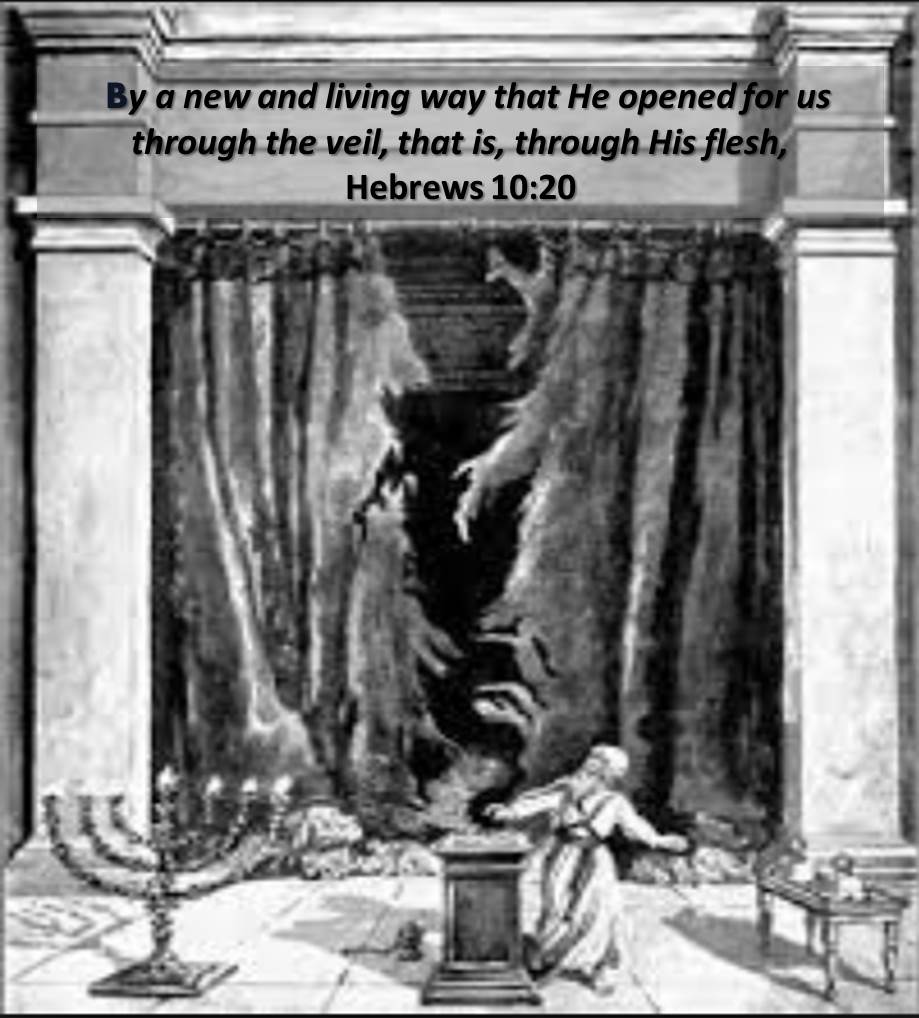
thru-the-veil-of-his-fleshIt is clear that Abba Father tore the veil separating the people from the Holy of Holies when Yeshua’s body perished, because the Scripture says it was “torn in two from top to bottom” (Matt 27:51).  The fact that it was torn from top to bottom symbolizes YHVH reaching down from Heaven and opening the way for us to “come boldly to His throne of grace, that we may obtain mercy” (Heb 4:16).  What is this place we are entering into, though?  For Torah observant Jews of Yeshua’s time, they may have wrongly believed that the way had been opened for them to come into the Holy of Holies and worship in YHVH’s presence, where His glory dwelled above the earthly Ark of the Covenant.

However, through history and the Scriptures, we find a much deeper meaning to the tearing of the veil.  From history we know that the Temple was destroyed and the Ark was hidden or taken away, just as Yeshua had prophesied in Luke 13:35.  Our entrance into the Holiest place, then, was not an entrance into an earthly place, but rather an entrance into YHVH’s heavenly throne of grace.  Sha’ul gives us some great hints as to what this means at a deeper level:

  • “We have this as a sure and steadfast anchor of the soul, a hope that enters into the inner place behind the veil, where Jesus [Yeshua] has gone as a forerunner on our behalf, having become a high priest forever..” (Hebrews 6:19-20)
  • The God who made the world and everything in it, being Lord of heaven and earth, does not live in temples made with human hands,” (Acts 17:24)

The first passage above tells us that Yeshua has gone into the inner place ahead of us, to make a way for us to come before the Father’s throne.  We know from Scripture that Yeshua ascended to Heaven after his Resurrection and now sits at the right hand of the Father, and Hebrews 6:20 tells us that Yeshua is now our high priest.  When He opened the way into the Holy place of the Father in heaven, Yeshua also did away with the sacrificial system.  He became our God-man sacrifice who took away our sins and diseases for all time, not just once a year like the earthly high priest or the animal sacrifices people brought to the Temple.

In the second Scripture above, we learn that YHVH does not live in earthly temples – rather, He dwells in His heavenly Tabernacle, where He now invites us to come and fellowship with Him, through the Way that Yeshua has made for us by tearing the veil.  Yeshua has also made us holy and righteous before Abba, as He has washed us white as snow by His blood (I Cor 6:11).  This is not only a way to the Father, but rather it is the only way to draw close to Abba – in John 14:6, Yeshua Himself said that no one can come to the Father except through Him.

Even with all these insights into the tearing of the veil, though, and the way that has been opened for us into Yehovah’s most Holy place, there is still a deeper and more personal significance to this event.  Hebrews 10:20 (NIV) says that Yeshua opened a “new and living way for us through the veil, but then it equates the veil with Yeshua’s flesh.  This means that we are actually entering into Yeshua’s body when we come before YHVH’s throne – now that is the way to come to the Father!  The next time you come before Abba’s throne in worship, remember that you are entering through the perfect, sinless flesh of the One who showed us His unconditional love by sacrificing His life for us.

Gedi Star Teachings

gedi-the-goatToday we are going to explore another of the amazing signs that YHVH placed in our heavens from the beginning of Creation.  The sign is commonly known as Capricorn, which translated from Latin literally means a horned goat.  However, as I have mentioned in the past, we cannot trust modern Greek and Latin names of stars or constellations, as their names and meanings have been corrupted over the years from the original Hebrew meanings.  In Hebrew, this sign is called Gedi, which means kid goat, but is sometimes translated as sea goat, due to the strange half-goat/half-fish image portrayed in ancient drawings of the sign.

The image we see in Egyptian, Indian, and Phoenician drawings is of a fish that is weak and dying at the head, but alive as a healthy fish at its tail end.  The stars in this sign confirm the meaning associated with this image: ma’asad: the slaying; dabih: the sacrifice slain; and sa’ad al nashira: the cutting off.  As with many Hebrew words, gedi (kid goat) has a second meaning: to be cut off.  This sign, then, represents the sacrificial Goat of atonement, Yeshua, who was slain to redeem us from our sins, was “cut off” (crucified) to bring us salvation, healing and deliverance from evil.

The fish portion of the goat’s body represents us: the people for whom the sacrifice was made.  Other star names in this sign also point to Gedi as being the goat who was sent into the wilderness for remission of our sins (so that they would be sent away as far as the east is from the west).  We know that Yeshua fulfilled both of these goat sacrifices!

To complete this awesome picture story, the three constellations associated with this sign give more of the details. The 1st constellation is Sagitta, means “the arrow of Elohim sent forth” – this connects with Psalm 38:2 where it says “Your arrows have struck deep, and Your blows are crushing Me”; and also Isaiah 53:4-5: “He was stricken, smitten of God & afflicted; He was wounded for our transgressions”.  Aquila (the eagle) is the 2nd constellation in Gedi – the stars in this constellation convey the meaning of “the smitten One falling”, “the One who comes in the Shekinah glory of God to shed His blood as a sacrifice”; and “the One who was wounded in the heel” (Gen 3:15).

The third and final constellation in Gedi is Delphinus, the original name meaning “the dead One rising”.  It is shown in ancient Zodiacs as a fish full of life, always with his head pointing upwards.  This represents Yeshua’s resurrection as “the first-fruits of them that sleep” (I Cor 15:20).  The Hebrew name is Dalaphin, which means Dolphin and also “pouring out of water”.  We see from this word picture that Yeshua fulfilled the prophecy to pour out the Holy Spirit on all flesh, symbolized in Scripture as the “fountains of living waters”.

The brightest star in Gedi is actually a double star named Deneb Al Giedi – “the Judge who is the sacrifice.”  When we think about Yeshua’s dual role as our Messiah, we know that He came to save us from our sins in His first coming to Earth, but that He will be our ultimate Judge in His second coming. As Yeshua says in John 3:36: “Whoever trusts in God’s Son has eternal life. Anyone who doesn’t obey the Son will never experience eternal life but will remain under God’s judgment”.  Draw close to Yeshua and He will draw close to you; get to know Him intimately and your greatest desire will be to trust Him with your life, walk in His way and lovingly obey all of His commandments.

Safe Shelters

refuge-under-your-wingsIn my blog two weeks ago, I wrote about Yeshua as the Door of the sheep, and how He protects from us from all dangers.  Another closely related Biblical concept is that YHVH shelters us, but how does He shelter us?  In many places in the Psalms, David talks about YHVH sheltering us in His hiding place, for example:

  • Psalm 91:1 – He who dwells in the secret place of the Most High shall abide under the shadow of the Almighty [El Shaddai].
  • Psalm 27:5 – For in the time of trouble He shall hide me in His sanctuary; in the secret place of His tabernacle He shall hide me (the Orthodox Jewish Bible says that He will keep us safe in His Sukkah and shelter us in His tent)…He is our refuge and our fortress;
  • Psalm 32:7 – You are my hiding place; You shall preserve me from trouble; You shall surround me with songs of deliverance;
  • Psalm 119:117 – You are my hiding place and my shield; I hope in Your word;
  • Psalm 144:2 – My lovingkindness and my fortress, my high tower and my deliverer, my shield and the One in whom I take refuge

Other scriptures speak about God sheltering us in His high tower, on a rock that is higher than us, or in his fortress, just to name a few of the graphic images He paints.  Many times David and others speak about YHVH as not only keeping them safe in His secret hiding place, but as actually being that hiding place, refuge, fortress, high tower, stronghold, rock, sanctuary, Sukkah, etc.  As an illustration of a high / strong tower, Sh’lomo says in Proverbs: the name of Yehovah is a strong tower; and the righteous run to it [Him] and are safe.  Now we are getting to the purpose of YHVH sheltering us in all these amazing ways: He is keeping us safe from the enemy.  Psalm 32:7 above provides one of the most beautiful word pictures of God’s protection in all of Scripture: He is not only our hiding place, but He protects us from trouble and surrounds us with songs of deliverance.

In Psalm 91, David says that no evil will befall him because he has made YHVH his refuge and dwelling place.  Because David is abiding under the shelter of His wings, YHVH has promised to give His angels charge over David to keep him safe against all physical and spiritual enemies and attacks.  In Verse 14, He says that because we know and trust in His name (Yehovah), He will set us up on high places (a high rock, high tower, etc.).  He also promises that no evil will befall us, no plague will come near our dwelling, and we do not need to fear the arrows by day or the pestilence that comes in the night.  Finally, in Verse 7 He paints an even more vivid picture of how he delivers us in the middle of great battles: “Though a thousand fall at our side and ten thousand are dying around us, these evils will not touch us” (NLT).

Even from the beginning, God has always been there to shelter us and keep us safe.  When He created the Garden for Adam and Eve, He created it as an enclosed garden that was protected on all sides against enemies.  The meaning of the “Garden of Eden” [Gan Eden] from Hebrew is a sheltered or enclosed garden.  There are many examples of how God has provided for our protection in His creation. For instance, the way an eggshell protects the baby chick as the strongest shape in the world, or the way a mother’s womb protects her unborn baby against environmental dangers.

When God saved Noah and his family from the flood, He once again protected them with an Ark that provided their covering and protection from all the devastation that was going on around them.  Another example of YHVH’s protection was the lamb’s blood covering He told the Israelites to apply to their doorposts to protect them from the angel of death.  In the end times, YHVH’s remnant will be sheltered in the protective rocks of Petra (Bosrah in Hebrew), waiting for our King, Messiah Yeshua, to come and usher us into the homeland of Israel.

As you think about all the ways YHVH protects and shelters us in His fortress or high tower, think about the Hebrew letter “tet”, which in the ancient word pictures represented a shelter for protection.  It is used in the word beten to mean the house that surrounds life (the mother’s womb), and in the word for trust (batach), which pictures us being safe inside the surrounding fence.  The word seter means a hiding place or covering, and from the ancient word pictures it literally means a secret hiding place.  Whereas the word for adversary (satan) means the snake that devours life, YHVH provides the seter hiding place which protects us from evil.  Would you rather be under YHVH’s wings which protect your life from harm, or the enemy’s snake-coil which devours your life?