Tag Archives: Yeshua

Yeshua is the Door

the-door-of-the-sheep“Then Jesus said to them again, “Most assuredly, I say to you, I am the door of the sheep.John 10:7

In Yeshua’s “I am” statement about being the Door of the Sheep,  He teaches us that He is “the Door”, not just “a door”.  He is saying that He is not only our Shepherd who leads us into the sheepfold of the Kingdom, but He is the only door by which we can enter and be saved and find safe pasture (John 10:9).  There are deeper meanings for understanding Yeshua as our door into the Kingdom of God, so come with me now as we dig deeper into the Word to explore these meanings.

It is helpful to understand more about sheep and shepherding in general and specifically during Yeshua’s time.  Of all domesticated animals, sheep are the most helpless.  Sheep will spend their entire day grazing, wandering from place to place, never looking up. As a result, they often become lost. But sheep have no “homing instinct” as other animals do. They are totally incapable of finding their way to their sheepfold, even when it is in plain sight. By nature, sheep are followers. If the lead sheep steps off a cliff, the others are likely to follow.

Also, sheep are very susceptible to injuries and are utterly helpless against predators. If a wolf enters the pen, sheep won’t defend themselves or run away.  Sheep are totally dependent upon their shepherd for food, shelter, guidance and protection. So close is the bond between shepherd and sheep that to this day Middle Eastern shepherds can divide flocks that have mingled at a well or during the night simply by calling their sheep, who know and follow their shepherd’s voice. The shepherd leads the sheep to safe places to graze and makes them lie down for several hours in a shady place (think of the parallel to Psalm 23). Then at nightfall, the shepherd leads the sheep to the protection of a sheepfold.

In ancient times, there were two kinds of sheepfolds or pens. One kind was a public sheepfold found in villages. It would be large enough to hold several flocks of sheep. This sheep pen would be in the care of a “doorkeeper”, whose duty it was to guard the door to the sheep pen during the night and admit the shepherds in the morning. The shepherds would call their sheep, each of which knew their own shepherd’s voice, and he would lead them out to pasture (see John 10:4).

The second kind of sheep pen was in the countryside, where the shepherds would keep their flocks in good weather. This type of sheep pen was nothing more than a rough circle of rocks piled into a wall with a small open space to enter. Through it the shepherd would drive the sheep at nightfall. Since there was no gate to close—just an opening—the shepherd would keep the sheep in and wild animals out by lying across the opening. He would sleep there, in this case literally becoming the door to the sheep[fold].

Several ancient Hebrew word pictures point to Yeshua as the Door in a powerful way.  The ancient letter for door is dalet.  This meant the tent flap or door originally, but also the “path” or the “way of life”.  Devar in Hebrew means “word”. When we look at the ancient characters for Devar, though, the root meaning is “the Door of the Son”.  Since Yeshua is the living Word, Devar can also be interpreted as “The Word of YHVH”, as in the book of Deuteronomy [Devarim].  Psalm 19:14 says: “Let the words of my mouth and the meditations of my heart be acceptable in thy sight, YHVH, my rock and my redeemer”.  In Hebrew, a word for redeem is Padah and the word picture meaning is “redemption comes by the mouth of the door”. The ancient letters tell us that redemption is by the words of the door, and we know that door is Yeshua. Another significant word is the Hebrew word for Righteous, Tsedek, and the word picture tells us that  a person is righteous when their hook is the Door they follow (hook, or fishhook, refers to that which draws you – your passion or desire).

God’s name, Yehovah, is spelled yod-hey-vav-hey in Hebrew. The letter dalet is added to spell “Yehudah” [Judah], out of whose line Yeshua was descended. These 4 letters of the Name of God plus the letter dalet which means “door,” paint a different word picture:  His name tells us that Praise opens the Door to God“.  Since Yeshua is the Door, and He said everyone must enter through Him, this is a graphic picture of the pathway to YHVH – the key to the Door is praise!

Yeshua tells us that He is not only the shepherd of His sheep, but also the door of the sheep. In doing so, He is inviting us to be part of His sheepfold, where we will never have to fear or want for anything.  All we have to do is praise Him, and follow Him on His path, trusting Him with every part of our lives!

Trust in YHVH with all Your Heart

trust-in-yhvhTrust in the Lord with all your heart, and lean not on your own understanding; in all your ways acknowledge Him, and He shall direct your paths. Do not be wise in your own eyes; fear the Lord and depart from evil. It will be health to your flesh and strength to your bones.” Proverbs 3:5-8

I had memorized this well-known passage in proverbs 3:5-8 many years ago and still repeat it often in many different circumstances.  I would like to be able to say that it always calms my nerves or worries, but I can’t truthfully say that.  I usually have to spend some time with Yeshua remembering all the promises He gave us, that we are not to fear or be anxious for anything.  This tells me then that trust is not just about knowing the Scriptures that tell us God is faithful to watch over and take care of us in all situations.  It is far more about personally knowing the Living Word [Yeshua] who inspired the written Word, than it is about just knowing the written Word.

As believers, we often talk about having faith, more faith, or enough faith to endure whatever trial we are experiencing.  Unfortunately though, faith has become an overused and even watered down concept in our modern society.  Nowadays, we can have faith in Santa Claus, the Easter Bunny or the Tooth Fairy.  So what do we really mean when we say that we need to have strong faith in God?  Yeshua told his disciples that they could have cast the demon out of the young boy if they even had the faith of a grain of a mustard seed (Matt 17:20).  It is clear from this story that what they needed was not more faith, but rather a solid foundation of trust to back up the faith they had.

As human beings, we understand what it means to trust someone at a much deeper level than just having faith in someone.  Think about yourself for a moment and how you feel about trusting your neighbor. You may trust your neighbor enough to lend them your lawnmower, but do you trust them to watch out for your house when you go on a trip?  Would you trust them enough to give them a key so they can take of your plants when you are away?  Would you trust them to take care of your children for a weekend?

I would like to illustrate this point through a true story about a man named Charles Blondin, who was the greatest tightrope walker of his time, in the mid 1800’s.  He gained great fame in 1859 when he became the first person to cross Niagara Falls on a tightrope.  Charles and his friend and manager, Harry Colcord, strung a 2” diameter hemp rope from an oak tree on the American side to a large rock on the Canadian side, and used a series of guy ropes every 20’ (anchored to the shore) to keep the rope as steady as possible.  The greatest risk was the 50’ section in the center of the 1300’ span that could not be reached by anchor ropes.  The incredible thing was that Charles was able to navigate his way across the Falls without any mishaps.  He traversed the Falls a number of times over the next few weeks, carrying props such as a camera and a griddle on which he cooked an omelet, pushing a wheelbarrow, and even doing a backflip on a couple of occasions.

The most daring feat of all, though, was when he carried his manager Harry on his back during one of his crossings.  This is where the rubber meets the road – although the many fans in attendance had faith that Charles was able to cross the Falls (and even bet their money on him), it was only Harry who was able to trust Charles with his life.  A number of guy wires snapped during their crossing, but Charles never wavered.  Harry later told reporters that Charles had coached him to: “look up…you are no longer Harry, you are Charles. Until I clear this place, you are to be a part of me, mind, body and soul. If I sway, sway with me. Do not attempt to do any balancing on your own”.

Here is the essence of trusting God; not just having faith in Him. The spectators watching Charles had faith in him and believed that he was capable of traversing the Falls.  Only Harry, though, trusted him enough to climb on his back and ride across Niagara Falls with him walking on a 2” thick rope.  Is this the kind of trust you have in YHVH – do you trust Him to protect you and care for you and supply all your needs?  Do you trust Him with your whole life – body, soul and spirit – or do you trust more in your own abilities, your financial resources, or your trusted friends? In Psalm 3:6, God promised to direct our paths (keep us going in the right direction) if we would trust and acknowledge Him in every part of our lives.  Are you ready to trust YHVH with your whole heart? He is trustworthy beyond any other person or force in heaven or on Earth.  Go ahead and start trusting Him today – it will be the best decision you ever made!

Yom Teruah helps us Remember and Rehearse

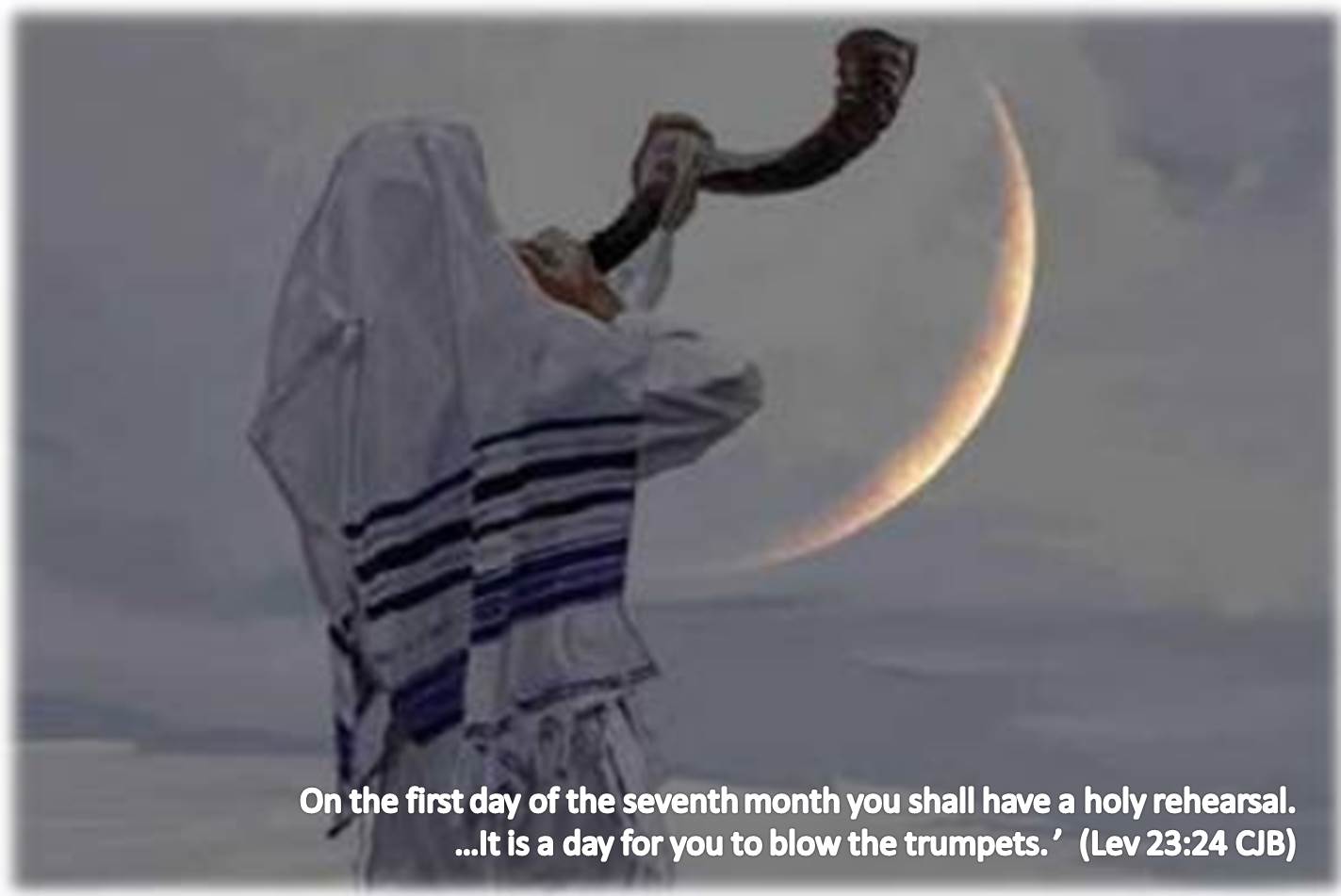
yom-teruahWhen we talk about YHVH’s feasts or festivals, we sometimes think of big celebrations with lots of festive foods along with family and friends.  Although some of YHVH’s feasts are meant to be joyous celebrations (such as Sukkot – the Feast of Tabernacles), others are meant to be more somber and introspective.  Yom Teruah (literally the “feast of the blowing of trumpets (shofarot)”) is a combination of both joyous and somber emotions.  In a previous blog (When Yeshua Returns), we have already dealt with the misconception that Yom Teruah is actually the Jewish new year, or what is called Rosh Hashanah (literally “the head of the year”).  Yom Teruah marks the beginning of the seventh month on God’s calendar, so by definition it cannot be the start of the year.

The Hebrew word used most often for YHVH’s feast days in the Scriptures is Mo’ed (feast) or Mo’edim (feasts plural).  However, this word is much better translated as “appointment” or more accurately “divine appointment”.  YHVH meant for these appointments to be holy (set-apart) times on His calendar to meet with Him.  They were also called “Holy Convocations”, which in the Hebrew is Miqra, meaning an “assembly” but also a “Dress Rehearsal”.

Whenever one of YHVH’s divine appointments arrives, we are supposed to look back and remember something that God has done for us in the past, but we are also supposed to look forward to what He will do in the future.  In His Mo’edim, God has essentially given us a “roadmap” of the most important events in human history.  Leviticus 23:24 describes Yom Teruah in this way: “In the seventh month, on the first day of the month, you shall have a sabbath-rest, a memorial of blowing of trumpets, a holy convocation (rehearsal)”.  Where it says “memorial” in this verse, another name is being used for the Feast of Trumpets – it is also called Zihk’ron Teruah which means a call for remembering through the loud blowing of trumpets.  So what are we remembering from the past and what are we rehearsing for the future?

By Jewish tradition and ancient calendars, it is believed that Yom Teruah commemorates the first day of Elohim’s Creation of the universe.  This fits with God’s biblical calendar.  When the Israelites were delivered out of Egypt, YHVH then said to them: This month shall be the beginning of months for you; it is to be the first month of the year to you” (Exodus 12:2).  This was of course the first day (new moon) of the Passover month (Aviv), which had been their seventh month but was now their first month by God’s instruction.  Thus we know that the seventh month (Ethanim) had been the first month on God’s calendar, which is the calendar He created for us at the time He created the world.  We can give thanks to Yehovah Elohim on Yom Teruah for creating the universe and us as His children.

As far as rehearsing the future on Yom Teruah, we need to look to the verses where the shofar blast is described as a warning or announcement of a future event.  There are a number of Scriptures where we see the shofar being blown as a call to repent and turn back (teshuvah) to YHVH, warning us of the God’s great judgment at the end times, in the “Day of the LORD”. (Joel 2:1, Zech 9:14, Rev 11:15)  In Matthew 24, Yeshua tells us of the great shofar blast when He comes in judgment and to gather His remnant together from the whole Earth: “And He will send out his angels with the mighty blast of a trumpet, and they will gather His chosen ones from all over the world—from the farthest ends of the earth and heaven”.

Abba, as we are celebrating your appointed time to be with You on Yom Teruah, help us to remember all that You have done for us in the past, including the great sacrifice of Your Son for our salvation and deliverance.  Help us to also look ahead at what You are going to do in the future, and make sure we are prepared like the wise virgins who had an abundance of oil for their lamps.  We want to be a part of Your remnant, pleasing to you and prepared in our hearts and spirits to receive Your blessing when You return to this Earth to reign and rule.

Releasing Love

God's Love

Many of us have accepted Yeshua as our Lord and Redeemer, yet we are unable to trust what He has accomplished for us.  Yeshua bore our punishment for all time so that we could maintain a relationship with YHVH and be a part of His family and His kingdom.  We have all heard this message preached, taught, argued and dissected until the words have perhaps become meaningless to us.   Words are not enough; each of us must experience the love of YHVH.

Too often Yeshua’s sheep silently struggle with guilt, regret, and shame that bog us down and block us from enjoying our Father’s overwhelming love.  Instead, we are inundated with misery that YHVH never intended for us to experience.  Do we believe that if we suffer enough, we can somehow make up for our sins?  Truly, there is no way that we can pay for even one sin.  It doesn’t seem right to us that we can repent and walk away free.  Perhaps that is why we find it so difficult to forgive those who have wronged us.  If others have made us suffer, then we feel justified in wanting them to suffer also.  We do not see things from YHVH’s perspective.  We forget how He rejoices over recovering the lost sheep (Luke 15:1-7) or re-uniting with the prodigal son (Luke 15:11-32).  When things go wrong, we think that YHVH is punishing us, even when we have repented and turned away from sin.  It is right to loathe the sin, but we must not loathe ourselves.

Our experiences in this world color our perception.  We assume that YHVH loves the way people love:  half-heartedly, sporadically, conditionally, and so on.  Over the last several months, I have encountered numerous others who are struggling to see themselves as YHVH sees them.  I, too, tend to see myself from a worldly perspective rather than as YHVH sees me.  YHVH loves us extravagantly not because of us, but because of who He is.  What does it mean to us that God is love?   1 Cor 13:4-7 provides some helpful insights.

YHVH does not keep a record of our wrongs and is not easily angered.  He is focused on us, not on Himself.  He believes in us, trusts us and hopes in us.  He is willing to endure all things so that we might be loved into reaching our full potential.  Derek Prince in a work entitled “The Divine Exchange” has provided a beautiful illustration of YHVH’s love through Yeshua’s sacrifice.  Below is a summary of “The Divine Exchange”.

  1. [Yeshua] was punished that we might be forgiven
  2. [Yeshua] was wounded that we might be healed
  3. [Yeshua] was made sin with our sinfulness, that we might be made righteous with His righteousness
  4. [Yeshua] tasted death for us that we might share His life
  5. [Yeshua] was made a curse that we might receive the blessing
  6. [Yeshua] endured our poverty that we might share His abundance
  7. [Yeshua] bore our shame that we might share His glory
  8. [Yeshua] endured my rejection that I might have His acceptance with the Father
  9. He was cut off that we might be joined to [YHVH]
  10. Our Old Man was put to death in Him that the New Man might come to life in us

Sin causes damage and loss.  In John 10:10, Yeshua tells us that the thief comes to steal, kill and destroy.  Yeshua came so that we might have abundant life.  Yeshua came to recover, restore, replace, re-unite and revive.   Let us throw off the temptation to dwell on the past, on what has been lost or destroyed, and focus instead on what Yeshua has done, is doing, and will do.

YHVH’s love releases us from every burden and barrier, so that we are free to release His divine love to others, including ourselves.  When we are truly set free by His love, we will be able to love as YHVH loves.


Does God care about Genes or Jeans (Part 2)?

least of these

In Part 1 of this blog last week, I talked about who are YHVH’s children and those who should keep His Torah, and concluded that it is not Abraham’s biological descendants, but rather those who are His spiritual descendants.  The true children of YHVH’s covenant are those are following His will and trusting Him, keeping His Torah and striving to be pleasing to Him in every part of their lives.  That covered the “genes” part of this 2-part series.  This week I want to focus on what God sees when He looks at us: we know from Scripture that He looks on the inside of us and does not focus on our outer appearance or the level of recognition we merit from the world.  In other words, He doesn’t care whether we wear threadbare jeans vs. classy suits, or how many degrees we have achieved or awards we have won.

What is YHVH truly looking for when He looks deep down inside of our souls?  From Hebrews 4:12, we know that He “discerns the thoughts and intents of our heart”.  But what are His criteria in evaluating our hearts – does He look to see how perfectly we are following His Torah, or how diligently we are working to serve our congregation?  Psalm 58 gives us a beautiful window into YHVH’s heart, and we know that our hearts should line up with His heart as we seek to renew ourselves more into His image every day.

God is conveying a very strong message through Isaiah when He tells Him to shout it out with a shofar blast. (Isa 58:1)  He chastises His people for their false piety – they are trying to impress God by putting on sackcloth and ashes, and afflicting themselves severely when they fast.  The only ones they are impressing are people around them though, not YHVH.  He desires them to fast from their hearts when He says:

“..this is the kind of fasting I want: free those who are wrongly imprisoned; lighten the burden of those who work for you. Let the oppressed go free, and remove the chains that bind people. Share your food with the hungry, and give shelter to the homeless. Give clothes to those who need them, and do not hide from relatives who need your help”. (Isa 58:6-7)

If these concepts sound familiar to New Testament readers, that’s because they are.  Listen to what Yeshua said when He was speaking to the goats on His left and the sheep on His right:

“Then the King will say to those on His right, ‘Come, you who are blessed by My Father, inherit the Kingdom prepared for you from the creation of the world. For I was hungry, and you fed Me. I was thirsty, and you gave Me a drink. I was a stranger, and you invited Me into your home.  I was naked, and you gave Me clothing. I was sick, and you cared for Me. I was in prison, and you visited Me.’  “Then these righteous ones will reply, ‘Lord, when did we ever see You hungry and feed You? Or thirsty and give You something to drink? Or a stranger and show You hospitality? Or naked and give You clothing? When did we ever see You sick or in prison and visit You?’  “And the King will say, ‘I tell you the truth, when you did it to one of the least of these My brothers and sisters,[f] you were doing it to Me!’

“Then the King will turn to those on the left and say, ‘Away with you, you cursed ones, into the eternal fire prepared for the devil and his demons. For I was hungry, and you didn’t feed Me. I was thirsty, and you didn’t give Me a drink. I was a stranger, and you didn’t invite Me into your home. I was naked, and you didn’t give Me clothing. I was sick and in prison, and you didn’t visit Me.’  “Then they will reply, ‘Lord, when did we ever see You hungry or thirsty or a stranger or naked or sick or in prison, and not help You?’  “And He will answer, ‘I tell you the truth, when you refused to help the least of these My brothers and sisters, you were refusing to help Me.’  “And they will go away into eternal punishment, but the righteous will go into eternal life.”

What, then, is truly important to Abba Father when He looks into our souls?  From Yeshua’s words in Matthew 5:7, we know that He desires for us to be pure in heart, not obeying Him out of obligation but because we sincerely want to please Him from the depths of our heart.  And what does He say about those who are pure in heart?  ‘They shall see God’.

This takes us right back to the essence of our relationship with Yehovah – if we want to know Him intimately, we need to align our hearts with His, which means we will automatically do the things that please Him: feed the poor, take care of orphans and widows, shelter the homeless, etc.  In your life, try not to focus on the outward things, but look deep inside your heart.  In the ‘intents and desires of your heart’, after stripping away everything superficial, do you see what YHVH is looking for?

What is True Delight?

delight yourselfMost believers are familiar with the verse in Psalm 37:4 that says “Delight yourself in the LORD [YHVH] and He will give you the desires of your heart.”  What is the first thing that comes to mind when you think of this verse?  Before I understood this spiritual concept completely, I thought it meant that if I worked hard enough at praising and glorifying God, He would answer all my prayers and give me everything I wanted, but later on when I became more spiritually mature I realized I was mistaken.

The first fallacy I discovered with this interpretation was that David was not talking about God satisfying our worldly desires in the verse.  Looking more carefully at the Scripture, we see that he says that YHVH will give us the desires of our heart.  In previous blogs we have talked about what is meant by the “heart” when used in Bible verses.  It is usually used to denote our conscience, or the part of our soul that guides us in knowing and doing what is right in God’s eyes.  Recall verses like Psalm 119:11, where David said that he hid YHVH’s Word in his heart so that he would not sin, and then in Proverbs 23:7, where Solomon [Sh’lomo] says “as a man thinks in his heart, so is he”.

One of my favorite passages on the importance of focusing our heart on YHVH is in Proverbs 4 in verses 20-21 where Sh’lomo shares his wisdom about YHVH’s word: ”My child, pay attention to what I say. Listen carefully to My words. Don’t lose sight of them. Let them penetrate deep into your heart”.  Then in verse 22, Sh’lomo tells us how YHVH blesses us when we do this: “for they (YHVH’s words in our heart) bring life to those who find them, and healing to their whole body”. He shares his final bit of wisdom in verse 23: “Guard your heart above all else, for it determines the course of your life”.

Finally, in Philippians 3:8, Paul (Sh’au)] says that “everything else in life is worthless compared to the incomparable value of knowing Messiah Yeshua my Lord”.  Putting all these passages together, they tell me that if I focus my heart (the deepest inner part of my soul) on YHVH and His word, then the desires of my heart will be fulfilled in knowing Abba Father and His Son, Yeshua, at a deep intimate level that brings joy beyond anything else I can experience in this life on Earth.

So now we have covered the second half of Psalm 37:4 at a deeper level, but what exactly does the first half mean, “Delight yourself in YHVH…”?  The Hebrew word used in this passage for delight is aw-nag, which is in the imperative form, so it is a command from YHVH to delight in Him.  A more complete translation is: ”to be wholly dependent upon God and to derive one’s pleasure from Him”.  It is true that I derive great joy from spending time with YHVH, worshiping Him and fellowshipping with Him, meditating on His word and gaining understanding of who He is and what is in His heart.  However, it is also true that there are times when I desire to watch a mindless TV show or read a book that reveals its plot from the first page.

Another great concept from Scripture that helps us understand what it means to delight ourselves in YHVH comes from Isaiah 58, where YHVH says that if we honor His Sabbath (Shabbat) in everything we do (verse 13), then He will be our delight and He will give us great honor (verse 14).

How do we delight ourselves in YHVH?  How do we keep our minds and hearts focused on YHVH so He is able to give us the desires of our hearts?  We need to stay laser-focused on guarding our heart and mind from being consumed by the desires of this world, keeping ourselves tuned into the Holy Spirit who is able to guide us into all truth and guard our hearts from the wiles of the enemy and the distractions of the world.  He will help us to stay set apart from the world, spending our most precious time in fellowship with YHVH.

Ancient Hebrew Confirms Yeshua’s Work on the Cross

How to live Torah“So Jesus said, “When you have lifted up the Son of Man on the cross, then you will understand that I am He.” John 8:28

We have spoken before about all the amazing prophecies of the Messiah in the Nevi’im (prophets) that foretold the first coming of Yeshua and how He would die and be resurrected to atone for our sins and bring us back into relationship with Abba Father.  When we go deeper into the history of the Hebrew language and look at the paleo-Hebrew word pictures, even more incredible Messianic prophecies are revealed to us.

The most elemental aspects of our relationship with YHVH [Yehovah] are the life instructions He gave us in His Torah, and the covenant(s) He made with us from the beginning of His creation.  Looking at the ancient Hebrew symbols for Torah first, we see that the final letter is hey, which appears like a person with their arms raised, meaning “to reveal or behold”.  As the final letter, it actually means “what is revealed from”.  Looking back at the first three letters, they tell us where the law [Torah] originates from.  The third letter, resh, which looks like a person’s head, means “the man”.  The second letter, vav, means “nail”, and the first letter, tav, means “cross”.  So, putting all these together, torah means “what is revealed from the Man nailed to the cross”.

Covenant in Hebrew is b’rit (pronounced breet).  This word starts off with the letter bet, which means “house” in ancient Hebrew word pictures, and then is followed by the letter resh, meaning a person, man or leader.  When these two letters are placed together, they mean “the man of the house” or more commonly “the son of the house”.  The next letter is yod, which means hand or arm, but when used at the end of the first two letters, it becomes possessive, or “my”.  So the first three letters now give us the meaning of “my son”.  Finally, we have the tav at the end of the word, which we saw above meant “cross”.  Putting these together, we get the awesome prophetic meaning of the word covenant as “the cross of My Son”!  This was prophesied in Psalms 22:16 as “they pierced My hands and My feet.” And Zechariah 12:10 as “they shall look upon Me [Yeshua] whom they have pierced”.  We know that YHVH’s covenant with His people started with Abraham, but it was prophesied that the final covenant would be fulfilled through the Messiah, our Redeemer.  Through Isaiah, Abba Father said to Yeshua the Messiah: “I will preserve You and give You as a covenant to the people” (Isa 49:8).

If we go full circle back to the name of the Hebrew language, iv’rit, in the ancient word pictures it is written the same as covenant [b’rit] with one addition – the letter ayin (meaning reveal) is added to the front of the word.  Putting these letters together, we can see the purpose of the Hebrew language stated in its name, meaning in English “to reveal the covenant”, which is “the cross of My Son”.

These are beautiful insights into the Scriptures and the Hebrew language, but what does it all mean for our lives?  If we study YHVH’s Word, then His Son will be revealed to us more and more, and we will come to know Yeshua and His Father, our Creator and Redeemer, who desires only good things for our lives (Jer 29:11).

Made in the Image of God’s DNA

Knit me TogetherIn my previous postings on the evidence of God’s brilliant hand in Creation, I talked about why we should believe that God [Elohim] is the Creator of everything in the universe.  I also spoke about the evidence of ingenious design we see all around us in the Earth and skies.  Finally, I have cited examples of creatures that have amazing characteristics and abilities that could only be conferred on them by an intelligent designer as awesome as our supreme being, YHVH Elohim.  One of my Creation blogs focused on all the indisputable evidence of the young age of the Earth – in this blog, I want to dig deeper in this exploration, specifically looking at the young age of the human population.

Without getting into too many technical details of human DNA, even from a high-level point of view we know that it is the most complex but at the same time easily traceable element of our physical bodies.  The DNA in each of cells is what makes us uniquely who we are, in terms of how others see us externally, as well as the nature of our mind and heart tendencies and emotional characteristics deep within our souls.  Staying on the surface level, we also know that each subsequent human generation experiences a certain number of mutations (copying errors) in their DNA.

Through extensive research over the years*, scientists have found consistent rates of mutations from one generation to the next.  Focusing on the average mutations of the male Y chromosome from one generation to the next, these have been recorded at a higher rate of about 1 mutation per generation.  The average number of total Y chromosome mutations per person area about 300, giving a complete genealogy of only 300 generations in humankind’s history.  If we figure that a generation is somewhere around 20 years, then this would calculate out to about 6,000 since Adam and Eve were created.  In addition, at this standard rate of mutations, it would be impossible for humans to be able to function as living beings past 1,000 Y mutations, meaning that we could not have existed for more than 20,000 years as a race.  We have a similar type of scenario when we look at the Mitochondrial DNA (mtDNA), which is only inherited from the mother, with the total number of years since the first woman also coming out to about 6,000.

In the evolutionary science camp, it is believed that a great percentage of our DNA (approx.. 95%) is “junk DNA”, meaning that it is left over from all the trial-and-error attempts of “natural selection” to produce a higher level of species.  However, it has recently been found that the vast majority (98%) of all DNA serves a useful purpose, much of it in support of producing new DNA by replicating itself.  And because DNA is loaded with more information than all the Wikipedias contained in all the world’s computers, it would take a divine Programmer to reprogram one animal kind’s DNA into another’s (e.g. an ape into a human).

If we go back to the source of all human beings, we see that we were made in the image of YHVH: “So God [Elohim] created human beings in His own image. In the image of God He created them; male and female He created them” (Genesis 1:27).  Without going into too much detail about it means to be created in the image of YHVH Elohim as far as our spirit, soul and body, we can at least say with confidence that we have some portion of God’s DNA within us.  We know that “God is Spirit” (John 4:24), so we cannot even speculate what it means to be created in the image of God’s DNA.  We know that Yeshua is a perfect image of God: “ For in Him dwells all the fullness of the Godhead bodily” (Col 2:9).  We can extrapolate from this (I know, I’m a computer geek – what can I say) that we as humans are made in the perfect image of God, Father, Son and Holy Spirit!

Since Yeshua said that He wants us to be one [echad] with Him as He is one with the Father, does that mean we are just meant to have the same physical DNA in our bodies?  I believe from Scripture that it means far more than this.  We are body, soul and spirit just as YHVH is body, soul and Spirit.  However, our bodies do not endure – only our soul and spirit last beyond this earthly life, into eternity.  The focus of our lives should be on renewing and perfecting our souls and spirits, not our bodies.  When we are “born again” (born from above), our spirits are perfect and sealed forever (Eph 4:30).  However, it is our responsibility to work on our souls, bringing them closer in line with YHVH every day.  When we get the DNA of our souls and spirits in line with the Creator and Master of the universe, then we can truly feel the Echad closeness with Yehovah that Yeshua spoke about – let’s renew our minds day-by-day: “even though our outward person is perishing, yet our inward person [our soul] is being renewed day by day” (II Cor 4:16).

  • Thomas, Brian, MS “Does Modern Genetics Confirm a Historical Adam?,” in Acts & Facts, Vol 45, Number 4 (Texas, Institute for Creation Research, 2016), page 20.

Life in the Rock

for they drank froim the Rock

In a previous blog (Tzur Chayeinu-Rock of Our Lives, March 12, 2016), we began a study of rocks and stones in Scripture.  We discovered that rocks can have either positive or negative connotations.  Stones and rocks had various uses in Scripture including memorials of visions or significant events and witnesses to covenants. The most important Rock in Scripture is Yeshua, who produced the most significant event in our history and is the Mediator and Guarantee of our most important covenant (Matt 26:28, Heb 7:22).

A comment in the New Revised King James Bible led me to explore the word tzur further.  I learned that not only is this word for rock or cliff a noun, but it can be a verb as well.  I did not have to search long before I uncovered a treasure trove of meaningful information and symbolism.  One cannot plunge anywhere in Scripture without encountering a bottomless depth.  My exploration produced a wealth of pictures or images of our Rock, Yeshua, and the numerous roles He has in our lives.  Each of these Scripture references uses the word tzur or a variation of it.

Yeshua (YHVH) is our Origin, the Rock from which we were cut (Is 51:1).  We see a clearer picture in Deuteronomy 32:18.  You neglected the Rock who had fathered you; you forgot the God who had given you birth.  YHVH not only created us, but He gives us a new birth in Yeshua.

Yeshua is our Defender.  A tzur is not only a mountain or a cliff, but it can contain caves or enclosures where we can hide.  One of the definitions associated with tzur is “to enclose or barricade” (Song of Songs 8:9; Ps 139:5).   David hid from the Philistines in or near a cave (1 Chron 11:15).  Although the cave and rock were physical structures that David used as a stronghold, David discovered that his only true stronghold is YHVH (Ps 18:2, 27:1, 5).  In Daniel 2:45, we see that the Rock that destroys the other nations is hewn from a mountain, but not with human hands, signifying Yeshua.  Our Rock trains us for battle (Ps. 144:1, 2 Sam 22:35).  Our Rock besieges our enemies and even us, when He needs to punish us or bring us back (Ex 23:22, Is 29:2).

Our Tzur is our Atonement (Ps. 62:6).  It is appalling how quickly we can forget Yeshuas sacrifice for us, yet we do, just as the Israelites forgot the Savior who rescued them from slavery to the Egyptians (Deut. 32:5).  Perhaps that is one reason for circumcision.  The instrument to be used was a sharp (surim) knife (flint) (Joshua 5:2-3).  The males were to be cut in a vulnerable area of their bodies, causing them much pain, just as Yeshua made Himself vulnerable to severe pain at His crucifixion.

Yeshua, our Rock, is our Righteousness.  Everything He does is perfect and everything He does is just and fair (Deut 32:4).  In Judges 6:21, we have a picture both of YHVH accepting sacrifices offered to Him as well as the perfect sacrifice of Yeshua (the meat and the unleavened bread).  YHVH is perfect holiness and righteousness (1 Sam 2:2).

Finally, our Rock, Yeshua, is our Eternal Life.  My favorite Scripture in this study is the picture presented in Exodus 17:6.  I will stand before you on the rock at Mount Sinai. Strike the rock, and water will come gushing out. Then the people will be able to drink.” So Moses struck the rock as he was told, and water gushed out as the elders looked on.  Yeshua, our Rock, was struck on our behalf and out of Him flow rivers of living water.  Yeshua Himself provides eternal life and is Life (John 11:25). With joy you will draw water from the wells of salvation (yeshua) (Is 12:3).  Yeshua invites us to come to Him to drink (John 7:37).

Although I have always been attracted to mountains and cliffs, I will now look at them with a new appreciation as I reflect on our most important and awesome Rock.  This article barely skims the surface. I encourage you to search for yourself in the treasure trove of Scripture perhaps beginning with Strong’s Exhaustive Concordance Hebrew 6696 and 6697.  You will be greatly rewarded for your efforts.

Lessons from Bees

bees and creationOur Creator God (Yehovah Elohim) has made some awesome creatures, and I’ve written about some of them in previous blogs.  From my vantage point as a human being, though, there is none more awesome than the humble honey bee.  Evolutionary scientists used to describe the bee and their brain and body functions as being very simple.  However, the more that is discovered about these amazing creatures, the less you hear them described in this way.  As recently as 2006, a well-known scientist said this about bees’ brainpower: The brain of the honeybee is “relatively simple.” (Evolution Research – General Evolution News, August 5, 2006).

Let’s look at some known facts from scientific studies of bees and their anatomy and behavior.  A number of years ago a study was done to compare the processing power and speed of a bee’s brain to that of a supercomputer. The findings showed that the bee’s brain was 7-8 times more efficient than the most advanced computer chips, and about 1,000 times faster in processing instructions.  A bee’s brain can process one trillion instructions per second.  With the latest generation of supercomputers, it is now possible for them to process information faster than the brain of a bee, but there is no comparison in efficiency.  The Fujistsu “K” computer runs 8 times faster than a bee’s brain, but it takes enough electricity to power a city of 10,000 people, while a bee’s brain fits on the head of a pin and takes less than a microwatt of power!

Much of the bee’s incredible brainpower is used to control and process information from their two compound eyes, each of which contains 7,000 hexagonal facets.  Using these light-detecting facets, each pointed in a slightly different direction, the bee has an uncanny ability to detect different types and colors of objects, how far away they are, and how quickly they are moving towards them.  This allows them to see flowers quickly (with a built-in mechanism for detecting whether or not they have pollen), know exactly how far away they are and to find them in any type of weather.  The bee’s eyes (and other sensors in their bodies) also allow them to tell if a food source has been moved to a different location.  Being a God of meticulous design and possessing a great sense of humor, Yehovah’s amazing bee creatures are programmed to do a little “waggling” dance to tell their fellow workers how far away a food source is, and when and where it has been moved.

If Abba put so much thought and creativity into making these tiny pollinating creatures, then how much more does He love us, who have far more intricate, complex bodies than our miniature friends?  In a recent Independent news story, a beekeeper in the UK witnessed the most amazing episode of loyalty to a hive’s queen bee.  As the beekeeper was moving a hive, the box she was transporting them in blew over in the wind, and somehow the queen bee was attracted to something sweet in the trunk of a Mitsubishi Outlander.  She then got herself lodged into the back of the SUV.  About 20,000 bees (from her hive that was being moved) attached themselves to the back of the SUV.  When the car drove off, the swarm of bees followed it for over 48 hours, while the SUV was driving around various parts of western Wales.  They were seeking to rescue their queen!

When I thought about the unwavering loyalty of these bees to their queen, I realized that God has put a deep desire into human beings as well to be loyal to their leaders, or to the homeland where they dwell.  On this Memorial Day weekend in the US, I reflected on how this relates to our soldiers’ pledge to fight for our nation under the most severe conditions, risking their lives to preserve the security of our country.  We know from God’s word that “There is no greater love than to lay down one’s life for one’s friends” (John 15:13).  But what about Yeshua and what He did for us – He laid down His life for his enemies; those who persecuted and hated Him and put Him to death in the most brutal, painful way.  He gave up His life willingly – He said: “No one can take My life from Me; I sacrifice it voluntarily” (John 10:18).  While it is true that bees would sacrifice their lives for their queen, and soldiers for their country, they are sacrificing for the one that gives them safety and livelihood, not for someone who beat and cursed them and then put them to death.

If we are loyal to our family, friends and nation, how much more should we be loyal to our Savior.  We should be willing to lay down our lives for our Lord at any time, just as we see modeled for us by martyred believers in terrorized nations across the world.  When we think of our awesome God who created bees and humans, our greatest desire should be to follow Him at all costs, boldly telling others of His amazing love and sacrifice for us, and praising Him for who He is and what He has done for us.