Tag Archives: Yeshua

What would you do if you were God? (Part 2)

free will      So God created man in his own image, in the image of God [Elohim] he created him; male and female he created them.Genesis 1:27 [ESV]

In the first part of this series a couple of weeks ago, I dealt with the frequent questions about why God was supposedly such an angry, vengeful God in the Old Testament but now is a merciful and gracious God who declares all of His people righteous and holy through the blood of the Lamb, Yeshua HaMashiach.  Please go back and read that episode (What would you do if you were God) to get the full context if you have not done so. In today’s blog, I wanted to delve into the motives and intents of God’s heart in creating human beings, the crowning work of His creation.

When God [Elohim] first created mankind, He said, “Let us make human beings in Our image, to be like Us” (Gen 1:26 – NLT).  The first thing I noticed when I read this passage is that God spoke of Himself as a plural being.  As we have taught before, God [Elohim] is a name for a triune God representing all three persons of the Godhead (Father, Son and Holy Spirit).  So when God says He created us to be like Him, He meant all three persons of Himself.  You could loosely relate the whole essence of our being to these three persons – we certainly have a spirit (relating to God’s Holy Spirit and even able to be filled with the Holy Spirit), and we have a fleshly body, which relates to Yeshua when He came to Earth in the flesh.

But what about our soul – our mind, heart, will and emotions?  The Scriptures speak clearly about the mind of God (Num 23:13, Rom 8:27, Job 12:13, Isa 40:28, I Cor 2:16).  We know from stories like the prodigal son about the loving heart of God the Father (Luke 15:11-32).  We also know that God created us to have emotions like Himself: love, compassion, joy, anger, etc. (see Job 20:23, Ps 74:1; 86:15, Jer 7:20, Isa 62:5, Zeph 3:17).  Finally, God’s will is supreme in the universe, and He wants us to follow His will to the best of our abilities, with the help of the Holy Spirit – in Romans 12:2, Sha’ul says: “…you will learn to know God’s will for you, which is good and pleasing and perfect”.

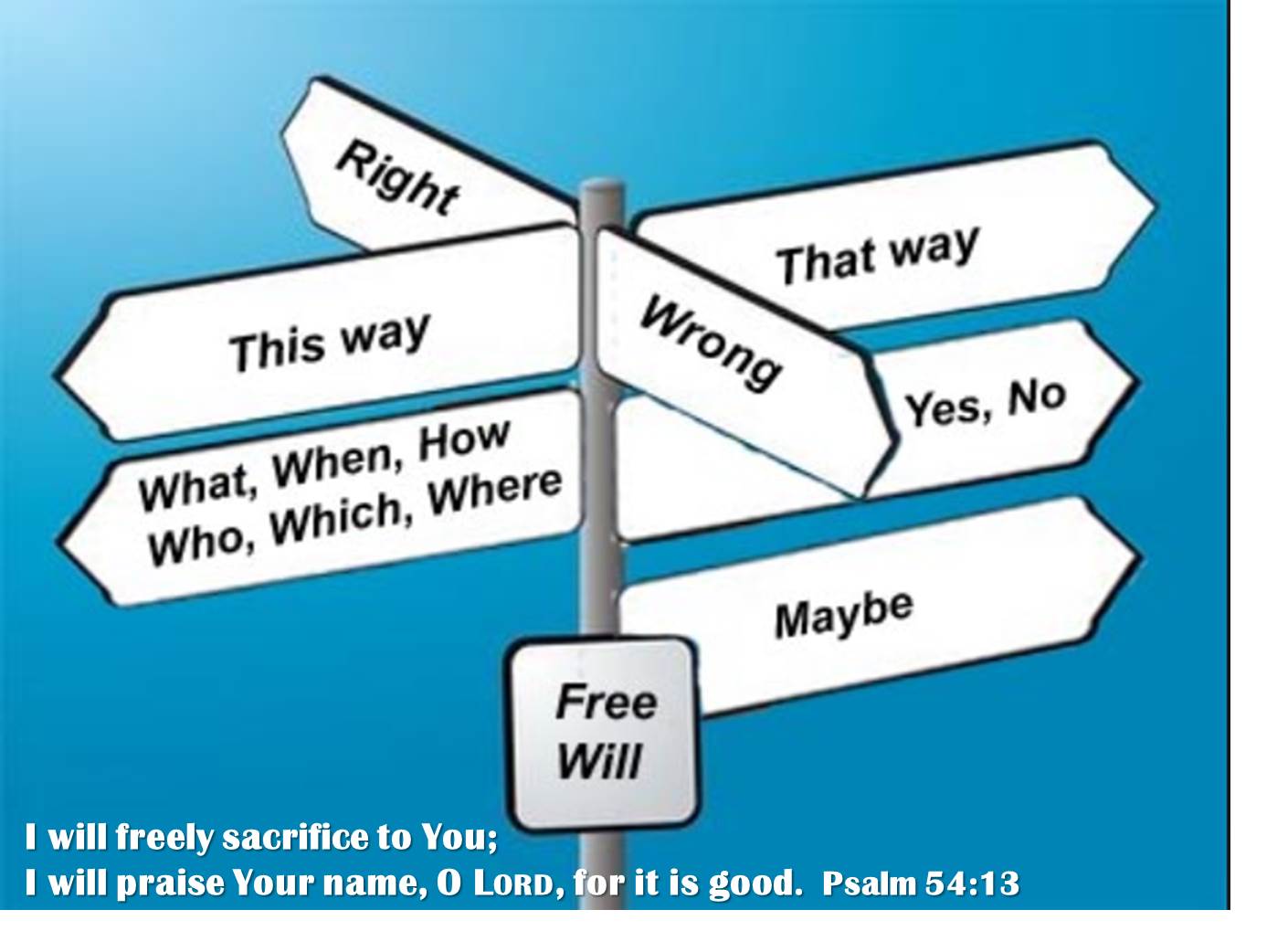
God not only created us with a will as part of our souls; He created us with a free will to make our own life choices.  Because God is all-knowing, He knew that many of His children would make bad decisions in their lives and damage or destroy their lives.  We see people every day making bad choices that cause them physical and emotional pain either for themselves or others, falling into addictions, committing crimes against others or treating others unfairly.  So why did God give us free will, and “what would you have done if you were the Creator God”?

The Scriptures say that “God is love” and that He is the source of all love.  He created us in His image, to love Him and our fellow brothers and sisters.  Many people choose not to love God or follow His will, but rather they follow their own selfish will.  Because of their bad choices, they cause great pain and suffering to themselves and others.  So what if God had “programmed” our minds and hearts to love Him, so that we had no choice but to love Him.  Everyone would love Him unconditionally, but would God be pleased and rejoice over us?  If I were Him, I would be sad and depressed, knowing that my creation loved me, but they had no choice in the matter, so it wasn’t fulfilling and their love didn’t mean anything to me.

God is a God of relationships, and He created us to be in relationship with Him.  When we love and trust Him as our best friend, Lord and ruler of our lives, we have the greatest joy and fulfillment possible, and God smiles and rejoices over us because we have chosen the best path and because another one of His children loves Him of their own free will and has a personal relationship with Him.

More Than Salvation

Eye has not seen

There is a traditional song for Passover entitled Dayenu that means “it would have been enough”.  It begins this way:  “If He had brought us out from Egypt, and had not carried out judgments against them Dayenu, it would have sufficed us!  If He had carried out judgments against them, and not against their idols Dayenu, it would have sufficed us!”  The song goes on to recount all that YHVH did for the Israelites relative to their exodus from Egypt and their move toward the Promised Land.  Actually, all that YHVH did was needed to accomplish His purpose!

For many of us, salvation seems to be all that we need.  To be forgiven for our sins and to be restored to relationship with YHVH is monumental and is far more than we have any right to expect.  Even though it seems sufficient, Yeshua’s suffering and death provide us  much more.  YHVH has so much more that He wants to accomplish.

When we accept Yeshua as our Lord and Redeemer, we are freed from slavery to hasatan and become children of the Most High God.  We are clothed in the righteousness of Yeshua, a righteousness so holy and pure that none of us could attain it on our own.   This seems more than sufficient, but there is still more.

During His first coming, Yeshua demonstrated the gifts He came to bring us.  He healed multitudes of people from physical, mental, and emotional damage and He even restored life to some who had died.  Yeshua also delivered many people from bondage to demons.  What He provided then, He provides to this day.  This should certainly be sufficient, but the blessings continue.

Yeshua taught us by His example and His words how to be effective citizens of the Kingdom of Heaven.  He explained Abba’s values to us and told parables to make His lessons easier to comprehend. He fed the hungry with a small bit of food that was miraculously multiplied.  He met everyone’s needs and He wants to meet our every need also.  Surely this is sufficient, isn’t it?  Ah, but there is still more.

Not only has Yeshua provided all these things for us, but He has empowered us to share the gifts with others.  Yeshua temporarily relinquished all His power as the second Person of the Triune God and was empowered solely by the power of the Holy Spirit in order to demonstrate to us how we could do the works He did and greater.  For many Christians this news is too good to be true, so many of YHVH’s gifts are denied and rejected and much of the work needed to build the Kingdom of YHVH is left undone.

A 2009 Barna survey reveals that the majority of Christians do not believe that Satan or the Holy Spirit are actual living entities.  Even though YHVH is spirit and we are to worship Him in spirit and in truth, many of us aren’t doing that because we deny the existence of a spiritual realm or are confused that there is a spiritual realm.  How much are these brothers and sisters in Yeshua missing because of blindness and/or stubbornness?

YHVH overflows with mercy, compassion, and generosity.  He knows that even though we have received our citizenship to the Kingdom of Heaven, we still reside in the Kingdom of Hell. YHVH provides for us not just a bright future, but a delightful present.  YHVH did not liberate the Israelite slaves in Egypt just to abandon them in the wilderness.  Instead, He worked with them to show them His ways and to prepare them to live as His special people in the land He provided just for them.  Likewise, YHVH does not provide us escape from the kingdom of darkness without equipping us to be effective citizens in the kingdom of light.

YHVH provided protection and sustenance (manna, quail and water) for the Israelites.  As long as they obeyed and trusted Him, they were not sick and even their clothing did not wear out over a 40-year period.  YHVH gave the Israelites His commandments and teachings, so that they could live in harmony and prosperity and all would be treated fairly.  He wanted them to be a light to all the other nations.  YHVH taught them how to worship Him.  The feasts He provided were meant to commemorate what they had experienced as well as to prepare them to recognize and receive their Messiah, who was coming to bring them even greater gifts than they had already received.  We read in the book of Exodus how the Israelites wanted to pick and choose among the gifts offered, and even rejected the gifts sometimes.  Many times they not only refused to live in the light, but were unable or unwilling to share that light with others.

We often shake our heads at their blindness and stubbornness, yet we fail to first remove the plank from our own eyes.  Yeshua has offered us forgiveness, salvation, His righteousness, eternal life, health, protection, teaching through Scripture, His example and the Holy Spirit, deliverance from bondage to demons, and empowerment to do the same works He did.  We fail to recognize that every single thing that Yeshua provides for us is absolutely essential to us for both our well-being and the building of YHVH’s kingdom.  Yeshua not only shares what He has with us, but He sacrificed Himself so that we might have all that He offers.  Will we continue to insult Him by devaluing some of His gifts?  Yeshua humbled Himself in every way to obtain for us what we could never get for ourselves.  Are we too proud and foolish to admit that we need what He offers?  It is not sufficient (dayenu) that we pick and choose only what appeals to us.

Speaking God’s Awesome Name

LORD of Hosts“And Moses built an altar, and called the name of it the LORD my Banner [Yehovah Nissi]” Exodus 17:15

In my previous postings on God’s Name, Yehovah, I spoke about the importance of knowing and speaking God’s holy Name. We learn from the Scriptures that His Name is holy, righteous, mighty, beautiful, glorious, exalted, a high tower, the Word of God. As far as the LORD being a helper for us in our everyday lives having to live “in the world” but not being “of the world”, here are some of the titles and roles that our God [Yehovah Elohim] fulfills: The LORD my rock (tzuri) and my redeemer (goali), my banner/miracle (nissi), my provider (yireh), our shield (mageinu), our refuge (mach’seh), our righteousness (Yehovah Tsid’keinu), The LORD of peace (Yehovah Shalom), the LORD our presence – or “He is there” (Yehovah Shammah), the One who heals (Yehovah Rapha), and the LORD of hosts/armies (Yehovah Tzeva’ot).

This final name, Yehovah Tzeva’ot, is one of the most powerful – it literally means LORD of armies or LORD of hosts.  In Isaiah, we see how this Name is associated with the Messiah in several different passages – here are a couple of examples:

  • Isaiah 44:6 – “Thus says the LORD, the King of Israel and his Redeemer, the LORD of hosts [Yehovah Tzeva’ot]: ‘I am the first and I am the last; besides me there is no god’.
  • Isaiah 47:4 – “Our Redeemer—the LORD of hosts [Yehovah Tzeva’ot] is his name—is the Holy One of Israel.”

From other passages in Isaiah, we know that “The Holy One or Mighty One of Israel” is always used to refer to the Messiah. Putting these references together, it is clear that Yeshua HaMashiach is called the LORD of Hosts as He is the person of the Godhead who directs God’s armies (both heavenly and earthly armies). One other clear passage that identifies Yeshua as Yehovah Tzeva’ot is in Zechariah 14:16: “Then it will come about that any who are left of all the nations that went against Jerusalem will go up from year to year to worship the King, the LORD of hosts and to celebrate the Feast of Booths”. We have learned from these and other Scriptures (through the Holy Spirit’s inspiration) that when we are cleansing our household of evil spirits (demons), it is very effective to use this divine name of Yeshua, as He is the LORD of Hosts.

There is truly “power in the Name” as believers often quote, but what name is that? We know from Yeshua’s own words to us that we can pray to the Father in His name and whatever we ask will be done (paraphrased from John 16:23). Yeshua also says in John 17:11 (in his prayer to Abba Father): “Holy Father, you have given me Your name; now protect them by the power of Your name so that they will be one just as We are One. During My time here, I protected them by the power of the name You gave me”. Then later in His prayer He says: “I have declared to them Your name, and will declare it, that the love with which You loved Me may be in them, and I in them” (John 17:26). So we see from this that Yeshua’s name is holy and powerful, but He is also named with the same name as all persons in the triune Godhead, Yehovah.

So when you are praying, remember that the name and titles of our God, Father, Son & Holy Spirit, are powerful, not only for salvation, but for protection and deliverance from our enemies (physical and spiritual), for healing, for victory in life’s battles, and for our times of praise and worship when we are seeking His face, His guidance, and His voice speaking into our lives. Try out these names and see how Yehovah answers you.

The Lion of the Tribe of Judah

Lion of JudahJudah is a lion’s whelp…and as a lion, who shall rouse him? The scepter shall not depart from Judah, nor a lawgiver from between his feet, until Shiloh comes; and to Him shall be the obedience of the people. Gen 49:9-10

As I mentioned in a previous blog on YHVH’s Gospel message written in the stars (Messiah’s First Coming Foretold in the Stars), we can identify the beginning and ending of the story written in the star pictures, as it is confirmed in all the ancient Zodiac drawings. For instance, the great sky painting found in the Temple of Esneh in Egypt shows the whole image of the Zodiac with all of its constellations. Virgo (the virgin) is shown as the first sign of the Zodiac. Between Virgo and Leo (the Lion), there is a carved figure of the sphinx with the head of a woman and the body of a lion. The woman’s face is looking at Virgo and the lion’s tail is pointing at Leo, telling us where the Zodiac Gospel story begins and ends.

The sign of Leo the Lion (or Aryeh in Hebrew – אַרְיֵה) is not only the last of the 12 signs of the Zodiac, but it tells the end of the Gospel story if you are following it in the Scriptures. Taking the ancient star names from this sign and compiling them together, the meaning that emerges can be paraphrased as “Messiah’s final triumph”. Leo (Aryeh) represents Messiah Yeshua, returning to Earth as King of kings and LORD of lords at the end of the age as revealed in the Word of YHVH.  Aryeh is always shown and named as a lion in the drawings and languages of all the ancient Zodiac depictions.

He is sometimes shown to be treading on a serpent (Hydra), as confirmed by the ancient star name Regulus, which literally means “treading under foot”. Based on some of the other star names in this sign, Aryeh also means “a lion hunting down His prey”, or (from the Arabic star-names) “coming forth as a flame”.

The Egyptian name (Pi Mentekeon) means “the pouring out”, which symbolizes the pouring out of Divine wrath on the Old Serpent. The name of the Serpent constellation associated with this sign, Hydra, literally means “he is the abhorred” – Yeshua is the only One who is able to destroy the evil one (HaSatan). The star names in Aryeh tell the rest of the story without further explanation: “the Judge or Lord who comes”; “the exaltation”; and “the shining forth” (see Revelation 5:5-14).

The second constellation in Aryeh is Crater (the Cup, which represents the cup of Divine wrath poured out upon the Serpent. This syncs up with Scripture as “the cup of His indignation” (Rev 14:10) and “the cup of the fierceness of His wrath” (Rev 16:19). The final constellation in Aryeh is Corvus (the Raven), whose star-names in the ancient languages refer to the birds of prey devouring the Serpent. Its Arabic name is Minchir al Gorab, meaning “the Raven’s tearing to pieces”. The brightest star is Al Chiba, which means “the curse inflicted” – which refers to the birds of prey who took part in the final avenging of God’s curse on the evil forces of the world (Rev 19:17,18,21).

We can see confirmation of the Lion being used as a symbol for YHVH coming in judgment to defeat His enemies in Isaiah 42:13: “The LORD shall go forth as a mighty man, He shall stir up jealousy like a man of war; He shall cry, yea, roar; He shall prevail against His enemies”. Just as with the other “strongman” signs in the stars, Aryeh is a Lion in this case which symbolizes Yeshua as El Gibbor, “a mighty man” who is also YHVH God.

Out of all the universe, the Lion of Judah alone is worthy to judge and to reign over the Earth. In Revelation 5:5-6, after John starts weeping because no one is found worthy to open the scroll and read the final words proclaiming the end of the world, John says:

“…one of the elders said to me, ‘Do not weep. Behold, the Lion of the tribe of Judah, the Root of David, has prevailed to open the scroll and to loose its seven seals.’  And I looked, and behold, in the midst of the throne and of the four living creatures, and in the midst of the elders, stood a Lamb as though it had been slain…”

This is our Messiah Yeshua, a Mighty Man, God incarnate, the Lamb slain from the foundation of the world, the Lion of the tribe of Judah.  Even quoting His names and titles from the Scriptures sends supernatural joy and power surging through my veins. Speak His names out loud, bask in His glory, tell Him how worthy He is and how much you love and worship Him. For we know that someday, all people will bow down and worship Him, the Lion of Judah, “…the Lamb slain from the foundation of the world” (Rev 13:8). I am going to start now instead of waiting until the end of the world – how about you?

Is Persecution part of YHVH’s Plan?

persecuted for righteousnessRemember the word that I said to you, ‘A servant is not greater than their master.’ If they persecuted Me, they will also persecute you…” (John 5:20)

What do you think of when you hear the word persecution? Do you think it is something God sanctions as part of His plan, or something He is working to eliminate? Listen to Sha’ul [Paul] when he is speaking to the Corinthians (II Cor 11:21-26):

“…But whatever they dare to boast about—I’m talking like a fool again—I dare to boast about it, too…I have worked harder, been put in prison more often, been whipped times without number, and faced death again and again. Five different times the Jewish leaders gave me thirty-nine lashes. Three times I was beaten with rods. Once I was stoned. Three times I was shipwrecked. Once I spent a whole night and a day adrift at sea. I have traveled on many long journeys. I have faced danger from rivers and from robbers. I have faced danger from my own people, the Jews, as well as from the Gentiles”.

This was part of a long passage where Sha’ul was boasting in what Yeshua was doing through him – not that he was boasting because of his own merit or abilities, but because YHVH had blessed Him to be able to survive and endure through trials and unjust persecution.

So what does YHVH Father say about persecution (speaking through Yeshua, since we know that Yeshua speaks only His Father’s words (John 12:50) and that He is One with Abba Father (John 10:30). In Matthew 5:10-12 He says:

“God blesses those who are persecuted for righteousness, for the Kingdom of Heaven is theirs. God blesses you when people mock you and persecute you and lie about you and say all sorts of evil things against you because you are my followers. Be happy about it! Be very glad! For a great reward awaits you in heaven. And remember, the ancient prophets were persecuted in the same way”.

In the verse at the top of this blog (John 5:20), Yeshua says that persecution is a natural result of being His follower. Why would we not be persecuted, since He was persecuted so viciously, and as His servants we are no greater than our Master?

Sha’ul says he was persecuted by his own people, the Jews, as well as by the Gentiles (the Romans). This time period (64-68 AD) was also the beginning of the first government sponsored persecution of Christians. This was during the reign of Nero, and began a long succession of cruel and merciless tyrants who ruled the Roman Empire from the 1st – 3rd centuries AD. Nero was the last of the Caesar’s and was known for his hatred of the Christians. Tacitus the historian wrote that Nero was strongly suspected of setting the great fire in Rome (64 AD). He went on to lay the blame on the Christians, which justified his subsequent persecution of believers: “Nero fastened the guilt and inflicted the most exquisite tortures on a class hated for their abominations, called Christians” (Tacit. Annals XV).

By the mid-2nd century AD, mobs could be found willing to throw stones at Christians, and they might be mobilized by rival sects. The Persecution in Lyon in which Christians were mass-slaughtered by being thrown to wild beasts under the decree of Roman officials for reportedly refusing to renounce their faith (according to St. Irenaeus) was preceded by mob violence, including assaults, robberies and stonings.

The persecutions culminated with Diocletian and Galerius at the end of the third and beginning of the 4th century. The Great Persecution is considered the largest. Beginning with a series of four edicts banning Christian practices and ordering the imprisonment of Christian clergy, the persecution intensified until all Christians in the empire were commanded to sacrifice to the Roman gods or face immediate execution. Over 20,000 Christians are thought to have died during Diocletian’s reign. This persecution lasted until Constantine I came to power in 313 and legalized Christianity.

Over the last 1700 years, persecution against Jews has been rampant and widespread across the world, but persecution against Christians, although strong in Islamic nations and Godless nations such as China and India (and historically Russia) for many years, has greatly intensified in the Middle East over the past 10-15 years. Christians in America have not generally known true persecution, but we are now seeing the atrocities of it reported daily in places like Iraq, Syria, Pakistan and Saudi Arabia. We are seeing beheadings like we have never known in our lifetimes, and detestable acts of cruelty against men, women and children that are too horrible to even describe.

This could be a sign that the End Times are drawing closer, as Yeshua described in Matthew 24, but it could also be a warning to all believers that they will be persecuted: “Yes, and all who desire to live godly in Messiah Yeshua will suffer persecution”. (II Tim 3:12) How will you prepare yourself to be stand firm in the face of persecution – will you be able to face the worst form of persecution, and will YHVH be able to say of you that you were one of the martyrs who: “… overcame him by the blood of the Lamb and by the word of their testimony, and they did not love their lives to the death”? (Rev 12:11) The best way to prepare yourself is by strengthening your relationship with YHVH.

Yehovah is Light

light shining out of darkness We must work the works of Him who sent Me while it is day; the night is coming when no one can work. As long as I am in the world, I am the light of the world.” John 9:4-5

I John 1:5 says that God is light, but what does that really mean and why is it important to us? It seems significant that immediately after God [Elohim] created the heavens and the earth, He saw that “The earth was without form and void; and darkness was over the face of the deep”. (Gen 1:2)  It is clear that He was not pleased with the darkness, because He then said “Let there be light”, and when He saw the light, He declared that it was good (Gen 1:4). But He didn’t stop there – He was still not totally satisfied, because He then separated the light from the darkness.

At a physical level, we have a very consistent theme here – God is light and is the source of all light. There is a related theme that is just as important though – God cannot dwell in the presence of darkness, so He must separate His light from all darkness. I quoted the first part of I John 1:5 above, but I left out the last part – after John says that God is light, he goes on to say “in Him there is no darkness at all”. Throughout the Scriptures, darkness is associated with people’s sinful hearts (John 3:19), or the evil one and his Kingdom of darkness (Col 1:13).

In the same way that YHVH separated the light from the darkness in His creation, he wants to separate us from the darkness of this world. In Isaiah 52:11, YHVH says: “Depart, depart, go out from there; touch no unclean thing; go out from the midst of her; purify yourselves..”. He is telling His people to come out of the darkness and impurity of the world and to cleanse their hearts of worldly impurities. Sha’ul tells us to live in the light: “You are all children of light and of the day. We are not of the night nor of darkness”. (I Thess 5:5) Peter [Keifa] says that as followers of Yeshua we are: “…a chosen generation, a royal priesthood, a holy nation, His own special people, that we may proclaim the praises of Him who called us out of darkness into His marvelous light”. (I Pet 2:9)

From all that we have studied about the deeper (sod) spiritual meaning of YHVH’s Scriptures, everything that YHVH does has a purpose and usually teaches us some type of lesson. So let’s dig a little deeper here. We started at the front of the book with God “turning on the lights” in the beginning, and also heard John make the statement that God is light. Now let’s go to the back of the book. In Revelation 21:23, Yeshua tells John that in the end there will no longer be any need for the sun and moon because the glory of God will illuminate the city of New Jerusalem, and the Lamb [Yeshua] will be its light. When we look at the ancient Hebrew word pictures associated with the three letters in the word for light (ohr in Hebrew), we see a deeper meaning emerge: “the first Man [Yeshua the living Word] was there in the beginning when light was created”. So, we see that Yeshua was the source of light in the beginning, and He will be the source of Light again when He comes to reign on the new Earth.

Yeshua told us clearly that He is the Light of the world and we are to follow Him:

  • John 8:12: “I am the light of the world. He who follows Me shall not walk in darkness, but have the light of life.”
  • John 12:46: “I have come as a light into the world, that whoever believes in Me should not abide in darkness.”
  • Acts 26:17: Yeshua encountered Sha’ul on the road and told him to be a light to the lost: “… to open their eyes, so that they may turn from darkness to light and from the power of Satan to God…”.

Sha’ul encourages us to walk in the light of Yeshua: “For you were once darkness, but now you are light in the Lord. Walk as children of light”. (Eph 5:8) In Yeshua’s well-known teaching in the Sermon on the Mount, He says: “You are the light of the world. A city that is set on a hill cannot be hidden. Nor do they light a lamp and put it under a basket, but on a lampstand, and it gives light to all who are in the house. Let your light so shine before people, that they may see your good works and glorify your Father in heaven”. (Matt 5:14-16) At first glance, it sounds like He wants us to be out there in the world drawing attention to ourselves as we do good works. But look at the punchline at the end. What is the purpose of doing good works? So that we can “Glorify our Father in Heaven”. We are not to draw attention to ourselves through our wonderful deeds, but to Abba Father! We need to be constantly pointing to Him when people ask us why we are doing what we do, acting humbly and selflessly but boldly giving Him the glory.

Who Is YHVH?

Jesus is GodIn last week’s blog, Peter pointed out that Yeshua is YHVH. Why is it so important to make this point? Does it change your perspective of Yeshua? There is a tendency in many of us to rank God the Father as superior to Yeshua. It has even been taught in some circles that we are only to address the Father in prayer, and that it is wrong to pray to Yeshua. When Yeshua taught His disciples how to pray, He addressed the Father rather than Himself. And yet, Yeshua also tells us “Whatever you ask in My name, that will I do, so that the Father may be glorified in the Son. “If you ask Me anything in My name, I will do it (John 14:13-14). Yeshua glorifies the Father, and the Father glorifies His Son, Yeshua (John 8:54, 17:1; John 17:5).

Over the past two centuries, there have been various creeds and teachings denying that Yeshua is God. This type of heresy continues today. In fact, in some circles Yeshua is considered to be merely a thought or spiritual representation of YHVH.  Yeshua is clearly identified as YHVH’s Son in Scripture (1 Cor 15:28; Ps 2:7; Heb 1:5; Matt 3:17; John 1:14; 1 John 4:10; John 5:26; 1 John 5:9). Even we mortals produce children and they are certainly more than just a thought or a representation of us. If the name of YHVH had been known and if Scripture in its entirety had been correctly understood, then these debates would not have surfaced or, if they had, could have been quickly dismissed.

In order to get a more complete picture, it is best to start at the beginning and work from there. John 1:1-2 helps us to get started.  In the beginning was the Word, and the Word was with God, and the Word was God. He was with God in the beginning. Through him all things were made; without him nothing was made that has been made.” . This verse takes us back to the first chapter of Genesis. The Word spoke creation into being. Later the Word would speak to Abraham in front of his tent (Gen 18) and to Moses in the burning bush (Ex 3). We learn in John 1:14 that the Word became flesh and dwelt among us.

The Word not only became flesh, but put Himself in the same position as the rest of us. For a time He set aside His power and entered the world in total dependence on the Father. Who, being in very nature God, did not consider equality with God something to be grasped, but made himself nothing, taking the very nature of a servant, being made in human likeness (Phil 2:5). He showed us what we could do when empowered by the Holy Spirit as He was. “Very truly I tell you, whoever believes in me will do the works I have been doing, and they will do even greater things than these, because I am going to the Father.” (John 14:12-14)

The Jewish leaders understood that to be the Son of YHVH meant equality with YHVH.    For this reason they tried all the more to kill him; not only was he breaking the Sabbath, but he was even calling God his own Father, making himself equal with God (John 5:18).  Yeshua told them that he saw the Father at work and did the same work as His Father.  Yeshua went on to clarify the relationship between His Father and Himself (John 5:19-23).

YHVH tells us that His thoughts are above our thoughts, and His ways above our ways (Is 55:8-9). It is difficult to understand how three separate persons can be so united and act as one. Yet, YHVH has provided an example for us. The three persons of YHVH are echad, just as a husband and wife are echad.  The husband and wife can become one flesh, but they can also think and act in unity. Even so, they remain two distinct people.  In Hebrew, echad can not only mean “one” as in the number one, but it can mean thinking and acting together as one. The example we have of husband and wife is not perfect, and sometimes far from it.  But we can see how the ideal would be when a husband and wife are aligned in their thinking and acting.

The third Person (Holy Spirit) of the Godhead has been sent to us to help us understand YHVH’s thoughts and ways.  Yeshua tells us in John 16:12-14:

“I have many more things to say to you, but you cannot bear them now. “But when He, the Spirit of truth, comes, He will guide you into all the truth; for He will not speak on His own initiative, but whatever He hears, He will speak; and He will disclose to you what is to come. “He will glorify Me, for He will take of Mine and will disclose it to you.…”. 

We see clearly that the Holy Spirit is also a Person, for Yeshua refers to the Spirit repeatedly as He, not it.  Yeshua states that the Holy Spirit will not speak on His own initiative.  If Father, Son and Holy Spirit were all the same Person, there would be no need to make such a statement.  The three persons of YHVH are perfectly aligned at all times and, therefore, may seem to be only one.   Each person of the Godhead, YHVH, is wholly divine and wholly deserving of our worship, awe, and devotion.

Jesus is LORD [Yeshua is Yehovah]

Yeshua is YehovahSo that at the name of Jesus every knee will bow, of those who are in heaven and on earth and under the earth, and that every tongue will confess that Jesus Christ [Yeshua the Messiah] is Lord [YHVH], to the glory of God the Father. Phil 2:10-11

In previous postings on the Name of the sovereign God of the universe, YHVH [Yehovah], I talked about the importance of knowing and speaking His Name, as well as the sad history of the silencing of God’s Name for the past 2300 years. If you recall from those blogs, after the return from exile in Babylon, priests of the Second Temple era decided that God’s name was too holy to pronounce, and they banned the speaking of the Name among the common Jewish people (the priests still knew how to pronounce the Name).

In this blog, I continue this history up into the New Testament period and show how there was even further obfuscation of the Name leading up to the time of Yeshua’s first coming. The first translation of the Old Testament [Tanach] into Greek was the Septuagint, which was completed in 132 BCE. By this time, it was well established that the Name of YHVH was not to be written in any texts (even within Greco-Roman writings). Since the Jews had already been substituting Adonai (Lord) for YHVH, the Septuagint scribes continued the same tradition. When more modern English translators strove to come up with translations that were more faithful to the original Hebrew Tanach Scriptures, they reverted the references to God’s Name (as opposed to His holy title of Lord) back to “LORD”, leaving the other references as “Lord”. Thus, we have a clear way to distinguish God’s Name (YHVH) from his title (Lord) in the Old Testament Scriptures.

When the translators of the Greek New Testament translated the Greek into Latin and modern languages such as English, though, they could not distinguish between the references to the Name YHVH and Lord (as a title). Both words are written as Kurios in Greek. What we have in the New Testament, then, are many verses that are ambiguous as to which meaning is being expressed, God’s Name or His title. I want to focus here on the places in the New Testament where Yeshua is referred to as Lord. Many times this truly is a holy title given to our Messiah and Savior. However, there are quite a few places where Yeshua is being addressed by the Name of God Almighty, YHVH [Yehovah].

Some of the most obvious references to Yeshua as YHVH are quotes or paraphrases of Old Testament verses. The most vivid example of this is the Scripture quoted at the top of this blog, Philippians 2:10-11. Just before this passage (vv. 6-8), the author is saying that Yeshua did not take advantage of the fact that He was in His very nature part of the Godhead, but lowered Himself to be born as a human and then of His own will gave up His life to die on a cross. Then in Verse 9, Sha’ul says that Abba Father gave Him the Name that is above every name. Believers in Yeshua, having the English translations available to them for the New Testament, have always assumed that this Name above all names is Jesus [Yeshua]. However, remember that Yeshua was the name given to the Son of God when He was born on Earth as a human – this name represents His mission, since Yeshua means salvation or deliverance.

Here are a few other verses where it speaks of Yeshua as Lord (which should have been translated as LORD [YHVH]:

  • Rom 10:9-10: ..if you confess with your mouth that Jesus is Lord [YHVH] and believe in your heart that God raised him from the dead, you will be saved. For with the heart one believes and is justified, and with the mouth one confesses and is saved.
  • I Cor 12:3: and no one can say “Jesus is Lord [YHVH]” except in the Holy Spirit.
  • Matt 23:39: [Yeshua said to the people on “Palm Sunday”] – for I say to you, you shall see Me no more till you say, ‘Blessed is He who comes in the name of the Lord [YHVH]!’

Some of these verses include quotes or paraphrases from the Old Testament:

  • Phil 2:10-11 was patterned after Isa 45:3: That to Me every knee shall bow, every tongue shall confess. They shall say, ‘Surely in the Lord [YHVH] I have righteousness and strength.
  • Matt 23:39 was a direct quote from Psalm 118:26 (with LORD in all caps): Blessed is He who comes in the name of the Lord [YHVH]!

You’re probably asking yourself at this stage – so what is the point of all this? Here’s the bottom line – Jesus [Yeshua] was the Messiah’s name when He was on the Earth fulfilling prophecy as our Savior, but His eternal name is the same as the Father’s – YHVH or Yehovah! He is one of the three persons of the Godhead. He existed from the beginning and was there directing the Creation of the universe along with Abba and the Holy Spirit (John 1:3). To know Yehovah the Father is to know Yehovah the Son and Yehovah the Ruach HaKodesh – they are one [echad] in Spirit but different in character and roles.

[We usually address people by using formal titles (Mr, Mrs, Doctor, and so forth) when we don’t know them well, of if they are entitled to a higher level of respect. Only when we have established some degree of intimacy, do we begin calling people by their given names.] For example, if we are Yeshua’s servants, we would call Him Master; but we are His friends so we call Him by His name, Yehovah. If you want to draw even closer to our Creator, Redeemer, Miracle-Worker, and Lord, call on His Name and you will be able to speak to any or all of the holy and awesome persons of the Godhead who created and love us!

Become an Overcomer

soar high on eagle's wingsThe one who overcomes, I will grant to them to sit down with Me on My throne, as I also overcame and sat down with My Father on His throne (Rev 3:21).

Several passages in Scripture stress the importance of being overcomers, but exactly what does that mean?   At first glance, it seems a fairly simple thing to be an overcomer. For example, we read in 1 John 5:4,5:  For everyone who has been born of God overcomes the world. And this is the victory that has overcome the world—our faith. Who is it that overcomes the world except the one who believes that Jesus [Yeshua] is the Son of God?

It might seem that all we need is faith that Yeshua is the Son of God. Ephesians 2:8 tells us that we have been delivered by grace through faith and that even our faith is a gift. This is all true (for Scripture does not lie). However, it is not the complete picture. Faith is more than a sentiment or a creed. Our faith must lead to action. Faith is a gift, but it matters greatly what we do with that gift.

Consider Yeshua’s words in Matthew 25:14-30. We believe that one of the “talents” we have been given is faith. We have also been given other gifts or “talents” corresponding with the purpose YHVH has for each of us in building His kingdom. It is not acceptable for us to bury our gift of faith or let it lay sleeping on a pew. Our faith must spur us into action.

Our faith begins inside, but it should at some point manifest outside as well. Are we becoming more like Yeshua in our attitudes and actions?  2 Corinthians 5:10 shows us that we are accountable: “For we must all appear before the judgment seat of Christ [Messiah], so that each one may be recompensed for their deeds in the body, according to what they have done, whether good or bad.”

So how do we become more like Yeshua? One clear statement is in Romans 12:1-2: “Therefore I urge you, brethren, by the mercies of God, to present your bodies a living and holy sacrifice, acceptable to God, which is your spiritual service of worship. And do not be conformed to this world, but be transformed by the renewing of your mind [soul]…”.  The concept of renewing our minds seems abstract and difficult to accomplish.  Several Scriptures help clarify this process: Ezra 10:11 – Honor the LORD [YHVH]…and do His will. Separate yourselves from the [worldly] people around you…; Ephesians 5:17 – Therefore do not be foolish, but understand what the Lord’s will is; I Peter 1:14 – As obedient children, do not conform to the evil desires you had when you lived in ignorance;  and          I John 2:15 – Do not love the world or anything in the world…

Psalm 103:5 tells us that: [YHVH] contents you with good as long as you live, so that your youth is renewed like an eagle’s.

What does it mean that our youth will be renewed like an eagle’s? An eagle can live up to 70 years, but only if at age 40 the eagle makes a very difficult decision. The eagle has to subject itself to a painful transformation. By age 40, the eagles talons are overgrown and inflexible, the feathers weigh down its wings, and its beak is too bent to be useful. So, over a period of 150 days, the eagle must pluck out beak, talons, and feathers and wait for replacement parts to grow in. He cannot eat and he is completely defenseless. If at any time, the eagle decides that this process is too troublesome, it can give up, but it will die. However, if the eagle persists and “overcomes,” it can regain its youth and live for another 30 years.

What about us? We also must make tough decisions and endure sometimes painful transformations. We must turn our backs on much that might seem desirable in this world and focus on our future with Yeshua. We may be asked to give up everything, even our lives. “And they overcame him because of the blood of the Lamb and because of the word of their testimony, and they did not love their life even when faced with death” (Rev 12:11). However, if we overcome, we will have more than just an extra 30 years of life. We will have eternal life with YHVH. However, we will have much more than that, more than we can imagine.

He who overcomes will thus be clothed in white garments; and I will not erase his name from the book of life, and I will confess his name before My Father and before His angels (Rev 3:5).

He who overcomes, and he who keeps My deeds until the end, TO HIM I WILL GIVE AUTHORITY OVER THE NATIONS; (Rev 2:26)

Follow the World or YHVH?

do not worship their godsIn this second blog of our series on Chanukah and the Maccabbees, we show the distinction between the people of Israel who were staying faithful to YHVH’s appointed times and commandments, and those who were following the pagan ways of the Greeks and Romans. In our previous blog (The Mighty Power of YHVH), we saw that Onias, the high priest of the Jews, stayed faithful to YHVH’s Laws, even when Simon, an Israelite from the tribe of Benjamin plotted with the king to confiscate money from the Temple treasury that was designated for widows and orphans. When the Israelites prayed fervently, YHVH showed great signs and thwarted the intentions of the pagan government to keep the Temple from being defiled.

In II Maccabees 4, Onias’ brother Jason betrayed Onias by telling lies about him and even claiming that he had plotted against the government. He then became the High Priest deceitfully by offering large sums of silver and gold to the king.  He even offered additional silver to build a gymnasium beneath the Temple, and convinced the people to use this pagan facility for nude games in the style of the Greeks. He encouraged the people to follow Greek customs that were contrary to the Law [Torah] and even the priests lost interest in Temple services and sacrifices and would rush off to participate in the games that were forbidden by the Law (II Maccabees 4:14). The people stopped keeping the Feasts and Sabbaths and kept Greek celebrations instead.

Jason was so corrupt that he sent men to the “games” in Tyre with a large amount of silver for a sacrifice to the pagan god Hercules (II Maccabees 4:18-19). Once the Jews moved into actively participating in the ways of the world instead of YHVH’s ways, things went downhill for them very quickly. As recounted in Maccabees 6, There was dissension and jealously among the priests and Jewish leaders, and they killed and bore false testimony to the king about each other, until finally the king decided to become more vindictive about having the Jews abandon their Feasts and Sabbaths, and he defiled the Temple by dedicating it to their chief god, Zeus.

Jason had started the downward spiral of the Jews into the abominations that were committed in the following months. The verse in II Maccabees 4:17 gives the reason for the serious judgments against the Jews that followed their disobedience: “It is a serious thing to disregard God’s Law”. Persecution increased greatly from this time forward, and the Greeks defiled the Temple by holding drinking parties and conducting their immoral sexual rituals with prostitutes there. The altar was filed with unclean animal sacrifices. King Antiochus then prohibited the Jews from keeping their Sabbaths and Feasts, and forced them to eat unclean meats that were sacrificed to the false gods. “Then, during the festival in honor of the wine god Dionysus, they were required to wear ivy wreaths on their heads and march in procession” (II Maccabees 6:7). From this time on, as described in II Maccabees 6:9, the Greek leaders “were told to put to death every Jew who refused to adopt the Greek way of life”.

When Onias was high priest, the people kept the Torah. However, our suspicion is that they were more into following the leaders than they were truly seeking YHVH and His ways. When Jason unjustly replaced Onias, many of the Jews were all too ready to follow him into every type of evil and apostasy. When we look at our modern times, we see that most people (Christian, Messianic or otherwise) tend to follow the ways and customs of the world’s culture, rather than seeking to follow God’s ways and keep His appointed times.

Many today do not realize that they are fighting a battle. Even those who do often fail to recognize that the battle is spiritual. Many followers of Yeshua do not understand the spiritual realm and do not operate in the spirit. However, there is no excuse for ignorance since we have ready access to many versions of Scripture and study tools. We also have the Holy Spirit to guide us.   We must not blindly follow human leaders, but must realize that we as individuals are accountable to YHVH for our choices.

The most glaring examples of this relate to the holidays of Christmas and Easter. Our ancestors celebrated these holidays and many continue to follow suit. When we look at the ancient pagan celebrations, the birth of their chief gods was always celebrated on December 25th. These gods include Zeus/Jupiter, Dionysus/Bacchus, Hercules, Tammuz, Apollo, Mithras, Sol Invictus and others. Birthday celebrations for these pagan gods date back to the time of Nimrod, who was alleged to be Tammuz’ father. Note that Zeus, Dionysus, and Hercules were all being worshiped by the Greeks, and then were adopted by the Jews as part of their apostasy. YHVH established seven feasts to point to the work of His Son. We sin against YHVH when we seek to “honor” Him by celebrating holidays that have always been an abomination to Him. Many try to justify celebrating Yeshua during these pagan holidays, but to mix the pagan and the sacred is an even worse abomination to YHVH. We must not yield to the predominating culture any more than the Jews should have yielded to the predominating Greek culture of their day.

We know that HaSatan attracts followers by counterfeiting the true God. From pagan beliefs, we see a counterfeit parallel between the Greek god Dionysus (Roman god Bacchus) and Yeshua. Dionysus was purported to have been born of a virgin (Ishtar/Isis), son of the heavenly father (Zeus), performed miracles such as turning water into wine (he is the god of wine), died and was raised again on the 3rd day (on March 25th), was identified with the lamb, and given titles such as: “only begotten son“, “king of kings”, “god of gods”, “sin bearer”, “redeemer“,  “anointed one” and “the alpha and omega“.

We do not have space for full discussion here, but many of the other rituals and symbols of Christmas and Easter (whose name comes from Ishtar) originated from pagan rituals and symbols. The wreath comes from the wreath worn at pagan sports celebrations, the tree comes from a pagan ceremony at the time of Nimrod, which claimed that the resurrected Nimrod returned each year to leave gifts under a decorated tree. Read Jeremiah 10 if you want to find out what YHVH says about cutting down and decorating trees for pagan celebrations, and Jeremiah 44:17-19 to read God’s admonition against worshiping the Queen of Heaven (Ishtar in pagan lore).

Armed with this knowledge, how does this affect your view of the main Christian holidays, and more importantly, what does it say to your heart about keeping YHVH’s Feasts and Sabbaths and not the festival celebrations of the world? As we read the story of the Maccabees, it is easy to condemn the Jews who strayed from Yehovah’s commands. Are we guilty of the same thing?

”You shall not worship the LORD your God in that way, for every abominable thing that the LORD [YHVH] hates they have done for their gods…” (Deut 12:31).