Tag Archives: YHVH

There is Power in The Name

In my first posting on this topic (What’s in a Name?), I established through a chain of scriptural references that God wants His Name to be known and spoken, although it has been hidden from the majority of Jews and Christians for 2,000+ years. The true pronunciation of God’s (Yehovah’s) Name was hidden before Yeshua (Jesus) came to earth the first time, as the Jewish leaders had decided it was too holy for the common people to speak. Yeshua said that one of the main reasons Abba had sent Him to Earth was to reveal the true name of the Father (Yehovah) to His disciples while He was on the earth (John 17:6).

Since there were no vowels in Hebrew scrolls at that time, there was no way to know the pronunciation of God’s Name from reading the scrolls. However, Jewish scribes painstakingly transcribed the scriptures in the 10th and 11th centuries into what are now known as the Aleppo and the Leningrad Codex. These scrolls are unique because vowel points were added so that unfamiliar words, such as God’s Name, could be pronounced properly. The image at the top of this posting contains the Hebrew letters for God’s Name, including the vowel points as found in the two Codexes mentioned above. According to 100+ instances in these two Codexes, the Name is clearly pronounced as Yehovah or Y’hovah.

What is even more crucial, though, is how we use His Name. In Zechariah 13:9, YHVH says to His people that they will call upon His Name and He will answer them. In the Aaronic blessing, Yehovah spoke to Aaron through Moses and told him what words he was to speak to the people of Israel to bless them (Num 6:23-26). Very few people know that what YHVH said in the next verse is the most important part of the blessing. He was explaining the significance of the blessing when He said: “So shall they [the priests] put My Name upon the people of Israel, and I will bless them” (Num 6:27). Each verse of the blessing contains God’s holy Name, and YHVH was saying that if they would place (speak) God’s Name over the people, He would promise to bless them.

God loves to hear His Name spoken and there are so many different ways to speak His Name: in praise and worship (Ps 8:1, 66:4, 148, etc.), in blessings (as in Num 6), in prayers (Isa 1:4, Ps 105:1) and in the joys and sorrows of everyday life (as a greeting in Ruth 2:4). There is power in God’s Name; the greatest power in all the universe. In Isa 45:22, Yehovah is telling everyone to look to Him and be saved; He is saying that He Alone is God and there is no other god. Then in the next verse (Isa 45:23) He says “That to Me every knee shall bow, every tongue shall confess.” Finally in Verse 24 He says that all Israel will glorify Yehovah as the true Creator and Redeemer God of the universe.

The power of YHVH’s Name is best seen through His attributes that are contained in His compound names in scripture. One of the most powerful is in the graphic at the beginning of this posting: “Yehovah my Miracle [YHVH Nissi]” – this illustrates that we can call on the Name of Yehovah and trust Him to work miracles in our lives, and then give glory to His Name once again when they happen. Another descriptive name for God is Yehovah Yireh (sometimes written as Jevohah Jireh). This is usually translated as “The LORD my Provider”; however, a more accurate translation is “Yehovah who sees”, meaning in essence that He not only sees and knows our needs but that He satisfies them.

The many other names for God in the scriptures powerfully illustrate YHVH’s mercy, forgiveness, and unconditional love for His people. To know God’s Name is important, but it is more relevant to experience the power and beauty of using His Name when we pray. Such prayers are like sweet fragrant incense rising up to our Father in heaven (Rev 5:8).

For instance, when we are interceding for another who is suffering from illness, we can speak His Name along with the attribute of His character that relates to healing: “Yehovah Rapha (The LORD our Healer)”. When we do this, we can sense the Holy Spirit going into action, bringing healing. In the same way, when we cry out to God that He is our Rock (Yehovah Tsuri) we feel comforted in our soul that we can lean on him as our solid Rock and He will never leave us or forsake us. Many people have experienced peace and comfort when they recite the 23rd Psalm, but when you realize that “The LORD our shepherd” is actually “Yehovah Ro’i” in Hebrew and we can call our Shepherd by His Name, then it makes Yeshua’s words in John 10 so much more personal. Yeshua said in John 10:27: “My sheep hear My voice, and I know them, and they follow Me.” (Isn’t it easier to hear His voice and discern it from all other (false) shepherds when we know His Name as well as His voice? Finally, He says: “I am the good Shepherd. The good Shepherd lays down His life for the sheep.” (John 10:11) How comforting to know that our Creator and Lord is willing to lay down His life for us (and did just that when He died on the cross)?

I will leave you with the words that Yeshua spoke to His disciples near the end of His first mission to the earth: “Peace I leave with you, My peace I give unto you; not as the world gives do I give to you. Let not your heart be troubled, neither let it be afraid.” (John 14:27) If you want to see more about the Hebrew Names for God, see this Web site (remember that “Y” is usually written as “J” in English translations): Names of God – Blue Letter Bible

What’s in a Name ?

They know My Name

When we meet someone, one of the first questions we ask is “what is your name”? Jesus (Yeshua) died for our sins, to restore our relationship with our Father. We relate to God as our heavenly Father, so it is good to call Him Abba (Aramaic for Father or Daddy). But we also know from scripture that He has a name, and that His children are even called by His name – see II Chron 7:14 and Isa 43:7 (“…everyone who is called by My name, whom I created for My glory…”). And should you believe that knowing and speaking God’s name is only for Israel, see Amos 9:12 where God speaks through Amos and says “…And all the Gentiles [nations] who are called by My name, says the LORD…”.

So, how do we know that God wants us to know and speak His name? There are over 100 scriptures in the Torah, Psalms and Prophets where God says that He wants all the earth to know, speak, and praise His name (e.g. Ex 9:16; Num 6:27; Ps 9:10; Ps 66:4; Ps 91:14; Ps 105:1,3; Ps 105:1,3; Ps 119:132; Ps 148:13; Isa 42:8; Isa 52:6; Jer 16:21; Mal 4:2). The other question that pops up is whether God’s name is to be remembered by everyone for all time? This question is answered soundly by David in Ps 45:17 “I will cause Your name to be remembered in all generations; therefore nations will praise You forever and ever”. A prime example of God blessing His people when they remember His name is in Ex 20:27 “In every place where I cause My name to be remembered I will come to you and bless you.”

What does Yeshua have to say about the name of God? In Matt 23:39, when He was weeping over the people of Jerusalem because they had not recognized Him as their Messiah, He said “for I say to you, you shall see Me no more till you say, ‘Blessed is He who comes in the name of the LORD!’ ”. “The LORD“ in this verse is actually YHVH (Yehovah), not Adonai (the Hebrew word for Lord). Yeshua was quoting directly from the prophecy in Ps 118:26, which was talking about the future end times when people would speak those words, and use God’s true name in place of the generic title of “The LORD”. In John 17:6, when Yeshua was praying to Abba Father on behalf of his disciples, He said “I made your name known to the people you gave me out of the world. They were yours, you gave them to me, and they have kept your word.”

In Acts 2:21, Peter quotes Joel 2 when he says “And it shall come to pass that all who call upon the name of the Lord [YHVH] shall be saved”. Just as in Matt 23 above, “the Lord” in this verse is not the generic title for Lord, but rather YHVH (written as The LORD in the Old Testament). In the end times (as reported in Zech 13:9), YHVH says “They will call on My name, and I will answer them. I will say, ‘This is My people’; and each one will say, ‘The LORD [YHVH] is my God.’”

So now that we have established that YHVH wants His name to be known, spoken, praised and glorified in all the earth, how can we know how to speak and pronounce His name? I will go into this in more detail in future blogs in this series, but in summary we know the following to be true:

  • God always wanted us to know His name (from the time He spoke His name to Moses in Ex 3:15)
  • God’s name (the full pronunciation of YHVH) was spoken regularly by people up until the time of the Second Temple, after the return from Babylon – see Ruth 2:4
  • The speaking of God’s name was progressively restricted to a smaller and smaller group of Jews during the Second Temple period (first only the priests, and eventually only the high priest, before and during Yeshua’s time)
  • As stated in John 17:6 above, Yeshua revealed the true name of YHVH to His disciples while He was on the earth (which had been hidden from the common people for several hundred years)

As far as the actual pronunciation of God’s name, there is great dispute, but through our research over a number of years, we believe that His name (YHVH), which is written 6828 times in the Hebrew scriptures, is pronounced as Yehovah (or Y’hovah). We also believe that His name is being revealed to many in this age, as another of the many signs of the approach of the end times that are now unfolding. Finally, we believe it is all part of Yehovah’s plan, that His name would be hidden for a time, and then revealed again to His remnant when the time was right. Stay tuned for further chapters in this story and why we and others believe as we do.

Yeshua is the Way

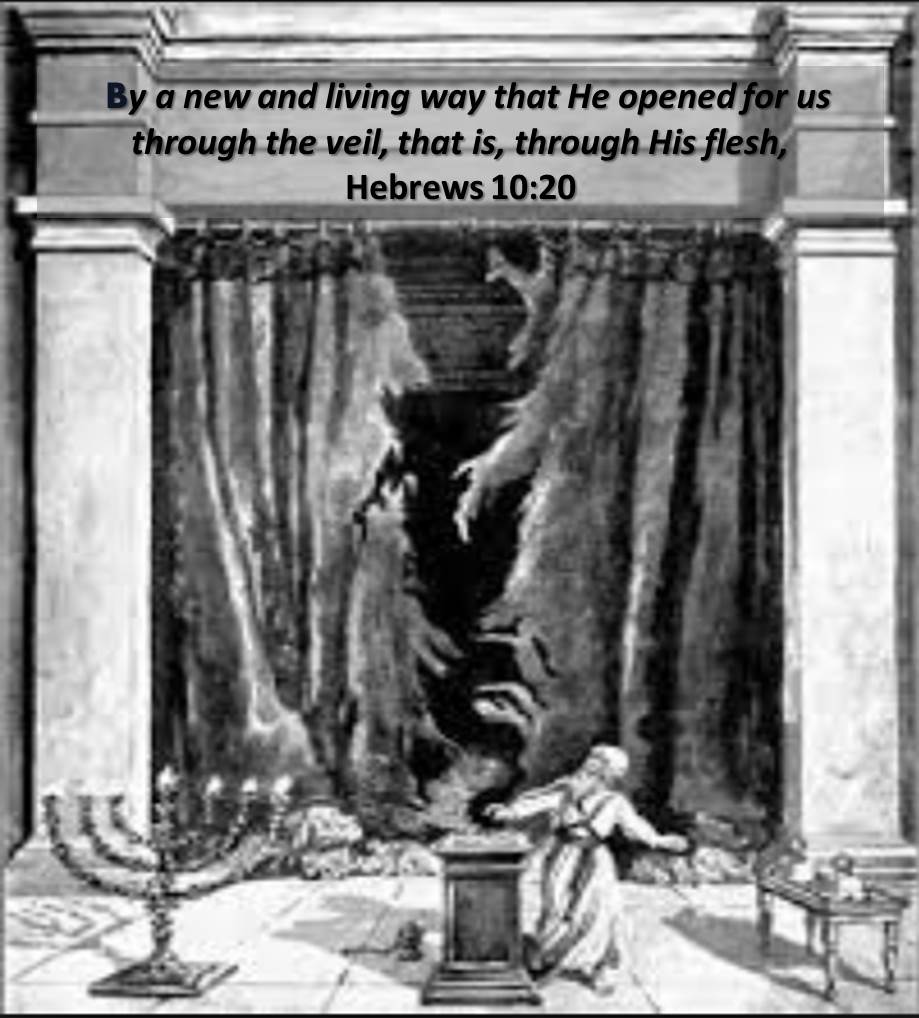
thru-the-veil-of-his-fleshIt is clear that Abba Father tore the veil separating the people from the Holy of Holies when Yeshua’s body perished, because the Scripture says it was “torn in two from top to bottom” (Matt 27:51).  The fact that it was torn from top to bottom symbolizes YHVH reaching down from Heaven and opening the way for us to “come boldly to His throne of grace, that we may obtain mercy” (Heb 4:16).  What is this place we are entering into, though?  For Torah observant Jews of Yeshua’s time, they may have wrongly believed that the way had been opened for them to come into the Holy of Holies and worship in YHVH’s presence, where His glory dwelled above the earthly Ark of the Covenant.

However, through history and the Scriptures, we find a much deeper meaning to the tearing of the veil.  From history we know that the Temple was destroyed and the Ark was hidden or taken away, just as Yeshua had prophesied in Luke 13:35.  Our entrance into the Holiest place, then, was not an entrance into an earthly place, but rather an entrance into YHVH’s heavenly throne of grace.  Sha’ul gives us some great hints as to what this means at a deeper level:

  • “We have this as a sure and steadfast anchor of the soul, a hope that enters into the inner place behind the veil, where Jesus [Yeshua] has gone as a forerunner on our behalf, having become a high priest forever..” (Hebrews 6:19-20)
  • The God who made the world and everything in it, being Lord of heaven and earth, does not live in temples made with human hands,” (Acts 17:24)

The first passage above tells us that Yeshua has gone into the inner place ahead of us, to make a way for us to come before the Father’s throne.  We know from Scripture that Yeshua ascended to Heaven after his Resurrection and now sits at the right hand of the Father, and Hebrews 6:20 tells us that Yeshua is now our high priest.  When He opened the way into the Holy place of the Father in heaven, Yeshua also did away with the sacrificial system.  He became our God-man sacrifice who took away our sins and diseases for all time, not just once a year like the earthly high priest or the animal sacrifices people brought to the Temple.

In the second Scripture above, we learn that YHVH does not live in earthly temples – rather, He dwells in His heavenly Tabernacle, where He now invites us to come and fellowship with Him, through the Way that Yeshua has made for us by tearing the veil.  Yeshua has also made us holy and righteous before Abba, as He has washed us white as snow by His blood (I Cor 6:11).  This is not only a way to the Father, but rather it is the only way to draw close to Abba – in John 14:6, Yeshua Himself said that no one can come to the Father except through Him.

Even with all these insights into the tearing of the veil, though, and the way that has been opened for us into Yehovah’s most Holy place, there is still a deeper and more personal significance to this event.  Hebrews 10:20 (NIV) says that Yeshua opened a “new and living way for us through the veil, but then it equates the veil with Yeshua’s flesh.  This means that we are actually entering into Yeshua’s body when we come before YHVH’s throne – now that is the way to come to the Father!  The next time you come before Abba’s throne in worship, remember that you are entering through the perfect, sinless flesh of the One who showed us His unconditional love by sacrificing His life for us.

Righteous Oaks

righteous-oaksWhen YHVH promises in the beginning of Verse 3 of Isaiah 61 that He will give us: “Beauty instead of ashes, the oil of joy instead of mourning, the garment of praise instead of the spirit of heaviness”, His end goal is not just to give us temporary help to get us through a crisis in our lives. Ultimately, God is building us up to be trees [oaks] of righteousness. We are the “trees” God is planting in the place He desires us to bear fruit.

Oak trees are known to be the strongest, most sturdy and resilient of all trees on Earth. They can withstand hurricanes, tornadoes, earthquakes, droughts and floods better than almost any other type of tree.  God likens His children to oak trees and says we can be just like them in our character and integrity: “They shall be like great oaks of righteousness”.  These are not the words of a long-ago prophecy that have no meaning for us today. This is the expression of God’s heart for His people down through the generations. God wants us to be strong and enduring and He has given us clear insight in His word as to how we are to make that happen.

The average large oak tree needs as much as fifty gallons of water per day, so the root system is large and goes deep to reach that water. The root system not only brings the needed nourishment to the tree but it provides the anchoring base that allows the tree to withstand all kinds of assaults, from the wind, the rain and the shaking of earthquakes.  The root system of a mature oak tree can total hundreds of miles, and the roots of an oak tree extend out underground up to two and a half times their height.  So how can we as YHVH’s children ever hope to have such deep roots?

Jeremiah 17:7-8 is a powerful amplification of what Isaiah is talking about: “But blessed is the person who trusts in the LORD, whose confidence is in Him. They will be like a tree planted by the water that sends out its roots by the stream. It does not fear when heat comes; its leaves are always green. It has no worries in a year of drought and never fails to bear fruit”.

Both in Isaiah 61 and here in Jeremiah, it is clear that YHVH plants His seeds purposefully. He does not take His seeds and scatter them to the wind, disregarding where they fall.  God picks a perfect place for each of us, personally putting the tender shoot in the ground, knowing exactly what lies ahead. God knows every detail of our lives and the place of our planting and He does not make mistakes; we were not planted in the wrong part of the garden!

We were destined to display the “splendor of the Lord.” It doesn’t matter how you feel, you are destined to display the splendor and majesty of YHVH. There are days when you may not feel that you are reflecting God’s glory to others in your world, but if you have deep spiritual roots and are standing tall in constant relationship with YHVH, you will be displaying His majesty.   In fact, He will “rejoice over you with gladness” (Zephaniah 3:17) and even “protect you from trouble and surround you with songs of victory” (Psalm 32:7).

Trees do not instantly develop deep roots, and neither do people – both must go through difficult times of physical or spiritual drought and hardship, and must be patient until their roots develop.  In the case of God’s people, we must be filled with God’s Holy Spirit and grow in our faith and spiritual maturity, learning to trust YHVH more and more for strength to overcome the attacks and temptations of the world.

Trees contribute greatly to purify the air, and render it fit for us to breathe. When the air around us passes through leaf surfaces, it is purified and invigorated.  In the same way, there is a moral atmosphere around us.  When the air around us passes through our spirit and soul, we have the ability to speak life or death, blessing or curse to those around us.  As YHVH spoke in Deuteronomy 30:19-20, “I call on heaven and earth to witness against you today that I have presented you with life and death, blessing and curse. Therefore, choose life, so that you will live, you and your descendants, loving the LORD [YHVH] your God, paying attention to what He says and clinging to Him — for that is the purpose of your life!

As YHVH’s children, when we trust in Him with all our heart and follow His ways and His instructions, our roots will go down deep into the “earth” of the Holy Spirit within us, enabling us to withstand all the trials and tribulations of life, bearing much fruit and glorifying Him through our lives.  As YHVH says in Jeremiah 17:7-8 about those whose confidence is in Him: “we will be like trees planted by the stream, that send our roots deep: we will not fear when heat [persecution] comes; our leaves will always be green. We will have no worries in a year of drought and we will never fail to bear fruit”.

Safe Shelters

refuge-under-your-wingsIn my blog two weeks ago, I wrote about Yeshua as the Door of the sheep, and how He protects from us from all dangers.  Another closely related Biblical concept is that YHVH shelters us, but how does He shelter us?  In many places in the Psalms, David talks about YHVH sheltering us in His hiding place, for example:

  • Psalm 91:1 – He who dwells in the secret place of the Most High shall abide under the shadow of the Almighty [El Shaddai].
  • Psalm 27:5 – For in the time of trouble He shall hide me in His sanctuary; in the secret place of His tabernacle He shall hide me (the Orthodox Jewish Bible says that He will keep us safe in His Sukkah and shelter us in His tent)…He is our refuge and our fortress;
  • Psalm 32:7 – You are my hiding place; You shall preserve me from trouble; You shall surround me with songs of deliverance;
  • Psalm 119:117 – You are my hiding place and my shield; I hope in Your word;
  • Psalm 144:2 – My lovingkindness and my fortress, my high tower and my deliverer, my shield and the One in whom I take refuge

Other scriptures speak about God sheltering us in His high tower, on a rock that is higher than us, or in his fortress, just to name a few of the graphic images He paints.  Many times David and others speak about YHVH as not only keeping them safe in His secret hiding place, but as actually being that hiding place, refuge, fortress, high tower, stronghold, rock, sanctuary, Sukkah, etc.  As an illustration of a high / strong tower, Sh’lomo says in Proverbs: the name of Yehovah is a strong tower; and the righteous run to it [Him] and are safe.  Now we are getting to the purpose of YHVH sheltering us in all these amazing ways: He is keeping us safe from the enemy.  Psalm 32:7 above provides one of the most beautiful word pictures of God’s protection in all of Scripture: He is not only our hiding place, but He protects us from trouble and surrounds us with songs of deliverance.

In Psalm 91, David says that no evil will befall him because he has made YHVH his refuge and dwelling place.  Because David is abiding under the shelter of His wings, YHVH has promised to give His angels charge over David to keep him safe against all physical and spiritual enemies and attacks.  In Verse 14, He says that because we know and trust in His name (Yehovah), He will set us up on high places (a high rock, high tower, etc.).  He also promises that no evil will befall us, no plague will come near our dwelling, and we do not need to fear the arrows by day or the pestilence that comes in the night.  Finally, in Verse 7 He paints an even more vivid picture of how he delivers us in the middle of great battles: “Though a thousand fall at our side and ten thousand are dying around us, these evils will not touch us” (NLT).

Even from the beginning, God has always been there to shelter us and keep us safe.  When He created the Garden for Adam and Eve, He created it as an enclosed garden that was protected on all sides against enemies.  The meaning of the “Garden of Eden” [Gan Eden] from Hebrew is a sheltered or enclosed garden.  There are many examples of how God has provided for our protection in His creation. For instance, the way an eggshell protects the baby chick as the strongest shape in the world, or the way a mother’s womb protects her unborn baby against environmental dangers.

When God saved Noah and his family from the flood, He once again protected them with an Ark that provided their covering and protection from all the devastation that was going on around them.  Another example of YHVH’s protection was the lamb’s blood covering He told the Israelites to apply to their doorposts to protect them from the angel of death.  In the end times, YHVH’s remnant will be sheltered in the protective rocks of Petra (Bosrah in Hebrew), waiting for our King, Messiah Yeshua, to come and usher us into the homeland of Israel.

As you think about all the ways YHVH protects and shelters us in His fortress or high tower, think about the Hebrew letter “tet”, which in the ancient word pictures represented a shelter for protection.  It is used in the word beten to mean the house that surrounds life (the mother’s womb), and in the word for trust (batach), which pictures us being safe inside the surrounding fence.  The word seter means a hiding place or covering, and from the ancient word pictures it literally means a secret hiding place.  Whereas the word for adversary (satan) means the snake that devours life, YHVH provides the seter hiding place which protects us from evil.  Would you rather be under YHVH’s wings which protect your life from harm, or the enemy’s snake-coil which devours your life?

Trust in YHVH with all Your Heart

trust-in-yhvhTrust in the Lord with all your heart, and lean not on your own understanding; in all your ways acknowledge Him, and He shall direct your paths. Do not be wise in your own eyes; fear the Lord and depart from evil. It will be health to your flesh and strength to your bones.” Proverbs 3:5-8

I had memorized this well-known passage in proverbs 3:5-8 many years ago and still repeat it often in many different circumstances.  I would like to be able to say that it always calms my nerves or worries, but I can’t truthfully say that.  I usually have to spend some time with Yeshua remembering all the promises He gave us, that we are not to fear or be anxious for anything.  This tells me then that trust is not just about knowing the Scriptures that tell us God is faithful to watch over and take care of us in all situations.  It is far more about personally knowing the Living Word [Yeshua] who inspired the written Word, than it is about just knowing the written Word.

As believers, we often talk about having faith, more faith, or enough faith to endure whatever trial we are experiencing.  Unfortunately though, faith has become an overused and even watered down concept in our modern society.  Nowadays, we can have faith in Santa Claus, the Easter Bunny or the Tooth Fairy.  So what do we really mean when we say that we need to have strong faith in God?  Yeshua told his disciples that they could have cast the demon out of the young boy if they even had the faith of a grain of a mustard seed (Matt 17:20).  It is clear from this story that what they needed was not more faith, but rather a solid foundation of trust to back up the faith they had.

As human beings, we understand what it means to trust someone at a much deeper level than just having faith in someone.  Think about yourself for a moment and how you feel about trusting your neighbor. You may trust your neighbor enough to lend them your lawnmower, but do you trust them to watch out for your house when you go on a trip?  Would you trust them enough to give them a key so they can take of your plants when you are away?  Would you trust them to take care of your children for a weekend?

I would like to illustrate this point through a true story about a man named Charles Blondin, who was the greatest tightrope walker of his time, in the mid 1800’s.  He gained great fame in 1859 when he became the first person to cross Niagara Falls on a tightrope.  Charles and his friend and manager, Harry Colcord, strung a 2” diameter hemp rope from an oak tree on the American side to a large rock on the Canadian side, and used a series of guy ropes every 20’ (anchored to the shore) to keep the rope as steady as possible.  The greatest risk was the 50’ section in the center of the 1300’ span that could not be reached by anchor ropes.  The incredible thing was that Charles was able to navigate his way across the Falls without any mishaps.  He traversed the Falls a number of times over the next few weeks, carrying props such as a camera and a griddle on which he cooked an omelet, pushing a wheelbarrow, and even doing a backflip on a couple of occasions.

The most daring feat of all, though, was when he carried his manager Harry on his back during one of his crossings.  This is where the rubber meets the road – although the many fans in attendance had faith that Charles was able to cross the Falls (and even bet their money on him), it was only Harry who was able to trust Charles with his life.  A number of guy wires snapped during their crossing, but Charles never wavered.  Harry later told reporters that Charles had coached him to: “look up…you are no longer Harry, you are Charles. Until I clear this place, you are to be a part of me, mind, body and soul. If I sway, sway with me. Do not attempt to do any balancing on your own”.

Here is the essence of trusting God; not just having faith in Him. The spectators watching Charles had faith in him and believed that he was capable of traversing the Falls.  Only Harry, though, trusted him enough to climb on his back and ride across Niagara Falls with him walking on a 2” thick rope.  Is this the kind of trust you have in YHVH – do you trust Him to protect you and care for you and supply all your needs?  Do you trust Him with your whole life – body, soul and spirit – or do you trust more in your own abilities, your financial resources, or your trusted friends? In Psalm 3:6, God promised to direct our paths (keep us going in the right direction) if we would trust and acknowledge Him in every part of our lives.  Are you ready to trust YHVH with your whole heart? He is trustworthy beyond any other person or force in heaven or on Earth.  Go ahead and start trusting Him today – it will be the best decision you ever made!

Let all Creation Praise YHVH !

every-created-thingI have often marveled at Psalm 148 that speaks about everything and everyone in Heaven and on the Earth praising the LORD [YHVH].  We know that our LORD God [Yehovah Elohim] created everything in the universe with His spoken Word.  We also know that the Living Word (Yeshua) was there at the beginning participating in every aspect of Creation (John 1:3).

It is not so amazing that people praise YHVH, since He created us to praise and glorify Him.  He says in Isaiah 43:7 when speaking about His people: “Everyone who is called by My name, whom I created for My glory…”.  In I Chronicles 16:29, David says in his song of praise to YHVH: “Give to the LORD the glory due His name…Worship the LORD in His holy splendor.”  The beautiful thing about glorifying God is that it brings the greatest joy to our hearts because that’s how YHVH created us.  C.S. Lewis once said: “In commanding us to glorify Him, God is inviting us to enjoy Him”.   All through Psalm 16, David talks about praising and glorifying God, and then in Verse 11 He says: “You show me the path of life, granting me the joy of Your presence and the pleasures of living with You forever”.

If we literally believe that “everything that has breath praises YHVH” (Psalm 150:6), then we can look around us and listen to all the voices of God’s creatures.  We are all familiar with the beautiful songs of the birds of the air.  There are also other less familiar voices that are beautifully expressed in the animal world.  Experts say that Fin whales can hear the bleeps of other fin whales from more than 500 miles away, and under the right conditions, Blue whales can hear each other from over 1,000 miles away!

Humpback whales are famous for singing songs that can last up to 30 minutes. They sing in rhyme, and the songs can be heard by other whales. The songs are passed along in the water so that an entire ocean may have all the humpback whales singing the exact same song at the same time—a kind of great whale choir.  How incredible is our God who created these amazing sea creatures, and how incredible is the sound of their praises sung to their Creator!

Any of us who have children (and we ourselves are children of our parents of course), know that when children praise and respect their parents, their relationship is strengthened and there is much greater joy and peace in the household.  In the same way, the right response from us toward God is praise because He deserves it.  When we show our love for YHVH by praising Him, we fulfill the purpose for which YHVH created us.  When we fulfill this purpose, we experience the greatest possible joy—God is pleased, our relationship with Him is enhanced, and He has received what He deserves.

What is even more incredible to me is that all of Creation is praising YHVH (from Psalm 148:1-8): “…His angels; His heavenly army (recall that Yeshua is the LORD of Heaven’s armies); the sun and the moon; all the shining stars (and scientists know that the stars “sing”); the highest heaven of the heavens; the waters above the heavens; the Earth; large sea creatures and the ocean depths; lightning and hail; snow and fog; strong winds that obey His commands; mountains and all hills; fruit trees and all cedars; wild and domestic animals; crawling animals and birds”.  Verse 13 sums up the whole Psalm by saying: “All creation, come praise the name of the Lord. Praise His name alone”.

Fortunately for us, YHVH’s command to praise Him and glorify His Name is not difficult to follow, for when we truly love Him, our praise will flow naturally from that love.  Start praising Him and rejoicing in His name today in this season of joy (Sukkot) and you will experience the greatest joy possible in His presence.

Joy through Obedience

well-watered-gardenIn a previous blog, I talked about God wanting to bless us with happiness, as He says in Psalm 37:4 “Delight yourself in YHVH, and He will give you the desires of your heart”.  What brings us the greatest joy on this Earth, though?  We know it is not “seeking after our own pleasure on His holy day” that YHVH speaks against in Psalm 58.  YHVH is speaking about His Shabbat, and He goes on to say in a positive way: “if you call the Sabbath a delight, the holy day of the Lord honorable, and shall honor Him, not doing your own ways, nor finding your own pleasure, nor speaking your own words, then you shall delight yourself in the Lord; and I will cause you to ride on the high hills of the earth, and feed you with the heritage of Jacob your father. The mouth of the Lord has spoken”.

This is one of my favorite passages from all of Scripture, and one of the most amazing promises YHVH makes, to bless us to the highest degree possible!  Can we be truly blessed by YHVH if we are not following His instructions in the Torah?  Consider the example of the remnant of Israel who returned from Babylon: they were back in Israel for almost 100 years before they re-discovered the Torah scrolls and the people asked for them to be read.

In Nehemiah 8, when the people came together as one in the city center, they appealed to Ezra the scribe to read the Torah Scriptures to them.  When they heard the words of the Torah, they were convicted of their sins and they bowed their faces to the ground and began to mourn and weep.  It is obvious from their reactions that they did not just come to listen to the scrolls for entertainment or casual curiosity, but rather they wanted to know the truth of the Torah commands they had broken before the captivity.  They came to hear, listen and then obey what they heard.  This is the meaning of Sh’ma in connection with the greatest of the Torah commandments: “Hear oh Israel, the LORD our God, the LORD is One” Deut 6:4.  We are to hear YHVH’s word, take it deep down into our hearts, and then act on it by obeying what He says.

Going back to the promise from Isaiah 58, YHVH says that if we obey and honor Him, He will cause us to ride on the high hills of the earth.  When YHVH first brought His children out of Egypt, He also said He would make them ride in the heights of the Earth (Deut 32:13).  We know from the other passages that He meant He would give them prosperity, fruitfulness, and blessings in the land.

In Habakkuk 3:18-19, the prophet says: “Yet I will rejoice in the LORD, I will joy in the God of my salvation. The LORD God is my strength; He will make my feet like deer’s feet, and He will make me walk on His high hills”.  God describes Himself as one “Who treads the high places of the earth” (Amos 4:13).   YHVH created us in His image, and He wants us to keep growing closer to Him so that we can walk on His high hills and experience those same high places where He roams in both His earthly and heavenly realms.

YHVH’s thoughts and ways are higher than ours, but He has given us the ability to draw closer to Him through keeping His Torah and His appointed times (Sabbaths and feasts), coming into His presence more and more so that we can enjoy intimate fellowship with Him.  When we walk in our own paths and fail to follow YHVH’s guidance, we are like dry plants in a desert.  I would much rather be a “follower of the way”, keeping YHVH’s commands and enjoying His blessings to be “like a well-watered garden, like a spring whose waters never fail” (Isa 58:11).  Give it a try – walk with YHVH and follow his instructions and the blessings of joy will flow through your life like a never-ending spring.

Oh the Depth of God !

God's love has no limitWhy do we want to limit God?  I have often heard it said that we should not limit God, but what does that really mean?  Recall the time in the wilderness when God was grieved because His people forgot how He had done many signs and wonders to protect and deliver them from Pharaoh and his army.  In Psalm 78, David tells us how the Israelites provoked YHVH by their sin and disobedience, but how YHVH loved them so much, that whether they turned back to Him or not, He would be divinely forgiving and gracious to them.

What grieved YHVH the most was not so much their sin or disobedience as their lack of trust in Him.  They had forgotten all that He had done for them.  He always had their best interest in mind.  YHVH was saddened that His people limited Him: “Again and again they turned back and tested God, and imposed limits on the Holy One of Israel” Psalm 78:41.  What they had forgotten was that no matter how far they strayed from Him and how many times they grieved Him by their sins, He was always merciful to them and forgave and blessed them.

When I think about YHVH as a limitless God who has no beginning and no end (Rev 1:8; 4:8) and who never changes (Mal 3:6, I Sam 15:29), I think about the times in my life that I have meditated on these attributes of God.  When I was a young child, I would lay on my back watching the clouds float by, thinking about how huge the universe was.  Even at a young age, people had told me that God was infinite, that He existed before anything in the Earth or heavens was made, and that He had no beginning.  I could not wrap my mind around the concept that God had no beginning and that He had always existed, before anything in the universe was created.

Knowing about God and His divine attributes intellectually is one thing, but it’s not the same as knowing God personally.  Even now as an adult, I cannot fully understand our God (Yehovah) who has always existed and always will.  But I do not believe YHVH intends for us to understand everything about Him, since He tells us in Isaiah 55:9 – “..just as the heavens are higher than the earth, so My ways are higher than your ways and My thoughts higher than your thoughts”.

At this point, you may be thinking that God is so far beyond us that understanding Him is impossible, and relating to Him in any meaningful way is an insurmountable goal.  We know through Scripture, though, that YHVH has given us the opportunity to have a personal relationship with Him, and that as we draw closer to Him, He will reveal things to us that can help us understand Him better and expand our limited thinking and expectations.  In James 4:8, right after he says to submit to God and resist the devil, he tells that if we draw near to God, then He will draw near to us.

Although we are limited and He is limitless, if we draw near to Him, YHVH will reveal great things to us: “But as it is written:Eye has not seen, nor ear heard, nor have entered into the heart of people the things which God has prepared for those who love Him.’ But God has revealed them to us through His Spirit“ (I Cor 2:9-10).  Notice in this passage that it is God’s Holy Spirit who reveals His secrets to those who love Him.  This tells me that we cannot understand the deep things of God in the flesh / physical realm, but only in the Spiritual realm.  As we age in spiritual maturity in YHVH’s kingdom, we learn to draw closer and closer to God by spending time with Him and listening to the voice of His Spirit.

At the same time we understand our limitations and God’s limitlessness, we know that YHVH desires us to seek knowledge and wisdom from Him.  In Jeremiah 29:13, He tells us: “And you will seek Me and find Me, when you search for Me with all your heart”.  This is the essence of our walk with YHVH – when we seek Him with our whole heart, we will find Him, and He will reveal His incredible secrets to us as He desires.  Seek this type of relationship with your Creator and Lord and He will give you an abundant life that is so full of wonder and miracles you will not be able to contain them within yourself.

Releasing Love

God's Love

Many of us have accepted Yeshua as our Lord and Redeemer, yet we are unable to trust what He has accomplished for us.  Yeshua bore our punishment for all time so that we could maintain a relationship with YHVH and be a part of His family and His kingdom.  We have all heard this message preached, taught, argued and dissected until the words have perhaps become meaningless to us.   Words are not enough; each of us must experience the love of YHVH.

Too often Yeshua’s sheep silently struggle with guilt, regret, and shame that bog us down and block us from enjoying our Father’s overwhelming love.  Instead, we are inundated with misery that YHVH never intended for us to experience.  Do we believe that if we suffer enough, we can somehow make up for our sins?  Truly, there is no way that we can pay for even one sin.  It doesn’t seem right to us that we can repent and walk away free.  Perhaps that is why we find it so difficult to forgive those who have wronged us.  If others have made us suffer, then we feel justified in wanting them to suffer also.  We do not see things from YHVH’s perspective.  We forget how He rejoices over recovering the lost sheep (Luke 15:1-7) or re-uniting with the prodigal son (Luke 15:11-32).  When things go wrong, we think that YHVH is punishing us, even when we have repented and turned away from sin.  It is right to loathe the sin, but we must not loathe ourselves.

Our experiences in this world color our perception.  We assume that YHVH loves the way people love:  half-heartedly, sporadically, conditionally, and so on.  Over the last several months, I have encountered numerous others who are struggling to see themselves as YHVH sees them.  I, too, tend to see myself from a worldly perspective rather than as YHVH sees me.  YHVH loves us extravagantly not because of us, but because of who He is.  What does it mean to us that God is love?   1 Cor 13:4-7 provides some helpful insights.

YHVH does not keep a record of our wrongs and is not easily angered.  He is focused on us, not on Himself.  He believes in us, trusts us and hopes in us.  He is willing to endure all things so that we might be loved into reaching our full potential.  Derek Prince in a work entitled “The Divine Exchange” has provided a beautiful illustration of YHVH’s love through Yeshua’s sacrifice.  Below is a summary of “The Divine Exchange”.

  1. [Yeshua] was punished that we might be forgiven
  2. [Yeshua] was wounded that we might be healed
  3. [Yeshua] was made sin with our sinfulness, that we might be made righteous with His righteousness
  4. [Yeshua] tasted death for us that we might share His life
  5. [Yeshua] was made a curse that we might receive the blessing
  6. [Yeshua] endured our poverty that we might share His abundance
  7. [Yeshua] bore our shame that we might share His glory
  8. [Yeshua] endured my rejection that I might have His acceptance with the Father
  9. He was cut off that we might be joined to [YHVH]
  10. Our Old Man was put to death in Him that the New Man might come to life in us

Sin causes damage and loss.  In John 10:10, Yeshua tells us that the thief comes to steal, kill and destroy.  Yeshua came so that we might have abundant life.  Yeshua came to recover, restore, replace, re-unite and revive.   Let us throw off the temptation to dwell on the past, on what has been lost or destroyed, and focus instead on what Yeshua has done, is doing, and will do.

YHVH’s love releases us from every burden and barrier, so that we are free to release His divine love to others, including ourselves.  When we are truly set free by His love, we will be able to love as YHVH loves.