Healing Our Souls

the-righteous-personYHVH tells us in His Word that He is our Healer (Ex 15:26, Ps 103:1-5; Is 53:4-5).  We know through the sacrifice of Yeshua we can be set free from sin.   And that would have been enough, but Dayenu!  We have a God who always does more.  He heals our bodies and souls completely!  Today, let us focus on healing for our soul wounds.

We all have them.  Some are just under the surface and others are buried deep within us.  It is nearly impossible to reside in this fallen world and remain unscathed.  However, it is up to us whether or not we will remain injured and broken.  It is possible for YHVH to heal  all our soul wounds if we are willing to cooperate with Him. This is often easier said than done, but well worth the effort.

What are soul wounds?  Our souls are made up of mind, will, and emotions.  Many types of wrongs can damage to our souls.  In many societies, we feel pressured to bury emotional  pain and proceed as if nothing happened.  Over time, some hurts get buried deep for so long that we seem to forget about them.  Isn’t it best to forget and move on?  It is best to forgive and move on, but it is also necessary to take the time to work on healing the soul wounds that often remain.  We must not confuse forgiving others with healing the wounds they have inflicted.  The two are separate although closely connected.

Just as untended flesh wounds get worse and cause complications, so do untended soul wounds fester within us.  Fear, anger, bitterness, resentment, rejection, pain, or guilt must be dealt with properly.  Holding onto such burdens slows us down and weakens our relationships with YHVH and others.  We build walls or strongholds to “protect” ourselves from being hurt again.  However, the strongholds do not guarantee that we will be safe from future harm;  they actually imprison us, making us more vulnerable to our enemies.

YHVH is aware of all our injuries and promises in His word to restore us to perfect wholeness (shalom).  Let us examine some of YHVH’s promises.

Fear, anxietyPeace I leave with you; my peace I give to you. Not as the world gives do I give to you. Let not your hearts be troubled, neither let them be afraid (John 14:27).

For you did not receive the spirit of slavery to fall back into fear, but you have received the Spirit of adoption as sons, by whom we cry, “Abba! Father!” The Spirit himself bears witness with our spirit that we are children of God, (Rom 7:15-16)

For God gave us a spirit not of fear but of power and love and self-control (2 Tim 1:7).

So we can confidently say, “The Lord is my helper; I will not fear; what can man do to me?” (Heb 13:6)

Fear not, for I am with you; be not dismayed, for I am your God; I will strengthen you, I will help you, I will uphold you with my righteous right hand (Is 41:10).

Anger, bitterness, resentment:  [YHVH] will fight for you, and you have only to be silent.” (Ex. 14:14)

In your anger do not sin, do not let the sun go down on your anger and do not give the devil a foothold.  Get rid of all bitterness, rage and anger, brawling and slander, along with every form of malice.  (Eph 4: 26-27, 31)

Do not say, “I will repay evil”; wait for the Lord, and he will deliver you (Prov 20:22).

Whoever says he is in the light and hates his brother is still in darkness. Whoever loves his brother abides in the light, and in him there is no cause for stumbling. But whoever hates his brother is in the darkness and walks in the darkness, and does not know where he is going, because the darkness has blinded his eyes (1 John 2:9-11).

And after you have suffered a little while, the God of all grace, who has called you to his eternal glory in Christ, will himself restore, confirm, strengthen, and establish you (1 Pet 5:10).

Loss, mourning, rejection: When the righteous cry for help, the Lord hears and delivers them out of all their troubles. The Lord is near to the brokenhearted and saves the crushed in spirit. Many are the afflictions of the righteous, but the Lord delivers him out of them all. He keeps all his bones; not one of them is broken (Ps. 34:17-20)

 He heals the brokenhearted and binds up their wounds (Ps. 147:3).

You have turned for me my mourning into dancing; you have loosed my sackcloth and clothed me with gladness, (Ps. 20:11)

Sin, guiltTherefore, confess your sins to one another and pray for one another, that you may be healed. The prayer of a righteous person has great power as it is working (James 5:16).

Create in me a clean heart, O God, and renew a right spirit within me (Ps. 51:10).

There is therefore now no condemnation for those who are in Christ Jesus (Rom 8:1).

For I will be merciful toward their iniquities, and I will remember their sins no more.” (Heb 8:12)

But when they heard it, they went away one by one, beginning with the older ones, and Jesus was left alone with the woman standing before him. Jesus stood up and said to her, “Woman, where are they? Has no one condemned you?” She said, “No one, Lord.” And Jesus said, “Neither do I condemn you; go, and from now on sin no more.” (John 8:9-11)

How can we cooperate with YHVH to make ourselves whole again?  First, we need to examine ourselves and ask the Holy Spirit to bring soul wounds to our attention.  Next, we take our wounds and lay them at the feet of Yeshua.  Then, we ask YHVH to heal our wounds according to His promises.  We meditate on His promises until they become not mere words, but reality for us.  Healing of soul wounds can lead to physical healing.

Only when we are made whole do we reach the full potential YHVH has planned for us.  During these ten days of awe, let us seek YHVH’s help in examining and healing our souls.

Yom Teruah helps us Remember and Rehearse

yom-teruahWhen we talk about YHVH’s feasts or festivals, we sometimes think of big celebrations with lots of festive foods along with family and friends.  Although some of YHVH’s feasts are meant to be joyous celebrations (such as Sukkot – the Feast of Tabernacles), others are meant to be more somber and introspective.  Yom Teruah (literally the “feast of the blowing of trumpets (shofarot)”) is a combination of both joyous and somber emotions.  In a previous blog (When Yeshua Returns), we have already dealt with the misconception that Yom Teruah is actually the Jewish new year, or what is called Rosh Hashanah (literally “the head of the year”).  Yom Teruah marks the beginning of the seventh month on God’s calendar, so by definition it cannot be the start of the year.

The Hebrew word used most often for YHVH’s feast days in the Scriptures is Mo’ed (feast) or Mo’edim (feasts plural).  However, this word is much better translated as “appointment” or more accurately “divine appointment”.  YHVH meant for these appointments to be holy (set-apart) times on His calendar to meet with Him.  They were also called “Holy Convocations”, which in the Hebrew is Miqra, meaning an “assembly” but also a “Dress Rehearsal”.

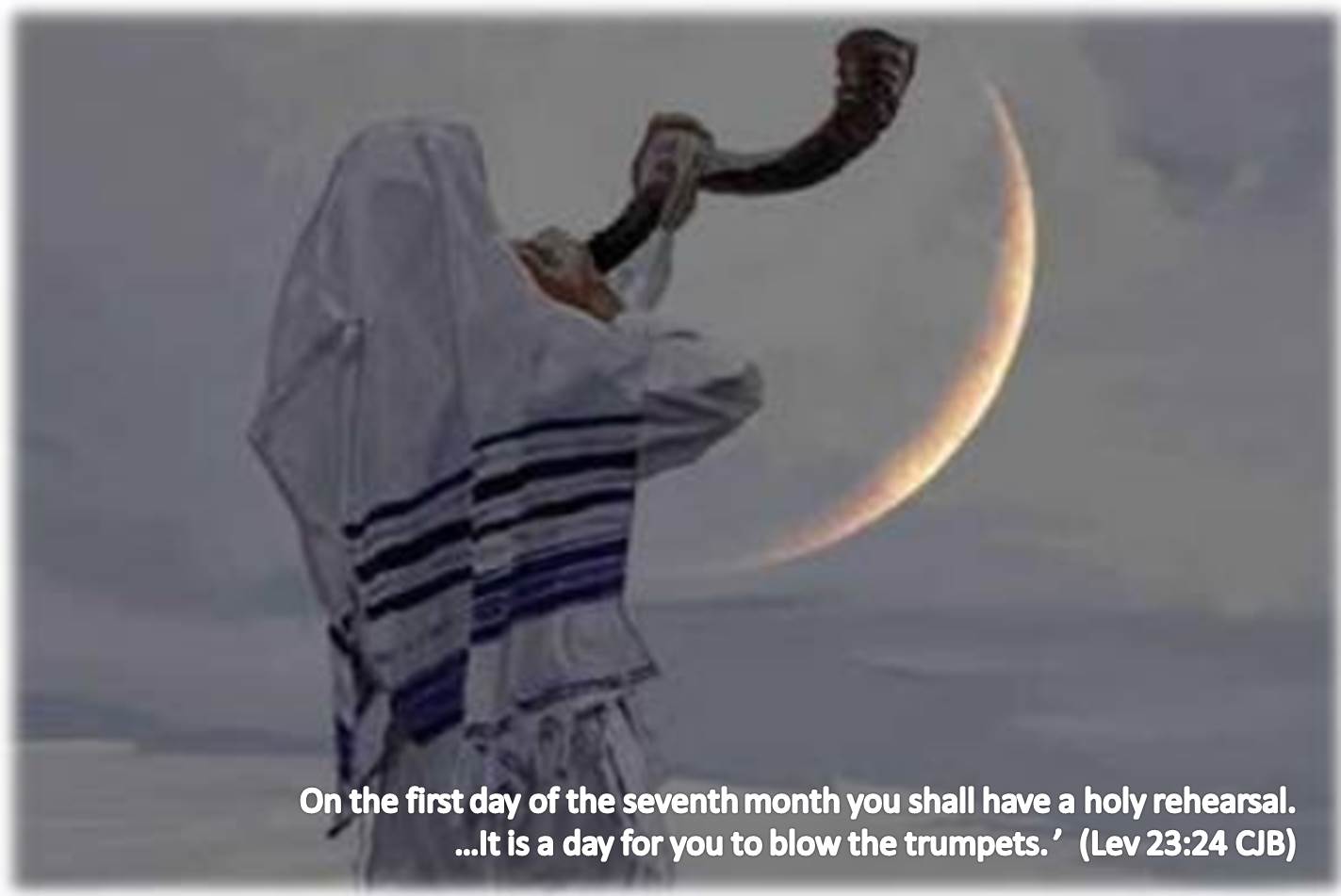
Whenever one of YHVH’s divine appointments arrives, we are supposed to look back and remember something that God has done for us in the past, but we are also supposed to look forward to what He will do in the future.  In His Mo’edim, God has essentially given us a “roadmap” of the most important events in human history.  Leviticus 23:24 describes Yom Teruah in this way: “In the seventh month, on the first day of the month, you shall have a sabbath-rest, a memorial of blowing of trumpets, a holy convocation (rehearsal)”.  Where it says “memorial” in this verse, another name is being used for the Feast of Trumpets – it is also called Zihk’ron Teruah which means a call for remembering through the loud blowing of trumpets.  So what are we remembering from the past and what are we rehearsing for the future?

By Jewish tradition and ancient calendars, it is believed that Yom Teruah commemorates the first day of Elohim’s Creation of the universe.  This fits with God’s biblical calendar.  When the Israelites were delivered out of Egypt, YHVH then said to them: This month shall be the beginning of months for you; it is to be the first month of the year to you” (Exodus 12:2).  This was of course the first day (new moon) of the Passover month (Aviv), which had been their seventh month but was now their first month by God’s instruction.  Thus we know that the seventh month (Ethanim) had been the first month on God’s calendar, which is the calendar He created for us at the time He created the world.  We can give thanks to Yehovah Elohim on Yom Teruah for creating the universe and us as His children.

As far as rehearsing the future on Yom Teruah, we need to look to the verses where the shofar blast is described as a warning or announcement of a future event.  There are a number of Scriptures where we see the shofar being blown as a call to repent and turn back (teshuvah) to YHVH, warning us of the God’s great judgment at the end times, in the “Day of the LORD”. (Joel 2:1, Zech 9:14, Rev 11:15)  In Matthew 24, Yeshua tells us of the great shofar blast when He comes in judgment and to gather His remnant together from the whole Earth: “And He will send out his angels with the mighty blast of a trumpet, and they will gather His chosen ones from all over the world—from the farthest ends of the earth and heaven”.

Abba, as we are celebrating your appointed time to be with You on Yom Teruah, help us to remember all that You have done for us in the past, including the great sacrifice of Your Son for our salvation and deliverance.  Help us to also look ahead at what You are going to do in the future, and make sure we are prepared like the wise virgins who had an abundance of oil for their lamps.  We want to be a part of Your remnant, pleasing to you and prepared in our hearts and spirits to receive Your blessing when You return to this Earth to reign and rule.

Behind the Scenes

praise-to-yhvh-my-rockIn our book, What’s Missing, we discussed how the story of the Israelites in Exodus is symbolic of the redemption that Yeshua, the true Passover Lamb, brings to all of us.  The story of YHVH actively intervening on behalf of the Israelites to set them free from slavery to the Egyptians and leading them out of Egypt in a miraculous way is an account of real events.  However, these events are a type or shadow of an even greater story of YHVH working on behalf of all humanity to free us from our spiritual enemies.   A phrase or even a single word in Exodus paints a graphic picture of the ongoing battle between YHVH and His adversary.  We must keep in mind that behind the scenes of our daily dramas, YHVH is carrying out His plan to establish His kingdom on earth while His adversary is trying to do the same.  It is the greatest drama of all.

After the tenth and final plague, we find that the Israelites left Rameses, which means “born of Ra”.    Who is Ra?  Ra was the primary name for the sun god in Egypt.  We get a clear picture that those who partake of the Passover Lamb are leaving the kingdom of darkness (ruled by the sun god) and going to Succoth (ruled by the one true God, YHVH).  Succoth is derived from the Hebrew word sakah and carries several different meanings.  Let us examine these meanings to see how our “behind the scenes” picture develops.

One of the meanings of sakah is “covering” as used in 1 Kings 8:7.  Just as the cherubim provided a covering for the ark of the covenant,  YHVH provides a covering for His sheep.  In Ezekiel 28:13, we see the description of YHVH’s archenemy before his rebellion.  He was covered (derived from sakah) in precious gems just as we are covered with Yeshua’s robes of righteousness.  In 2 Kings 16:18, the word is used for the Shabbat canopy.  YHVH stands beside us and is our protective covering (Ps. 121:5 NLT).  Isaiah 1:8 uses the word sukka as a watchman’s hut.  In 2 Samuel 11:11 the same word is used to denote a protective booth for soldiers.  Leviticus 23:41-42 and Deuteronomy 16:13 require all Israelites to construct temporary shelters (sukkot) for themselves for a week each year to commemorate YHVH dwelling among them.

All those who have left the kingdom of darkness for YHVH’s kingdom of light are protected by YHVH Himself.  However, all of us are also called to be soldiers in YHVH’s campaign to establish His kingdom on earth as it is in heaven.   YHVH is fully capable of eradicating His enemies and establishing His kingdom by Himself.  However, He purposely gave dominion of the earth to humans and expects each of  us to participate in the great spiritual battle for the earth.  We are not left to fight the battle alone for YHVH Himself is our leader and protector.  It is imperative for us to get off the spiritual milk and onto meat (1 Cor 3:2) as soon as we are able so that we can fully participate in the role that YHVH has assigned for each of us.

The word selected in Exodus 12:41, 51 (tsaba) refers to the Israelites and those who joined them in the flight from Egypt as armies or hosts.  In most other places the people are referred to as Israelites or the children of Israel (b’nei yisrael). In Exodus, 13:17-18, the picture becomes crystal clear.  YHVH takes the Israelites on a detour because they are not yet ready to do battle with their Egyptian enemies.  However, YHVH still has them leave Egypt “like an army ready for battle”.  A short time later they would have the opportunity to do battle for the land promised to them.  They were still not ready and thus the nation of Israel spent 40 years wandering in the desert.  The battle must and will be fought at some point.

The children of Israel would have to fight their enemies in order to take over the land that YHVH promised them.  The children of YHVH will have to fight our enemies to reclaim the earth for YHVH.  In both cases it is YHVH who will go ahead of us and be our covering.  What role are you called to play in this great drama?

Joy through Obedience

well-watered-gardenIn a previous blog, I talked about God wanting to bless us with happiness, as He says in Psalm 37:4 “Delight yourself in YHVH, and He will give you the desires of your heart”.  What brings us the greatest joy on this Earth, though?  We know it is not “seeking after our own pleasure on His holy day” that YHVH speaks against in Psalm 58.  YHVH is speaking about His Shabbat, and He goes on to say in a positive way: “if you call the Sabbath a delight, the holy day of the Lord honorable, and shall honor Him, not doing your own ways, nor finding your own pleasure, nor speaking your own words, then you shall delight yourself in the Lord; and I will cause you to ride on the high hills of the earth, and feed you with the heritage of Jacob your father. The mouth of the Lord has spoken”.

This is one of my favorite passages from all of Scripture, and one of the most amazing promises YHVH makes, to bless us to the highest degree possible!  Can we be truly blessed by YHVH if we are not following His instructions in the Torah?  Consider the example of the remnant of Israel who returned from Babylon: they were back in Israel for almost 100 years before they re-discovered the Torah scrolls and the people asked for them to be read.

In Nehemiah 8, when the people came together as one in the city center, they appealed to Ezra the scribe to read the Torah Scriptures to them.  When they heard the words of the Torah, they were convicted of their sins and they bowed their faces to the ground and began to mourn and weep.  It is obvious from their reactions that they did not just come to listen to the scrolls for entertainment or casual curiosity, but rather they wanted to know the truth of the Torah commands they had broken before the captivity.  They came to hear, listen and then obey what they heard.  This is the meaning of Sh’ma in connection with the greatest of the Torah commandments: “Hear oh Israel, the LORD our God, the LORD is One” Deut 6:4.  We are to hear YHVH’s word, take it deep down into our hearts, and then act on it by obeying what He says.

Going back to the promise from Isaiah 58, YHVH says that if we obey and honor Him, He will cause us to ride on the high hills of the earth.  When YHVH first brought His children out of Egypt, He also said He would make them ride in the heights of the Earth (Deut 32:13).  We know from the other passages that He meant He would give them prosperity, fruitfulness, and blessings in the land.

In Habakkuk 3:18-19, the prophet says: “Yet I will rejoice in the LORD, I will joy in the God of my salvation. The LORD God is my strength; He will make my feet like deer’s feet, and He will make me walk on His high hills”.  God describes Himself as one “Who treads the high places of the earth” (Amos 4:13).   YHVH created us in His image, and He wants us to keep growing closer to Him so that we can walk on His high hills and experience those same high places where He roams in both His earthly and heavenly realms.

YHVH’s thoughts and ways are higher than ours, but He has given us the ability to draw closer to Him through keeping His Torah and His appointed times (Sabbaths and feasts), coming into His presence more and more so that we can enjoy intimate fellowship with Him.  When we walk in our own paths and fail to follow YHVH’s guidance, we are like dry plants in a desert.  I would much rather be a “follower of the way”, keeping YHVH’s commands and enjoying His blessings to be “like a well-watered garden, like a spring whose waters never fail” (Isa 58:11).  Give it a try – walk with YHVH and follow his instructions and the blessings of joy will flow through your life like a never-ending spring.

What’s Wrong?

whats-wrong

After reading Exodus 10:1-20 recently, a few insights came to mind, especially in light of events going on around me.  It may seem that I am repeating myself in this article.  However, the message is so vital that it bears repetition.  Hopefully, those of us who need to hear, will take heed.

First of all, let us review Exodus 10:1-20.  Moses and Aaron are once again confronting Pharaoh to release the Israelites so that they may go and worship YHVH.  The first message from YHVH to Pharaoh is “How long will you refuse to submit to me?”  His second message to Pharaoh is a command, “Let my people go so that they can worship me.”  YHVH’s third statement to Pharaoh is a warning, “If you refuse to let my people go, tomorrow I will bring locusts into your territory.”  Even Pharaoh’s servants try to persuade him to comply.  Then Pharaoh makes his compliance conditional; only the men may go and worship.  Pharaoh refuses to obey and YHVH sends the promised locusts.  Vegetation in the land was destroyed, so Pharaoh summoned Moshe and Aaron, admitted that he had sinned against YHVH and asked Moses and Aaron to intercede for him.  He makes an interesting statement that shows the condition of his heart: “Please forgive my sin just this once and intercede with YHVH your God so that he may take this plague away from me.”  Pharaoh was willing, under the circumstances, to admit to one sin, but what about any other sins in his life?  As soon as the plague was removed any “remorse” expressed by Pharaoh vanished.

Within my own little sphere of family, friends and acquaintances there have been numerous adversities in the past few weeks including:  illness, natural disasters, broken or dysfunctional relationships, drug abuse and death from drug overdose, and employment issues.  Perhaps some of you are experiencing challenges of your own. When adversity strikes, we may be tempted to ask what YHVH is doing about these problems.  Why is He allowing these things to happen?  Is YHVH to blame?  Are we asking the right questions?

Let us examine the points made in Exodus 10 and see if or how they may apply to our own situation:

  • YHVH asks Pharaoh how long he will refuse to submit to YHVH? Have you accepted Yeshua as your Lord and Savior?  Is Yeshua king over the particular area in question or are you?
  • Are you obeying YHVH’s commands? At first glance, we are often tempted to say “of course”, but careful examination sometimes reveals otherwise.
  • Do we “conditionally” obey YHVH, rationalizing or amending His commands?
  • Is your current dilemma a result of your own stubbornness or disobedience? In other words, is there any way that you could have brought this on yourself?
  • Are you sorry that you are suffering the consequences of your choices or are you sorry for making poor choices?
  • When a problem arises, how do we react? Do we cast blame, have a pity party, or ask YHVH for help and guidance?
  • Is there some area in your life where you are sorry long enough to perhaps persuade YHVH to help you, but not sorry enough to change your ways?

It is often distressing for us to ask ourselves these questions honestly.  It seems much more comfortable to blame someone or something else for our troubles.  I have been guilty of such reactions.  However, once we get to the point of admitting that the problem just might be due to our own faulty choices or attitudes, then we can begin to make corrections.  YHVH will accept our repentance and help us to change.

Sometimes we are faced with problems that are not our fault, but our reaction can either help or hinder the situation.  Within the last two weeks, I found myself in a crisis situation, my panic rising by the second.  While wavering between feeling sorry for myself and wanting to cast blame, the Holy Spirit gently reminded me to ask YHVH for help.  I asked YHVH for help and the situation was soon resolved.  Seeking YHVH should always be our first choice.  We must cooperate with the Holy Spirit until it becomes our first reaction when we feel threatened or overwhelmed.

Oh the Depth of God !

God's love has no limitWhy do we want to limit God?  I have often heard it said that we should not limit God, but what does that really mean?  Recall the time in the wilderness when God was grieved because His people forgot how He had done many signs and wonders to protect and deliver them from Pharaoh and his army.  In Psalm 78, David tells us how the Israelites provoked YHVH by their sin and disobedience, but how YHVH loved them so much, that whether they turned back to Him or not, He would be divinely forgiving and gracious to them.

What grieved YHVH the most was not so much their sin or disobedience as their lack of trust in Him.  They had forgotten all that He had done for them.  He always had their best interest in mind.  YHVH was saddened that His people limited Him: “Again and again they turned back and tested God, and imposed limits on the Holy One of Israel” Psalm 78:41.  What they had forgotten was that no matter how far they strayed from Him and how many times they grieved Him by their sins, He was always merciful to them and forgave and blessed them.

When I think about YHVH as a limitless God who has no beginning and no end (Rev 1:8; 4:8) and who never changes (Mal 3:6, I Sam 15:29), I think about the times in my life that I have meditated on these attributes of God.  When I was a young child, I would lay on my back watching the clouds float by, thinking about how huge the universe was.  Even at a young age, people had told me that God was infinite, that He existed before anything in the Earth or heavens was made, and that He had no beginning.  I could not wrap my mind around the concept that God had no beginning and that He had always existed, before anything in the universe was created.

Knowing about God and His divine attributes intellectually is one thing, but it’s not the same as knowing God personally.  Even now as an adult, I cannot fully understand our God (Yehovah) who has always existed and always will.  But I do not believe YHVH intends for us to understand everything about Him, since He tells us in Isaiah 55:9 – “..just as the heavens are higher than the earth, so My ways are higher than your ways and My thoughts higher than your thoughts”.

At this point, you may be thinking that God is so far beyond us that understanding Him is impossible, and relating to Him in any meaningful way is an insurmountable goal.  We know through Scripture, though, that YHVH has given us the opportunity to have a personal relationship with Him, and that as we draw closer to Him, He will reveal things to us that can help us understand Him better and expand our limited thinking and expectations.  In James 4:8, right after he says to submit to God and resist the devil, he tells that if we draw near to God, then He will draw near to us.

Although we are limited and He is limitless, if we draw near to Him, YHVH will reveal great things to us: “But as it is written:Eye has not seen, nor ear heard, nor have entered into the heart of people the things which God has prepared for those who love Him.’ But God has revealed them to us through His Spirit“ (I Cor 2:9-10).  Notice in this passage that it is God’s Holy Spirit who reveals His secrets to those who love Him.  This tells me that we cannot understand the deep things of God in the flesh / physical realm, but only in the Spiritual realm.  As we age in spiritual maturity in YHVH’s kingdom, we learn to draw closer and closer to God by spending time with Him and listening to the voice of His Spirit.

At the same time we understand our limitations and God’s limitlessness, we know that YHVH desires us to seek knowledge and wisdom from Him.  In Jeremiah 29:13, He tells us: “And you will seek Me and find Me, when you search for Me with all your heart”.  This is the essence of our walk with YHVH – when we seek Him with our whole heart, we will find Him, and He will reveal His incredible secrets to us as He desires.  Seek this type of relationship with your Creator and Lord and He will give you an abundant life that is so full of wonder and miracles you will not be able to contain them within yourself.

Releasing Love

God's Love

Many of us have accepted Yeshua as our Lord and Redeemer, yet we are unable to trust what He has accomplished for us.  Yeshua bore our punishment for all time so that we could maintain a relationship with YHVH and be a part of His family and His kingdom.  We have all heard this message preached, taught, argued and dissected until the words have perhaps become meaningless to us.   Words are not enough; each of us must experience the love of YHVH.

Too often Yeshua’s sheep silently struggle with guilt, regret, and shame that bog us down and block us from enjoying our Father’s overwhelming love.  Instead, we are inundated with misery that YHVH never intended for us to experience.  Do we believe that if we suffer enough, we can somehow make up for our sins?  Truly, there is no way that we can pay for even one sin.  It doesn’t seem right to us that we can repent and walk away free.  Perhaps that is why we find it so difficult to forgive those who have wronged us.  If others have made us suffer, then we feel justified in wanting them to suffer also.  We do not see things from YHVH’s perspective.  We forget how He rejoices over recovering the lost sheep (Luke 15:1-7) or re-uniting with the prodigal son (Luke 15:11-32).  When things go wrong, we think that YHVH is punishing us, even when we have repented and turned away from sin.  It is right to loathe the sin, but we must not loathe ourselves.

Our experiences in this world color our perception.  We assume that YHVH loves the way people love:  half-heartedly, sporadically, conditionally, and so on.  Over the last several months, I have encountered numerous others who are struggling to see themselves as YHVH sees them.  I, too, tend to see myself from a worldly perspective rather than as YHVH sees me.  YHVH loves us extravagantly not because of us, but because of who He is.  What does it mean to us that God is love?   1 Cor 13:4-7 provides some helpful insights.

YHVH does not keep a record of our wrongs and is not easily angered.  He is focused on us, not on Himself.  He believes in us, trusts us and hopes in us.  He is willing to endure all things so that we might be loved into reaching our full potential.  Derek Prince in a work entitled “The Divine Exchange” has provided a beautiful illustration of YHVH’s love through Yeshua’s sacrifice.  Below is a summary of “The Divine Exchange”.

  1. [Yeshua] was punished that we might be forgiven
  2. [Yeshua] was wounded that we might be healed
  3. [Yeshua] was made sin with our sinfulness, that we might be made righteous with His righteousness
  4. [Yeshua] tasted death for us that we might share His life
  5. [Yeshua] was made a curse that we might receive the blessing
  6. [Yeshua] endured our poverty that we might share His abundance
  7. [Yeshua] bore our shame that we might share His glory
  8. [Yeshua] endured my rejection that I might have His acceptance with the Father
  9. He was cut off that we might be joined to [YHVH]
  10. Our Old Man was put to death in Him that the New Man might come to life in us

Sin causes damage and loss.  In John 10:10, Yeshua tells us that the thief comes to steal, kill and destroy.  Yeshua came so that we might have abundant life.  Yeshua came to recover, restore, replace, re-unite and revive.   Let us throw off the temptation to dwell on the past, on what has been lost or destroyed, and focus instead on what Yeshua has done, is doing, and will do.

YHVH’s love releases us from every burden and barrier, so that we are free to release His divine love to others, including ourselves.  When we are truly set free by His love, we will be able to love as YHVH loves.


Does God care about Genes or Jeans (Part 2)?

least of these

In Part 1 of this blog last week, I talked about who are YHVH’s children and those who should keep His Torah, and concluded that it is not Abraham’s biological descendants, but rather those who are His spiritual descendants.  The true children of YHVH’s covenant are those are following His will and trusting Him, keeping His Torah and striving to be pleasing to Him in every part of their lives.  That covered the “genes” part of this 2-part series.  This week I want to focus on what God sees when He looks at us: we know from Scripture that He looks on the inside of us and does not focus on our outer appearance or the level of recognition we merit from the world.  In other words, He doesn’t care whether we wear threadbare jeans vs. classy suits, or how many degrees we have achieved or awards we have won.

What is YHVH truly looking for when He looks deep down inside of our souls?  From Hebrews 4:12, we know that He “discerns the thoughts and intents of our heart”.  But what are His criteria in evaluating our hearts – does He look to see how perfectly we are following His Torah, or how diligently we are working to serve our congregation?  Psalm 58 gives us a beautiful window into YHVH’s heart, and we know that our hearts should line up with His heart as we seek to renew ourselves more into His image every day.

God is conveying a very strong message through Isaiah when He tells Him to shout it out with a shofar blast. (Isa 58:1)  He chastises His people for their false piety – they are trying to impress God by putting on sackcloth and ashes, and afflicting themselves severely when they fast.  The only ones they are impressing are people around them though, not YHVH.  He desires them to fast from their hearts when He says:

“..this is the kind of fasting I want: free those who are wrongly imprisoned; lighten the burden of those who work for you. Let the oppressed go free, and remove the chains that bind people. Share your food with the hungry, and give shelter to the homeless. Give clothes to those who need them, and do not hide from relatives who need your help”. (Isa 58:6-7)

If these concepts sound familiar to New Testament readers, that’s because they are.  Listen to what Yeshua said when He was speaking to the goats on His left and the sheep on His right:

“Then the King will say to those on His right, ‘Come, you who are blessed by My Father, inherit the Kingdom prepared for you from the creation of the world. For I was hungry, and you fed Me. I was thirsty, and you gave Me a drink. I was a stranger, and you invited Me into your home.  I was naked, and you gave Me clothing. I was sick, and you cared for Me. I was in prison, and you visited Me.’  “Then these righteous ones will reply, ‘Lord, when did we ever see You hungry and feed You? Or thirsty and give You something to drink? Or a stranger and show You hospitality? Or naked and give You clothing? When did we ever see You sick or in prison and visit You?’  “And the King will say, ‘I tell you the truth, when you did it to one of the least of these My brothers and sisters,[f] you were doing it to Me!’

“Then the King will turn to those on the left and say, ‘Away with you, you cursed ones, into the eternal fire prepared for the devil and his demons. For I was hungry, and you didn’t feed Me. I was thirsty, and you didn’t give Me a drink. I was a stranger, and you didn’t invite Me into your home. I was naked, and you didn’t give Me clothing. I was sick and in prison, and you didn’t visit Me.’  “Then they will reply, ‘Lord, when did we ever see You hungry or thirsty or a stranger or naked or sick or in prison, and not help You?’  “And He will answer, ‘I tell you the truth, when you refused to help the least of these My brothers and sisters, you were refusing to help Me.’  “And they will go away into eternal punishment, but the righteous will go into eternal life.”

What, then, is truly important to Abba Father when He looks into our souls?  From Yeshua’s words in Matthew 5:7, we know that He desires for us to be pure in heart, not obeying Him out of obligation but because we sincerely want to please Him from the depths of our heart.  And what does He say about those who are pure in heart?  ‘They shall see God’.

This takes us right back to the essence of our relationship with Yehovah – if we want to know Him intimately, we need to align our hearts with His, which means we will automatically do the things that please Him: feed the poor, take care of orphans and widows, shelter the homeless, etc.  In your life, try not to focus on the outward things, but look deep inside your heart.  In the ‘intents and desires of your heart’, after stripping away everything superficial, do you see what YHVH is looking for?

Does God care about Genes or Jeans?

Foreigner keeping TorahIn our recent blog series, Nancy and I made a strong case from the Scriptures that Torah (instruction) has not been done away, but is still just as valid in today’s world as it was in the Temple sacrifice period before Yeshua’s first coming.  In this week’s blog, I would like to focus on to whom YHVH’s Torah applies, and explain why Torah is intended for every person on this Earth, Jew and non-Jew.

In Romans 9, Sha’ul explains to his mostly non-Jewish audience why some of the Israelites are not being saved and brought into God’s Kingdom, while many people who are not Israelites by birth are being redeemed and brought into the body of Messiah by faith.  “Well then, has God failed to fulfill his promise to Israel? No, for not all who are born into the nation of Israel are truly members of God’s people! Being descendants of Abraham doesn’t make them truly Abraham’s children. For the Scriptures say, ‘Isaac is the son through whom your descendants will be counted, though Abraham had other children, too’.  This means that Abraham’s physical descendants are not necessarily children of God. Only the children of the promise are considered to be Abraham’s children”. (Rom 9:6-8)

In the rest of this passage, Sha’ul goes on in Verse 23 to say that God shows mercy to those to whom He desires to show mercy (i.e. He draws them to the truth of Yeshua as the Messiah) and hardens the hearts of others so that they will not listen to the truth.  He then quotes from Hosea, speaking of how the Gentiles (non-Jews from the nations) were “not a people” but now YHVH loves them and calls them His children.  In Verse 24, Sha’ul says that the ones God selects as His children are taken from both the original descendants of Abraham, Isaac and Jacob, as well as those who are “gentiles” (not descended biologically from the fathers of Israel).  He also quotes Isaiah 10:22-23 in saying that only a remnant of Israel will be saved: “Though the people of Israel are as numerous as the sand of the seashore, only a remnant will be saved”.

Since we have established in our previous blogs that the Torah is for all of Abba Father’s children to observe, then the agreement between Old and New Testament Scriptures becomes crystal clear.  Sha’ul quotes Isaiah once again in Romans 10:20 in making his point that the Gentiles will be drawn to YHVH, the true God of Creation, and become part of the “Commonwealth of Israel”: I was found by those who did not seek Me; I was made manifest to those who did not ask for Me” (Isa 65:1).   And again in Romans 10:21 he repeats that many of Israel’s genetic descendants will turn away from YHVH and reject His Messiah: “All day long I have stretched out My hands to a disobedient and contrary people” (Isa 65:2).

The real clincher for me in terms of making the case that YHVH wants to draw all people into His covenant is in Isaiah 56:6-7: “Also the sons of the foreigner who join themselves to the Lord, to serve Him, and to love the name of the Lord, to be His servants—everyone who keeps from defiling the Sabbath, and holds fast My covenant—even them I will bring to My holy mountain, and make them joyful in My house of prayer. Their burnt offerings and their sacrifices will be accepted on My altar; for My house shall be called a house of prayer for all nations”.  YHVH is clearly speaking of the non-Israelite (Gentile) people of the nations whom He will accept as part of His family, no less His children than the native Israelites.  In the preceding verse (Isa 56:5), YHVH also says: ”Even to them I will give in My house and within My walls a place and a name better than that of sons and daughters; I will give them an everlasting name that shall not be cut off“.

In summary, it is clear that YHVH accepts all of His created humans as His children, whether they are genetic descendants of Israel or foreigners from pagan nations, as long as they keep His Sabbaths and are faithful to His covenant.  This is essentially a restatement of the Torah, as these are YHVH’s key instructions to His people: to keep His Sabbaths (which include His feasts) and live by his Kingdom laws.  It all boils down to Yeshua’s words from Matthew 6:33, to seek first the Kingdom of God and His righteousness – this is the essence of His Torah, where He teaches us how to do this – how can we do any less if we truly love Yehovah our Creator, Lord and Redeemer?  In the nest installment of this 2-part series, I will cover the “Jeans” part of the “Genes or Jeans” equation.

Fire Proof

Fire proves person's valueScripture mentions the word “fire” over 600 times.  What is the significance of fire in Scripture?  One of the major themes that runs through Scripture is that fire is used to destroy evil and refine and strengthen the good.  What are we to learn from these passages and how does it apply to us?

We know that fire consumes evil, as we see in Genesis 19 with the destruction of Sodom and Gomorrah. Isaiah 30 beginning at verse 27 presents another example, “Behold, the name of the LORD comes from a remote place; Burning is His anger and dense is His smoke; His lips are filled with indignation And His tongue is like a consuming fire; His breath is like an overflowing torrent, Which reaches to the neck, To shake the nations back and forth in a sieve, And to put in the jaws of the peoples the bridle which leads to ruin.”  Fire consumed the burnt offerings, on which were placed the sins of the people.  “Lay your hand on the animal’s head, and the Lord will accept its death in your place to purify you, making you right with him” (Lev. 1:4).

We also know that fire is also used as a purifier in Scripture, as we see in Psalm 66:10-12, “For You have tried us, O God; You have refined us as silver is refined.”       Isaiah 48:10 states, “Behold, I have refined you, but not as silver; I have tested you in the furnace of affliction. What does this mean for us?  How can we be sure that we will withstand the fire of affliction?

When the Israelites came before YHVH, they were not to come empty handed.  They were to bring some of the best of the products of their labor.  One day soon we will appear before YHVH (Deut 16:16).  We will not be expected to bring garden produce and animals, for these were merely a prototype of the real fruit that we are expected to produce.   YHVH is looking for the fruit of our labors as workers in His spiritual harvest.  How have we contributed to the building of His kingdom?

We see in Acts 2:3, that when the disciples of Yeshua were baptized with the Holy Spirit, that tongues of fire appeared over each person.  The Holy Spirit provides fire for us, to help us discern that which is pleasing to YHVH and that which is not.  We must follow the guidance of the Holy Spirit in choosing and performing our works for the kingdom.  What we deem as useful may appear only as straw in YHVH’s eyes.  In 1 Corinthians 3:13, Paul tells us that any of our works that are deemed useless will be burned up in the fire.  All we will have left to present to YHVH are the works that withstand the purifying fire.  Peter also warns us about the coming fire of judgment.   

However, the Day of the Lord will come “like a thief.” On that Day the heavens will disappear with a roar, the elements will melt and disintegrate, and the earth and everything in it will be burned up.   Since everything is going to be destroyed like this, what kind of people should you be? You should lead holy and Godly lives, as you wait for the Day of God and work to hasten its coming. That Day will bring on the destruction of the heavens by fire, and the elements will melt from the heat” (2 Pet 3:10-12).

Are we choosing each day to follow the guidance of the Holy Spirit?  When we follow the guidance of the Holy Spirit, we are sure to have something of value to present to YHVH.  We will be sure to have works that withstand the purifying fire of YHVH.